Development of the evaluation system for automobile
remanufacturing
GHAZALLI Zakri
1and MURATA Atsuo
2Dept. of Intelligent Mechanical Systems, Division of Industrial Innovation Sciences,
Graduate School of Natural Science and Technology, Okayama University
3 – 1 – 1, Tsushimanaka, Okayama – Shi, 700 – 0085, Japan
1[email protected]
2
[email protected]
Abstract – By 2015, the EU directives required the automobile manufacturers to produce a vehicle that contains reusable and / or recoverable parts at least 95% of total weight. In the developed countries, the legislative issue the take – back policy which requires the manufacturers to consider the end – of – life (EOL) of their products at early design stage. The goal of this paper is to propose a framework of development methodology that focuses on integrated design for remanufacturing evaluation system. This system supports the automobile product design and development at the early design phase. The proposed method is divided into two phases. The first phase aims to identify the suitable EOL process. The second phase aims to verify the most economical EOL process. The proposed method incorporates the Case base Reasoning [CBR] into the remanufacturing techniques. It is expected that the proposed method can provide the EOL with decision support during designing the automobile parts at the early design stage.
I. INTRODUCTION
The number of non – commercial vehicle industries has increased in the last 20 years, reaching about 58 million units in 2000. According to the Organization for Economic Cooperation and Development (OECD), the total number of vehicles in OECD countries is expected to grow by 32% from 1997 to 2020. Automobile production is more or less equally distributed between North and South America, Europe, and Asia [1].
At present, in end – of – life (EOL) vehicles, approximately 75-80% of ferrous and non – ferrous is being recycled. The remaining 20-25% that contain the mixed of materials such as resin, rubber, glass etc is still disposed [1]
According to EU Directive, by 2015, vehicles may be put on the market only if they are re-usable and / or recoverable to a minimum of 95% of total weight [2]. The disposal of cars is considered as a major source of hazardous waste and toxic emissions whereby 25% of a vehicle’s weight is classified as hazardous waste [3]. In Europe, about 12 million tones of car reach its EOL every year, and 25 % of them are disposed to the landfill [4].
Figure 1: Volume of car in - use in China [5]
In China, as illustrated in Figure 1, the volume of in – use vehicles increased dramatically, which reached up to 32 million in the end of 2006 and it is expected to reach to 50 million in 2010. The end – of – life vehicle (ELV) is predicted to exceed more than 3.5 million by the end of 2010 in volume. However, merely 10% of ELV were processed [5].
To reduce the environmental impact of EOL vehicle, European Union, Japan, USA, and Australia pass a bill that requires manufacturers not only to produce the product that has a little impact on the environment but also to take back their products at the end of their life.
In order to respond to that challenge, the manufacturers develop the methodologies that proactively consider the environmental value. Hence, the manufacturer needs to consider the EOL of their product at the early design stage [6]. Therefore, the manufacturers need to change their operation from the open loop to the closed loop as illustrated in Figure 2.
Fourth International Workshop on Computational Intelligence & Applications
Figure 2: The open loop and close loop operation system As illustrated in Figure 2, the current practice of the manufacturers is starting from receiving the materials (raw materials, components etc) before making a product. The material is then thrown into the process in order to form the product. This product is finally delivered to the end users (output). On the other hand, the law requires the manufacturers to take back the EOL products and remanufacture them as products.
The other challenge towards the manufacturers is that while considering the products’ EOL, the EOL products need to be delivered to the market as early as possible before its competitors do. Hence, it is desirable that the OEM manufacturers and remanufacturers should attempt to develop a system that can integrate the remanufacturing methodologies with the artificial intelligence (AI) information tools, and provide and facilitate the decision – making processes to manufacturers at the early phase of product design and development [7]. However, less attention is paid to incorporating any of these tools towards remanufacturing although Hula et al [8] dedicated his work on minimizing the environmental impact via genetic algorithm while, Shih et al [9] applied the AI tools to product recycling.
Case Base Reasoning is one of the AI tools that function as ‘an experience bank’ that enable us to restore, retrieve the previously solved cases, provide the useful information, and justify the evaluation of the new problems [9].
Therefore, it is important to integrate the remanufacturing process with artificial intelligence tools, and support the decision – making process at the early design stage. This paper proposes a framework of develop methodology that focus on integrated design for remanufacturing evaluation system to support the automobile product design at the early design phase.
In this proposal, the CBR is adopted as an AI tool. The CBR would be integrated with the remanufacturing methodology to form an evaluation system. The aim of the CBR is to aid the designer in selecting the EOL path of the product and determining the cost of the remanufacturing process of the core. The CBR stores the previous EOL practiced all over the world. This enables the designer to extract the best EOL practice in remanufacturing system when evaluating the new design product. Therefore, the CBR approach is proposed in this study for selecting the EOL path. This is the first phase of the evaluation system.
In current practice, the assemblability and disassemblability is estimated via assembly and disassembly time and cost. Thus, it requires detail information such as assembly and disassembly motion and time information, parts’ geometry, parts’ features and assembly and disassembly sequence [10, 11]. As a result, it needs detail information and trade-off analysis. This study also proposes a CBR approach at the second phase to provide relatively estimates of disassembly and reassembly time for disassembly and reassembly cost estimation.
As many products successfully remanufactured worldwide, it is expected that this CBR approach is can be used to get a disassembly and reassembly cost estimate for evaluating the EOL products without doing detailed experiment and data acquisition at the design stage.
In this paper, the remanufacturing process is overviewed in Section 2. Section 3 will review other researchers’ works on the EOL. The propose framework will be proposed in Section 4
II. REMANUFACTURING PROCESS
Remanufacturing is defined as a process of returning a used product to at least OEM original performance specification from the customers’ perspective and giving the resultant product a warranty that is at least equal to that of a newly manufactured one [12].It aims to extend the product life by diverting it to a new second life instead of buried / land filled.
The advantage of the remanufacturing process is that, the parts are processed to ‘like – new’ without shredding them into new material. Thus, it has much lower environmental load was compared to recycling [13].The activities of remanufacturing process are performed as illustrated in Figure 3.
Figure 3: The Remanufacturing Process [11]
The product to-be remanufacture is known as core. As illustrated in Figure 3, the disassembly process is a main process. The disassembled cores are then cleaned, reprocessed / refurbished and stored. Finally, the core is reassembled by combine with old and new parts, which creates a unit equal to the OEM via quality control process [14].
III. OTHER RESEARCHERS WORKS
Several studies have focused on EOL strategies selection. Rose, developed a system called ELDA (End – of – Life Design Adviser) to help us determine the EOL strategies’ [15]. The ELDA contains the characteristics that influence the EOL. These characteristics are wear-out life, technology cycle, level of integration, number of parts, reason for redesign and design cycle. A decision tree model is developed to identify a best EOL strategy.
Zhang et al. adopted an analytical hierarchic process (AHP) to find best recycling strategy. The AHP based evaluation considered environmental impact, cost and reclaimed materials as a major criterion for strategy determination [16]. Bras and Hammond proposed remanufacturing indices to define the product remanufacturability [17]. Johnson developed a methodology for incorporating the disassembly into recycle, remanufacturing and reuse process. The analysis method is divided into the economic analysis, disassembly planning, disassembly planning optimization and product disassembly design. The economic analysis evaluates the trade – off between reclamations and individual components. The disassembly planning aims to identify the optimum path for the disassembly of the component. The disassembly planning
optimization aims to optimize the identified optimum path. Finally, the product disassembly design is aim at designing the product disassembly [18]. Ishii et al [19], [20] developed a design strategy so – called ‘clumping’ strategy to aid designers in grouping the cores and determine the path of the core. Shu and Flowers [21] applied the axiomatic design (AD) and design structure matrix (DSM) concepts to develop remanufacturing product and process planning methodology.
IV. OVERVIEW OF PROPOSEDAPPROACH
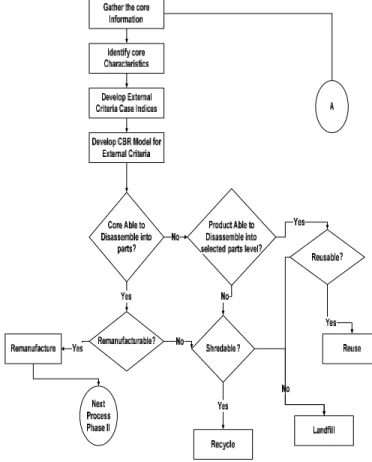
The proposed method consists of two phases. The first phase aims to identify the product EOL paths. The second phase aims to identify the optimum cost for EOL process. Both phases are applying the CBR as an AI tool in the proposed remanufacturing evaluation system. The first phase of the propose framework is illustrated in Figure 4.
Figure 4: Proposal of the develop framework for first phase
The first phase starts with gathering the information of the parts and components, and classification of the automobiles. The next step is to identify the characteristics of the parts and components. The characteristics are based on the ELDA developed by Rose. These components are as follows (Rose 2000):
Wear out life – the length of time from product purchase until the product no longer meets original functions. For instance, a computer has a wear-out life of approximately 7–10 years.
Technology cycle – the length of time that the product will be on the leading edge of technology before new technology makes the original product obsolete. For example, the technology cycle of computers is about 6 months – 1 year.
Level of integration – the interrelation between modules and functions. For example, if there are many unique functions for each module, the level of integration is high.
Number of parts – the number of assemblies in the product that is relevant to EOL treatment.
Reason for redesign – any original design, evolutionary design, functional improvement, aesthetic change, feature change which depend on customer demand, competitor behavior and scientific progress.
Design cycle – the frequency that a design team redesigns the product. For example, an automobile has the design cycle of 2 – 4 years.
From these six characteristics, the external case indices will be developed. Then, the model for selecting the EOL strategies will be developed. The path of parts and components will be determined by the sets of questions before it is entered into the second phase.
The first question is related to the core disassemblability. If it is impossible to disassemble the core, it must be determined weather parts can be disassembled at a certain level of the selected parts or reusable. Then, the dissemble core need to be identified whether it is either remanufacturable, or recyclability (reusable). If the cores are not categorized under these three, the core will be disposed.
For instances, in the first question, the designer should ask him / herself if “the core is able to disassemble into parts level?” if the answer is “Yes”, then, the core should disassemble into parts. However, if the answer is “No”, then, the core should go to the other path. At this path, the designer again should going through the question and answer process. For the answer of “Yes”, again, the designer should ask him / herself if “the part is able to be remanufacturable?”. If the answer is “Yes”, the part is recommended to be remanufactured. On the other hand, if the answer is “No”, then the part should go into the shredability process in order to determine whether the part should be recycle or landfilled. The part that fall into the “Remanufacture” in this phase will enter into the next phase which is second phase.
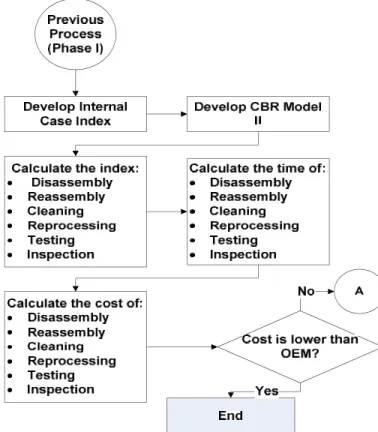
The second phase is illustrated in Figure 5. The second phase aims at determining the cost of each remanufacturing. In the second phase of the proposal, the internal criteria for case indices will be develop. This criterion is base on the criterion developed by Rose [15]. The CBR is a model built for the purpose of estimating and evaluating the total cost of
remanufacturing. The internal case index is developed based on the disassembly, reassembly, cleaning, testing, inspection and refurbishing evaluations.
Figure 5: Proposal of the develop framework for second phase
Then the CBR model will be developed in order to aid the designer in decision – making process for evaluating the total indices, time and cost of remanufacturing process. The indices are based on Bras and Hammond [17]. The total cost of remanufacturing process is given by the following equation:
CRem = Cd + Cr + Ccl+ Ctest+ Cins+ Crf
(1) where,
CRem : Core remanufacturing cost
Cd : Core disassembly cost
Cr : Core reassembly cost
Ccl : Core cleaning cost
Ctest : Core testing cost
Cins : Core Inspection Cost
Crf : Core reprocess cost
The core will be verified by comparing the cost of core remanufacturing with the original product (OEM). If the total cost of remanufacturing the core (CRem), is higher than that of
the OEM, it will be sent back to the previous process (first phase) that corresponds to the CBR model I stage (“No”
route). On the other hand, if the CRemis lower than the OEM
(“Yes”), it will be entered into the manufacturing process (“End”).
V. CONCLUSION
The propose framework aim at integrating the design for remanufacturing techniques with the artificial intelligent tool. The application of the artificial intelligent tool (CBR) helps designer make decision by identifying the suitable EOL path of the automobile cores. This also verifies the selected paths in terms of remanufacturing time and cost by comparing with the (OEM) product.
Six characteristics are used to determine the core criteria in the first phase. Through CBR model, the cores are expected able to be divided into remanufacture, reuse, recycle or recycle process. At the second phase, the CBR model is expected to provide the justifiable cost for selecting the one of these three processes.
REFERENCES
[1] Kanari, N.; Shallari; Pineau, J.-L. "End – of – Life Vehicle Recycling in the European Union". journal
of minerals, metals and materials (The Minerals,
Metals & Materials Society), no. August (2003). [2] 2005/64/EC. The reusing, recycling and recovering
of motor vehicles. August 8, 2006.
http://europa.eu/scadplus/leg/en/lvb/n26102.htm (accessed August 5, 2008).
[3] 2000/53/EC. Management of end – of – life vehicles. APRIL 4, 2008. http://europa.eu/scadplus/leg/en/lvb/l21225.htm (accessed AUGUST 5, 2008).
[4] PricewaterhouseCoopers, LLP. The European Union end – of – life vehicle directive is a sensitive issue for global automotive industry. PricewaterhouseCoopers LLP. 2002.
http://www.pwc.com/.
[5] Chen, Ming. “End – of – Life Vehicle Recycling in China: Now and Future”. Journal of Metallurgy, page 20 – 26, October, 2005
[6] Mathieux, F, G Rebitzger, S Ferrendier, and M. and Froelich, D. Simon. "Ecodesign in the European Electronics Industry – An Analysis of the Current Practices Based on Cases Studies". Journal of
Sustainable Product Design (Kluwer Academic
Publisher) 1, no. 4 (2001): 233 – 45.
[7] Bras, Bert, and Mark W. McIntosh. "Product, process, and organizational design for remanufacture - an overview of research." Robotics and Computer
Integrated Manufacturing 15 (1999): 167-178.
[8] A, Hula, Jalali K, Hamza K, Skerlos SJ, and Saitou K. "Multi-criteria decision – making for optimization of product disassembly under multiple situations."
Environment Science Technology 23, no. 37: 5303–
13.
[9] Shih, Li-Hsing, Yu-Si Chang, and Yung-Teh Lin. "Intelligent evaluation approach for electronic product recycling via case-based reasoning."
Advanced Engineering Informatics (Eelsavier), no.
20 (November 2006): 137-145.
[10] Boothroyd, G. and Atling, L. “Design for assembly and disassembly”. Annual CIRP, 1992;41(2):625– 36.
[11] Ichikawa Y. Practice and case study of DFE. Tokyo: Ohmsha Publishing Co.; 2001.
[12] Ijomah, Winifred L., Christopher A. McMahon, Geoffrey P. Hammond, and Stephen T. Newman. "Development of design for remanufacturing guidelines to support sustainable manufacturing."
Robotics and Computer-Integrated Manufacturing
23 (2007): 712-719.
[13] Seizo, Kato, Sadamichi Yucho, Osugi Tmomya, Maruyama Naoki, A Widyanto, and Nishimura Akira. "Environmental Advantage of Inverse Manufacturing for End – of – Life Vehicles." Nippon
Kikai Gakkai Kankyo Kogaku Sogo Shinpojiumu Koen Ronbunshu (Sciencelinks) 12 (2002): 417-420.
[14] Östlin, Johan. On Remanufacturing Systems
-Analysing and Managing Material Flows and Remanufacturing Processes . Linköping, Linköping:
Production Systems, Department of Management and Engineering,Institute of technology, Linköpings universitet, 2008.
[15] Rose, Catherine Michelle. Design for Environment:
A Method for Formulating Product End – of – Life Stratergies. PhD Dissertation, Department of
Mechanical Engineering, Stanford University, Anm Abror, Michigan: Bell and Howell Information and Learning Company, 2000.
[16] Zhang, HC, Y Yu, K Jin, FF Ling, and A. D. Barnes. "Decision – making model for materials management of end – of – life electronic products." (Journal of Manufacturing System) 19, no. 2 (2000): 94-107.
[17] Bras, B, and R Hammond. "Design for remanufacturing metrics. In:Flapper SD." Edited by AJ de Ron. Proceedings of the first international
workshop on reuse. Eindhoven, The Netherlands,
1996. 5-22.
[18] Johnson, Micheal. A Methodology for Planning of
Product Disassembly For Recycling, Reuseand
Remanufacturing. Master Thesis, Industrial
Engineering, University of Windsor, Ontario: National Library of Canada, 1994.
[19] MarksMD, Eubanks CF, and Ishii K. "Life-cycle clumping of product designs for ownership and retirement." Fifth Int Conf on Design Theory and
Methodology. ASME Design Engineering Technical
[20] P, Di Marco, Eubanks C, and Ishii K. "Compatibility analysis of product design for recyclability and reuse." ASME International Computers in Engineering Conf and Exhibition. Minneapolis:
ASME, 1994.
[21] Shu, L, and W Flowers. "A structured Approach to Design for Remanufacture." Proceeding 1993 ASME
Winter Annual Meeting. New Orleans: ASME
![Figure 1: Volume of car in - use in China [5]](https://thumb-ap.123doks.com/thumbv2/123deta/5822095.1034789/1.918.485.865.349.637/figure-volume-car-use-china.webp)