Fast
Spherical
Harmonic
Transform
Algorithm
based on Generalized
Fast
Multipole
Method
Reiji
Suda
the
University
of Tokyo
/
CREST,
JST
1
Introduction
Spherical harmonic transform is the most important orthogonal function transform only except
Fourier transform, and is used not only for climate simulation and signal processing but also for
a
baseof several numerical algorithms. Fast Fourier Transform (FFT), which
runs
in time$O(N\log N)$is quite well known, but, for spherical harmonic transform, there is no fast algorithm which is
as
simple
as
FFT.We have proposed a fast transformalgorithm for spherical harmonictransform using Fast
Multi-poleMethod (FMM)[17, 25], and its program is publicly available
as
FLTSS[24, 20]. Our algorithmcomputes the transform using polynomial interpolations, and to make it possible,
we
haveintro-duced split Legendrefunctions[25], which nearly double the computationalcosts, and also affect the
numerical stability[21].
Toreducecomputationalcosts,
we
tried fasttransformwithout using split Legendre functiors[22,23] with the help of generalized FMM[29, 28]. This algorithm (we call this
new
algorithm and theformer old algorethm)
runs
faster than the old algorithm with improved numerical stability.This paper discusses some details of the new algorithm and its implementation.
2
Spherical
Harmonic
Transform
2.1
Spherical harmonic transform
A spherical harmonic function $Y_{n}^{m}(\lambda, \mu)$ can be decomposed into
an
associated Legendre functionand a trigonometric function
as
$Y_{n}^{m}(\lambda, \mu)=P_{n}^{m}(\mu)e^{im\lambda}$.
Thusevaluation of
a
spherical harmonic expansion$g( \lambda, \mu)=\sum_{m=0}^{T}\sum_{n=m}^{T}g_{n}^{m}Y_{n}^{m}(\lambda, \mu)$
can also be decomposed into associated Legendre function transform and Fourier transform
as
$g^{m}(\mu)$ $=$ $\sum_{n=m}^{T}g_{n}^{m}P_{n}^{m}(\mu)$, (1)
$g(\lambda, \mu)$ $=$ $\sum_{m=0}^{T}g^{m}(\mu)e^{im\lambda}$. (2)
The inversespherical harmonic transform is
a
computation of$g(\lambda_{j}, \mu k)$ from $g_{n}^{m}$, whilethesphericalharmonic transform is acomputation of$g_{n}^{m}$ from$g(\lambda_{j}, \mu k)$, where $1\leq j\leq J,$ $1\leq k\leq K$, and$J$ and
$K$
are
usually determined by the so-called alias-free conditionFor asymptotic complexity analysis,
we can
simplyassume
that $J=O(T)$ and $K=O(T)$. Theinverse transform consists of the associated Legendre function transform and Fourier transform,
and the Fourier transform (2) can be computed in time $O(T^{2}\log T)$ by using FFT for each $\mu k$.
Conventional method of the associated Legendre function transform is the direct summation of
the form of (1), thus requires time $O(T^{3})$
.
Let us call this method direct $\omega mputation$. By usingdirect computation for associated Legendre function transform, the spherical harmonic transform
requires time$O(T^{3})$. Thus,by accelerating associated Legendre functiontransform,
we
can reduce thecomputational complexity of spherical harmonic transform up to$O(T^{2}\log T)$,which is the complexity
of FFT. It is well known that the forward transform algorithm is easily derived from the inverse
transform algorithm. Sowe focus on the inverse associated Legendre function transform (1) in the
following discussion.
2.2
Related
works
Some related research works
are
reviewed.Driscoll and Healy[6] proposed a fast spherical harmonic transform using FFT. Their
algo-rithm runs in time $O(T^{2}\log^{2}T)$, and is precise (under infinite precision arithmetic operations).
Their algorithm is quitewell known, but unfortunately it is numerically unstable. Several modified
versions[7, 14] wereproposed to remedy the instability, but they increase computational costs. The
research is still continuing[10, 9] but
a
tight complexity bound for the stabilized algorithm is notfound yet.
Mohlenkamp[ll] proposed two stable and fast algorithms for the spherical harmonic transform
using fast wavelet transform. His algorithms
run
in time $O(\tau^{5/2}\log T)$ and $O(T^{2}\log^{2}T)$, but theformer
runs
faster in practicalsizes.Rokhlin and Tygert[15] proposed another fast spherical harmonic transform algorithm by using
FMM. The complexity of their algorithm is $O(T^{2}\log T)$, but their implementation in that paper is
not faster than the direct computations for $T\leq 4096$, so it requires a better implementation.
The following works
are
of the Legendre polynomial transform, which is a part of sphericalharmonictransform(onlyfor$m=0$). Toclarify the difference from the spherical harmonictransform,
we
will use $N$ instead of$T$.Orszag[13] invented
an
algorithmof Legendre polynomial transform thatuses
the WKBapprox-imation and FFT. Orszag’s algorithm
runs
in time $O$($N\log^{2}$N/loglog$N$). We have improved hisalgorithm using the asymptotic expansion by Stieltjes[16], with the resulting computational
com-plexity of$O(N\log N)[12]$
.
Alpert and Rokhlin[l] proposed
a
fast algorithm for Legendre polynomial transform and runs intime$O(N\log N)$
.
They providea
pairoftransforms betweenthe coefficients ofaLegendrepolynomialexpansion and those ofa Chebyshev expansion that represents thesamefunction. Accelerating those
transforms
as
thesame
manner
as
the FMM, theycan
show their complexityas
$O(N)$. Then byusing FFT, one can compute the Legendre polynomial transforms (forward and backward) in time
$O(N\log N)$.
Beylkin, Coifman and Rokhlin showed that the transform between
a
Legendre polynomialex-pansion and the corresponding Chebyshev exex-pansion can be computed in time $O(N)$ by using fast
wavelet transform. Thus their algorithm also
runs
in time $O(N\log N)$.The followings
are
not of spherical harmonic transforms, butour
old algorithmowes
them thekey idea.
Boyd[3] showed that
a
functionrepresented byanassociated Legendrefunctionexpansion canbeinterpolated in linear time with
a
help ofFMM.Jakob-Chien and Alpert[8] proposed
a
fast algorithmfor thespherical filtering, whichremoves
the3
The
new
fast
transform algorithm
3.1
Fast interpolation
of associated Legendre
function
expansions
Legendrefunction can be represented with ultraspherical polynomial $q_{n-m}^{m}(\mu)$ as
$P_{n}^{m}(\mu)=c_{n}^{m}P_{m}^{m}(\mu)q_{n-m}^{m}(\mu)$, (4)
where$c_{n}^{m}$ is
a
constant. $P_{n}^{m}(\mu)/P_{m}^{m}(\mu)$ isa polynomial ofdegree$n-m$and thus$g^{m}(\mu)/P_{m}^{m}(\mu)$ (where $g^{m}(\mu)$ is defined in (1)$)$ is alsoa
polynomial of degree $T-m$. Nowwe
have Lagrange interpolationformula for polynomial
$p( \mu)=\omega(\mu)\sum_{i=1}^{D}\frac{1}{\mu-\mu_{i}}\frac{p(\mu i)}{\omega_{i}(\mu i)}$
with $D=\deg(p)+1$ and
$\omega(\mu)=\prod_{i=1}^{D}(\mu-\mu_{i})$, $\omega_{i}(\mu)=\frac{\omega(\mu)}{\mu-\mu_{i}}$.
Thus letting
$M=T-m+1$
we can evaluate $g^{m}(\mu k)$ on a set of arbitrary points $\{\mu k\}$ from $M$sampling points $\{g^{m}(\mu_{i})\}_{i=1}^{M}$
as
$g^{m}( \mu k)=P_{m}^{m}(\mu k)\omega(\mu k)\sum_{i=1}^{M}\frac{1g^{m}(\mu_{i})}{\mu k-\mu_{i}P_{m}^{m}(\mu_{i})\omega_{i}(\mu_{i})}$. (5)
The computation (5)
can
be computed in three steps.1. Point-wise multiplication $\overline{g}_{i}=g^{m}(\mu_{i})/P_{m}^{m}(\mu_{i})\omega_{i}(\mu_{i})$ for $1\leq i\leq M$.
2. Summation $\overline{g}k=\sum_{i=1}^{At}\overline{g}_{i}/(\mu k-\mu_{t})$ for $1\leq k\leq K$.
3. Point-wise multiplication $g^{m}(\mu k)=\overline{g}kP_{m}^{m}(\mu k)\omega(\mu k)$ for $1\leq k\leq K$.
Ifwe havefixed the sets $\{\mu_{i}\}$ and $\{\mu k\}$ and precompute $P_{m}^{m}(\mu_{i})\omega_{i}(\mu_{i})$ and $P_{m}^{m}(\mu k)\omega(\mu k)$, thensteps
1 and 3 are computed in time $O(M)$ and $O(K)$
.
By applying FMM[5], wecan
compute step 2 intime $O(M+K)$ ,
as
is pointed out by Boyd[3]. Thus the interpolation (5) can be computed in timelinear to theinput size $(i.e., O(M+K))$.
3.2
Base scheme of fast
associated Legendre
function transform
Using the fast interpolation of associated Legendre function expansion discussed in the previous
section, we can accelerate the associated Legendre function transform inthe following way. 1. Compute values on the sampling points $g^{m}( \mu_{i})=\sum_{n=m}^{T}g_{n}^{m}P_{n}^{m}(\mu_{i})$ for $1\leq i\leq M$.
2. Compute values
on
the target points $g^{m}(\mu k)$ for $1\leq k\leq K$ by interpolation from $g^{m}(\mu_{i})$.
The computational complexity ofstep 1 is clearly$O(M^{2})$. By choosing the sampling points $\{\mu i\}_{i=1}^{M}$
from the target points $\{\mu k\}_{k=1}^{K}$ and using fast interpolation, the computational complexity of step
2 is $O(K)$
.
Remembering$M=T-m+1$
and the alias-free condition (3), one cansee
that theasymptotic computational costs of the abovescheme is 4/9 ofthe direct computation.
3.3
The divide-and-conquer scheme
To reduce thecomputationalcostsfurthermore, weapplytheabovescheme to step 1 recursively. Let
us
restate step 1:We divide the summation into two roughlyequal parts.
$g^{m}(\mu_{i})$ $=$ $g_{0}^{m}(\mu_{i})+g_{1}^{m}(\mu_{i})$, (6)
$g_{0}^{m}(\mu i)$ $=$ $\sum_{n=m}^{n_{O}-1}g_{n}^{m}P_{n}^{m}(\mu_{i})$, (7)
$g_{1}^{m}(\mu_{i})$ $=$ $\sum_{n=no}^{T}g_{n}^{m}P_{n}^{m}(\mu_{i})$. (8)
where$n_{0}$ is a nearest integer of$m+(T-m)/2$
.
Now the fast interpolation scheme is applicable. To accelerate computation of (7), we choose
an
appropriate set of $n_{0}-m$ points $\mathcal{M}_{0}=\{\mu_{i_{0}}\}$ from the set of $M$ points $\mathcal{M}=\{\mu_{i}\}$, computevalues $g_{0}^{m}(\mu_{i_{(}})$ for $\mu_{i_{()}}\in \mathcal{M}_{0}$. and interpolate those values onto the other points $\mu i\in \mathcal{M}_{0}-\mathcal{M}$.
This is accomplished exactly
as
stated in the previous section. The computational complexity is$O((n_{0}-m)^{2}+M)$.
We want to do the
same
thing for (8). Let us choose $T-n_{0}+1$ points $\mathcal{M}_{1}=\{\mu_{i_{1}}\}$ from $\mathcal{M}$.(Note that $\mathcal{M}_{0}$ and $\mathcal{M}_{1}$
can
be different sets of points.) Because the degreeoffreedom of$g_{1}^{m}(\mu)$ is$T-n_{0}+1$, the values$g_{1}^{m}(\mu_{i})$
on
the remainingpoints $\mu_{i}\in \mathcal{M}-\mathcal{M}_{1}$can
be determined from thoseon
$\mathcal{M}_{1}$.
However, $g_{1}^{m}(\mu)/P_{m}^{m}(\mu)$ isa
polynomial of degree$M=T-m+1$
, not $T-n_{0}+1$.For
thisreason,
we
cannotuse
the polynomial-based interpolation (5).Inthe old algorithm[17, 25],
we
solved this problem by introducing split Legendre functions:$P_{n}^{m}(\mu)$ $=$ $P_{n,\nu}^{m,0}(\mu)+P_{n,\nu}^{m,1}(\mu)$,
$P_{n,\nu}^{m,l}(\mu)$ $=$ $q_{n,\nu}^{m,l}(\mu)P_{\nu+l}^{m}(\mu)$ $l=0,1$
.
By splitting the expansion $g_{1}^{m}(\mu)$ accordingly
$g_{1}^{m}(\mu)$ $=$ $g_{1,\nu}^{m,0}(\mu)+g_{1,\nu}^{m,1}(\mu)$
$g_{1,\nu}^{m,l}(\mu)$ $=$ $\sum_{n=n_{0}}^{T}g_{n}^{m}P_{n,\nu}^{m,l}(\mu)$ $l=0,1$ ,
$g_{1,\nu}^{m,l}(\mu)/P_{\nu+l}^{m}(\mu)$ becomes
a
polynomial ofdegree $|T-\nu+l-1|$ , and thus interpolation scheme (5)becomes applicable. This method requirestwointerpolations for $l=0$and 1, thus the computational
costs are doubled. Also wehave additional computational costs to change the split point $\nu$, and the
numerical stability is affected$[$21$]$.
In the new algorithm[22],
we use
generalized FMM[29, 28]. Let $P_{1}$ bean $M\cross(T-n_{0}+1)$ matrixwhose $(i,j)$ element is $P_{n_{0}+g}^{m}(\mu_{i})$, and$g_{1}$ be a column vector $(g_{n_{t1}}^{m}, g_{n_{|)}+1}^{m}, \cdots, g_{T}^{m})^{T}$. By letting $v_{1}$ as
a column vector with$g_{1}^{m}(\mu_{i})$
as
its elements, we have matrix-vector representation for (8)as
$v_{1}=P_{1}g_{1}$.
Let
us
consider the set of sampling points $\mathcal{M}_{1}$ which has $T-n_{0}+1$ points. Collect the set of rowsfrom $P_{1}$ and$v_{1}$ that correspond to $\mathcal{M}_{1}$ and represent them as $\overline{P}_{1}$ and $\overline{v}_{1}$
.
Then we have$\overline{v}_{1}=\overline{P}_{1}g_{1}$
.
Also collect the remaining
rows
and represent themas
$\hat{P}_{1}$ and$\hat{v}_{1}$, then
we
have$\hat{v}_{1}=\hat{P}_{1}g1$
.
Since each element of$v_{1}$ is either in $\overline{v}_{1}$
or
in $\hat{v}_{1}$,we can
obtain$v_{1}$ by aggregating $\overline{v}_{1}$ and$\hat{v}_{1}$ by usingan
appropriate permutation matrix $\Pi_{1}$as
Note that $\overline{P}_{1}$ is a square matrix, and
assume
that it is non-singular. Thenwe
have$v_{1}$ $=$ $\Pi_{1}(\begin{array}{l}IQ_{1}\end{array})\overline{P}_{1}g_{1}$, (9)
$Q_{1}$ $=$ $\hat{P}_{1}\overline{P}_{1}^{-1}$
.
The matrix $Q_{1}$ represents the interpolations of the elements of $\hat{v}_{1}$ from $\overline{v}_{1}$
.
We apply generalizedFMM (details described in [28]) to $Q_{1}$. Then the computation $Q_{1}\overline{v}_{1}$ is accelerated.
For the problems to which the analytical FMM is applicable, generalized FMM works
no
worse
than the analytical FMM. Thus if $Q_{1}$ represents a polynomial interpolation, then the complexity
of computing $\hat{v}_{1}=Q_{1}\overline{v}_{1}$ is linear to the
sum
(instead of the product) of the numbers of the rowsand the columns of$Q_{1}$. But $Q_{1}$ is surely not
a
polynomial interpolation. So we lose the complexitybound. However, we can avoid the split Legendre functions that doubled the computational costs in
the old algorithm. Thus we may have somegain. Let us evaluate it experimentallyin section 4.
Before closingthissubsection, weevaluate the computational complexity on the assumption that
generalized$FMM$runs in linear time. We will discuss about the preprocessing phase somewhatlater,
and here let
us
consider only transform computations assuming that appropriate preprocessing hasbeen done. Let
us
compute the computational costs ina
backwardmanner.
The last step of thecomputation is the polynomial interpolation (5).
As
isstated in the previous section, its complexityis $O(K)$. The second last step isthe summation (6). Thecomplexityisclearly$O(M)$. The thirdlast
step is the interpolation $\hat{v}_{1}=Q_{1}\overline{v}_{1}$ and the corresponding interpolation of the other half. From the
assumption,their computational costs
are
summed upas
$O(M)$.
The step beforethat is summationssimilar to (6). They
are
two summations of halfsizes, thus their costsare
summed upas
$O(M)$.Then
we
have four interpolations of halfsizes, which also amounts $O(M)$.
After $O(\log M)$ steps ofrecursion,
we
have$O(M)$ problems ofa constantsize. Summingupthem,we
have the computationalcomplexity$O(K+M\log M)$. This complexity isfor each$m$. Notethat$M=T-m+1$ and $K=O(T)$.
Summing up for all $m$, the computational complexity is $O(T^{2}\log T)$.
3.4
Error control and sampling point selection
As stated in the previous subsection, the interpolation matrix $Q_{1}$ in (9) is accelerated by using
generalized FMM. Because the FMM is an approximatealgorithm, wehave toconsider theerrors at
the output ($v_{1}$ in (9)) incurred by the approximation. The following methodology of
error
analysisand control is introduced in [26, 27] and used also for generalized FMM[28].
Before discussion, note that (9) does not reach the end of the computation. The resulting $v_{1}$
are
interpolated into the remaining points by the interpolation (5). Let
us
represent the interpolation(5) by a matrix$Q$
) and consider thecomputation
$w_{1}=Q\Pi_{1}(\begin{array}{l}IQ_{1}\end{array})\overline{P}_{1}g_{1}$.
Let $\tilde{Q}_{1}$ bethe matrix representation of the approximate interpolation accelerated by generalized
FMM. Then the actual computation is
$\overline{w}_{1}=Q\Pi_{1}(\begin{array}{l}I\tilde{Q}_{l}\end{array})\overline{P}_{1}g1\cdot$
Thusthe
error
is$\tilde{w}_{1}-w_{1}=Q\Pi_{1}(\begin{array}{l}0\tilde{Q}_{1}-Q_{1}\end{array})\overline{P}_{1}g_{1}$
.
Let
us
ignore $0$ above $\tilde{Q}_{1}-Q_{1}$, andwe
want to control$e_{1}=Q\hat{\Pi}_{1}(\tilde{Q}_{1}-Q_{1})\overline{P}_{1}g_{1}$,
where $\hat{\Pi}_{1}$
Let $\Vert\cdot\Vert$ representsome normboth for vectors and matrices that satisfies the consistency inequality:
$\Vert AB\Vert\leq\Vert A\Vert\Vert B\Vert$, $\Vert Av\Vert\leq\Vert A\Vert\Vert v\Vert$ (10)
for any matrices $A$ and $B$ and any vector $v$ (but of
course
the number of columns of $A$ and thenumberof
rows
of$B$ and $v$ should be the same).Then we have
$\Vert e_{1}\Vert\leq\Vert Q\hat{\Pi}_{1}\Vert\Vert\tilde{Q}_{1}-Q_{1}\Vert\Vert\overline{P}_{1}\Vert\Vert g_{1}\Vert$
.
(11)
Note that if
we use
double precision, then wecannot expect approximation of higher precisionthanthe round-off
error
$\epsilon\approx 10^{-16}$:$\frac{\Vert\tilde{Q}_{1}-Q_{1}\Vert}{||Q_{1}\Vert}\geq\epsilon$.
Thus the right-handside of (11) has
a
lower bound$|IQ\hat{\Pi}_{1}I1\Vert\tilde{Q}_{1}-Q_{1}\Vert\Vert\overline{P}_{1}\Vert\geq\Vert Q\hat{\Pi}_{1}\Vert\Vert Q_{1}\Vert\Vert\overline{P}_{1}\Vert\epsilon$,
and so $\kappa=||Q\hat{\Pi}_{1}\Vert\Vert Q_{1}\Vert\Vert\overline{P}_{1}\Vert$ works as a kind ofcondition number.
However, in many
cases
the above condition number $\kappa$ can be very largeeven
when the outputerror
$\Vert e_{1}\Vert$or
$\Vert\tilde{v}_{1}-v_{1}\Vert$ is quite reasonable. This happens when the consistency inequality (10) isvery loose. Then the evaluation (11) does not give
a
good estimate.A simple solution is proposed in [26, 27]. Let
us
introduce diagonal matrices $S_{A}$ and $S_{B}$ andinsert them
as:
$e_{1}=(Q\hat{\Pi}_{1}S_{A}^{-1})(S_{A}(\tilde{Q}_{1}-Q_{1})S_{B})(S_{B}^{-1}\overline{P}_{1})g1$
so that we have
$\Vert e_{1}.\Vert\leq\Vert Q\hat{\Pi}_{1}S_{A}^{-1}\Vert\Vert S_{A}(\tilde{Q}_{1}-Q_{1})S_{B}\Vert\Vert S_{B}^{-1}\overline{P}_{1}\Vert\Vert g_{1}\Vert$ .
By letting $Z_{1}=S_{A}Q_{1}S_{B}$ and $\tilde{Z}_{1}=S_{A}\tilde{Q}_{1}S_{B}$we have
$\Vert e_{1}\Vert\leq\Vert Q\hat{\Pi}_{1}S_{A}^{-1}\Vert\Vert\overline{Z}_{1}-Z_{1}\Vert\Vert S_{B}^{-1}\overline{P}_{1}\Vert\Vert g1\Vert$.
Now the “condition number” becomes
$\kappa_{S}=\Vert Q\hat{\Pi}_{1}S_{A}^{-1}\Vert\Vert Z_{1}\Vert\Vert S_{B}^{-1}\overline{P}_{1}\Vert$,
which can be controlled by appropriately choosing $S_{A}$ and $S_{B}$
.
Our previous works[26, 27, 28]proposed to choose $S_{A}$ and $S_{B}$
so
that the columns of $Q\hat{\Pi}_{1}S_{A}^{-1}$ and therows
of $S_{B}^{-1}\overline{P}_{1}$ have theunit
norm.
This method isquite wellknownas
a
simple device to improvethe condition numbersof matrices$Q\Pi_{1}$ and $\overline{P}_{1}$.
The effects of$S_{A}$ and $S_{B}$ dependon
the matrices, andwe
haveno
theoretical
guarantee oftheir goodness. Weonly know it worksvery well in the experiments.
Now ifwe want to limit the “relativeerror“
$\frac{||e_{1}||}{||g_{1}||}\leq\delta$,
then it is enough to approximate $Z_{1}=S_{A}Q_{1}S_{B}$
as
$\frac{\Vert\tilde{Z}_{1}-Z_{1}\Vert}{\Vert Z_{1}\Vert}\leq\frac{\delta}{\kappa_{S}}$
.
Practically it is$observed\sim$that this requirement is still too pessimistic. So in
our
implementation therequired precision for $Z_{1}$ is mitigated
as
follows.Before discussing it, note that
we can
boundsome norms
by using the proposed $S_{A}$ and $S_{B}$.
Let
us use
2-norm which is bounded by the Frobeniusnorm as
$\Vert A\Vert_{2}\leq\Vert A\Vert_{F}$.
Rememberthat theFrobenius
norm
ofa
matrix is the positive squareroot of the sum ofthe 2-normsof therows
or thecolumns of the matrix. Reviewing the previous subsection, we
can
count the number of rows andcolumns ofthe matrices. We have
Thus$\kappa_{S}\leq\sqrt{(n_{0}-m)(T-n_{0}+1)}\Vert Z_{1}\Vert$.
In our implementation $\kappa_{S}$ is replaced by $\kappa_{0}\Vert Z_{1}\Vert$ with a constant $\kappa_{0}$. We start computation (of
preprocessing) with $\kappa_{0}=1$, and if the resulting
error
is too large, thenwe
reduce $\kappa_{0}$ accordingly.After a few itcrations, theresulting error meets the requirement $\delta$. Ifthe required precision $\delta$ is too
small,then $\delta/(\kappa_{0}\Vert Z_{1}\Vert)$ may be smaller thanthe round-off
error
level. Thenour
program terminateswith
a message
that the precision $\delta$ cannot be achieved.Note that the attainable precision $\delta$ is determined mostly by $\Vert Z_{1}\Vert=\Vert S_{A}Q_{1}S_{B}\Vert$. Smaller $\Vert Z_{1}\Vert$
is preferable. Remember that $Z_{1}=S_{A}Q_{1}S_{B}$ and $Q_{1}=\hat{P}_{1}\overline{P}_{1}^{-1}.\overline{P}_{1}$ and $\hat{P}_{1}$
comes
ffomone
common
matrix $P_{1}$, and $\overline{P}_{1}$ corresponds to the sampling points of the interpolation and $\hat{P}_{1}$ corresponds to
the other points. Thus
we
know that $\Vert Z_{1}\Vert$ dependson
the selection ofthe sampling points. Sincethe number of choices of the set of the sampling points is finite, we
can
minimize $\Vert Z_{1}\Vert$ by trying allpossibilities, but it is computationally impractical. So
we
do not minimize $\Vert Z_{1}$li
directly. What wedo is just
an
LQ (transposed QR) decomposition with pivoting for $S_{A}P_{1}$:$S_{A}P_{1}=(\begin{array}{l}\overline{L}_{1}\hat{L}_{1}\end{array})U_{1}=(\begin{array}{l}I\hat{L}_{1}\overline{L}_{1}^{-1}\end{array})\overline{L}_{1}U_{1}$ .
(Notethat
we use
$U$instead of the usual$Q.$) The pivoted LQ decomposition approximately minimizes$\hat{L}_{1}\overline{L}_{1}^{-1}$, but it does not completely equal to $Z_{1}$, rather $Z_{1}=\hat{L}_{1}\overline{L}_{1}^{-1}S_{A}S_{B}$.
We don’t consider$S_{A}S_{B}$,
so
it’s suboptimal. Alsowe
ignoretheeffectsof the recursion. But it workswell,
as
is reported in the next section.Last, let us discuss about the numerical stability. The Driscoll-Healy algorithm [6], which is
numericallyunstable, also
uses
exactly thesame
divide-and-conquer schemeas our
algorithm.How-ever,
our
algorithm is numerically stable,as
the next section reports. The numerical instability oftheDriscoll-Healyalgorithm
comes
from theuse
of Fourier-Chebyshev expansion using ultrasphericalpolynomial (4). It is successful for low values for $m$, but for higher $m$,
we
meet difficulties atrep-resenting the associated Legendre functions using trigonometric functions. Our algorithm
uses
thesame
relation (4) toderive the fast interpolation (5), but it has enough degrees offreedom to attainnumerical stability, that is, choice ofthe sampling points. The use of Fourier-Chebyshev expansion
in the Driscoll-Healy algorithm effectively limits the sampling points to be the Chebyshev knots,
and that makes $\overline{L}_{1}^{-1}$ large for large $m$
.
In ournew
algorithm it is effectively solved by the pivotedLQ decomposition. In the old algorithm
we
have another method of sampling point selection fornumerical stability$[$18$]$.
As is discussed in [21], the split Legendre functions in
our
old algorithm considerably increasenumerical instability. Our new algorithm
removes
the split Legendre functions,so
it may improvethe numerical stability compared to the old algorithm. The experimental results in the next section
confirm this.
3.5
Preprocessing algorithm
Our algorithm uses divide-and-conquer strategy. It recursively divide the problem into two
sub-problems. At
some
level of recursion, the problem becomesso
small that the direct computationis faster. At that point the recursion should be stopped. To minimize the computational cost,
our
implementation
uses
the branch-and-bound technique in the preprocessing phase. Figure 1 showsa
pseudo-code of
our
preprocessing algorithm. It is almostsame as
that given in [27].The function fast-pp$(m, n_{0}, n_{1}, \mathcal{M}, c)$ computes the preprocessing of fast transform
on
the setof the evaluation points $\mathcal{M}$ for specified $m$ and $n_{0}\leq n<n_{1}$. Parameter $c$ is the limit of the
computational costs for the prescribed transform, and the return value of fast-pp is the obtained
computational costs. Function dir-pp takes similar parameters and returns thecomputational costs
of the direct computation.
This algorithm compares three methods: (1) compute the prescribed transform by the direct
1 function fast-pp$(m, n_{0}, n_{1}, M. c)$
2 $c_{D}=dir_{-}pp(m, n_{0}, n_{1}, \mathcal{M})$
3 $c_{n}= \min\{c,$$c_{D}\}//$
new
cost limit4 compute interpolation matrix and its FMM approximation
5 let $\mathcal{X}\subset \mathcal{M}$ be the set of the sampling points
6 let $c_{i}$ bethe computationalcosts of the fast interpolation
7 if$(c_{i}>c_{n})$
8 prepare direct computation without interpolation (method 1)
9 return $c_{D}$
10 else//try
use
of interpolation11 $c_{d}=$ dir$-pp(m, n_{0}, n_{1}, \mathcal{X})$
12 $c_{t}= \min\{c_{n}-c_{i},$$c_{d}\}//$
new
cost limit13 $\nu=(n_{0}+n_{1})/2//$divide the problem into two halves
14 $c_{0}=$ fast$-pp(m, n_{0}, \nu, \mathcal{X}, c_{t})$
15 $c_{1}=$ fast-pp$(m. \nu, n_{1}, \mathcal{X}, c_{t}-c_{0})$
16 if$(c_{0}+c_{1}<c_{d}$ and $c_{i}+c_{0}+c_{1}<c_{n})$
17 prepare interpolation with divide-and-conquer (method 3)
18 return $c_{1}+c_{0}+c_{1}$
19 else if$(c_{i}+c_{d}<c_{n})$
20 prepare interpolation with direct computation (method 2)
21 return $c_{i}+c_{d}$
22 else
23 prepare direct computation without interpolation (method 1)
24 return $c_{D}$
Figure 1: Pseudo-code of preprocessing algorithm
$\mathcal{X})$ by the direct computation and then interpolate them on $M$, and (3) compute the values
on
$\mathcal{X}$using divide-and-conquer and then interpolate them
on
$M$.
At lines 4 to 6 it generatesthe interpolation matrix and its FMM approximation, andevaluates
its computational costs$c_{t}$. If the costs of interpolation$q$ islargerthan$c$(givenlimit
as
parameter)or$c_{D}$ (costsof direct computation),then
we
must abandon methods (2) and (3) that use interpolation.This check is done at lines 7 to 9. Otherwise,
we
will try methods (2) and (3). At line 11 the costsof the direct method for computing values on $\mathcal{X}$ is evaluated as
$c_{d}$
.
Lines 14 and 15 call fast-pprecursively, with appropriate cost limits. The costsof the method (2) are now given as $c_{i}+c_{d}$, and
the costs of the method (3) are $c_{i}+c_{0}+c_{1}$. Comparing them with the costs of the direct method
without interpolation $c_{D}$, the method of the lowest costs is chosen at lines 16 to 24. The function
does not abortevenifthe obtainedcomputational costs are
over
the givenlimit $c$, becausetheresultmust be discarded in the caller.
Let us consider the computational complexityof the preprocessing algorithm given in Figure 1.
Let the number of points$M=|\mathcal{M}|$ and $N=n_{1}-n_{0}+1$. Notethat usually
we
have $M\geq N$. UsingSuda-Kuriyama algorithm[28] for generalized FMM, the preprocessing costs for the FMM in line 4
is $O(MN)$
.
The computation of the interpolation matrix in line 4uses
pivoted LQ decomposition,which requires computations of $O(MN^{2})$, which is the major costs at this recursion level. So the
computational costs
are
1/8ofthis level for each of the halves at the next recursion level. Thereforethe computational costs of the lower recursion levels
are
less than half of those at this level. Thusthe computational costs at the root of the recursion tree determine the complexity order, which is
$O(K(T-m+1)^{2})$
.
Summing up for every $m$, and assuming that $K=O(T)$ , the totalcomputa-tional costs for the preprocessing is computed
as
$O(T^{4})$.
Those heavy costs solelycome
from theLQ decomposition to obtain the interpolation matrix $Q_{1}$
.
Ifwe
had any method to compute theinterpolation matrix faster, then the computational complexity of the preprocessing phase would be reduced.
4
Evaluation of the
new
algorithm
This sectionreportsthe performance ofthe
new
algorithm. The following data are taken from [23].4.1
Evaluation
in
spherical harmonic transform
Table 1: Comparison of speedup rates of spherical harmonic transform by old andnew algorithms
Table 1 comparesthe speedup rates of
our
old and newalgorithms. The required precision is setto $10^{-10}$. Here speedupiscomputed with the number of floating point number operations relative to
that ofthe direct computation, and it is not of the CPU times.
Table 1 reportsconsiderable speedup
even
for$T=255$. Thiscomes
mostly from the dropping[27],andtheeffects of theFMM
are
small in this size. For largersizes,thenewalgorithm performs slightlybetter than the old
one.
4.2
Evaluation in Legendre polynomial
transform
Nextthe
new
algorithm is examined further by limiting to$m=0$, thatis, tothe Legendrepolynomialtransform. The computational costs
are
the higher for the smaller $m$, and also the FMM has themore
effects on the performance. Also the recursion is the deepest for$m=0$. The number of points$M$ is
now
setas
$M=T+1$.
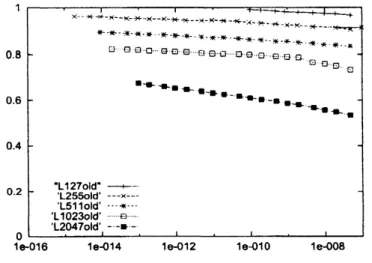
Figure 2: Relativecomputationalcosts of Legendre polynomial transforms by the old algorithm
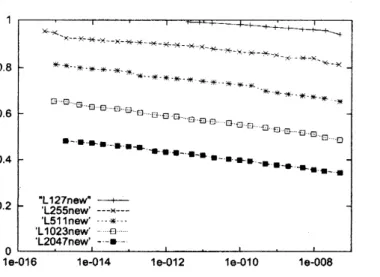
Figures 2 and 3 show the floating point operation counts relative to the direct computation. The
x-axis shows the attained precision. $L12701d$” and $Ll27new$” give the performances for $T=127$,
etc.
Comparingthose figures,
we can see
that $T=127$ gives small difference between theold andthenew
algorithms, but for $T=2047$ the old algorithm takes about 1.5 times $mo$re
computations thanFigure 3: Relative computationalcosts of Legendre polynomialtransforms by the new algorithm
For the old algorithm, the gradient is different for$T=1023$with lower precision and for$T=2047$
thanthe other
cases.
This is becausethe split Legendre functionsare used only for those conditions.However for the
new
algorithm, we found nosuch phase change.Theplotsfor the old algorithm stop at precisionof$10^{-15}$ to$10^{-11}$. This isbecausehigher precision
was
not attained because of the numerical stability. For the new algorithm higher precisionswere
attained. Those results imply that the numerical stability is much improved in the
new
algorithm.Further discussion on the performance will befound in [23].
5
Summary and future works
This paper discusses our fast algorithm for
as
sociated Legendre function transformswith generalizedFMM. This algorithm is formerly reported in
our
previous reports [22, 23], but the details of thealgorithmwerenotpresented. Inthis paper, the transform algorithm and the preprocessing algorithm
are
discussed. The performance is reported in English for the first time.There
are
several remaining works to do.The new algorithm performs better than the old algorithm, but its computational complexity is
not bounded theoretically. To bound it, the complexity bound for the interpolation with generalized
FMM must be obtained, and to that purpose,
we
must have some analytical expression for theinterpolation matrix entries.
Any specific property of the associated Legendre functions is utilized in the
new
algorithm.The
new
algorithm just compresses the transform matrix. The only exception is that the forwardtransformcan be obtained bytransposition ofthe inverse transform matrix, but this assumption
can
be removed if
we
compute the forward transform matrix directly. Thus thenew
algorithmcan
beapplied to any
transform
at least conceptually.Last, the implementation should be improved and released to the public use. Before doing that,
we
should improve the implementation of generalized FMM, because its current performance issomewhat lower than theprevious one (but with dramatically reduced preprocessingtime).
Acknowledgments
This research is partly supported by Grant-in-Aid for Scientific Research
on
Priority Areas, MEXTReferences
[1] B. K. Alpert and V. Rokhlin: A Fast Algorithm for the Evaluation of Legendre Expansions,
$SI\mathcal{A}M$J. Sci. Stat. Comput., Vol. 12, No. 1, pp. 158-179, 1991.
[2] G. Beylkin, R. R. Coifman, and V. Rokhlin: Fast WaveletTransformsandNumericalAlgorithms
I, Comm. Pure Appl. Math., No. 44, pp. 141-183, 1991.
[3] J. P. Bovd: Multipole expansions and pseudospectral cardinal functions: A
new
generation ofthe fast Fourier transform, J. Comput. Phys., Vol. 103, pp. 184-186, 1992.
[4] A. Dutt, M. Gu, and V. Rokhlin: Fast algorithms for polynomial interpolation, integration, and
differentiation, SIAMJ. Numer. Anal., Vol. 33, No. 5, pp. 1689-1711, 1996.
[5] L. Greengard and V. Rokhlin: A Fast algorithm for particle simulations, J. Comput. Phys.,
Vol. 73, pp. 325-, 1987.
[6] J. R. Driscoll and D. Healy, Asymptotically Fast Algorithms for Spherical and Related
Trans-forms, Proc. 30th IEEE FOCS, pp. 344-349 (1989).
[7] D. M. Healy Jr., D. Rockmore, P. J. Kostelec, and S. S. B. Moore, FFTs for 2-Sphere –
Improvements and Variations, Tech. Rep. PCS-TR96-292, Dartmouth Univ., 1996.
[8] R. Jakob-Chien and B. K. Alpert, A Fast Spherical Filter with Uniform Resolution, J. Comput.
Phys., Vol. 136, pp. 580-584, 1997
[9] J. Keiner and D. Potts, Fast Evaluation of Quadrature Formulae
on
the Sphere, Math. Comp.,Vol. 77, No. 261, pp. 397-419 (2008).
[10] S. Kunis and D. Potts, Fast spherical Fourier algorithms, J. Comp. Appl. Math., Vol. 161,
pp. 75-98 (2003).
[11] M. J. Mohlenkamp, A Fast Transform for Spherical Harmonics, J. Fourier Anal. Appl., Vol. 2,
pp. 159-184, 1999.
[12] A. Mori, R. Suda and M. Sugihara, An improvement on Orszag’s Fast Algorithm for Legendre
Polynomialhansform, Trans.
Inform.
Process. Soc. Japan,Vol. 40, No. 9, pp. 3612-3615(1999).[13] S. A. Orszag, Fast Eigenfunction T}ansforms, Science and Computers, Adv. Math.
Supplemen-tary Studies, Vol. 10, pp. 23-30, Academic Press, 1986.
[14] D. Potts, G. Steidl, and M. Tasche, Fast and stable algorithms for discrete spherical Fourier
transforms, Linear Algebra Appl., pp. 433–450, 1998.
[15] V. Rokhlin and M. Tygert: Fast algorithms for spherical harmonic expansions, SIAM J. Sci.
Comp. Vol. 27, No. 6, pp. 1903-1928 (2006).
[16] G. Szego, Orthogonal Polynomials, p. 193. AMS, 1959.
[17] R. Suda, A Fast SphericalHarmonics Transform Algorithm,
Infor.
Proc. Soc. Japan SIGNotes,No. 98-HPC-73, pp. 37-42, 1998.
[18] R. Suda: Stability Control ofFast Spherical Harmonics Transform,
Info.
Proc. Soc. Japan SIGNotes, No. 2001-HPC-88, pp. 43-48 (2001).
[19] R. Suda: Fast spherical harmonics transform of FLTSS and its evaluation, The 2002 Workshop
on
the Solutionof
PanialDifferential
Equations on the Sphere, Fields Inst., U. Toronto (2002).[20] R. Suda: Fast spherical harmonic transform routine FLTSS applied to the shallow water test
set, Mon. Wea. Rev., Vol. 133, No. 3, pp. 634-648 (2005).
[21] R. Suda: Stabilityanalysis of the fast Legendre transform algorithm based
on
the fastmultipole[22] R. Suda: Fast Spherical Harmonic Transform with generalized Fast Multipole Method, 2005
International
Conference
onScientific
Computing andDifferential
Equations (SciCADE05),p. 86 (2005)
[23] R. Suda: High Performance Implementation and Evaluation of the Spherical Harmonic
Trans-forms in the Fast Orthogonal Function Transform Routine FXTPACK,
Info.
Proc. Soc. JapanSIG Technical Report, Vol. 2005, No. 97 (2005-HPC-I04), pp. 31-36 (2005).
[24] R. Suda: FLTSS home page:
http:$//www$
.
na.
cse. nagoya-u. ac.$jp/\sim_{reiji}/fltss/$[25] R. Suda and M. Takami: A Fast Spherical Harmonics Transform Algorithm, Math. Comp.,
Vol. 71, No. 238, pp. 703-715 (2002).
[26] R. Suda and M. Takami: Error Analysis and Control ofFast Spherical Harmonics Transform,
Info.
Proc.
Soc. Japan SIG Notes, No. 2000-HPC-84, pp. 7-12 (2000).[27] R. Suda and M. Takami: Error Analysis and Control ofFast Spherical Harmonics Transform,
Tmns.
Info.
Proc. Soc. Japan HPS, Vol. 42, No. SIG12 (HPS4), pp.49-59 (2001).[28] R. Suda and S. Kuriyama: Another Preprocessing Algorithm for Generalized One-Dimensional
Fast Multipole Method, J. Comp. Phys., Vol.195, pp. 790-803 (2004).
[29] N. Yarvinand V. Rokhlin: A Generalized One-Dimensional Fast Multipole Method with