ORIGINAL
Cut-off values for skeletal muscle strength and physical
functions in Japanese elderly with walking difficulty
Teruhiro Morishita1)*, Michiko Sato1)*, Takafumi Katayama2), Nami Sumida1), Hiroshi Omae1), Shigeko Satomura3), Masae Sakuma4), Hidekazu Arai5), Akihiko Kawaura1), Eiji Takeda1), Shinsuke Katoh6), and Koichi Sairyo7)
1)Kenshokai Gakuen College for Health and Welfare, Tokushima, Japan, 2)Department of Statistics and Computer Science, College of Nursing Art and Science, University of Hyogo, Akashi, Japan, 3)Division of Child Neurology, Tokushima Prefectural Hinomine Medical Center for the Handicapped, Komatsushima, Japan, 4)Department of Human Nutrition, School of Life Studies, Sugiyama Jogakuen University, Nagoya, Japan, 5)Laboratory of Clinical Nutrition and Management, Graduate School of Nutritional and Environmental Sciences, The University of Shizuoka, Shizuoka, Japan, 6)Department of Rehabilitation Medicine, Tokushima University Hospital, Tokushima, Japan, 7)Department of Orthopedics, Tokushima University, Tokushima, Japan, * : Equally contributed in this study
Abstract : Age-related changes in muscle strength and physical functions, and the association between vitamin D status and skeletal muscle functions were investigated in 36 men (21-90 years old) and 52 women (21-104 years old). Significant ageing-related decreases in several skeletal muscle functions and serum 25-hydroxyvitamin D [25(OH)D] levels were observed in both men and women. Cut-off values for the Timed up and go (TUG) test, walking speed, handgrip strength and Barthel Index (BI) detecting walking difficulties in the receiver operating characteristic (ROC) analysis were 11.1 sec, 0.60 m / sec, 17.0 kg, and 90.0 in males, and 28.6 sec, 0.43 m / sec, 13.9 kg, and 67.5 in females, respectively. By comparing personal present data of muscle strength with these cut-off val-ues, people can easily understand their process to walking difficulty. Therefore, these results are important and useful to avoid or to delay a handicapped and dependent status by improving the vitamin D level, rehabilitation and nursing care. J. Med. Invest. 68 : 48-52, February, 2021
Keywords : skeletal muscle power, physical function, vitamin D
INTRODUCTION
Several factors are involved in the maintenance of activities of daily living (ADL) in older adults (1). Loss of muscle mass is highly prevalent in older adults (2), and represents an impaired state of health with mobility disorders, impaired ability to be well and perform ADL, and loss of independence (3-5). The de-cline in skeletal muscle mass is associated with muscle strength and physical function, in addition to social costs (6, 7). Muscle strength is an important component in maintaining physical function, mobility and vitality with age (8, 9).
Although there is a growing interest in welfare in ageing societies regarding such conditions, information on sarcopenia and frailty-related QOL in nursing homes, and their relationship with physical function is lacking. Understanding skeletal muscle function and muscle mass is important to provide sufficient re-habilitation and proper care in nursing homes. In our previous study, age-related decreases in skeletal muscle mass and cut-off levels for walking difficulty were calculated using 24-h creati-nine excretion as a measure of total-body skeletal muscle mass in the Japanese population, including nursing home residents (10, 11). Furthermore, the serum 25-hydroxyvitamin D [25(OH) D] level was closely related to skeletal muscle mass. This study investigated the age-related changes in muscle strength and physical functions, and their association with vitamin D levels.
MATERIALS AND METHODS
Subjects
Age-related changes in skeletal muscle strength and physical functions, and their association with serum 25(OH)D levels were analyzed in this cross-sectional study. The numbers of male and female subjects in age groups of 21-30 years, 31-50 years, 51-75 years and 76 years or older were 13 and 10, 13 and 11, 8 and 15, and 2 and 16, respectively. Among them, the numbers of male and female subjects with walking difficulty in nursing homes were 1 and 1 in the 51-75 years group, and 2 and 16 in the 76 years or older group. The other 68 subjects aged between 21-75 years old were healthy registered care workers, physical and occupational therapists in nursing homes, or teaching and administration staff at Kenshokai Gakuen College for Health and Welfare. None of the healthy subjects were engaged in high levels of exercise training or taking any medications just before or during the study.
Assessment of physical performance and serum 25(OH)D levels
Physical performance was evaluated through several physical tests such as the Timed up and go (TUG) test (sec), walking speed (m / sec), handgrip strength (kg) and Barthel Index (BI). Muscle strength was assessed as handgrip strength using a dynamometer (Takei Scientific, Tokyo, Japan). Both hands were measured twice and the maximum value of either hand was analyzed. For the TUG test, individuals were asked to rise from a standard chair, walk to a marker 3 m away, turn around, walk back and sit down again (12). The BI is a 10-item measure of basic ADL (13). It is used in clinical practice to inform rehabili-tation and care planning, and in research to describe outcomes and as a case-mix adjuster (14).
Serum 25(OH)D levels, as an indicator of vitamin D status, were measured by Electro Chemiluminescent Immunoassay
The Journal of Medical Investigation Vol. 68 2021
Received for publication March 30, 2020 ; accepted October 20, 2020. Address correspondence and reprint requests to Eiji Takeda, Kenshokai Gakuen College for Health and Welfare, 369-1 Higashitakawa, Tenma, Kokufu-cho, Tokushima, 779-3105, Japan and Fax : +81-88-642-9227.
(ECLIA), as previously reported (11).
Statistical analysis
Data were expressed as the mean ± SD of the male and fe-male subjects of different age groups. Spearman’s analysis was used for age-related changes in skeletal muscle functions, and association between serum 25(OH)D levels and skeletal muscle functions. The Mann-Whitney U test (nonparametric analysis) was used to assess differences between male and female values in each group, and Steel’s multiple comparison test was used to assess differences between the 21-30 year group and the other groups. A P-value less than 0.05 was evaluated as significant.
Ethical considerations
The protocol of this project was approved by the institutional review board of Hinomine Medical Center (Komatsushima, Tokushima, Japan). The procedures were fully explained to sub-jects and an informed consent form was signed.
RESULTS
1) Age-related changes in skeletal muscle functions and serum 25(OH)D levels
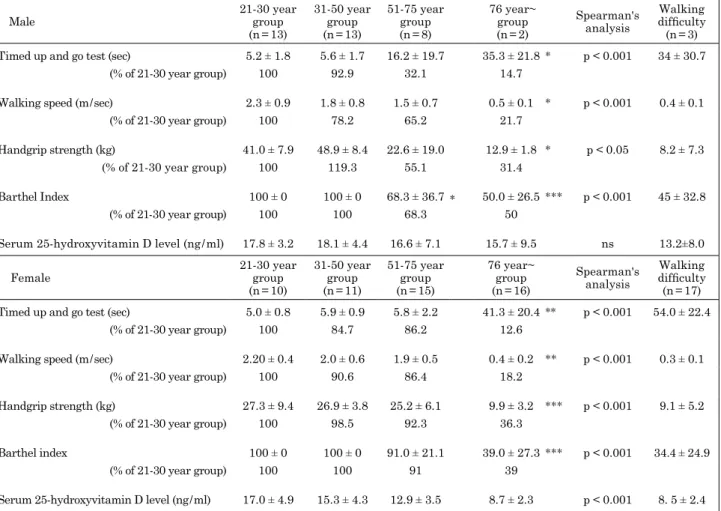
The skeletal muscle functions, such as the TUG test (sec), walking speed (m / sec), handgrip strength (kg) and BI, and serum 25(OH)D levels of men and women in different age groups
are shown in Table 1. A significant aging-related reduction in all skeletal muscle functions and serum 25(OH)D levels was observed in both men and women.
Comparing these indices with those of the 21-30 year group, the TUG test (sec), walking speed (m / sec), handgrip strength (kg) and BI values were lower in both men and women in the 76 year or older group, but only the BI was lower in men in the 51-75 year group. Handgrip strength (kg) as muscle torque in the 31-50 year, 51-75 year and 76 year or older groups was 119.3%, 55.1% and 31.4% of that of males in the 21-30 year group, and 98.5%, 92.3% and 36.3% of females in the 21-30 year group, respectively.
On comparison of the values for the TUG test (sec), walking speed (m / sec) and BI in males in the 31-50 year, 51-75 year and 76 year or older groups, the TUG test (sec) was 92.9%, 32.1% and 14.7%, walking speed (m / sec) was 78.2%, 65.2% and 21.7%, handgrip strength (kg) was 119.3%, 55.1% and 31.4%, and BI was 100%, 68.3% and 50% of those of males in the 21-30 year group, respectively. The values in females in the 31-50 year, 51-75 year and 76 year or older groups for the TUG test (sec), walking speed (m / sec), handgrip strength (kg) and BI were 84.7%, 86.2% and 12.6%, 90.6%, 86.4% and 18.2%, 98.5%, 92.3% and 36.3%, and 100%, 91.0% and 39.0%, respectively, of those of females in the 21-30 year group.
The walking speed and grip strength of males in the 21-30 year and 31-50 year groups were higher than those of women. In contrast, the BI of women in the 51-75 group was higher than
Table 1. Skeletal muscle function and serum 25-hydroxyvitamin D level Male 21-30 yeargroup
(n = 13) 31-50 year group (n = 13) 51-75 year group (n = 8) 76 year~ group (n = 2) Spearman's analysis Walking difficulty (n = 3) Timed up and go test (sec) 5.2 ± 1.8 5.6 ± 1.7 16.2 ± 19.7 35.3 ± 21.8* p < 0.001 34 ± 30.7
(% of 21-30 year group) 100 92.9 32.1 14.7
Walking speed (m / sec) 2.3 ± 0.9 1.8 ± 0.8 1.5 ± 0.7 0.5 ± 0.1 * p < 0.001 0.4 ± 0.1 (% of 21-30 year group) 100 78.2 65.2 21.7
Handgrip strength (kg) 41.0 ± 7.9 48.9 ± 8.4 22.6 ± 19.0 12.9 ± 1.8 * p < 0.05 8.2 ± 7.3 (% of 21-30 year group) 100 119.3 55.1 31.4
Barthel Index 100 ± 0 100 ± 0 68.3 ± 36.7 * 50.0 ± 26.5*** p < 0.001 45 ± 32.8 (% of 21-30 year group) 100 100 68.3 50
Serum 25-hydroxyvitamin D level (ng / ml) 17.8 ± 3.2 18.1 ± 4.4 16.6 ± 7.1 15.7 ± 9.5 ns 13.2±8.0
Female 21-30 yeargroup (n = 10) 31-50 year group (n = 11) 51-75 year group (n = 15) 76 year~ group (n = 16) Spearman's analysis Walking difficulty (n = 17) Timed up and go test (sec) 5.0 ± 0.8 5.9 ± 0.9 5.8 ± 2.2 41.3 ± 20.4** p < 0.001 54.0 ± 22.4
(% of 21-30 year group) 100 84.7 86.2 12.6
Walking speed (m / sec) 2.20 ± 0.4 2.0 ± 0.6 1.9 ± 0.5 0.4 ± 0.2 ** p < 0.001 0.3 ± 0.1 (% of 21-30 year group) 100 90.6 86.4 18.2
Handgrip strength (kg) 27.3 ± 9.4 26.9 ± 3.8 25.2 ± 6.1 9.9 ± 3.2 *** p < 0.001 9.1 ± 5.2 (% of 21-30 year group) 100 98.5 92.3 36.3
Barthel index 100 ± 0 100 ± 0 91.0 ± 21.1 39.0 ± 27.3*** p < 0.001 34.4 ± 24.9 (% of 21-30 year group) 100 100 91 39
Serum 25-hydroxyvitamin D level (ng / ml) 17.0 ± 4.9 15.3 ± 4.3 12.9 ± 3.5 8.7 ± 2.3 p < 0.001 8. 5 ± 2.4 Different from the 21-30 year group (* : p < 0.05, ** : p < 0.01, *** : p<0.001)
that of men. Furthermore, the serum 25(OH)D level was closely related to handgrip strength (kg) and BI in men, and with the TUG test (sec), walking speed (m / sec), handgrip strength (kg) and BI in women.
2) Cut-off values for skeletal muscle functions with walking difficulty
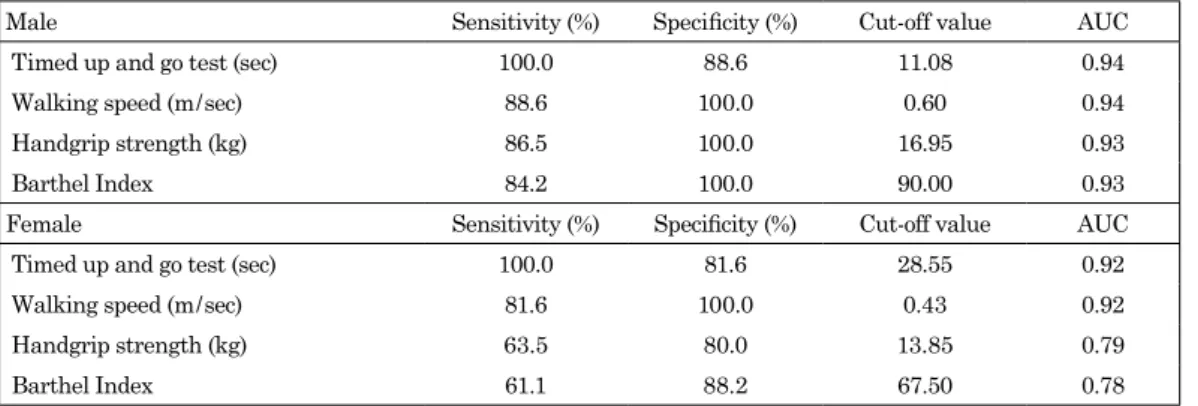
Cut-off values for the TUG test, walking speed, handgrip strength and BI for detecting walking difficulties in the ROC analysis were 11.1 sec, 0.60 m / sec, 17.0 kg and 90.0 in males, and 28.6 sec, 0.43 m / sec, 13.9 kg and 67.5 in females, respective-ly (Table 2). All 20 subjects with walking difficulty were living in nursing homes, and the rate was 60% (3 in 5) for men and 94.4% (17 in 18) for women.
DISCUSSION
In general, muscle mass and strength increase with growth during childhood and young adulthood, are maintained in midlife and then decrease with age. In young adulthood up to 40 years, maximal levels are observed (15). Beyond the age of 50 years, loss of leg muscle mass and strength was reported to occur at a rate of 1-2% per year and 1.5-5% per year, respectively (16). Frailty is a geriatric syndrome associated with adverse health outcomes such as physical disability, hospitalization and mortality (17). One of the key features of frailty is marked muscle weakness and a decline in functional capabilities (18).
Age-related loss of muscle strength and functions were ob-served in both men and women in this study. The skeletal muscle functions, skeletal muscle mass (kg, kg / m2, %BW) and creatine height index were also closely related to serum 25(OH)D levels in present and previous studies (11). These results are consistent with earlier studies suggesting that a decline in muscle function is strongly correlated with the loss of muscle mass due to aging (19-21). Aging results in a decline in strength, which is primar-ily attributed to a loss of muscle mass (22-24). Of note, several cross-sectional studies involving adults and younger humans found that sufficient vitamin D levels positively affect muscle strength (25-27). Recent studies demonstrated adipose tissue accumulation around and between muscle fibers concomitant with reductions in the muscle cross-sectional area due to aging, and this skeletal muscle attenuation is inversely associated with muscle performance (28, 29).
Corroborating these findings in the present study, subjects in the 76 year or older group and nursing home residents were more
likely to be at risk for physical dependence than those in younger groups. In addition, the loss of strength was much greater than the loss of muscle mass, which suggests a decrease in muscle quality (30, 31). Furthermore, we calculated cut-off values for the TUG test (sec), walking speed (m / sec), handgrip strength (kg) and BI for walking difficulty. In the initial stages of sarcopenia development, an individual may be above the threshold of low physical performance and is likely to be above the threshold of disability. Handgrip strength was reported to be a reliable and cost-effective surrogate of overall muscle strength (32, 33), and is a robust indicator of subsequent functional limitations and future disease status (31, 34, 35).
The Asian Working Group for Sarcopenia (AWGS) 2019 retained the original cut-off values for height-adjusted muscle mass : dual-energy X-ray absorptiometry, < 7.0 kg / m2 in men and < 5.4 kg / m2 in women ; and bioimpedance, < 7.0 kg / m2 in men and < 5.7 kg / m2 in women, but revised the diagnostic algorithm, protocols and some criteria : low muscle strength is defined as handgrip strength < 28 kg for men and < 18 kg for women (36). These are intermediate values between the young, healthy situation and old, handicapped situation with walking difficulty. Therefore, it is recommended that the cut-off values for muscle mass and handgrip strength for walking difficulty be kept in mind when aged persons are trained in rehabilitation to avoid physical disability and independence.
Although the cause of this loss in strength and function is multifactorial, serum 25(OH)D levels were significantly as-sociated with physical performance in this study. Previously reported surveys revealed that vitamin D levels are positively correlated with muscle mass, strength and physical performance in older adults (37-40). Handgrip strength has gained attention as a simple, noninvasive marker of muscle strength and function in both epidemiological and clinical studies (41). In addition, several studies reported an association between vitamin D defi-ciency and reduced handgrip strength (42, 43). Thus, handgrip strength is more effective than muscle mass as a predictor of adverse outcomes such as falls, decreased physical performance and mortality (44-47).
Vitamin D deficiency is globally widespread, particularly in older populations (48-50). Therefore, based on the present study, optimizing the vitamin D status may be a practical and cost-ef-fective approach to support skeletal muscle function, although sufficient intervention study using vitamin D supplementation will be required.
Table 2. Cut-off values for detecting walking difficulty in ROC analysis
Male Sensitivity (%) Specificity (%) Cut-off value AUC Timed up and go test (sec) 100.0 88.6 11.08 0.94 Walking speed (m / sec) 88.6 100.0 0.60 0.94 Handgrip strength (kg) 86.5 100.0 16.95 0.93 Barthel Index 84.2 100.0 90.00 0.93 Female Sensitivity (%) Specificity (%) Cut-off value AUC Timed up and go test (sec) 100.0 81.6 28.55 0.92 Walking speed (m / sec) 81.6 100.0 0.43 0.92 Handgrip strength (kg) 63.5 80.0 13.85 0.79 Barthel Index 61.1 88.2 67.50 0.78 ROC : Receiver operating characteristic, AUC : area under the curve.
CONFLICT OF INTEREST AND ACKNOWLEDGEMENT
This study was financially supported by Meiji Co., Ltd. and the Food Science Institute Foundation (Ryoushoku-kenkyukai), and this is one of the cooperating programs in Kenshokai Group promoting welfare societies. We express special thanks to all volunteers and nursing homes (Egao, Heart and Shoenburn) in Kenshokai Group for kindly supporting this study.
REFERENCES
1. Yamada M, Arai H, Uemura K, Mori S, Nagai K, Tanaka B, Terasaki Y, Iguchi M, Aoyama T : Effect of resistance training on physical performance and fear of falling in el-derly with different levels of physical well-being. Age Ageing 40(5) : 637-641, 2011
2. Chien MY, Huang TY, Wu YT : Prevalence of sarcopenia es-timated using a bioelectrical impedance analysis prediction equation in community-dwelling elderly people in Taiwan. J Am Geriatr Soc 56 : 1710-1715, 2008
3. Cawthon PM, Marshall LM, Michael Y, Dam TT, Ensrud KE, Barrett-Connor E, Orwoll ES : Osteoporotic Fractures in Men Research Group : Frailty in older men : prevalence, progression, and relationship with mortality. J Am Geriatr Soc 55 : 1216-1223, 2007
4. Rolland Y, Czerwinski S, Abellan Van Kan G, Morley JE, Cesari M, Onder G, Woo J, Baumgartner R, Pillard F, Boirie Y, Chumlea WM, Vellas B : Sarcopenia : its assess-ment, etiology, pathogenesis, consequences and future per-spectives. J Nutr Health Aging 12 : 433-450, 2008
5. Topinkova E : Aging, disability and frailty. Ann Nutr Metab Suppl 1 : 526-511, 2008
6. Silva AM, Shen W, Heo M, Gallagher D, Wang Z, Sardinha LB, Heymsfield SB : Ethnicity-related skeletal muscle dif-ferences across the lifespan. Am J Hum Biol 22 : 76-82, 2010 7. Mithal A, Bonjour J-P, Boonen S, Burckhardt P, Degens H,
El Hajj Fuleihan G, Josse R, Lips P, Morales Torres J, Rizzoli R, Yoshimura N, Wahl DA, Cooper C, Dawson-Hughes B ; IOF CSA Nutrition Working Group : Impact of nutrition on muscle mass, strength, and performance in older adults. Osteoporosis Int 24 : 1555-1566, 2013
8. Visser M, Kritchevsky SB, Goodpaster BH, Newman AB, Nevitt M, Rubin SM, Simonsick EM, Harris TB : Leg muscle mass and composition in relation to lower extrem-ity performance in men and women aged 70 to 79 : the health, aging and body composition study. J Am Geriatr Soc 50 : 897-904, 2002
9. Goodpaster BH, Park SW, Harris TB, Kritchevsky SB, Nevitt M, Schwartz AV, Simonsick EM, Tylavsky FA, Visser M, Newman AB : The loss of skeletal muscle strength, mass, and quality in older adults : the health, aging and body composition study. J Gerontol A Biol Sci Med Sci 61 : 1059-1064, 2006
10. Morishita T, Sato M, Kume H, Sakuma M, Arai H, Katayama T, Katoh S, Sairyo K, Takeda E : Skeletal muscle mass of old Japanese women suffering from walking difficulty in nursing home. J Med Invest 65(1.2) : 122-130, 2018
11. Sato M, Morishita T, Katayama T, Satomura S, Okuno H, Sumita N, Sakuma M, Arai H, Katoh S, Sairyo K, Kawaura A, Takeda E : Relationship between age-related decreases in serum 25-hydroxyvitamin D levels and skeletal muscle mass in Japanese women. J Med Invest 67(1,2) : 151-157, 2020
12. Podsiadlo D, Richardson S : The timed ‘Up & Go’ : a test of basic functional mobility for frail elderly persons. J Am
Geriatr Soc 39 : 142-148, 1991
13. Mahoney FI, Barthel DW : Functional evaluation : the BARTHEL Index. Md State Med J 14 : 61-65, 1965 14. Granger CV, Dewis LS, Peters NC, Sherwood CC, Barrett
JE : Stroke rehabilitation : analysis of repeated Barthel index measures. Arch Phys Med Rehabil 60 : 14-17, 1979 15. Dodds RM, Syddall HE, Cooper R, Benzeval M, Deary
IJ, Dennison EM, Der G, Gale CR, Inskip HM, Jagger C, Kirkwood TB, Lawlor DA, Robinson SM, Starr JM, Steptoe A, Tilling K, Kuh D, Cooper C, Sayer AA : Grip strength across the life course : normative data from twelve British studies. PLoS One 9 : e113637, 2014
16. Keller K, Engelhardt M : Strength and muscle mass loss with aging process. Age and strength loss. Muscles Liga-ments Tendons J 3 : 346-350, 2013
17. Rockwood K, Stadnyk K, MacKnight C, McDowell I, Hebert R, Hogan DB : A brief clinical instrument to classify frailty in elderly people. Lancet 353(9148) : 205-206, 1999 18. Fried LP, Tangen CM, Walston J, Newman AB, Hirsch
C, Gottdiener J, Seeman T, Tracy R, Kop WJ, Burke G, McBurnie MA : Cardiovascular Health Study Collaborative Research G : Frailty in older adults : evidence for a pheno-type. J Gerontol A Biol Sci Med Sci 56 (3) : M146-156, 2001 19. Frontera WR, Hughes VA, Lutz KJ, Evans WJ : A
cross-sec-tional study of muscle strength and mass in 45- to 78-yr-old men and women. J Appl Physiol 71 : 644-650, 1991 20. Reed RL, Pearlmutter L, Yochum K, Meredith KE, Mooradian
AD : The relationship between muscle mass and muscle strength in the elderly. J Am Geriatr Soc 39 : 555-561, 1991 21. Kallman DA, Plato CC, Tobin JD : The role of muscle loss in the age-related decline of grip strength : cross-sectional and longitudinal perspectives. J Gerontol 45 : M82-88, 1990 22. Frontera WR, Hughes VA, Fielding RA, Fiatarone MA,
Evans WJ, Roubenoff R : Aging of skeletal muscle : a 12-yr longitudinal study. J Appl Physiol 88(4) : 1321-1326, 2000 23. Kent-Braun JA, Ng AV : Specific strength and voluntary
muscle activation in young and elderly women and men. J Appl Physiol 87(1) : 22-29, 1999
24. Klein CS, Rice CL, Marsh GD : Normalized force, activa-tion, and coactivation in the arm muscles of young and old men. J Appl Physiol 91(3) : 1341-1349, 2001
25. Foo LH, Zhang Q, Zhu K, Ma G, Hu X, Greenfield H, Fraser DR : Low vitamin D status has an adverse influence on bone mass, bone turnover, and muscle strength in Chinese adolescent girls. J Nutr 139(5) : 1002-1007, 2009
26. von Hurst PR, Conlon C, Foskett A : Vitamin D status predicts hand-grip strength in young adult women living in Auckland, New Zealand. J Steroid Biochem Mol Biol 136 : 330-332, 2013
27. Ward KA, Das G, Roberts SA : A randomized, controlled trial of vitamin D supplementation upon musculoskeletal health in postmenarchal females. J Clin Endocrinol Metab 95(10) : 4643-4651, 2010
28. Goodpaster BH, Carlson CL, Visser M, Kelley DE, Scherzinger A, Harris TB, Stamm E, Newman AB : Attenuation of skel-etal muscle and strength in the elderly : the Health ABC Study. J Appl Physiol 90 : 2157-2165, 2001
29. Borkan GA, Hults DE, Gerzof SG, Robbins AH, Silbert CK : Age changes in body composition revealed by computed tomography. J Gerontol 38 : 673-677, 1983
30. Goodpaster BH, Park SW, Harris TB, Kritchevsky SB, Nevitt M, Schwartz AV, Simonsick EM, Tylavsky FA, Visser M, Newman AB : The loss of skeletal muscle strength, mass, and quality in older adults : the health, aging and body composition study. J Gerontol A Biol Sci Med Sci 61 : 1059-1064, 2006
31. Mitchell WK, Williams J, Atherton P, Larvin M, Lund J, Narici M : Sarcopenia, dynapenia, and the impact of ad-vancing age on human skeletal muscle size and strength ; a quantitative review. Front Physiol 3 : 260, 2012
32. Li C-I, Li T-C, Lin W-Y, Liu C-S, Hsu C-C, Hsiung CA, Chen CY, Huang KC, Wu CH, Wang CY, Lin CC ; Sarcopenia and Translational Aging Research in Taiwan (START) Team : Combined association of chronic disease and low skeletal muscle mass with physical performance in older adults in the Sarcopenia and Translational Aging Research in Taiwan (START) study. BMC Geriatr 15 : 11, 2015 33. Morley JE, Anker SD, von Haehling S : Prevalence,
inci-dence, and clinical impact of sarcopenia : facts, numbers, and epidemiology-update 2014. J Cachexia Sarcopenia Mus-cle 5 : 253-259, 2014
34. Cruz-Jentoft AJ, Baeyens JP, Bauer JM, Boirie Y, Cederholm T, Landi F, Martin FC, Michel JP, Rolland Y, Schneider SM, Topinková E, Vandewoude M, Zamboni M ; European Working Group on Sarcopenia in Older Peo-ple : Sarcopenia : European consensus on definition and diagnosis : report of the European working group on sarco-penia in older people. Age Ageing 39 : 412-423, 2010 35. Studenski SA, Peters KW, Alley DE, Cawthon PM, McLean
RR, Harris TB, Ferrucci L, Guralnik JM, Fragala MS, Kenny AM, Kiel DP, Kritchevsky SB, Shardell MD, Dam TT, Vassileva MT : The FNIH sarcopenia project : rationale, study description, conference recommendations, and final estimates. J Gerontol A Biol Sci Med Sci 69 : 547-558, 2014 36. Chen LK, Woo J, Assantachai P, Auyeung TW, Chou MY,
Iijima K, Jang HC, Kang L, Kim M, Kim S, Kojima T, Kuzuya M, Lee JSW, Lee SY, Lee WJ, Lee Y, Liang CK, Lim JY, Lim WS, Peng LN, Sugimoto K, Tanaka T, Won CW, Yamada M, Zhang T, Akishita M, Arai H : Asian Working Group for Sarcopenia : 2019 Consensus Update on Sarcopenia Diagnosis and Treatment. J Am Med Dir Assoc 21(3) : 300-307, 2020
37. Park S, Ham JO, Lee BK : A positive association of vitamin D deficiency and sarcopenia in 50 year old women, but not men. Clin Nutr 33 : 900-905, 2014
38. Tieland M, Brouwer-Brolsma EM, Nienaber-Rousseau C, van Loon LJ, De Groot LC : Low vitamin D status is associated with reduced muscle mass and impaired phys-ical performance in frail elderly people. Eur J Clin Nutr 67 : 1050-1055, 2013
39. Mastaglia SR, Seijo M, Muzio D, Somoza J, Nunez M, Oliveri B : Effect of vitamin D nutritional status on muscle function and strength in healthy women aged over sixty-five years. J Nutr Health Aging 15 : 349-354, 2011
40. Bischoff-Ferrari HA, Dietrich T, Orav EJ, Hu FB, Zhang Y, Karlson EW, Dawson-Hughes B : Higher 25-hydroxyvitamin D concentrations are associated with better lower-extremity function in both active and inactive persons aged > or = 60 y. Am J Clin Nutr 80 : 752-758, 2004
41. Norman K, Stobäus N, Gonzalez MC, Schulzke JD, Schulzke M : Hand grip strength : outcome predictor marker and of nutritional status. Clin Nutr 30(2) : 135-142, 2011
42. Toffanello ED, Perissinotto E, Sergi G, Zambon S, Musacchio E, Maggi S, Coin A, Sartori L, Corti MC, Baggio G, Crepaldi G, Manzato E : Vitamin D and physical performance in elderly subjects : the Pro.V.A study. PLoS One 7(4). ARTN e3495010.1371, 2012
43. Houston DK, Cesari M, Ferrucci L, Cherubini A, Maggio D, Bartali B, Johnson MA, Schwartz GG, Kritchevsky SB : Association between vitamin D status and physical performance : the InCHIANTI study. J Gerontol A Biol Sci Med Sci 62(4) : 440-446, 2007
44. Ramirez-Velez R, Correa-Bautista JE, Garcia-Hermoso A, Cano CA, Izquierdo M : Reference values for handgrip strength and their association with intrinsic capacity do-mains among older adults. J Cachexia Sarcopenia Muscle 10 : 278-286, 2019
45. Schaap LA, van Schoor NM, Lips P, Visser M : Associations of sarcopenia definitions, and their components, with the incidence of recurrent falling and fractures : the longitudi-nal aging study Amsterdam. J Gerontol A Biol Sci Med Sci 73 : 1199-1204, 2018
46. Leong DP, Teo KK, Rangarajan S, Lopez-Jaramillo P, Avezum A Jr, Orlandini A, Seron P, Ahmed SH, Rosengren A, Kelishadi R, Rahman O, Swaminathan S, Iqbal R, Gupta R, Lear SA, Oguz A, Yusoff K, Zatonska K, Chifamba J, Igumbor E, Mohan V, Anjana RM, Gu H, Li W, Yusuf S : Prognostic value of grip strength : findings from the Pro-spective Urban Rural Epidemiology (PURE) study. Lancet 386 : 266-273, 2015
47. Schaap LA, Koster A, Visser M : Adiposity, muscle mass, and muscle strength in relation to functional decline in older persons. Epidemiol Rev 35 : 51-65, 2013
48. Roth DE, Abrams SA, Aloia J, Bergeron G, Bourassa MW, Brown KH, Calvo MS, Cashman KD, Combs G, De-Regil LM, Jefferds ME, Jones KS, Kapner H, Martineau AR, Neufeld LM, Schleicher RL, Thacher TD, Whiting SJ : Global prev-alence and disease burden of vitamin D deficiency : a road-map for action in low- and middle-income countries. Ann N Y Acad Sci. 1430(1) : 44-79, 2018
49. Laird E, O’Halloran AM, Carey D, Healy M, O’Connor D, Moore P, Shannon T, Molloy AM, Kenny RA : The prev-alence of vitamin D deficiency and the determinants of 25(OH)D concentration in older Irish adults : data from The Irish Longitudinal Study on Ageing (TILDA). J Gerontol A Biol Sci Med Sci 73(4) : 519-525, 2018
50. Aspell N, Laird E, Healy M, Shannon T, Lawlor B, O’Sullivan M : The prevalence and determinants of vitamin D sta-tus in community-dwelling older adults : results from the English Longitudinal Study of Ageing (ELSA). Nutrients 11(6) : 1253, 2019