x73
ANALYTICAL SCIENCES 2008, VOL. 24 x73
2008 © The Japan Society for Analytical Chemistry
4-Aminoantipyrine and its derivatives are important compounds in pharmacology and biochemistry, and are especially used as anti-inflammatory drugs. The structural chemistry of organotin
carboxylate complexes has attracted considerable attention, owing to their good antitumor activities, their versatile structures and the supramolecular architectures exhibited by these complexes.1 In the context of our continued interest in the
structural and biological properties of organotin complexes,2 we
have been interested in studying the structure and biological properties of the title compound.
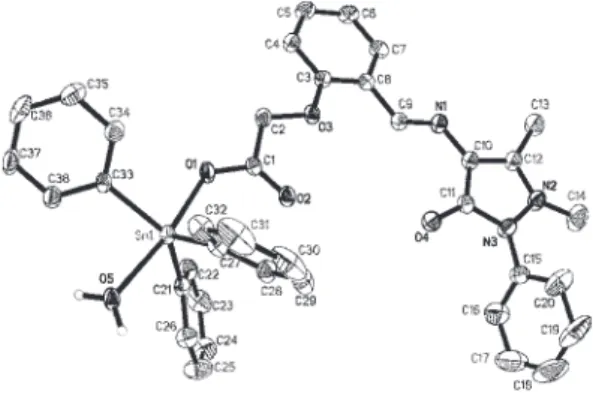
Complex 1 crystallizes in space group Cc, with a triphenyltin carboxylate and a coordinated water molecule in the asymmetric unit, as shown in Figs. 1 and 2. The Sn atom is five-coordinate and has a trans-C3SnO2 trigonal-bipyramidal geometry. The
X-ray Structure Analysis Online
Synthesis and Crystal Structure of Aqua[(E)-2-(2-((2,3-dimethyl-5-oxo-1-
phenyl-2,5-dihydro-1H-pyrazol-4-ylimino)methyl)phenoxy)acetato]-
triphenyltin(IV)
Xiao-Niu F
ANG,
†Jian-Hong W
U, Meng-Qiang Z
HOU, and Ji-Wu W
ENSchool of Chemistry & Chemical Engineering, Jinggangshan University, Ji’an, 343009, P. R.China
The title compound, aqua[(E)-2-(2-((2,3-dimethyl-5-oxo-1-phenyl-2,5-dihydro-1H-pyrazol-4-ylimino)methyl)phenoxy)-acetato]triphenyltin(IV) (1), C38H35N3O5Sn, has been synthesized by the reaction of carboxylic acid [prepared from
2-(2-formylphenoxy)acetic acid with 4-aminoantipyrine in ethanol] with triphenylstannanol in acetonitrile. It is composed of a triphenyltin carboxylate and a coordinated water. The Sn atom is five-coordinate, and has a trans-C3SnO2
trigonal-bipyramidal geometry, with the three phenyl groups occupying the equatorial plane, the carboxylate ligand coordinating in a monodentate mode and a water molecule in the axial positions. Strong intermolecular O–H·O hydrogen bonds link the molecules into an infinite one-dimensional chain extending along the c-axis, as well as a weak aromatic p-p stacking
and two C–H·p interactions.
(Received November 29, 2007; Accepted March 5, 2008; Published on web May 2, 2008)
† To whom correspondence should be addressed. E-mail: [email protected]
Fig. 1 Chemical diagram of the title compound.
Fig. 2 Structure of 1, showing the atom-numbering scheme. Displacement ellipsoids are at the 20% probability level. All the H atoms on carbon were omitted for clarity.
Table 1 Crystal and experimental data Formula: C38H35N3O5Sn
Formula weight: 732.38 g mol–1
Crystal system: monoclinic Space group: C c Z = 4 a = 25.617(5)Å b = 11.640(2)Å b = 119.08(3)˚ c = 14.471(3)Å V = 3771(2)Å3 Dx = 1.290 g cm–3
No. of reflections used = 6219 2qmax = 50.1˚ with Mo Ka
R = 0.0429 (D/s)max = 0.001
(Dr)max = 0.734 eÅ–3
(Dr)min = –0.514 eÅ–3
Measurement: Bruker APEX II
Program system: APEX2 software package Structure determination: Direct method Refinement: Full matrix
CCDC 668710 contains the supplementary crystallographic data for this paper. These data can be obtained free of charge from The Cambridge Crystallographic Data Centre via
x74 ANALYTICAL SCIENCES 2008, VOL. 24
three phenyl groups occupy the equatorial plane, with the Sn atom lying only 0.126(1)Å out of the trigonal plane (in the direction of the O1 atom) defined by the three ipso-C atoms of the phenyl groups. The interplanar angles between three phenyl rings are 58.9(3) (between the C21- and C27-rings), 63.6(3) (between the C27- and C33-rings) and 86.2(2)˚ (between the C21- and C33-rings), respectively. The ligand [(E)-2-(2-((2,3- dimethyl-5-oxo-1-phenyl-2,5-dihydro-1H-pyrazol-4-ylimino)-methyl)phenoxy)acetate] coordinates in the monodentate mode, and occupies an axial position, with the other axial ligand being a coordinated water molecule. The axial ligands are not coordinated exactly linearly [the O1–Sn1–O5 bond angle is 172.1(2)˚]. The Sn1–O1 bond length is slightly longer [2.176(4)
vs. 2.120(6)Å], and the Sn1–O5 bond length is shorter [2.362(4)
vs. 2.471(6)Å] than the values found by Kemmer.3 This is due
to the less basicity of the ligand due to an electron-drawing effect of substituted phenoxy group, as well as its steric effect; the data are comparable to values found by Das.4 The antipyrine
ring makes a dihedral angle of 68.8(4)˚ with the bonded phenyl group, and 8.3(3)˚ with the benzene ring of phenoxyacetate.
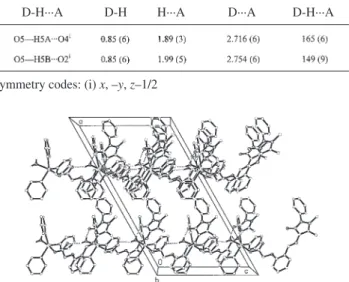
In the packing structure of 1, the classical intermolecular hydrogen bonds [O5–H5A·O4i and O5–H5B·O2i, as shown in
Table 2 and Fig. 3] link the molecules into an infinite one-dimensional chain extending along the [001] direction, as well as a weak aromatic p-p stacking and two C–H·p interations
[Cg1·Cg2ii = 3.689(4)Å, C29·Cg3ii = 3.8387 Å, C29–H·Cg3ii
= 159˚, C38·Cg2i = 3.5724 Å, C38–H·Cg2i = 127˚, here, Cg1
is the centroid of the pyrazole ring, Cg2 for the C27–C32 ring and Cg3 for the C21–C26 ring. Symmetry codes: (i) x, –y, z– 1/2; (ii) x, –y, z+1/2].
The title complex was prepared by the following procedure. A solution of carboxylic acid (0.366 g, 1 mmol) and triphenylstannanol (0.367 g, 1 mmol) in acetonitrile (30 ml) was heated for 12 h under reflux. The reaction mixture was then cooled and the yellow precipitate that had formed was filtered off. The reaction yield was 42% with a melting point 395.5 – 396.5 K. Recrystallization of the crude product from aqueous methanol resulted in single crystals of 1, suitable for X-ray diffraction analysis after several days.
Some residual electron density in the accessible voids of the structure was difficult to model. The deepest hole in the final Fourier map was 3.20 Å from atom H19. Therefore, the SQUEEZE function of PLATON5 was used to eliminate the
contribution of the electron density in the solvent region from the intensity data, and the solvent-free model was employed for the final refinement. The volume that is accessible for potential solvent molecules was calculated to be 493.9 Å3 and the total
electron count per cell was calculated to be 51. Note that the calculated density, the F(0 0 0) value, the molecular weight and the formula are given without taking into account of the results obtained with the SQUEEZE option in PLATON. Slightly disordered carbon atoms were refined by applying restraints to the bond lengths [1.40(2)Å for C15 to C20]. H atoms on water were located and refined with a distance restraint of O–H = 0.85(6)Å. All other H atoms were positioned in idealized locations and refined as riding on their carrier atoms, with an O– H distance of 0.82 Å and C–H distances of 0.93 (aryl), 0.97 Å (methylene) and 0.97 Å (methyl) with Uiso(H) = 1.5Ueq(C) for
C13, C14 and Uiso(H) = 1.2Ueq(C) for the other C atoms.
References
1. F. Barbieri, F. Sparatore, M. Cagnoli, C. Bruzzo, F. Novelli, and A. Alama, Chem. Biol. Interact., 2001, 134, 27.
2. X.-N. Fang, X.-Q. Song, and Q. L. Xie, J. Organomet.
Chem., 2001, 619, 43.
3. M. Kemmer, L. Ghys, M. Gielen, M. Biesemans, E. R. T. Tiekink, and R. Willem, J. Organomet. Chem., 1999, 582, 195.
4. V. G. K. Das, C. Wei, S. W. Ng, and T. C. W. Mak, J.
Organomet. Chem., 1987, 322, 33. 5. A. L. Spek, J. Appl. Cryst., 2003, 36, 7. Table 2 Hydrogen-bond geometry (Å, ˚)
D-H···A D-H H···A D···A D-H···A
Symmetry codes: (i) x, –y, z–1/2
Fig. 3 Packing diagram of 1, viewed along the b axis. Hydrogen bonds are shown as dashed lines. All carbon-bound H atoms were omitted for clarity.