54
Plasma generation in organic solvent for amorphous carbon Film deposition inside a narrow tube
Shuai Zhang
1, Kenji Kotani
2, Kazuhiko Akaki
2,
Masanori Shinohara
1, Yoshinobu Matsuda
2, and Hiroshi Fujiyama
11
Graduate School of Science and Technology,
2
Department of Electrical and Electronic Engineering, Nagasaki University,
1-14 Bunkyo-machi, Nagasaki 852-8521, Japan
*Tel: +81-95-819-2542, Fax: +81-95-819-2542, E-mail: [email protected]
Abstract
Plasma was generated in organic solvents (ethanol-hexane mixture) in order to coating inside a narrow tube. The discharge feature was examined with oscilloscope.
The deposited films were characterized with FTIR. We introduce the recent results in this presentation.
Introduction
Recently much attention has been paid to the generation of plasma in liquid. The plasma has various advantages. The experimental setup is very cheap, since vacuum systems are not needed. The processing can be done at low temperature. Various processing can be done since there are a lot of kinds of solvents. The plasma can be generated in a very small area. Then, plasma in liquid can be used for a coating method on a small area, with low cost. Especially it is suitable to the film coating on the inside area of fine tubes.
An amorphous carbon film is one of the promising coating materials for medical application. The films are comprised of mainly carbon and hydrogen atoms. The films have a lot of unique properties, such as chemical inertness, surface smoothing, bio-compatibility, and so on. Moreover, a lot of deposition methods have been proposed.
However, the difficulties remain in the coating inside the narrow tube, even by using the gas-phase plasma. Furthermore, the electrochemical process can hardly be used in a deposition of insulators. Then, it is not suitable to the deposition of amorphous carbon.
Then we tried coating inside the tube, using the plasma.
Experiments
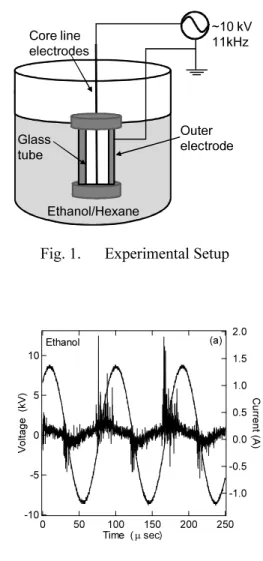
The experimental setup was shown in Fig. 1. The electrode structure was the coaxial type. The core electrode was Ti. The outer electrode was made of brass. The
Nagasaki Symposium on Nano-Dynamics 2010
P 23
55
high voltage was supplied to the core electrode, while the outer electrode was grounded. Glass tube was set between the core electrode and the outer electrode. Glass tubes were used for the substrate so that the deposited film can be easily removed from the glass substrate. The high voltage (1~10 kV) was generated by low-frequency (11 kHz) sine wave power supply.
Results and Discussions
High voltage in the form of sine wave was supplied to the core line electrode in every case. The current between both electrodes was large in the form of spikes, when the sine wave of the supplied voltage came to 0V, as shown in Fig. 2. It means that plasma was generated at large current region. This region is large at the high ratio of ethanol to hexane.
Ethanol is suitable to plasma generation. The film deposited inside the tube was investigated with FTIR. The film exhibited the polymer-like carbon feature. Moreover,
the uniform film was deposited when the mixture ratio (ethanol/hexane) was 1:1.
Conclusions
The plasma was generated in the mixture of hexane and ethanol in order to coat the inside of the tubes. The results indicate that the discharge was easily occurred in ethanol.
However, the uniform film can be deposited when the mixture ratio of hexane to ethanol is 1. The film exhibited the feature of polymer-like amorphous carbon film from FTIR analysis.
Acknowledgments
This research was partially supported by Research for promoting technological seeds from JST (2008-2009) and a Grant-in-Aid for Scientific Research Nagasaki University (2007-2008).
~10 kV 11kHz
Ethanol/Hexane
Outer electrode Core line
electrodes
Glass tube
Fig. 1. Experimental Setup
2.0 1.5 1.0 0.5 0.0 -0.5 -1.0
Current (A)
250 200 150 100 50
0 Time (µ sec)
10
5
0
-5
-10
Voltage (kV)
Ethanol (a)