Letter J. Geomag. Geoelectr., 43, 685-689, 1991
Quiescence of GLE-Producible Solar Proton Eruptions during the Transition Phase of Heliomagnetic Polarity Reversal
near the Solar-Activity-Maximum Period
Kazuo NAGASHIMA1, Shizuko SAKAKIBARA1, and Isao MORISHITA2 1 Cosmic -Ray Section , Solar-Terrestrial Environment Laboratory, Nagoya University,
Nagoya 464-01, Japan
2Department of Information Management, Asahi University, Hozumi-cho, Motosu-gun, Gifu 501-0,2, Japan
(Received June 6, 1991)
By using data of the ground-level-enhancement (GLE), of solar cosmic rays observed with the neutron and muon monitors in the period 1942-1990, it is shown that the solar proton eruptions producible GLE are forbidden during the transition phase of the heliomagnetic polarity reversal, near the period of the maximum solar activity. It is suggested that the quiescence of GLE is not due to the suppression effect of the proton eruption from the Sun by the strong solar magnetic field, but is due to the deterioration of the proton acceleration efficiency by the structual change of the field during the transition period.
The relativistic solar protons sometimes produce the enhancement of the cosmic- ray intensity observable with the neutron and muon monitors on the ground (e.g.
ELLIOT, 1952; CARMICHAEL, 1962; DUGGAL,1979; SMART and SHEA,1990; and refer- ences therein). We call this phenomenon the ground-level-enhancement (GLE) of solar cosmic rays. The occurrence of GLE is mainly in the period of the enhanced solar activity, but according to KODAMA (1962) it is forbidden in the maximum-activity pe- riod of the solar cycle when the sunspot number (R) is greater than some critical value (Rc) such as about 100. This suggests that the relativistic protons cannot escape from the Sun owing to the strong magnetic field in the extremely active period even though they might be accelerated to the relativistic energy. With the increase of GLE-events, his statement, however, has become an unsafe criterion for ascertaining the forbidden period of the occurrence. We propose here an alternative criterion as expressed by the title of the present paper.
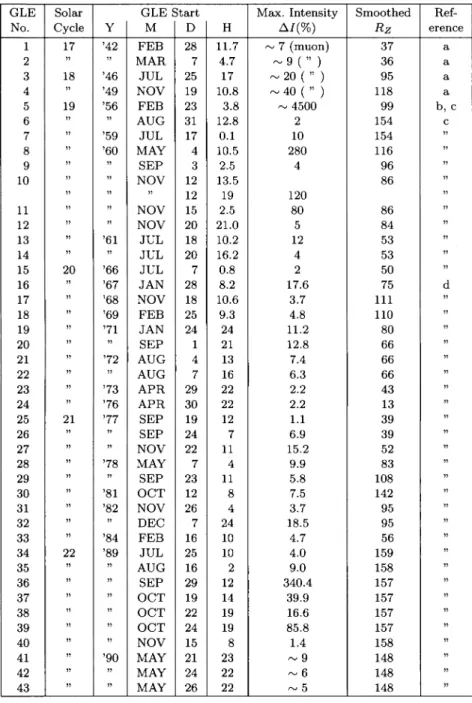
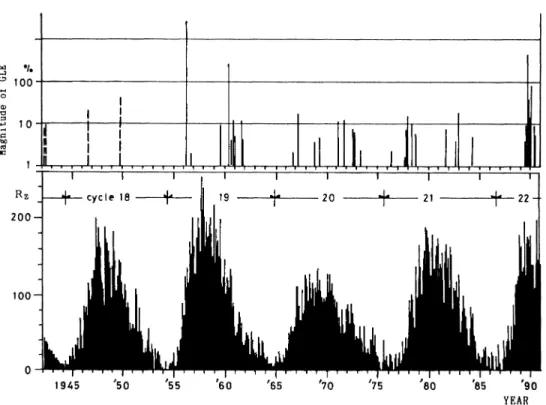
Data used for the analysis are 43 events observed in the period 1942-1990, as shown in Table 1. The occurrence time (Ti) of GLE is shown by the vertical line in Fig. 1, together with the sunspot number. As can be seen in the figure, his criterion in the above seems effective before the present solar cycle (#22). But, in the present cycle, many GLEs have been observed even in the maximum period for R > Rc.
Figure 2 shows the distribution of the relative occurrence time (zTR) of GLE which is measured from the epoch (Tmax) of the maximum sunspot number of the respective solar cycles shown at the bottom. As anticipated, the distribution does not show any depression near the period of the maximum solar activity and furthermore it rather
685
686 K. NAGASHIMA et al.
Table 1. Ground-based-enhancement (GLE) of solar cosmic rays observed with the neutron and
muon monitors in the period 1942-1990. ĢI is the hourly average of peak intensity of neutrons (unless specified) at high latitude station. Alphabetical symbol in the remaks represents the reference of the data source written below.
No. 1•`4: CHELTENHAM Ion Chamber, No. 5: LEEDS, No. 6•`15: DEEP RIVER, No. 1633:
1/2 (ALERT+McMURD), No. 34•`43: THULE.
Data sources:
a: FORBUSH and LANGE (1942), FORBUSH (1946), FORBUSH et al. (1950) and ELLIOT (1952), b: SITTKUS et al. (1956) and MEYER (1956),
c: SVESTKA and SIMON (1975),
d: WDC-C2 for Cosmic Rays, and Solar-Geophysical Data.
Quiescence of GLE-Producible Solar Proton Eruptions 687
shows a peak in the period. This implies that the criterion in the above cannot be
adopted any more. The quiescence of GLE seems to be related to the polarity reversal
of the solar magnetic field. Figure 3 shows the distribution of the occurrence time
(ĢTp) of GLE which is measured from the initial time (Tp) of the transition phase of
the heliomagnetic polarity reversal in each solar cycle. We have defined the transition phase as follows; it starts from the time of the sign change of the magnetic field in one of the polar regions (north or south) and ends at the time of the sign reversal
of the magnetic field in another polar region. The period of transition phase in each
solar cycle is shown by the horizontal bar in the figure and listed in the caption of the figure with references. In the early period, as there was no observation of the polarity
reversal, the transition in the solar cycle #17 has been assumed to have started near
the maximum solar activity and continued about one year, and the transition in the
cycle #18 has been inferred from the polarity dependence of the long term variation of
cosmic-ray intensity (cf. NAGASHIMA and MORISHITA, 1980; $ABCOCK, 1959). Such
assumption and inferrence does not give any decisive influence on the distribution, as
the GLE-events reported in these cycles (#17, #18) are very few. As can be seen in
Fig. 3, the occurrence frequency is maximum just before the period of the transition phase, becomes zero during the period and increases gradually afterwards.
It is noted that the absence of the proton events in this period is limited only in
the high energy region. According to the analysis of space probe data in the period
Fig. 1. Occurrence times and magnitudes of the ground-level-enhancement (GLE) of solar cosmic
rays expressed with the vertical lines and the sunspot number (R) during the period 1942-1990.
688 K. NAGASHIMA et al.
Quiescence of GLE-Producible Solar Proton Eruptions 689
of solar cycles #19•`#21 by SMART and SHEA (1990), the low-energy proton events
are observed even in the periods of the transition phase, although we can find, in
the Fig. 2 in their paper, some slight indication of the depression of the occurrence
frequency of the events in these periods. This indicates that the absence of GLE is
not due to the suppression effect of the proton eruption from the Sun by the strong
solar magnetic field. As can be seen in Fig. 3, the sunspot number does not show
any abrupt change at the bounds of the transition phase in the same solar cycle, and
the sunspot activities in the period in different solar cycles are considerably different
from each other. These facts indicate that the quiescence of GLE-producible solar
proton eruption during the transition phase is not due to the change of the solar
activities represented by the sunspot number, the solar radio flux and the like. The
principal cause of the quiescence would be to be sought in the structural change of
the solar magnetic field in the period, which could induce at least one of the following deteriorations of the particle acceleration efficiency; (1) the shortage of energy supply for the acceleration of the solar protons, (2) the reduction of the efficiency of the particle acceleration and (3) the shortening of the storage time of particles inside the source region for the acceleration to the relativistic energy.