2015 年度 修士論文
Plasticity in the larval life history of the salamander, Hynobius retardatus, in a
permanent pond with abundant spring water in hill areas of eastern Sapporo
札幌市東部の丘陵地にある湧水が豊富な池における エゾサンショウウオ幼生生活史の表現型可塑性
2131019 緑 卓馬
指導教員 野生動物学 教授 山舗 直子
酪農学園大学大学院酪農学研究科
CONTENTS
INTRODUCTION …1
MATERIALS AND METHODS
1. Study area …4
(1) Two study ponds
(2) Conditions of the permanent pond (3) Conditions of the temporary pond (4) Sympatric organisms in both ponds
2. Field survey …7
(1) Capture and measurement in the permanent pond (2) Capture and measurement in temporary pond (3) Judgement of larval developmental stages (4) Marking
3. Statistical analysis …9
RESULTS
1. Water temperature …9
(1) The permanent pond (2) The temporary pond
2. Spawning and hatching …11
(1) The permanent pond (2) The temporary pond
3. Growth, development and metamorphosis …12
(1) The permanent pond (2) The temporary pond DISCISSION
1. Variation of larval life history …16
2. Timing of metamorphosis and water temperature …18
3. Intra- and inter-specific interactions …20
4. Climatic effects …21
要約 …24
ABSTRACT …25
ACKNOWLEDGES …27
REFERENCES …28
FIGURES …35
1
INTRODUCTION
Amphibians have biphasic life sequences characterized by drastic metamorphosis of an aquatic larval morph to a terrestrial adult morph. Many amphibians have modified their developmental sequence by extending or shortening their larval period.
Phenotypic plasticity in timing of metamorphosis has been reported, and various abiotic and biotic environmental factors have been studied in both anurans and urodeles. Abiotic factors include water temperature (Bizer, 1978; Smith-Gill and Berven, 1979; Voss, 1993; Alvarez and Nicieza, 2002), hydroperiod (Wilbur, 1987;
Rowe and Dunson, 1995; Laurila and Kujasalo, 1999; Phillips et al., 2002), water level (Beachy, 1995), and photoperiod (Kukita et al., 2015). Biotic factors include population density (Scott, 1990; Newman, 1998), food availability (Krause et al., 2011), and competition and predation (Buskirk and Yurewicz, 1998; Boone et al., 2002; Segev and Blaustein, 2007; Orizaola et al., 2013). However, the difference in timing of metamorphosis cannot be interpreted by only one factor. Genetic factors have also been suggested (Merila et al., 2000a, b; Nishikawa and Matsui, 2008).
In urodeles, variations of larval life history have been shown even in conspecific populations. For example, there are interspecific variations of life histories in the banded newt, Triturus vittatus, and fire salamander, Salamandra salamandra (Segev and Blaustein, 2007), and there is considerable intraspecific variation in the emigration timing among ponds for three salamander species, Ambystoma maculatum, A. opacum, and Notophthalmus viridescens (Timm et al., 2007).
2
Moreover, it is known that populations of Ambystoma tigrinum in some ponds have several life histories: standard, neotenic and paedogenic (Bizer, 1978). In addition, Bruce (1982, 1985) reported that larvae of Eurycea bislineata have various life histories in different habitats.
In Japan, several studies have shown that some salamanders have variations of larval life history within conspecific populations; metamorphosis occurs in the same year of hatching (i.e., the first year) or in the second or third year (Kusano, 1981;
Misawa and Matsui, 1997; Nishikawa and Matsui, 2008). Hynobius retardatus is common and widely distributed only in subarctic Hokkaido Island, northern Japan.
This salamander normally spawns and hatches in early spring and metamorphoses within the hatched year. In permanent ponds at high altitude habitats, however, larvae overwinter several times and consequently metamorphose at one year of age or more (Iwasaki and Wakahara, 1999; Michimae, 2011). In a specific environment of Lake Kuttara, H. retardatus has been reported to show neotenic reproduction (Sasaki, 1924). It is known that larvae of this salamander are strictly carnivorous and usually prey on tadpoles of Rana pirica that co-exist during the breeding season.
Many previous studies showed intraspecific interaction in larvae of the salamander (Nishihara, 1999) and interspecific interactions between larvae of the salamander and tadpoles of the frog (Ohdachi, 1994; Michimae and Wakahara, 2002; Kishida et al,.
2014).
3
There is a unique pond in the suburbs of Sapporo in which there were many overwintered larvae. The pond is located not at a high altitude, but a low altitude, and is not ephemeral but permanent. Pond drying may be viewed as an extreme disturbance for larval amphibians, since larvae may be killed if the pond dries before metamorphosis occurs (Semlitsch et al., 1996). In contrast, pond permanency affects larval metamorphosis by permitting many predators, such as fishes, to persist (Semlitsch et al., 1996). The presence of many big larvae in early spring in the permanent pond seems to be due to no time constraint caused by desiccation and freezing of the pond, and there may be little predation pressure. In the permanent pond, it is expected that the combination of factors in the natural environment is relatively simple. There are some ponds in which the salamanders spawn every year near the permanent pond, but all larvae emigrate without wintering. In my laboratory, the life history of salamander larvae has been monitored and water temperature has been recorded in the permanent pond and another pond since 2011.
There have been only a few studies on the internal mechanism of metamorphosis in urodeles, while many studies have been conducted in anurans (cf. Rose, 2005).
Moreover, morphological features that are indices of metamorphosis in urodeles are not as clear as those in anurans (Taylor and Kollros 1946, Gosner 1960). Smith-Gill and Berven (1979) reported that there is differential sensitivity in growth and differentiation to temperature and larvae are affected by hormonal systems in amphibians. For salamanders, a few laboratory experiments have been carried out to
4
determine how a low temperature affects larval development and the thyroid gland (Moriya 1983a, b).
Based on previous research in my laboratory, it is expected that wintering of the salamander larvae is affected by mainly water temperature. However, it has not yet been clear that when and how water temperatures affect larval development and metamorphosis. In my thesis, relationships between water temperature and larval growth and development in H. retardatus by referring to not only body size but also larval developmental stages were investigated. Todd et al. (2011) reported that recent climate changes have induced delay and advancement in reproductive timing in an amphibian community. I therefore discussed what kinds of environmental changes affect larval life histories in the permanent pond.
MATERIALS AND METHODS 1. Study area
(1) Two study ponds
The larval life histories of Ezo salamander, H. retardatus, were studied at two small ponds in a residential area of Sapporo (alt. 60 m). The both ponds which are separated about 200 m, are located in a belt-like forest that was divided from ambient forests due to urban construction after the 1970’s. The salamander larvae overwinter in one of the pond, while they do not in the other pond. The former is a permanent pond with abundant groundwater supplied from some spring-fed spots (hereafter the
5
permanent pond). The latter pond is not permanent but partially dried up in summer and completely frozen in winter (hereafter the temporary pond).
Both of the ponds are surrounded by broad leaved deciduous trees (Japanese oak, Quercus crispula, and full moon maple, Acer japonicum, etc.). Direct sunlight shines on the ponds when leaves have fallen, but sunlight is intercepted due to canopy cover from mid-May to late September. Air temperature in the area around the ponds increases up to 30 °C in summer and decreases down to -15 °C in winter. In this study, I referred to air temperature data of weather station in my campus, Rakuno Gakuen University in Ebetsu, which is about 8 km from the pond. In each pond, a thermometer (RTR-52A, T&D Co.) was set, and water temperature per hour was logged to the nearest 0.1 °C.
(2) Conditions of the permanent pond
The spatial structure and thermal distribution of the permanent pond were measured twice, on March 1, 2014 in late winter and on July 5, 2014 in summer. The depth contour and longitudinal water temperature gradient of the pond are shown in Fig. 1. Maximum depth of the pond was approximately 190 cm. The pond had abundant groundwater supplied throughout the year from some spring-fed spots located at the bottom and edge of the pond (Fig. 1 A). Hence, an obvious vertical thermocline was not formed by continual discharge of groundwater (Fig. 1 B, C).
Maximum water temperature at a certain spot in the pond on March 1 was 9.1 °C,
6
and minimum water temperature on July 5 was 9.3 °C. Thus, the differences between maximum and minimum water temperatures in this pond were approximately 4.7°C on March 1 and approximately 2.5 °C on July 5. The pond overflows from one outlet and the water level is stable even when there is rainfall or snowmelt water is flowing into the pond. Although the surface layer of lower area of the pond was slightly frozen in mid-winter, the upper area was never completely frozen. The thermometer was set about 0.5 meters below the surface (Fig. 1). This pond has a bulky litter layer on the bottom.
(3) Conditions of the temporary pond
This pond (approximately 18 m x 9 m) has not only a litter layer but also a bulky bottom mud. Maximum depth of the pond was approximately 40 cm. There is no spring-fed spot, and, water level is unstable, e.g., water level is increased after raining, and fluctuation of water temperature is large. The thermometer was set about 0.1 meters below the surface.
(4) Sympatric organisms in the both ponds
Sympatric organisms, such as competitors and predators, might affect larval life of H. retardatus. Egg masses of a native brown frog, Rana pirica, were found every year sympatrically and concurrently with larvae of H. retardatus. There were dragonfly naiads and Japanese crayfish, Cambaroides japonicas, as potential
7
predators, and some benthos including Tubificidae, Gammaridea, and nymphs of Chironomidae as possible prey. The number of possible preys was scarce in the permanent pond, but largein the temporary pond.
2. Field survey
(1) Capture and measurement in the permanent pond
Larvae were collected with a dip net every week or twice per month from late February to late November each year. In the breeding season, from March to May, the number of egg sacs were searched and recorded before larvae captured. Numbers of embryos per egg sac were counted on April 4, and April 11, 2015. Some hatchling larvae were observed near the egg sacs, but they were very small and difficult to pick up. In order to capture larvae that had just emigrated to land, 10 pitfall traps were set around the pond. The traps were checked once or twice each week, and larvae that had emigrated were also captured by hand. We measured larval total length (TL:
from the tip of head to the tip of the tail) and snout-vent length (SVL: from the tip of the snout to the anterior margin of the cloaca) using a digital caliper (Mitutoyo, CD- 15PSX) to the nearest 0.01 mm after the larvae had been anesthetized by immersion in 0.05% MS222 (ethyl 3-aminobenzoate methane sulfonate, SIGMA-ALDRICH).
We also checked whether larvae were tail-defective or not. Collected larvae were released after they were come out of the anesthetic.
8
(2) Capture and measurement in the temporary pond
The number of egg sacs were searched and recorded in April and larvae were collected every week or twice per month from May to August each year. We set some pitfall traps and checked the traps each week, and we also captured by hand larvae that had emigrated. We measured the larval size as described above.
(3) Judgement of larval developmental stages
We determined the larval developmental stages according to the normal table for congeneric salamander H. nigrescens (Iwasawa and Yamashita, 1991). The main morphological features by which we decided larval stages after elongated hind legs were as follows: 5th toe being faintly recognizable (St. 60), 5th toe being recognizable but not completely (St. 62), 5th toe being clearly recognizable (St. 63), onset of regression of the dorsal fin (St. 64), regression of the dorsal fin reaching half of the body and onset of shortening of the external gills (St. 65), gills being small (St.
66), remarkable regression of the gills (St. 67), and complete disappearance of the gills (St. 68).
(4) Marking
In order to estimate the year of hatching and emigrating habit of larvae in the permanent pond, we marked 0+ larvae (i.e., larvae hatched from eggs spawned in the year) using VIE tags (Visible Implant Elastomer: Northwest Marine Technology,
9
Inc.) injected into limbs. From November in 2013 to April in 2014, we marked larvae with red tags until new hatching larvae were observed. When we captured non- marked larvae during the marking period, we marked these larvae with tags.
Furthermore, we injected blue tags of VIE from October in 2014 to April in 2015.
3. Statistical analysis
From winter in 2014 to early spring in 2015, larval SVL and composition of developmental stages in the permanent pond were analyzed by using nonparametric ANOVA in order to determine whether larvae could grow and develop or not.
Additional statistical analysis by using nonparametric multiple comparisons was carried out.
RESULTS 1. Water temperature
(1) The permanent pond
Successive changes of water temperature in 2013-2015 are shown in Fig. 2. In this pond, four seasonal transition phases of water temperature were recognized, such as warming period in spring, almost constant high period from late spring to early autumn, cooling period from mid-autumn to early winter, and almost constant low period in winter were recognized. Lengths of each period were slightly different among the years, but definitely applying each period was as follows: from June 10 to
10
September 20 in the constant high period (2013: mean (°C) ± SD = 10.77 ± 0.19, 2014: 10.78 ± 0.25, 2015:10.68 ± 0.27) and from December 10 to February 28 in the constant low period (2013-2014: 4.78 ± 0.50, 2014-2015: 5.65 ± 0.39). The mean temperature of the constant high period in 2014 was approximately 1.5°C higher than the water temperature near the spring-fed spot on July 5, 2014 as shown in Fig. 2 C.
Water temperature was lower than air temperature in the constant high period and was significantly higher than air temperature in the constant low period. During the warming and cooling periods, inversion occurred between air and water temperatures: in the cooling period, the water temperature became lower gradually according to the decreasing air temperature. Contrary to this, in the warming period, the water temperature became higher according to the increasing air temperature.
The end of warming period was almost the same time as the start of canopy closure around the pond. The cooling period was initiated at the time when daily minimum air temperature became lower than the water temperature, and proceeded simultaneously with leaves falling.
(2) The temporary pond
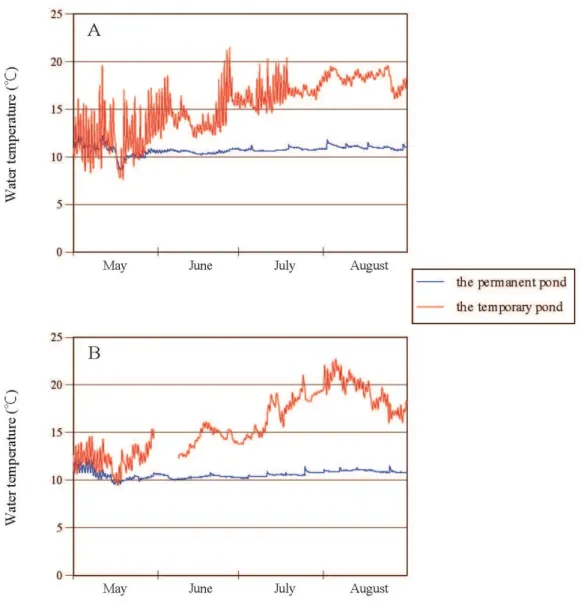
Successive changes of water temperature from May to August in 2014 and 2015 were shown in Fig. 3. Changes of water temperature were intense, and seasonal transition was different between years. Maximum water temperature is 21.5 °C in late June, 2014 and 22.7 °C in early August, 2015.
11 2. Spawning and hatching
(1) The permanent pond
In 2014, checking the first spawning was started from March 15 in 2014, but egg sacs were not found then. Two fresh egg sacs on March 22 and a total of 88 egg sacs of H. retarduts from March 22 to April 26 were found. The first hatching day was on April 26. The time to hatching was about 30 days in 2014.
In 2015, egg sacs were firstly found on February 28. Because they looked very fresh, these egg sacs were presumably spawned in the early morning of the day. A total of 107 egg sacs were found from February 28 to April 25. Hatching was confirmed from April 4 to May 30. The time to hatching was about 30 days in 2015 as well as in 2014.
Egg masses of the sympatric amphibian R. pirica were also found. Four egg masses were found from April 5 to 19 in 2014 and 11 egg masses were found from March 24 to 31 in 2015. Embryos in egg jelly of R. pirica disappeared before hatching in this pond.
(2) The temporary pond
Egg sacs of H. retarduts and egg mass of R. pirica were observed sympatrically. A total of 38 egg sacs of the salamander from April 19 to May 3, 2014 and 36 egg sacs from April 4 to May 9, 2015 were found. Egg masses of R. pirica were found also in
12
this pond. A total of 38 egg masses were found from 12 to 19 in April, 2014 and 26 egg masses from 4 to 25 in April, 2015 were found.
Larvae of H. retarduts hatched somewhat later than those of R. pirica did.
3. Growth, development and metamorphosis (1) The permanent pond
Many aquatic larvae were observed during autumn and winter each year. Some larvae with shortening gills were found on land, and those larvae thus were defined larvae that had just moved from the water to land as not juvenile but larvae that had emigrated. We captured a total of 139 and 147 tail-defective larvae in 2014 and 2015 respectively.
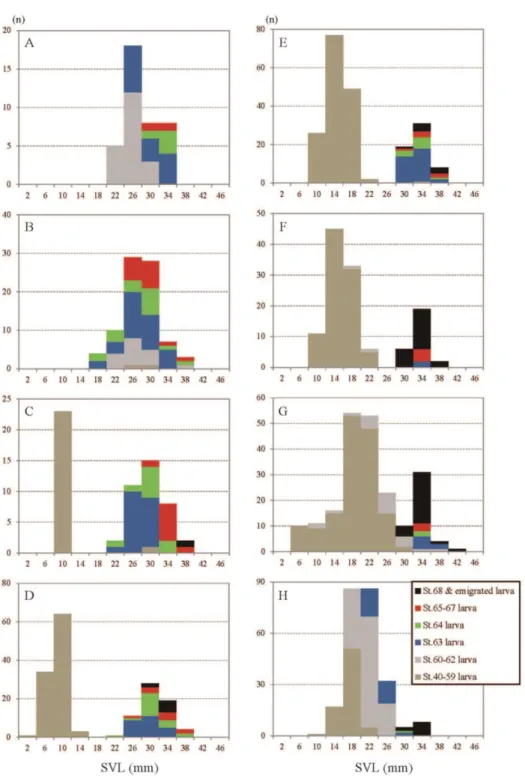
Size frequency histograms of larval SVL with composition of developmental stages from April 5 in 2014 to November 7 in 2015 are shown in Fig. 4. From April 5 to May 3 in 2014 and until April 11 in 2015, only one group of larvae was observed (Fig. 4 A, B, N-P).
In 2014, a smaller group of larvae emerged in mid-May (Fig. 4 C) and there were two separated peaks in the histogram from May to July. Both smaller and larger groups were clearly recognized until July 5 (Fig. 4 C-F). Larvae in the smaller group grew and some of the larvae in the smaller group reached the same size as that of slow-growing larvae in the larger group in July. The two groups joined, though a bimodal pattern remained on July 19 (Fig. 4 G). The number of larger individuals
13
decreased (probably due to emigration to land) and, as a result, the bimodal histograms changed to one mound-shaped histogram in August. This one mound- shaped histogram remained until the next spring in 2015.
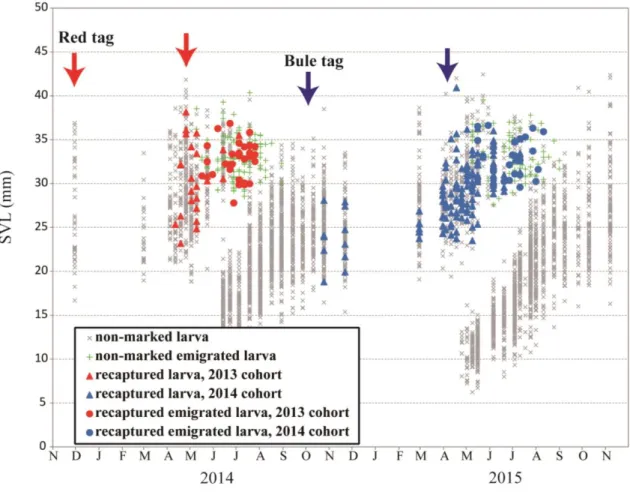
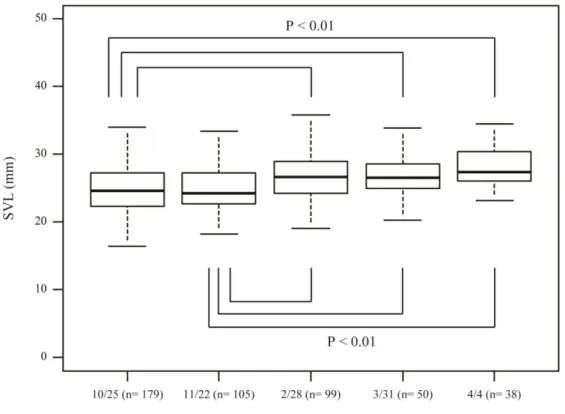
Newly hatched larvae steadily grew from May to September in 2014, that is, in the constant high period (Fig. 5). The SVLs of larvae in March and April in 2015 were significantly larger than those in October and November in 2014 (Steel-Dwass, P <
0.05, Fig.6), indicating that larval growth becomes considerably slow during the cooling and constant low periods.
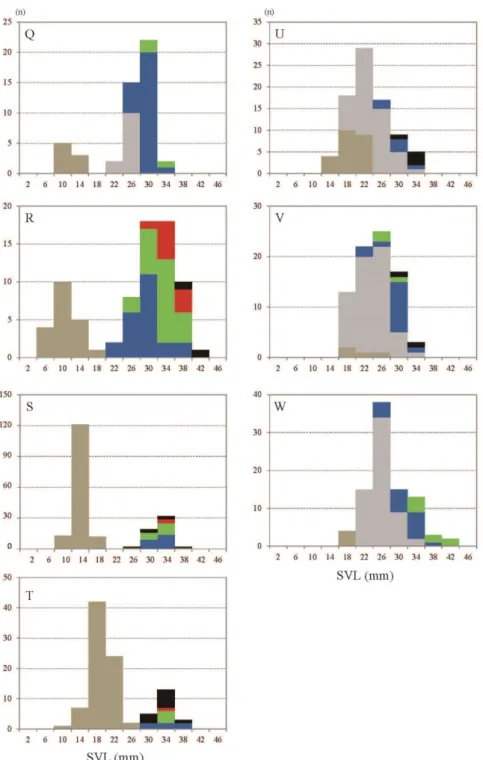
In 2015, a smaller group of larvae emerged in late April (Fig. 4 Q), and there were two separated peaks in the histogram from late April to July. Both smaller and larger groups were clearly recognized until June 6 (Fig. 4 Q-S). The bimodal histograms changed to one mound-shaped histogram in August, this one mound-shaped histogram remained in winter, continuously (Fig. 4 U-W).
One hundred and fifty-one larvae that had emigrated were captured from May 10 to August 30 in 2014 and 101 larvae May 2 to September 1 in 2015 (Figs. 4 C-I, R-V and 5), and they were found most frequently in July. Not only larvae at St. 68 with disappearing gills but also those at Sts. 65-67 with shortening gills were captured on land by hand and by using pitfall traps. The SVLs of the larvae that had emigrated were between 27.79 mm and 40.34 mm in 2014 and 27.58 mm and 41.80 mm in 2015, respectively. The SVLs of the larvae at St. 65 were between 19.43 mm and 38.35 mm in 2014 and between 28.71 mm and 42.42 mm in 2015, respectively, and
14
larvae larger than the minimum size of larvae that had emigrated were found in April and May.
Newly hatched larvae in May in 2014 progressively developed, and the developmental stage of the most advanced larvae was St. 62 on July 19 (Fig. 4 G).
After August 30, some of them reached St. 64 (Fig. 4I, J), and only a few of them reached St. 65 at the beginning of the cooling period (Fig. 4J, K). Larvae at St. 65 were not observed between October 11 and April 11 of the next year. Compositions of larval developmental stages were not significantly different during the cooling and constant low periods (Kruskal-Wallis, P > 0.05).
Newly hatched larvae were caught as early as in late April in 2015, but the developmental stage of the most advanced larvae did not reach at St. 60 on July 11 (Fig. 4 T). In 2015, there was no larva at St. 65 after July 11 (Fig. 4 T-W).
A total of 418 larvae were marked with red VIE tags from November in 2013 to April in 2014, and 58 larvae with red tags were re-captured by July in 2014. There were no larvae with red tags found after August in 2014 (Fig. 5). Moreover, a total of 765 larvae were marked with blue VIE tags from October in 2014 to April in 2015, and 159 larvae with blue tags were re-captured by April in 2015. Estimation of the number of overwintered larvae in the pond from October in 2014 to April in 2015 using Schnabel method showed 2,260-4,992. Total numbers of egg sacs were 88 in 2014 and 107 in 2015. The mean number of embryos per egg sac was 83.7 in 2015
15
(n=20). The potential numbers of hatching larvae were calculated to be 7,366 in 2014 and 8,956 in 2015.
(2) The temporary pond
In 2014, aquatic larvae were captured from May 24 to July 19, although the number of larvae was very small. There was no larva in this pond after late July, indicating all larvae emigrated to land by late summer. Size frequency histograms of larval SVL with composition of developmental stages from May 9 to August 11 in 2015 are shown in Fig. 7. Larvae that had emigrated were found from July 11 to August 11. The SVLs of the larvae that had emigrated were between 30.28 mm and 38.73 mm.
DISCUSSION
The permanent pond used in this study was shown that has three features; stable
water level, small fluctuations of water temperature, and limited predators. On the contrary, in the temporary pond used, water level was unstable, fluctuation of water temperature was large, and there were more competitor and predator than the permanent study pond. The present study indicated that larval life history, mainly timing of metamorphosis, of the spring-breeding salamander H. retardatus, was closely related to changes in the seasonal water temperature.
16 1. Variation of larval life history
When bimodal histograms changed to a one peak-like distribution in August 2014, it was difficult to distinguish by larval body size alone whether larvae were 0+, 1+
(hatched from eggs spawned in last year) or 2+ (hatched from eggs spawned in the year before last) larvae. To distinguish a larval year’s cohort in the field, both marking and stage judgement of larvae were used. There is a skeletochronology method by which lines of arrested growth are counted in stained preparations (Kanki and Wakahara, 2001; Nishikawa and Matsui, 2008), but that method were not used.
Larvae that had emigrated were first caught on May 30 in 2014. From that day until July 12, larvae of St. 68 and larvae older than St. 65 were collected on land. In August (Fig. 4 H, I), larvae that had emigrated were found, but larvae older than St.
65 were not captured, indicating that larvae that had emigrated in August were 1+
larvae but not 0 + larvae. Consequently, all of the larvae that emigrated from May 10 to August 30 derived from overwintered larvae, namely, larvae that hatched in the previous year.
Wintering larvae that hatched in 2013 were marked with red VIE tags, and some of them were captured from April to July in 2014. However, any larvae with red-tags were not captured after August in 2014 until November in 2015. These results suggest that no larvae would winter twice in the permanent pond. Thus, it is presumed that both 1+ larvae and 0+ larvae emigrated to land from the pond, and thus there were two larval life histories in the permanent study pond.
17
Overwintered larvae of some Asian salamanders are larger than metamorphosed larvae without overwintering (Misawa and Matsui, 1997; Iwasaki and Wakahara, 1999). On the other hand, in the mole salamander Ambystoma talpoideum, the size of late-metamorphosing individuals was not larger than that of individuals metamorphosing early, and early-metamorphosing individuals were larger at the first and second reproductions than were late-metamorphosing individuals (Semlitsch et al., 1988). Furthermore, neither the time of metamorphosis nor the size at metamorphosis was associated with survival to the first reproduction, and large females at the time of metamorphosis reproduced at a younger age than did small females (Semlitsch et al., 1988). In addition, larval growth and development in urodeles were influenced by other biotic factors: population density and cannibalism.
Larvae reared at high density were smaller at the time of metamorphosis than were those reared at low density (Wilbur and Collins, 1973). Moreover, larvae in a high density condition shortened their larval period to avoid cannibalism and metamorphosed at a small size (Ohdachi, 1994).
In this study, many premetamorphic larvae that were much larger than some of the larvae that had emigrated were captured in autumn. Hence, there is no correlation between SVL and larval stage. This result suggests that the required size to initiate metamorphosis was relatively small and that many larvae had grown to a size larger than the required size even before metamorphosing. However, the age and size at first maturation of H. retardatus are still poorly understood.
18 2. Timing of metamorphosis and water temperature
Water temperature has different effects on larval growth and development, with differentiation ceasing at low temperature as in winter, but growth continuing at a slow rate until water temperatures become too low and both cease (Smith-Gill and Berven, 1979; Morrison and Hero, 2003).
In endocrinology, thyroid hormones are known to play an essential role in regulation of amphibian metamorphosis. Results of several experiments on thyroid hormones have also been reported for the salamander H. retardatus. It has been shown that thyroid hormones are inactive at extremely low temperatures such as 4°C (Moriya, 1983a, b; Iwasaki and Wakahara, 1999). Moriya (1979, 1983a) reported that larvae maintained at 10 °C never metamorphosed but that they metamorphosed when transferred from 22°C to 10°C, suggesting that there is a critical temperature for metamorphosis. However, the endocrinological mechanism by which larval metamorphosis progresses in the salamander has not been fully elucidated.
The most progressed stage of larvae in the permanent pond was St. 64 from November, 2014 to April of the next year. Larvae at St. 65 were not found in the pond in October, probably due to emigration of all larvae at St. 65 to land even though their metamorphosis was not completed. In 2015, larvae at St. 65 were not found in autumn and winter, as well. Larval development and metamorphosis ceased after late autumn when water temperature was still not extremely low. Hereafter, I refer to the lower limit temperature to complete preparation of metamorphosis as a
19
hypothetical critical temperature (HCT). From the above results, it is presumed that the HCT acts on the threshold of initiating metamorphosis between St. 64 and 65. In addition, many larvae at Sts. 65-67 that had already emigrated were found, even though they remained in exposing gills. They were assumed to be in the preliminary stage of complete metamorphosing (St. 68).
Some 0+ larvae that had already reached St. 65 before the cooling period disappeared from the pond, suggesting that these larvae quickly progressed to metamorphosis and emigrated to a terrestrial environment. In contrast, other larvae younger than St. 64 in the cooling period overwintered. From these results, the HCT is expected to be nearly the same but slightly higher than the water temperature at spring-fed spots in winter. If larvae had moved to a spring-fed spot, where the water temperature was maximum in winter, larval developmental stages would be progressed to metamorphosis. Emigrating to a snowy terrestrial environment in winter may increase mortality risk. In order to avoid involuntary metamorphosis and emigration, the HCT might be slightly higher than the water temperature at spring- fed spots. However, it is not clear yet whether the HCT is physiologically determined or is dependent on geographically different temperature that is closely related to latitude and altitude of the habitat (Nakano et al. 1996). We need to conduct an additional survey at other ponds with abundant spring-fed water.
Overwintered larvae may resume progression quickly in the warming period.
Emigration of overwintered larvae was observed from May to August, and these 1+
20
larvae completely metamorphosed and emigrated in the following year of hatching.
However, the mean water temperature in the constant high period was approximately 10.8 °C, only 1.5°C higher than the water temperature near a spring-fed spot. In contrast, newly hatched larvae developed slowly in the constant high period, and most of the larvae did not metamorphose within the hatched year, consequently prolonging the aquatic larval period.
In the temporary pond, all of the larvae emigrated to land within the year of hatching. The mean of water temperature was much higher than the HCT from late spring to summer, thereby the larval development proceeded to St. 65-68 long before the time when the water temperature dropped to the HCT.
3. Intra- and inter-specific interactions
In the permanent study pond, many tail-defective larvae were caught in every survey, suggesting that the salamander larvae had been injured. The dragonfly larvae and Japanese crayfish, as suspected predators, were scarce compared with those in the temporary pond, indicating that the larvae had suffered injuries by intraspecific interaction, also known as cannibalism in H. retardatus (Ohdachi, 1994; Nishihara- Takahashi, 1999; Michimae and Wakahara, 2002). Preying upon larvae in a small cohort (i.e., 0+ larvae) by larvae in a large cohort (i.e., 1+ larvae) affects 0+ larval survival and activity rates (Boone et al., 2002; Segev and Blaustein, 2007; Wissinger et al., 2010). In H. retarduts it has been reported that the larvae that fed conspecifics
21
metamorphosed faster than larvae fed benthos (Michimae, 2011; Michimae and Emura, 2012). Thus, preying upon 0+ larvae by 1+ larvae might affect the development of 1+ larvae. In addition, embryos of R. pirica were decreased before hatching and almost tadpoles were quickly disappeared after hatching. In a sympatric breeding environment, tadpoles can lessen their risk of predation or mutilation by hatching earlier than the salamanders (Ohdachi, 1994), but the predation on embryos and tadpoles of the native frog with the large 1+ salamander larvae may occur in the permanent study pond. Thus, 1+ larvae can prey on next cohort larvae of H. retarduts and tadpoles of R. pirica as predictable gifts.
4. Climatic effects
In 2015, initiation of the breeding season is one month faster than in 2014. Several studies have shown trends for breeding earlier in some winter-spring breeding amphibians as a consequence of climatic warming (Reading, 1998; Carey and Alexander, 2003; Corn, 2005; Todd et al., 2011). Early breeding by terrestrial adults maybe provide larvae to prolong growth season length after hatching and indirectly encourage to metamorphose in the hatching year. Change in the groundwater temperature generally influences the behavior and distribution of aquatic animals.
Nakano et al. (1996) predicted that the geographic distribution of typical temperature-regulated cold-water fishes will shrink with rising groundwater temperature in relation to global warming. Groundwater temperature is generally 1-2
22
degrees higher than annual mean air temperature in the Japanese archipelago (Nakano et al., 1996, Arai, 2009). Local groundwater temperature was roughly estimated using a numerical equation by the altitude and latitude of the site, GWT = 56.364 - 1.120LAT - 0.005ALT (Nakano et al., 1996). Calculated groundwater temperature in our study area was approximately 8.4 °C, which is lower than the measured groundwater temperature between 9.1 and 9.3 °C at a spring-fed spot in the study pond.
Increasing groundwater temperature in response to future climatic warming will probably result in a rise in water temperature in the study pond, encouraging larval growth and increasing the proportion of larvae emigrating to land in the hatching year, as 0+ larvae. A decrease in the number of overwintering larvae maybe relieves predation pressure on tadpoles and competition between tadpoles and 0+ larvae will intensify.
The behavior and timing of metamorphosis of the salamander will be inescapably influenced by a change in the groundwater temperature. Determination of the occurrence and ratio of overwintering larvae is essential to understand the cause and effect of environmental changes and larval life history. For instance, it is likely that most of the larvae will metamorphose without wintering in the study pond if the water temperature would rises by several degrees Celsius. Monitoring of groundwater is important to predict changes of larval life history and to find some undetected disturbance in this area. Therefore, a continuous survey of the larval
23
population of H. retarduts will provide us to notice some sign occurred with environmental changes.
24 要約
エゾサンショウウオHynobius retardatus幼生の生活史多型は同じ個体群の中でも 見られる。幼生の発生は主に水温による影響を受けるが、生物的要因と同様に他の 非生物的要因もある。多くの越冬幼生が確認される捕食者が少ない池において、水 温の変動とエゾサンショウウオの幼生生活史の追跡を行った。池は年間を通して水 位が安定し、複数の地点から湧水が豊富に供給されており、周囲の樹冠形成により 夏の直射日光が遮られるため、年間の水温の変動幅は非常に小さく(5-10 °C)、明 確に4つに区分される季節的変動(1. 春の水温上昇期、 2. 春から秋の高水温期、 3.
秋から冬の水温下降期、 4. 冬の低水温期)がみられた。上陸個体は5月から8月ま で捕獲され、短いエラを持つSt.65-67の上陸個体も含まれていたことから、幼生は 完全に変態完了期(St. 68)にならなくても上陸できることが示唆された。秋から翌 年の早春にかけての幼生越冬期において、St. 64の個体は継続して捕獲されたが、
St. 65以降の個体は捕獲されなかった。このことから、ある水温がSt. 64とSt. 65の
間にある変態開始に閾値のような作用をしており、その値は冬季の最高水温である 湧水付近の水温よりもわずかに高いと推測された。越冬した幼生は春の水温上昇と ともに発生が再び進行した。幼生が孵化した時期から夏にかけて水温はあまり上昇 しないため、孵化後の幼生の発生速度は遅く、ほとんどは孵化した年内に変態する ことなく幼生として越冬した。一方、湧水のない周辺の池では、春から夏にかけて 水温が大幅に高くなり、全ての幼生が8月までに当年幼生として上陸した。
25 ABSTRACT
Variations of larval life histories in the salamander, Hynobius retardatus, have been shown even in the same populations. Larval development is mainly affected by water temperature, but other abiotic factors, as well as biotic factors, are also
involved. The salamander larvae were monitored in a permanent pond where there were many overwintered larvae and limited predators. It was revealed that there were four seasonal transition phases of water temperature period (i.e., warming period in spring, the constant high period from summer to autumn, cooling period from autumn to winter, and the low constant period in winter). The range of temperatures was very narrow (between 5 and 11 °C), which was due to abundant groundwater supplied from some spring-fed spots throughout the year and canopy covered from spring to autumn. Many larvae with shortening gills (Sts. 65-67) that had emigrated to land were found, indicating that larvae could emigrate before completion of metamorphosis (St. 68). During the periods from late autumn in 2014 to the next early spring, larvae at St. 64 were found continuously, while larvae after St. 65 were not. It was presumed that a certain critical temperature acts like a threshold of
initiating metamorphosis between St. 64 and 65. The critical temperature is expected to be nearly the same but slightly higher than the water temperature at spring-fed spots in winter. Overwintered larvae, which were younger than St. 64, resumed their development in spring and metamorphosed from May to August. Since water
temperature in summer was not so high, newly hatched larvae developed slowly, and
26
most of the larvae did not metamorphosed within the year of hatching. Monitoring of the salamander larvae and the water temperature were also performed in a temporary pond near the permanent one. All of the larvae developed during the water
temperature was considerably high, and emigrated to the land without wintering.
27
ACKNOWLEDGMENTS
I would like to express my deep gratitude to Dr. Naoko Yamashiki. I am extremely
grateful to Dr. Masami Wakahara, Dr. Hidetomo Iwano, and Dr. Toru
Suzuki for helpful advice and comments. Special thanks go to Mr. Tomoaki
Kuwahara for the tremendous support throughout my master study. I wish to thank
Dr. Nobutake Nakatani and Mr. Tomoki Kikuchi for measuring spatial structure and
water temperature in entire the permanent pond. I also wish to thank the members of
my laboratory for supporting field survey.
28 REFERENCES
Alvarez D, Nicieza AG (2002) Effects of temperature and food quality on anuran larval growth and metamorphosis. Funct Ecol 16: 640-648
Arai T (2009) Climate change and variations in the water temperature and ice cover of inland waters. Jpn J Limnol 70: 99-116
Beachy CK (1995) Effects of larval growth history on metamorphosis in a stream- dwelling salamander (Desmognathus ochrophaeus). J Herpetol 29: 375-382 Bizer JR (1978) Growth rates and size at metamorphosis of high elevation
populations of Ambystoma tigrinum. Oecologia 34: 175-184
Boone MD, Scott DE, Niewiarowski PH (2002) Effects of hatching time for larval ambystomatid salamanders. Copeia 2002: 511-517
Bruce RC (1982) Larval periods and metamorphosis in two species of salamanders of the genus Eurycea. Copeia 117-127
Bruce RC (1985) Larval period and metamorphosis in the salamander Eurycea bislineata. Herpetol 41: 19-28
Carey C, Alexander MA (2003) Climate change and amphibian declines: Is there a link? Divers Distrib 9:111-121
Corn PS (2005) Climate change and amphibians. Anim Biodivers Conser 28: 59-67 Gosner KL (1960) A simplified table for staging anuran embryos and larvae with
notes on identification. Herpetol 183-190
29
Iwasaki F, Wakahara M (1999) Adaptable larval life histories in different populations of the salamander, Hynobius retardatus, living in various habitats.
Zool Sci 16: 667-674
Iwasawa H, Yamashita K (1991) Normal stages of development of a hynobiid salamander Hynobius nigrescens Stejneger. Jpn J Herpetol 14: 39-62
Kanki K, Wakahara M (2001) The possible contribution of pituitary hormones to the heterochronic development of gonads and external morphology in overwintered larvae of Hynobius retardatus. Int J Dev Biol 45: 725-732 Kishida O, Costa Z, Tezuka A, Michimae H (2014) Inducible offences affect
predator-prey interactions and life-history plasticity in both predators and prey. J Anim Ecol 83: 899-906
Krause ET, Steinfartz S, Caspers BA (2011) Poor nutritional conditions during the early larval stage reduce risk-taking activities of fire salamander larvae (Salamandra salamandra). Ethology 117: 416-421
Kukita S, Gouda M, Ikeda S, Ishibashi S, Furuya T, Nakamura K (2015) Effects of photoperiod and temperature on growth and development in clouded salamander (Hynobius nebulosus) larvae. Zool Sci 32: 266-271
Kusano T (1981) Growth and survival rate of the larvae of Hynobius nebulosus Tokyoensis Amphibia, Hynobiidae. Res Popul Ecol 23: 360-378
30
Laurila A, Kujasalo J (1999) Habitat duration, predation risk and phenotypic plasticity in common frog (Rana temporaria) tadpoles. J Anim Ecol 68:
1123-1132
Merila J, Laurila A, Laugen AT, Rasanen K, Pahkala M (2000a) Plasticity in age and size at metamorphosis in Rana temporaria: Comparison of high and low latitude populations. Ecography 23: 457-465
Merila J, Laurila A, Pahkala M, Rasanen K, Laugen T (2000b) Adaptive phenotypic plasticity in timing of metamorphosis in the common frog Rana temporaria.
Ecoscience 7: 18-24
Michimae H (2011) Plasticity in the timing of a major life-history transition and resulting changes in the age structure of populations of the salamander Hynobius retardatus. Biol J Linn Soc 102: 100-114
Michimae H, Emura T (2012) Correlated evolution of phenotypic plasticity in metamorphic timing. J Evol Biol 25: 1331-1339
Michimae H, Wakahara M (2002) A tadpole-induced polyphenism in the salamander Hynobius retardatus. Evolution 56: 2029-2038
Misawa Y, Matsui M (1997) Larval life history variation in two populations of the Japanese salamander Hynobius kimurae (Amphibia, Urodela). Zool Sci 14:
257-262
31
Moriya T (1979) Effect of temperature on embryonic and post embryonic development of salamander Hynobius retardatus. Low Temp Sci Ser B 37:
113-116
Moriya T (1983a) Cytological changes induced by low temperature in the thyroid glands of larvae of the salamander Hynobius retardatus. Gen Comp Endocrinol 49: 8-14
Moriya T (1983b) The effect of temperature on the action of thyroid hormone and prolactin in larvae of the salamander Hynobius retardatus. Gen Comp Endocrinol 49: 1-7
Morrison C, Hero JM (2003) Geographic variation in life-history characteristics of amphibians: A review. J Anim Ecol 72: 270-279
Nakano S, Kitano F, Maekawa K (1996) Potential fragmentation and loss of thermal habitats for charrs in the Japanese archipelago due to climatic warming.
Freshwater Biol 36: 711-722
Newman RA (1998) Ecological constraints on amphibian metamorphosis:
Interactions of temperature and larval density with responses to changing food level. Oecologia 115: 9-16
Nishihara-Takahashi A (1999) Faster growth of head size of pre-feeding larvae in a cannibalistic population of the salamander Hynobius retardatus. Zool Sci 16:
303-307
32
Nishikawa K, Matsui M (2008) A comparative study on the larval life history in two populations of Hynobius boulengeri from Kyushu, Japan (Amphibia:
Urodela). Curr Herpetol 27: 9-22
Ohdachi S (1994) Growth, metamorphosis, and gape-limited cannibalism and predation on tadpoles in larvae of salamanders Hynobius retardatus. Zool Sci 11: 127-131
Orizaola G, Dahl E, Nicieza AG, Laurila A (2013) Larval life history and anti- predator strategies are affected by breeding phenology in an amphibian.
Oecologia 171: 873-881
Phillips CA, Johnson JR, Dreslik MJ, Petzing JE (2002) Effects of hydroperiod on recruitment of mole salamanders (genus Ambystoma) at a temporary pond in vermilion county, Illinois. Trans Ill Acad Sci 95: 131-139
Reading CJ (1998) The effect of winter temperatures on the timing of breeding activity in the common toad Bufo bufo. Oecologia 117: 469-475
Rose CS (2005) Integrating ecology and developmental biology to explain the timing of frog metamorphosis. Trends Ecol Evol 20: 129-135
Rowe CL, Dunson WA (1995) Impacts of hydroperiod on growth and survival of larval amphibians in temporary ponds of central Pennsylvania, USA.
Oecologia 102: 397-403
Sasaki M (1924) On a Japanese salamander, in lake Kuttarush, which propagates like the axolotl. J Coll Agr Hokkaido Imp Univ 15: 1-36
33
Scott DE (1990) Effects of larval density in Ambystoma opacum an experiment in large-scale field enclosures. Ecology 71: 296-306
Segev O, Blaustein L (2007) Priority effects of the early breeding fire salamander on the late breeding banded newt. Hydrobiologia 583: 275-283
Semlitsch R, Scott D, Pechmann J, Gibbons J (1996) Structure and dynamics of an amphibian community: Evidence from a 16-year study of a natural pond.
Long-term studies of vertebrate communities. Academic Press, San Diego, California 217-248
Semlitsch RD, Scott DE, Pechmann JHK (1988) Time and size at metamorphosis related to adult fitness in Ambystoma talpoideum. Ecology 69: 184-192
Skelly DK, Freidenburg LK, Kiesecker JM (2002) Forest canopy and the performance of larval amphibians. Ecology 83: 983-992
Smith-Gill SJ, Berven KA (1979) Predicting amphibian metamorphosis. Am Nat 113: 563-586
Taylor AC, Kollros JJ (1946) Stages in the normal development of Rana pipiens larvae. Anat Record 94: 7-23
Timm BC, McGarigal K, Gamble LR (2007) Emigration timing of juvenile pond- breeding amphibians in western Massachusetts. J Herpetol 41: 243-250
Todd BD, Scott DE, Pechmann JHK, Gibbons JW (2011) Climate change correlates with rapid delays and advancements in reproductive timing in an amphibian community. Proc R Soc B 278: 2191-2197
34
Van Buskirk J, Yurewicz KL (1998) Effects of predators on prey growth rate:
Relative contributions of thinning and reduced activity. Oikos 82: 20-28 Voss SR (1993) Relationship between stream order and length of larval period in the
salamander Eurycea wilderae. Copeia 1993: 736-742
Wilbur HM (1987) Regulation of structure in complex systems experimental temporary pond communities. Ecology 68: 1437-1452
Wilbur HM, Collins JP (1973) Ecological aspects of amphibian metamorphosis.
Science 182: 1305-1314
Wissinger SA, Whiteman HH, Denoel M, Mumford ML, Aubee CB (2010) Consumptive and nonconsumptive effects of cannibalism in fluctuating age- structured populations. Ecology 91: 549-559
35
Fig. 1. Plan view and longitudinal section view of the permanent pond. Depth contour lines are shown in A. Water temperature gradient in winter, March 1, 2014, is shown in B, and that in summer, July 5, 2015, is shown in C. Note that water temperatures at the points around a spring-fed are maximum in summer and minimum in winter.
36
Fig. 2. Successive changes of water temperature in the permanent pond in the period April 2013 to November 2015. Data for air temperature were obtained from a
weather monitoring station in Rakuno Gakuen University about 8 km from the pond.
Note that there are four water temperature periods in one year: warming, constant high, cooling, and constant low periods.
37
Fig. 3. Comparison water temperature between the permanent pond and the temporary pond from May 1 to Aug. 31. A, 2014; B, 2015. Some of data were not recorded by malfunction of thermometer in 2015.
38
Fig. 4-1. Size frequency histograms with composition of developmental stages of larva H. retardatus in the permanent pond. A, Apr 5, 2014; B, May 3; C, May 10; D, May 24; E, June 14; F, July 5; G, July 19; H, Aug 2.
39
Fig. 4-2. Size frequency histograms with composition of developmental stages of larva H. retardatus in the permanent pond. I, Aug 30; J, Sep 14; K, Oct 11; L, Oct 25; M, Nov 22; N, Feb 28, 2015; O, Apr 4; P, Apr 11. Graph legends, see Fig. 4-1.
40
Fig. 4-3. Size frequency histograms with composition of developmental stages of larva H. retardatus in the permanent pond. Q, Apr 30, 2015; R, May 2; S, Jun 6; T, Jul 11; U, Aug 11; V, Sep 1; W, Nov 7. Graph legends, see Fig. 4-1.
41
Fig. 5. Time sequence in SVL distributions and recapture of marked larvae from October 2013 to May 2015. Marking 0+ larvae with VIE tags was done several times (indicated by color arrows) from November to April; red tags for 2013 wintering cohort, blue tags for 2014. Recaptured larvae with red or blue marks are shown, respectively.
42
Fig. 6. Comparison of SVL in 2014 wintering cohort. Boxes indicate interquartile range, the thick horizontal bar in boxes indicates median, and the whiskers indicate range of data. The SVL of larvae in early spring in 2015 was significantly larger than that in late autumn in 2014 (Steel-Dwass).
43
Fig. 7. Size frequency histograms with composition of developmental stages of larva H. retardatus in the temporary pond. A, May 9, 2015; B, Jul 4; C, Jul 11; D, Aug 11.