
3
Trends in Services Sciences in Japan and Abroad
KAZUYOSHI HIDAKA Affiliated Fellow
1 Introduction
American and European universities are taking a new approach to services. By regarding services as part of science and applying scientific methods to solve problems associated with services, they intend to increase productivity and bring about innovations in services, thereby invigorating the economy. This emerging academic discipline is called “Services Sciences, Management and Engineering,” or simply “Services Sciences.” The services here refer to the interactive process of creating economic values between the service provider and the user, and include not only the service industry as a tertiary industry but also the service business in the manufacturing sector.
This article explains how services sciences have developed (Chapter 2), what services sciences are (Chapter 3), services sciences in European and American universities (Chapter 4), and the current status of this field of research in Japan (Chapter 5), followed by a conclusion (Chapter 6).
2 Background
2-1 U.S. investment in service research as a national strategy
The U.S. Council on Competitiveness published a report (commonly known as the “Palmisano Report”[1]) in December 2004 that emphasizes the importance of national innovation strategy from the three perspectives of human resources, investment and infrastructure. Based on an analysis of the current position of the U.S., the report cites, as the reasons that the country needs innovation, threats from other countries as a result of globalization, a slowdown in research in science and technology, and delays in smooth
technology transfer to the manufacturing sector.
It also points out the service sector’s lack of research investment in innovative business process design, organization and management, despite ser vices’ major contribution to the economy. To put it simply, a factor behind this report is a perception that research investment in services should be addressed as part of U.S.
national strategy. The report triggered a move toward integrating many recent approaches to services in academia into the term “services sciences.”
2-2 Development of the service economy
W hat k i nd of role are ser vices g iven i n the global economy? Nowadays, services are increasingly important to the economy. This is evident from two facts: the service industry has grown significantly, and even companies that fall outside of the service industry are more and more reliant on “service-based business.”
(1) Development of the service industry Trends in the working population by industry demonstrate that the workforce in the service industry has increased sharply worldwide. Figure 1 shows the change in the working population in the world's top 10 countries by workforce size over the past two centuries[2]. In developed countries, mainly in Europe and North America, the work i ng popu lation i n the seconda r y (manufacturing) industry increased sharply over the periods of the First Industrial Revolution, which was ushered in by the improvement of spinning machines in England in the late 18th century, and the Second Industrial Revolution, which took place as a result of the increased use of oil and electricity in the late 19th century.
However, by the middle of the 20th century,
the service industry had gained momentum in these countries. Unlike Western countries, newly industrializing countries, such as China and India, are shifting directly from the age of agriculture to that of services, without experiencing a period of surge in secondary-industry workforce. In Japan, the workforce in the service industry has grown as much as, or greater than, that in the manufacturing industry since the postwar high-growth period.
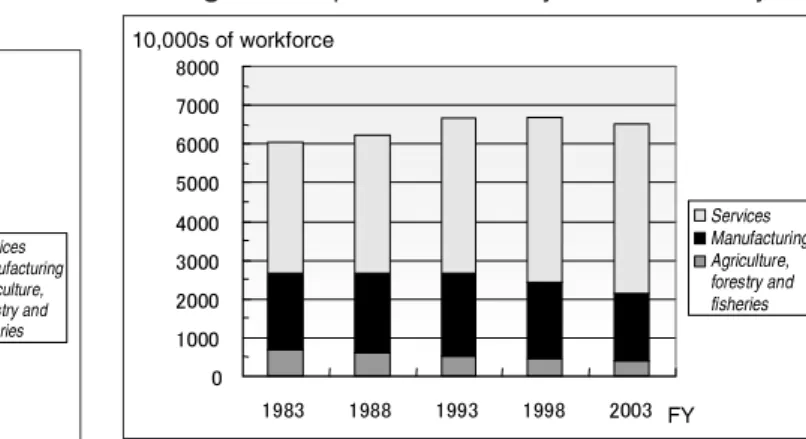
Fig u r e 2 shows Jap a n’s g r o s s dome s t ic product by econom ic activ it y. T he g r aph demonstrates that the service industry exceeds the manufacturing industr y in not only the contribution to the gross domestic product, but also the growth rate. Figure 3 shows the trend
in Japan’s workforce size by economic activity.
According to this graph, the workforce in the service industry continues to increase despite a decline in the total workforce since 1998.
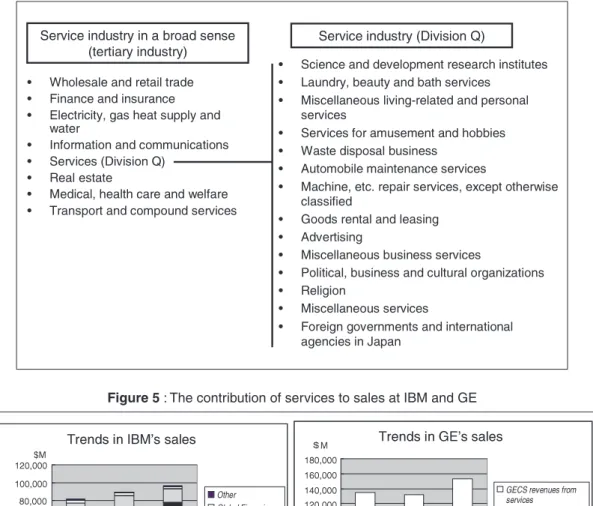
“Service industry” here refers in a broad sense to that defined by the Japan Standard Industrial Classification set by the Ministry of Internal Affairs and Communications (Figure 4), which is also known as tertiary industry.
(2) Growth of services in the manufacturing industry
Next, let us examine how services have grown in the manufacturing industry.
Fig u re 5 shows changes i n an nua l sa les between 2002 and 2004 for the U.S. firms IBM
Figure 1 : Growth of the service industry in major developed countries
Source : http://www.nationmaster.com Figure 2 : Japan’s gross domestic product
by economic activity
Source: Annual Report on National Accounts (the Cabinet Office, Government of Japan) [3]
Figure 3 : Japan’s workforce by economic activity
Source: Annual Report on National Accounts (the Cabinet Office, Government of Japan) [3]
and General Electric. The contribution by services increased for both companies. In particular, services came to account for over 50% of IBM’s sales in 2004, exceeding the combined sales of hardware and software. These services include systems constr uction, consulti ng, systems integration, outsourcing, maintenance, and support services. For General Electric, the sum of the top two sections of the bar (“GECS revenues from services” and “Sales of services”) is assumed to represent service-related sales.
The manufacturing industry is undergoing a major transition to services, not just in sales but also in business structure. B. Van Looy et al.’s “Services Management”[6] provides in Chapter 3 a detailed explanation of the recent transformation of business strateg y in the
manufacturing industry from the perspective of business structure. This literature describes manufacturers’ transition from “manufacturing and supplying goods alone” to “providing goods together with added values” and eventually to
“promoting service business strategy.” Providing goods together with added values refers to combining products with maintenance, usage assistance, in formation provision, suppor t for user communities, and other services that increase customer values. Promoting service business strategy represents extending the scope of service to support and maintain even competitors’ products, in a quest to broaden the ser vice business from the viewpoint of customer value orientation. This move toward more extensive, customer- oriented services
Figure 4 : Classification of the service industry by the Japan Standard Industrial Classification (the Ministry of Internal Affairs and Communications)
Figure 5 : The contribution of services to sales at IBM and GE
Source: Consolidated financial statements, IBM, 2005 [4], Statement of Earnings, General Electric, 2005 [5]
has become common in many manufacturing i ndu st r ie s, i nclud i ng t hos e t h at pro duce automobi les and electr ical and electron ic products.
T he above d iscussion sug gests t hat t he importance of services to companies in the global economy is rapidly increasing, both quantitatively and qualitatively, in manufacturing and service industries alike.
2-3 Factors behind development of the service economy
There are several reasons for the development of the service economy: With increased personal incomes, people are more willing to pay to have their chores done by somebody else; the growth of dual-income families and an aging population have led to the emergence of new assistance businesses; technological development, such as advances in the Internet and communications technologies, has dramatically changed the qualit y and quantit y of available ser vices;
introduction of advanced products has sharply increased demand for support and maintenance;
and companies have begun outsourcing business processes as a result of consolidation of their business sectors into components for selection and concentration on core competence[6].
From a broader perspective, some experts argue that the reason for ser vice economy development is a transition from an economy that centers on the ownership and trade of land and natural resources to one that is driven by knowledge, skills and other human assets. This argument is described in detail by S.L. Vargo, R.F.
Lusch et al. in “Evolving New Dominant Logic for Marketing”[8].
3 Services sciences
3-1 The definition, characteristics and issues of services
As mentioned in Chapter 2, there are two
types of services: services constituting tertiary industry and services in manufacturing industry.
Although many experts have attempted to define services by addressing the essence of services as an economic activity so that the definition can apply to both types of services and cover diverse tasks in the service industry, none of their definitions have gained general approval. Table 1 lists examples of these definitions.
Likewise, many researchers have taken diverse approaches to characterizing services[2, 6 -9], and their research papers commonly cite intangibility, simultaneity and heterogeneity. They point out that these characteristics of services are attributable to difficulties that are nonexistent in product-based economic activities.
“Intangibility” refers to the state whereby the things to be provided as a result of the provider’s activities are effects that are unable to be physically handled. This translates into the economic value of the provided things being less concrete than that of tangible products.
As a consequence, it is more difficult to price and manage ser vices, def i ne and measu re productivity, and evaluate quality in order to be accountable to users.
“Simultaneity” implies that production and consumption are interactive and concurrent processes. For example, medical practice and education are services that primarily consist of personal communication. Such economic activities require the simultaneous involvement of the provider and the user of the service, such as a doctor’s diagnosis concurrent with a patient’s consultation, and a teacher’s guidance concurrent with a student’s learning. In this model, unlike that in which a product is made and subsequently delivered to the user, the user is part of the economic activity, and the reliance on users or consumers is significant. This raises the issue of how to improve the user’s capacity to effectively use services. In other words, the service provider needs to consider user-side innovation (demand Table 1 : Definitions of services [9,16]
• An activity or series of activities provided as a solution to customer problems (Gronroos, 1990)
• All economic activity whose output is not physical product or construction (Brian et al, 1987)
• Intangible and perishable… created and used simultaneously (Sasser et al, 1978)
• A time-perishable, intangible experience performed for a customer acting in the role of co-producer (Fitzsimmons, 2001)
• A change in condition or state of an economic entity (or thing) caused by another (Hill, 1977)
innovation) as well as its own innovation.
Simultaneity causes another problem: inability to inspect the quality of services before they are delivered to users. Furthermore, the need for simultaneous existence of the producer and the user can make geographical distance a key factor. In this regard, companies that pursue globalization to strengthen their price competitiveness should address services from a different perspective than that applied with respect to products.
“Heterogeneity” refers to the idea that the same services can have different effects and elicit different responses, depending on the provider, the place of provision, and the user's mental state and environment. This underlines the importance of improving the quality of the front end, i.e., those who directly interact with users. However, being heterogeneous also implies the possibility of differentiation. Depending on the types of services, companies should decide which model to pursue: one for providing standard, uniform services or another aimed at differentiation.
3-2 Services sciences
(1) The targets of services sciences
Services sciences have three objectives. First, to provide methods for scientifically analyzing services, efficiently managing services, and maximizing the productivity of services through engineered production processes. Second, to solve problems arising from the characteristics of services that were discussed in Section 3 -1, and consequently to improve productivity.
Third, to explore a framework for systematically developing innovation. The research division o f I B M , w h ic h o r i g i n a t e d t h i s a c a d e m ic discipline, uses the term “services sciences” to refer to “Services Sciences, Management, and Engineering.” The services referred to include both the service industry and services in the manufacturing industry.
Jap a n’s h ig h po s t wa r g r ow t h h a s b ee n dependent on an economy in which people produce goods and sell them. However, a parallel economic stream that provides services and pursues values has grown to the point where it accounts for an essential proportion of both the global and the Japanese economies.
In other words, stimulation of the service economy can contribute significantly to global and Japanese economic revitalization. Experts agree that services sciences should be promoted as a framework for systematically addressing stimulation of the service economy.
(2) Research issues in services sciences What should be researched in services sciences is still under debate and thus remains largely undefined. The most important issue at this point may be deciding what to research in order to improve productivity and enable innovation in services. However, there are several emerging topics in the field of services sciences.
(A) Service innovation management
A major research issue is searching for methods of systematically creating innovation in services to improve service productivity and of developing new business seeds, and proposing practical applications for such methodologies. Seeking innovation in business processes through which services are actually provided is another key issue. This will include research into legislation because dynamic changes in business processes and the advent of unconventional business processes are expected.
(B) Technology to improve service efficiency Clarifying the role of technology in services is considered to be a major research issue. This consists of two aspects: how to exploit existing technologies, and what kinds of new technologies will be needed. For example, research into technologies such as ubiquitous computing, robotics and networks should originate from awareness of the ser vice context, i.e., how people use a given technology, rather than follow conventional technology- driven development models. Resulting technologies are expected to become key elements of services.
(C) Setting the price of services
Since ser vices are intangible and vaguely defined, their values tend to be determined from the user’s point of view. This makes the pricing of ser vices more difficult than that of products, whose performance is explicitly
defined by physical and objective specifications.
For this reason, establishing a pricing method that is convincing for both the provider and the user is essential. Research should be conducted on methodologies and tools to dynamically price services, based on information from the market, users and competitors. At the same time, research is also needed on how to quantify (digitize) personal feelings and relate them to mathematics and economics. This is because the final value of services is assessed in relation to the user’s satisfaction, and this highly subjective factor needs to be incorporated into the pricing model.
(D) Measuring productivity in services
Defining the productivity of ser vices is a challenging task because ser vices produce intangible output and therefore it is often difficult to identify what has been produced. Research is needed on models and methods to quantify the effects of services and estimate the investment that has actually been made to implement the applicable services.
(E) Testing services
Since the production and consumption of services tend to be simultaneous, their effects cannot be tested before consumption. If the positive and negative effects associated with services can be projected by computer simulation or other technologies, services of higher quality may be provided. The development of prior testing methods to improve service quality is a prospective research issue.
(F) Risk management for service projects Construction of information systems is a critical service in today’s society, but managing such projects has become extremely difficult because of advanced and complex technology, diverse and complicated user demands, and intensifying market competition. Research to predict and resolve project risks, the most serious threat in managing such strenuous service projects, through collective application of mathematics, organization theory, human science, economics and other disciplines, is recognized as a concrete research issue in services sciences.
(G) Methodologies and tools to improve quality and efficiency in business services
(Business process modeling)
To improve business services in terms of both quality and efficiency, a scientific framework is necessary in order to comprehensively analyze the business operations of the company or office for which services are provided. One example of such a framework is a technique that divides a company’s overall operations into components, with no overlaps or omissions, and formulates the workflow between individual components. This technique applies a component technology used in software development and splits a business model into components in order to express it as a model. This serves as a tool for determining the components to which services should be directed for greater effectiveness and what kind of impact services will have on key performance indicators (KPI). Such business process modeling is expected to become increasingly important as a research area.
(H) Operations research (OR) and total optimization
O p e r at io n s r e s e a r c h ( OR) i s a f i el d of research that originated in the U.S. and the U.K. during the Second World War in the quest for improved efficiency of military operations.
Today, it is utilized as a branch of management science for identifying objective grounds for decision-making, and provides many tools for realizing mathematical precision. Although OR i s con sidered to be a key element of ser vices sciences, ser vices usually include many components that cannot be expressed as mathematically precise models and thus cannot be solved by OR. Some such components involve human factors while others are associated with social or business practice and regulations.
An important research issue in this regard is methodology to optimize all the ser vice components, including those that can be solved by OR-based mathematical models and those that are closely linked to humans or society/business.
(I) Computational organization theory
The economic value of ser vices is highly
dependent on humans. Given that a company is driven by an organization consisting of humans, this translates into the concept that the economic va lue of ser v ices i s h ig h ly dependent on organizational behavior. Therefore, it is essential in discussing service productivity and quality to study a framework for scientific analysis of organizational behavior on both provider and user sides. An emerging approach to this need is computational organization theory, an area of research that uses computers to simulate organizations and examines organizational per for mance. This area is high ly li kely to continue developing in services sciences.
(3) Services sciences as knowledge integration A comprehensive review of the key research issues listed in the previous section leads to the following findings concerning potential core academic disciplines of services sciences:
• M at hem at ics a s su me s a m ajor role i n model i ng the rea l world a nd der ivi ng solutions.
• Information science assumes a major role of providing tools for collecting, accumulating and analyzing data for real-world assessment.
• Social sciences, such as economics, law and organization theory, are essential for acquiring real-world knowledge.
• There is a need for an academic discipline to deepen our understanding of humans, for the purpose of analyzing personal satisfaction and other feelings.
• Practical business knowledge and experience must be harnessed adequately.
A new knowledge structure to integrate these academic disciplines and findings is needed, and this is exactly what services sciences provide.
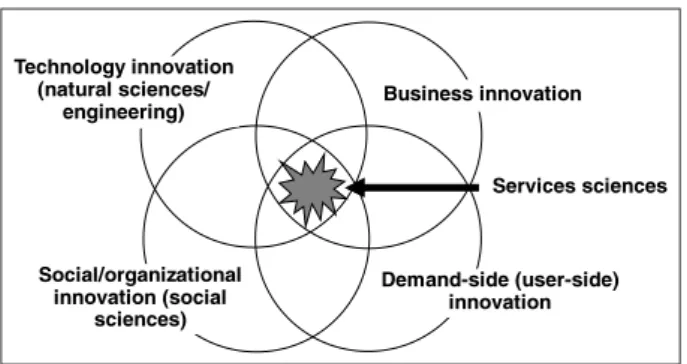
In summary, services sciences are significant in that they are aimed at creating innovation in services by fusing all the knowledge and methodology derived from business, natural sciences, engineering, and social sciences, as well as the demand - side (consumer- side) i n novations explai ned i n Section 3 -1 (see Figure 6). Services sciences are, in effect, a
“multidisciplinary” discipline, and American and
European universities are already considering the introduction of curricula in line with these requirements.
4 Progress of services sciences in American and
European universities
Some American and European universities al ready recog n ize ser vices sciences as an academic discipline and teach them as part of their curricula[10].
Table 2 lists overseas research organizations related to services sciences. Naturally, many of them are in the U.S. and the U.K., where university education is advanced, but some are in Scandinavia, where interest in social systems is traditionally strong; China, which has a rapidly developing economy; Singapore; and other parts of Asia.
Table 3 shows part of the curriculum[11] for the Operation Research and Management Science major at the University of California, Berkeley, in the U.S. This curriculum is designed to teach multiple fields of study, such as economics, mathematics, praxeology, accounting, sociology, and mathematical programming, in an integrated manner, and is close to the objective of services sciences.
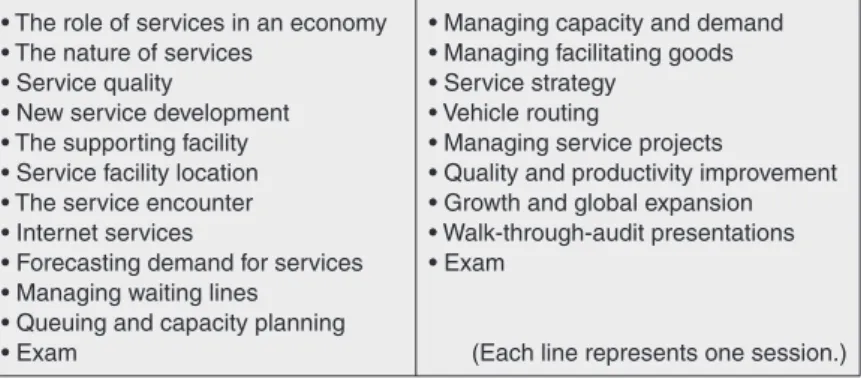
Table 4 shows the curriculum[12] for service operations management at the business school of the University of Texas. The curriculum not only covers the services’ economic, sociological and business aspects, such as management and development, but also includes methodologies in applied mathematics and operations research that are essential for real-world strategy planning and service operations, such as queuing theory, demand forecasti ng, faci l it y location, and Figure 6 : Services sciences as knowledge integration
Table 2 : Overseas programs related to services sciences [16]
America (including Canada and Brazil)
• Center for Service Leadership, Arizona State University, USA
• The Center for Hospitality Research, Cornell University, USA
• Relationship Marketing, Emory University, USA
• Center for Services Marketing, University of Maryland, USA
• Operations Management of Services, California State University, Northridge, USA
• Services Management & New Service Development, University of Texas, Austin, USA
• Services Management, Brigham Young University, USA
• Fishman-Davidson Center for Service and Operations Management, Wharton, University of Pennsylvania, USA
• Service Operations Management, San Jose State University, CA, USA
• Managing Service Operations, DePaul University, USA
• Service Operations Management, University of Calgary, Canada
• Management of Services, University of Western Ontario, Canada
• Service Operations Management, Universidade Federal, Rio de Janeiro, Brazil Europe
• Center for Relationship Marketing and Service Management, Hanken, Finland
• CTF, Centrum för Tjänsteforskning (Service Research Centre), University of Karlstad, Sweden
• Centre for Service Management, Cranfield School of Management, UK
• Service Management, University of Buckingham, UK
• Service Management, Warwick Business School, UK
• Service Management and Strategy, London School of Business, UK
• Service Engineering, Technion, Israel Asia
• Service Management Research Program, Nankai University, PR China
• Productivity Management, City University of Hong Kong
• Relationship Marketing, University of Auckland, New Zealand
• School of Services Management, Nanyang Polytechnic, Singapore Others at
http://www.servsig.org/Syllabi/Service_Operations_Management_Syllabi.pdf
Table 3 : An excerpt from the Operations Research Management Science course curriculum at the University of California, Berkeley [11]
(1) Decision-making in Economic Systems
Macroeconomic Theory; Advanced Microeconomic Theory; Economic Statistics and Econometrics; Engineering Statistics, Quality Control and Forecasting
(2) Decision-making in Industrial and Service Systems
Production Systems Analysis; Service Operations Design and Analysis; Logistics and Supply Chain Management; Linear Programming; Engineering Statistics, Quality Control and Forecasting
(3) Decision-making in Societal Systems
Sociological Theory; Introduction to Sociological Methods, Intermediate Sociological Methods; Engineering Statistics, Quality Control and Forecasting
(4) Algorithmic Decision-making
Data Structures; Efficient Algorithms and Intractable Problems (algorithm design theory); Computability and Complexity;
Combinatorics and Discrete Probability
(4 credits each)
Table 4 : An excerpt from the Service Operation Management course curriculum prepared by Professor James A. Fitzsimmons at the University of Texas [12]
• The role of services in an economy
• The nature of services
• Service quality
• New service development
• The supporting facility
• Service facility location
• The service encounter
• Internet services
• Forecasting demand for services
• Managing waiting lines
• Queuing and capacity planning
• Exam
• Managing capacity and demand
• Managing facilitating goods
• Service strategy
• Vehicle routing
• Managing service projects
• Quality and productivity improvement
• Growth and global expansion
• Walk-through-audit presentations
• Exam
(Each line represents one session.)
transport routing.
Figure 7 is an excerpt from North Carolina State Un iversit y's proposa l to create new services science programs (the source listed as Reference[13]). This document was jointly prepared by the Colleges of Management and Engineering with a view to setting up a new academic course named “Services Sciences”
across the t wo col leges. T he new cou r se will take organizational, technological, and process - or iented approaches to ser v ices, c o v e r i n g s e r v i c e m a n a g e m e n t , p r o c e s s analysis and design, organizational culture, IT service architecture and design, and network services/systems design/efficiency assessment.
The proposal states that “this course aims to provide precise analytical methods that are key to service efficiency improvement and service innovation,” and seeks to create programs, including a doctoral course, for nurturing the human resources that are essential in the service economy era.
One example of academic programs centered on the service industry is at Cornell University’s School of Hotel Administration[14]. Students at this school learn management and organizational beh av ior, hu m a n resou rces m a n a gement, manager ial com mu n ication, law, food and beverage management, operations, facilities management, planning and design, marketing/
tourism/strategy, information systems, finance, accounting, and real estate, as well as gaining basic knowledge in human, social and physical
sciences. While this school is inclined toward practical learning, if this program leads to innovation in the hotel industry it may become a model for education in services sciences.
References 18 to 24 at the end of the report are documents describing other overseas activities in services sciences.
5 Current status in Japan
5-1 Efforts by Japanese universities
As of October 2005, only a handful of Japanese universities officially incorporate ser vices sciences in their curricula. One is the Japan Advanced Institute of Science and Technology ( JAIST), which has launched a new course centered on services sciences. Table 5 shows the course syllabus. JAIST regards services sciences as a key area of next- generation Management of Technology (MOT) and declares that this course is aimed at helping students to deepen their understanding of the basic notion of and latest theories on services and to acquire practical knowledge in “service innovation,” and at cultivating broad-based human resources for innovation[15].
Other examples can be seen among Japanese business schools that offer MBA programs.
Students learn about and conduct research o n s e r v i ce m a n a ge m e nt f r o m m a r ke t i n g perspectives. One such school is Hitotsubashi University’s Graduate School of International Corporate Strategy.
Figure 7 : An excerpt from the NC State University proposal for services science programs [13]
5-2 Current status and challenges for Japan
(1) Services Sciences Symposium
A symposium on services sciences was held in Tokyo on September 8, 2005. The event was hosted by IBM's Tokyo Research Laboratory[16].
The symposium attracted 45 participants from three government agencies (Ministr y of Education, Culture, Spor ts, Science and Technology, Ministry of Economy, Trade and Industry, Japan Science and Technology Agency) and eight universities (Tokyo, Hitotsubashi, Waseda, Keio, Tsukuba, Miyagi, Tokyo Institute of Technology, JAIST), and nine companies (NEC, Hitachi, NTT, NTT DoCoMo, CSK, Mitsubishi Corporation, Fujitsu, Toshiba, IBM; including participants from in-house laboratories).
In light of the topics discussed during the symposium, the current status and key issues for Japan are summarized below:
(A) Need for innovation in services
Despite their increasingly important role in the economy, services are not as productive a s ma nu fact u r i ng. I n novation i n ser v ices i s cr it ica l to cont i nuou s i mprovement i n service productivity. To enable innovation, a problem-solving knowledge structure needs to be constructed to link industry-specific knowledge with scientific knowledge.
(B) Need for service-oriented education
Japan must improve the productivity and quality of its ser vices. From an educational viewpoint, productivity improvement requires
motivation and cultivation of a spirit of challenge.
The key to raising service quality is developing the service skills of people working in the front line. This suggests a need for Japan to incorporate service- oriented perspectives in its education, which traditionally focuses on manufacturing skills development.
(C) Need for scientific approaches
to problem-solving in the service industry I n i n d u s t r i e s s u c h a s h e a l t h c a r e a n d tourism, laws and regulations often inhibit the development of new business processes.
Other sectors of the service industry also face problems, such as the difficulty of pricing or obtaining patents for services and dependence on experience-based management styles. For further development of the service industry, scientific approaches to solving these problems should be devised.
(D) Importance of the process of making things It is risky for those discussing future economic development to overemphasize the ser vice aspect. Si nce most ser vices are processes that involve the provision of both goods and information, excellent services are highly reliant on the stability of the processes through which goods and information are provided (operational stability). Discussing excellent services with no consideration of operational stability will lead to
“armchair theories.” In any debate on new growth possibilities for the Japanese economy, which has been driven by the manufacturing industry, it is important to be aware that both production and
Table 5 : Services Sciences course syllabus (1) What are services?: Outlining the basic notion of services
(2) The necessity for services sciences and future directions: Basic notion of services sciences (3) The structure and challenges of the service industry and a service society
(4) “Innovation as something to feel” —Innovation processes in the service industry— “Service innovation”
(5) Approaches to and theories of services sciences (1) (6) Approaches to and theories of services sciences (2) (7) Services sciences research in Europe and the U.S.
(8) Case study: Service innovation cases
(9) Services sciences discussion by field (law and services; service management)
(10) Lecture on service property research etc. by a guest from a service excellence company (1) — hotel operator (tentative) (11) Lecture by a guest from a service excellence company (2) – food manufacturer (call center) (tentative)
(12) Service innovation processes (group discussion) (13) Research presentation by group (1)
(14) Research presentation by group (2)
(15) Challenges and strategies for services sciences and service innovation (summary discussion)
Source: Provided by Vice President Akio Kameoka, MOT Course, the Japan Advanced Institute of Science and Technology
services are processes that take place over the course of time.
(E) Improving the international competitiveness of Japanese services
While Japan’s service industry is comparable in quality to that of any other country, few Japanese service providers have successfully globalized.
Strengthening the international competitiveness of Japanese services is a critical issue.
(2) Japan Society for Science Policy
and Research Management 20th Annual Academic Conference
The Japan Society for Science Policy and Research Management held its 20th Annual Academic Conference on October 22-23, 2005, at the National Graduate Institute for Policy Studies.
Table 6 lists the session titles that include the term “service,” which have been extracted from the conference program[17].
Several university researchers included the term “services sciences” in their lecture session titles, suggesting that Japanese universities are beginning to show an interest in this area of research. At the same time, the list implies that innovation is attracting as much attention as services, and services tend to be discussed i n con nec t ion w it h tech nolog y. A not he r recognizable trend is that the Japanese academic community is inclined to analyze Japanese research into ser vices in comparison with overseas research, probably because this research area originated in Western countries.
In the program, most of the sessions on service research came under the category of “Toward the Next Stage of Interdisciplinary Research.” This fact demonstrates that service-related research and services sciences are regarded as typical interdisciplinary research areas.
6 Conclusion
The provision of services requires a certain amount of human involvement and appeals d i rect ly to hu ma n feel i ngs, wit h t he a i m of d el i ve r i ng p e r s on a l s at i sf ac t ion. T h i s characteristic of services makes their economic value highly dependent on human factors, such
as the culture, customs and sense of values of the country in which services are offered. However, the types of services that have developed in the Western value structure as an economic act under explicitly defined contracts to offer resources, to teach and provide knowledge and skills, or to support business operations are likely to grow further within the world economy and to become a steady driving force for globalization.
To maintain the development of its economy, Japan should establish a policy of pursuing scientific methods to invigorate the service economy. This is exactly where services sciences come into play. The key is to establish a new academic discipline aimed at achieving the following goals: providing methods for scientific analysis of ser vices, efficient management of ser v ices, a nd m a x i m i z at ion of ser v ice productivity through engineered production processes; solving problems originating from the nature of ser vices in order to improve productivity; and developing a framework for systematic development of innovation.
To this end, Japan should promote joint service research between industry, academia and government in order to identify problems and discuss their solutions, and foster through such research the human resources needed for service innovation. Another major issue for Japan is how to provide school education for the service economy.
A lt houg h s er v ice s s cience s a re st i l l a n emergi ng f ield of research, thei r scope is expected to continue expanding. Since the role of services sciences is to solve problems, improve Table 6 : Service-related lecture sessions at the Japan
Society for Science Policy and Research Management 20th Annual Academic Conference
• Promotion of service innovation in Japan: A discussion centered on IT & solution services
• The role of technologists who promote knowledge service businesses based on services sciences and their path to techno-producers
• Services by services sciences: Integrated strategy road mapping for technology innovation
• Approaches to establishing services sciences:
An approach from interdisciplinary science;
Organizational structure issues toward the development of information society: Need for Japanese services sciences
• Verification analysis of innovation in communications services
• Study on the penetration process of service-led innovation
• Growth of corporate competitiveness by approaches in services sciences
productivity, and formulate a framework for innovation, new research issues will continue to emerge as services transform and expand over time.
Services sciences are likely to be established initially for services to the business sector, where formal definition of problems is relatively easy and the information required for problem solving is readily available. Examples of such services are those in the manufacturing, information technology and finance sectors. Subsequently, services sciences will be applied to services to individuals in such areas as tourism, health care and welfare, where there is greater human involvement and definitions are difficult to formalize.
Acknowledgements
The author would like to thank the following people for their valuable input and provision of reference materials: Mr. Masahiro Hashimoto, Director of the Ser vice Industries Division, Commerce and Information Policy Bureau, Ministry of Economy, Trade and Industry; Mr.
Mitsuhiro Nemoto, Director of the Research E nv i r on ment a nd I ndu st r i a l Co op e r at ion Division, Research Promotion Bureau, Ministry of Education, Culture, Spor ts, Science and Technology; Director- General Toshiaki Ikoma and Senior Fellow Kunihiko Niwa, Center for Research and Development Strategy, Japan Science and Technology Agency; Prof. Akira Goto and Prof. Yasunori Baba, Research Center for Advanced Science and Technology, the University of Tokyo; Prof. Hirokazu Kono, Graduate School of Business Administration, Keio University;
Associate Prof. Ken Kusunoki and Lecturer Yoshinori Fujikawa, Hitotsubashi University’s Graduate School of International Corporate Strategy; Vice President Akio Kameoka, Graduate School of Knowledge Science, Japan Advanced Institute of Science and Technology
References
[1] “ I n n o v a t e A m e r i c a ” ( N a t i o n a l Innovation Initiative Report), Council on Competitiveness, December 2004:
http://www.compete.org/pdf/NII_Interim_
Report.pdf
(Note) This report was created by the Council on Competitiveness in the U.S., a group comprising representatives of major A mer ican companies and universities, and it summarizes proposals for America’s future national strategy. The report is also recognized by Japan as likely to have as significant an impact on American external economic policy as did the 1988 Young Report.
[2] S e r v i c e s S c i e n c e s , M a n a g e m e n t a n d Engineering, IBM Research:
http://www.research.ibm.com/ssme
[3] “Annual Report on National Accounts.”
Economic and Social Research Institute, the Cabinet Office, Government of Japan:
http://www.esri.cao.go.jp/jp/sna/toukei.htm l#kakuho
[4] IBM, Consolidated financial statements, 2005: http://www.ibm.com/annualreport/2 004/annual/cfs_earnings.shtml
[5] General Electric, Statement of Earnings, 2005: http://www.ge.com/en/company/in vestor/ar/cfs_e.htm
[6] B. Van Looy et al., “Service Management,”
Pearson Education Ltd., 2003.
[7] J.R. Br yson, P.W. Daniels and B. Warf,
“Service Worlds,” Routledge, 2004.
[8] Stephen L. Vargo, Robert F. Lusch, "Evolving New Dominant Logic for Marketing," Journal of Marketing, Vol. 68, January 2004.
[9] J.A. Fitzsimmons and M.J. Fitzsimmons,
“Service Management: Operations, Strategy and Information Technology,” “Chapter 1. The role of services in an economy,”
McGraw-Hill, 2001.
[10] 14 t h A n n u a l F r o n t i e r s i n S e r v i c e s Conference (October 6 -9, 2005, Arizona State University, Tempe, AZ).
[11] “ N e w U n d e r g r a d u a t e L & S m a j o r i n Operations Research and Management Science,” University of California, Berkeley:
http://www.ieor.berkeley.edu/AcademicProg rams/Ugrad/ORMS.pdf
[12] J. A . Fit z s i m mon s, “M A N 335 S e r v ice Operations Management,” Professor James A.
Fitzsimmons Classroom, McCombs School of Business, The University of Texas at Austin:
http://www.mccombs.utexas.edu/faculty/Ja
mes.Fitzsimmons/335.htm
[13] “P roposa l to Create Ser v ices Science Programs at NC State,” Harry Perros, Yannis Viniotis, Michael Devetsikiotis (Electrical and Computer Engineering), Steve Allen (A ssociate Dea n), Lynda A i ma n, Joh n McCreery, Mitzi Montoya-Weiss (Business Management), Paul Mugge (Director, Center for Innovation Management Studies), NC State University, September 2005 (Draft).
[14] C o r n e l l U n i v e r s i t y, S c h o o l o f H o t e l Administration:
http://www.hotelschool.cornell.edu/
[15] Brochure for Japan Advanced Institute of Science and Technology's MOT Course:
http://www.jaist.ac.jp/ks/mot/panfu.htm [16] IBM Tokyo Research Laboratory, Release
material on “Services Sciences Symposium,”
2005: http://www.research.ibm.com/trl/ne ws/SSS05/index.htm
[17] Program for the Japan Society for Science Policy and Research Management’s 20th Annual Academic Conference, 2005:
http://wwwsoc.nii.ac.jp/jssprm/
[18] “Breakthrough Ideas for 2005,” Harvard Business Review, February 1, 2005.
[19] H. Chesbrough, “A failing grade for the innovation academy,” Financial Times.
[20] J.M. Tien and D. Berg, “A Case for Service System Engineering,” Journal of System Science and System Engineering.
[21] R. Oliva and J. Sterman, “Cutting Corners and Working Overtime: Quality Erosion in the Service Industry,” Management Science.
[22] S.A. Herzenberg, J.A. Alic and H. Wial, “New Rules for a New Economy,” “Chapter 5.
Reorganizing Work: Using Knowledge and Skill to Improve Economic Performance.”
[23] A. McA fee, “Wi l l Web Ser vices Real ly Tr a nsfor m Col labor ation ? ” M I T Sloa n Management Review.
[24] S.E. Sampson, “Understanding Ser vice Business: Applying Principles of Unified Services Theory,” “Unit 1. Unified Services Theory Basics.”
Kazuyoshi HIDAKA, Ph.D.
Affiliated Fellow, NISTEP
Manager, Tokyo Research Laboratory, IBM Japan, Ltd.
Holds a D.Sc. degree. Completed a graduate course in energy science at the Interdisciplinary Graduate School of Science and Engineering, Tokyo Institute of Technology in March 1984.
Obtained a dissertation doctorate in science from Waseda University's Graduate School of Science and Engineering in March 1996. Has worked for IBM Japan Tokyo Research Laboratory since 1984 and led research projects in optimization technology, discrete algorithms, mathematical analysis techniques, business solutions, and computational organization theory. Following a transfer to IBM’s Watson Research Center in the U.S. to take part in strategy research, returned to the Tokyo Research Laboratory and is now in charge of on-demand business transformation research.
(Original Japanese version: published in December 2005)
![Figure 7 is an excerpt from North Carolina State Un iversit y's proposa l to create new services science programs (the source listed as Reference [13] )](https://thumb-ap.123doks.com/thumbv2/123deta/6926670.2265833/9.892.211.678.103.383/figure-excerpt-carolina-iversit-proposa-services-programs-reference.webp)

