Analysis of small microplastics in coastal surface water samples of the subtropical island of Okinawa, Japan
Author Christina Ripken, Domna G. Kotsifaki, Sile Nic Chormaic
journal or
publication title
Science of The Total Environment
volume 760
page range 143927
year 2020‑12‑13
Publisher Elsevier B.V.
Rights (C) 2020 The Author(s).
Author's flag publisher
URL http://id.nii.ac.jp/1394/00001770/
doi: info:doi/10.1016/j.scitotenv.2020.143927
Creative Commons Attribution‑NonCommercial‑NoDerivatives 4.0 International (https://creativecommons.org/licenses/by‑nc‑nd/4.0/)
Analysis of small microplastics in coastal surface water samples of the subtropical island of Okinawa, Japan
Christina Ripken
a,b, Domna G. Kotsifaki
a,⁎ , Síle Nic Chormaic
aaLight-Matter Interactions for Quantum Technologies Unit, Okinawa Institute of Science and Technology, Onna, Okinawa 904-0495, Japan
bMarine Genomics Unit, Okinawa Institute of Science and Technology, Onna, Okinawa 904-0495, Japan
H I G H L I G H T S
• A method to detect and chemically identify single small microplastics in seawater was demonstrated.
• The occurrence of small microplastics was investigated in the surface waters around Okinawa, a“blue zone”region.
• Identification of different types of particles. Polyethylene was the most abundant polymer type found around Okinawa.
• The abundance of small microplastics was highest in areas associated with more intense human activities.
G R A P H I C A L A B S T R A C T
a b s t r a c t a r t i c l e i n f o
Article history:
Received 19 August 2020
Received in revised form 11 November 2020 Accepted 12 November 2020
Available online 13 December 2020 Editor: Dimitra A Lambropoulou Keywords:
Microplastics Surface water
Micro-Raman optical tweezers Environmental pollution Nanoparticles Okinawa-Japan
Marine plastic debris is widely recognized as a global environmental issue. Small microplastic particles, with an upper size limit of 20μm, have been identified as having the highest potential for causing damage to marine eco- systems. Having accurate methods for quantifying the abundance of such particles in a natural environment is essential for defining the extent of the problem they pose. Using an optical micro-Raman tweezers setup, we have identified the composition of particles trapped in marine aggregates collected from the coastal surface wa- ters around the subtropical island of Okinawa. Chemical composition analysis at the single-particle level indicates dominance by low-density polyethylene, which accounted for 75% of the small microplastics analysed. The smallest microplastics identified were (2.53 ± 0.85)μm polystyrene. Our results show the occurrence of plastics at all test sites, with the highest concentration in areas with high human activities. We also observed additional Raman peaks on the plastics spectrum with decreasing debris size which could be related to structural modifica- tion due to weathering or embedding in organic matter. By identifying small microplastics at the single-particle level, we obtain some indication on their dispersion in the ocean which could be useful for future studies on their potential impact on marine biodiversity.
© 2020 The Author(s). Published by Elsevier B.V. This is an open access article under the CC BY-NC-ND license (http://creativecommons.org/licenses/by-nc-nd/4.0/).
1. Introduction
Plastic polymers are a versatile, widely used material fully integrated in our daily lives. In the environment, plastics accumulate because of their recalcitrant nature (Wright et al., 2013). Once plastic items are discarded in the environment, they often end up in waterways and are ultimately transported to the ocean (Eriksen et al., 2014). Thefirst
⁎ Corresponding author.
E-mail addresses:[email protected](D.G. Kotsifaki),[email protected] (S. Nic Chormaic).
https://doi.org/10.1016/j.scitotenv.2020.143927
0048-9697/© 2020 The Author(s). Published by Elsevier B.V. This is an open access article under the CC BY-NC-ND license (http://creativecommons.org/licenses/by-nc-nd/4.0/).
Contents lists available atScienceDirect
Science of the Total Environment
j o u r n a l h o m e p a g e :w w w . e l s e v i e r . c o m / l o c a t e / s c i t o t e n v
report on the emergence of small plastic particles in the oceans drew worldwide concern (Carpenter and Smith, 1972). Because most plastics undergo very slow chemical or biological degradation in the environ- ment, the debris can remain in the ocean for years, decades, or even lon- ger (Andrady, 2011). Moreover, plastic debris can entrap marine fauna (Laist, 1987) and be ingested by a wide variety of animals, ranging in size from plankton to mammals (Cole et al., 2011). Ingestion of marine plastic fragments andfibres into the trophic chain may cause human health problems. Furthermore,field observations and oceanographic models show thatfive subtropical ocean gyres are hotspots for plastic debris accumulation (Maximenko et al., 2012). Supporting this, it has been reported that the global microplastic distribution across the oceans is estimated to be 236 thousand metric tons (van Sebille et al., 2015). However, a discrepancy of orders of magnitude exists between these observations and the expected mass of microplastic in oceans, suggesting complicated export dynamics are at play.
While mesoplastic (5 mm–2.5 cm) and macroplastic (>2.5 cm) marine pollution has been extensively studied for many oceanic re- gions and across different ecosystems (Barnes et al., 2009;Moore, 2008), small microplastic pollution has been less of a focus (Wright et al., 2013;Cole et al., 2011). As proposed by the National Oceanic and Atmospheric Administration (NOAA), the term microplastics re- fers to very small, ubiquitous plastic particles < 5 mm in diameter (Baker et al., 2009). They have been separated into different fractions, large (1–5 mm) or small (1μm–1 mm) microplastics (Gigault et al., 2018) and the sub-20-μm fraction (20μm–1μm). Like large microplastics, small microplastics can adsorb and carry hydrophobic chemicals that have a potential biological and toxicological impact on the environment (Engler, 2012). Therefore, a clear understanding of the interaction of small microplastics with the environment, especially with living organ- isms, is essential to assess possible health hazards.
Currently, there is a need for reliable and precise identification of plastics without separating them from the matrices in which they are collected. The current protocols for quantification and characterisation of environmental plastic contamination is hampered by a lack of sensi- tive yet high-throughput methods. Commonly applied techniques for the analysis of plastics include a visual inspection or stiffness test (Hidalgo-Ruz and Thiel, 2013), spectroscopy (Frére et al., 2016), trans- mission or scanning electron microscopy (Pivokonsky et al., 2018), andfluorescence imaging (Cole and Galloway, 2015). Very recently, surface-enhanced Raman spectroscopy was used to chemically identify commercial, standardised micro- and nanoparticles suspended in a NaCl liquid environment, as a model system for plastics in seawater (Lv et al., 2020). However, the chemical characterisation of single, plastic particles in a liquid environment is still limited. Therefore, techniques with selec- tivity and precision that enable the analysis of single particlesin-situin any collected seawater sample and in real-time are necessary.
Since thefirst demonstration of single microparticle optical trapping in 1986 (Ashkin et al., 1986), optical tweezers have emerged as a pow- erful tool for controlling particles influids (Ashkin et al., 1986). Optical tweezers use a highly focussed laser beam to trap and manipulate (typ- ically) dielectric particles from 10 nm to 100μm in diameter. The parti- cle is trapped near the focal spot due to scattering and gradient optical forces (Ashkin, 1997;Kotsifaki and Nic Chormaic, 2019); the scattering force is from radiation pressure of the light beam along its direction of propagation and the gradient force pulls the particle towards the high-intensity focal point. The total optical force exerted on a particle is in the range of 100 f. to 100 pN depending on the difference between the refractive indices of the particle and the liquid medium, and the in- tensity of the laser beam. The ability to measure such small forces has opened the way for many new experiments in physics, chemistry, bio- physics, and nanotechnology. Important examples include the develop- ment of multiple particle trapping (Kotsifaki et al., 2013), a variety of biophysics measurements on single biomolecules (Arbore et al., 2019), and trapping in subwavelengthfields created by plasmonic nanostruc- tures (Kotsifaki and Nic Chormaic, 2019).
The combination of optical tweezers with a range of different optical read-out techniques has enabled various single-particle investigations to be performed. With regard toin-situsmall microplastic analysis, op- tical tweezers micro-Raman spectroscopy (OTRS) is a viable option.
Raman spectroscopy has already been used to analyse single cells and biomolecules suspended in an aqueous environment. Recently, the combined OTRS technique has been used for chemical qualitative anal- ysis of different plastic particles with sizes in the sub-20μm regime in a seawater environment (Gillibert et al., 2019). The authors successfully discriminated between plastics and mineral sediments at the single- particle level, overcoming the limitations of conventional Raman spec- troscopy in a liquid environment (Gillibert et al., 2019).
Compared to the rest of the world, there is limited information on plastic pollution of seawater in a “blue zone” area, regions of the world in which exceptional longevity has been recorded (Buettner, 2012). In this work, we have collected environmental samples around the subtropical island of Okinawa and analysed them using an OTRS technique, to determine the occurrence, the average size and the poly- mer type of small microplastic particles. Crucially, OTRS has the ability to unambiguously chemically identify different microplastics in real- time. This study improves our knowledge on the extent and magnitude of small microplastics pollution in the ocean around a blue zone region.
It also gives an estimate on the current state of pollution, as well as how the pollution correlates with population and industrial densities on the island of Okinawa.
2. Materials and methods
The main island of Okinawa (26.2124° N, 127.6809° E) is part of the Ryukyu Island Arc (inset inFig. 1) and consists of uplifted coral reefs and, particularly in the northern half, igneous rock (solidified magma or lava). It is surrounded by fringing reefs, making the water intake that reaches the beaches more reliant on surface waves and wind (Hench et al., 2008). Land-based pollution originating on Okinawa is more likely to be found in the bigger bays of the island. The six sampling sites were chosen to provide a road map of the pollution distribution of Okinawa (Fig. 1). Sites differ in population density and industry in and
Fig. 1.Map offield study area in Okinawa with the locations of the six towing stations from which particles were collected and analysed (Google Earth, 2020). Inset: Geographical location of Okinawa in the Ryukyu Island Ark (De Scally, 2004).
C. Ripken, D.G. Kotsifaki and S. Nic Chormaic Science of the Total Environment 760 (2021) 143927
2
around the respective bay regions. Additionally, Okinawa has been pre- viously deemed as a“blue zone”(Willcox et al., 2014). Therefore, it is crucial to monitor ocean pollution as it may adversely affect the resi- dents' longevity in such a region.
2.1. Study region
To quantify small microplastic abundance in the surface waters around Okinawa, the water samples were collected over 24 h in Sep- tember 2018 with the Okinawa Prefectural Fisheries (OPF) and Ocean Research Center (ORC) ship, Tonan Maru. The cruise was designed to obtain an overview of the small microplastic pollution around Okinawa.
2.2. Field sampling
The sampling was performed using a manta trawl (Hydro-Bios Manta, 300μm net, net opening of 15 cm × 30 cm, with a Hydro-Bios Mechanical Flow Meter No.: 438 110). The manta net was deployed off the starboard side of the boat to the surface and trawled for 15 min at 2–3 knots covering an average distance of 1 km andfiltering an aver- age volume of 856.8 L. It is worth noting that, during the collection pro- cess, we did not observe any seaweed or woody debrisfloating in the seawater which may have been scooped up in the manta trawl. After trawling, the nets were washed down twice before transferring the con- tents into 450 mL glasses. All samples were stored in a climatised envi- ronment until processing the next day. Between each sample, the Manta net was back-washed with seawater and the collector at the end of the net was washed separately to limit cross-contamination between sam- pling locations.
2.3. Laboratory analysis
Each of the stored sample solutions wasfiltered over a 300μm sieve to remove large agglomerates and microplastics. No additional diges- tion steps were added to remove the organic matter. The remaining sea- water solutions after thefiltering process were stored in new, clean glasses bottles. After 1 h, we collected a small volume of liquid from the top of each of these remaining seawater solutions and we carefully examined them using an optical microscope. It was evident that small microplastics (less than 300μm) were contained in this small volume and these samples were used for the studies reported herein. Therefore, the small microplastics were analysed within the agglomerate matrix in which they were trapped in this study.
To limit contamination of the samples via clothing or air, all samples werefiltered, sorted, and prepared onto the microscope slides in a pos- itive pressure chamber. Only cotton clothing was worn during sampling and preparation. For the experiments, a blank control sample of Milli-Q water was prepared simultaneously in order to detect any possible con- tamination during sample processing in the laboratory environment.
2.4. Optical micro-Raman tweezers spectroscopy
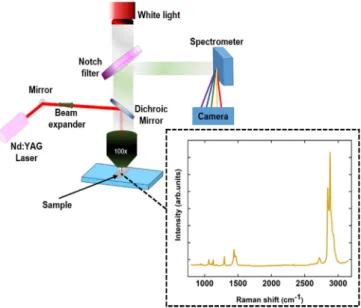
The OTRS system we used consists of a Nd:YAG laser beam (λ= 532 nm with 17 mW of power at the sample plane) focussed using a high numerical aperture (NA = 1.3) oil immersion objective lens (Plan-Neofluar 100×, Carl Zeiss) onto the seawater sample, as shown inFig. 2. We used a trapping laser at 532 nm which provides better Raman efficiency compared to longer wavelengths. The trapping laser beam was integrated into a Raman spectrometer (3D Laser Raman Microspectrometer Nanofinder 30). The high NA of the lens ensured trapping of the small microparticle and provided the necessary laser in- tensity needed to maximise its Raman signal. Using adhesive micro- scope spacers, a microwell was is formed on the microscope glass slide, and trapping occured in the 20μL sample solution under a glass cover slide. The sample of water in the microwell was taken from the small volumes collected from the top of the seawater solutions, as
mentioned inSection 2.3. Therefore, the microwell contained small microplastics and nanoparticles in seawater from the sampled regions around Okinawa. As a control, a microwell with 10μL milli-Q water aqua was prepared on the same microscope slide. The microscope slide was mounted andfixed on top of a translation stage. A CCD camera was used to image the trapped microplastic during the trapping process.
The optical images were analysed using ImageJ software to identify the shape and the size of the trapped microplastic as well as to confirm that the analysis is performed on a newly trapped particle in the same sam- ple solution. Using this setup, the OTRS technique allowed us to identify small microplastic fragments trapped by the laser.
3. Results and discussion
Ocean surface water samples from several bays around Okinawa have been collected (seeFig. 1) and analysed, as shown inFig. 2. The chemical identification of optically trapped particles within the seawater sample was accomplished by employing OTRS after background subtrac- tion. Notably, the majority of the small microplastics are quasispherical.
A shift of the Raman peaks or alteration of the bands can be expected due to their crystalline structure and level of degradation.
Table 1lists the most dominant types of plastics which we have identified in our samples that contain seawater collected around Okinawa. Moreover, we include their hazard score (Lithner et al., 2011) in order to indicate their potential impact on the environment and human health.
Fig. 3(a) shows Raman spectra for a quasispherical, optically trapped microplastic diluted in seawater from a sample collected near the Naha region (S10 inFig. 1). Naha is the capital of the Okinawa Prefecture and the sample location is next to the industrial port and commercial Fig. 2.A schematic illustration of the optical tweezers micro-Raman setup used in our experiments. Inset: characteristic spectrum of a polyethylene (PE) particle of 15μm diameter in a seawater environment.
Table 1
Polymer types found as nanoplastics around Okinawa: Detailed information for polymers identified in this study, including monomer, hazard score (Lithner et al., 2011), and plastic size range for each polymer type.
Polymer Abb Monomer Hazard
score
% of total particles analysed
Plastic size range (μm)
Polyethylene PE Ethylene 11 10.94 1.40–30.5
Polypropylene PP Propylene 1 0.61 3.07–6.15
Polyvinyl chloride PVC Vinyl chloride 10,551 0.61 8.97–47.8
Polyamide (Nylon) PA Adipic acid 47 1.52 2.06–10.5
Polystyrene PS Styrene 30 0.91 1.38–4.18
airport. Despite being a heavily commercialised area, Naha has an esti- mated population of 318,270 inhabitants, representing almost 30% of the total population of Okinawa island and a population density of 8043 people/km2. InFig. 3(a), we have identified the characteristic Raman peaks of polyvinyl chloride (PVC) (Table 2-left). Additionally, we investigated the Raman signal of the optically trapped microplastic for various positions on its surface. We note that the intensity of the Raman signal changes. This could be due to the difference in weathering of the material at various places. In total, 51 particles were analysed from station S10, with approximately 19.6% being plastic such as poly- ethylene (PE) or polyvinyl chloride (PVC). This is the second highest percentage of plastics that we have found contained within the samples taken from seawater around Okinawa. This result correlates well with a recent study byKitahara and Nakata (2020),finding small plastics in road dust on Okinawa. Although the population density is highest in Naha and most land use is urban (Ross et al., 2018), plastic particles in the road dust were lower in front of our station S10 (Kitahara and Nakata, 2020). One possible reason forfinding many small microplastics within the sampled volume, although it was not the highest percentage measured, could be due to its location outside of a bay. Although many rivers discharge on this side of Naha city (Shilla et al., 2013), pollution is not easily trapped this side of the island.
Plasticisers, dyes, and weathering can change the Raman spectra, adding additional peaks to the spectra of the different polymers as well as changing relative intensities and accuracy. These additives are often harmful and can leach from the polymer matrix (Wagner and Schlummer, 2020). In addition, the particles are often embedded in or- ganic material, which can also add peaks to the actual polymer spectra.
InFig. 4(b), we show the Raman spectra of the microscope slide that we used in our experimental process and the organic matter found in the plastics. Based on these reference spectra we can distinguish the plastics from organic matter and identify their Raman peaks. Generally, we ob- served that most small microplastics are embedded in organic matter (68.75%) while only 31.25% are free-floating. No data is published on this ratio, as the methods for polymer identification used most often add a step of digesting the organic material in the samplefirst, so as to get a better Raman signal. This ratio is important to investigate further, as it could shed some light on the fate of the (small) microplastics within the water column.
Fig. 4(a) shows the Raman peaks of PE small microplastics which were found in several areas around Okinawa, while inTable 2(right) we present the modes attributed to PE. We note that all the particles have the characteristic PE peaks spanning from 1000 cm−1 to 1500 cm−1(Gillibert et al., 2019).Fig. 4(b) shows the Raman spectra Fig. 3.(a) Raman spectra of a polyvinyl chloride (PVC) quasispherical microplastic of 47.8μm diameter found at station S10, near Naha. Each spectrum relates to a different region on the trapped particle. Inset: microscope image of the plastic in which different spectral regions are labelled. The intensity of the Raman signal may indicate the difference in weathering.
(b) Additional Raman spectra peaks that typically appear in the signals from the trapped particles in our samples. Purple (upper) curve: spectrum from the microscope slide. It displays the glass solid-state structure with long range transnational symmetry manifesting–the peaks are very broad with widths up to several hundred wavenumbers. Green (lower) curve: spectrum from organic matter found in the samples with CCO stretching (around 1000 cm−1) and CH3and CH2deformations (1250 cm−1to 1750 cm−1) in the Raman spectrum. The individual peaks vary depending on the organic matter of the trapped particles.
Table 2
Raman peaks of: (Left): Polyvinyl chloride (PCV) has a hazard score of 10,551 (Lithner et al., 2011), making it one of the most toxic plastics based on hazard classification of monomers. PVC is mostly used for cables, pipes &fit- tings, window frames, andflexiblefilms for water proofing. (Right): Polyethylene (PE) is the most common plastic used in daily life. Primarily used for packaging, resulting in air trapping items such as bottles and plastic bags. Combined with its low density this leads to a majority of the PEfloating at the ocean's surface (Gillibert et al., 2019).
C. Ripken, D.G. Kotsifaki and S. Nic Chormaic Science of the Total Environment 760 (2021) 143927
4
for polystyrene (PS) and polypropylene (PP) particles which were not embedded in organic matter.
The most common plastic that was found in the samples taken from seawater of Okinawa is PE with a percentage of 10.94% of the total par- ticles analysed (seeTable 1). The reason for the high percentage of PE within the sampled volume could be its structural characteristics and lower density compared with the other polymer types found (see Table 1). It has more porous structures than other plastics and, as such, it may be more easily broken down into microscopic debris by sunlight, wind, and current erosion (Song et al., 2017). We notice sur- rounding organic matter overlays the PE Raman spectra in a microparti- cle of 5μm diameter (red line inFig. 4(a)), which was collected from the Naha (S10) area. Additionally, an overlay of dyes or additives is ob- served in Raman spectra of small microplastic with 5μm diameter (pur- ple line inFig. 4(a)) which was collect from the Kin (S4) area. The characteristic peaks of polystyrene (PS) (black line inFig. 4(b)) and polypropylene (PP) (blue line inFig. 4(b)) were identified at Nago (S8) and Nakagusku (S2) areas, respectively. PS is frequently found in the environment as a material from diverse uses such as packaging foams and disposable cups. Since it is mainly used for manufacturing of single-use products, a large portion of post-consumer production ends up into oceans (Eriksen et al., 2014), and remains there for several hundred years due to their resistance to degradation (Table 1). PP is used in the manufacturing of, for example,flip-top bottles, piping sys- tems, and food containers, among others.
Together with the plastics, trapped sediment micrometric and nanometric particles can also be detected (seeFig. 4(c)). Specifically, we note that some particles have peaks at 512 cm−1and 472 cm−1
(Krishnan, 1945), indicating trapped quartz particles (blue curve-S10 in Fig. 4(c)). Particles of polymorphous CaCO3 with one peak at 706 cm−1followed by a larger peak at 1088 cm−1indicate that they are most likely calcite and not aragonite or vaterite (Zou et al., 2019).
The origin of these particles is probably related to trace calcite-based contaminants. Finally, wefind particles that display the spectralfinger- print of rutile (green curve-S8 inFig. 4(c)) with microscope slide signal overlay (Frank et al., 2012). Rutile is a mineral composed primarily of ti- tanium dioxide (TiO2) and is the most common natural form of TiO2. These sediment-derived particles are likely found because of high river input (Shilla et al., 2013).
The abundance of small microplastics in the sampled volume taken from each station displayed a difference between those col- lected in urban and less populated areas. The heterogeneity of the small microplastics in the volume at the sampling stations may be caused by several factors, predominately the closeness of point sources such as sewage outfalls, river outlets and run-off after heavy rain fall.
Atmospheric input of micro- and small microplastic from domestic activities such as traffic should also be taken into consideration. In Table 3, we summarise the plastic distribution of small microplastics found within the sampled volumes collected around Okinawa. In total we have identified 282 particles by employing the OTRS method, of which 48 are small microplastics. The small microplastic pollution ob- served within the sampled volumes follows the population gradient of the island (Ross et al., 2018). There is a clear distinction between the northern (Fig. 1), less populated part of Okinawa, and the southern part with high population density. While the south west side with the capital Naha has the highest population density, there is no bay on Fig. 4.Raman spectra of optically trapped small microplastics dispersed in seawater with their optical images: (a) Polyethylene (PE) spectra from different particles found in different locations. The red line (S10) has an organic matter overlay, while the purple (S4) and blue (S2) lines have additional peaks most likely from dyes or additives to the PE. (b) The black line indicates the Raman spectrum of polystyrene (PS) and the blue line of polypropylene (PP) found at Nago (S8) and Nakagusku (S2) areas, respectively. (c) Raman spectra of trapped sediment particles suspended in seawater with their optical images. In the purple line (S8-up) the calcite peaks are overlaid with organic matter, as observed on the optical image. The green line (S8-down) shows a rutile nanoparticle in which the Raman spectra is overlaid by the characteristic microscope slide Raman peaks.
that side of the island. On the south east side of Okinawa, on the other hand, the big bay of Nakagusku (S2-Fig. 1) is located. The cities of Nanjō(2.98% of population), Urasoe (7.90% of population), Ginowan (6.71% of population) and Okinawa city (9.74% of population) are lo- cated along that bay. While only a handful of rivers drain into this bay, these rivers have been found to have the highest levels of inorganic nu- trients (Shilla et al., 2013) on Okinawa. We analysed 44 particles in the sampled volume from that bay and we determined that 25.0% are plas- tics (8 of PE, 1 of PP, 1 of PS and 1 of PVC). We conclude that the samples coming from this area have the highest percentage of plastics due to the high population density (2838 people/km2) found along the intake of the bay. The southern part of the island has a high proportion of urban land use (Ross et al., 2018), which, in combination with high traffic den- sity (Kitahara and Nakata, 2020), leads to high anthropogenic pressure on the coastal ecosystem (DiBattista et al., 2020). This results in a signif- icant increase of small microplastic particles in sampled volumes from the southern half of the island (t-test, two tailedp= 0.0147). This is in reasonable agreement with studies showing microplastic abundance in areas with an increase of intensive anthropogenic activities such as:
urban areas with high population density (Kataoka et al., 2019), tourist beaches with high density of tourists (Bissen and Chawchai, 2020), areas of intensive agriculture (Chen et al., 2018), as well asfishing and shipping activities (Aytan et al., 2016).
In the central part of the island, the land use shifts from urban areas to more forest cover (Ross et al., 2018;Pakoksung et al., 2019). Traffic density goes down by between one third to about one half that found in the southern part of the island (Kitahara and Nakata, 2020). On the east side, we have a station at Kin (S4), while Nago (S8) is located on the west side. Kin has a surrounding population of up to 1386 people/
km2while at Nago the population density is lower at 296 people/km2. The anthropogenic pressure on the Kin station is predicted to be high (DiBattista et al., 2020). This difference in the population density is reflected in the small microplastics distribution within the sampled vol- ume, 17.9% (S4) and 13.8% (S8), respectively, while the percentage of organic particles within the sampled volume is reasonably stable (66.1% (S4) and 65.5% (S8)). At Nago, we analysed 58 particles from the sampled volume. PE was the only plastic type found there. In Kin (S4) we characterised a similar number of particles (n= 56) but found a wider variety of plastic polymer types (8 PE, one PS, and one PP small microplastic particle). The particles in Nago bay ranged in size from 1.4μm to 27.2μm. According to industrial density, which is
higher on the east side of the island, the split of the stations into east (S2, S4, S6) and west (S10, S8, S7)) does not yield a significant difference (t-test,p= 0.7) in small microplastic distribution from within the sam- pled volume, as most plastic is correlated with domestic activity, not in- dustrial, on Okinawa.
Finally, in the north of Okinawa, Cape Hedo is located (Fig. 1), with a low anthropogenic pressure prediction (DiBattista et al., 2020). We col- lected particles from two stations (S6 and S7) located on both sides of the cape. In total, 60 particles were identified within the sampled vol- ume at station S6, of which 8 are plastics (3 PE, 4 polyamide (PA) and 1 PS) while at station S7 we identified 13 particles within the sampled volume with two of them being plastics (1 PE and 1 PA). S6 is located on the east side of the cape and has rivers draining into the ocean. Be- cause of that, particulate organic matter content is comparable to the station located further south (Yang et al., 2013). Polyamide is a family of polymers named Nylon. It is a ductile and strong polymer, permitting the fabrication of textilefibres and cordage. Based onTable 1, PA is the second most common plastic identified in the seawaters of Okinawa with 1.52% of all particles analysed.
Our analysis confirmed that 17% of particles were identified as small microplastic within the samples around Okinawa island, in which PE, PP, PVC, PA and PS are among the most abundant polymer types in aquatic environments (Fig. 5(a) and (b)). Polyethylene (PE) was the most com- mon plastic type, comprising of 75% of all the small microplastics poly- mers analysed (Fig. 5(b)). The order of numerical dominance of small microplastic polymers was PE > PA > PS > PP = PVC. Generally, these polymers accounted for 74% of global plastic production and are com- monly used in short life-cycle products (PlasticsEurope, 2015). More- over, factors such as hydraulic conditions, salinity, temperature, wind, bio-flouring, as well as changes in surface to volume ratio may affect the distribution of small microplastics around Okinawa.
The source of small microplastics is related to the anthropogenic ac- tivities on the seawater, beaches, and in the trading centres in the area around Okinawa. In thefishing communities at thefish landing beaches, woven polymer sacks are used for storage and transport of a variety of products including fishes. Over 75% of the small microplastics are made of polyethylene and these may originate from brokenfishing nets, lines or ropes, water bottle caps, household utensils, consumer carry bags, containers/packaging, etc. Recently, a study of the abun- dance of microplastics in road dust samples collected from several areas in Okinawa shows a high concentration of them in urban areas Table 3
Small microplastic distribution around Okinawa: Station split for population and industry around Okinawa following the respective gradients.
Area name Station names Population distribution Industry distribution Volume checked [μL] Particles Particles plastic (%) Particles organic (%)
Nakagusku 2 S2 Sth2 E2 40 44 25.0 56.8
Kin 2 S4 Sth4 E4 60 56 17.9 66.1
Cape Hedo 1 S6 N2 E6 60 60 13.3 66.7
Cape Hedo 2 S7 N3 W1 60 13 15.4 61.5
Nago 1 S8 N4 W2 60 58 13.8 65.5
Naha 1 S10 Sth5 Naha1 40 51 19.6 58.8
Fig. 5.(a) Percentage composition of all particles. (b) Polymer types of small microplastics collected in seawater around the main Okinawa island. (c) Average diameter of small microplastics wherenindicates the number of polymers.
C. Ripken, D.G. Kotsifaki and S. Nic Chormaic Science of the Total Environment 760 (2021) 143927
6
in which daily vehicle traffic, industrial activity, and high population density are dominant (Kitahara and Nakata, 2020). In the road dust of Okinawa, PE was 29% of the total microplastics (Kitahara and Nakata, 2020), while in seawater it is 75% of the total small microplastics. At the end, some of the road dust may be found in the oceans surrounding Okinawa, correlating the twofindings via common high concentration areas.
Small microplastics were also classified based on their size as prod- ucts of degradation of large plastic materials (optical images of eachfig- ure). The average size of all collected small microplastics is shown in Fig. 5(c). The majority of small microplastics range from 1.4μm to 18.7μm, although we identified three microplastics with sizes of 27.2, 30.5, and 47.8μm. The smallest average size of 2.53 ± 0.85μm is iden- tified for PS polymers while the largest average size of 28.4 ± 9.4 is identified for PVC polymers. Likewise, the sampled small microplastics showed a wide range of sizes in various areas of Okinawa with the highest around Naha (S10).
Finally, we have demonstrated that the OTRS technique can be used for detecting small microparticles in a liquid environment; however, in order to use it to calculate the number of particles per L, and to estimate the environmental microplastic concentrations with high accuracy, some modifications would be needed and these are beyond the scope of this study. As an example, a higher percentage of the total sample vol- ume would need to be checked using some form of through-put system.
This technique has already been verified using commercial particles with different particle concentrations (Gillibert et al., 2019), whereas our work is applied to seawater samples from around Okinawa and the small microplastics contained therein. Summarising, the OTRS method presented in this work permits afirst study into how these very small particles are embedded within an organic matrix, while si- multaneously providing a means of identifying the polymer type of the particle. No additional sample preparation is needed, thereby reduc- ing both chemical and material waste.
4. Summary
In recent years, much progress has been made in understanding the sources, transport, fate, and biological implications of the smallest plas- tic pollution particles. The public interest in plastic marine pollution and their ecological impacts have increased during the same time. Our re- sults contribute to the knowledge aboutin-situanalysis and identifica- tion of microplastics and demonstrate that the seawater around Okinawa is polluted with micro- and small microplastics. They were ubiquitously detected at all sites we sampled, present at different con- centrations within each sampled volume, with a higher concentration found in samples from areas characterised by human activities. All the small microplastics were fragments of plastic materials used by the community, with the major polymers being polyethylene and polyam- ide materials. While some particles may have originated from and been transported over large distances, correlation with population densities points to land-based sources of the plastic particles. Being predominately found embedded into organic matter, the resulting in- teractions between marine planktonic organisms and the plastic parti- cles are inevitable. One potential fate could be eventual sedimentation with the rest of the organic matter particle. Concluding, the risks that microplastics pose tofish and their natural foods especially inverte- brates, and the possible link to human health, need to be better under- stood. Strategies such as proper waste management, plastic recycling, and penalties for illegal dumping in areas close to water resources should be promoted and implemented in the communities, to reduce the land-based microplastics found in coastal waters.
CRediT authorship contribution statement
Christina Ripken:Conceptualization, Methodology, Formal analysis, Investigation, Writing - original draft, Visualization.Sile Nic Chormaic:
Methodology, Resources, Writing - review & editing, Supervision.
Domna G. Kotsifaki:Conceived the experiments, Methodology, Valida- tion, Formal analysis, Investigation, Writing - original draft, Visualization.
Declaration of competing interest
The authors declare that they have no known competingfinancial interests or personal relationships that could have appeared to influ- ence the work reported in this paper.
Acknowledgements
This work was funded by Okinawa Institute of Science and Technol- ogy Graduate University. DGK acknowledges support from JSPS Grant- in-Aid for Scientific Research (C) Grant Number GD1675001. We thank Elissaios Stavrou from Lawrence Livermore National Laboratory (USA) for useful comments on the Raman peak analysis. We also thank the Captain and crew of the Okinawa Prefectural Fisheries and Ocean Re- search Center ship, Tonan Maru, during the cruise No. 672 (FY2018 No.16) and the on-board team of Akinori Murata and Marine Works Japan LTD technician, Shinsuke Toyoda. The Engineering Support Section of OIST is also acknowledged.
References
Andrady, Anthony L., 2011.Microplastics in the marine environment. Mar. Pollut. Bull. 62 (8), 1596–1605.
Arbore, Claudia, Perego, Laura, Sergides, Marios, Capitanio, Marco, 2019.Probing force in living cells with optical tweezers: from single-molecule mechanics to cell mechanotransduction. Biophys. Rev. 11 (5), 765–782.
Ashkin, Arthur, 1997.Optical trapping and manipulation of neutral particles using lasers.
Proc. Natl. Acad. Sci. 94 (10), 4853–4860.
Ashkin, Arthur, Dziedzic, Joseph M., Bjorkholm, John E., Chu, Steven, 1986.Observation of a single-beam gradient force optical trap for dielectric particles. Opt. Lett. 11 (5), 288–290.
Aytan, Ulgen, Valente, Andre, Senturk, Yasemen, Usta, Riza, Sahin, Fatma Basak Esensoy, 2016.Rahsan Evren Mazlum, and Ertugrul Agirbas. First evaluation of neustonic microplastics in black sea waters. Mar. Environ. Res. 119, 22–30.
Baker, Joel E., Arthur, Courtney, Bamford, Holly A., United States. National Ocean Service.
Office of Response, and Restoration, 2009.Proceedings of the International Research Workshop on the Occurrence, Effects, and Fate of Microplastic Marine Debris, Sep- tember 9–11, 2008, University of Washington Tacoma, Tacoma, WA, USA. U.S. Depart- ment of Commerce, National Oceanic and Atmospheric Administration, National Ocean Service, Office of Response & Restoration.
Barnes, David K.A., Galgani, Francois, Thompson, Richard C., Barlaz, Morton, 2009.Accu- mulation and fragmentation of plastic debris in global environments. Philosophical Transactions of the Royal Society B: Biological Sciences 364 (1526), 1985–1998.
Bissen, Raphael, Chawchai, Sakonvan, 2020.Microplastics on beaches along the eastern Gulf of Thailand–a preliminary study. Mar. Pollut. Bull. 157, 111345.
Buettner, Dan, 2012.The Blue Zones, Second Edition: 9 Lessons for Living Longer From the People Who’ve Lived the Longest.
Carpenter, Edward J., Smith, Kenneth L., 1972.Plastics on the sargasso sea surface. Science 175 (4027), 1240–1241.
Chen, Minglong, Jin, Meng, Tao, Peiran, Zheng, Wang, Xie, Weiping, Yu, Xubiao, Wang, Kan, 2018.Assessment of microplastics derived from mariculture in Xiangshan Bay, China. Environ. Pollut. 242, 1146–1156.
Cole, Matthew, Galloway, Tamara S., 2015.Ingestion of nanoplastics and microplastics by Pacific oyster larvae. Environ. Sci. Technol. 49 (24), 14625–14632.
Matthew Cole, Pennie Lindeque, Claudia Halsband, and Tamara S. Galloway. Microplastics as contaminants in the marine environment: a review. Mar. Pollut. Bull., 62(12):
2588–2597, 2011.
De Scally, Fes A., 2004.historical tropical cyclone activity and impacts in the cook islands 1. Pacific Science 62 (4), 443–459.
DiBattista, Joseph D., Reimer, James D., Stat, Michael, Masucci, Giovanni D., Biondi, Piera, Brauwer, Maarten De, Wilkinson, Shaun P., Chariton, Anthony A., Bunce, Michael, 2020.Environmental DNA can act as a biodiversity barometer of anthropogenic pres- sures in coastal ecosystems. Scientific Reports 10 (1), 8365.
Engler, Richard E., 2012.The complex interaction between marine debris and toxic chemicals in the ocean. Environ. Sci. Technol. 46 (22), 12302–12315.
Marcus Eriksen, Laurent C. Lebreton, Henry S. Carson, Martin Thiel, Charles J. Moore, Jose C. Borerro, Francois Galgani, Peter G. Ryan, and Julia Reisser. Plastic pollution in the world's oceans: more than 5 trillion plastic pieces weighing over 250,000 tons afloat at sea. PLoS One, 9(12):e111913, 2014.
Otakar Frank, Marketa Zukalova, Barbora Laskova, Jenö Kürti, János Koltai, and Ladislav Kavan. Raman spectra of titanium dioxide (anatase, rutile) with identified oxygen isotopes (16, 17, 18). Phys. Chem. Chem. Phys., 14:14567–14572, 2012.
Frére, Laura, Paul-Pont, Ika, Jonathan, Moreau, Philippe, Soudant, Christophe, Lambert, Arnaud, Huvet, Rinnert, Emmanuel, 2016.A semi-automated Raman
micro-spectroscopy method for morphological and chemical characterizations of microplastic litter. Mar. Pollut. Bull. 113 (1), 461–468.
Gigault, Julien, ter Halle, Alexandra, Baudrimont, Magalie, Pascal, Pierre-Yves, Gauffre, Fabienne, Phi, Thuy-Linh, El Hadri, Hind, Grassl, Bruno, Reynaud, Stéphanie, 2018.
Current opinion: what is a nanoplastic? Environ. Pollut. 235, 1030–1034.
Gillibert, Raymond, Balakrishnan, Gireeshkumar, Deshoules, Quentin, Tardivel, Morgan, MagazzÃ, Alessandro, Donato, Maria Grazia, Maragò, Onofrio M., de La Chapelle, Marc Lamy, Colas, Florent, Lagarde, Fabienne, Gucciardi, Pietro G., 2019.Raman twee- zers for small microplastics and nanoplastics identification in seawater. Environmen- tal Science & Technology 53 (15), 9003–9013.
Google Earth. Okinawa island 26.2124°n, 127.6809°e, viewed June 2020.
Hench, James L., Leichter, James J., Monismith, Stephen G., 2008.Episodic circulation and exchange in a wave-driven coral reef and lagoon system. Limnol. Oceanogr. 53 (6), 2681–2694.
Hidalgo-Ruz, Valeria, Thiel, Martin, 2013.Distribution and abundance of small plastic de- bris on beaches in the SE Pacific (Chile): a study supported by a citizen science pro- ject. Mar. Environ. Res. 87-88, 12–18.
Kataoka, Tomoya, Nihei, Yasuo, Kudou, Kouki, Hinata, Hirofumi, 2019.Assessment of the sources and inflow processes of microplastics in the river environments of Japan. En- viron. Pollut. 244, 958–965.
Kitahara, Ken-Ichi, Nakata, Haruhiko, 2020.Plastic additives as tracers of microplastic sources in japanese road dusts. Sci. Total Environ. 736, 139694.
Kotsifaki, Domna G., Makropoulou, Mersini, Serafetinides, Alexandros A., 2013.Efficient and low cost multiple optical trap, based on interference. Optik 124 (7), 617–621.
Kotsifaki, Domna G., Nic Chormaic, Síle, 2019.Plasmonic optical tweezers based on nano- structures: fundamentals, advances and prospects. Nanophotonics 8 (7), 1227–1245.
Krishnan, Rappal S., 1945.Raman spectrum of quartz. Nature 155 (3937), 452.
Laist, David W., 1987.Overview of the biological effects of lost and discarded plastic de- bris in the marine environment. Marine Pollution Bulletin 18 (6, Supplement B), 319–326.
Lithner, Delilah, Larsson, Ake, Dave, Göran, 2011.Environmental and health hazard rank- ing and assessment of plastic polymers based on chemical composition. Sci. Total En- viron. 409 (18), 3309–3324.
Lv, Lulu, He, Lei, Jiang, Shiqi, Chen, Jinjun, Zhou, Chunxia, Junhao, Qu, Lu, Yuqin, Hong, Pengzhi, Sun, Shengli, Li, Chengyong, 2020.In situ surface-enhanced raman spectros- copy for detecting microplastics and nanoplastics in aquatic environments. Sci. Total Environ. 728, 138449.
Nikolai Maximenko, Jan Hafner, and Peter Niiler. Pathways of marine debris derived from trajectories of lagrangian drifters. Marine Pollution Bulletin, 65(1):51–62, 2012.
Moore, Charles J., 2008.Synthetic polymers in the marine environment: a rapidly increas- ing, long-term threat. Environ. Res. 108 (2), 131–139.
Pakoksung, Kwanchai, Suppasri, Anawat, Matsubae, Kazuyo, Imamura, Fumihiko, 2019.
Estimating tsunami economic losses of Okinawa island with multi-regional-input- output modeling. Geosciences (Switzerland) 9 (8), 1–21.
Pivokonsky, Martin, Cermakova, Lenka, Novotna, Katerina, Peer, Petra, Cajthaml, Tomas, Janda, Vaclav, 2018.Occurrence of microplastics in raw and treated drinking water.
Science of The Total Environment 643, 1644–1651.
PlasticsEurope, 2015.Plastics–The Facts.
Ross, Samuel R.P.J., Friedman, Nicholas R., Dudley, Kenneth L., Yoshimura, Masashi, Yoshida, Takuma, Economo, Evan P., 2018.Listening to ecosystems: data-rich acoustic monitoring through landscape-scale sensor networks. Ecological Research 33 (1), 135–147.
van Sebille, Erik, Wilcox, Chris, Lebreton, Laurent, Maximenko, Nikolai, Hardesty, Britta Denise, van Franeker, Jan A., Eriksen, Marcus, Siegel, David, Galgani, Francois, Law, Kara Lavender, 2015.A global inventory of smallfloating plastic debris. Environmen- tal Research Letters 10 (12), 124006.
Shilla, Dativa J., Mimura, Izumi, Takagi, Kimberly K., Tsuchiya, Makoto, 2013.Preliminary survey of the nutrient discharge characteristics of Okinawa rivers, and their potential effects on inshore coral reefs. Galaxea, J. Coral Reef Stud. 15, 172–181.
Song, Young Kyoung, Hong, Sang Hee, Jang, Mi, Han, Gi Myung, Jung, Seung Won, Shim, Won Joon, 2017.Combined effects of uv exposure duration and mechanical abrasion on microplastic fragmentation by polymer type. Environmental Science & Technology 51 (8), 4368–4376.
Wagner, Swetlana, Schlummer, Martin, 2020.Legacy additives in a circular economy of plastics: current dilemma, policy analysis, and emerging countermeasures. Re- sources, Conservation and Recycling 158, 104800.
Willcox, Donald Craig, Scapagnini, Giovanni, Willcox, Bradley J., 2014.Healthy aging diets other than the mediterranean: a focus on the Okinawan diet. Mechanisms of Ageing and Development 136–137, 148–162.
Wright, Stephanie L., Thompson, Richard C., Galloway, Tamara S., 2013.The physical impacts of microplastics on marine organisms: a review. Environ. Pollut. 178, 483–492.
Yang, Sung-Yin, Bourgeois, Carine, Ashworth, Carey Denise, Reimer, James Davis, 2013.
Palythoa zoanthid‘barrens’in Okinawa: examination of possible environmental causes. Zool. Stud. 52 (1), 1–11.
Zou, Zhaoyong, Habraken, Wouter J.E.M., Matveeva, Galina, Jensen, Anders C.S., Bertinetti, Luca, Hood, Matthew A., Sun, Chang-Yu, Gilbert, Pupa U.P.A., Polishchuk, Iryna, Pokroy, Boaz, Mahamid, Julia, Politi, Yael, Weiner, Stephen, Werner, Peter, Bette, Sebastian, Dinnebier, Robert, Kolb, Ute, Zolotoyabko, Emil, Fratzl, Peter, 2019.A hy- drated crystalline calcium carbonate phase: calcium carbonate hemihydrate. Science 363 (6425), 396–400.
C. Ripken, D.G. Kotsifaki and S. Nic Chormaic Science of the Total Environment 760 (2021) 143927
8