• 検索結果がありません。

VERIFICATION OF HISTORICAL ERUPTIONS OF THE YATSUGATAKE VOLCANO, CENTRAL JAPAN

N/A
N/A
Protected

Academic year: 2021

シェア "VERIFICATION OF HISTORICAL ERUPTIONS OF THE YATSUGATAKE VOLCANO, CENTRAL JAPAN"

Copied!
8
0
0

読み込み中.... (全文を見る)

全文

(1)

VERIFICATION OF HISTORICAL ERUPTIONS OF THE YATSUGATAKE VOLCANO, CENTRAL JAPAN

Masayuki OISHI*

Abstract This study involved a geological survey in the northern Yatsugatake area, central Japan, with the aim of identifying historic eruptive activity of the Yatsugatake volcano. White-colored thin deposits were noted in soil; because of their distribution pattern and particle components, these were determined to be volcanic ash deposits (“ash A” and “ash B”). Their AMS ages are the 14th and 9th centuries, respectively, with the deposit sources estimated to be located around Inagodake and north of the Mugikusa pass, respectively. It is assumed that a few magmatic eruptions of the Yatsugatake volcano occurred within the historical time period. The trigger of AD 887 sector collapse could not be identified in this study.

Key words: Yatsugatake volcano, volcanic ash,AMS, historical eruption, Inagodake

1. Introduction

The frequency of volcanic eruptions generally increases when lower volumes of material are erupted (e.g. McCelland et al. 1989; De la Cruz-Reyna 1991). It is therefore important to gather basic data about small-scale eruptions for reconstructing eruptive histories to estimate the timing of future eruptions. Immediately after large-scale explosive eruptions, erupted materials are usually packed into the soil and stored. On the other hand, it is difficult for products derived from small-scale eruptions to be stored because these are generally thin and/or fine.

The Yatsugatake volcano, located in central Japan, has been active for more than one million years, with effects on its surrounding area. The volcano is voluminous, and a number of studies have addressed in detail the ages and stratigraphies of its eruptive products (e.g. Matsumoto et al.

1999; Uchiyama 2001; Nishiki et al. 2007). However, there are relatively few works focusing on younger eruptive products, such as those from the Late Pleistocene to Holocene. In particular, there has been little study of historical eruptions.

The aim of this study is to describe deposits distributed in the northern Yatsugatake area in order to determine the ages and eruptive characteristics of historical eruptions. The ages of eruptive products were determined using AMS dating. Based on the results obtained, the deposits (characterized as volcanic ash products) will be described. The findings suggest that there may have been a number of historical eruptions in the middle to northern Yatsugatake area.

______________________________________________________________________________

* Department of Geography, Rissho University.

(2)

2. Yatsugatake Volcano

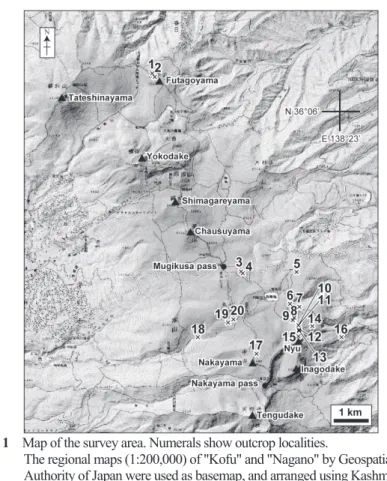
Fig. 1 Map of the survey area. Numerals show outcrop localities.

The regional maps (1:200,000) of "Kofu" and "Nagano" by Geospatial Information Authority of Japan were used as basemap, and arranged using Kashmir 3D.

The Yatsugatake volcano is located on the volcanic front and forms a volcanic chain trending ca. 21 km N–S, with many eruptive centers (Fig. 1). The volcanic chain is usually divided into the

“northern Yatsugatake” and “southern Yatsugatake” at the Natsuzawa pass. The volcanic landforms in the southern Yatsugatake are sharp and poorly vegetated, while the northern Yatsugatake landforms consist of many lava domes, with moderate coverage of conifer forest.

Eruptive activity in and around Yatsugatake area started ca. 1.2 Ma, as the activities of the

Yabashira, Kurumayama, and Kirigamine volcanoes at the base of Yatsugatake. The activity of the

Yatsugatake volcano dates back to ca. 0.5 Ma (Nishiki et al. 2007). The Yokodake lava dome in

the northernmost part of Yatsugatake consists of nine lava flows and one pumice fall deposit and is

recognized as an active volcano; there are some volcanic ash deposits (NYk-1 and NYk-2) and the

eruption age of NYk-1 is estimated to be between 800–600 years ago (Japan Meteorological

Agency 2013). However, Okuno and Kobayashi (2010) doubted the existence of an eruption

corresponded to the NYk-1 tephra bed, considering NYk-2 tephra bed (2.35–2.15 cal ka BP) to be

the most recent products of the Yokodake volcano. Oishi (2015) concluded that the four lava flows

covering the Yt-Pm4 tephra bed (31 cal ka BP) were erupted during the last 31 ky. A sector

collapse occurred in the vicinity of Nyu, Inagodake, Nakayama Pass, and the Tengudake area in

AD 887 or AD 888, and Otsukigawa debris avalanche flew the east flank. Eruptive activity could

(3)

have occurred during this event and we therefore must discuss triggers of the sector collapse to determine Holocene volcanic activity.

3. Description

White-colored thin deposits, consisting mainly of silt-sized particles, can be identified from the region between Nyu and the Mugikusa pass of the northern Yatsugatake area (Fig. 2, Table 1).

For purposes of this study, the deposits were washed using water and an ultrasonic cleaner, dried using a hotplate, and sieved (using meshes of 500–250 μm in diameter). Proportions were measured by counting 300 particles.

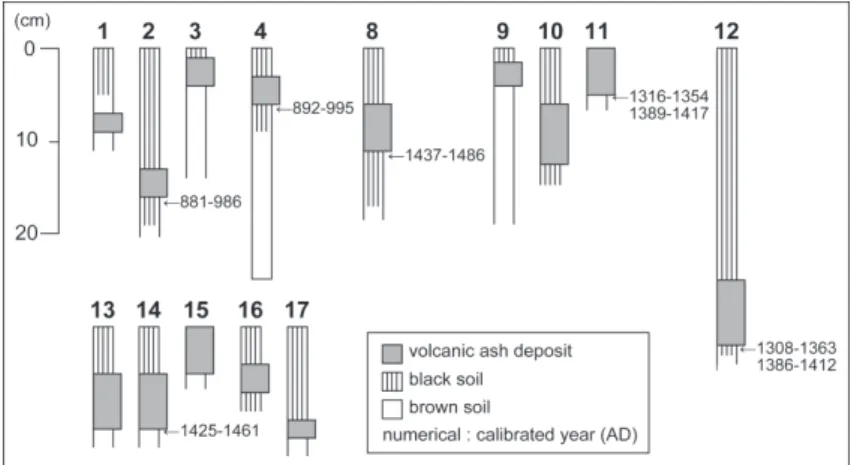
Fig. 2 Columnar sections showing the stratigraphic positions of the deposits.

Table 1 Sample list

Loc. Thickness Size of

particles * Particle

proportion analysis AMS analysis

1 2 Sa

2 3 Sa ○ ○

3 5 Si ○

4 3 Si ○ ○

5 0 - - -

6 0 - - -

7 0 - - -

8 5 Si ○ ○

9 2.5 Si ○

10 6.5 Si

11 5 Si ○

12 7 Sa ○ ○

13 6 Si

14 1 Si ○ ○

15 5 Si

16 3 Si

17 2 Si

18 0 - - -

19 0 - - -

20 0 - - -

* Sa: sandy, Si: silty

(4)

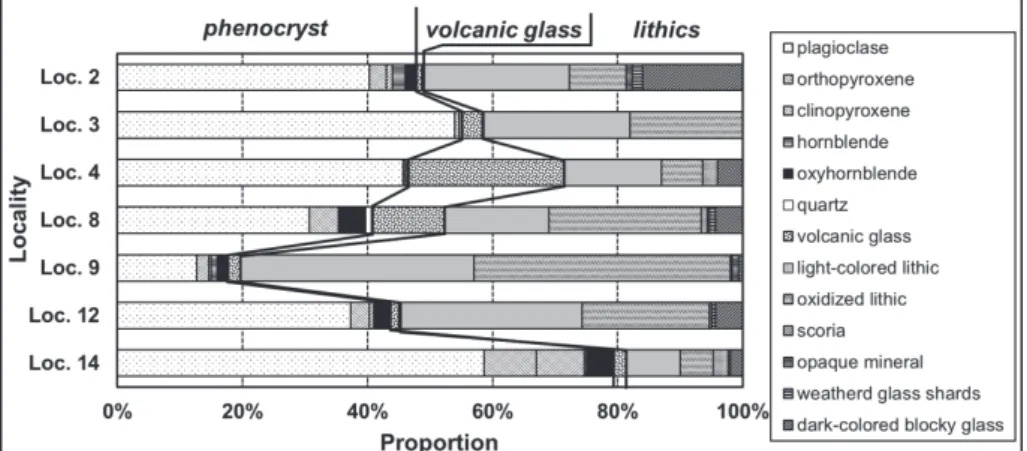
A white-colored deposit, consisting mainly of sandy and silt-sized particles was identified at Loc. 12, slightly north of Nyu. The layer is 7 cm in thickness and is covered by black soil of ca. 25 cm in thickness (Fig. 2). The particles consist of plagioclase, two-pyroxene, and oxyhornblende phenocrysts, light gray lithic fragments, red oxidized lithic fragments, and minor glassy particles (Fig. 3). The glassy particles consists mainly of brown-colored blocky type (Fig. 4). At Loc. 4, on the east side of Mugikusa pass, there is a white-colored deposit consisting mainly of silt-sized particles. The layer is 3 cm in thickness and is covered by black soil of ca. 3 cm in thickness (Fig.

2). The particles consist of plagioclase phenocrysts, lithic fragments, and 25% glassy particles having sharp morphology (Fig. 3). The glassy particles consists mainly of fiber type (Fig. 4). Loc.

2, on the north peak of Futagoyama, includes a deposit that consists mainly of sandy particles; the layer is 3 cm in thickness and is covered by black soil of ca. 13 cm in thickness (Fig. 2). The particles consist of plagioclase, two-pyroxene, and oxyhornblende phenocrysts, light gray-colored lithic fragments, and minor glassy particles (Fig. 3).

Fig. 3 Particle components of the deposits at several localities.

Fig. 4 SEM-based backscattered electron images of the external morphologies of volcanic glass particles contained in the deposits at Locs. 4 and 12.

The SEM (JEOL JSM-6610LV) at the Geological Survey of Japan, AIST was used.

The refractive indices of oxyhornblende (n 2 ) were measured for the deposits in Locs. 8, 9, and 12 using the Refractive Index Measurements System (RIMS) 2000 (produced by Kyoto Fisson Track Co. Ltd.) at the Tokyo Metropolitan University (Fig. 5). The indices for Locs. 8, 9 and 12 were 1.736–1.749, 1.733–1.743, and 1.737–1.746, respectively.

The ages of deposits were measured using the AMS method (Table 2). The samples used were

(5)

of black soil located just under the deposits. AMS radiocarbon analysis was conducted at the Paleo Labo Co. Ltd. The samples were treated using the standard acid-alkali-acid method. Following preparation, these were analyzed using accelerator mass spectrometry (compact AMS of Paleo Labo Co. Ltd.: NEC 1.5SDH). Radiocarbon ages were corrected for isotopic fractionation and calendar years were calculated. A 14 C-half-life of 5568 years (Libby half-life) was used for purposes of age calculation. Calibrations were produced using OxCal 4.2, employing the IntCal 13 atmospheric curve (Bronk Ramsey 2009; Reimer et al. 2013).

The ages (correlated calendar year, 2σ) of deposits at Locs. 2 and 4 (north of Shirakomaike pond) were estimated to be AD 881–986 and AD 892–995, respectively (Table 2). On the other hand, the ages of deposits at Locs. 8, 11, 12, and, 14 (south of Shirakomaike pond) were estimated to be AD 1437–1486, AD 1316–1354 and AD 1389–1417, AD 1308–1363 and AD 1386–1412, and AD 1425–1461, respectively (Table 2).

Fig. 5 Refractive indices of oxyhornblende phenocrysts.

Table 2 Results of AMS dating

2 PLD-19038

(110720-2) -24.65±0.12 1125±20 881 AD (95.4%) 986 AD

4 PLD-19040

(110721-1) -23.49±0.17 1095±20 892 AD (95.4%) 995 AD

8 PLD-16919

(101014-2) -24.14±0.15 415±20 1437 AD (95.4%) 1486 AD

11 PLD-16920

(101014-4) -24.69±0.14 565±20 1316 AD (50.6%) 1354 AD 1389 AD (44.8%) 1417 AD

12 PLD-16921

(101014-5) -23.51±0.16 585±20 1308 AD (66.4%) 1363 AD 1386 AD (29.0%) 1412 AD

14 PLD-16923

(101015-2) -23.99±0.29 445±20 1425 AD (95.4%) 1461 AD

Loc. Labo ID δ

13

C Calibrated year ranges (2σ)

(‰)

14

C age (yrBP±1σ)

4. Discussion Sources of deposits

All deposits contained 1–25% glassy particles with sharp morphology and gloss. This study defined such glassy particles as juvenile materials. This suggests that the deposits are comprised of magma emitted during eruptions. There are some Holocene tephras in Yatsugatake region.

Especially, the Tenjosan tephra derived from the eruption at the Kozushima volcano in AD 838

was distributed around Yatsugatake region (e.g. Sugihara et al. 2001), and its age is similar to those

of deposits of Locs. 2 and 4. In future work, I will attempt to correlate the deposits of Locs. 2 and 4

with Kozushima Tenjosan tephra. The deposits at Locs. 8, 11, 12, and 14 were dated to the

(6)

14–15th centuries, but there was no distal tephra deposited around the Yatsugatake volcano at this age. The deposit is thus more likely to be comprised of volcanic ash from eruptions of the Yatsugatake volcano.

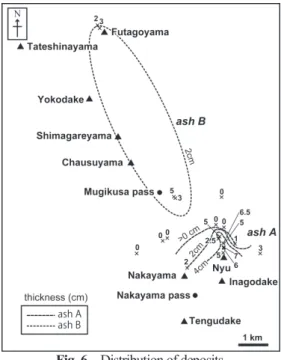
All volcanic ashes at Locs. 8, 9, 12, and 14 have similar particle components; for example, they contain 1.7–4.3 % oxyhornblende (Fig. 3), and their ages and stratigraphic positions are similar. These data strongly suggest that these can be correlated each other. Similarly, all volcanic ashes of Locs. 1, 2, 3, and 4 are distributed in close proximity and their ages are similar; this would strongly suggest that these are also correlated each other. In addition, the types of glassy particles are usually different from both group. In this study, volcanic ashes from Locs. 8–17, distributed around Nyu, are referred to as “ash A”, and those from Locs. 1–4, distributed in the area between Futagoyama and Mugikusa pass, are referred to as “ash B” (Fig. 6). The eruptive ages of ashes A and B are AD 1308–1486 and AD 881–995, respectively. However, the correlation between these needs to be established more accurately, in particular for deposits that have not yet been analyzed;

the correlation results presented in this paper may thus be revised in future.

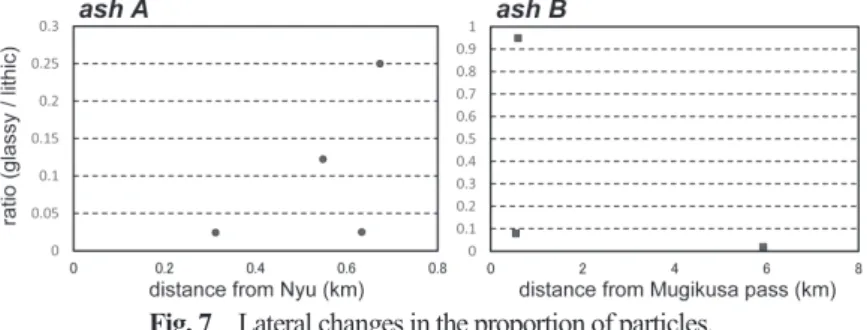
The distribution pattern of ash A shows systematic thickness changes (Fig. 6). The thickness of ash A increases with decreasing distance from Inagodake. In addition, Inagodake lava, distributed around Nyu and Inagodake, contains oxyhornblende phenocrysts. Furthermore, the proportion of lithic fragments increases with decreasing distance from Inagodake (Fig. 7). From these indications, this study concluded that ash A was produced by an explosive eruption around Inagodake, which emitted fragments of juvenile magma. The refractive index of oxyhornblende contained in Inagodake lava is 1.736–1.752. This supports the correlation of ash A and Inagodake lava.

Fig. 6 Distribution of deposits.

There is no clear pattern of thickness changes for ash B; however, the proportion of lithic

fragments in ash B increases with increasing distance from Mugikusa pass (Fig. 7). This study

(7)

therefore estimated that the source would likely have been in the area between Yokodake and Futagoyama in the northernmost part of Yatsugatake. Okuno (1995) indicated that an eruption occurred around Yokodake in the 9th century, producing NYk-1 tephra. On the other hand, and as noted above, Okuno and Kobayashi (2010) disagree with the existence of NYk-1. The presence of ash B may suggest that the eruption from which this was emitted occurred around the Yokodake area in the 9th century. There is clear crater topography at the summit of Yokodake, supporting this possibility. However, in order to determine the distribution and source craters of ash A and ash B with high accuracy, further description of these tephras is necessary and will be conducted in future.

Fig. 7 Lateral changes in the proportion of particles.

Trigger of sector collapse in the 9th century

The trigger of sector collapse in 9th century may have been a phreatic explosion (Kawachi 1983). On the other hand, Ishibashi (1999) argued that the trigger was likely strong motion caused by the Tokai and Tonankai (Goki-shichidou) earthquake, which occurred on August 22, 887 AD (as per the Julian calendar). However, if the trigger of sector collapse was a mega earthquake in the Enshu-nada area, further collapse should have occurred nearer to the epicenter, such as in Shizuoka and Yamanashi Prefectures. Kariya et al. (2014) described the collapse triggered by an earthquake in AD 877 at Dondokosawa, within the Southern Alps of Japan. There is little evidence to refute the possibility that the trigger may have been volcanic activity. Further examination is therefore necessary to investigate the possibility of volcanic activity being the trigger of sector collapse. The source of ash A was estimated to be located around Inagodake, a part of the collapsed source. On the other hand, ash B erupted during the 9th century. This suggests that there was eruptive activity in the Yatsugatake area at this time. The source of ash B was estimated to be in the northernmost part of Yatsugatake volcano. This study could therefore not conclude that the trigger of sector collapse was volcanic activity, and further research into volcanic activity in the Yatsugatake volcano during the Holocene and historic periods should be conducted.

Acknowledgements

I am able to study volcanology, complete my doctorates, and obtain posts with the Geological Survey of Japan, AIST, and Rissho University thanks to the considerable advice and encouragement received from Professor Haruo Yamazaki. Without him, I would not have been able to pursue a career as a volcanologist.

This study was supported by grant from Paleo Labo Co. Ltd.

(8)

References

Bronk Ramsey, C. 2009. Bayesian analysis of radiocarbon dates. Radiocarbon 51: 337–360.

De la Cruz-Reyna, S. 1991. Poisson-distributed patterns of explosive activity. Bulletin of Volcanology 54: 57–67.

Ishibashi, K. 1999. Great Tokai and Nankai, Japan, Earthquakes as Revealed by Historical Seismology: 1. Review of the Events until the mid-14th Century. Journal of Geography (Chigaku Zasshi) 108: 399–423.**

Kariya, Y., Mitsutani, T. and Inoue, K. 2014 Dendrochronology of a fossil log from the dammed lake deposit by Dondokosawa rock avalanche, the Southern Japanese Alps. Abstracts of Japan Geoscience Union Meeting 2014: HDS29-P01.**

Kawachi, S. 1983. Ohtsukigawa debris avalanche, Yatsugatake Volcanic Chain, central Japan. The Journal of the Geological Society of Japan 89: 173–182.

Japan Meteorological Agency ed. 2013. Yokodake. National Catalogue of the Active Volcanoes in Japan (The 4th edition), 725-730.*

Matsumoto, A., Uto, K. and Mizuno, K. 1999. K-Ar Ages of the Northern Yatsugatake Volcanic Rocks in the Tateshinayama District, Central Japan. Programme and abstracts, the Volcanological Society of Japan 1999 fall meeting, 20.*

McCelland, L., Simkin, T., Summers, M., Nielsen, T. and Stein, T. 1989. Global Volcanism 1975-1985, Washington: Smithsonian Institution.

Nishiki, K., Matsumoto, A., Uto, K., Takahashi, K. and Miyake, Y. 2007. Reexamination of volcanic activity of Yatsugatake area, central Japan. The Journal of the Geological Society of Japan 113: 193–211.**

Oishi, M. 2015. 14 C dating of the Yt-Pm4 tephra, the youngest pumice fall from the Yatsugatake volcano, Japan. Bulletin of the Volcanological Society of Japan 60: 477–481.**

Okuno, M. 1995. Eruption age inferred from radiocarbon accelerator (AMS) dating of paleosol.

Summaries of Researches Using AMS at Nagoya University (Nagoya Daigaku Kasokukishitsuryobunsekiki Gyouseki Houkokusho) VI: 43–53.**

Okuno, M. and Kobayashi, T. 2010. The latest magmatic eruption of Yokodake lava dome, Northern Yatsugatake Volcanoes, Central Japan. Transactions, Japanese Geomorphological Union 32: 343.*

Reimer, P. J., Bard, E., Bayliss, A., Beck, J. W., Blackwell, P. G., Bronk Ramsey, C., Grootes, P. M., Guilderson, T. P., Haflidason, H., Hajdas, I., Hatté, C., Heaton, T. J., Hoffmann, D. L., Hogg, A.

G., Hughen, K. A., Kaiser, K. F., Kromer, B., Manning, S. W., Niu, M., Reimer, R. W., Richards, D. A., Scott, E. M., Southon, J. R., Staff, R. A., Turney, C. S. M. and van der Plicht, J.

2013. IntCal 13 and Marine 13 Radiocarbon Age Calibration Curves 0-50,000 Years cal BP.

Radiocarbon 55: 1869–1887.

Sugihara, S., Fukuoka, T. and Ookawara, R. 2001. Volcanic Eruptions of Tenjouzan Volcano at Kozushima and Mukaiyama Volcano at Niijima, Izu Islands. Journal of Geography (Chigaku Zasshi) 110: 94–105.**

Uchiyama, T. 2001. Re-investigation of Volcanostratigraphy in the Late to Middle Pleistocene Southern Yatsugatake Volcanoes, based on the Tephrostratigraphy, Central Japan. Daishiki (the Quaternary) 33: 35–64.**

(* : in Japanese, ** : in Japanese with English abstract)

Fig. 1 Map of the survey area. Numerals show outcrop localities.
Fig. 2 Columnar sections showing the stratigraphic positions of the deposits.
Fig. 3 Particle components of the deposits at several localities.
Table 2 Results of AMS dating
+3

参照

関連したドキュメント

Keywords: homology representation, permutation module, Andre permutations, simsun permutation, tangent and Genocchi

Part V proves that the functor cat : glCW −→ Flow from the category of glob- ular CW-complexes to that of flows induces an equivalence of categories from the localization glCW[ SH −1

In this section, we construct the branching homology of a flow and we prove that it is invariant with respect to weak S-homotopy equivalences

Standard domino tableaux have already been considered by many authors [33], [6], [34], [8], [1], but, to the best of our knowledge, the expression of the

H ernández , Positive and free boundary solutions to singular nonlinear elliptic problems with absorption; An overview and open problems, in: Proceedings of the Variational

We construct a cofibrantly generated model structure on the category of flows such that any flow is fibrant and such that two cofibrant flows are homotopy equivalent for this

Keywords: Convex order ; Fréchet distribution ; Median ; Mittag-Leffler distribution ; Mittag- Leffler function ; Stable distribution ; Stochastic order.. AMS MSC 2010: Primary 60E05

Kilbas; Conditions of the existence of a classical solution of a Cauchy type problem for the diffusion equation with the Riemann-Liouville partial derivative, Differential Equations,