• 検索結果がありません。

“Plant Hunters” and Japan : Plants, Collection, and Exhibition

N/A
N/A
Protected

Academic year: 2021

シェア "“Plant Hunters” and Japan : Plants, Collection, and Exhibition"

Copied!
15
0
0

読み込み中.... (全文を見る)

全文

(1)

Plant Hunters  and Japan : Plants, Collection, and Exhibition

著者(英) Yozaburo Shirahata

journal or

publication title

Senri Ethnological Studies

volume 54

page range 15‑27

year 2001‑03‑09

URL http://doi.org/10.15021/00002831

(2)

"Plant Hunters" and Japan: Plants, Collection, and Exhibition

       SHIRAHA[FA Ybzaburo

International Research Centerfor Jtupanese Studies

I 1. Plant Hunters in Japan ‑‑‑‑‑‑‑‑l I 2. The Personality of thePlant Hunter i

I 3. An Approach to the Mind of the Collector: Plants and Collections i

li 4. People: Plant Hunters and Collectors l

i 5. System: Collection, the Individual, and the State l , 6. Apparatus: the Preservation and Display of Collections i

I 7. Applying the Model: Plant Hunters and Japan l

L‑"‑‑‑‑‑‑‑‑‑‑‑‑‑‑‑‑‑‑‑‑‑.‑L‑‑. .".‑‑ ‑‑‑‑L‑‑‑.‑‑‑‑.".‑‑..‑‑J

1. PLANT HUNTERS IN JAPAN

    "Japan is a treasure house of plants." This kind of thinking was already widespread in the West by the early eighteenth century; its emergence was likely made possible by Engelbert Kaempfer's Amoenitates Exoticae (1712) and History of lqpan (first published in English in 1727). It began with Kaempfer, who had been in Japan in the late 17th century (1690‑92), and relied on inforrnation brought back to the West by European travellers in Japan ‑ one could call them plant hunters ‑ such as Thunberg in the eighteenth century (1775‑76) and the Siebolds in the nineteenth (1823‑28 and 1859‑62). It was a view of Japan formed through the travel accounts, dried plant specimens, and living plants which these men brought back to the West.

This idea of Japan as "a treasure house of plants" was given further resonance by Japan's so‑called isolation. The fact that one could not easily experience for oneself the actual situation in Japan and so could acquire only a limited amount of indirect information seems to have further encouraged such imaginative projection.

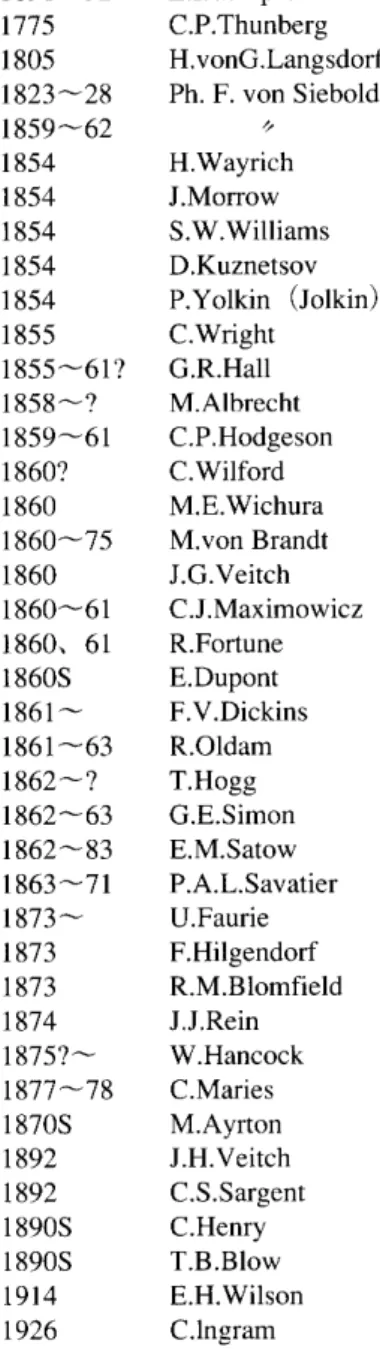
    The opening of Japan with the arrival of Perry's ships served to set this smouldering pile of fantasies alight. Hordes of plant hunters began to arrive in Japan, the "treasure house of plants" (Table 1). Besides the botanical and horticultural professionals sent by horticultural associations and plant companies, these included amateur enthusiasts such as the diplomats Rutherford Alcock and Emest Satow. Since I am grouping together these various individuals‑of diverse occupations and classes ‑ as "plant hunters," let me first explain this term.

    There is no clear definition of the term, but broadly speaking it indicates all those who are recorded as having engaged in the search for and collection of plants;

one can perhaps define it more narrowly as a class of people who specialize in the

15

(3)

Table 1.

1690‑‑92 1775 1805 1823‑‑‑28 1859‑‑‑62 1854 1854 1854 1854 1854 1855 1855‑‑・61?

1858"'v?

1859‑61

1860?

1860 186O"‑‑75 1860 1860‑‑61 1860, 61 1860S 1861‑‑

1861・‑‑63 1862‑‑‑?

1862‑‑63 1862‑‑83 1863'v71 1873‑‑

1873 1873 1874 1875?‑‑

1877Av78 1870S 1892 1892 1890S 1890S 1914 1926

Planthunters in Japan

E.Kaempfer C.P.Thunberg H.vonG.Langsdorf Ph. F. von Siebold

      o H.Wayrich J.Morrow S.W.Williams D.Kuznetsov P.Yolkin (Jolkin) C.Wright

G.R.Hall M.Albrecht C.P.Hodgeson C.Wilford M.E.Wichura M.von Brandt J.G.Veitch C.J.Maximowicz R.Fortune E.Dupont F.V.Dickins R.Oldam T.Hogg G.E.Simon E.M.Satow P.A.L.Savatier U.Faurie F.Hilgendorf R.M.B1omfie1d J.J.Rein

W.Hancock

C.Maries

M.Ayrton

J.H.Veitch

C.S.Sargent

C.Henry

T.B.Blow

E.H.Wilson

C.lngram

(4)

collection of plants as a profession. There are plant hunters who are themselves collectors, as well as those who are employed by collectors. The important point is that there have to be plant hunters in order for there to be plant collections.

2. THE PERSONALITY OF THE PLANT HUNTER

    Let me briefly outline the activities of plant hunters in England, the birthplace of the term. First let us consider the John Tradescants, father (?‑1638) and son (1608‑

62), who are representative of their early history.

    It was once thought that John Tradescant the elder was a Protestant in Flanders who had come to England during the reign of Elizabeth I, at the end of the sixteenth century. However recent research suggests that he was the son of a London farmer.

The first time his name clearly appears in the records is in 1607, as gardener at Hatfield House, the property of Robert Cecil, Earl of Salisbury, who later became Chancellor of the Exchequer. Tradescant was subsequently sent to Europe to acquire rare plants with which to decorate the house and gardens at Hatfield. This was the beginning of his career as a plant hunter. He collected plants in what is now Holland, Belgium, and France. Holland had assembled a number of rare products from the East, through the activities of the East India Company. Tradescant seems to have purchased plants which were rare in England from among these. In Paris, he concluded agreements for the exchange and purchase of plants with Jean Robin (1550‑1629), the king's gardener, who was in charge of plants at the Jardin des Plantes, or, the "royal botanical garden." We know from surviving records what kind of plants Tradescant collected in Holland during this time. They included ftuit trees (for example, cherry and gooseberry), flowers (rose), and other plants (anemone, lily, orange, and tulip). Nowadays these are not rare in England. At the time, however, these were plants which even the aristocracy could hardly acquire. At the time, the orange was one of the most popular plants. North of the Alps it was impossible to grow the orange outdoors. Thus to own such a plant was a clear symbol of luxury, given the time and effort required to cultivate it. The tulip, too, was a rare plant; it had been brought to Europe from Turkey in the second half of the sixteenth century, and the techniques required to cultivate it were not well known. One can imagine how plants from foreign lands compelled the interest of the English aristocracy as rare, unseen, and unknown objects.

    Tradescant's earlicst recorded activities are limited for the most part to horticulture and botany. The first Earl of Salisbury died in 1611, but Tradescant also worked as the gardener for the second Earl. In 1615 he became the gardener at the St. Augustine Palace of the Archbishop of Canterbury, and in 1618 he was sent to Moscow. A Russian abacus which he acquired at this time is now on display in the Ashmolean Museum in Oxford. He also collected a large number of plants, as recorded in a journal held by the Bodleian Library, but nothing remains except the jouma}. Subsequently, in 1623, he entered service under George Villiers, Duke of

Buckinghan (1592‑1628). In 1625 he accompanied the Duke and collected plants

(5)

when the latter was sent by the court to Paris. In 1630 he became Keeper of His Majesty's Garden, but it seems that already before this, in 1628, he had built a house and garden at Lambeth in West London, and had begun to collect and cultivate rare plants from the European continent and North America.

    It seems that in addition to filling out his collection of plants, Tradescant also built a collection of other rarities and curiosities. People began to call the collection in Lambeth "Tradescant's ark," suggesting the vast nature of the collection by comparing it to Noah's ark in the Old Testament, which had accommodated every last living creature on the earth. What kind of things did it include? In 1652, after his father's death, and with the help of EIias Ashmole, John Tradescant the Ybunger completed a draft of the catalogue, and in 1656 he published it under the title

"Museum Tradescanteum" [TRADEscANT 1980 (1656)]. The contents are divided

into two main sections. The first is a list of various rarities and curiosities, classified under fourteen headings: "1. Birds; 2. Fourfooted beasts; 3. Strange fishes; 4. Shell‑

creatures; 5. Insects; 6. Mineralls; 7. 0utlandish fruits; 8. Mechanicks; 9. 0ther rarities; 10. Warlike instruments; 11. Garments and ornaments; 12. Utensils and Housholdstuffe; 13. Coynes; i4. Medalls." In other words, this section comprised all the objects connected to everyday life. The other section is a list of plants titled "A catalogue of the plants in John Tradescant's garden." This lists all the plants which were growing at the time in Tradescant's garden in Lambeth. There are a total of 1701 entries, including lily, Mandoragora, Marvel of Peru, tulip, et al. After Tradescant the Elder's death in 1638, his son continued in his father's footsteps, being appointed as Keeper of His Majesty's Garden. As such, he collected plants in the new colony of Virginia, on the North American continent. Thus this catalogue also includes objects collected by the son. These plants were not products of the imagination, but actually grown in the garden at Lambeth. Among the rarities, however, divided under fourteen headings, one can find any number of imaginary objects, such as "the tail feathers of a phoenix," or "the unicorn of the sea." These may have been creatures whose existence was subsequently confirmed as the bird of paradise, or the narwhal, which lives in the Arctic, but at the time these were purely figments of the imagination. Possibly the foreign plants were also understood as being somewhat ambivalent, existing as actual physical objects, but also having a mysterious quality which came from belonging to this same imaginary realm. Plant hunters were regarded as messengers bringing these "mysterious" but real objects to the European world.

3. ANAPPROACH TO THE MIND OF THE COLLECTOR: PLANTS    AND COLLECTIONS

    Collections of plants, together with the cultivation required in order to preserve

and maintain them, encouraged the creation and development of the academic fields

of pharmacology, medicine, brewing science, agronomy, nutrition science,

honiculture, and genetics.

(6)

     The Christian Church had no interest in improving flowers or omamental plants, but it did concern itself with research into plants as food and medicine. It was particularly interested in research into the production of wine. Wine, as a symbol of Christ's blood, was essential to the holy sacraments, and so the church encouraged improvements in the way in which it was made and advances in the cultivation of grapes (thus paving the way for the discovery of noble rot, research into molds and viruses, and into plant bacteria). Mendel's discovery of genetics, through his work cultivating peas in the gardens of the Augustinian monastery at BrUnn, now Bmo in the Czech Republic, is a concrete example of a discovery in the plant world which is related to the Church, indeed an explanation of the world of plants which was formulated on Church premises. Generally speaking, Christianity promoted modem science. It did not, however, improve gardens. This was left to the secular world.

Gardens which required the omamental use of plants were developed in the secular world. Although churches and monasteries created sites for meditation, omamental gardens were quite outside their interest. This was perhaps due to Christian doctrine.

    Buddhism in Japan, on the other hand, developed gardens mainly as an art, and did not support modem science. Rather, in Japan, this field was the responsibility of the secular world. During the rule of Yoshimune, the eighth Tokugawa shogun, agronomy, horticulture, and agriculture were encouraged as forms of practical learning, focusing on medicine and nutrition. For example, Aoki KonyO's research into the cultivation of the sweet potato, and Noro Geaj6, Matsuoka Gentatsu, and others' work in decoding and reading the western and East Asian literature on plants were due to an interests in increasing food production and in pharmacology. Because of this there was in Japan only a limited interest in the properties of plants: an interest in looking at the plant world as a whole did not develop, and perhaps it is because of this that no plant hunters appeared. The official duty of Japanese plant collectors like Uemura Saheijj was defined as "medicine gathering," that is, searching for and collecting medicinal plants. Uemura was so assiduous in his collecting that rumors began to circulate about his spying for the bakufu on the various domains. Although interest was thus focused purely on the plants' medical efficacy, there were of course a number of exceptions. This is perhaps due to the fact that interest in plants in Japan was marked by the expression of a curiosity which was at root purely intellectual.

One example of this is Hidetada, the second shogun, who was a devotee of fine camellias and lavished his attention on his collection. He cultivated Iarge numbers of ornamental camellias in the "noble flower beds" (o‑hanabatake) in Edo castle, creating a superb collection on the basis of a purely horticultural interest.

    Ornamental gardens in the West were left to the secular world, and became the

sites of plant collections. Gardens in Japan, on the other hand, were the

responsibility of the religious world, and became sites for collections of stones. The

military houses and the aristocracy of course showed great interest in decorative

garden rocks, and collected them enthusiastically, but this interest was supported by

religious sentiments. In Japan it was the "stone hunters" who were active, whereas in

the West it was the plant hunters who contributed to the creation of gardens.

(7)

4. PEOPLE: PLANT HUNTERS AND COLLECTORS

    In thinking about the role of the individual in building collections, there is a distinction between the collector and the enthusiast. Inasmuch as the enthusiast is sustained by what one might call an obsessive impulse, he or she does not regard objects as materials for comparison or classification. On the other hand, the collector always has rivals, and so will likely be interested in comparisons with other collections. Of course, this contrast is only relative: wherever there is an

enthusiastic collector, there will be a collecting enthusiast.

    Where should one situate the plant hunters? Tradescant, mentioned above, was employed by aristocrats and the clergy. Subsequently he began his own plant collection, but initially he worked only for others, mere}y assisting with their collections. To take another example, let us consider Francis Masson (1741‑1805), a plant hunter who can be considered representative of the 18th century. Masson was born in Scotland, and was the first plant hunter sent abroad from Kew Gardens.

Joseph Banks, who was in charge of Kew Gardens at the time, considered the plants of the world as useful natural resources; he decided to begin a systematic collection, and chose Masson as his first collecting specialist. In 1772, on Banks' orders, Masson joined Captain James Cook's second (of three) circumnavigations of the globe, disembarking in South Africa, and collecting plants from an extensive area around present‑day Cape 'Ibwn. Thunberg, who was employed by the Dutch East Indies Company, was living in the area at the time, and the two men joined forces, collecting many plants which were unknown in the European world. Thunberg subsequently travelled to Japan, but Masson went on with his collecting, continuing to send plants to England for about three years. Among the plants sent during this time were over fifty varieties of geranium, many of which are now classified in the genus Palargonium. Subsequently the cultivated species was improved such that nowadays, it has become ubiquitous as a flowering potted plant, decorating windowsills throughout Europe. After this, Masson continued as a plant hunter for Kew Gardens, travelling to the Canary Islands, the Azores, the West Indies, and North America, and collecting twice more in South Africa. Although he actively collected in regions for which there was almost no accurate information, he never developed his own plant collection. He sent everything back home, his specimens becoming the Kew Gardens collection. In other words, he himself was not a collector, nor an enthusiast. Given the enthusiasm of his collecting activity, however, one begins to want to describe it as obsessive.

    From the end of the 18th to the middle of the 19th century, the Royal

Horticultural Society, the British East India Company, and horticultural firms began

to send plant hunters like Masson overseas. In late 18th century England was born

the professional plant hunter who, precisely because he was an emp}oyee, was

dedicated solely to collecting. What kind of aims lay behind the appearance of these

individuals, who one can generally refer to as plant hunters? I would like to consider

the following three motivations:

(8)

1. An amateur motivation to create a collection'

      '

2. A scholarly motivation to comprehend intellectually the plant world as a whole;

3. A financial motivation to profit from plants as commodities.

The first applies to the aristocrats and clergy such as the Duke of Salisbury who employed Tradescant, the second to individuals like Banks who pursued the life of the mind. Also related to the first and second motivations are a desire for ostentation and considerations of power and authority. The third motivation applies to horticultural firms and the East India Company. While any of these can function as a motivation for an employer to send a plant hunter overseas, it is hard to call any of them the motivation for the plant hunter himself. What reveals itself in the activities of the plant hunters is a sense of being drunk on the activity of collection itselL fu11 of the joys of discovery.

    Perhaps, plant hunters are not themselves collectors. But while this may be true, numerous " plant hunters" became known in Britain through collecting plants. Ray Desmond, a horticultural historian, has discovered the names of 8,OOO individuals [DEsMoND 1977]. In my opinion, only one tenth of these can be regarded as plant hunters. No other country in Europe besides Britain, not to mention Japan, produced such large numbers of plant hunters. From this one can infer the special relationship the British have to the botanical world.

5. SYSTEM: COLLECTION, THEINDIVIDUAL, AND THE STATE

    The historical agents who have been responsible for creating collections are individuals, groups, and states. From the 15th century on, in Italy, there was a "spirit of patronage" toward artists and scholars. The Medici family, who ruled Florence to all intents and purposes as its sovereigns, were generous protectors of artists and men of letters. Among them, Lorenzo di Medici (1449‑‑92), alias Lorenzo il Magnifico (the Great Lorenzo), is regarded as a great patron of the Renaissance. His patronage had the effect of creating a "collection," an accumulation of the various objects which it supported. However, his collection was a collection of art, not a natural history collection which included plants. It seems that collections which incorporated an interest in natural history began to appear in Italy with Cosimo di Medici (1519‑74) in the 16th century. The core of his collection was still art and craft objects, but it also included products from the "New World," that is, the American continent, and particularly products from South America, which had arrived via Spain. The collections of his sons, Ferdinand and Francisco, included products from Africa, India, China, and Japan. From the second half of the 16th century, the proportion of products of the natural world increased rapidly in the collections of the aristocracy. The collections of Francesco Carzolari (1566?‑86) in Venice, Ferrante Imperato (1550‑1631) in Naples, and Michele Mercati (1541‑93), who was both a doctor and keeper of the Vatican gardens, seem to have included both ancient relics and large numbers of natural products.

    The countries north of the Alps seem to have lagged well behind Italy in this

(9)

kind of collection. One theory suggests that the repeated, harsh denunciations of the worship of idols and relics by 16th century Protestants may have been due to the flood into Europe of objects from regions "discovered" during the age of great ocean voyages, objects that from a Christian perspective were regarded as idols. The famous British collections, like the Tradescant collection mentioned above, appeared from the beginning of the 17th century. In Britain and Holland, natural history collections began to emerge after the establishment of the East India and West Indies Companies and their voyages across the world's oceans.

    Initially, individual collections, such as those of the Tradescants and Hans Sloane (1660‑‑1753), were the most comprehensive and advanced. The Tradescant Collection was the core around which the Ashmolean Museum was established at Oxford University in 1683. The Ashmolean is known as both England's first science museum, and the world's first public museum. The Sloane Collection was the basis on which the British Museum was opened in 1759. This history reveals that initially it was the curiosity of an individual which became the driving force behind the collection. The collection was the expression of an individual's will; it came into being as an expression of his interests. When a coliector dies, it passes into public hands. And when it is thus tied to a group (or state) interests, the collection will conform to the will of the group (or state). The Tradescant collection was bound up with their curiosity toward plants. There were dried specimens in Sloane's collection, but plants were again the majority, and this became the core of the natural history section of the British Museum. In Britain, plants were closely related to the development from private collections to the birth of the museum. Kew Gardens in the 18th century and the Royal Horticultural Society in the 19th began as organized, group collections solely focused on plants. I am tempted to hypothesize that these collections of plants in England‑ manifestations of collective will‑ were supported by an aggregation of curiosity towards the world of plants at the national level.

6. APPARATUS:THEPRESERVATIONANDDISPLAYOFCOLLECTIONS

    How were plant collections preserved? And how were they displayed?

    When one thinks about preserving plants over the long term, the first thing that comes to mind is the dried specimen. Certainly, of the plants collected by Kaempfer in Japan, it is the dried specimens which were kept in the Sloane Collection that have actually survived, and are still preserved in good condition today in the Natural History Museum (formerly the natural history department of the British Museum).

Indeed, in addition to those collected by Kaempfer, all the plants which survive from the Sloane Collection are dried specimens. A place where dried specimens are kept is known as a Herbarium. Most plant collectors, however, were not interested in dried specimens, nor did they have much enthusiasm for creating herbaria. Indeed, I cannot think of a collection of dried specimens which received any public attention.

To keep one's plant collection in the form of dried specimens in a herbarium‑a

(10)

kind of preservation apparatus ‑ would seem to be in order to ensure that they lasted a long time. But however long one may be able to preserve the specimen, one can only see the remains of the plant; its colour and living quality are absent. There is no sense of the actual plant. Nor are dried specimens any good for display. For this, one has pictures of plants. The drawing of plant pictures has a very long history.

However, it was in 16th century Europe, with the German Otto Brunfels, in 1530, that illustrated books of plants began to appear, with pictures which sought to provide a sense of the actual plant. Such illustrated books were, so to speak, the display of a plant collection in pictures.

    Botanical gardens began to appear at the same time. The first botanical gardens were established mainly as places for university medical education, and so were characterized by a strong interest in plants with medicinal properties. The botanical garden at the University of Padua, established in 1545 is said to have been the world's first. It was round, and divided into small sections. The way in which this early botanical garden was divided up seems to have reflected an intention to comprehend in a systematic manner not only medicinal plants, but the world of plants as a whole. Botanical gardens are not so much places for display, as sites which aim at an intellectual comprehension of the natural world, even the whole world, based on plants.

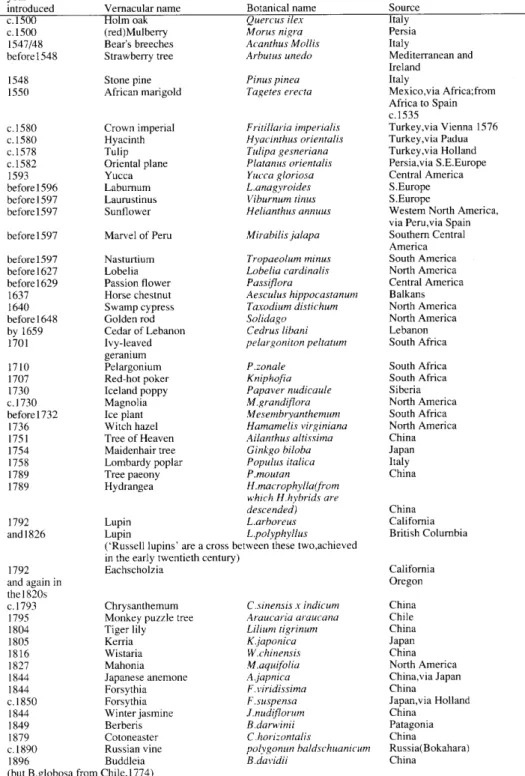
    The flower garden was the most suitable apparatus for displaying plant collections. The plant hunter Tradescant created a garden using as materials the foreign plants he had brought back for the Earl of Salisbury. Recently the garden has been restored to close to its original condition. The garden uses especially colorfu1 flowers. The flowers planted in the knot garden that spreads out in front of the house include a rare species of violet which he brought back, as well as various kinds of rose, lily, and tulip. The garden was a means whereby a lord could show off his wealth and display his authority through his collection of rare plants. Flower gardens, in particular, functioned as sites for the preservation and display of collections of flowers with great rarity value. Among the gardens which appeared during the age of absolute monarchies were flower gardens known as "embroidered gardens," created to decorate the front of royal palaces with carpets of luxurious flowers. The expensive, colorful, foreign flowers which were planted throughout the gardens were themselves a display of power (Table 2).

    Flower gardens also began to appear in Japan. There are records of "flower terraces" (kadan) from the Muromachi period (Kanmon Gyoki). One can still see today the bed of peonies in the garden of Ginkakujitemple (Jishojj), which was created during this period. While its position within the garden is thought to have changed, its size seems to have remained almost the same. It is a flower bed scarcely one meter wide and five meters long. Peonies, which are thought to have come from the China of the Southem Sung, were rare and valued flowers in Japan at the time.

Peonies cannot grow without good drainage. The flower bed, created by piling up

earth, was thus used for cultivation, not for display (Table 2). Perhaps because of

this, one does not see much evidence of subsequent development in flower gardens in

(11)

Table 2. Plants introduced to Europe

year introduced Vemacular name Botanical name Source c.1500

c.1500 1547148 before1548

1548 1550

c.1580 c.1580 c.1578 c.1582 1593 before1596 before1597 before1597 before1597 before1597 before1627 before1629 1637 1640 before1648 by 1659 1701 1710 1707 1730 c.1730 before1732 1736 1751 1754 1758 1789 1789

Holm oak (red)Mulberry Bear's breeches Strawberry tree

Stone pine African marigold

Crown imperial Hyacinth Tulip Oriental plane

Yucca Laburnum Laurustinus Sunflower Marvel of Peru Nasturtium Lobelia Passion flower Horse chestnut Swamp cypress Golden rod Cedar of Lebanon Ivy‑leaved geranlum Pelargonium Red‑hot poker Iceland poppy Magnolia Ice plant Witch hazel Tree of Heaven Maidenhair tree Lombardy poplar Tree paeony Hydrangea

1792 Lupin

and1826 Lupin

       (̀Russell lupins'

       in the early twentieth century)

1792 Eachscholzia

and again in theI820s

c.1793 Chrysanthemum l795 Monkey puzzle tree

1804 Tiger lily

1805 Kerria 1816 Wistaria 1827 Mahonia

1844 Japanese anemone

1844 Forsythia c.1850 Forsythia 1844 Winterjasmine 1849 Berberis 1879 Cotoneaster c.1890 Russian vine

1896 Buddleia

(but B.globosa from Chile,1774)

euercus itex Morus nigra Acanthus Mollis Arhutus unedo Pinus pinea 7kegetes erecta

Fritillaria imperialis Hlyacinthus orientalis Tulipa gesneriana Platanus orientalis Yucca gloriosa L.anagyroides Viburnum tinus Helianthus annuus Mirabilis jalqpa

7}‑opaeolum minus Lobelia cardinalis Passavora

Aesculus hippocastanum 7‑tixodium distichum Soliclago Cedrus libani pelargonitonpeltatum P.zonale

Kniphoj}a Papaver nudicaule M.grandWora Mesemhiyanthemum Hamamelis virginiana Ailanthus altissima Ginkgo hiloba Populus italica P.moutan H.macrqphylla(f}iom which H.hvhrids are descended) L.arhoreus L.po(yphvyllus are a cross between these two,achieved

C.sinensis x indicum Araucaria araucana Lilium tigrinum KJ' aponica VV.chinensis M,aquijblia AJ'crpnica F.viridissima F.suspensa J.nudij7orum B.darM,inii C.hori.7.ontalis

pol.vgonun baldschuanicum B.davidii

Italy Persia Italy

Mediterranean and Ireland

Italy

Mexico,via Africa;from Africa to Spain c.1535

Turkey,via Vienna 1576 Turkey,via Padua Turkey,via Holland Persia,via S.E.Europe Central America S.Europe S.Europe

Westem North America, via Peru,via Spain Southern Central America South America North America Central America Balkans North America North America Lebanon South Africa South Africa South Africa Siberia North America South Africa North America China Japan Italy

China

China California British Columbia

California Oregon China Chile China Japan China North America China,via Japan China

Japan,via Holland China

Patagonia China

Russia(Bokahara) China

(From Christopher THAcKER, The Histor.v ofGardens, Croom Helm, London, 1979.)

(12)

Japan. This may be because conspicuous display took different forms from that in Europe. In Japan, people did not turn to flower gardens in order to express their wealth or authority.

    Among the European royalty and aristocracy, on the other hand, while a few individuals kept their plant collections in herbaria in the form of dried specimens and some recorded them in the form of plant illustrations, most people displayed their collections in the form of flower gardens. In European gardens, where flowers were highly valued, the best place for displaying one's collection of plants was a flower garden.

7. APPLYING THE MODEL: PLANT HUNTERS AND JAPAN

    Perry's expedition to Japan, which stimulated interest in Japanese plants in the West, included two designated plant hunters, namely James Morrow (1820‑65) and Samuel Wells Williams (1812‑84). In the official record of the expedition, however, two others are mentioned as having been involved in collecting plants, namely Daniel S. Green and Charles E Farrs, who were both on board as surgeons.

Although they knew something about plants, they seem to have been used solely for their manpower, handing over the plants they collected to Morrow. Williams had joined the expedition as chief interpreter, in recognition of his achievements as a China scholar and his long experience living in China. It seems that he was given the responsibility of collecting because from a young age he had shown a deep interest in plants and had also studied botany in school. Morrow had been employed as an agriculturist, but had taken a degree in medicine after studying at the University of Georgia and the University of Pennsylvania. It was because he had the best academic background, that Morrow is thought to have been put in charge of collecting plants. The plants which were gathered through this team effort were identified and written up into a detailed report by Asa Grey, a professor of natural history at Harvard University who was an eminent figure in the American Botanical Society. It is clear that the collection was intended to be scientific.

    The collectors also caught and mounted birds and animals, and collected fish

and shellfish. They had the same aim as the expeditions which European countries

like England and France had been sending throughout the world since the 17th

century. The various expeditions sent by the European countries to circumnavigate

the world had included a team to carry out scholarly research, with people to carry

out natural history surveys and collect specimens, and artists to record these. The

dispatch of Perry's expedition belongs to this tradition. That is, it had the character

of a scholarly survey mission, which was to systematically survey the natural history

and collect the plants of Japan. The second volume of the official report provides the

results of the survey of animals, plants, fish, and shellfish. This was what one should

call a report on zoology and botany as distinct from natural history. However, in

addition to collecting animals and shellfish, Morrow and the others also gave out

American farm tools and seeds to farmers in the Ryukyus and China, and supervised

(13)

the operation of the machinery and crop cultivation. Given this, it is clear they did not focus solely on collecting plants. Nevertheless, one can claim that they initiated a survey into natural history, pure and simple, divorced from considerations of utility.

    The British diplomats Alcock and Satow enthusiastically collected plants in the restricted area within which they were allowed to travel, again out of an intellectual interest in plants. In Satow's travel diary, one finds more observations on plants than on diplomatic subjects or on his research on the Japanese people. He grew a collection of various kjnds of bamboo in the garden of the ministerial residence, and got a Japanese artist to paint it. His colleague Mitford, in addition to taking a collection of bamboo back home, even wrote a monograph on the subject tMiTFoRD, 1896]. Alcock's "Capital of the Tycoon" is regarded solely as a record of the diplomatic history of modern Japan, but is punctuated with many observations on the vegetation and plant species of Japan [ALcocK 1863]. Indeed, at the end of the volume is appended a report on the vegetation of Japan. Its author was John G.

Veitch, one of the sons of the great London gardening firm of the same name. In 1860 he visited Japan as part of a round‑the‑world tour, investigating the market value of Japanese plants as a gardening merchant. It was not only academic interest that was attracted to Japan, once it was heard that the country was "open"; there was also a strong commercial interest in the prospects of Japanese plants in the horticultural marketplace.

    It was Robert Fortune who added the image of "Japan as a treasure house of horticultural plants"‑that is, of ornamental plants which might be traded‑to the existing image of "Japan as a treasure house of plants". He exported ornamental plants in great quantities. Because travel was restricted at the time, other than in the area of the treaty ports, it was Japanese nurseries which enabled him to acquire plants freely. Even so, somewhat surprisingly, he was himself able to find a great variety of plants and send them ofl7 to England. The gardening business in Japan was highly developed. Most of the plants which were used ornamentally at the time had been commodified, and there were domestic supply routes for rarities and curiosities. The Japanese plants which Fortune imported excited English plant enthusiasts and the gardening world, and initiated a series of visits to Japan by plant hunters. Of course, the plant hunters who visited Japan subsequently also acquired many of their plants at nurserles.

    Soon after the opening of Japan, the round‑the‑world route was completed with the opening of the Suez Canal and the Transcontinental Railway in North America.

With this, it also became possible to travel around the world in search of plants.

Japan, until then a secret, inaccessible region, became the final frontier for plant collectors. It was now possible to complete a missing part of one's collection. Nor is it too surprising that an image of a Japan emerged as being full of unknown species.

From the 1880s, numerous advertisements for plants described simply as "Japonica"

were published in gardening magazines. The image of Japanese plants was

mystified, acquiring enormous popularity, such that a plant which given its shape a

customer thought might be a camellia, would arouse his or her interest solely on the

(14)

off−chance that it was a Japonica.

BIBHOGRAPHY

ALcocK, Rutherford

    l863  :τ7z8 C砺ρ 01ρプ zθτ:ycooη」Aノ〉αrrα ∫v8ρプατ乃「86 yF6α「5 R65 018ηcθ加ノ卯αη,

      vols. l and 2. London.

DESMOND, Ray

    l977  ∠)〜c ∫o〃αry 6ゾB〃 81zαη41々31〜Bo αη∫∫ 8αη4 Hor cκ〃麗r 5∫∫, ηc1μ4 η9 Ploη∫

      Co〃θαor30η4 Bo∫αη∫cα1 Aπ ∬5. London。

GOSUKOIN(後崇光院)

    1958−59(15th Century)「看聞御記」『続群書類従 補遺二』(全2巻)続群書類従       刊行会( Kanmon Gyoki・. Z脈配G房η∫加Rμ加, Ho,2,2vols. Zoku Gunsho       RuijU Kankokai,)

KAEMPFER, Engelbert

    l712 141η08η∫∫α加贋αo∫∫cαr配襯ρo〃 ∫co一助y5 co−1η64∫cαrμ刑拘5dc配〃V. Lemgo.

    1727 H∫5 oリア6ゾノαpαη.London.

MAcGREGoR, Arthur(ed.)

    1983  7rα465cαη〆∫Ror〃 {〜∫ θ5∫αy∫oη〃z6/bμη40 oηρプ〃z6 A51z〃zo1{〜oηル1祝56μ〃11683       w∫漉αcα∫α109配66ゾ読83配rv∫v加98α〃y co〃6〜α oη5. Oxford:Clarendon Press.

MITFoRD, Algemon Bertram Freeman     l896 丁加、8α〃めooGαr48η.

PERRY, Matthew Calbraith;HAwKs, Francis L.

    1856  〈1α〃40 v86ゾ 乃66μ)64∫〃。ηρプαη、A〃z8r∫cαノ〜5gz4αゴroη o〃z6 C〃∫ηα∫603αη4       ノ「αPαη ρ{〜1プbr〃z84∫η 〃z{〜yθαr31852,1853,αη41854,μη4θr〃z6 co〃〜〃〜oη016ゾ       Co〃2〃zo40r6ル∫・C・P6r若y,ση 845 α 85〈1αvy,わy or4〔η・ρブ〃z6 Goγ81・η〃2θη (〜プ〃z8       乙励845 伽8/co〃〜μ1θ4加〃π加or∫9 ηα1ηo 6∫αηの。脚α13げCo〃z〃zo40rθ       Pθ〃ツαη4傭(〜が c8r∫, o醐∫r69配88∫,αη4κ漉r乃∫∫∫配μrv∫∫∫o肋y Frαηc ∫L.

         Hαwん∫,2vols. Washington:A.0. P. Press SATow, Emest Mason, Sir(アーネスト・サトウ)

    1992 『日本旅行日記』全2巻庄田元男訳,平凡社,(T1・αv81 D αry∫〃¢ραη,2

      vols. Trans, SH6DA. Motoo. Heibonsha。)

Shirahata, Yozaburo

    l994 『プラントハンター』講談社.(伽rαη∫o Hαη δ. Kodansha.)

TRADEscANT, John

    1980(1656) 7〃θτrα46∫cαη Co〃6c oη. London:John Hewett.

(15)

Table 1. 1690‑‑92 1775 1805 1823‑‑‑28 1859‑‑‑62 1854 1854 1854 1854 1854 1855 1855‑‑・61? 1858"'v? 1859‑61 1860? 1860 186O"‑‑75 1860 1860‑‑61 1860, 61 1860S 1861‑‑ 1861・‑‑63 1862‑‑‑? 1862‑‑63 1862‑‑83 1863'v71 1873‑‑ 1873 1873 1874 1875?‑‑ 1877Av78
Table 2. Plants introduced to Europe

参照

関連したドキュメント

Lemma4.1.. This is not true if f is not positively homogeneous as the following example shows.. Let f be positively homogeneous. We shall give an example later to show that

In [1, 2, 17], following the same strategy of [12], the authors showed a direct Carleman estimate for the backward adjoint system of the population model (1.1) and deduced its

In Section 3 the extended Rapcs´ ak system with curvature condition is considered in the n-dimensional generic case, when the eigenvalues of the Jacobi curvature tensor Φ are

Keywords: continuous time random walk, Brownian motion, collision time, skew Young tableaux, tandem queue.. AMS 2000 Subject Classification: Primary:

The last sections present two simple applications showing how the EB property may be used in the contexts where it holds: in Section 7 we give an alternative proof of

Then it follows immediately from a suitable version of “Hensel’s Lemma” [cf., e.g., the argument of [4], Lemma 2.1] that S may be obtained, as the notation suggests, as the m A

The time-frequency integrals and the two-dimensional stationary phase method are applied to study the electromagnetic waves radiated by moving modulated sources in dispersive media..

[Mag3] , Painlev´ e-type differential equations for the recurrence coefficients of semi- classical orthogonal polynomials, J. Zaslavsky , Asymptotic expansions of ratios of