• 検索結果がありません。

昭和大学横浜市北部病院麻酔科*

N/A
N/A
Protected

Academic year: 2021

シェア "昭和大学横浜市北部病院麻酔科* "

Copied!
15
0
0

読み込み中.... (全文を見る)

全文

(1)

1

術後に発症する低酸素血症に対する術中因子の検討―晶質液投与量の影響

坂本篤紀*,増田陸雄 **,小坂 誠*,信太賢治*,大嶽浩司***,飯島毅彦****

昭和大学横浜市北部病院麻酔科*

昭和大学横浜市北部病院歯科麻酔科**

昭和大学医学部麻酔科学講座***

昭和大学歯学部全身管理歯科学講座歯科麻酔科学部門****

抄録

【目的】術後の呼吸器合併症は患者予後を左右する.手術中は人工呼吸による陽圧 換気で肺は障害を受けやすく,それ以外でも術後に呼吸器合併症を引き起こす原因 には様々なものがある.全身麻酔下に手術を受けた患者を対象として,術後低酸素 血症の発症に影響を及ぼすと考えられる誘因を解析し,その予測因子を検討した.

【方法】本研究は昭和大学横浜市北部病院臨床試験審査委員会の承認を受け,後ろ 向きに調査を行った. 2017 年 1 月 1 日から 2017 年 5 月 31 日までに当院消化器セン ターの手術を全身麻酔下で受けた成人患者のうち,術後 ICU に入室した患者を対象 とした.患者カルテから性別,ASA 分類,年齢,身長,体重,BMI,緊急手術の有 無,腹腔鏡の有無,手術部位,全身麻酔薬の種類,神経ブロックの有無,レミフェ ンタニル使用量,手術時間,麻酔時間,出血量,尿量,輸血の有無およびその総量,

輸液量,輸血と輸液の総量, In-out balance,ヘモグロビン値,アルブミン値,心胸郭 比(CTR),PaO 2 /FiO 2 (P/F)比,ICU での人工呼吸の有無を調べた. P/F 比が 300 以 下のものを術後低酸素血症と定義し, P/F 比が 300 以上を正常群, 300 以下を低酸素 血症群とした.多重ロジスティック回帰分析を行い,P/F 比が 300 以下をもたらす 因子を統計的に抽出した.

【結果】調査した期間中に当院消化器センターで全身麻酔下に手術を受けた成人患 者は 418 名で,術後に ICU に入室した患者は 164 名であった.すべての測定項目を 満たした 150 名を対象に解析した.正常群と低酸素血症群との群間比較では,正常

群は 150 名のうち 138 名で P/F 比は平均 497±119,低酸素血症群は 12 名で P/F 比

は平均 270±34 であった.抽出項目のうち,単変量解析で P<0.25 となった因子を

共変数として多重ロジスティック回帰分析を行った結果,P/F 比が 300 以下となる には晶質液の投与量(オッズ比 2.304,95%信頼区間 1.052-5.048,P 値 0.037)のみ が有意な予測因子となった.術後,人工呼吸が必要になった患者は 150 名中 3 名で あり,正常群では 138 名 1 名,低酸素血症群では 12 名 2 名であり群間差を認めた

(P<0.05).

【結論】今回,全身麻酔下の消化器外科手術において術後低酸素血症の発症に影響

を及ぼす術中因子を検討した.晶質液の過量投与は術後の低酸素症の発生に最も影

響を及ぼす因子であることが示唆された.これまでの輸液療法は,不足分を補充す

るという概念を基に成り立ってきた.サードスペース,不感蒸泄,その他の不足分

を計算して速度を基に十分な輸液が推奨されてきた.しかし,手術時間が延長する

と総輸液量は過量となり,術後に遷延する水分貯留を招くことになる.本研究結果

から,消化器外科手術では晶質液の過量投与を防ぐことが術後の呼吸器系合併症を

減らすと示された.

(2)

2

キーワード:術後低酸素血症,術中因子,晶質液

緒言

全身麻酔では肺に障害を受けやすく,術後の病棟で低酸素血症を発症している症 例が散見される.手術中は人工呼吸を行うが,陽圧により肺を拡張させる非生理的 な呼吸運動であるために肺は機械的な損傷を受けやすい.また,敗血症や輸血関連 急性肺障害(TRALI)の影響を受ける可能性もある.術後低酸素血症の誘因は患者

の年齢や BMI,緊急手術,麻酔方法,手術時間,輸血・輸液,低アルブミン血症な

ど複数の因子が関係していると予測される.術後の呼吸器合併症は入院期間を延長 させ予後を左右するため,手術中に介入することのできる因子を探り,術中の麻酔 管理に役立てる必要がある.本研究では全身麻酔下に手術を受けた患者を対象とし て,術後低酸素血症の発症に影響を及ぼすと考えられる術中の誘因を解析し,予測 因子を検討したので報告する.

研究方法

本研究は昭和大学横浜市北部病院臨床試験審査委員会の承認を受け,後ろ向きに 調査を行った(承認番号 18H057).診療情報の利用に伴う同意取得の方法は,ホー ムページによるオプトアウトを行った.研究概要(研究目的・調査内容など)を適 切に通知・公開し,診療録情報の利用について適切な拒否機会を与えた.

1.対象

2017 年 1 月 1 日から 2017 年 5 月 31 日までに当院消化器センターの手術を全身麻 酔(気管挿管・調節呼吸)下で受けた成人患者のうち,術後 ICU に入室した患者を 対象とした.当院消化器センターの ICU 入室基準は,原則として消化管穿孔,腸閉 塞および悪性疾患の手術を受けた患者としている.調査項目が満たされていない患 者,術前から人工呼吸されていた患者,間質性肺炎を合併していた患者は対象から 除外した.

2.調査項目

患者カルテおよび麻酔チャートから,性別, ASA 分類,年齢,身長,体重, BMI,

緊急手術,腹腔鏡手術,手術部位(上腹部・下腹部),全身麻酔薬(吸入麻酔薬・静 脈麻酔薬),神経ブロック(硬膜外麻酔,局所ブロック含む)の併用,レミフェンタ ニル使用量,手術時間,麻酔時間,出血量,尿量,輸血(赤血球液,血小板,新鮮 凍結血漿, 5%アルブミン製剤含む)の有無およびその総量,輸液(晶質液の使用量,

膠質液使用の有無とその使用量および晶質液と膠質液の総量),輸血と輸液の総量,

In-out balance(輸血量と輸液量の合計から出血量と尿量を減じたもの),ICU での人

工呼吸の有無を抽出した.血液検査の結果からヘモグロビン値とアルブミン値,胸 部レントゲン写真から心胸郭比(CTR)を求めた.術後の動脈血血液ガス分析の結 果から PaO 2 を調べた.PaO 2 /FiO 2 (P/F)比を算出するために,手術室で抜管された 患者の酸素吸入濃度(FiO 2 )は,抜管後全症例でリザーバーなしの酸素マスクを使

用し 100%酸素 5L が投与されていたので 0.4 に設定した.また,ICU で人工呼吸さ

れていた患者の FiO 2 は呼吸器で設定されていたものを用いた.

(3)

3 3.術後低酸素血症

本研究では,手術が終了して ICU 入室直後の P/F 比が 300 以下のものを術後低酸 素血症と定義し,P/F 比が 300 以上を正常群,300 以下を低酸素血症群とした.

4.統計学的検定

得られたデータのうち,量的変数は平均±標準偏差(SD)で示し,正常群と低酸 素血症群との群間比較には 2 標本 t 検定あるいは χ 2 検定を用い,P<0.05 を有意と した.P/F 比が 300 以下になる因子を明らかにするために,従属因子として P/F 比 が 300 以上および 300 未満の 2 項とし,単変量解析をおこなった.P<0.25 となっ た因子を抽出し,さらに多重ロジスティック回帰分析を行い,尤度比検定で P<0.05 を有意とした.統計解析には SPSS Statistics version 25(IBM 社,USA)を用いた.

結果

調査した期間中に当院消化器センターで全身麻酔(気管挿管・調節呼吸)下に手 術を受けた成人患者は 418 名で,術後に ICU に入室した患者は 164 名であった.そ のうち,術前から人工呼吸されていた患者 1 名,間質性肺炎を合併していた患者 2 名,術中尿量の記載漏れ 6 名,ICU 入室後に動脈血血液ガス分析が行われていなか った患者 5 名を除外し,すべての測定項目を満たす 150 名を対象に解析を行った.

対象患者は男性が 58.0%で,ASA 分類 1 が 30.7%,2 が 62.7%,3 が 6.7%であった

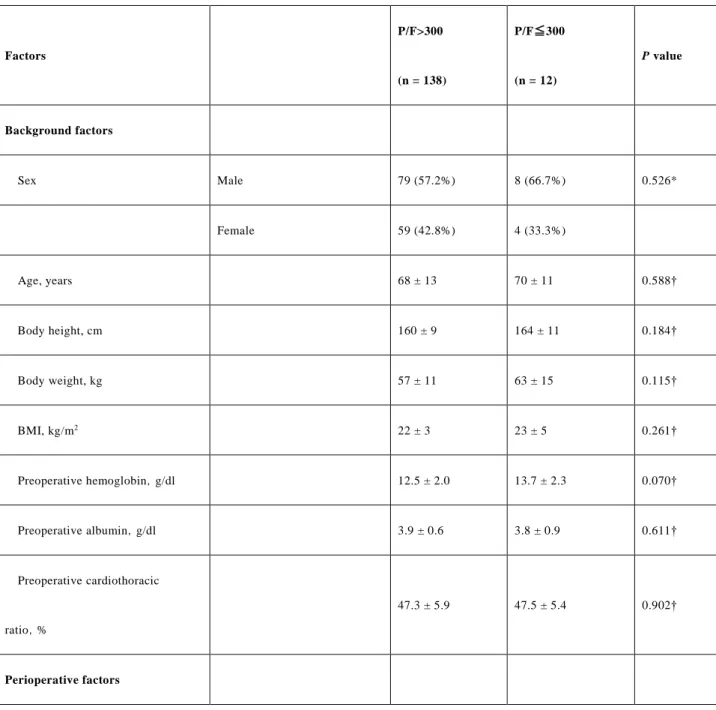
(Table 1).対象患者の ICU 入室直後の P/F 比は平均 479±130 (最小値-最大値: 187- 935)であった.

正常群と低酸素血症群との群間比較では,正常群は 150 名のうち 138 名(92.0%)

で P/F 比は平均 497±119 (最小値-最大値:304-935),低酸素血症群は 12 名(8.0%)

で P/F 比は平均 270±34(最小値-最大値:187-299)であった.性別,年齢,身長,

体重,BMI,緊急手術,腹腔鏡手術,手術部位,全身麻酔薬,ブロックの併用,レ ミフェンタニル使用量,手術時間,麻酔時間,出血量,尿量,輸血の有無および輸 血量,膠質液使用の有無と使用量,晶質液と膠質液の総量,輸血と輸液の総量,In-

out balance,術前および術後のヘモグロビン値・アルブミン値・CTR に有意差はな

かった(Table 2).単変量解析で P<0.25 となった因子を共変数として多重ロジステ ィック回帰分析を行った結果,P/F 比が 300 以下となるには晶質液の投与量(オッ

ズ比 2.304,95%信頼区間 1.052-5.048, P 値 0.037)のみが有意な予測因子となった

(Table 3).

手術室で抜管せずに ICU に入室し,人工呼吸が必要になった患者は 150 名中 3 名 であった.正常群で術後に人工呼吸が必要になった患者は 138 名中 1 名(0.7%),

低酸素血症群では 12 名中 2 名(16.7%)であり,群間差を認めた(P<0.05) (Table 2).

考察

術後の低酸素血症は様々な原因で発生するが,大規模な疫学的な分析により,その原 因を絞り込むことができる.輸血による白血球の活性化が肺血管透過性の亢進を促すと されている TRALI も術後呼吸器合併症のひとつである 1) . TRALI はその発症原因が 明らかでなかったために いくつかの比較的規模の大き な研究が行われてき た. Mayo

Clinic のグループが行った後方視的研究では,敗血症,輸血当日の過剰な 24 時間水分バ

ランスが急性肺障害で有意に多くみられ,血液製剤に注目してさらに分析することにより,

(4)

4

投与された血漿製剤の量,およびドナーが女性由来である血液製剤の投与が有意な因子 として抽出されている 2) .またさらなる前方視的研究でも同様の結果を得ている 3) .TRALI の概念が確立するに伴い,臨床的に TRALI と診断される中には過剰な水分バランス,ショ ック,アルコール依存が術後の肺障害の原因であるものも指摘されるようになってきた 4) . この結果からわかるように術後低酸素血症の原因は,敗血症,過剰水分投与,血液製剤 が術中の因子としては重要であることが確認されている.

今日の術中輸液の概念は,1960 年代に Moore,Shires らが提唱した「出血 1 に対して晶

質液 3〜4」という計算式を基にしている.この計算式は戦場での「急性大量出血」に対して

晶質液のみでどう対処するかという研究 5) 6) から生まれたものであるが,その後全身麻酔 中の晶質液を投与する方法と拡大解釈され広く普及した.今現在も多くの麻酔科医は,絶 飲食分,不感蒸泄分,サードスペース分および術中の In-out balance から輸液量を算定す る輸液療法を行っている.しかし,計算式をベースとした輸液療法は手術が長引けば,過 量投与になる.過剰輸液の問題はデンマークの多施設研究で示された.この研究では,絶 飲食分やサードスペース分を計算に入れず術中輸液をほぼ維持量とした輸液制限群と,こ れまでの標準的な輸液計画で投与した群の予後が比較された 7) .その結果,手術時間によ らず術中の大量輸液は,術後数日間にわたりナトリウム貯留をもたらし,体重を増加させ,

また増加した体重に比例して術後合併症が多いことが確認された.Lowell らも,体液貯留 による体重増加が 20%以上であった患者の死亡率はほぼ 100%であったと報告している 8)

9) .一般に晶質液は速やかに体外へ排泄されるために危険性は低いと考えられがち であるが,ナトリウムは水を体内に貯留してしまうため,術中の晶質液の過量投与は術後 の合併症の原因になると考えられる.

輸血・輸液の種類またはどの程度の輸血・輸液量が術後肺機能を悪化させるかについ ては以前から議論されており 10) ,過剰な In-out balance が肺機能を悪化させることが確認 されている 8) 11) .米国国立衛生研究所および国立心肺血液研究所の急性呼吸窮迫症候群

(ARDS)ネットワークにおける Fluid and Catheter Treatment Trial でも,輸液の過量投与自 体が ARDS の危険因子になり得ると報告している 12) .今回使用された晶質液は Na:130-

140mEq/l,Cl:109-115mEq/l,K:4mEq/l の酢酸リンゲルあるいは重炭酸リンゲルであり,こ

れまで晶質液はその投与量の 3 分の 1 ないし 4 分の 1 が血管内に残ると考えられてきた.

しかし,晶質液はほとんどが尿,あるいは間質へ流出することが示されている 13) .流出量

は輸液量に比例するが,血管内への貯留量は輸液量に比例しないのである.晶質液は循

環の安定のためにしばしば急速投与されているが,その過剰投与は循環の安定には役立

っていないのである.今回,P/F 比が 300 以下になった低酸素血症群では,有意差はなか

ったが輸血と膠質液の投与量が少なく,反対に晶質液の投与量は有意に多かった.有意

差はなかったが In-out balance も低酸素血症群で多くなっており,その結果,低酸素血症群

では相対的な晶質液の過量投与になっていた.我々は以前,晶質液,膠質液および輸血

で容量負荷実験を行い,先行する出血性ショックは大量輸血後の呼吸困難を助長する危

険性があることを報告している 14) .この研究は,侵襲を受けない全身麻酔下のブタを対象

として,負荷前の循環血液量の 100%当量までそれぞれを負荷し,心負荷のレベルと呼吸

機能への影響を調べている.さらに輸血群は 2 群とし,負荷前に出血性ショックにしてから

輸血負荷したモデルも併せて調査された.その結果,晶質液,膠質液投与群の P/F 比はど

ちらとも呼吸困難のレベルまで減少しなかったが,輸血群は容量負荷により 2 群とも P/F 比

は有意に減少していた.特にショックモデルでは P/F 比 227±29 まで低下しており,白血球

数の増加も認めていた.この結果より,侵襲を受けていないブタでは,肺と心臓はある程度

の容量過負荷に耐えることができるが,先行する出血性ショックは炎症反応を誘発し,その

後の血液過負荷に対して肺を脆弱にすると考察している.一般的にも健康な肺は体液過

剰を許容することが知られている.しかし,過去には晶質液輸液がショック後の肺をより脆

(5)

5

弱にするという報告がされている 15) .今回,P/F 比が 300 以下になった 12 症例のうち 75%

が ASA 分類 1 あるいは 2 であった.手術時間はほぼ同じで,有意差はないがレミフェンタ ニルは低酸素血症群で多く使用されており,手術侵襲が大きかったことが推察される.手 術侵襲による炎症反応が晶質液輸液に対して肺を脆弱化すると仮定すれば,心機能,腎 機能または肺機能が重度に低下していない患者においても晶質液の相対的な過量投与の 結果として術後低酸素血症は引き起こされる可能性が示唆された.

輸血は患者予後を良くするために行われるが,輸血自体が死亡率や罹患率と関連 しているという報告 16) や,術後の低酸素血症は輸血の量に比例するという報告があ る 2) .今回の調査結果では,正常群および術後低酸素血症群とも出血量に対して輸 血量は少なかったが,術直後のヘモグロビン値,アルブミン値は両群とも正常範囲 内であった.循環動態維持のための輸血は避けられ,適正量が使用されたことによ って,輸血は術後低酸素血症の発症に影響を及ぼす予測因子として抽出されなかっ たと考えた.

肥満患者は肺の生理機能が制限されており,特に全身麻酔下では筋弛緩薬や陽圧 呼吸などの影響で術中あるいは術後に低酸素血症を呈する症例を認めるが,今回の 多重ロジスティック回帰分析の結果では予測因子として抽出されなかった.非胸腔 外科手術後に肺合併症を引き起こす可能性のある術前リスクを検討した系統的レビ ューでも,肥満は術後肺合併症の独立したリスク因子ではないと結論されている 17)

本研究にはいくつかの制限がある.まず,炎症性バイオマーカーを調べていない.

手術侵襲による炎症反応が晶質液輸液に対して肺を脆弱化するという仮説を解明するた めには,サイトカインまたは他のパラメータの測定を含む分析が必要である.また,

人工呼吸器関連肺障害は,過膨張を避け,肺の開存度を維持することにより抑制す ることができるとされている 18) 19) .ARDS の分類である Berlin 定義では P/F 比に加 え,呼気終末陽圧(PEEP)も分類上必要になっている 20) .今回,全身麻酔中の気道 内圧,呼吸回数および呼気終末陽圧などの呼吸器設定項目については検討しておら ず,今後の課題である.

今回,全身麻酔下の消化器外科手術において術後低酸素血症の発症に影響を及ぼ す術中因子を検討した.その結果,相対的な晶質液の過量投与によって P/F 比は 300 以下になってしまう可能性が示唆された.一般に晶質液は安全と思われており,過 量投与しても看過されているが,晶質液の投与方法を再考する必要性が考えられた.

利益相反

本研究に関し,開示すべき利益相反はない.

文献

1) 飯島毅彦, 岡崎仁. TRALI(輸血関連急性肺障害).

麻酔

2007;56:1319-1328.

2) Rana R, Fernandez-Perez ER, Khan SA et al. Transfusion-related acute lung injury

(6)

6

and pulmonary edema in critically ill patients: a retrospective study. Transfusion 2006;46:1478-1483.

3) Gajic O, Rana R, Winters JL et al. Transfusion Related Acute Lung Injury in the Critically Ill: Prospective Nested Case-Control Study. Am J Respir Crit Care Med 2007.

4) Toy P, Gajic O, Bacchetti P et al. Transfusion-related acute lung injury: incidence and risk factors. Blood 2012;119:1757-1767.

5) Moore FD, Dagher FJ, Boyden CM et al. Hemorrhage in normal man. I. distribution and dispersal of saline infusions following acute blood loss: clinical kinetics of blood volume support. Ann Surg 1966;163:485-504.

6) Shires T, Coln D, Carrico J, Lightfoot S. Fluid Therapy in Hemorrhagic Shock. Arch Surg 1964;88:688-693.

7) Brandstrup B, Tonnesen H, Beier-Holgersen R et al. Effects of intravenous fluid restriction on postoperative complications: comparison of two perioperative fluid regimens: a randomized assessor-blinded multicenter trial. Ann Surg 2003;238:641- 648.

8) Lowell JA, Schifferdecker C, Driscoll DF et al. Postoperative fluid overload: not a benign problem. Crit Care Med 1990;18:728-733.

9) Chappell D, Jacob M, Hofmann-Kiefer K et al. A rational approach to perioperative

fluid management. Anesthesiology 2008;109:723-740.

(7)

7

10) Finfer S, Liu B, Taylor C et al. Resuscitation fluid use in critically ill adults: an international cross-sectional study in 391 intensive care units. Crit Care 2010;14:R185.

11) Wiedemann HP, Wheeler AP, Bernard GR et al. Comparison of two fluid- management strategies in acute lung injury. N Engl J Med 2006;354:2564-2575.

12) Grissom CK, Hirshberg EL, Dickerson JB et al. Fluid management with a simplified conservative protocol for the acute respiratory distress syndrome*. Crit Care Med 2015;43:288-295.

13) Nishimura A, Tabuchi Y, Kikuchi M et al. The Amount of Fluid Given During Surgery That Leaks Into the Interstitium Correlates With Infused Fluid Volume and Varies Widely Between Patients. Anesth Analg 2016;123:925-932.

14) Masuda R, Iijima T, Kondo R et al. Preceding haemorrhagic shock as a detrimental risk factor for respiratory distress after excessive allogeneic blood transfusion. Vox Sang 2018;113:51-59.

15) Demling RH, Manohar M, Will JA. Response of the pulmonary microcirculation to fluid loading after hemorrhagic shock and resuscitation. Surgery 1980;87:552-559.

16) Glance LG, Dick AW, Mukamel DB et al. Association between intraoperative blood transfusion and mortality and morbidity in patients undergoing noncardiac surgery.

Anesthesiology 2011;114:283-292.

17) Smetana GW, Lawrence VA, Cornell JE. Preoperative pulmonary risk stratification

(8)

8

for noncardiothoracic surgery: systematic review for the American College of Physicians. Annals of Internal Medicine 2006;144:581-595.

18) Neto AS, Hemmes SN, Barbas CS et al. Association between driving pressure and development of postoperative pulmonary complications in patients undergoing mechanical ventilation for general anaesthesia: a meta-analysis of individual patient data. The Lancet Respiratory medicine 2016;4:272-280.

19) Fernandez-Perez ER, Sprung J, Afessa B et al. Intraoperative ventilator settings and acute lung injury after elective surgery: a nested case control study. Thorax 2009;64:121-127.

20) Ranieri VM, Rubenfeld GD, Thompson BT et al. Acute respiratory distress syndrome: the Berlin Definition. Jama 2012;307:2526-2533.

Table 1. Patient backgrounds.

Variable Value

n 150

Sex, male/female 87/63

ASA class, 1/2/3 46/94/10

Age, years 68 ± 13 (22-95)

(9)

9

Body height, cm 160 ± 9 (135-181)

Body weight, kg 57 ± 12 (35-87)

Values are number of individuals or mean ± standard deviation (min-max).

Table 2. Bivariate analysis of factors

Factors

P/F>300

(n = 138)

P/F≦300

(n = 12)

P value

Background factors

Sex Male 79 (57.2%) 8 (66.7%) 0.526*

Female 59 (42.8%) 4 (33.3%)

Age, years 68 ± 13 70 ± 11 0.588†

Body height, cm 160 ± 9 164 ± 11 0.184†

Body weight, kg 57 ± 11 63 ± 15 0.115†

BMI, kg/m

2

22 ± 3 23 ± 5 0.261†

Preoperative hemoglobin,g/dl 12.5 ± 2.0 13.7 ± 2.3 0.070†

Preoperative albumin , g/dl 3.9 ± 0.6 3.8 ± 0.9 0.611†

Preoperative cardiothoracic

ratio,%

47.3 ± 5.9 47.5 ± 5.4 0.902†

Perioperative factors

(10)

10

Emergency surgery Yes 10 (7.2%) 2 (16.7%) 0.247*

No 128 (92.8%) 10 (83.3%)

Laparoscopic surgery Yes 100 (72.5%) 9 (75.0%) 0.576*

No 38 (27.5%) 3 (25.0%)

Surgery site Upper abdomen 36 (26.1%) 4 (33.3%) 0.402*

Lower abdomen 102 (73.9%) 8 (66.7%)

Drug for General anesthesia Inhalation anesthetic 132 (95.7%) 12 (100.0%) 0.601*

Intravenous anesthetic 6 (4.3%) 0 (0.0%)

Combined block anesthesia Yes 126 (91.3%) 10 (83.3%) 0.311*

No 12 (8.7%) 2 (16.7%)

Amount of remifentanil, mg 2.0 ± 1.5 2.6 ± 1.7 0.206†

Duration of procedure, min 224 ± 129 227 ± 97 0.931†

Duration of anesthesia, min 277 ± 133 288 ± 100 0.773†

Amount of bleeding, L 0.214 ± 0.997 0.226 ± 0.357 0.965†

Amount of urine, L 0.308 ± 0.310 0.310 ± 0.344 0.982†

Amount of transfusion, L 0.107 ± 0.662 0.073 ± 0.173 0.860†

Amount of infusion, L 1.692 ± 0.957 2.007 ± 0.761 0.269†

Amount of crystalloid fluid, L 1.266 ± 0.638 1.686 ± 0.623 0.030†

Amount of colloid fluid, L 0.426 ± 0.592 0.321 ± 0.461 0.552†

(11)

11

Total of transfusion and infusion, L 1.799 ± 1.394 2.080 ± 0.805 0.493†

In-out balance, L 1.277 ± 0.668 1.544 ± 0.625 0.185†

Intraoperative use of transfusion Yes 10 (7.2%) 2 (16.7%) 0.247*

No 128 (92.8%) 10 (83.3%)

Intraoperative use of colloid fluid Yes 75 (54.3%) 5 (41.7%) 0.398*

No 63 (45.7%) 7 (58.3%)

Postoperative hemoglobin,g/dl 11.3 ± 1.9 12.2 ± 2.2 0.135†

Postoperative albumin,g/dl 3.0 ± 0.5 3.0 ± 0.9 0.874†

Postoperative cardiothoracic

ratio,%

54.2 ± 5.9 53.5 ± 6.2 0.691†

Artificial ventilation in the ICU Yes 1 (0.7%) 2 (16.7%) 0.017*

No 137 (99.3%) 10 (83.3%)

Values are number (%) of individuals or mean ± standard deviation.

*Values for "male", " Upper abdomen ", " Inhalation anesthetic" or "yes" were analyzed using the χ2 test.

†Values for continuous variables were analyzed using the two sample t-test.

Abbreviations: P/F: PaO 2 /FiO 2 , BMI: Body mass index.

Block anesthesia: including epidural analgesia or regional block; transfusion: including

concentrated red cells, platelet concentrates, fresh frozen plasma and/or 5% albumin

preparation; infusion: including crystalloid and/or colloid fluid; in-out balance: the total

(12)

12

amount obtained by subtracting the amount of bleeding and urine volume from the amount of transfusion and infusion volume.

Table 3. Multivariate logistic regression analysis of predictors

Predictors OR (95% CI) P value

Amount of crystalloid fluid (per increasing value) 2.304 (1.052-5.048) 0.037 Abbreviations: OR: odds ratio, CI: confidence interval.

EXAMINATION OF INTRAOPERATIVE FACTORS FOR POSTOPERATIVE HYPOXEMIA

-THE EFFECT OF THE AMOUNT OF INTRAOPERATIVE CRYSTALLOID SOLUTION

Atsunori SAKAMOTO 1) , Rikuo MASUDA 2) , Makoto KOSAKA 1) , Kenji SHIDA 1) , Otake HIROSHI 3) , Takehiko IIJIMA 4)

1) Department of Anesthesiology, Showa University Northern Yokohama Hospital

2) Department of Dental Anesthesiology, Showa University Northern Yokohama Hospital

3) Department of Anesthesiology, Showa University School of Medicine

4) Department of Perioperative Medicine, Division of Anesthesiology, Showa University

School of Dentistry

(13)

13 Abstract

Postoperative respiratory complication is a major source of postoperative morbidity.

Intraoperative lung injury should be avoided, considering etiological factors of adverse

effect on healthy lung. Lung is unphysiologically functioning during anesthesia due to

positive pressure ventilation, making lung vulnerable to adverse factors, including infection,

fluid load, and leukocyte activation. We have explored the contributing perioperative factors

(14)

14

for postoperative hypoxia, suggesting lung injury. A consecutive patient cohort, in which

gastroenterological surgeries were undergone, was retrospectively examined. We have

defined postoperative hypoxia as lower than 300 of PaO 2 /FiO 2 (P/F). Perioperative factors

including basic backgrounds, anesthesia methods, dose of remifentanil, infusion volume and

serum albumin were picked up for the statistical analysis. The enrolled patients amounted to

418, and 150 patients were picked up among 168 patients admitted to ICU. The average P/F

value was 497±119 in non-hypoxic group (n=138), while it was 270±34 in hypoxic group.

Three patients postoperatively required the respiratory management by using the ventilator.

A logistic regression analysis revealed the amount of intraoperative crystalloid as a

statistically significant factor contributing to postoperative hypoxia(odds ratio 2.304 ,

(15)

15

95%CI (1.052-5.048), P=0.037) . There has been a conventional concept, which recommends

sufficient fluid be supplied intraoperatively, including the estimating amount of third space

loss, insensible vapor, and others. Recently, the concept has gradually changed, so as to avoid

fluid overload. Our results support the concept aiming the minimizing the positive fluid

balance to avoid postoperative respiratory distress.

Key words: postoperative hypoxia, intraoperative factor, crystalloid

Table 1. Patient backgrounds.
Table 2. Bivariate analysis of factors

参照

関連したドキュメント

Conclusions: The results of this retrospective multicenter study highlight three important points: (1) the possibility of latent existence and progression of

In the present study, the mechanism of injury following acute ischemiareperfusion of the canine small intestine was clarified by evaluating changes in the plasma endotoxin levels in

熱力学計算によれば、この地下水中において安定なのは FeSe 2 (cr)で、Se 濃度はこの固相の 溶解度である 10 -9 ~10 -8 mol dm

In order to improve the coordination of signal setting with traffic assignment, this paper created a traffic control algorithm considering traffic assignment; meanwhile, the link

Time series plots of the linear combinations of the cointegrating vector via the Johansen Method and RBC procedure respectively for the spot and forward data..

Mindfulness-based stress reduction in patients with interstitial lung diseases: A pilot, single-centre observational study on safety and efficacy. 糖尿病 こころのケア,

In Section 2, we establish conditions under which (1.2) is well-posed using stable families of generators of semigroups and Kato’s stability conditions [8, 11]; our work also

Beyond proving existence, we can show that the solution given in Theorem 2.2 is of Laplace transform type, modulo an appropriate error, as shown in the next theorem..