Late Campanian e early Maastrichtian heteromorph-dominated ammonoid assemblages of the Nakaminato Group, central Honshu, Japan: biostratigraphic and paleontological implications
Genya Masukawa
a,b,*, Hisao Ando
caGraduate School of Science and Engineering, Ibaraki University, 2-1-1 Bunkyo, Mito 310-8512, Japan
bNittoc Construction Co., Ltd., 3-10-6 Higashinihonbashi, Chuo-ku, Tokyo 103-0004, Japan
cDepartment of Earth Sciences, College of Science, Ibaraki University, 2-1-1 Bunkyo, Mito 310-8512, Japan
a r t i c l e i n f o
Article history:
Received 2 March 2018 Received in revised form 6 June 2018
Accepted in revised form 25 June 2018 Available online 28 June 2018 Keywords:
Late Cretaceous Nostoceratidae Diplomoceratidae Northwest Pacific
a b s t r a c t
A late Campanian and early Maastrichtian heteromorph-dominated ammonoid fauna is reported for the Nakaminato Group. The mudstone-dominated offshore Hiraiso Formation and the overlying sandy turbidite-dominated Isoai Formation are exposed along the Pacific coast of Hitachinaka City, Ibaraki Prefecture, central Honshu. This paper describesfive taxa of nostoceratid and diplomoceratid hetero- morph ammonoids from these strata. Among thefive lithostratigraphic units of the Hiraiso Formation, the lowest unit containsDidymocerassp., and the two overlying units yield the late Campanian index speciesD. awajiense, together withDiplomocerassp., a few planispiral ammonoids, and several speci- mens ofInoceramus(Endocostea)shikotanensis.The Isoai Formation contains a few indeterminate nos- toceratid ammonoids as well asBaculitesspp. in its upper part, and the middle to late early Maastrichtian index species“Inoceramus”kusiroensis.These taxa provide important information for the Campanian and Maastrichtian biostratigraphy and palaeoecology of the northwest Pacific region.
©2018 Elsevier Ltd. All rights reserved.
1. Introduction
CampanianeMaastrichtian marine macrofossil-bearing strata are widespread on Hokkaido and are also found on Honshu and Shikoku, and include the Yezo, Nemuro, Nakaminato, Izumi, and Sotoizumi groups (Fig. 1A). Several nostoceratid heteromorph am- monoids, as well as the planispiral ammonoids that characterize these groups, were described bySaito (1961, 1962), Matsumoto and Morozumi (1980), Morozumi (1985), Misaki and Maeda (2009), Shigeta et al. (2015, 2016, 2017), Kurihara et al. (2016). Some palaeoecological research on these ammonoid faunas have also been undertaken byMisaki and Maeda (2010), Misaki et al. (2014), Yoshino and Matsuoka (2016).
Although continuous successions are restricted by poor expo- sure, the Nakaminato Group suitably demonstrates the succession of heteromorph-dominated ammonoid fauna, as well as other molluscan species. The Nakaminato Group is exposed continuously
in Hitachinaka City, Ibaraki Prefecture, central Honshu, along a 4 km-long series of wave-cut benches facing the Pacific coast. In the 1950s and 1960s, late Campanian and early Maastrichtian hetero- morphs, such as Didymoceras awajiense, and other molluscs including inoceramids, were reported from this group (Ozaki and Saito, 1955; Saito, 1958, 1959, 1961, 1962). The sedimentary envi- ronments of the group were subsequently studied by Tanaka (1970), Masuda and Katsura (1978), and Katsura and Masuda (1978).Ando (2006)reviewed the geological and tectonic settings of the group by considering other Cretaceous strata deposited in the Cretaceous forearc basin within the Paleo-Japan arc-trench system (Takahashi and Ando, 2016; Ando and Takahashi, 2017).
Even though fossils are rare in the Nakaminato Group, their presence is important for demonstrating the late Campanianeearly Maastrichtian marine faunal transition within the offshore facies in the northwest Pacific region. In this paper, we report succession of macrofossils in the Nakaminato Group and describefive hetero- morph taxa among the heteromorph-dominated assemblage. We consider the depositional age of the Nakaminato Group through its ammonoid and inoceramid biostratigraphy. Furthermore, by considering previous studies conducted on other strata, the
*Corresponding author.
E-mail address:[email protected](G. Masukawa).
Contents lists available atScienceDirect
Cretaceous Research
j o u r n a l h o m e p a g e : w w w . e l s e v i e r . c o m / l o c a t e / C r e t R e s
https://doi.org/10.1016/j.cretres.2018.06.018 0195-6671/©2018 Elsevier Ltd. All rights reserved.
Cretaceous Research 91 (2018) 362e381
CampanianeMaastrichtian biostratigraphic zonation in the north- west Pacific region is discussed.
2. Geological setting of the Nakaminato Group 2.1. Distribution and geological structure
The Upper Cretaceous Nakaminato Group crops out only along a
~4 km northesouth stretch of wave-cut benches facing the Pacific coast in Hitachinaka City, Ibaraki Prefecture, Japan (Fig.1B). The Upper Cretaceous strata form a fault block in contact with the lower middle Miocene Tonoyama Formation in the south and the middle middle Miocene Isozaki Formation in the north (Sakamoto et al., 1972). The homoclinal (30e40NE dipping and NWeSE striking) strata provide a continuous ca.~1900 m-thick middle Campanianelower Maas- trichtian succession (Fig. 2).
Furthermore, on the southern side of the Miocene Tonoyama Formation around the northern mouth bank of the Naka River (Fig. 1B), the Nakaminato Group underlie clino-unconformably and are in fault contact with the upper Paleocene Oarai Formation (Fig. 1B;Ozaki and Saito, 1955; Saito, 1961; Sakamoto et al., 1972).
The Tonoyama and Isozaki formations, which are components of the Taga Group, are widely distributed in the Hitachi to Kitaibaraki areas northwards along the Pacific coast (Sakamoto et al., 1972;
Ando et al., 2014).
The Upper Cretaceous Nakaminato Group and the upper Paleocene Oarai Formation associated with the middle Miocene Tonoyama and Isozaki formations of the Taga Group form tectonic fault blocks along the southern extension of the Tanakura Tectonic Line (TTL;Fig. 1A) (Ando, 2006). The TTL was thought to be a large
tectonic fault dividing the pre-Neogene basement into Southwest (SW) and Northeast (NE) Japan (Ando, 2006). But recently,Ando and Takahashi (2017) defined the Tonegawa Tectonic Line (ToTL;
Fig. 1A) as a boundary between SW and NE Japan. The Cretaceous Yezo forearc basin in NE Japan, has general NeS trend, and is rep- resented by the ConiacianeSantonian Futaba Group (Fig. 1A) distributed ~100 km north of the Nakaminato area, and the offshore Pacific Cretaceous (Ando, 2003; Ando and Takahashi, 2017). The general strike of the Nakaminato Group (NEeSE to WNWeESE) intersects the distribution trend of the Yezo forearc basin nearly at a right angle. Therefore, the fault blocks may have been rotated anticlockwise by a few tens of degrees in terms of the left-lateral strike-slip fault movement of the TTL and its associated post- middle Miocene tectonics (Ando, 2006; Ando and Takahashi, 2017).
2.2. Lithostratigraphy and sedimentary facies
The Nakaminato Group is subdivided into the offshore mudstone-dominated Hiraiso Formation at the base and the sandstone- and sandy turbidite-dominated Isoai Formation at its top (Figs. 1B and 2). The isolated southern exposures, which are interpreted as the lowermost part of the formation (Chikko For- mation;Fig. 1B;Saito, 1962) or as an isolated block of the lower part of the Isoai Formation (Sakamoto et al., 1972). It is not exposed at present, however, because of the artificial covering of Nakaminato Port.
The>740 m-thick Hiraiso Formation is in fault contact with the middle Miocene Tonoyama Formation (currently not exposed because of the artificial cover of the Hiraisofishing port) and is conformably overlain by the Isoai Formation (Fig. 1B). The Hiraiso Fig. 1.A: Map showing the major distributions of marine strata bearing ammonoid fauna around the Japanese Islands. AeJ correspond to stratigraphic columns inFig. 13. Dashed line indicates estimated boundary of the Northeast (NE) Japan and Southwest (SW) Japan. B: Pacific Coast geological map around Hitachinaka City, Ibaraki Prefecture, Japan.
Compiled afterSakamoto et al. (1972)and our own survey. Dashed lines indicate estimated faults.
Fig. 2.Stratigraphic column and macrofossil successions of the Nakaminato Group. UPb age of detrital zircons indicated by Nagata and Otoh (pers. comm., May, 2016).
G. Masukawa, H. Ando / Cretaceous Research 91 (2018) 362e381 364
Formation consists mainly of dark gray siltstone intercalated frequently with thin,fine to veryfine sandstone layers and occa- sionally with thick, massive medium-grained sandstones having sharp erosional bases (Fig. 2). The lower part of the Hiraiso For- mation, which forms wave-cut benches, is subdivided into three lithostratigraphical units in this paper, namely, Hl1, Hl2, Hl3, although the lower limit of unit Hl1 is not exposed (Fig. 2). The upper part of the Hiraiso Formation frequently consists of alter- nating sandstone and mudstone, subdivided into two units: Hu1 and Hu2 (Fig. 2;Tanaka, 1970). The Hl2 and Hl3 units contain few calcareous nodules but have many siderite nodules. Microfossils such as radiolarians and diatoms are found in the calcareous nod- ules (Ando et al., 2014; Kashiwagi et al., 2015), and macrofossils occur in the siltstone and in the calcareous and siderite nodules from the Hl2 and HL3 units (Fig. 2).
The ~1160 m-thick Isoai Formation conformably overlies the Hiraiso Formation. Although the uppermost part of the Isoai For- mation lies beneath the sea, the formation is in fault contact with the middle Miocene Isozaki Formation at the northern end of the distribution (Sakamoto et al., 1972; Fig. 1B). The Isoai Formation consists of sandstone-dominated interbedded sandstone and mudstone, although their layers of various thicknesses are inter- calated commonly with conglomerate that is several centimetres to decimetres thick. Pebbly mudstone layers interpreted as debris flow deposits, as well as chaotically mixed and deformed beds of slump deposits, each less than a few metres thick, are intercalated at several levels throughout the Nakaminato Group (Ando et al., 2014).
Tanaka (1970)subdivided the Isoai Formation into eight lith- ostratigraphical units (Is1 to Is8;Fig. 2). The middle part of unit Is3 and the lower part of unit Is4 form a large overturned slump block (Saito, 1961; Sakamoto et al., 1972). Macrofossils, including verte- brates, are found rarely in the debrisflow deposits and the un- derlying siltstone (Fig. 2; Kato et al., 2017). Microfossils such as foraminifera were reported from the unit bySaito (1961, 1962).
In the lower part of the Hiraiso Formation, dark grey siltstones are frequently intercalated with thin, relatively fossiliferous, and fine to veryfine sandstone layers (Fig. 2), which are interpreted as low-density distal turbidites. Sandstone-dominated interbeds of sandstone and mudstone in the upper part of the Hiraiso Formation and in the Isoai Formation (Fig. 2) are interpreted as high-density proximal turbidites. The Hiraiso and Isoai formations were depos- ited under sedimentary environments as basin plain (Hl1) to lower submarine fan facies (Hl2 to Hl3) and mid to upper submarine fan facies (Hu1 to Is8) (Masuda and Katsura, 1978; Katsura and Masuda, 1978).
3. Macrofauna of the Nakaminato Group
The major macrofossil components of the Nakaminato Group were described byOzaki and Saito (1955)andSaito (1958, 1959, 1961, 1962).Sakamoto et al. (1972)listed some additional macro- fossils. Since the original collection of Saito, all subsequent collec- tions of invertebrates and vertebrates have been stored at Ibaraki University (GIUM; over 170 specimens), Ibaraki Nature Museum (INM; about 20 specimens), and National Museum of Nature and Science (NMNS; 5 specimens). Here in addition to our newly collected specimens (stored at GIUM), we have compiled the stratigraphic successions of all these macrofossils (Fig. 2).
The lower part of the Hiraiso Formation (Hl1 to Hl3) contains four ammonoid taxa, a few inoceramid bivalves (Saito, 1962), gas- tropods (Saito, 1962), and echinoids (Saito, 1959; Tanaka, 1984). The Hiraiso Formation yieldsDidymocerassp. in the lowermost unit Hl1, followed by the rather commonD. awajienseand rareDiplomoceras sp. in units Hl2 and Hl3. Very few heavily distorted shells of the
planispiral ammonoidPachydiscuscf.awajiensis(Fig. 3A) and the body chamber of an indeterminate species (Fig. 3B) occur in the middle part of unit Hl3. Three inoceramids,Inoceramus(Platycer- amus) cf.ezoensis,I. (Endocostea)balticus, andI. (E.)shikotanensis (Fig. 4AeC), occur in the lower part of the Hiraiso Formation, whereas only fragments ofDiplomocerassp. and some bivalves are observed in the upper part of the Hiraiso Formation.
The lower part of the Isoai Formation contains isolated bones of a mosasaur, a trionychid, and a nyctosaurid pterosaur (Fig. 2;Kato et al., 2017). A few articulated bivalves and some fragments of ostreid and inoceramid shells are found uncommonly in Is2 and Is3.
Several small fragments of heteromorphs have been found in unit Is3 (Fig. 2).
The upper part of the Isoai Formation yields many fragments of Baculitesspp. in the upper part of unit Is6 to middle of unit Is7 (Fig. 3C and D). Some bivalves (including“Inoceramus”kusiroensis;
Fig. 4D), gastropods, and echinoderms also occur in these horizons.
An indeterminate long-spined large nostoceratid was found in the mudstone of the upper part of unit Is6.
4. Palaeontological descriptions
The terms for ammonoid morphology used in this study are based onWright et al. (1996)andOkamoto and Shibata (1997). The quantifiers used to describe the shell shape are those proposed by Matsumoto (1954, p. 246) and modified by Haggart (1989, table 8.1).
Abbreviations for shell dimensionsdH¼whorl height;W¼whorl width.
Institution abbreviationsdHMG ¼Hobetsu Museum, Mukawa, Hokkaido; GIUM¼Department of Earth Sciences, Ibaraki Univer- sity, Mito; INM¼Ibaraki Nature Museum, Bando; NMNS¼National Museum of Nature and Science, Tsukuba; OMNH¼Osaka Museum of Natural History.
Superfamily TurrilitoideaGill, 1871 Family NostoceratidaeHyatt, 1900 GenusDidymocerasHyatt, 1894
Type species:Ancyloceras nebrascenseMeek and Hayden, 1856 Didymoceras awajiense(Yabe, 1901)
Figs. 5AeE, 6AeC and 7AeC
1901Hamites(Anisoceras)awajiensisYabe, p. 2, text-fig. 1aec.
1915Turrilites(Hyphantoceras)oshimai(Yabe, 1904) var.;Yabe, p.
18, pl. 1,fig. 1a, b.
1915Turrilites(Bostrychoceras)otsukai(Yabe, 1904);Yabe, p. 16, pl.
1,figs. 2, 3.
1936Bostrychoceras awajiense(Yabe, 1901);Sasai, p. 598, pl. 29.
1958Nostoceras awajiense(Yabe, 1901);Saito, p. 87, pl. 1,figs. 1, 2;
pl. 2,figs.1, 2; pl. 3,figs. 1e3; pl. 4,figs. 1e3; text-figs. 3e5.
1958Cirroceras(?)nakaminatoenseSaito, p. 91, pl. 5,figs. 1, 2; text- figs. 6, 7.
1959Cirroceras(?)nakaminatoenseSaito, 1958; Saito, p. 79, pl. 1, figs. 1, 2.
1962Didymoceras awajiense(Yabe, 1901);Saito, p. 93, pl. 3,figs.
1e3; pl. 4,figs 1e3; pl. 6,figs 3e4; pl. 7,figs 1, 2.
1962Didymocerascf.awajiense(Yabe, 1901);Saito, p. 96, pl. 4,figs.
6, 7.
1962Didymoceras nakaminatoense(Saito, 1958);Saito, p. 97, pl. 5, figs. 2, 3.
1962Didymoceras nakaminatoense(Saito, 1958);Saito, p. 97, pl. 5, fig. 1; pl. 6,figs. 1, 2.
1984Didymoceras awajiense(Yabe, 1901);Bando and Hashimoto, p.
16, pl. 4,fig. 1a, b.
G. Masukawa, H. Ando / Cretaceous Research 91 (2018) 362e381 366
1985Didymoceras awajiense(Yabe, 1901);Morozumi, p. 35, pl. 10, figs. 1e4; pl. 11,fig. 1; pl. 12,figs. 1, 2; pl. 13,figs. 1, 2; pl. 14,figs.
1, 2; pl. 15,figs. 1e3; text-figs. 9e11.
2009 Didymoceras awajiense(Yabe, 1901); Misaki and Maeda, p.
1408,fig. 10I-J.
2010 Didymoceras awajiense(Yabe, 1901); Misaki and Maeda, p.
226,fig. 6.
2014Didymoceras awajiense(Yabe, 1901);Misaki et al., p. 91, fig.
14A-B.
Material.Three specimens from unit Hl2 or Hl3: GIUM 5102 (Fig. 5C), INM-4-16733 (Fig. 6A), INM-4-16734 (Fig. 6C); one specimen from the lower part of Hl3: GIUM 5601 (Fig. 5A); seven specimens from the middle part of unit Hl3: GIUM 4071 (Fig. 6B), GIUM 4072
Fig. 3.Selected ammonoids from the Nakaminato Group. A:Pachydiscuscf.awajiensisINM-4-16735; unit Hl2 or Hl3; lateral view. B: indeterminate planispiral ammonoid GIUM 5007; middle part of unit Hl3. C:Baculitessp. GIUM 20729; previously described asB. cf.rexinSaito (1962); middle part of unit Is7. D:Baculitessp. GIUM 40710; previously described asB.inornatusbySaito (1962); upper part of unit Is6; cross-section (D1), left lateral (D2), and right lateral (D3) views; D2 shows aperture.
Fig. 4.Inoceramids from the Nakaminato Group. A:Inoceramus(Platyceramus) cf.ezoensisGIUM 5301; lower part of unit Hl2. B:Inoceramus(Endocostea)balticusGIUM 5201;
middle part of unit Hl2. C:Inoceramus(Endocostea)shikotanensisGIUM 5501; middle part of unit Hl3. D: silicone rubber cast of“Inoceramus”kusiroensisGIUM 40653; previously described asI. cf.shikotanensisbySaito (1962); middle part of unit Is7. Red arrow indicates anterior wing.
(Fig. 7A), GIUM 4074 (Fig. 7B, holotype ofD. nakaminatoense), GIUM 4075 (Fig. 7C, referred to as D. nakaminatoense by Saito (1959, 1962)), GIUM 4076 (Fig. 5D), GIUM 4077 (Fig. 5E), and NMNS P1 5304 (Fig. 5B) (Saito, 1958, 1959, 1961); the Nakaminato Group specimens show no early growth stages (<15 mm in the entire shell diameter).
Description. The shell consists of a helically coiled (dextrally or sinistrally (roughly equivalent frequency) in contact) phragmocone, followed by a body chamber forming a retroversal hook. There is significant variation in the entire shell size and mode of coiling (Figs. 6e7). Its helical whorls (spire) generally touch each other, but the entire height of the spire varies, as reported by Morozumi (1985). The whorl section, which is nearly circular in the spire, has a gradually planar innerflank at the start of the retroversal hook, and is fairly compressed in the adult-stage body chamber.
The shell surface is ornamented with dense, oblique ribs and two rows of tubercles. Some strong and highly elevated ribs, fol- lowed by a shallow constriction on a wide interrib space, occur irregularly (Fig. 5A). Rursiradiate ribs appear on the lower and outer whorl faces of the spire, curving forward on the upper face and crossing over the dorsum in a slightly convex manner. In all growth stages, the ribs become less intense as they cross the dorsum. In the middle growth stage (15e100 mm in the entire shell diameter;
Figs. 5AeE), long tubercles appear, as seen in GIUM 5102 (Fig. 5C).
Some ribs are branched or looped. In general, two rows of tubercles appear on every other rib or second ribs in the middle growth stage and rather irregularly on all ribs or every other rib or second to fourth ribs in the late growth stage (>100 mm in the entire shell diameter;Figs. 6e7). There are also some variations in the density of the ribbing and morphology of the tubercles. The aperture of the adult shell is characterized by a strongly rounded double collar rib (Fig. 6C).
Remarks.A large shell GIUM 4074 (Fig. 7B; measured at the middle portion of the preserved body chamber;H¼46.2,W¼37.0,W/
H ¼ 0.80) was first described as the holotype of Cirroceras (?) nakaminatoenseSaito (Saito, 1958), but was subsequently emended toDidymoceras(Saito, 1961).Saito (1958)regarded GIUM 4074 as a separate species fromD. awajiensebecause of its mode of coiling and suture lines. AlthoughMorozumi (1985)andMisaki and Maeda (2010)showed a wide range of variation in the mode of coiling of D. awajiense,Morozumi (1985) acceptedD. nakaminatoense as a distinct species and noted that this species has suture lines with shallowerEand deeperIthan those ofD. awajiense.However,Iis not illustrated by Saito (1958, text-fig. 7). Although the suture line of GIUM 4074 cannot currently be observed because of the phrag- mocone missing subsequently (Figs. 7B1a and 7B2a), a significant difference in the suture line cannot be detected between the D. awajienseexamined in this study, that ofMorozumi (1985), and the GIUM 4074 described in the text-fig. 7 ofSaito (1958). There- fore, D. nakaminatoense is considered as a junior synonym of D. awajiense.The combination of the small spire and large body chamber of GIUM 4074 (Figs. 7B1b and 7B2b) is somewhat similar to the“planar shape”ofD. awajiense(Misaki and Maeda, 2010,fig.
6.7, 6.8) and shows an intermediate form betweenD. awajienseand Pravitoceras sigmoidale.
The nodule which contained the ammonoid specimen INM-4- 16734, which is one of the best-preserved specimens from the Nakaminato Group, also yields two anomiid bivalve shells. One of the shells (seeFig. 6C2) is attached to the inner side of the retro- versally coiled body chamber of the ammonoid (INM-4-16734), whereas the other is located a few centimetres outside.
A specimen ofD. awajienseINM-4-16733 (Fig. 6A), has smaller spire and larger retroversal hook than typicalD. awajiense, shows similar coiling pattern to a microconch ofN. hornbyense(McLachlan Fig. 5.Middle growth stage specimens ofDidymoceras awajiensefrom the lower part of the Hiraiso Formation (AeE) and phragmocone fragment of indeterminate nostoceratid from the lower part of the Isoai Formation (F). A: GIUM 5601; lower part of unit Hl3. B: NMNS P1 5304; middle part of unit Hl3; apical (B1) and lateral (B2) views. C: GIUM 5102; unit Hl3 or Hl2; apical view, showing long tubercles. D: GIUM 4076, middle part of unit Hl3. E: GIUM 4077; middle part of unit Hl3; apical (E1) and lateral (E2) views. F: phragmocone fragment of indeterminate nostoceratid (Nostoceratidae gen.etsp. indet. A) GIUM 5320; lower part of unit Is3; apical (F1), ventral (F2), and dorsal (F3) views.
G. Masukawa, H. Ando / Cretaceous Research 91 (2018) 362e381 368
and Haggart, 2017;fig. 25D). Another specimen GIUM 4074 (Fig. 7B) also shows the similar coiling pattern toN. hornbyense.
Some specimens ofD. awajiense(Morozumi, 1985; pl. 10,fig. 4;
Misaki and Maeda, 2010;fig. 6.7, 6.8) have very low spire somewhat similar to Bostrychoceras sanctaeluciense described from the Maastrichtian of South Africa (Klinger and Kennedy, 2003b).
B. sanctaeluciense also has similar shell ornamentations to D. awajiense, though the former have more dispersive tuberculation on the retroversal hook than the latter.
Occurrence. Didymoceras awajienseoccurs commonly in the upper upper Campanian of the Izumi Group of Shikoku (the upper part of the Higaidani Formation and Hiketa Formation;Misaki and Tsujino, 2017; Fig. 1A-A) and Awaji Island (the lower part of the Seidan Formation;Morozumi, 1985; Hashimoto et al., 2015;Fig. 1A-B), the Sotoizumi Group of the Kii Peninsula (the lower to middle parts of the Hasegawa muddy-sandstone Member of the Toyajo Formation;
Misaki and Maeda, 2009; Fig. 1A-D), and the Nakaminato Group (the lower part of unit Hl2 upwards to the middle part of unit Hl3 of the Hiraiso Formation;Figs. 1A-E, 1B and 2).
Didymoceras sp.
Fig. 8A1a, A1b, A2 and A3
Material.One specimen, GIUM 5001 (Fig. 8A).
Description. The body chamber is almost completely preserved.
Although most of the outer shell layer was lost during its excava- tion, the silicon rubber cast taken from the exposed outer mould
shows its original shell surface ornamentation. The whorl section, circular in the last part of the phragmocone, becomes rapidly compressed within the body chamber. Greater part of the phrag- mocone is missing.
The shell surface is ornamented with relatively dense oblique ribs and two rows of tubercles. In the spire and the transitional region to the retroversal hook, rursiradiate ribs appear on the lower and outer whorl faces, but they curve forward on the upper face and cross over the dorsum in a slightly convex manner. The ribs on all growth stages become less intense as they cross the dorsum. In the transitional part from the spire to the retroversal hook, most ribs are branched, and a zig-zag morphology appears.
The ribs are slightly convex and are broad, high, and pointed on the retroversal hook, in contrast to those on the spire (Fig. 8A1b). A double collar rib is observed near the aperture. In general, two rows of tubercles appear irregularly on all ribs or every other rib or every second ribs. The tubercles on the spire and the retroversal hook are weaker than those of D. awajiense. A small “bridge,” which is possibly a pathological restored/repaired trace, is observed between the ribs near the ventral shoulder of the body chamber (Fig. 8A1).
Remarks.GIUM 5001 shows some morphological differences from D. awajienseandD. hidakensefrom the Chinomigawa Formation of the Yezo Group (lower upper Campanian;Shigeta et al., 2016), and Bostrychoceras-like unnamed taxon (Morozumi, 2007; Misaki and Fig. 6.Adult shells ofDidymoceras awajiense from the lower part of the Hiraiso Formation. A: INM-4-16733; unit Hl2 or Hl3; left lateral view. B. GIUM 4071; middle part of unit Hl3;
left lateral (B1) and right lateral (B2) views. C1: INM-4-16734; unit Hl2 or Hl3; right lateral view, showing complete aperture. Red arrows indicate associated anomiid valves. C2 shows an anomiid individual attached to the whorl surface of the retroversal hook ofD. awajiense (in detail).
G. Masukawa, H. Ando / Cretaceous Research 91 (2018) 362e381 370
Tsujino, 2017) from the upper part of theDidymoceras sp. Zone (lower upper Campanian; Hashimoto et al., 2015) of the Izumi Group. On the middle tofinal portions of the retroversal hook, the ribs are coarser and broader than those of a typicalD. awajienseand theBostrychoceras-like ammonoid, and they are coarser than those of D. hidakense. The coarsely ribbed specimen of D. awajiense (OMNH. MI2212;Morozumi, 1985; pl. 14,fig. 1) has no broad ribs on the retroversal hook. Furthermore, GIUM 5001 differs from D. hidakensein having small but distinctive tubercles on the ret- roversal hook.
The morphological differences, together with the lower strati- graphic horizon thanD. awajiense, suggest that GIUM 5001 might belong to a different species fromD. awajienseand should not be included in the range of morphological variations shown in Morozumi (1985)andMisaki and Maeda (2010). The relationship between GIUM 5001 and the corkscrew-like turretedDidymoceras sp. reported from the lower half of theDidymocerassp. Zone un- derlying the D. awajiense Zone of the Izumi Group (Bando and Hashimoto, 1984, pl. 5; Morozumi, 2007) is impossible to compare directly because the description of the latter species is from the spire specimen without retroversal hook.
Occurrence.Approximately 110 m below the lowest occurrence of D. awajiensein the lower part of unit Hl1, the Hiraiso Formation of the Nakaminato Group (Fig. 2).
Nostoceratidae gen.etsp. indet.A Fig. 5F1, F2 and F3
Material.One specimen, GIUM 5320.
Description.A small fragment of the helically coiled phragmocone is preserved. The whorl-section is nearly circular. The outer whorl face is damaged. The shell surface is ornamented with dense, oblique ribs. The ribs are rursiradiate on the lower and outer whorl faces but curve strongly forward on the upper face and cross over the dorsum with weak convexity. Ribs become less intense as they cross the dorsum. The siphuncle appears to run close to the center of the outer side of the whorl (Fig. 5F2).
Remarks.The studied specimen has denser ribs than the middle growth stage shell ofD. awajiense(Figs. 5B, D and E). Furthermore, it cannot be referred toP. sigmoidale, which has almost vertical ribs on the ventral face and eachflank. The similar dense oblique ribs can be observed in the early to middle growth stage shell ofNos- toceras hetonaiense, the earliest Maastrichtian index species of the northwest Pacific region (Hashimoto et al., 2015). However, this specimen remains under open nomenclature because of its frag- mentary phragmocone.
Occurrence.The lower part of unit Is3 in the Isoai Formation of the Nakaminato Group (Fig. 2).
Nostoceratidae gen.etsp. indet.B Fig. 8B
1955 cf.Didymocerassp.;Ozaki and Saito, p. 48, unnumbered plate, fig. 1.
1962Didymocerascf.nakaminatoense(Saito, 1958); Saito, p. 53, pl.
7,fig. 9.
Material.One specimen, NMNS P1 5002a (plaster cast; made from the original external mould). The original specimen (unnumbered;
Ozaki and Saito, 1955; unnumbered plate,fig. 1) was collected from
dark grey sandy mudstone in the upper part of the Is6 unit of the Isoai Formation (seeRemarks).
Description.The left side of the transitional region from the spire to the retroversal hook can be observed. The shell surface is orna- mented with dense, oblique ribs and two rows of tubercles. The ribs are rursiradiate on the lower and outer whorl faces; some ribs are branched. The tubercles show a long (~5 mm) blade-like form, although some of the tubercles are damaged.
Remarks.The original specimen, representing thefirst ammonoid fossil collected from the Nakaminato Group, is now missing. Several plaster replicas of that specimen are housed at NMNS as NMNS P1 5002, of whichSaito (1962; pl. 7,fig. 9) erroneously presented an unnumbered replica under the nameD.cf.nakaminatoense from the Hiraiso Formation with no description. Our specimen strongly resemblesNostocerassp., HMG-1741 (Shigeta et al., 2017;fig. 22G, F), from the Etanpakku Formation of the Yezo Group (upper lower MaastrichtianGaudryceras izumienseZone;Shigeta et al., 2017) in having elongated tubercles and dense, sharp ribs. Although possibly being the same taxon, our fragmentary material must remain under open nomenclature.
Occurrence. Upper part of unit Is6 in the Isoai Formation of the Nakaminato Group (Fig. 2).
Family DiplomoceratidaeSpath, 1926 GenusDiplomocerasHyatt, 1900
Type species:Baculites cylindraceaDefrance, 1816 Diplomocerassp.
Figs. 9e12
Material.Two specimens from the upper part of unit Hl2 of the Hiraiso Formation: GIUM 5213 (Fig. 9A) and GIUM 5305 (Fig. 9D);
one specimen from the middle part of unit Hl3: GIUM 5401 (Fig. 10A); one specimen likely from unit Hl2 or Hl3: GIUM 6008 (Fig. 9C; plaster cast); one specimen from the lower part of unit Hu1: GIUM 5602 (Fig. 9B). For comparison, four specimens from the lowermost Maastrichtian N. hetonaiense Zone (Hashimoto et al., 2015) of unit IVb of the Hakobuchi Formation of the Yezo Group in the Hobetsu area of Hokkaido (Shigeta et al., 2010) studied:
HMG-0017 (Fig. 11A), HMG-0131 (Fig. 11B), HMG-0132 (Fig. 10B), and HMG-1347 (Fig. 11C).
Description. All Hiraiso Formation specimens (Figs. 9e10A, red, purple, and reddish-orange ofFig. 12) are considerably distorted fragments. GIUM 5213 (Fig. 9A) consists of two straight, parallel shafts (possible seventh and eighth). GIUM 5305 (Fig. 9D) consists of a straight shaft (possible seventh) and the initial part of the subsequent U-shaped curve (possible seventh turn), which shows well-preserved shell ornamentation. GIUM 5401 (Fig. 10A) con- sists of four straight, nearly parallel shafts (possible fourth,fifth, sixth, and seventh) and a U-shaped curve (possible fourth turn). It shows well-preserved shell ornamentation and shafts of the middle growth stage. GIUM 5602 (Fig. 9B) consists of a straight shaft (possible sixth or seventh), and a strong flared rib is pre- served. GIUM 6008 (Fig. 9C) is a plaster cast of a large-sized body chamber. It consists of two straight, nearly parallel shafts (possible seventh and eighth) connected by a U-shaped curve (possible seventh turn). In contrast to the Hakobuchi Formation specimens (HMG-0017, 0131, 0132, and 1347; Figs. 10B and 11), the Hiraiso Formation specimens (except for GIUM 5401) consist only of body chambers.
Fig. 7.Adult shells ofDidymoceras awajiensefrom the middle part of unit Hl3 showing wide range variation in entire shell size and mode of coiling. A: GIUM 4072; small and high turreted specimen; right lateral (A1) and left lateral (A2) views. B: GIUM 4074; holotype specimen ofD. nakaminatoense; large and possibly low turreted specimen; right lateral (B1a, b) and left lateral (B2a, b) views. B1b and B2b, fromSaito (1958), show small and low spire (now lost). C: GIUM 4075; comparable size for Awaji specimens (Morozumi, 1985); right lateral (C1) and left lateral (C2) views.
G. Masukawa, H. Ando / Cretaceous Research 91 (2018) 362e381 372
Fig. 8.Nostoceratid body chambers from the Nakaminato Group. A:Didymocerassp. GIUM 5001; lower part of unit Hl1; left lateral (A1), right lateral (A2), and basal (A3) views. A1a is the original fossil with broken shell. A1b (silicone rubber cast) shows broad, high, and pointed ribs on the retroversal hook. B: NMNS P1 5002a; plaster cast of large body chamber of indeterminate nostoceratid (Nostoceratidae gen.etsp. indet. B); upper part of unit Is6.
Fig. 9.Diplomocerassp. from the Hiraiso Formation. A: GIUM 5213; possible seventh and eighth shafts; upper part of unit Hl2; lateral view. B: GIUM 5602; possible seventh shaft;
lower part of unit Hu1; lateral view. C: GIUM 6008; possible seventh and eighth shafts with seventh turn; possibly from unit Hl3 or Hl2; lateral view. D: GIUM 5305; possible seventh shaft with part of seventh turn; upper part of unit Hl2; two lateral views (D1 and D2).
In the specimens from the Hiraiso and Hakobuchi formations, the shell ornamentation mainly comprises numerous, regularly spaced, narrow, and sharp encircling ribs that vary from straight to oblique. A branched rib is observed on the possiblefifth shaft of GIUM 5401 (Fig. 10A). At least on thefifth, sixth, and seventh shafts, slightly serrated ribs that are less-steep toward the growth direc- tion, as well asflared ribs, are developed irregularly. Some shallow and broad constrictions withflared ribs and striations are observed on possibly the seventh shaft of GIUM 5401 (Fig. 10A).
Poor preservation precludes observation of suture lines on any specimens coming from the Hiraiso Formation.
Remarks. Diplomocerasis a gigantic paperclip-like coiled ammonoid found nearly worldwide (Klinger and Kennedy, 2003a). We use the middle (~5 mm to ~20 mm in H or W, i.e., fourth to sixth shafts) and late (W or H>20 mm, i.e., seventh to ninth shafts) growth stages for comparison of coiling patterns across the different specimens. All the Hiraiso Formation specimens with regularly-spaced, dense and straight ribs and constrictions resembleD. cylindraceumfrom the Northumberland Formation of the Nanaimo Group, British Columbia (Whiteaves, 1903; Usher, 1952; McLachlan and Haggart, 2017) and
the upper part of the Matanuska Formation, Alaska (Jones, 1963). A small shell ofD. cylindraceum(McLachlan and Haggart, 2017) from the Northumberland Formation has some branched ribs (Usher, 1952; pl. 26,fig. 7). Similar rib densities in the late growth stages were reported in specimens from the Campanian to Maastrichtian in Japan (Matsumoto and Morozumi, 1980; Matsumoto, 1980; Maeda et al., 2005; Shigeta et al., 2015). Although their shell ornamenta- tion is generally similar, McLachlan and Haggart (2017) shows coiling mode of the middle growth stage ofD. cylindraceumfrom the Northumberland Formation (McLachlan and Haggart, 2017;fig. 10A) is different from the GIUM 5401 (Fig. 10A). Thus, we tentatively refer to the Hiraiso Formation specimens asDiplomocerassp.
The middle to late growth stages of the Hakobuchi Formation specimens have irregular constrictions (Figs. 10B and 11), as seen in GIUM 5401 (Fig. 10A). Their well-preserved shell ornamentation shows narrow, sharp, and irregularlyflared ribs. On the basis of the similarities in shell ornamentation and stratigraphical position, the Hiraiso Formation and Hakobuchi Formation specimens may belong to the same taxon. At the end of the possible sixth turn, the combination of a constriction, a flared rib, and a very broad Fig. 10.Diplomocerassp. from the upper Campanian and the lower Maastrichtian of the northwest Pacific region. A: GIUM 5401; four associated shafts (possible fourth,fifth, sixth, and seventh shafts) with possible fourth turn; middle part of unit Hl3. Arrow indicates a branched rib. Dashed lines indicate damaged fourth turn. B: HMG-0132; three associated shafts (possible sixth, seventh, and eighth shafts); unit IVb of the Hakobuchi Formation of the Yezo Group in the Hobetsu area, Hokkaido. Red arrow indicates the combination of a constriction, aflared rib, and a very broad interspace.
G. Masukawa, H. Ando / Cretaceous Research 91 (2018) 362e381 374
interspace can be seen in specimens HMG-0131, HMG-0132 and HMG-1347 (Fig. 11). This characteristic shell ornamentation may be related to shell growth and living attitude changes (Okamoto and Shibata, 1997).
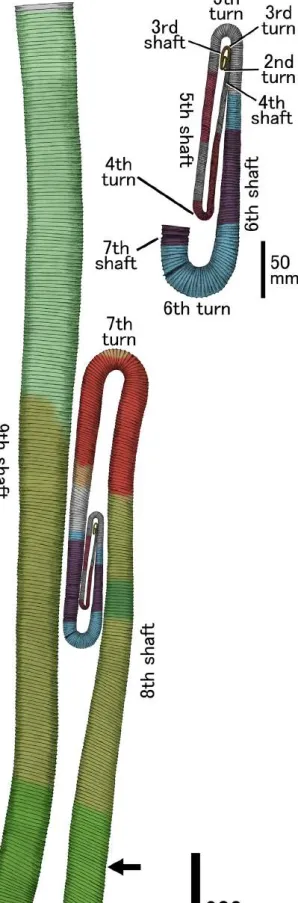
Reconstruction of entire shell form.GIUM 5401 preserves a total of four shafts of the middle growth stage (Fig. 12; red and purple in the web version, fourth to seventh shafts).Matsumoto (1984)andMatsumoto and Miyauchi (1984)described the early growth stage specimens of Fig. 11.Diplomocerassp.; preserving possible sixth and seventh shafts with possible sixth turn; unit IVb of the Hakobuchi Formation in the Hobetsu area, Hokkaido; lateral view.
Red arrow indicates the combination of a constriction, aflared rib, and a very broad interspace. A: HMG-0017. B: HMG-0131. C: HMG-1347.
Diplomocerasoccurred from the middle Campanian strata of the Yezo Group (Soya specimen;Fig. 12; yellow in the web version,first to fourth shafts), which shows the different coiling pattern from D. cylindraceum(McLachlan and Haggart, 2017). A huge specimen of D. cylindraceumoccurred from the Tercis area, France (Tercis spec- imen) that was heavily distorted but still preserved its entire shell shape was presented byOdin et al. (2001)(Fig. 12; pale orange, tan, bluish-green, and reddish-orange in the web version, seventh to ninth shafts). Almost the complete undistorted body chamber of D. maximum occurred from Seymour Island, Antarctic (Seymour specimen) was presented by Zinsmeister and Oleinik (1995)and Oleinik (2010)(Fig. 12; grayish-green, tan, green, and bluish-green in the web version, sixth to ninth shafts). In the Makarov area of Sakhalin Island, unit K3 of the Krasnoyarka Formation, Yezo Group yieldsDiplomocerascf. notabile(Makarov specimen;Maeda et al., 2005), which possibly preserves the eighth and ninth shafts with the eighth turn (Fig. 12; green in the web version).
By compiling these previous descriptions, which are based mostly on fragmentary specimens, and our own observations on the specimens examined herein (Fig. 12; red, light blue, purple, reddish-orange, and bluish-green in the web version), the entire adult shell of northwest PacificDiplomocerascan be reconstructed as having a total of nine shafts and eight U-shaped turns (Fig. 12). Its entire shell length exceeds 1.7 m if it has the long ninth shaft as in D. maximum. The last septum position (Fig. 12arrow) is assumed to be near the end of the eighth shaft, as presented byZinsmeister and Oleinik (1995)andOleinik (2010).
Olivero and Zinsmeister (1989)reconstructed the middle to late growth stages ofDiplomoceras maximumon the basis of approxi- mately 20 fragmentary preserved specimens. They suggested that the entire shell form of a full-grown individual has at least eight shafts, although no complete juvenile specimens are yet known.
Zinsmeister and Oleinik (1995)andOleinik (2010)showed another reconstruction ofD. maximumbased on a single specimen but could not reconstruct the early stage. Coiling mode of the early growth stage ofDiplomocerasmay vary between species as suggested by McLachlan and Haggart (2017).
Our reconstruction shows the extraordinarily long ninth shaft, as presented byZinsmeister and Oleinik (1995)andOleinik (2010);
however, the eighth shaft is significantly shorter than the ninth as presented here. The proportion of eighth to seventh shaft length is approximately 2e2.2, which is similar to that observed byOlivero and Zinsmeister (1989). Some specimens have narrow interspace between the seventh and eighth shafts near the seventh turn (e.g., Fig. 9C), thus suggesting that thefifth turn is in the further inner side of the narrow interspace. Therefore, the sixth shaft is signifi- cantly shorter than the seventh (Fig. 12). Given that the very narrow interspace between the fourth andfifth shafts at the fourth turn can be observed in GIUM 5401 (Fig. 10A), we reconstructed the whorl of the third and earlier shaft stages (Matsumoto, 1984; Matsumoto and Miyauchi, 1984) far from the fourth turn. Our reconstruction suggests that a rapid increase in shaft length proportion occurs later than the sixth shaft stage.
Fig. 12.Composite shell reconstruction ofDiplomoceraswith close-up of early and middle growth stages. Red, purple, and reddish-orange: Hiraiso Formation specimens (D.sp.). Light blue, purple, and bluish-green: Hobetsu Formation specimens (D. sp.).
Yellow: Soya specimens (D. notabile;Matsumoto, 1984; Matsumoto and Miyauchi, 1984). Green: Makarov specimen (D. cf.notabile;Maeda et al., 2005). Pale orange, reddish-orange, tan, bluish-green, and green: Tercis specimen (D. cylindraceum;Odin et al., 2001). Greyish-green, tan, green, and bluish-green: Seymour specimen (D. maximum;Zinsmeister and Oleinik, 1995; Oleinik, 2010). Arrow indicates position of the last septum.
G. Masukawa, H. Ando / Cretaceous Research 91 (2018) 362e381 376
The last septum position and the small volume of the phrag- mocone in our reconstruction suggest thatDiplomocerasmay have negative buoyancy. Diplomoceras may have exhibited a nekto- benthic mode of life, as suggested forPolyptychoceras(Okamoto and Shibata, 1997; contra; Seilacher and Labarbera, 1995;
Westermann, 1996), which is a Santonianemiddle Campanian paperclip-like heteromorph.Seilacher and Labarbera (1995) and Westermann (1996) state paperclip-like coiled ammonoids are planktonic and vertical migrants based on their shell coilings and estimation of living attitudes.Okamoto and Shibata (1997)suggests that Polyptychoceras pseudogaultinum have exhibited a nekto- benthic mode of life based on computer simulation of its shell growth and living attitude changes.Okamoto and Shibata (1997) notes that many damage scars possibly by crustaceans are observed on Polyptychoceras shells. The peculiar morphology of Diplomoceras, e.g., its huge size, paperclip-like coiling patterns, and extreme shaft extention at the late growth stage (seventh to ninth shafts), reminds us thatDiplomocerasis one of the largest and most notable heteromorphs, possibly with the nektobenthic mode of life.
Occurrence.In the northwest Pacific region,Diplomoceras occurs from the middle Campanian (Metaplacenticeras subtilistriatum Zone; Shigeta et al., 2016) to the uppermost Maastrichtian (Matsumoto and Morozumi, 1980; Matsumoto, 1984; Matsumoto and Miyauchi, 1984; Maeda et al., 2005; Misaki and Maeda, 2009;
Shigeta et al., 2015; Kurihara et al., 2016). However unequivocally late Campanian specimens had not been reported yet, in contrast to other regions (Klinger and Kennedy, 2003a; Remin et al., 2015;
McLachlan and Haggart, 2017).
In the Nakaminato Group,Diplomocerasoccurs in the upper part of unit Hl2 and in the lower part of unit Hu1 of the Hiraiso For- mation (Fig. 2), which can be correlated with the upper upper Campanian because of co-occurrence withDidymoceras awajiense.
5. Discussion
5.1. Age of the Nakaminato Group
The heteromorph ammonoids and inoceramid bivalves of the Nakaminato Group in SW Japan are of biostratigraphical impor- tance. The characteristic heteromorph index ammonoid D. awajiense, recognized as an upper upper Campanian index in SW Japan (Hashimoto et al., 2015;Fig. 13A-D) occurs in the lower part of the Hiraiso Formation (units Hl2 and Hl3;Figs. 2, 13E). However, this species has not been known from the northern parts of the north- west Pacific region than this area (Fig. 13F-J). On the other hand, the peculiar inoceramid“I.”kusiroensis, which is known in the northern parts of the northwest Pacific (Fig. 13G-J) and northeast Pacific (Jones and Clark, 1973; Sample and Reid, 2003) regions, also occurs in the upper part of the Isoai Formation (Fig. 13E). But this is un- known in the southern parts of the northwest Pacific region (SW Japan). These two species allow to correlate the SW Japan groups (Izumi and Sotoizumi) with the NE Japan groups (Yezo and Nemuro) for the upper Campanian to the lower Maastrichtian (Fig. 13). Given that I. (Endocostea) shikotanensis, an early Maastrichtian index designated byToshimitsu et al. (1995), is found in unit Hl3, which contains several specimens ofD. awajiense.Matsunaga et al. (2008) reported co-occurrence of I. (E.) shikotanensis and heteromorph Pravitoceras sigmoidale, which indicates the upper upper Campa- nian (Hashimoto et al., 2015). Thus, the range ofI.(E.)shikotanensis may extend into the upper upper Campanian.
Considering that the above describedDidymocerassp. of unit Hl1 apparently differs fromD. awajiense, the lowest part of the Hiraiso Formation may include the lower upper Campanian
Didymoceras sp. Zone of the Izumi Group (Fig. 13; Bando and Hashimoto, 1984; Morozumi, 2007; Hashimoto et al., 2015;
Misaki and Tsujino, 2017). Although there is a general morpho- logical similarity between the D. sp. of Hl1 and at least some of undescribed nostoceratids occurred fromD. sp. Zone of the Izumi Group, direct comparisons remain difficult because of the different growth stages represented by the available specimens.
Although well-preserved index macrofossils in unit Is3 of the Isoai Formation are lacking, a few invertebrate fossils have been found (Fig. 2; Kato et al., 2017). A small phragmocone fragment resembling Nostoceras hetonaiense (Fig. 5F) suggests an early Maastrichtian age for this horizon (as for the Hakobuchi Formation of the Yezo Group (Shigeta et al., 2010) and the Kitaama Formation of the Izumi Group (Fig. 13B;Hashimoto et al., 2015). Units Is6 and Is7 of the Isoai Formation contain similar heteromorph ammonoids and inoceramid assemblages of the lower part of theGaudryceras izumienseZone of the Yezo Group (Fig. 13H, I). Several occurrences of “I.” kusiroensis associated with G. izumiense are reported by Shigeta et al. (2017,figs. 7C, 7M). This co-occurrence suggests that other“I.”kusiroensis-bearing levels lacking the characteristic zonal index ammonoids can be at least provisionally correlated with the lower part of the G. izumiense Zone. The occurrence of“I.”kusir- oensisin the Monshizu Formation of the Nemuro Group (Fig. 13J) agrees withfindings in other lower Maastrichtian strata in the NW Pacific region (Fig. 13G, I, e.g.,Vereschagin et al., 1965; Ando et al., 2001; Maeda et al., 2005) and the NE Pacific region (Jones and Clark, 1973; Sample and Reid, 2003). In addition, detrital zircons in a sandstone layer of the middle part of unit Is8 showed a radiometric UePb age of 71.1±1.2 Ma (Nagata and Otoh, pers. comm., in May, 2016;Fig. 2), also supporting an early Maastrichtian age for the upper part of the Isoai Formation.
Therefore, the Hiraiso Formation correlates with the middle part of the Izumi Group (Fig. 13A, B) and with the middle part of the Toyajo Formation of the Sotoizumi Group (Fig. 13D) based on the occurrence ofDidymoceras awajiense, thus suggesting the upper Campanian. The Isoai Formation can be correlated with the middle to upper parts of the Hakobuchi Formation (including the“Etan- pakku”Formation;Fig. 13G, H), the middle part of the Krasnoyarka Formation of the Yezo Group (Fig. 13I), and the Monshizu Formation of the Nemuro Group (Fig. 13J), based on the occurrence of long- spined nostoceratid and“Inoceramus” kusiroensis. Thus, the Isoai Formation could be inferred as the lower Maastrichtian. The Campanian/Maastrichtian boundary could then be expected be- tween the uppermost Hiraiso (Hu2) and lower Isoai (Is2) forma- tions. ThePravitoceras sigmoidaleZone (Hashimoto et al., 2015) is recognized in the Izumi Group and the Toyajo Formation in SW Japan above theD. awajienseZone (Fig. 13B, D). It may be situated just above unit Hl3 of the Hiraiso Formation if present.
5.2. Heteromorph-dominated ammonoid fauna
The molluscan fauna from the lower part of the Hiraiso For- mation (Hl2 to Hl3;Fig. 2) is characterized by the dominance (high frequency) of heteromorph ammonoids such asDidymoceras awa- jiense(over sixty specimens) andDiplomocerassp. (over ten spec- imens) and the infrequency of planispiral ammonoids (only two specimens;Fig. 3A and B).D. awajienseoccurs commonly in the upper upper Campanian strata of both the Izumi Group and the Toyajo Formation of the Sotoizumi Group (Morozumi, 1985; Misaki and Maeda, 2009). Outside the Nakaminato area of the NW Pacific region, however, the co-occurrence of D. awajiense with Dip- lomocerashas not been observed. The occurrence ofDidymoceras (and a close relative, Bostrychoceras) and Diplomoceras has also been reported in other regions such as the NE Pacific (Whiteaves, 1903; Anderson, 1958; Jones, 1963), Australia (Henderson et al.,
Fig. 13.Correlation of selected marine strata with Campanian to Maastrichtian ammonoid fauna in the NE Pacific region. Biostratigraphic zonation of the Izumi Group is based onHashimoto et al. (2015)with little modification by Shigeta et al. (2016). Magnetostratigraphy is based onHashimoto et al. (2015)andShigeta et al. (2015). AeC: Izumi Group (Hashimoto et al., 2015). D: Toyajo Formation of the Mt. Toyajo area (Misaki and Maeda, 2009). E: Nakaminato Group (this study). F: Hakobuchi Formation of the Hidaka area (Matsunaga et al., 2008). G: Yezo Group of the Nakatombetsu area (Ando et al., 2001). H: Yezo Group of the Soya hills area (Ando and Ando, 2002; Shigeta et al., 2017). I:
Yezo Group of the Makarov area (Maeda et al., 2005). J: Nemuro Group of the Kushiro-Nemuro area (Kiminami, 2010; Shigeta et al., 2015). SeeFig. 1A for location of each column.
G.Masukawa,H.Ando/CretaceousResearch91(2018)362e381378
1992), South Africa (Klinger and Kennedy, 2003b), and Europe (Küchler and Odin, 2001; Summesberger and Kennedy, 2004), suggesting a worldwide distribution of these large heteromorph ammonoid genera during the latest Cretaceous.
The long-spined large nostoceratid (Nostoceratidae gen.etsp.
B),Baculitesspp. and small but distinctively anterior winged“Ino- ceramus”kusiroensis(Fig. 4D) represent a macrofossil assemblage from the upper part of the Isoai Formation (lower Maastrichtian). In the Yezo Group of north Hokkaido,Shigeta et al. (2017)recognized the similar assemblage in the“Etanpakku” Formation, correlated with theG. izumienseZone (upper lower Maastrichtian;Hashimoto et al., 2015).Ando and Ando (2002)regarded the same strata to be a part of the Hakobuchi Formation. Because this assemblage has not yet been reported for SW Japan (Matsumoto and Morozumi, 1980;
Morozumi, 1985), it suggests the faunal similarity with those from the northern part of the northwest Pacific region for the upper part of the Isoai Formation.
In SW Japan, heteromorph-dominated ammonoid faunas are also observed in the upper Campanian Izumi Group and the Toyajo Formation of the Sotoizumi Group (Morozumi, 1985; Misaki and Maeda, 2009; Yoshino and Matsuoka, 2016). In NE Japan, except for the Nakaminato Group, planispiral ammonoids are rather common in the upper Campanian (e.g.,Ando et al., 2001; Ando and Tomosugi, 2005; Shigeta et al., 2016). This faunal differentiation is one of the reasons for the difficulty in correlating the uppermost Cretaceous in NE Japan and southern Sakhalin with SW Japan. The macrofossil fauna of the Nakaminato Group is important for the comparison of the Late Cretaceous ammonoid fauna between NE and SW Japan because it contains the characteristic speciesDidy- moceras awajienseand“Inoceramus”kusiroensis.
In the Hiraiso Formation, heteromorph ammonoids occur as isolated fragments in mudstone and calcareous nodules. This is due to the rarity and small size of the calcareous nodules. Large-sized ammonoid shells could not be entirely enveloped within such nodules as host rocks after burial and the parts of the shell outside the nodules would have been readily dissolved during early diagenetic processes. Despite their often squashed mode of occur- rence, the well-preserved shells ofDiplomocerassp. are occasion- ally associated with a few adjacent shafts of the middle growth stage (without heavy breakage), thus suggesting that the trans- portation distance from the original habitat was relatively short (Oleinik, 2010) in the lower part of the Hiraiso Formation. This is exemplified byPravitoceras sigmoidalein the Izumi Group (Yoshino and Matsuoka, 2016). Several well-preserved juvenile and adult D. awajienseshells from the Hiraiso Formation may also support this idea, judging from no heavy shell breakage.Saito (1962)re- ported several juvenile (Figs. 5B, D and E) and adult (Figs. 6B and 7) shells ofD. awajiensefrom one horizon in the middle part of unit Hl3 of the Hiraiso Formation. Thus this suggests juvenile and adult shells of D. awajiense preserved in association within the same calcareous nodule due to small influence of the sorting of ammo- noid assemblage during transportation (Yoshino and Matsuoka, 2016). Based on our observations of the mudstone-dominated sedimentary facies, the preservation of ammonoid and other fos- sils, and the peculiar morphology of the heteromorphs, the main habitat ofD. awajienseandDiplomocerassp. may have been near the offshore muddy seafloor, possibly near basin plain not so far from a submarine fan.
In addition, there is a D. awajiense specimen (INM-4-16734) associated with two anomiid bivalves, one of which is attached to the ammonoid shell (Fig. 6C). Their preservation is similar to that of the several specimens ofD. awajiense andP. sigmoidalethat were colonized by anomiids (Misaki et al., 2014), thus suggesting a rapid burial of specimen INM-4-16734.
Poor preservation ofBaculitesspp. (Fig. 3B and D) from pebbly mudstone and alternating sandstone and mudstone in the upper part of the Isoai Formation (Fig. 2), suggests relatively long-distance transportation (Yoshino and Matsuoka, 2016). These appear to be transported as debris by debris flows or turbidity currents. By contrast, the large nostoceratid with exceptionally well-preserved tubercles (Nostoceratidae gen. et sp. B; Fig. 8B) from massive mudstone in the upper Isoai Formation, suggest short-distance transportation from their adult stage habitat.
6. Conclusions
The macrofossils such as ammonoids, inoceramids, other bi- valves and vertebrate fragmentary remains occur in ~1900 m-thick upper Campanianelower Maastrichtian siliciclastic succession of the Nakaminato Group exposed along the Pacific coast of central Honshu. Heteromorph ammonoids, represented by nostoceratids and diplomoceratids, are numerically dominant among ammonoid assemblages from the lower to middle parts of the lower-Hiraiso Formation and from a few horizons of the upper, Isoai Formation.
Five heteromorph taxa, Didymoceras awajiense, Didymoceras sp., Diplomocerassp., Nostoceratidae gen.etsp. indet. A, and N. gen.et sp. indet. B, are described. The co-occurrence ofDidymocerasand Diplomocerasis currently only known for the Hiraiso Formation of the Nakaminato Group in the northwest Pacific region. The entire shell morphology of Diplomoceras sp. was successfully recon- structed on the basis of a comparison of our specimens with those of previous studies in France, Antarctica, and the northwest Pacific.
The early growth stage of our reconstruction, based on northwest Pacific region specimens, shows the different coiling mode from the reconstruction ofDiplomoceras cylindraceum, based on northeast Pacific region specimens. The biostratigraphic range of the Naka- minato Group from the late Campanian to the early Maastrichtian is deduced on the basis of the age diagnostic ammonoids and ino- ceramids and correlating with other contemporaneous sections in SW Japan, Hokkaido, and Sakhalin. The Nakaminato Group provides basic information on the faunal characteristics for the reconstruc- tion of the Campanian and Maastrichtian ecosystems of the northwest Pacific region.
Acknowledgements
We are indebted to Dr Shigeta Yasunari (National Museum of Nature and Science, Tsukuba), Mr Taichi Kato (Ibaraki Nature Museum, Bando), Dr Tomohiro Nishimura (Hobetsu Museum, Mukawa), Dr Kiyoshi Kawabata (Osaka Museum of Natural History, Osaka), and Dr Yasuyuki Tsujino (Tokushima Prefectural Museum, Tokushima) for giving us access to ammonoid specimens. We thank Prof. Shigeru Otoh, Assoc. Prof. Kenji Kashiwagi, and Mr Mitsuhiro Nagata (Toyama University, Toyama) for their helpful advice during ourfield work and for providing radiometric age data. We are very greatful to Dr Hiroaki Inose (Fukushima Prefectural Museum, Aizuwakamatsu) and Mr Toshifumi Kataoka for donating their collections. We appreciate all people who helped our fieldwork.
English language correction was performed by Dr Francis Hirsch and Enago (www.enago.jp). Dr James Haggart and two associate editors, Dr Marcin Machalski and Dr Elena Jagt-Yazykova, kindly helped so much with the editorial process. We also acknowledge the two anonymous reviewers for their constructive comments.
This paper is a contribution to UNESCO-IUGS IGCP608“Creta- ceous ecosystems and their responses to paleoenvironmental changes in Asia and the Western Pacific.”The study was supported financially by JSPS KAKENHI, Grants-in-Aid for Scientific Research (B) (No. 25302011) and (C) (No. 17K05688) provided to H. Ando.
References
Anderson, F.M., 1958. Upper Cretaceous of the Pacific Coast. Geological Society of America. Memoir 71, 1e378.
Ando, H., 2003. Stratigraphic correlation of Upper Cretaceous to Paleocene forearc basin sediments in Northeast Japan: cyclic sedimentation and basin evolution.
Journal of Asian Earth Science 21, 919e933.
Ando, H., 2006. Geologic setting of the Choshi and Nakaminato Groups and Oarai Formation exposed along the Pacific coast in the eastern end of the Kanto Plain.
The Journal of the Geological Society of Japan 112, 84e97 (in Japanese with English abstract).
Ando, M., Ando, H., 2002. Depositional facies and megafossil biostratigraphy of the Upper Cretaceous Hakobuchi Group in the Soya Hill area, northern Hokkaido.
Bulletin of the Nakagawa Museum of Natural History 6, 1e21 (in Japanese with English abstract).
Ando, H., Kashiwagi, K., Hirayama, R., Toshimitsu, S., 2014. Cretaceous forearc basin siliciclastic successions along the Pacific coast, central Japan: Choshi, Nakami- nato and Futaba groups. In: Field Excursion Guide, The Second International Symposium of International Geoscience Programme (IGCP) Project 608
“Cretaceous Ecosystems and Their Response to Paleoenvironmental Changes in Asia and the Western Pacific”, pp. 1e42.
Ando, H., Takahashi, M., 2017. Reconstruction of the Cretaceous Paleo-Japan con- tinental arc-trench system reconsidered from Cretaceous geologic records in the Japanese Islands. Fossils 102, 43e62 (in Japanese with English abstract).
Ando, H., Tomosugi, T., 2005. Unconformity between the Upper Maastrichtian and Upper Paleocene in the Hakobuchi Formation, north Hokkaido, Japan: a major time gap within the Yezo forearc basin sediments. Cretaceous Research 26, 85e95.
Ando, H., Tomosugi, T., Kanakubo, T., 2001. Upper Cretaceous to Paleocene Hako- buchi Group, Nakatonbetsu area, northern Hokkaidoelithostratigraphy and megafossil biostratigraphy. The Journal of the Geological Society of Japan 107, 142e162 (in Japanese with English abstract).
Bando, Y., Hashimoto, H., 1984. Biostratigraphy and ammonite fauna of the Izumi Group (Late Cretaceous) in the Asan Mountains. Memoirs of the Faculty of Education, Kagawa University, Part 2 34, 11e39 (in Japanese with English summary).
Defrance, M.J.L., 1816. Dictionnaire des sciences naturelles, dans lequel on traite methodiquement des diff erents Etres de la nature 3. Levrault, Paris and Strasbourg (in French).
Gill, T., 1871. Arrangement of the families of mollusks. Smithsonian Miscellaneous Collections 227, 1e49.
Haggart, J.W., 1989. New and revised ammonites from the Upper Cretaceous Nanaimo Group of British Columbia and Washington state. Geological Survey of Canada Bulletin 396, 181e221.
Hashimoto, H., Ishida, K., Yamasaki, T., Tsujino, Y., Kozai, T., 2015. Revised radiolarian zonation of the Upper Cretaceous Izumi inter-arc basin (SW Japan). Revue de Micropaleontologie 58, 29e50.
Henderson, R.A., Kennedy, W.J., McNamara, K.J., 1992. Maastrichtian heteromorph ammonites from the Carnarvon Basin, western Australia. Alcheringa 16, 133e170.
Hyatt, A., 1894. Phylogeny of an acquired characteristic. Proceedings of the Amer- ican Philosophical Society 32, 349e647.
Hyatt, A., 1900. Cephalopoda. In: Zittel, K.A. (Ed.), Text book of Palaeontology.
Macmillan, London, pp. 502e592.
Jones, D.L., 1963. Upper Cretaceous (Campanian and Maestrichtian) ammonites from southern Alaska. United States Geological Survey, Professional Paper 432, 1e53.
Jones, D.L., Clark, S.H., 1973. Upper Cretaceous (Maestrichtian) fossils from the Kenai-Chugach Mountains, Kodiak and Shumagin Islands, southern Alaska.
Journal of Research of the United States Geological Survey 1, 125e136.
Kashiwagi, K., Ando, H., Hirayama, R., 2015. Radiolarians from the middle Campa- nian to early Maastrichtian (Late Cretaceous) Hiraiso Formation of the Naka- minato Group, Japan. Abstracts with Programs, 164th Regular Meeting, Palaeontological Society of Japan 29 (in Japanese).
Kato, T., Koda, Y., Ando, H., Sonoda, T., Masukawa, G., 2017. Late Cretaceous Reptile fossils from Nakaminato Group, Hitachinaka-City, Ibaraki Prefecture. Bulletin of Ibaraki Nature Museum 20, 7e14 (in Japanese with English abstract).
Katsura, Y., Masuda, F., 1978. Sequences of structures in submarine-fan deposits in the Cretaceous Nakaminato Group, Ibaraki, Japan. Annual Report of the Institute of Geoscience, University of Tsukuba 4, 26e29.
Kiminami, K., 2010. Nemuro Group of the Nemuro Belt. In: Geological Society Japan (Ed.), Japanese Regional Geology 1, Hokkaido. Asakura Publishing, Tokyo, pp. 82e85 (in Japanese, original title translated).
Klinger, H.C., Kennedy, W.J., 2003a. Observations on the systematics, geographic and stratigraphic distribution and origin of Diplomoceras cylindraceum (Defrance, 1816) (Cephalopoda: Ammonoidea). Annals of the South African Museum 110, 171e198.
Klinger, H.C., Kennedy, W.J., 2003b. Cretaceous faunas from Zululand and Natal, South Africa. The ammonite families Nostoceratidae Hyatt, 1894 and Dip- lomoceratidae Spath, 1926. Annals of the South African Museum 110, 219e336.
Küchler, T., Odin, G.S., 2001. Upper Campanian-Maastrichtian ammonites (Nosto- ceratidae, Diplomoceratidae) from Tercis les Bains (Landes, France). In:
Odin, G.S. (Ed.), The Campanian-Maastrichtian Stage Boundary Characterisation at Tercis les Bains (France) and Correlation with Europe and Other Continents,
Developments in Palaeontology and Stratigraphy 19. Elsevier B.V., Amsterdam, pp. 500e528.
Kurihara, K., Kano, M., Sawamura, H., Sato, Y., 2016. The last surviving ammonoid at the end of the Cretaceous in the north Pacific region. Paleontological Research 20, 116e120.
Maeda, H., Shigeta, Y., Fernando, A.G.S., Okada, H., 2005. Stratigraphy and fossil assemblages of the Upper Cretaceous System in the Makarov area, Southern Sakhalin, Russian Far East. National Science Museum Monographs 31, 25e120.
Masuda, F., Katsura, Y., 1978. Submarine-fan deposits in the Cretaceous Nakaminato Group, Ibaraki, Japan. Annual Report of the Institute of Geoscience, University of Tsukuba 4, 23e25.
Matsumoto, T., 1954. The Cretaceous System in the Japanese Islands. Japan Society of Promotion of Science, Tokyo, 324pp.
Matsumoto, T., 1980. Cephalopods from the Shimanto Belt of Kochi Prefecture (Shikoku). In: Katto, J., Taira, A., Tashiro, M. (Eds.), Selected Papers in Honor of Prof. Jiro Katto, Geology and Paleontology of the Shimanto Belt. Rinyakosaikai Press, Kochi, pp. 283e298 (in Japanese, original title translated).
Matsumoto, T., 1984. Part 1. Ammonites from the Upper Campanian of the Teshio Mountains. Palaeontological Society of Japan, Special Papers 27, 5e32.
Matsumoto, T., Miyauchi, T., 1984. Part 2. Some Campanian ammonites from the Soya area. Palaeontological Society of Japan, Special Papers 27, 33e76.
Matsumoto, T., Morozumi, Y., 1980. Late Cretaceous ammonites from the Izumi Moun- tains, Southwest Japan. Bulletin of the Osaka Museum of Natural History 33, 1e31.
Matsunaga, T., Maeda, H., Shigeta, Y., Hasegawa, K., Nomura, S., Nishimura, T., Misaki, A., Tanaka, G., 2008. First discovery ofPravitoceras sigmoidaleYabe from the Yezo Supergroup in Hokkaido, Japan. Paleontological Research 12, 309e319.
McLachlan, S.M.S., Haggart, J.W., 2017. Reassessment of the late Campanian (Late Cretaceous) heteromorph ammonite fauna from Hornby Island, British Columbia, with implications for the taxonomy of the Diplomoceratidae and Nostoceratidae. Journal of Systematic Palaeontology 1e53.
Meek, F.B., Hayden, F.V., 1856. Descriptions of new species of Gastropoda and Cephalopoda from the Cretaceous formations of Nebraska Territory. Pro- ceedings of the Academy of Natural Sciences of Philadelphia 8, 70e72.
Misaki, A., Maeda, H., 2009. Lithostratigraphy and biostratigraphy of the Campanian-Maastrichtian Toyajo Formation in Wakayama, southwestern Japan.
Cretaceous Research 30, 1398e1414.
Misaki, A., Maeda, H., 2010. Two Campanian (Late Cretaceous) nostoceratid am- monoids from the Toyajo Formation in Wakayama South-west Japan. In:
Tanabe, K., Shigeta, Y., Sasaki, T., Hirano, H. (Eds.), CephalopodsePresent and Past. Tokai University Press, Tokyo, pp. 223e231.
Misaki, A., Maeda, H., Kumagae, T., Ichida, M., 2014. Commensal anomiid bivalves on Late Cretaceous heteromorph ammonites from south-west Japan. Palae- ontology 57, 77e95.
Misaki, A., Tsujino, Y., 2017. Nostoceratid ammonoids from the Upper Cretaceous Izumi Group in northeastern Shikoku, Japan and their evolutionary implica- tions. Abstracts with Programs, the Palaeontological Society of Japan, 2017 Annual Meeting 42 (in Japanese).
Morozumi, Y., 1985. Late Cretaceous (Campanian and Maastrichtian) ammonites from Awaji Island, Southwest Japan. Bulletin of the Osaka Museum of Natural History 39, 1e58.
Morozumi, Y., 2007. Nostoceratid ammonoids from the Asan Mountains, Museum News. Tokushima Prefectural Museum 66, 2e3 (in Japanese, original title translated).
Odin, G.S., Courville, P., Machalski, M., Cobban, W.A., 2001. The Campanian- Maastrichtian ammonite fauna from Tercis (Landes, France); a synthetic view.
In: Odin, G.S. (Ed.), The Campanian-Maastrichtian stage boundary Characteri- sation at Tercis-les- Bains (France) and correlation with Europe and other Continents. Developments in Palaeontology and Stratigraphy, 19. Elsevier B.V., Amsterdam, pp. 550e567.
Okamoto, T., Shibata, M., 1997. A cyclic mode of shell growth and its implications in a Late Cretaceous heteromorph ammonitePolyptychoceras pseudogaultinum (Yokoyama). Paleontological Research 1, 29e46.
Oleinik, A., 2010. Hooks and shafts come together in a fragile giant from Antarctica.
American Paleontologist 18, 10e13.
Olivero, E.B., Zinsmeister, W.J., 1989. Large heteromorph ammonites from the Upper Cretaceous of Seymour Island, Antarctica. Journal of Paleontology 63, 626e636.
Ozaki, H., Saito, T., 1955. The Cretaceous System along the Coast of Nakaminato City, Ibaraki Prefecture. Bulletin of the Faculty of Liberal Arts, Ibaraki University, Natural Science 5, 37e49 (in Japanese with English abstract).
Remin, Z., Machalski, M., Jagt, J.W., 2015. The stratigraphically earliest record of Diplomoceras cylindraceum(heteromorph ammonite)eimplications for Cam- panian/Maastrichtian boundary definition. Geological Quarterly 59, 843e848.
Saito, T., 1958. Notes on some Cretaceous fossils from the Nakaminato Formation, Nakaminato City, Ibaraki Prefecture Japan. Part 1. Bulletin of the Faculty of Liberal Arts, Ibaraki University, Natural Science 8, 83e94.
Saito, T., 1959. Notes on some Cretaceous fossils from the Nakaminato Formation, Nakaminato City, Ibaraki Prefecture Japan. Part 2. Bulletin of the Faculty of Liberal Arts, Ibaraki University, Natural Science 9, 79e85.
Saito, T., 1961. The Upper Cretaceous System of Ibaraki and Fukushima Prefectures, Japan (Part 1). Bulletin of the Faculty of Liberal Arts, Ibaraki University, Natural Science 12, 103e144.
Saito, T., 1962. The Upper Cretaceous System of Ibaraki and Fukushima Prefectures, Japan (Part 2). Bulletin of the Faculty of Liberal Arts, Ibaraki University, Natural Science 13, 51e88.
G. Masukawa, H. Ando / Cretaceous Research 91 (2018) 362e381 380