107
tAlt if 9 : 107-114 (2001)
Bull. Inst. Compr. Agr. Sci. Kinki Univ. 9 : 107 114 (2001)
Effect of Scavengers on Platelet Aggregation and Arteriosclerosis in Stroke-prone Spontaneously Hypertensive Rats (SHRSP)
Takashi TAJIRI* Hideaki HIGASHINO* * Aritomo SUZUKI**
SYNOPSIS
In recent years, continuous intake of high fat diet in daily life has been reported to be an etiological factor in life habit—associated diseases. Arteriosclerosis related to high fat diet has been suggested. It is generally known that hypertension is a factor in stimulating arteriosclerosis. In the sclerotic arterial wall, ulcer occurs and induces platelet deposition, causing vasoconstrictors and activating the blood coagulation system. Thus inducing thrombus formation.
In this study, we examined the effects of a scavenger (2-Aminomethy1-4-tert-buty1-6- propiony1 phenol hydrochloride : ATPH), which promotes platelet aggregation without influencing cycloxygenase, inhibits TXA2 synthesis, and exhibits potent anti-inflammatory actions, on platelet aggregation in vitro and in vivo with respect to the synthesis of prostaglandin 12 (PGI2) with inhibitory effects on platelet aggregation. Using stroke-prone spontaneously hypertensive rats (SHRSP), we investigated the effects of the scavenger on arteriosclerosis and blood pressure. The following results were obtained.
This study was conducted to develop and produce a diet for patients with life habit-associated diseases and elderly people.
1. ATPH inhibited platelet aggregation in a dose-dependent manner in vitro and in vivo.
2. Long-term administration of ATPH did not markedly inhibit platelet aggregation, but markedly
inhibited arteriosclerosis, cardiac hypertrophy, and cerebral edema, showing marked life-prolonging
effects.
3. These results suggest that this agent prevents arteriosclerosis.
4. Our findings suggest that ATPH can be utilized together with artificialdigestive enzymes for producing a diet for patients with life habit-associated diseases and elderly people, and that ATPH
may be effective.
INTRODUCTION
In recent years, there has been an increasing tendency to eat high-fat foods regularily, which is considered to be a factor in increasing cerebral infarction and myocardial infarction. These diseases are an effect of arteriosclerosis resulting from high-fat diets (neutral fat, low density lipoprotein).
Hypertension is an important factor in stimulating arteriosclerosis In sclerotic arterial walls, ulcers develop, and then platelet and fibrin are deposited. Thromboxane A2 (TXA2) released from platelets
* The Institute for Comprehensive Agricultural Sciences Kinki University , Nara 631-8505, Japan
** Kinki University School of Medicine , Osaka-Sayama, Osaka 589-8511, Japan
108 Bull. Inst. Compr. Agr. Sci. Kinki Univ. No. 9 (2001)
and bradykinin released from ulcers have vasoconstricting effects. TXA2 enhances the blood coagulation system, promoting thrombosis, which obstructs the arterial lumen, facilitating the induction of cerebral or myocardial infarction 1 ) .
In association with the synthesis of prostaglandin 12 (PGI2) which has inhibitory effects on platelet aggregation, we evaluated the effects of a scavenger (2-aminomethyl-4-tert-butyl-6-propionyl phenol hydroclocide : ATPH), which promotes platelet aggregation, and has marked anti-inflammatory effects, on in vitro and in vivo platelet aggregation. In stroke-prone spontaneously hypertensive rats (SHRSP), the effects of ATPH on arteriosclerosis and blood pressure were evaluated. These experiments were performed to obtain basic data for the production and development of rice as therapeutic food in patients with lifestyle-related diseases and the aged and to evaluate the potentiality for production of rice containing ATPH and artificial digestive enzymes.
MATERIALS and METHODS
1. In vitro experiments
Blood was collected from a 6-month-old male SHRSP, and 3.8% citrate as an anti-coagulant (v/v) was added. Platelets were purified and pretreated with a scavenger (ATPH : Fig. 1 ). Adenosine 5'-diphosphate (ADP : Sigma) was added, and the degree of inhibition of ADP-induced platelet aggregation by ATPH was measured using an NKK TRACERI (Niko Bioscience) 3) 4) .
2 —Aminomethyl —4— tert —butyl —6 —propionylphenol hydrochloride
0H
C2H5CO CH2 NH2 • HCI
C (CH3 )z
Fig. 1 Chemical abstracts and structure of scavenger
2. In vivo experiments
A) Acute administration experiments 5) 6 )
Eighteen 6-month-old male SHRSP were divided into 3 groups. ATPH (50 or 75mg/kg) was orally administered using a probe to two groups but not to the other group. After 1 hour, platelet aggregation induced by ADP (5 X 10' mM) was compared among the 3 groups.
B) Long-term administration experiments 5) 6 )
Twenty-four male SHRSP were divided into 4 dose groups (control group and 10, 2, and 0.4 mg/kg ATPH groups). ATPH was mixed with power stock feed and orally administered from 8 weeks after birth to 50 weeks after birth.
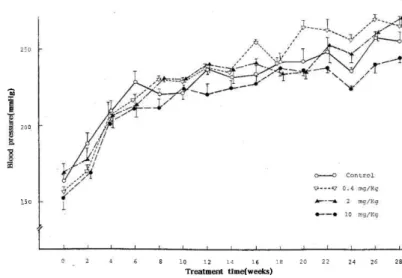
During the administration period, blood pressure was measured using a digital sphygmomano- meter (Omron) by the caudal volume method once weekly for 28 weeks.
T.TAJIRI et al. Effects of Scavengers on Platelet Aggregation and Arteriosclerosis in Strok-prone Spontaneously Hypertensive Rats (SHRSP) 109
RESULTS OF EXPERIMENTS
I. In vitro
ADP-induced blood aggregation is shown in Fig. 2.
Dose-activity curves were produced, and the degree of inhibition of platelet aggregation by PGI2 and ATPH was evaluated, basing on aggregation by 5 X 10⁻³ nM (EDO ADP as 100%.
Pretreatment with PGI2 dose-dependently inhibited platelet aggregation concentration (2 X10⁻⁸—
2 X 10⁻⁷ mM).
Pretreatment with ATPH dose-dependently inhibited platelet aggregation concentration (0.8 — 1.2 mM), and its inhibition effective range was narrower than that of PGI2.
IOC
0, 75 0
0 cr, 50
0 0 4J (a P. 25
O
(a)
a)
•H 0 a)
t,
a)
a) CS (1) 4J
0 a) 0 4j •H
•H
I-1 l00
10-3 10-2 ADP (141)
75
50
25
0
(b)
0
no tr, N
tT,
a) a)
4-1 0
0 4-)
0 .0
1 0 - 8 10-7 10-6
PGI2 (mM)
100
75
50
25
0 I.
( c )
0.5 1
Scavenger
1.5 (mM)
Fig. 2 Aggregation of Spontaneously Hypertensive Rat, Stroke-Prone(SHRSP) platelet by Adenosine 5- Diphosphate (ADP)-(a) and effects of scavenger-(b) and prostaglandin 12 (PGI2)-(c).
0
a tr, a en en a 4i a a) ra ga,
0 C 0
.0
c .g I -1
50
40
30
20
10
control
ao E E
200
,5c
50mg/Kg 75mg/Kg 8 10 12 14 16 18 20 22 24 26
Treatment time(weeks)
28
Fig. 3 Influence of oral administration of scavenger on the platelet aggregation.
Fig. 4 Influence of scavenger on the blood pressure of SHRSP.
110 Bull. Inst. Compr. Agr. Sci. Kinki Univ. No. 9 (2001)
2. In vivo
A) Acute administration
As shown in Fig. 3, platelet aggregation was slightly decreased in the 50 mg/kg ATPH groups and markedly decreased in the 75 mg/kg group compared with the control group.
B) Long-term administration
(1) Effects on blood pressure : As Fig. 4 showns, blood pressure increased in proportion to age in the control groups and each ATPH dose group. The blood pressures in the 4 mg/kg and 0.2 mg/kg ATPH groups were comparable or slightly higher than in the control group. However, the 10 mg/kg ATPH group showed a slightly lower blood pressure than the control group 12 days after the initiation of administration. No significant effects were observed in any ATPH group.
(2) Eye fundus findings : As shown in Table 1, funduscopy performed during and at the end of the experiments showed tortuous and narrowed fundus arteries in the control and all ATPH dose groups.
No differences were observed in the fundus arteries in the control and all ATPH dose groups. No differences were observed in the fundus arteries of the retinal vascular system among the groups.
The papillary system was enlarged at the end of the experiments compared with the initiation of the experiments in the control group and the 2 and 0.4 mg/kg ATPH groups but unchanged in the 10 mg/kg ATPH group.
Comparison at the end of the experiments showed enlargement of the papillary system in the control group compared with the ATPH groups. As shown in Photo 1, many amorphous papillae and marked papillary edema were observed in the control group. As Table 1 shows, the degree of
Table. 1 Influence of scavenger on the findings of optic disc
Animal Experiment-start times
~mm)
21 weeks (mm)
Experiment-end times (mm) SHRSP Control
Scavenger
WKY(wistar kyoto rat)
0,4 mg/Kg 2 mg/Kg 10 mg/Kg
47.19 1- 0.43 46.99 ± 0,44 48.85 ± 0.75 48.39 ± 0,87 42.99 ± 1.09
49.37 ± 0,54 47.71 ± 1,15 49.87 ± 0.65 48.82 ± 0.57 43.14 ± 0.80
54,32 ± 2.48 50.93 ± 1.47 50,73 ± 1.02 48,69 ± 1.63 44.78 ± 1.36
Table. 2 Influence of scavenger on the brain and heart weights
Animal Brain
(g)
Heart (g) SHRSP
WKY
Control
Scavenger 0,4 mg/Kg 2 mg/Kg 10 mg/Kg
2.834 ± 0.222 2.234 ± 0.339 2.091 ± 0.045 2.150 ± 0.134*
1.834 ± 0.106
2.045 ± 0.210 2,070 ± 0.382 2,156 ± 0.268 1,467 ± 0.047*
1.337 ± 0.069
significant difference from control *p< 0.05 enlargement was reduced in the 10 mg/kg ATPH group.
(3) Organ weight : As shown in Table 2, brain and heart weights significantly increased in the control
T.TAJIRI et al: Effects of Scavengers on Platelet Aggregation and Arteriosclerosis in Strok-prone Spontaneously Hypertensive Rats (SHRSP) 1 1 1
2mg/Kg
Photo 1 Funds oculi photographs of control rat and scavenger treated rat.
group compared with the 10 mg/kg ATPH group, but the weight of any other organ did not differ between the two groups.
As Photos 2 and 3 show, the control group and each ATPH group showed brain hemorrhage, brain edema, and cardiac hypertrophy. However, in the control group, the incidence of these findings was high, and aortic sclerosis and mesenteric aneurysms were also frequently observed.
(4) Survival rats and health state : At the end of the experiments, 50 weeks after the initiation of ATPH administration, the survival rate was 100% in the 10 mg/kg ATPH group but 50 - 60% in the other
Brain Brain
Control
Control 1 Omg/Kg
Photo
Heart Heart
Control 1 Omg/Kg 2 Brains and hearts of control rat and
10mg/kg treated rat.
scavenger Photo
1 Om g/Kg
3 Mesenteric arteries of control rat and scavenger 10mg/kg treated rat.
112 Bull. Inst. Compr. Agr. Sci. Kinki Univ. No. 9 (2001)
ATPH dose groups and control group.
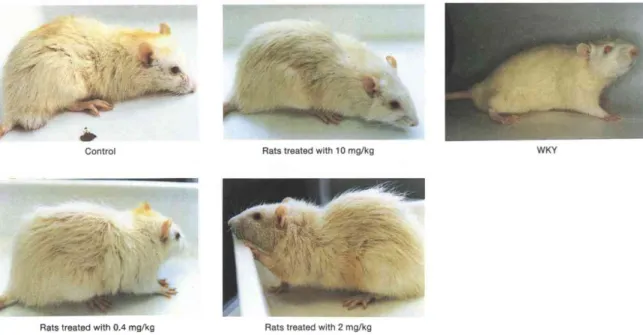
As shown in Photo 4, the 10 mg/kg ATPH group showed glossy hair and a health state similar to that in normal rats (WKY) of the same age. The control group and the 0.4 and 2 mg/kg ATPH groups showed lusterless hair and overreaction to stimuli such as light and sound.
(5) Platelet agrregation ability : As shown Fig. 5, platelet aggregation in the ATPH groups slightly decreased but did not significantly differ from that in the control group.
•
Rats treated with 0.4 mg/kg
Photo 4 Photographs of control rat and scavenger treated on the aggregation of SHRSP platelet by ADP.
00
0
0 0
4J
a 70
00
50
40
30
20
10
0
0 C) control y---,
0.4 mg/Kg •---411
2 mg/Kg 10 mg/Kg
Fig. 5 Influence of chronic scavenger treatment on the aggregation of SHRSP platelet by ADP.
10-3 10-2
A D P (mM)
T.TARRI et al. Effects of Scavengers on Platelet Aggregation and Arteriosclerosis in Strok-prone Spontaneously Hypertensive Rats (SHRSP) 113
DISCUSSION
In vitro, the degree of inhibition of platelet aggregation by ATPH was similar to that by PGI2. In vivo ATPH administration at a single dose of 75 mg/kg had significant aggregation inhibitory effects compared with the control group.
After long-term ATPH administration, platelet aggregation slightly decreased. This lack of significant changes may be because the duration of action was shortened by rapid ATPH metabolism, which reduced the effective inhibition range of platele aggregation. No marked reduction in blood pressure was observed in the 10 mg/kg ATPH group.
Inhibition of mesenteric aneurysms was closely associated with improvement in arteriosclerosis and longevity.
The mechanism of action on arteriosclerosis in the 10 mg/kg ATPH group was unclear because no marked inhibition of platelet aggregation was observed. However, the inhibitory effects of ATPH on TAX2 synthesis may cause inhibition of the synthesis of vasoconstricting substances, resulting in inhibition of arteriosclerosis. In addition, the inflammatory effects of ATPH may play an important role.
Anginin (anti-bradykinin)7) 8) with anti-inflammatory action is widely used as a prophylactic drug for arteriosclerosis. This fact may support the above speculation.
Measurement of PGI2 and TXB2 (a degradation product of TXA2) in arterial walls and evaluation of the action mechanism of ATPH are necessary.
LITERATURE
1) Imabori, K., T, Yamakawa : Biochemistry dictionary (No 2 printing), (Tokyokagakudojin, Tokyo), 431 (1991)
2) CYBREIN, J, R. : J. Clin. Pathol., 15, 452 (1962)
3) HAURAND, M. & ULIRICH, V : J. Biol. Chem., 28, 15059 (1985)
4) Sakamoto, K : Biochemistry experimentation for nutrition (No 10 printing), (Sankyousyupan, Tokyo), 70 - 79 (1993)
5) Endou, K : Nutritional physiology and Guide of biochemistory-99, (No 4 printing), (Nankoudou,
Tokyo), 144 - 147 (1987)
6) Kawagishi, S : Study of biopolymers faculty regulation in the foods, (experiment No 38), (Gakkaisyupansenta, Tokyo), 86 - 90 (1997)
7) Shimamoto, T., Atsumi, T and Itou, K : Gruel-hardening (Ather Oschlerosis) medica-Opening to traffic of blackade-artery with Anginin and advance of medical on the Arteriosclerosis obliterans
and Thromboangitis obliterans (Buerger's disease), 54 (4), 174 - 178 (1965)
8) Shimamoto, T : Action antikinin-B-23 and background of L-eaking vessel and advance and study of inflammation matters in the biochemistory, 51 (8), 443 - 452 (1964)
Bull. Inst. Compr. Agr. Sci. Kinki Univ. No. 9 (2001)
脳 卒 中易 発 症性 高血圧 自然発 症 ラ ッ トの血小板 お よび 動脈 硬化 に及 ぼす ス カベ ンジ ャーの影響
田 尻 尚 士*東 野 英 明**鈴 木 有 朋**
要 旨 近 年 、 食 生 活 に お け る 高 脂 肪 食 の 継 続 摂
取 が 生 活 習 慣 病 の 一 因 と さ れ 、 高 脂 肪 食 に よ る動 脈 硬 化 が 指 摘 さ れ 、 高 血 圧 は 動 脈 硬 化 を誘 発 ・促 進 す る 因 子 で あ る こ とや 硬 化 動 脈 壁 で は 潰 瘍 を生 じ、 血 小 板 な どが 沈 着 す る た め に 血 管 収 縮 作 用 を生 じ、 血 液 凝 固 系 を促 進 させ て 血 栓 を誘 発 し 、 動 脈 内 腔 の 閉 塞 に よ り脳 梗 塞 や 心 筋 梗 塞 を 誘 発 す る こ
とが 知 られ て い る 。
本 報 で は 、 血 小 板 凝 集 抑 制 性 作 用 を有 す る プ ロ ス タ グ ラ ジ ン12(PGI2)の 合 成 に 関 し、cycloxygenaseに 無 影 響 で 血 小 板 凝 集 促 進 作 用 を有 し、TXA2の 合 成 を 阻 害 す る と
と も に強 い 抗 炎 症 作 用 を 有 す る ス カ ベ ン ジ ャ ー(2‑aminomethyl‑4‑tert‑butyl‑6‑
propionylphenolhydroclocide:ATPH)を
用 い て 、 血 小 板 凝 集 能 に 対 す る 影 響 をin vitro及 びinvivoで 観 察 し、 脳 卒 中 易 発 症 性 高 血 圧 自然 発 症 ラ ッ ト(SHRSP)を 用 い て 、
動 脈 硬 化 の 改 善 と血 圧 に 対 す る 影 響 を検 討 し、 次 の結 果 を得 た 。
な お 、 本 研 究 は 生 活 習 慣 病 及 び 高 齢 者 治 療 食 米 飯 の 製 造 、 開 発 の 基 礎 と し て 実 施 し
た 。
1.ATPHの 血 小 板 凝 集 能 の 抑 制 効 果 は 、in vitro、invivoの 何 れ に お い て も濃 度 依 存 性 を示 した 。
2.ATPHの 長 期 投 与 で は 、 血 小 板 凝 集 能 の 抑 制 効 果 は 著 明 で な い が 、動 脈 硬 化 、 心 肥 大 、 脳 浮 腫 を顕 著 に抑 制 し、 著 し い 延 命 効 果 を 示 した 。
3.上 記 の 結 果 よ り、 本 薬 物 は動 脈 硬 化 の 予 防 効 果 を有 す る こ とが 認 め られ た 。 4.以 上 の 結 果 よ り、ATPHは 生 活 習 慣 病
及 び 高 齢 者 治 療 食 米 飯 製 造 で の 、 人 工 消 化 酵 素 と と も に利 用 が 可 能 で あ り、
有 効 性 が 期 待 され る こ とが 示 唆 され た。