Modality and point of view in media discourse
Noriko Iwamoto
ῌ῍
ῌ !"#$%&'()*"+,- P. Simpson ῌ+33-῍
"./01234*"156789:;)- Simpson".<=>?@A"4B'3CD4*"+,E +FGHI"@AJKLM"@AN*O;+P Q1RS)- Simpson".T "
UVWTX 3YUZ"[\"]E^_)&`- ab cPdefgC" ῌinternal point of view῍ hfgC"
ῌexternal point of view῍ ijd*" @klD- efgC
"mnop ῌI, we῍ +[CD*"1&`- hfgC"
m-q ῌnarrator῍ "T*" rsot"g"uvq ῌreflector῍ "T*"lC@CD- QDC-wk"
D x D y z { ῌpositive shading῍ | z { ῌnegative shading῍ }z{ ῌneutral shading῍ E^_ ~
3wk"YUZ- yz{ ῌpositive shading῍ "
ῌhigh value῍ 1% ῌdeontic modality῍
J1)J ῌevaluative and emotive adjectives and adverbs῍ 1) ῌverba sentiendi῍ E;lD&Q
ῌ῎῍
ῌnegative shading῍
ῌlow value῍ !" ῌepistemic modality῍
# $%&'()*+ ῌwords of estrangement῍ ,-./
0123 456 7 ῌneutral shading῍ !",89 :;<: ῌcategorical assertions῍ ,=12 >#?@)ABC DCEFG?@)HC,IJK01 283"LMI
N"O PQRSTUVFWXYZ[3\]"^
Z_, `abc def8ghi- jkl@mn6o pqr5stuvl wxyῌz{|{}~qF
mvl !" H C ABC DCFK ,2s PQRSTU VFWXYZ[3\]"^E3 6M
ῌpositive shading῍ F*K,0n3 `ab
cpqr5stuvlM 6M ῌpositive
shading῍ FQY,0123 xyῌz{|
{}~qF mvl
6M ῌnegative shading῍ FK3,
¡M ῌpositive shading῍ ¢£23 ,¤
¥56s F¦ §§ Y\¨© M
!" ª«,¬m®3 ,¯
°r56s
Key words : commitment ; style ; perspective ; interpersonal function
ῌ῎῍
+. Introduction
This paper examines some spoken and printed media texts in journalism and characterizes their major stylistic and linguistic features. A special focus is placed upon the aspect of modality as related to point of view. Modality expresses the mode within which the propositional content of a sentence is presented ῌas certain, reliable, or obligatory῍ and it functions to regulate interpersonal relations. Point of view indicates a particular way of conceptualizing and refers to worldview. In relation to, or as a part of, modal functions, the following issues are considered : point of view, deontic and epistemic modality, evaluative adjectives and adverbs, andverba sentiendi.
The paper consists of a theoretical part and an application part. In the theoretical part, first the term “modality” is defined ; this is followed by a discussion of the relationship between modality and point of view, using the model proposed by Simpson ῌ+33-῍. Several patterns of points of view adopted in the narrative will be introduced. In the application part of the paper, I will apply this theoretical model, originally developed as a tool for analyzing fictional stories, to the analysis of some texts from media discourse, including a political speech and newspaper texts, to demonstrate that the distinctive patterns of modality and point of view are adopted in media discourse, too.
Modality and point of view in media discourse ῌ῎῍
,. Modality : Basic Concepts
Modality is a broad expression of a speaker’s attitude toward the situation or event described by a sentence or in regard to the proposition expressed by the sentence. It is an important linguistic tool for realizing the interpersonal function and expressing social roles between the speaker/writer and the hearer/reader ῌHalliday+33.; Halliday and Hasan+323῍. Modality can be both epistemic and deontic ῌPalmer +313, +320, +33*, ,**+, ,**-῍+῍ Epistemic modality indicates the means by which speakers/writers express judgment on the truth of the propositions they utter/write. Deontic modality is concerned with the criterion by which speakers/writers decide which future events are necessary, possible, desirable, etc. Most modal expressions can be used in both ways. For example, there are ambiguities in the interpretations of the sentence, “Peter mustmust have a bath every day.” ῌSee Halliday+31*and+310, for details῍.
There are degrees of certainty, probability, or obligation in modal operators respectively. They are called values, and these can be classified into high, median, and low values, as shown in the following table of modal operators.
Table+. Values in modality
High value must, should, ought to, need to, has to, is to Median value will, would, shall
Low value may, might, can, could
ῌHalliday+33.:-0,; Tatsuki,**0:10῍ ῌ῎῍
There are various other ways of expressing modality, or expressing different degrees of the speaker or writer’s commitment to the proposition, than through auxiliary verbs ; adverbs ῌe. g., supposedly, possibly῍, adjectives ῌe. g., probable, likely῍, nouns ῌe. g., likelihood, possibility῍, and verbs ῌe. g., wish, reckon, regret῍ can also be used. Table , schematizes the relationships between modal systems and the non-linguistic concepts that each of the modal systems realizes.
The terms boulomaic modality and perception modality in Table , are used as follows. Boulomaic modality, as a subcategory of deontic modality, expresses the desire or wish of the speaker, as in I wish..., I hope...,I regret.... Perception modality is a supplement to epistemic modality, and expresses the degree of commitment to the validity of a proposition, based on some reference to human perception ῌPerkins +32-, cited in Simpson +33-: /*῍. An example of perception modality is, It is obvious that they don’t like each other, Apparently she’s planning to marry him.
Table,. The relationship between the modal system and non-linguistic concepts
Modal system Non-linguistic concepts represented Deontic ῌῌῌῌῌ῍ Obligation, duty, and commitment Boulomaic ῌῌῌῌῌ῍ Desire
Epistemic ῌῌῌῌῌ῍ Knowledge, belief, and cognition Perception ῌῌῌῌῌ῍ Perception
ῌSimpson+33-:/+῍ Modality and point of view in media discourse ῌ῍῍
A difference in the degree or value of certainty, probability, or perceptual commitment leads to a different attitudinal stance on that part of speaker or writer. Let us next turn to the problem of point of view in relation to modality.
-. Modality and point of view
This section discusses the relationship between modality and point of view. The basic concept of point of view is introduced, and this is followed by a discussion of internal and external points of view. The argument is then developed to present several different modes of points of view.
-.+. Point of view as an indicator of an authorial attitude
In the simplest sense, point of view indicates a speaker’s or writer’s particular style of conceptualizing a worldview. No text or fiction can be totally objective or value-free ῌcf. Fowler +311: 10῍. It is the writer’s point of view, “angle of vision,” “angle of telling,” perspective, or authorial interest that determines the essence of a story’s style and that provides the story with its particular “feel” and “coloῌu῍r” ῌSimpson +33-: /῍. The studies of point of view were originally developed as a tool for analyzing narratives or fictional stories ῌcf. Uspensky +31-; Genette +32-῍. The theoretical model of point of view, nevertheless, may have wider applications in other fields as well. In this study I use the model in an analysis of spoken and printed media discourse. Two basic concepts are of particular importance : internal point of view
ῌ῍῎
and external point of view.
-.,. Internal and external points of view
Internal focalization represents that the story is mediated by the first-person narrator’s view, and often represents a subjective, fixed point of view, since the source of the narration is the center of consciousness of a narrator or a certain character. This viewing stance is characterized by the use of first-person pronouns ῌI, we῍ and verba sentiendi. Verba sentiendi are words that express feelings, thoughts, and perceptions, e. g., feel, suffer, or think.,῍ External focalization suggests an objective, neutral, and panchronic stance outside the consciousness of participants involved in the story, from which the events and characters are described ῌSimpson+33-:-3῍.
-. -. The model of modality and point of view propounded by Simpson
Modality and point of view have a close relationship. Simpson systematized the relationship between these two topics by developing Fowler’s original model of point of view. According to Simpson ῌ+33-:.0῍, “much of the ‘feel’ of a text is attributable to the type of point of view or authorial interests it exhibits.”
Figure + is a slightly simplified and revised model of point of view realized by modality, as developed by Simpson.
Category A stories represent stories written with an internal point
Modality and point of view in media discourse ῌ῍῎
of view and category B stories indicate stories written with an external point of view. Simpson ῌ+33-῍ uses the terms
“homodiegetic” and “heterodiegetic” instead, with slightly different connotations from “internal point of view” and “external point of view,” respectively. Category A stories, Category B narratorial mode stories, and Category B reflector mode stories ῌexplained below῍ are subdivided further on the basis of three patterns of modality : “positive, negative, and neutral shadings.”
These produce a total of 3 types of stories. The technical terms are taken from Simpson ῌ+33-῍ and the explanation of each category follows. The term “shading” is used here as equivalent to
Positive
Category A Internal point of
ῌ
Negative ῌ
῍ Neutral
ῌ Positive Narratorial mode ῌ Negative
Category B
External point of view
ῌ
῍ Neutral
Reflector mode
ῌ Positive
῍ ῌ
Negative
῍ Neutral
Figure+. A model of point of view ῌcf. Simpson+33-:/0῍
῍῎ῌ
“mode” ῌi.e., a particular style῍.
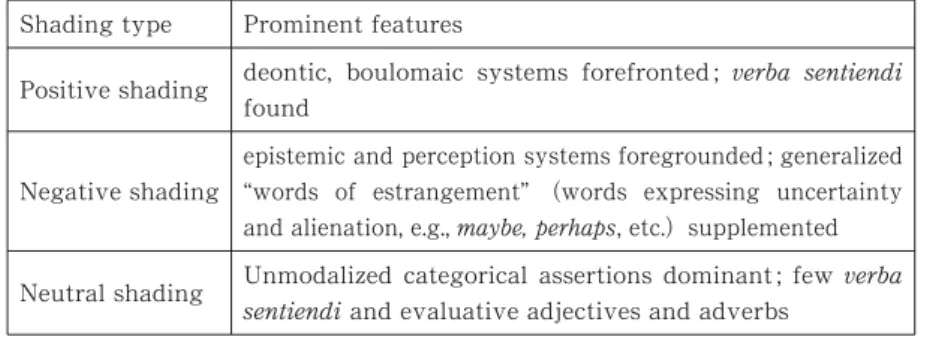
Positive shading stories are stories in which deontic and boulomaic modalities of high values are abundantly used, supplemented by verba sentiendi ῌsee section -.,῍. Hence, the general flow of discourse of this type is binding, obligatory, assertive, and strong. Negative shading stories are characterized by the use of weaker epistemic and perception modalities of low values, and by words denoting alienation and uncertainty ; this creates weaker connotations in discourse as opposed to positive shading stories. Finally, neutral shading stories are stories without modality or modal judgment ; use of verba sentiendi and evaluative adverbs and adjectives is suppressed ; the story is mostly told through “categorical assertions” ῌi.e., “something is or is not”῍ ῌLyons +311: 10-, 2*3῍. Categorical assertions are
“epistemically non-modal” assertions or propositions ῌSimpson +33-:.3῍ and express the strongest degree of a speaker’s commitment to the factuality of the proposition. For example, “it is snowing” is epistemically stronger than the modalized “it must be snowing” ῌLyons, +311: 2*2ῌ2*3῍. As a result, the style of neutral shading stories exhibits an uncommitted and detached connotation. Table -summarizes some distinctive features of each of these three shadings : positive, negative, and neutral ; it is followed by explanations of each of the shading patterns.
Modality and point of view in media discourse ῌ῍ῌ
Category A : Positive shading
Category A positive stories are characterized by the rich use of the high values of deontic and boulomaic modalities of obligation, desire, duties, and opinions ῌwe must..., I want...῍ and evaluative adjectives and adverbs ῌe. g., happily, terrible, meaningfully῍, and verba sentiendi. By contrast, the use of epistemic and perception
systems are rare ῌperhaps, maybe, evidently, might have been῍. In other words, the use of “words of estrangement,” or the more alienating forms of epistemic and perception modality ῌi. e., low-value modality῍, are suppressed ῌSimpson,+33-:/0ῌ/2῍.
Category A : Negative shading
Category A stories with negative shading are characterized by the use of weaker epistemic and perception modalities than are found in Category A stories with positive shading. This type of point of view presents the following linguistic features : epistemic modal auxiliaries, modal adverbs, and modal lexical verbs such as I
Table-. Characteristics of each of the three shading patterns Shading type Prominent features
Positive shading deontic, boulomaic systems forefronted ; verba sentiendi found
Negative shading
epistemic and perception systems foregrounded ; generalized
“words of estrangement” ῌwords expressing uncertainty and alienation, e.g.,maybe, perhaps, etc.῍supplemented
Neutral shading Unmodalized categorical assertions dominant ; fewverba sentiendiand evaluative adjectives and adverbs
ῌSimpson+33-:1/῍ ῌ῎῍
wonder, I think, I suppose; perception adverbs such as evidently, perhaps, apparently; human perception verbs such asit looked like ῌas if῍, it seemed, it appears. Because this type of point of view is internal, “the estrangement devices from within a participating character’s consciousness” signify his/her uncertainty about events or characters in the story ῌSimpson +33-: /2῍ or cynicism toward them.
Category A : Neutral shading
A third Category A story is the one with neutral shading. The criteria for identifying such a story is the absence of narratorial modality, which means that the narrator/reporter holds back subjective evaluation or opinions on events or characters in the story, and tells the story only through “categorical assertions”
that are non-modal propositions in an epistemic sense ῌSimpson +33- : .3῍. There are few uses of verba sentiendi and evaluative adverbs and adjectives. So the style of neutral shading stories in Category A exhibits the “flat, unreflective, cool…and detached”
narration of first person pronouns ῌSimpson+33-:0,,1/῍.
Category B stories
Category B stories are first of all subdivided into two modes : narratorial and reflector. The former implies a viewing position
“outside the consciousness of any of the characters,” while the latter indicates a position that is “mediated through the consciousness of a particular character” ῌSimpson +33-: 0,῍. The
Modality and point of view in media discourse ῌ῎῍
term “reflector” was adopted by Simpson ῌSimpson +33-: //῍ to identify a character whose perspective is expressed in a text. The two Category B modes occur in three shadings : positive, negative, and neutral, producing a total of six types of Category B stories.
Category B : Narratorial mode, positive shading
This type has a lot in common with its Category A counterpart : it has prominent deontic and boulomaic modalities of high values and evaluative adjectives and adverbs. The difference from its Category A counterpart lies in externality ; the narration is in a third-person voice that adopts a position outside the consciousness of any of the characters in the story.
Category B : Narratorial mode, negative shading
This type of narration is documented by “words of estrangement”
and the absence of detailed description of the thought of characters. This narration type has a lot in common with Category A negative stories in that epistemic and perception modal systems are given prominence and a sense of alienation is conveyed with the use of low-value modality. In addition, there are words of estrangement to distance the reader with an external perspective or a modalizer for negative shadingῌFowler+311: 3-ῌ 3/; Weber +323: 31; Simpson +33-: .,῍. Maynard calls them
“quotative explanation markers.” These markers include, for example, “it may be that...,” “it is said that...,” or “it is supposed to be that...” These “quotative explanation” markers express varying
ῌ῎῍
degrees of uncertainty or commitment on the writer’s part regarding the proposition to be made ῌMaynard+33-:,/+῍.
Category B : Narratorial mode, neutral shading
This narratorial mode is the most impersonal, as a narrator uses little or no modalized language ; there are few verba sentiendi or evaluative adjectives and adverbs. It lacks direct description and analysis of the thought and feelings of characters. This corresponds to objective ῌneutral, uninvolved῍ focalization as opposed to subjective or involved focalization ῌRimmon-Kennan +32-:2*῍. This narratorial mode is supposed to be the ideal journalistic style “in terms of its factuality and objective approach” to the events and characters that journalists are trying to describe ῌSimpson+33-:02῍.
Category B : Reflector mode
Unlike Category A stories and Category B stories in the narratorial mode, this type of narration is not directly related to this study. Hence only a brief explanation is given here. Each of the three shadings of Category B reflector mode has much in common with its counterpart in the Category B narratorial mode and Category A stories when it comes to the use of modal expressions. The main difference is clearly that, in Category B reflector mode, the story is narrated in the third person through the consciousness of a reflector ῌSimpson +33-: 03; see the reference for more details῍.
Modality and point of view in media discourse ῌ῎῍
Transitions of perspective
Having explained these types of modes of point of view, I may need to point out that there are cases in which intracategory transpositions or crosscategory transitions of point of view take place within a text ῌSimpson +33-: 10ῌ2-῍. The former suggests a conversion of mode, for instance, from neutral through negative or positive.-῍ The latter implies a moving of perspective from an external to an internal mode or vice versa, such as a shift from Category A positive to Category B narratorial, positive shading.
This can happen because, for instance, the positive modal shading that typifies a Category A positive mode will also be the main characteristic of its equivalent Category B narratorial ῌand reflector῍ positive modes. In the same way, Category A negative mode has estranging modal features in common with Category B narratorial and reflector counterparts. These crosscategorical similarities of the same shading are recognized, at least as far as modal patterns are concerned. Likewise, Category A neutral mode exhibits the flat and cool connotations that are held in common with its Category B narratorial and reflector counterparts. For these reasons, crosscategory transitions can take place. Actually, it would be incorrect to assume that a single text always consists of a single mode of telling throughout. The main aim of this study is rather to show that “a particular mode may dominate a text, contributing perhaps to the special ‘feel’ of the text”
ῌSimpson+33-:2*῍.
ῌ῎῍
.. Application : The use of modal structures in media discourse
The theoretical model and tools presented so far ῌmodality in relation to point of view and style῍ will next be applied to actual media texts. It may be helpful to explain briefly the types of texts that are going to be used in relation to the issues of modality and point of view. Because newspaper genre is supposed to present itself as being neutral and objective, it is generally easy to find texts written in Category B narratorial mode. Among them, the most abundant will be those texts written in Category B narratorial mode with neutral shading. These reports intend to inform readers about events from as objective a perspective as possible. News reports written in the Category B narratorial mode with positive shading inform readers about actions that affect the readers, for example, when governmental decisions are made to obligate certain personnel to do something, or in commentaries in which certain directions or policies are suggested. Category B narratorial mode with negative shading is adopted when the news writer or participants in the news story have uncertainty about the content of the reports. Category A texts, which suggest an internal perspective, may appear in commentary sections in newspapers or magazines. Outside printed media texts, Category A mode with positive shading is particularly used in political speeches or in election campaigns when the speaker is voicing strong opinions on the course of the nation. A complete Category A mode with neutral shading is rather difficult to find in
Modality and point of view in media discourse ῌ῎῍
journalistic discourse because subjectivity easily enters into the construction of personal reports. They may be partially found in witnesses’ reports or ῌjob῍ training reports, for example.
Category A mode with negative shading may also be found in commentary sections of newspapers, for example, when the writer is uncertain or cynical about the propositional content of the report. For the sake of showing typical and relatively easily recognizable examples, this study will present an example of Category A mode with positive shading in the form of an excerpt from a speech by President Bush concerning his policy in Iraq, and two examples of Category B narratorial mode῎one positive, one negative῎found in newspaper reports. Let us now look at these examples.
Sample text of Category A : Positive shading
The following is a portion of the transcript of President George W. Bush’s televised speech “Address to the Nation” broadcast on January +*, ,**1. The speech exhibits various characteristics of discourse written/spoken with an internal point of view of positive shading. In this speech the president sought to justify America’s continued military presence in Iraq and called for people’s support for his policy. The parts relevant to the analysis are underlined.
ῌText+῍
…The situation in Iraq is unacceptable to the American
ῌ῍῍
peopleῌand it is unacceptable to me. Our troops in Iraq have fought bravelybravely. They have done everything we have asked them to do….
It is clearclear that we need toneed to change our strategy in Iraq. So my national security team, military commanders, and diplomats conducted a comprehensive review….
On September the ++th, ,**+, we saw what a refuge for extremists on the other side of the world could bring to the streets of our own cities. For the safety of our people, America mustmust succeed in Iraq.…
We will use America’s full diplomatic resources to rally support for Iraq from nations throughout the Middle East.
Countries like Saudi Arabia, Egypt, Jordan, and the Gulf States need to understandneed to understand that an American defeat in Iraq would create a new sanctuary for extremists and a strategic threat to their survival. These nations have a stake in a successful
successful Iraq that is at peace with its neighbors, and they must
must step up their support for Iraq’s unity government….
The challenge playing out across the broader Middle East is more than a military conflict. It is the decisivedecisive ideological struggle of our time. On one side are those who believebelieve in freedom and moderation. On the other side are extremists
Modality and point of view in media discourse ῌ῍῎
who kill the innocentinnocent, and have declared their intention to destroy our way of life. In the long run, the most realisticrealistic way to protect the American people is to provide a hopefulhopeful alternative to the hatefulhateful ideology of the enemy, by advancing liberty across a troubled region. It is in the interests of the United States to stand with the bravebrave men and women who are risking their lives to claim their freedom, and to help them as they work to raise up just and hopeful
hopeful societies across the Middle East….
Let me be clear : The terrorists and insurgents in Iraq are without conscience, and they will make the year ahead bloody and violent
bloody and violent. Even if our new strategy works exactly as planned, deadly acts of violencedeadly acts of violence will continue῎and we must expect
must expect more Iraqi and American casualties. The question is whether our new strategy will bring us closer to success. I believebelieve that it will….
ῌGeorge W. Bush, “President’s Address to the Nation῎The Liberty,” January+*,,**1῍.῍
In the above example, the point of view implied in the wording is an internal point of view of positive shading rallying the nation to feel an obligation of commitment to the president’s policy.
Here, modality, as a manifestation of the interpersonal function of language, is used as a linguistic device to direct and regulate the behavior of the people. There are uses of first-person pronouns ῌe.
῍῎ῌ
g., I and we, my national security team῍, and high-value deontic modals indicating necessity and obligation such as mustand need to. The expression our enemy suggests the practice of dichotomizingusversusthem, which also confirms the presence of an internal, subjective perspective. Evaluative adjectives or adverbs are abundantly employed, such as brave, bravely, innocent, bloody and violent, successful, realistic, clear, decisive, deadly, hopeful, and hateful. Among these terms, those with a positive connotation are used to refer to us, while those with a negative connotation are employed in reference to them, which ideologically enhance the dichotomizing effect between us and them. In addition, verba sentiendi such as believe, expect, and understand are found. These all are characteristic traits of discourse written/spoken with an internal point of view of positive shading. The use of these linguistic patterns adds to the whole discourse a positive and powerful connotation.
Sample text of Category B : Narratorial mode, positive shading
Next we will see a sample text written in Category B narratorial mode ῌan external perspective῍. Unlike Category A texts, Category B texts are written from a position outside the consciousness of any of the participants in the story, hence a sense of externality is created. Below is an example of a text written in the Category B narratorial mode with a positive shading. As for the use of deontic modality intending to regulate the conduct of readers, this text type has much in common with
Modality and point of view in media discourse ῌ῍ῌ
discourse narrated with Category A positive shading. The difference lies in an externality characterized by the use of objective reference instead of first-person pronouns. The following is a portion of an article on the front page of a newspaper that reports the government’s new policy obliging doctors to give blood transfusions to patients under +/ years of age regardless of parental religious beliefs.
ῌText,῍
“UNDER +/s MUSTMUST BE GIVEN TRANSFUSIONS DESPITE BELIEFS”
A committee comprised of the country’s five medical societies has compiled a draft guideline that stipulates doctors shouldshould perform a blood transfusion during surgery on patients under +/ years of age even if their parents are Jehovah’s Witnesses and refuse it because of a Biblical injunction, it was learned Saturday.
The joint committee started discussing the refusal of blood transfusions by Jehovah’s Witnesses in response to requests from doctors who have said they are troubled about prioritizing either religious freedom or respect for life.
The committee judged that refusing a blood donation for children under +/ who are considered to be immature in
ῌ῎῍
terms of their self-determination capabilities constitutes an abuse of parental rights….
To deal with the refusal of blood transfusions by Jehovah’s Witnesses, a similar guideline compiled in+332by the Japan Society of Transfusion Medicine and Cell Therapy῎then known as the Japan Society of Blood Transfusion῎ stipulates that doctors shouldshould respect a patient’s wishes if he or she is +2 or older. If a patient is aged under +,, however, it said doctors shouldshould prioritize saving lives, including performing a blood transfusion during surgery, even if the child’s parents are against the transfusion….
In the case of patients aged from +/ to +1, the draft guideline said that a blood transfusion shouldshould not be performed if both the patient and their parents reject it.
ῌThe Daily Yomiuri, June,.,,**1῍
The point of view adopted here is external with positive shading.
Unlike Text +, this text is written from a perspective detached from those involved in the story, and so the event is seen from a more objective viewpoint. The text contains deontic modal auxiliaries, must and should, which impose obligation or injunction on doctors, directing them how to deal with this controversial problem. Here, high-value modality of obligation is used. Also, modality functions to regulate the interpersonal
Modality and point of view in media discourse ῌ῎῍
function, by commanding doctors in this case. The fact that the headline “Under +/s must be given transfusions despite beliefs” is in quotation marks, to indicate someone else’s words, may also confirm the external tone of this discourse. There is no use of evaluative or emotive adjectives and adverbs, as were abundantly found in Text +. There are objective references to the names of the groups involved ῌi.e., through third-person narration῍ instead of subjective references ῌsuch asweorthem῍.
Sample text of Category B : Narratorial mode, negative shading
Now we turn to a sample text written in Category B narratorial mode ῌan external perspective῍ of negative shading. This type of mode is characterized by the use of a weaker modality and externality, which is recognized by the adoption of objective references ῌas opposed to the use of we/them/enemy῍ and third-person telling instead of first-person telling. The following is a portion of an article on the front page of a newspaper that reports Christopher Hill, the assistant secretary of state for East Asian and Pacific affairs, commenting on the negotiation process regarding North Korea’s nuclear disarmament.
ῌText-῍
HILL : N. KOREA REACTOR MAYMAY SHUT IN-WKS
North Korea couldcould shut down its plutonium-producing reactor within three weeks, a top U. S. nuclear envoy said
ῌ῎῍
Saturday, after paying a rare visit to the reclusive country.
Christopher Hill, the chief U. S. negotiator at the six-party talks on North Korea’s nuclear programs, also told reporters in Tokyo that the next round of negotiations couldcould begin in early July, before a full shutdown of the Yongbyon reactor.
Hill said the reactor wouldwould be shut down after North Korea and the International Atomic Energy Agency agree on how to monitor the process.
“We do expect this to be soon, probablyprobably within three weeks
…though I don’t want to be pinned down on precisely the date,” Hill said after briefing his Japanese counterpart, Kenichiro Sasae, on the outcome of his two-day surprise trip to Pyongyang.
North Korea’s official Korean Central News Agency described the talks as “comprehensive and productive” on Saturday.
The trip, the first by a high-ranking U. S. official since October ,**,, came amid growing optimism that North Korea mightmight finally be ready to take concrete steps toward fulfilling a promise to dismantle its nuclear programs.
Modality and point of view in media discourse ῌ῎῍
Hill cautioned that shutting down the reactor was just a first step.
“Shutting down the reactor won’t solve all our problems, but in order to solve our problems we need toneed to make this beginning,” he said. “We really think this is the time to pick up the pace.”
ῌThe Daily Yomiuri, June,.,,**1῍
The point of view adopted in the discourse is external with negative shading. There is no use of deontic modals such as must or should to give a strong sense of commitment, as in Text + in particular. Instead, there is a use of such weaker epistemic modal auxiliaries as may or might and a word of estrangement,probably, which distances the reader, with the use of an external perspective. This is because of uncertainty or commitment on the part of Mr. Hill and the reporter as to the proposition to be made.
The relative reliability of information concerning North Korea and its policy is generally shaky. For these stylistic effects, some level of objectification of the propositional content is realized. The use of quoted speeches also supports the idea of the presence of an external point of view. However, in the final paragraph of this text, an intracategory transposition, or a shift from negative to positive shading, takes place. This may be recognized by the presence of need to denoting obligation as in Hill’s quoted words,
“we need to make this beginning…” At this point appears an
ῌ῎῍
evaluative adverb really and the first person pronoun we, in “We really
really think this is the time to pick up the pace,” which are characteristic of an external, positive-shading discourse.
/. Conclusions
This paper was aimed at investigating the subject of modality as related to point of view. Modality is interpreted fairly broadly here as a speaker’s means of expressing an attitude toward the propositional content of the utterance he or she makes. Point of view expresses a particular way of conceiving and representing the world. This study is intended to show that a certain mode and perspective may govern a text, in such a way that they give a particular “feel” or “color” to the text. To demonstrate that the distinctive patterns of modality and point of view are adopted in media discourse to give a certain tone to the text, three texts were presented as illustrations, one from a political speech and two from newspaper articles. President Bush’s speech concerning his policy toward Iraq, as an example of a political speech, is based on Category A positive-shading narration. The speech uses frequent high-value deontic modality and emotive terms with first-person narration, to express an assertive attitude to regulate the course of the nation. It is confirmed that modality, as a realizer of the interpersonal function of language, may be used as a linguistic tool to direct and control the behavior of the people.
The newspaper article concerning the government’s new policy legalizing blood transfusions for children under +/, written from a
Modality and point of view in media discourse ῌ῎῍
Category B narratorial, positive shading, also uses frequent high-value deontic modality, but with almost none of the emotive kind of terms used in the president’s speech. The text is written from an external point of view based on third-person narration, with the use of quotation mark for reported speeches. Hence, despite the modal similarity ῌpositive shading῍ with the president’s speech, its connotations differ. The final example, a newspaper article on Mr. Hill’s report of negotiations regarding North Korea’s nuclear disarmament, is written in Category B narratorial, negative shading, and contains quite different discoursal and modal patterns from the first two examples. In this article, lower-value epistemic and perception systems are forefronted, to which are added words of estrangement. It conveys a lower degree of certainty and commitment on the writer’s part in regard to the propositional content. There is, however, an intracategorical shift of point of view῎from negative to positive shading῎in the latter portion of the text, as corroborated by the use of deontic modality when Mr. Hill wants to express his policy from that point of time onward. It seems safe to conclude, then, that modality, point of view, and the “feel” of a text are closely related, as shown by the above analysis of these illustrative texts.
Notes
+῍ These two terms are distinguished by other terms such as epistemic/root ῌHofmann +313῍, modalization/modulationῌHalliday+31*῍, epistemic/cognitive ῌOta+31,῍, and ῌ῎῍
secondary/primaryῌClose+31/῍.
,῍ These are mental process verbs in transitivity, to use Halliday’s termsῌHalliday +33.῍.
-῍ Simpson argues that the intracategorical mode shift from neutral through negative or positive is easier to execute than the move from positive or negative through neutral shadingsῌsee Simpson+33-:13for details῍.
.῍ The script of the speech is drawn from the White House’s homepage : http :῎῎www.
whitehouse.gov῎news῎releases῎,**1῎*+῎,**1*++*-1.html.
References
Carter, R. and P. Simpson ῌeds.῍ ῌ+323῍. Language, Discourse and Literature. London : Unwin and Hyman.
Close, R. A.ῌ+31/῍.A Reference Grammar for Students of English. London : Longman.
Coates, J.ῌ+32-῍.The Semantics of Modal Auxiliaries. London : Croom Helm.
Facchinetti, R., M. Krug, and F. R. Palmerῌeds.῍ ῌ,**-῍. Modality in Contemporary English. Berlin : Mouton de Gruyter.
Fowler, R.ῌ+311῍.Linguistics and the Novel. London : Methuen.
Genette, G.ῌ+32-῍. Narrative Discourse : An Essay in Method. New York : Cornell University Press.
Halliday, M. A. K.ῌ+31*῍. “Functional Diversity in Language, As Seen from a Consideration of Modality and Mood in English.” Foundations of Language,0:-,,ῌ 0+.
Halliday, M. A. K.ῌ+310῍.System and Function in Language. Ed. G. Kress. London : Oxford University Press.
Halliday, M. A. K.ῌ+33.῍.An Introduction to Functional Grammar. Second edition. London : Edward Arnold.
Halliday, M. A. K. and R. Hasanῌ+323῍.Language, Context, and Text : Aspects of Language in a Social-Semiotic Perspective. Second edition. Oxford : Oxford University Press.
Hofmann, T. R.ῌ+313῍. “On Modality in English and Other Languages,” in Papers in Linguistics,+,:+ῌ-1.
Lyons, J.ῌ+311῍.Semantics,. Cambridge : Cambridge University Press.
Modality and point of view in media discourse ῌ῍῍
Maynard, S.ῌ+33-῍.Discourse Modality : Subjectivity, Emotion and Voice in the Japanese Language. Amsterdam : John Benjamins.
Ota, A.ῌ+31,῍. “Modals and Some Semi-auxiliaries in English.”The ELEC Publications,3: .,ῌ02.
Palmer, F. R.ῌ+313῍.Modality and the English Modals. London & New York : Longman.
Palmer, F. R.ῌ+320῍.Mood and Modality. Cambridge : Cambridge University Press.
Palmer, F. R.ῌ+33*῍.Modality and the English Modals. Second edition. London : Longman.
Palmer, F. R.ῌ,**+῍. Mood and Modality. Second edition. Cambridge : Cambridge University Press.
Palmer, F. R.ῌ,**-῍. “Modality in English : Theoretical, Descriptive, and Typological Issues,” in Facchinetti, R., M. Krug, and F. R. Palmerῌeds.῍,+ῌ+1.
Rimmon-Kennan, S.ῌ+32-῍.Narrative Fiction : Contemporary Poetics. London : Methuen.
Simpson, P.ῌ+33-῍.Language, Ideology and Point of View. London : Routledge.
Tatsuki, M.ῌed.῍ ῌ,**0῍. Kotaba wa Ikiteiru ῌLanguage is Living῍. Tokyo : Kuroshio Publishers.
Uspensky, B.ῌ+31-῍.A Poetics of Composition, translated by Valentina Zavarin and Susan Wittig. Berkeley : University of California Press.
Weber, J.ῌ+323῍. “Dickens’s Social Semiotic : The Modal Analysis of Ideological Structure,” in Carter, R. and P. Simpsonῌeds.῍,3.ῌ+++.
῍ῌῌ