tin mining in Bangka‑Belitung province of Indonesia
著者(英) Yoshihiko Wada
journal or
publication title
The Social Science(The Social Sciences)
volume 48
number 2
page range 187‑211
year 2018‑08‑31
権利(英) Institute for the Study of Humanities & Social Sciences, Doshisha University
URL http://doi.org/10.14988/pa.2018.0000000239
《NOTE》
Social, Environmental and Health Impacts of Tin Mining in Bangka-Belitung Province of Indonesia
Yoshihiko WADA
There have been tin mining activities in Bangka-Belitung Province of Indonesia since early 18th century. At that time, this region was part of the Palembang Sultanate. Chinese (Hakka) immigrant workers have played a significant role in carrying out mining activities. Tin industry has provoked socio-political changes in the region, including increased inflow of immigrant workers and extended economic control of the region by foreign economic and political powers. Tin development also has caused serious environmental and social problems. For example, waste sand from mine sites and tailings from tin smelters contain various toxic substances such as arsenic, and radioactive thorium and uranium, which can be risks to human health if not managed adequately. Off-shore tin mining has become one of the causes of degradation of ecosystems and decline in fisheries.
Palm oil production in Indonesia has increased rapidly in recent years. Bangka- Belitung Province is not an exception. Studies and my findings have shown that the soils in the oil palm plantations located adjacent to tin mines (and on granite) contain more toxic substances compared to the plantations located away from tin mines. However, oil palm fruits did not contain thorium and uranium.
People living on granite areas may be more prone to risks of contracting cancer and other radiation-related diseases. In order to reach conclusions, further research is necessary.
Radioactive substances from tin smelters, as well as leakage from tailing storage facilities may have been causing health damage to the residents. Provincial scale epidemiological study is urgently necessary.
1 Introduction
1.1 Problem Statement
Bangka-Belitung Province of Indonesia was part of the Sumatera Selatan Province until 2000. Bangka-Belitung Province was newly formed then. The province has population of 1,430,865 (estimated for Year 2017, based on Census 2010) (Statistics of Kepulauan Bangka Belitung Province 2018). In this province there are 470 islands, of which only 50 are inhabited. There are two main islands, namely, Bangka and Belitung Islands. This province is well-known for its production of white pepper, bitter honey, as well as fisheries, and tourism industry.
This province is distinctive from the rest of the country in terms of extensive production of tin. Indeed, there have been tin mining activities in this region since early 18th century, more specifically, since 1709, or 1710, or 1711 when tin mineral vein was believed to have been discovered (Schuurman, 1898). At that time, this region was part of the Palembang Sultanate. The Sultan had the exclusive power of controlling tin production.
Tin industry has provoked significant socio-political changes in the region, including increased inflow of immigrant labors and extended economic control of the region by foreign economic and political powers. For example, Chinese (Hakka) immigrant workers have played a significant role in carrying out tin mining and refining activities. Vereenigde Oostindische Compagnie (Dutch East India Company, VOC) had the exclusive business right for trading tin products with the rest of the world. Toward the end of the 18th Century, VOC was dissolved and Bangka Island was occupied by the British. Then the British East India Company (EIC) controlled tin production until 1816 when the island was returned to the Dutch.
This region has gradually become one of the world largest tin producers. Especially since late 1970s, tin production in Malaysia has shown gradual decline. On the contrary, tin production in Indonesia has gradually increased its relative importance in the global tin market. Indeed, Indonesia surpassed Malaysia in tin production in 1990 (U. S. Bureau of Mines 1990).
Tin development has caused serious environmental and social problems in the
region. For example, abandoned tin mines cover 1,053,253 hectares which is equivalent of 64.12% of the total land area of the province (Friends of the Earth Indonesia [WALHI] 2014). This resulted in the loss of living spaces for local people and the loss of agricultural and forest land. Waste sands and polluted water from mine sites and tailings (residues) from tin smelters contain various toxic substances such as arsenic, and radioactive thorium and uranium which can be risks to human health.
In recent years, coastal and off-shore tin mining has become one of the causes for degradation of marine ecosystems and decline in fisheries (Nurtjahya et al. 2015, Nurtjahya et al. 2017). An issue of child labor in on-shore and off-shore tin mining activities has been noticeable (Friends of the Earth Indonesia [WALHI] 2014).
Oil palm production in Indonesia has increased rapidly in recent years. Its production has become the world largest, surpassing Malaysia since 2009. Bangka- Belitung is not an exception. I witnessed that there are so many oil palm plantations located adjacent to tin mine sites or abandoned tin mine sites. Then, I suspected that some of the oil palm plantations had been built on top of abandoned tin mine sites.
This concern turned out to be true. According to a local scholar, Ibrahim of the University of Bangka-Belitung, it is often the case that abandoned tin mine sites are transformed into oil palm plantations (Ibrahim 2017). This is worrisome, since waste rocks and sand from tin mining activities contain various toxic substances, as mentioned above. Plantation workers, nevertheless, take care of the trees and harvest fruits without protection against dust, which may be harmful to their health.
So far, some studies have been carried out on environmental and social impacts of tin mining in the Bangka-Belitung Province. For example, Friends of the Earth Indonesia [WALHI] (2014) highlights various problems caused by tin mining activities, such as the loss of forest and agricultural land, and the prevalence of illegal child labor, frequent occurrence of mining accidents, and so on. Another study by academics addresses such problems as increased social conflicts, decreased environmental stability, degraded water quality, and loss of biodiversity, and so on (Nurtjahya et al. 2017). There is a unique study from the radiological point of view.
Scientists measured and evaluated the exhalation rates of gaseous radioactive
substances, namely, radon and thoron from surface soil of Bangka-Belitung Islands (Syarbaini and Pudjadi 2015).
However, these studies grasp and describe only partial pictures. Also, these studies do not address the health effects of excess exposure to radiation and other kinds of toxicity in sufficient manners. Tin mineral deposits/ores (granite and monazite, etc.) usually contain radioactive substances such as Thorium 232 (232Th), and Uranium 238 (238U). Other toxic substances (e.g. arsenic) are also included in the deposit. Without careful and proper management of wastes and without adequate protection, the health of tin mine and smelter workers as well as residents living nearby will be severely affected. Friends of the Earth Indonesia [WALHI] (2014) describes the health impacts of mining. However, it does not present the details of occurrence of tumor and cancer which are common diseases caused by excessive exposure to radiation and/or inhalation of radioactive substances.
1.2 Purposes of the Study
In this study I intended to grasp the reality of social and environmental impacts of tin mining industry (both on-shore and off-shore) in more comprehensive manners, based on scientific evidences. Especially, I intended to focus on the followings.
(1) Environmental impacts on fisheries by coastal and off-shore tin mining
(2) Environmental impacts on soil and water which are adjacent to tin mine sites and smelters
(3) Health impacts on workers working on palm oil plantation, and local residents
1.3 Research Method
(1) Visited Bangka-Belitung Province three times (February 26 - March 9, 2015, August 30 – September 8, 2015, and August 30 - September 8, 2016).
(2) Collected statistical data and information, documents at the governmental organizations.
(3) Interviewed residents, patients, workers of tin mines/smelters as well as oil palm plantations.
(4) Interviewed the Head of the Health Department of the Province, and medical
doctors.
(5) Collected sand and water samples, and Dr. Takao Fukumoto of Osaka University Graduate School of Sciences, Department of Chemistry conducted analysis of these samples.
1.4 History and Current Status-quo of Tin Production in Indonesia and the World
Bangka-Belitung Islands lie in Sunda peneplain. Geologically speaking, distribution of tin ore in Indonesia is a continuation of granitic belt of Jurassic to Cretaceous which consists of cassiterite series including granite. This belt is also called the “tin belt” which extends from Burma, Thailand, Malaysia, Riau Islands, Bangka, Belitung to Karimata Islands (IAEA 2011).
History of tin production in the region started when a vein (deposit) of tin was discovered. It is widely believed that the discovery was around 1709. The Palembang Sultan had the exclusive power over tin production. Vereenigde Oostindische Compagnie (VOC) had obtained the exclusive business right in exporting tin products to the rest of the world from the Palembang Sultanate after negotiation. Chinese (Hakka) immigrant workers have played an important role in tin production.
In the middle of the 19th Century, demand for tin increased drastically. This is due to the emergence of canning industry and increased popularity in the usage of canned food not only by solders in battle fields, but also by ordinary households (Kano 2014).
The second big wave arrived at the beginning of the 20th Century upon an arrival of a new industry, namely, electrical industry which requires a large amount of solder.
Tin is primary material for solder.
Before the Second World War, Malaysia (“Malayan Union” at that time) had long been the world largest tin producer (56,837 tons per annum on average during 1925- 1929). During the same period, Indonesia produced 33,266 tons per annum on average
(See Figure 1). After the WWII, Malaysia continued to be the top tin producer until China took over the first position in 1989 (China: 40,000 tons, Malaysia: 32,034 tons).
Since late 1970s, tin production in Malaysia has shown gradual decline. At the same time, Indonesian tin has slowly increased its production. Indonesia surpassed Malaysia in tin production in 1990, becoming the second largest tin producer after
China (i.e., China: 42,000 tons; Indonesia: 30,200 tons; and Malaysia: 28,468 tons (U. S.
Bureau of Mines, 1990).
In 2015, China produced 110,156 tons (ranking the first), while Indonesia produced 52,000 tons (ranking the 2nd), and Malaysia produced only 3,800 tons (ranking the 10th) (See Table 1). In that year, approximately one sixth (18%) of the world tin
production came from Indonesia (See Table 1). 90% of that come from Bangka- Belitung Province.
The land area of this province is 1.6 million ha. The total area of mining concession accounts for 75% of total area of the Province (Friends of the Earth Indonesia [WALHI] 2014). Most of tin production in Bangka-Belitung is conducted by a quasi- governmental corporation namely PT. Timah. PT. Timah is a private entity. However, 55% of its financial capital is owned by the Indonesian Government. There exist a
number of small scale miners. Most of them are illegal miners who have no mining permits.
Figure 1 Long-term Trend in Tin Mine Production (Malaysia, Indonesia, China)
Sources: USGS Minerals Yearbook (multiple years), U. S. Bureau of Mines.
56,837 61,244 63,670 64,364 36,884
6,402
2,857 3,800 33,266 33,368
14,699 25,337
21,759
38,378 80,000
52,000
7,085 11,500 25,000
22,000 15,000
61,900 126,000
110,156
- 20,000 40,000 60,000 80,000 100,000 120,000 140,000
1925-1929 Average
1955 1965 1975 1985 1995 2005 2015
Malayan Union/Malaysia Netherland Indies/Indonesia China (Ton)
2 Environmental and Social Impacts of Coastal and Off-shore Tin Mining
2.1 Impacts to Fisheries
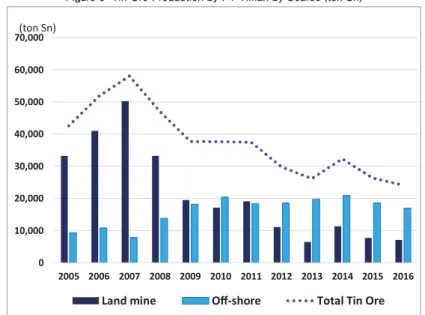
In recent years, the accessible reserve of tin on land in Bangka Island is declining.
Alternatively, coastal and off-shore mining has shown gradual increase. This method of tin mining is through excavation and suction of sea-bed sand.
The next map (Figure 2) illustrates areas of mining concessions in Bangka- Belitung Islands both on land and in ocean.
Table 1 World Tin Mine Production by Country
(Metric tons, tin content)
Country 2011 2012 2013 2014 2015
World Share in 2015
World Ranking
in 2015
Chinae 120,000 110,000 97,000 104,000 r 110,156 4 38.1% 1
Indonesia 89,600 r 44,202 r 59,412 r 51,801 r 52,000 e 18.0% 2
Burma3 11,000 e 10,600 17,000 30,000 r 34,271 11.9% 3
Brazil 10,725 13,667 16,830 25,534 r 25,000 8.7% 4
Bolivia 20,373 19,702 19,282 r 19,802 r 20,000 6.9% 5
Peru 28,882 26,105 23,668 23,105 19,511 6.8% 6
Australia 14,014 6,158 6,472 6,900 r 7,000 2.4% 7
Congo (Kinshasa)e 5,600 4,800 4,500 4 6,500 6,400 2.2% 8
Vietname 5,400 5,400 5,400 5,400 5,400 1.9% 9
Malaysia 3,340 3,725 3,697 3,777 3,800 1.3% 10
Total 315,000 r 249,000 r 260,000 r 285,000 r 289,000 100.0%
e Estimated. r Revised. NA Not available. ― Zero.
1 Totals and estimated data are rounded to no more than three significant digits; may not add to totals shown.
2 Includes data available through May 24, 2017.
3 Includes content of tin-tungsten concentrate.
4 Reported figure.
5 Tin content is estimated as 62% of reported gross weight concentrate.
Source: USGS Minerals Yearbook 2015, https://minerals.usgs.gov/minerals/pubs/commodity/tin/
Last accessed on February 12, 2018.
The next (Figure 3) is a photo of a special boat, called Pontoon, for suction of sea- bed sand, owned by small-scale coastal tin miners.
The following figure shows a medium size excavation ship which came from Thailand (12 workers on board). Two other similar type ships are also under operation. All of them obtained permits from the Indonesian and Bangka-Belitung Governments.
Figure 2 Location of Mining Concessions
Source: Friends of the Earth Indonesia [WALHI] 2014, p.5, Map 1.
Figure 3 Pontoon, Owned by Small-scale Coastal Tin Miners
Photo by Y. Wada,March 4, 2015, near Sampur, Eastern part of Bangka Island
The official concrete data were difficult to obtain as to how much tin ore is produced from tin mines on land, and how much from the off-shore mine in the province as a whole. Thus, I depended on the data of PT Timah. As the following Figure 5 shows, tin production from mines on land is in decline, while off-shore mining has been almost steadily increasing at least until 2014 (PT Timah 2008, 2010, 2015, 2016).
Figure 4 A Medium size Excavation Ship from Thailand
Photo by Y. Wada, September 5, 2016, near Rebo, Northwestern part of Bangka Island.
Figure 5 Tin Ore Production by PT Timah by Source (ton Sn)
Sources: TP Timah (2008, 2010) Annual Reports 2008, 2010. Pt Timah. (2015, 2016) Integrated Reports 2015, 2016.
0 10,000 20,000 30,000 40,000 50,000 60,000 70,000
2005 2006 2007 2008 2009 2010 2011 2012 2013 2014 2015 2016
Land mine Oī-shore Total Tin Ore (ton Sn)
Official statistics on fisheries show that the amount of fish caught and sold in auction market places in Bangka-Belitung Province has shown a rapid decline in 2014 as illustrated in Figure 6 (Badan Pusat Statistik [BPS], Statistics Indonesia 2018).
In order to understand what is happening to the economic life of fishers, I conducted interviews with the coastal fishers in September, 2016. I asked how their businesses had been. Their accounts confirmed the validity of the above mentioned statistics of decline of fish catch. They testified that the fish catch and their income are on rapid decline.
For example, Anonymous-a (2016), the leader of Tempilang Fisheries Cooperatives orally reported that their income was decreased by 84% on average between the period of 2011-2013 and 2014-2016 (See Figure 7). He also added that not only the quantity, but also the quality of fish has deteriorated (i.e., bad smell, etc.)1). Anonymous-b (2016), the Rebo Village Community leader testified that Rebo fishersʼ average monthly income between 2014 and 2016 went down to 38 to 25 percent of the income before 2013 (See Figure 7)2).These two testimonies are consistent with the
Figure 6 Sea Fishery Production Sold at Fishing Auction Places in Bangka-Belitung Province, Indonesia 2004-2016 (Ton)
Source: Badan Pusat Statistik [BPS], Statistics Indonesia 2018, January 12, 2018 https://www.bps.go.id/dynamictable/2018/01/12/1278/produksi-perikanan-laut-yang- dijual-di-tpi-menurut-provinsi-2004-2016.html Last accessed on February 14, 2018.
4,387
5,780 5,861
7,771 7,594 6,608
8,834 6,887
8,462 16,970
1,439 1,242 2,937
0 2,000 4,000 6,000 8,000 10,000 12,000 14,000 16,000 18,000
2004 2005 2006 2007 2008 2009 2010 2011 2012 2013 2014 2015 2016 (ton)
situations in other several parts of the province reported in Nurtjahya et al. (2015).
These negative impacts of mining on fisheries seems very significant. The group of fishers from Tempilang went all the way to the capital and met with the Governor on September 5, 2016 in order to request that some effective measures should be installed.
There are several possibility of causes for the decline of fish catch. First of all, the sediments from off-shore tin mining is causing the death of coral reef. According to Indra, a marine scientist at the Coral Reef Exploration run by the University of Bangka-Belitung states that approximately 60-70% of Bangkaʼs coral reefs have died and the condition of the coral reef is getting worse as mining becomes more widespread (TFT 2014). Newell et al. (2004) studied the impacts of off-shore mining in a different context, i.e., off the south coast of the United Kingdom. They concluded that the removal of aggregates has significant impacts on benthic marine organisms and seabed morphology.
Another possible cause is the loss of mangrove forests on the shore due to
Figure 7 Monthly Household Income of Fishers in Bangka Island
Sources: Interviews conducted by the author on September 4 and 5, 2016 0
2,000,000 4,000,000 6,000,000 8,000,000 10,000,000 12,000,000 14,000,000
Low value High value Average Low value High value Average Low value High value Average Low value High value Average
2011-2013 2014-2016 2011-2013 2014-2016 Tempilang Village Rebo Village (Indonesian Rupiah)
expansion of tin mine sites. Suci Puspita Sari et al. (2016) detected through the use of GIS imaging technic that in sub-district of Toboali and Tukak Sadai in Bangka Island, the mangrove forest was lost significantly by 57% in 17 years (Year 1997- Year 2014) because of expansion of costal tin mine sites. Mangrove forests are considered to
be cradles for juvenile and small scale fish species. It is suspected that the loss of mangrove forests is a vital cause of fisheries resource decline.
It may be too early to jump to a conclusion. However, it is highly likely that increased efforts of coastal and off-shore tin mining activities are causing negative impacts to fisheries and marine ecosystems.
2.2 Accident of Workers Engage in Coastal and Off-shore Tin Mining
Coastal and off-shore tin mining is a risky work. Especially, small scale mining operations on pontoon can be extremely dangerous. The number of casualties due to mining-related accident goes from 50 to100 each year ([WALHI] 2014)3). Causes of accidents are (1) arms being sucked into sucking hoses, as well as (2) landslide in the sea-bed, and (3) hypothermia due to cold sea water.
3 Impacts of Tin Mining on Oil Palm Plantations
3.1 Contamination of Soils in Oil Palm Plantations
Travelling through Peninsula Malaysia and through Bangka-Belitung Islands, I have witnessed that former tin mining areas have been utilized for the production of vegetables, oil palm, as well as for aquaculture. I was concerned that radionuclides such as Thorium and Uranium contained in residues of tin mining may be giving negative impacts to health of the farmers and workers on these areas and/or residents surrounding these areas through both external exposure and internal exposure of radiation (via inhalation).
I was also worried about high level of gamma ray in hotel rooms in Ipoh City, State of Perak of Malaysia. I stayed in several different hotels in that city and I noticed that radiation levels in all hotels were much higher than normal. I was concerned that residents and visitors in that city were exposed to higher level of gamma ray
emmitted from building materials. It was suspected that building materials contained residues left on tin mining areas which usually have higher level of radiation compared with non-mining areas.
My concerns were even further triggered by a notorious incident of environmental contamination which took place in Bukit Merah Village near Ipoh City, Malaysia between 1982 and 1994, i.e., the Asian Rare Earth (ARE) Incident. The ARE is a Malaysian company affiliated with a large Japanese chemical company, Mitsubishi Kasei Co., Ltd. which produced rare earth minerals. For the production of rare earth materials, they utilized waste materials generated in the refining process of tin (monazite, and so on). AREʼs waste management was extremely inadequate.
Radioactive waste was illegally dumped to nearby ponds and/or roadsides, etc. The impact was so significant that the health of the factory workers and residents who lived near the factory was severely affected (Wada 2015). To make the matters worse, we have discovered that there still exist some sites which have not been decontaminated even now (more than 30 years after the incident took place).
Survivors and their families are demanding that ARE and Mitsubishi Chemical Company should clean up those sites as soon as possible in order to prevent the further health damage (Wada et al. 2017).
Also, I was concerned that vegetables and oil palm fruits produced on former tin mine sites may have been contaminated with radionuclides, risking the health of consumers arising from the ingestion of products using those vegetables and fruits.
A radiological study addressed these concerns (i.e., whether soils are polluted, and whether there is health risk from ingestion of agricultural products) (Solehah, et al.
2017). Their study analyzed soils and vegetables at former tin mining areas and those
at non-mining areas in Peninsular Malaysia. The study concluded that vegetables planted at both areas would not pose any significant radiological impact to the population, despite the higher concentration of radionuclides in soil. However, the study only analyzed 226Ra (radon), 232Th (thorium) and 40Ka (potassium), and did not analyze other toxic substances such as cadmium and arsenic.
Thus, I tried to fill the gap using the cases in oil palm plantations in Bangka- Belitung Province of Indonesia. I had opportunities of visiting several oil palm
plantations in Bangka-Belitung. The first site, named “Oil Palm Plantation 1” is located in a suburb of Muntok in West Bangka. A number of tin mine sites are scattered in Muntok and its vicinity. This plantation is located adjacent to a tin mine site. It is highly possible that this plantation was built on an ex-tin mine site. Gamma ray measurement was 0.26 micro Sv/hour (5 times higher than background level). I collected soil samples near the oil palm trees.
The second case is named “Oil Palm Plantation 2” which is location near Tempilang, West Bangka. The site is far away from tin mine sites. I was certain that this plantation was not built on ex-tin mine site. This plantation is the only certified site in the Province by the Roundtable on Sustainable Palm Oil (RSPO), at least when I visited. RSPO is a not-for-profit organization which unites stakeholders from the seven sectors of the palm oil industry, i.e., oil palm producers, processors or traders, consumer goods manufacturers, retailers, banks/investors, and environmental and social non-governmental organizations (NGOs), to develop and implement global standards for sustainable palm oil (RSPO webpage).
Figure 8 presents results of soil sample analysis. Soil samples from Plantation 1 (an ex-tin mine site) contained far more toxic substances compared to those from Plantation 2.
Figure 8 Results of Soil Sample Analysis (ppm)
Thorium: EUʼs standard for building materials: 49 ppm Uranium: Canadian Standard(Residential Area): 23 ppm
Soil samples were collected on March 2 and March 5, 2015 by the author. Soil analysis was conducted by Dr. Takao Fukumoto of Osaka University Graduate School of Sciences, Department of Chemistry.
0.00 20.00 40.00 60.00 80.00 100.00 120.00 140.00 160.00 ppm
Ina River, Osaka, Japan
Oil Palm PlantaƟon 1
Sapmle 1
Oil Palm PlantaƟon 1
Sapmle 2
Oil Palm PlantaƟon 2
Sapmle 2
Oil Palm PlantaƟon 2
Sapmle 2
Arsenic (As) 5.75 16.50 141.00 14.90 18.90
Thorium (Th) 4.36 65.50 69.20 7.10 7.75
Uranium (U) 0.82 3.14 5.41 1.49 0.47
Arsenic (As) Thorium (Th) Uranium (U)
The soil samples from Oil Palm Plantation 1 contained thorium concentration of 65.50 ppm and 69.20 ppm respectively, both of which are higher than EUʼs safety
standard of thorium for building materials i.e., 49 ppm. Also, concentration of arsenic was also very high. The soil in this plantation seems to present health risks to plantation workers. We need to carry out further research on this topic urgently.
3.2 Safety of Palm Fruits
I was concerned whether palm fruits may contain radioactive and toxic substances which present risks to consumers. Several palm fruits samples were analyzed. Table 2 presents the results of sample analysis.
Good news is that radioactive substances such as thorium and uranium were not detected in the palm fruit samples. On the contrary, concentration of strontium (radioactive) was not so low. Cadmium was also detected. These may be health risk for consumers. I tried to find out the safety standards for strontium and cadmium, but in vain so far.
Table 2 Results of Analysis of Oil Palm Fruits (ppm)
F1 F2 F3 F4
Titanium (Ti) 56 43 53 44
Manganese (Mn) 364 466 306 190
Iron (Fe) 236 241 261 240
Copper (Cu) 6.2 9.6 45 23
Zinc (Zn) 42 26 37 37
Strontium (Sr) 484 179 181 91.00
Molybdenum (Mo) 0.52 0.56 0.43 0.46
Silver (Ag) 0.66 0.27 0.57 0.22
Cadmium (Cd) 0.069 0.017 0.027 0.018
Concentration analysis was conducted by Dr. Takao Fukumoto of Osaka University Graduate School of Sciences, Department of Chemistry.
4 Health Impacts of Tin Mining on the Residents, and Palm Plantation Workers
4.1 Arsani Hospital Patients Data
Bangka-Belitung is more prone to the publicʼs excessive exposure to radiation because of the extensive tin deposits as well as tin mining activities prevalent in the province, compared with other provinces in Indonesia.
As mentioned in Section 1.1, a study by Syarbaini and Pudjadi (2015) underscores this point. They analyzed 222Rn (radon) and 220Rn (thoron) exhalation rates from surface soil of Bangka - Belitung Islands. They examined air samples from 36 measurement sites by using an accumulation chamber equipped with a solid-state alpha particle detector. They concluded that Bangka Belitung Islands have the 222Rn and 220Rn exhalation rates twice higher than the world average value for the regions with normal background radiation. That means that generally speaking residents there are exposed more health risks than the world average.
Naturally, I had expected that the health authorities and medical circles as well as residents would be interested in protecting themselves against diseases associated with radiation exposure, such as cancer, leukemia and congenital diseases. However, I was shocked to know that there is no system of Cancer Registration in Bangka- Belitung. Medical doctors and the Department of Health do not have concrete data on occurrence of cancer and other radiation-related diseases.
This is because the highest priority of the country in terms of public health is placed on infectious diseases, such as malaria and dengue fever. Cancer and congenital abnormalities are low in priority in Indonesia (Maryano 2016). Academic research on this topic is limited so far. Even above-mentioned study (Syarbaini and Pudjadi 2015) does not discuss concrete impacts of radon and thoron gasses on the health of residents of the Province.
In order to fill the gap, I asked Dr. Benedicta, the Head of Arsani Hospital in Sungailiat for a list of cancer patients in September 2016. Dr. Benedicta kindly offered date on cancer patients, thanks to help of Dr. Maryono, Head of Provinceʼs Health Department. In fact, this hospital is the only hospital in Bangka Island which owns a
CT scanner. So, it seems safe to infer that almost all the cancer patients come to this hospital for diagnosis and treatment, according to Dr. Maryano (2016).
A list of cancer patients who have been hospitalized at Arsani Hospital between 2015 and 2016 was provided from Dr. Benedicta. The following attributes of each
patient were provided: initials of names, age, gender, occupation, origin (name of village, township, city where his/her home is located), and diagnosis. Following is the list. The initials of names were excluded herewith in order to protect privacy.
Table 3 List of Data of Inpatients, ICU & HCU Patients at Arsani Hospital in 2016 & 2015
No Age Sex Occupation Origin Diagnose
1 68 Male Retired tin worker Deniang, Bangka○ Multiple Cerebral Tumor 2 77 Female Housewife Lubuk Pabrik, Bangka○ Breast Cancer std V
3 26 Male No data Parit padang, Bangka○ Annorectal Carsinoma
4 66 Female Housewife Jebus, West Bangka○ Breast Cancer std IV
5 55 Male No data Baturusa, Bangka Nasopharynx Carcinoma
6 56 Male No data Baturusa, Bangka Nasopharynx Carcinoma
7 80 Male Retired tin worker Sungailiat, Bangka○ Lung Cancer 8 53 Female Housewife Sungailiat, Bangka○ Endometrium Carcinoma 9 53 Male No data Sungailiat, Bangka○ Gastric Cancer Metastasis
10 24 Female Housewife Matras, Bangka○ Breast Cancer
11 80 Female Housewife Sungailiat, Bangka○ Mediastinal Tumor
12 57 Female Housewife Kenanga, Bangka Ovarium Carcinoma std IV
13 68 Male Retired palm
farmer Kelapa, West Bangka○ Lung Cancer std IV
14 48 Female Housewife Sinar Jaya, Bangka Cervix Cancer
15 51 Male No data Bangka Vesica Urinaria Carcinoma
16 47 Female Housewife Sungailiat, Bangka○ Uterus Carcinoma
17 65 Male Retail Sungailiat, Bangka○ Lung Cancer std IV
18 43 Female Housewife Belinyu, Bangka○ Ovarium Carcinoma std IV 19 42 Female Gov.Officer Sungailiat, Bangka○ Breast Cancer residif 20 64 Female Housewife Sungailiat, Bangka○ Nasopharynx Carcinoma std IV
21 58 Male No data Kelapa, West Bangka○ Anal Carcinoma
22 63 Male No data Belinyu, Bangka○ Lung Cancer
23 68 Female Housewife/
fishermowan Sungailiat, Bangka○ Leukemia
24 56 Male No data Sungailiat, Bangka○ Hepatocellular Carcinoma
25 28 Female Nurse Pangkalpinang, Bangka Cervix Carcinoma
26 35 Female Housewife Pemali, Bangka Breast Cancer
27 63 Male No data Sungailiat, Bangka○ Rectosigmoid Carcinoma
28 44 Female Gov. Officer Sungailiat, Bangka○ Breast Cancer
29 90 Male No data Sungailiat, Bangka○ Prostat Cancer
30 44 Male No data Sungailiat, Bangka○ Colon Carcinoma
31 52 Female Housewife Banyuasin, South Sumatera Breast Cancer
32 32 Female Housewife Tempilang, Bangka○ Breast Cancer
33 55 Male Palmoil worker Kelapa, West Bangka○ Nasopharynx Carcinoma
34 55 Male Fisherman Sungailiat, Bangka○ Maxillaris Carcinoma
35 30 Female Housewife Sungailiat, Bangka○ Rectosigmoid Carcinoma
36 81 Male No data Sungailiat, Bangka○ Lung Cancer
37 1 Female - Sungailiat, Bangka○ Acute Leukemia
38 48 Male Palmoil worker Kelapa, West Bangka○ Nasopharynx Carcinoma std IV
39 48 Female Housewife Belitung Meningioma
40 83 Female Housewife Pemali, Bangka Cervix Carcinoma
41 43 Male No data Rebo, Bangka Mediastinal Tumor
42 67 Male Tin mining
worker Deniang, Bangka Colon Carsinoma
43 78 Female Housewife Belinyu, Bangka○ Malignant Limfoma
○ denotes that the residence is built on Klabat Granite which is designated as RJkg on the map presented as Figure 9.
Source: Dr. Benedicta, Head of Arsani Hospital and her colleagues
Total number of in-patients at the Arsani Hospital who have been diagnosed to have cancer and other related diseases between 2015 and 2016 is 43. Patients from
Figure 9 Official Geological Map of Northern Part of Bangka Island
RJkg denotes Klabat Granite (where tin vein exists)
Source: Bangka-Belitung Provincial Government, Department of Mining (2016).
within Bangka-Belitung Province is 41. Out of 41, 39 patientsʼ home addresses are known. Among them, 36 patients have been originated from Klabat Granite areas (designated as RJkg on the map) which represents 92.3% of the total number of inpatients. There are three oil palm plantation workers. Three of them came from Klabat Granite area (A summary of inpatients is presented as Table 4 below).
Table 4 Summary of Inpatients at Arsani Hospital between 2015 and 2016 Total number
Residents within Province
Origin known
Origin is within Klabat Granite
(Tin mine)
Origin : Others
Oil Palm Plantation
Workers
43 41 39 36 3 3
It is possible that tin mining may have been a cause of cancer for the residents, tin mine workers, and oil palm plantation workers. However, we should not jump to conclusions, since these overlapping may be just coincidental.
So far, this study has limitations: I have not adjusted the data in terms of population, and ages at this moment. More comprehensive further research has to be conducted urgently before reaching conclusions in respect to causal relations between tin mining activities and occurrence of cancer and other radiation-related diseases.
Here, I would like to draw attention to the radiological study by Syarbaini and Pudjadi (2015) again. They analyzed 222Rn (radon) and 220Rn (thoron) exhalation rates from surface soil of Bangka - Belitung Islands. They examined 36 sites from Bangka Island as a whole. Out of 36 sites, I chose 14 sites located in the northern part of Bangka Island, which is the boundary for the study of Arsani Hospital patients. I plotted each site onto the geological map of northern part of Bangka Island using GPS coordinates which Syarbaini and Pudjadi (2015) provided in Table 1 on Page 39.
Out of 14 sites, 7 sites were found to be within Non-Granite areas and other 7 sites were found to be within Granite areas. Then, I calculated average values of exhalation rates for both Radon and Thoron as well as parent nuclide concentrations of 226Ra (radium) and 232Th (thorium) (Table 5). Radon gas exhalation rates were found to be almost same for both non-granite and granite sites. However, thoron gas exhalation rates were found to be significantly different. The average figures were 608
Bq/m/s for Non-Granite area and 2,358 Bq/m/s for granite areas. Their study seems to support my hypothesis that residents living in granite areas are exposed to higher health risks due to higher exposure to radioactive substances.
Table 5 Radon and Thoron Exhalation Rates from Surface Soil in Northern Bangka Island: Difference between Non-Granite areas and Granite areas
Radon-Thoron Exhalation Rate Parent Nuclide Concentrations
222Ra (radon) 220Rn (thoron) 226Ra 232Th
(Bq m-2s-1) (Bq/kg)
Non-Granite 24.94 608 40.2 76.4
Granite 25.95 2,358 91.2 278.0
World Average 26.20 1,000 − −
Data are from Syarbaini and Pudjadi (2015) Table 1. Classification of the sites and calculation of average figures were conducted by the author.
4.2 Water Contamination from Smelters and Tailing Storage Facilities
There are 25 smelters (large and small) in Bangka-Belitung Islands. I have collected water which are leaking from two different smelters because the gamma ray measurements there were very high compared with the background. The first one was an old large scale smelter of PT Timah, in Muntock. The second one is seemingly illegal smelter near the airport of Pangkal Pinang. The result was astonishing (See Figure 10), especially the results of the one in Muntock was shocking. I hope that the health authority knows about this problem. This water was collected on the beach just outside the waste storage of PT Timahʼs smelter. When I was there, a family was enjoying walking nearby. I suppose this leakage has to be stopped as soon as possible.
5 Conclusions and Direction for Further Research
5.1 Impacts of Coastal and Off-shore Tin Mining
Judging from various scientific studies, coastal and off-shore tin mining activities seem to have been causing fish population decline as well as degradation of marine ecosystems. Fishing industry and fishing communities have been affected by the increase of these mining operations in terms of decline of revenue and income. Other negative impacts are apparent such as accidents of miners and so on. It is urgent that some effective policy measures are installed in order to protect marine environment as well as well-being of fishers.
5.2 Safety Concerns about Oil Palm Plantation built on the Ex-Tin Mine Site
Soil analysis suggested that the soils on plantations adjacent to tin mine sites (and built on former tin mine sites) have high concentration of toxic substances such as arsenic, thorium and uranium compared with the soils on plantations away from tin mine sites in Bangka-Belitung. However, radionuclides such as thorium and uranium were not detected in the palm fruit samples. On the contrary, concentration of
Figure 10 Concentration of Heavy Metals and Radioactive Substances in Water
Water samples were collected on September 4 and 6, 2016. Concentration analysis was conducted by Dr. Takao Fukumoto of Osaka University Graduate School of Sciences, Department of Chemistry.
0.0 500.0 1000.0 1500.0 2000.0 2500.0 3000.0 3500.0
Down-stream, Ina River, Osaka, Japan
Sukal River, Sukal PT Timah Smelter, Muntok
Informal Smelter, Pangkal Pinang Cadmium(Cd) Tin(Sn) Lead(Pb) Thorium(Th) Uranium(U) ppb=1ʅg / L
strontium (radioactive) was not so low. Cadmium was also detected in the fruits.
These may be health risk for consumers. We need to analyze more fruit samples as well as samples of food products which contain palm oil in order to reach conclusions.
Provincial scale epidemiological study is urgently needed. Dr. Maryono, Head of Health Department and Dr. Benedicta of Arsani Hospital are willing to assist.
5.3 Radioactive substances from Smelters, and Tailing Storages
Previous studies and my analysis suggest that the highest priority should be placed on the issue of radionuclide leakage from tin smelters as well as from tailing storage facilities, rather than decontamination of former tin mine sites per ce. The leakage of highly radioactive waste water from some smelters seems to be out of control. It is a big concern that the leakage may have been causing health damage to the nearby residents in addition to the workers working in these facilities. A provincial comprehensive study of fact finding is urgently necessary.
Acknowledgements:
I appreciate the great assistance of Professor Ibrahim of University of Bangka- Belitung, and his students Yusuf and Irwan, as well as Uday Ratno, WALHI researcher and his assistant Muri when conducting field research. Dr. Erwiza Erman of LIPI was kind enough to provide necessary information as well as to introduce officers at Bangka- Belitung Provincial Government, namely Ms. Ibu Yuyan Roeshi and her colleagues. I am indebted to dr. Maryono, Head of Provincial Department of Health and Dr. Benedicta, Head of Arsani Hospital in Sungailiat for their assistance in obtaining data of cancer patients.
Drs. Masaaki Okamoto and Yumi Kitamura of Kyoto University, as well as Professor Ryuichiro Abe of Rikkyo University provided valuable information and contacts in Indonesia. Professor Emeritus Hiroyoshi Kano of University of Tokyo kindly provided valuable advice on tin mining and palm oil plantations. Special thanks goes to Dr. Takao Fukumoto, Osaka University Graduate School of Sciences, Osaka, Japan for his essential contribution to the analyses of soil, water and oil palm fruits samples. I owe a lot to Professor Hideki Hayashida of Doshisha University for inviting me to join the palm oil and ASEAN projects. I appreciate valuable and detailed comments and suggestions from referees.
Notes
1 ) Anonymous-a (2016) stated that approximately 200 pontoons conduct operation 1 km away from the coast of Tempilang and its surrounding sea areas. Their monthly income was between 3,000,000 and 5,000,000 Indonesian Rupiah between 2011-2013. However, it dropped to 500,000 or 800,000 Rupiah between 2014-2016 which is only 16 percent of previous period.
2 ) Anonymous-b (2016), the Rebo Village Community leader testified that monthly income is higher than the fishers in Tempilang, because Rebo fishers use a special net gear called “Bagan.” Rebo fishers average monthly income used to be between 12,000,000 and 13,000,000 Rupiah until 2013. However, between 2014 and 2016, it went down to 3,000,000 or 5,000,000 Rupiah. It is only 38 to 25 percent of the past income.
3 ) Some months between 2006 and 2007, the number of death associated with off-shore tin mining was 30 per month (Ratno, 2016)
References
Badan Pusat Statistik [BPS], Statistics Indonesia. (2018) Published on January 12. https://
www.bps.go.id/dynamictable/2018/01/12/1278/produksi-perikanan-laut-yang-dijual-di- tpi-menurut-provinsi-2004-2016.html Last accessed on February 14, 2018.
Erman, E. (2007) “Rethinking Legal and Illegal Economy: A Case Study of Tin Mining in Bangka Island,” Paper presented at the International Symposium Commemorating 40th Anniversary of Japan Society for Southeast Asian Studies No. 86.
Friends of the Earth Indonesia [WAHLI] in cooperation with Friends of the Earth Netherlands (Milieudefensie). (2014) “Grim portraits of tin mining on Bangka Belitung, Indonesia,” https://milieudefensie.nl/publicaties/rapporten/grim-portraits-of-tin- mining-on-bangka-belitung-indonesia Last accessed on November 29, 2017.
Friends of the Earth, UK. (2012) “Mining for Smartphones: The True Cost of Tin,” https://
friendsoftheearth.uk/sites/default/files/downloads/tin_mining.pdf Last accessed on February 21, 2018.
International Atomic Energy Agency [IAEA]. (2011) “Country Nuclear Power Profiles - 2011 Edition,” IAEA-CNPP/2011/CD, IAEA, Vienna, ISBN 978-92-0-169710-3. (Indonesia).
https://www-pub.iaea.org/MTCD/Publications/PDF/CNPP2011_CD/countryprofiles/
Indonesia/Indonesia2011.htm Last accessed on January 20, 2018.
Kano, H. (2014) Zusetsu Shigen Taikoku Tounan Ajia: Sekai Keizai wo Sasaeru Hikari to Kage no Rekishi (Illustrated Booklet on South East Asia as Resource Rich Group of Nations : History of Light and Shadow on which Global Economy Depends), Tokyo:
Yosen-sha.
Newell, R. C., Seiderer, L. J., Simpson, N. M. and Robinson, J. E. (2004) “Impacts of marine
aggregate dredging on benthic macrofauna off the south coast of the United Kingdom,”
Journal of Coastal Research, Vol. 20, No.1, pp.115-125.
Nurtjahya, E. and Agustina, F. (2015) “Managing the socio-economic impact of tin mining on Bangka Island, Indonesia: preparation for closure,” Conference Paper. Mine Closure 2015, Vancouver, Canada, June 2015. https://www.researchgate.net/publication/28213 4174_Managing_the_socio-economic_impact_of_tin_mining_on_Bangka_Island_
Indonesia_-_preparation_for_closure Last accessed on February 21, 2018.
Nurtjahya, E., Franklin, F., Umroh, and Agustina, F. (2017) “The Impact of Tin Mining in Bangka Belitung and its Reclamation Studies,” MATEC Web of Conferences. 101, 04010 (2017), DOI: 10.1051/matecconf/201710104010. https://www.matec-conferences.org/
articles/matecconf/abs/2017/15/matecconf_sicest2017_04010/matecconf_sicest2017_04010.
html Last accessed on January 24, 2018.
PT Timah. (2008) “Annual Report 2008.” http://www.timah.com/v3/css/img/report/filea17442 ED08AB1B0F00A18D458FCA8B768.pdf Last accessed on May 23, 2018.
PT Timah. (2010) “Annual Report 2010.” http://www.timah.com/v3/css/img/report/fileaC1474 9477125E4D48661BE972BAC08EB.pdf Last accessed on May 23, 2018.
PT Timah. (2015) “Integrated Report 2015.” http://www.timah.com/v3/css/img/report/fileaA2 828E72BEF2ED883A0D0D9507510A57.pdf Last accessed on May 23, 2018.
PT Timah. (2016) “Integrated Report 2016.” http://www.timah.com/v3/css/img/report/fileaFF B7702F3046B49586A66C617DC9599C.pdf Last accessed on May 23, 2018.
Roundtable on Sustainable Palm Oil (RSPO) webpage: https://www.rspo.org/about Last accessed on April 12, 2018.
Schuurman, J. A. (1898) “Historische Schets van de Tinwinning op Banka,” Jaarboek van het Mijnwezen in Nederlandsch Oost-Indie, 27jrg. pp. 1-112.
Solehah, A.R. & Samat, S.B. (2018) “Radiological impact from natural radionuclide activity concentrations in soil and vegetables at former tin mining area and non-mining area in Peninsular Malaysia,” Journal of Radioanalytical and Nuclear Chemistry, Vol. 315, Issue 2, pp. 127-136. https://doi.org/10.1007/s10967-017-5654-7 Last accessed on April 15, 2018.
Statistics of Kepulauan Bangka Belitung Province. (2018) “Total Population of Kep. Bangka Belitung Province by Regency/City, 2001-2020.” https://babel.bps.go.id/dynamictable/
2018/01/23/402/jumla-penduduk-provinsi-kep-bangka-belitung-menurut-kab-kota-2001- 2020.html Last accessed on July 1, 2018.
Suci Puspita Sari and Rosalina, D. (2016) “Mapping and Monitoring of Mangrove Density Changes on Tin Mining Area,” Procedia Environmental Sciences, Vol. 33, pp. 436-442.
https://doi.org/10.1016/j.proenv.2016.03.094 Last accessed on February 8, 2018.
Suzuki, T. (2015) “18 seiki zenhan no Palembang Oukoku niokeru suzu seisan to koueki:
Oranda Higashi Indo Kaisha tono 1755 nen kyoutei to kanren shite (Tin Production and Trade by the Palembang Sultanate: In Relation to the Agreement of 1755 with the Vereenigde Oostindische Compagnie (VOC)),” Shiron. Vol. 68, pp. 1-32.
Syarbaini and Pudjadi, E. (2015) “Radon and Thoron Exhalation Rates from Surface Soil of Bangka - Belitung Islands, Indonesia,” Indonesian Journal on Geoscience, Vol. 2, No. 1, pp. 35-42. DOI:10.17014/ijog.2.1.35-42.
TFT. (2014) “Responsible tin mining in Bangka – the Journey begins,” (January 23, 2014) http://www.tft-earth.org/stories/blog/responsible-tin-mining-in-bangka-the-journey- begins/ Last accessed on February 12, 2018.
U.S. Bureau of Mines. (1990) “Minerals Yearbook 1990,” Year 1990, Vol.1, Washington: U.S.
Bureau of Mines. http://digital.library.wisc.edu/1711.dl/EcoNatRes.MinYB1990v1 Last accessed on February 11, 2018.
Wada, Y. (2015) “Malaysia deno Rea aasu shigen seizo katei ni okeru kankyo mondai: Asian Rare Earth (ARE) jiken no genjo to Lynas sha mondai (Environmental Contamination through refining process of rare earth minerals in Malaysia: Asian Rare Earth (ARE) Incident and Lynas Issue),” Environmental Information Science. Vol. 43, No. 4, pp. 32-38.
Wada, Y., Fukumoto, T., and Tan, L. (2017) “The Asian Rare Earth Incident Revisited: 30 Years After the Illegal Dumping of Radioactive Thorium and Uranium Waste in Bukit Merah Village, Malaysia.” 4th Asian Congress of Radiation Research, August 16-18, Astana, Kazakhstan (Presented on August 17).
Interviews
Anonymous-a. (2016) An interview conducted on September 5, 2016 in Pangkal Pinang, Bangka Belitung, Indonesia.
Anonymous-b. (2016) An interview conducted on September 6, 2016 in Rebo, Bangka Belitung, Indonesia.
Ibrahim. (2017) Personal communication on November 8, 2017 in Kyoto, Japan.
Maryano. (2016) An interview conducted on September 2, 2016 in Pangkal Pinang.
Ratno, U. (2016) Personal communication on September 1, 2016 in Pangkal Pinang, Bangka Belitung, Indonesia.