• 検索結果がありません。

<論説>Public Research and New Business: Does a Skew toward iPSC Contribute to Industry Growth in Japan?

N/A
N/A
Protected

Academic year: 2021

シェア "<論説>Public Research and New Business: Does a Skew toward iPSC Contribute to Industry Growth in Japan?"

Copied!
9
0
0

読み込み中.... (全文を見る)

全文

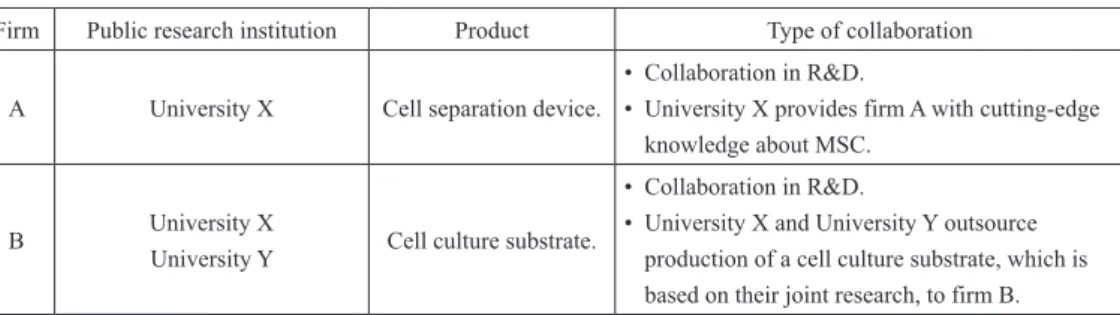
Abstract This study shows the influence of unevenly allocated financial resources to specific research on industry growth. Public investment in research compensates private firms for their investment, which tends to be less than optimal. However, skewed investment without strategy may inhibit industry growth. Skewed public investment in stem cell research is apparent for induced pluripotent stem cells (iPSC) in Japan. Although advent of iPSC contributes to increasing the total amount, the increment in investment is concentrated on iPSC. The trend restricts the development of new businesses relevant to other stem cells. In addition, clinical application of iPSC takes a longer time compared with that of somatic stem cells from a safety viewpoint. Difficulty in commercialization of new businesses inhibits industry growth. Conclusion suggests that increasing public investment in research on somatic cells, which are expected to be of clinical use in the near future, would lead to the building of infrastructure of medical treatment with stem cells and contribute to industry growth.. Keywords Public research; Public investment; Industry growth; Stem cells. Introduction Public investment in research compensates private firms for their investment, which tends to be less. than optimal (Arrow, 1962). Use of induced pluripotent stem cells (iPSC) in research resolves ethical issues and attracts not only researchers but also policymakers in allocating public financial support for the research. From a safety viewpoint, clinical application of iPSC takes long time, and research on iPSC deserves increased public funding. However, the proportion of public investment in research on iPSC is quite large in Japan. This study shows the degree of unevenly allocated financial resources to research on iPSC and its influences on industry growth.. David, Hall, and Toole (2000) show, based on literature review, the effect public investment in basic research has on private firms. However, quantitative measurement of the effect on industry growth is difficult because of the time lag between knowledge generated in publicly financed research and the impact on private firms (Cockburn and Henderson, 2001). Numerous factors other than public investment. 論 説. Public Research and New Business: Does a Skew toward iPSC Contribute to Industry Growth in Japan?. Naoko Kishi. 20( ) 横浜経営研究 第39巻 第 1・2 号(2018)20. could affect their performance. This study focuses on public grant allocation for stem cell research in Japan, and based on quantitative and qualitative data, shows that a skew for research on iPSC restricts development of new business relevant to other stem cells, which inhibits industry growth.. The regenerative medicine industry is in the early stage of its life cycle and needs basic infrastructure for growth. Infrastructure includes a supply chain system with safety at clinical level for stem cell products, a legal system for clinical use of stem cells, stem cell banks, cell culture technicians, all of which are essential to deal with clinical application of stem cells. Building infrastructure takes time, and it will not be driven without business demand.. Public research is a key factor for developing new business in science business (Pisano 2006; Danielle, Li, Pierre Azoulay, and Bhaven N. Sampat 2017). Cohen, Nelson, and Walsh (2002) define public research as research conducted by universities and public research institutions. This study follows their definition. Firms depend on knowledge spillover from public research institutions in order to grasp state-of-the-art knowledge about stem cells, which is updated daily. For example, Cockburn and Henderson (2001) state that progress in molecular biology has made it indispensable for firms to grasp the knowledge generated in publicly financed projects in order to build competitive advantages.. However, while public research supports new business development, they restrict selection of stem cells that firms use. This study focuses on the trend of public investment in research on stem cells, and it shows that public investment in Japan is skewed for research on iPSC. Intensively accumulated knowledge on iPSC determines the direction of new businesses and public support. As clinical application of iPSC takes much time from a safety viewpoint, this restricts generation of relevant new business. Thus, business opportunities are not enough to promote building infrastructure required to provide medical treatment with stem cells.. It is therefore necessary that public investment in stem cell research should shift gradually from diversification to concentration. There are somatic stem cells and pluripotent stem cells that may have clinical applications earlier than iPSC. Regarding public investment in stem cell research, allocating financial support to stem cells close to clinical application in the early stage of industry life cycle will contribute to designing infrastructure for growth of the regenerative medicine industry. Business infrastructures such as supply chain and a legal system are unable to depend on imports from other countries, and it is necessary to build these in the respective countries. Diversified investment is necessary to build business infrastructure before concentrated investment promotes accumulation of knowledge about iPSC strategically for firms to build competitive advantages in this field.. The paper is organized as follows. Next section refers to the role of public research in generating new business. Then, it shows the trend of Japanese public investment in research on stem cells. Finally it concludes that intensive public investment in iPSC inhibits industry growth and suggests gradual shift of public investment in stem cell research.. Public research and industry growth This section explains the role of public research in growth of the regenerative medicine industry. based on qualitative data. Specific focus in analysis is on new business development, which drives growth in the early stage of industry life cycle. Qualitative data shows that public research is an essential source. Public Research and New Business: Does a Skew toward iPSC Contribute to Industry Growth in Japan?(Naoko Kishi) ( )2121. of innovation in the new business development process and contributes to industry growth. Broad consensus on the role of public investment in basic research depends on a logic of market. failures. As private firms do not have many incentives to invest in basic research due to uncertain return on investment, public investment should have a role to make up for shortage (Arrow, 1962). In addition, Meyer-Krahmer and Schmoch (1998) describe that the network between public research and firms is significant for a more turbulent environment and for a new, more science-oriented technology field. Also, in a recent study, Budish, Ronin, and Williams (2015) show empirically that firms tend to underinvest in long-term research projects, based on data about clinical trials for cancer treatments and patient survival periods in 1973–2011. This is because they take a long time to generate revenue and that the fixed protection term in the patent system shortens the firm’s market monopoly. As regenerative medicine is a science-oriented field where it is difficult for firms to expect return on investment in the short term, it is reasonable to expect public investment in stem cell research. Firms conduct joint research with public research institutions to understand new findings of basic research on stem cells updated daily and to develop new businesses quickly.. Table 1 shows examples of Japanese firms that receive knowledge from national universities in order to develop new businesses. It is based on data from prior research, their homepage, and other web pages. It proves that knowledge spillover from the national university promotes their early entry into the market and that the direction of new business development depends on subjects of public research. Firms acquire opportunities of collaboration with national universities for new businesses through the following process.. Firm A was founded about 70 years ago and employs about 3,400 people. It is a medical equipment supplier for the regenerative medicine industry. It has conducted joint research with University X for about 10 years, and it has acquired cutting-edge knowledge on mesenchymal stem cell (MSC) and developed a cell separation device for MSC in bone marrow (Kishi 2015a). Their main market for this device is Europe. Owing to strong regulations for medical equipment, firm A faces difficulty in meeting cost and time criteria to acquire approval for marketing their products in Japan.. Firm B was founded about 110 years ago. It has been a supplier of collagen products and employs about 150 people. It has conducted joint research with University Y on cell substrate. University Y has conducted joint research with University X as well, and they find a suitable substance to cell culture substrate for embryonic stem cells (ESC)/iPSC (Kishi 2015b). They outsource firm B to produce cell culture substrate based on their research. Firm B has accumulated knowledge about cell culture substrate in the joint research with University Y in addition to networking with it.. Two cases show that knowledge accumulated in national universities contributes to new business development. However, they also prove that the direction of new business depends on cutting-edge knowledge of university laboratories. Therefore, the selection of stem cell for public investment may be an issue to be discussed for industry growth.. 22( ) 横浜経営研究 第39巻 第 1・2 号(2018)22. Table 1. Collaboration between firms and basic research institutions. Firm Public research institution Product Type of collaboration. A University X Cell separation device. • Collaboration in R&D. • University X provides firm A with cutting-edge. knowledge about MSC.. B University X University Y. Cell culture substrate. . • Collaboration in R&D. • University X and University Y outsource. production of a cell culture substrate, which is based on their joint research, to firm B.. Sources) Author makes based on Kishi (2015a) and Kishi (2015b).. Trend of public investment in research on stem cells Data. This study uses data from KAKEN database about public investment in stem cell research and shows that public investment has been skewed for research on iPSC since 2007. KAKEN is a public grant for scientific research in Japan. The data was collected through the website (https://kaken.nii.ac.jp/) in 2017- 2018. Responsibility of allocating the grant lies with the Ministry of Education, Culture, Sports, Science and Technology (MEXT) and Japan Society for the Promotion of Science (JSPS). Qualifications for application include both university and firm researchers. KAKEN database provides the following information relevant to research: research project’s title, outline, period, name and institutions of researchers, keywords, research field, amount of research grant, and research achievement. This study uses information about research project’s title, keywords, outline, period, and amount of research grant.. The sample includes research projects relevant to five stem cells: iPSC, ESC, MSC, hematopoietic stem cell (HSC), and neural stem cell (NSC). Research projects on five stem cells are selected because of the number of projects that acquired the KAKEN grant. More than 200 projects on the five stem cells have acquired grant during the sample period, while there are less than 100 projects on other stem cells. Research on iPSC has the highest number of projects acquiring grant. This shows that, among stem cell research, research on iPSC has been regarded as an important subject to researchers in Japan.. The criterion for picking up research projects as study samples is whether the title includes one of five stem cells to be analyzed. KAKEN database has a search system where projects for a sample are searched by a title and period. Some research projects need confirmation by keywords and outlines about whether the contents are relevant to the five stem cells to be analyzed. For example, when a title includes. “pluripotent stem cell,” it is necessary to check to which stem cell it is relevant: iPSC, ESC, or MSC. In case a title includes two stem cells, the research is counted as a sample of each cell. For example,. when a title includes iPSC and HSC, the research is counted as research on both iPSC and HSC. The sample period is 10 years: from 2007 to 2016. The next year in which the method to generate iPSC was established is considered as the starting period.. Public Research and New Business: Does a Skew toward iPSC Contribute to Industry Growth in Japan?(Naoko Kishi) ( )2323. Intensive public investment in research on iPSC Graphs 1 to 4 show a skewed trend in public investment in stem cell research on iPSC based on a. trend of KAKEN grant allocated for research on five stem cells during a sample period. Graph 1 shows a trend of number of research projects that have acquired grant by stem cell. The. dotted line at the top shows the total number of projects in each year. The number of research projects on iPSC in 2007 is zero because the method to generate iPSC was established in 2006.. There are three features of pluripotent stem cells in Graph 1: significantly increasing number of research projects on iPSC, fewer projects on ESC, and slightly increasing number of research projects on MSC. There is a reverse trend of the number of research projects on iPSC and ESC. Researchers have become more interested in research on iPSC than on ESC since 2009. However, the number of research projects on MSC has remained the same despite the advent of iPSC.. 0 50. 10 0. 15 0. 0 50. 10 0. 15 0. 2007 2011 2016. 2007 2011 2016 2007 2011 2016. iPS ES MSC. HSC NSC. N um. be r o. f r es. ea rc. h pr. oj ec. ts. Start year. Graph 1. Number of research projects by stem cell and start year. Graph 2 shows a trend of the amount of grants acquired by research projects by stem cell. It demonstrates that there is an impact of the advent of iPSC on the research projects on ESC. Particularly following the Nobel Prize award to research on reprogramming adult cells to pluripotent stem cells in 2012, the difference in allocated amount of grant between research projects on iPSC and ESC has expanded remarkably. After 2013, the amount of investment in iPSC is about eight times that in ESC. Although the amount of grant allocated to research projects on MSC is increasing, the increment is much smaller than the rate of increment in grant allocated to research on iPSC. In contrast, allocated grants for research projects on HSC are consistent, while those for research on NSC have decreased.. 24( ) 横浜経営研究 第39巻 第 1・2 号(2018)24. Amount of grants (Unit: million dollars). Year of start of research. Graph 2. Amount of grants by stem cell. Graph 3 shows a trend of proportion in grants allocated to each type of cell in a year. It demonstrates more clearly an impact of the Nobel Prize in 2012 on public investment in stem cell research. The proportion of grant allocated to research projects on iPSC has exceeded fifty percent of the total amount since 2013.In contrast, the proportion of grant to research projects on ESC has been less than ten percent. Although the proportion of grant to research projects on HSC and NSC decreased for a while after the advent of iPSC, the 2012 Nobel Prize has had little impact on them. Similarly, the advent of iPSC and the Nobel Prize in 2012 has had little impact on the proportion of grant allocated to MSC.. Graphs 1, 2, and 3 show that the advent of iPSC has affected the trend of public investment in stem cell research. It has increased the total amount of public investment in stem cell research, and much of the increase is concentrated on research projects on iPSC, since increasing number of research projects on iPSC leads to increase of total amount of public investment in stem cell research. The Nobel Prize in 2012 has particularly affected the amount of grant allocated to research on ESC.. Public Research and New Business: Does a Skew toward iPSC Contribute to Industry Growth in Japan?(Naoko Kishi) ( )2525. Proportion. Year of start of studies. Graph 3. Proportion of amount by stem cell. Graph 4 shows a trend of the average amount of grant allocated per project by stem cell. The average amount of grant per project for research on iPSC has been consistent since 2009 except for the year following the Nobel Prize. The advent of iPSC in 2006 and the Nobel Prize in 2012 showed the impact of lowering the average amount of grant per research on ESC. However, it was a temporary impact and has. Average amount of grants (Unit: thousand dollars). Year of start of research. Graph 4. Average amount per project by stem cell. 26( ) 横浜経営研究 第39巻 第 1・2 号(2018)26. since regained the previous level. However, research on NSC has seen a decrease in the average amount of grant per project since 2009, except in 2015. The advent of iPSC has little influence on grant for research on MSC and HSC.. Conclusion Intensive public investment in research on iPSC is expected to be complementary to building social. infrastructure for new businesses in the early stage of the life cycle of the regenerative medicine industry. However, the industry has a vulnerable and undeveloped infrastructure, and demand is still insufficient to drive public support for designing the necessary business environment. As public research provides an important source of knowledge for new business, allocating a high proportion of public investment in research on iPSC hinders design of infrastructure for growth of the regenerative medicine industry.. This study concludes that intensive focus on iPSC in public investment risks missing two opportunities for industry growth: losing business opportunities with other stem cells and missing opportunities of building business environment and designing a legal system for diffusion of stem cell therapy.. First, as table 1 shows, knowledge accumulated in public research contributes to new business development. Intensive public investment in research on iPSC means that firms lose opportunities to develop new businesses with other stem cells. On the other hand, iPSC is still far away from clinical application, and it takes time before relevant knowledge leads to new business development. In case that the direction of a new business is toward iPSC, firms face difficulties in making sales using spillover knowledge from public research.. Second, stagnation in new business development with stem cells other than iPSC leads to undeveloped business environment and then hinders industry growth. Public investment skewed for research on iPSC hinders a process of building infrastructure for industry growth.. Diffusion of medical treatment with stem cells requires appropriate social systems. Only after an appropriate infrastructure is established will the regenerative medicine industry be able to grow. Focus of public investment in the early stage of industry life cycle should be distributed among multiple subjects including pluripotent stem cells close to clinical application. Public investment should aim for gradual growth of the industry: from preparing business infrastructure to building competitive advantages strategically.. A limitation of this study includes qualitative data based on field research on why the number of accepted research projects on iPSC increases significantly in KAKEN. KAKEN database shows only projects accepted for grant allocation, and a number of candidate projects for grant by each stem cell to be analyzed is undisclosed. Analyzing the trend of applications and screening system in KAKEN grant may lead to correcting the skewed fund allocation.. References Arrow, K. (1962). Economic welfare and the allocation of resources for invention. In. R. Nelson, (Ed.), The Rate and. Direction of Inventive Activity: Economic and Social Factors, (pp. 609-625). Princeton, NJ: Princeton University Press.. Budish, E., Roin, B. N., & Williams, H. (2015). Do Firms underinvest in long-term research? Evidence from cancer. Public Research and New Business: Does a Skew toward iPSC Contribute to Industry Growth in Japan?(Naoko Kishi) ( )2727. clinical trials. American Economic Review, 105, 2044-2085. Cockburn, I., & Henderson R. (2001). Publicly funded science and the productivity of the pharmaceutical industry. In. A. B. Jaffe, Lerner, J. & Stern, S. (Ed.), Innovation Policy and the Economy, Volume 1, (pp.1-34). Cambridge, MA: MIT Press.. Cohen, W. M., Nelson, R. R., & Walsh, J. P. (2002). Links and impacts: The influence of public research on industrial R&D. Management Science, 48, 1-23.. David, P. A., Hall, B. H., & Toole, A. A. (2000). Is public R&D a complement or substitute for private R&D? A review of the econometric evidence. Research Policy, 29, 497-528.. Kishi, N. (2015a). Converting product concept to explore new business. Akamon Managent Review, 14, 99-126. Kishi, N. (2015b). External knowledge utilization for new business development. Akamon Managent Review, 14, 311-. 332. Li, D., Azoulay, P. & Sampat, B. N. (2017) The Applied Value of Public Investments in Biomedical Research. Science,. 356 (6333), 78-81. Meyer-Krahmer, F. & Schmoch, U. (1998). Science-based technologies: University–industry interactions in four fields.. Research Policy, 27, 835-851. Pisano, G. P. (2006). Science Business: The Promise, the Reality, and the Future of Biotech. Boston, MA: Harvard. Business School Press.. 〔Naoko Kishi, Associate Professor, Faculty of International Social Sciences, Yokohama National University〕 � 〔2018年6月16日受理〕

Table 1.  Collaboration between firms and basic research institutions

参照

関連したドキュメント

The current research suggests that developmental disorders might be a factor in depression and aggression, and indicates the importance of improved psychological interventions based

Environmental Research for the Sea of Japan and Adjacent Areas : FEB RAS Experience and Prospective..

This paper analyzes the relationship between the level of citizen participation,the degree of citizen's satisfaction with PI, and the degree of recognition of the plan, by using

This is a joint exhibition with KAKENHI Grant-in-Aid for Scientific Research on Innovative Areas (Research in a proposed research area) “Rice Farming and Chinese

[Publications] Yamagishi, S., Yonekura.H., Yamamoto, Y., Katsuno, K., Sato, F., Mita, I., Ooka, H., Satozawa, N., Kawakami, T., Nomura, M.and Yamamoto, H.: &#34;Advanced

 The aims of this study were to explore the trends in research on support for the siblings of children with diseases/disabilities and discuss future challenges related to this topic.

Our aim was not to come up with something that could tell us something about the possibilities to learn about fractions with different denominators in Swedish and Hong

In this paper we discover some new Schur positive differences of skew Schur functions and use them to derive a result on the basis of symmetric functions consisting of skew