50:952
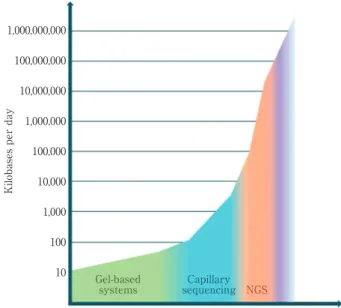
Fig. 1 Improvement in output of sequencing through time. 1,000,000,000 100,000,000 10,000,000 1,000,000 100,000 10,000 1,000 100 10
Kilobases per day
1980 1985 1990 1995 2000 2005 2010 Future Year NGS Capillary sequencing Gel-based systems
<シンポジウム 14―1>神経ゲノミクスの最先端
Whole Exome Sequencing
Karen Nuytemans, Ph.D. and Jeffery M. Vance, M.D., Ph.D.
(臨床神経 2010;50:952-955)Key words:Next generation sequencing, Whole exome sequencing, Rare variants, Neurogenetics
Over the years there have been many different ap-proaches and techniques that have been utilized to gather genetic information on family and patient data. Early on these focused on using family information and the pattern of inheritance of the disease in the family. The general location of the disease gene on the chromosomes could be deter-mined using linkage analysis. But this required large families and good family histories. Association studies moved away from family data, but still required large numbers of patients sharing the same disease. Over the past several decades we have had continuing growth in the number of genetic mark-ers that we could use in linkage and association analyses, the most recent work utilizing the specific sequence changes called single nucleotide polymorphisms or SNPs. But the use of these markers did not eliminate the need for large families or large population sizes. Thus, despite advances in genotyp-ing technology, the parameters of the applications in which these techniques could be used have not changed much in 30 years or so. This prevented many of the most interesting cases and families with Mendelian inheritance (due to a mu-tation in a single gene) from being studied, as they were too small for analysis, or too rare.
Sequencing genes provided more information, but the pre-vious existing technology was too expensive and labor inten-sive to do a large number of genes. Thus investigators were dependent on choosing candidate genes for study, which his-torically has proven to be fairly inefficient.
But this paradigm of needing large families to investigate a disease, or choosing a few candidate genes to test a hypothe-sis is now changing. The rapidly emerging sequencing tech-nology has now allowed the first practical medical applica-tion of the most useful and enlightening measure of genetic information, the DNA sequence itself.
The output of sequencing has been increasing at a rapid pace over the past several years, passing even the growth of the computer chip made famous by Moore s law (Moore, G. E. 1965). During the 1990 s and early in this century, capillary
sequencers, which produced the data for the human genome project, could identify 500 to 1,000 base pairs of sequence at a time. While impressive relative to previous slab gel tech-niques, the Next Generation Sequencers (NGS) of today have increased that sequencing output a million fold or more (Fig. 1).
This also means that the cost of sequencing per base pair has dropped precipitously. The human genome is approxi-mately 3.4 billion base pairs. The cost of sequencing was ap-proximately 10 million dollars in 2003. This dropped to around a million dollars in 2007, less than a $100,000 by 2009, and is expected to be close to the $1,000 goal in 2011-2012.
How has this remarkable increase been accomplished ? Sanger sequencing has been the mainstay of sequencing for many years. The Sanger sequencing method that was used for the human genome project utilizes a small primer (usu-ally 20 base pairs ), that allows the sequencing reaction to
Department of Human Genetics, University of Miami〔1501 NW 10th Ave, Biomedical Research Building, Suite 616 Miami, FL 33136, USA〕
Whole Exome Sequencing 50:953
Fig. 2 Next generation sequencing workflow. Identify genes to
study
Design capture chip/ primers Capture your region (s) of interest Next generation sequencing Computing
e.g. whole exome whole exome
genes causing a disease class of genes create small sequence fragments sequencing reaction Substantial need for bioinformatics !
This is your specificity step
uncaptured
start exactly at the location the investigator wishes to begin sequencing. But the use of this primer prevents any signifi-cant increase in the amount of sequencing that can be done, as only one primer can be utilized in each sequencing reac-tion, and any sequencing reaction is only accurate for a lim-ited number of sequences.
The solution to this problem was to eliminate the primer, and create millions of small (50 to 100 base pair) parallel se-quencing reactions in a single machine. This approach, called Next Generation Sequencing or NGS, is very powerful, but creates new challenges. First, the complexity and cost of NGS sequencers removes the sequencing labor from the indi-vidual laboratory and moves it to a core facility. Second, the massive amount of sequence created now requires a univer-sity or corporation to support a large computing and bioin-formatic network to handle the data, as the current NGS se-quencing reactions produce in the neighborhood of 300 bil-lion base pairs of sequence per run. It is this challenge of han-dling this amount of data that is likely to be the rate limiting factor of maintaining the current rate of sequencing growth. Third, the sequencing reaction still needs some specificity as to where to start or what regions to sequence, at least until whole genome sequencing is economically practical. As the specificity is no longer in the sequencing reaction itself (the primer is eliminated), a new step to NGS is required, the capture . Here a template is made of the DNA to be se-quenced, and the corresponding DNA of the subject is hy-bridized to the designed template, to capture the DNA for sequencing. This captured sequence is then chopped up, and used for the sequencing reaction (Fig. 2).
So what are the advantages and applications of this new technology ? Well, obviously, an enormous amount of
se-quence can be produced. This allows the sequencing to be much more accurate than Sanger sequencing, and the de-sired amount of accuracy can be chosen by the user. NGS can sequence very large regions, or a very large number of genes, or even all the exons of all the known genes, which is called whole exome sequencing. At this time, the first gen-eration exome assays or kits capture approximately 92% of the consensus sequence. As our understanding of the human exome changes over time, so will the design of these capture kits.
Whole exome sequencing removes the guess work out of choosing which candidate genes to sequence for a single gene disorder; you sequence almost all of them. Further, as you are sequencing all of the exome, you don t have to have families large enough for linkage analysis, which was previ-ously used to give you a clue where on the genome to se-quence. Thus, small single gene (Mendelian) families, previ-ously unable to be analyzed, can now have their genetic de-fect determined. NGS is now the technique of choice in work-ing up any unknown Mendelian family, and is likely to change the way clinical medicine is practiced. For example, if the cost of sequencing becomes less than many of the tradi-tional analytical tools, such as electromyography and nerve conduction studies in the workup of potentially inherited pe-ripheral neuropathies, it could replace them as part of the in-itial workup in many situations. Further, large number of genes can now be grouped for sequencing (say, all the genes for Charcot-Marie-Tooth disease), and sequenced for about the cost of one gene previously.
Will this technology also be helpful when studying patients who are diagnosed with a common, complex disease and who do not always show obvious Mendelian inheritance ? Well,
臨床神経学 50巻11号(2010:11) 50:954
Fig. 3 Genetic approaches to identify variants of different effect sizes and frequencies. 0.001 Large Mendelian diseases → Causal mutations Complex diseases → Rare variants Common diseases → common variants NGS NGS GWAS NGS 0.005 Moderate Effect size 0.05 Small Allele frequency
more evidence supports the hypothesis of multiple rare vari-ants for complex diseases such as Parkinson, Alzheimer dis-ease or autism, so the ability to identify multiple genetic de-fects in a high throughput manner, as does NGS, will prove to be a valuable tool when studying complex diseases. The total of moderate effects from a series of variants with low fre-quency (usually below 2%), each contributing to an increased risk, may explain a large part of the inherited susceptibility for these complex diseases (Cohen, J.C. 2004; Mitsui, J. 2009; Fearnhead, N.S. 2004; Nejentsev, S. 2009; Ji, W. 2008). Because these rare variants have a low population frequency and probably bring forth only moderate effects they are not in-cluded in or their effect would not have been picked up in genome wide association studies. So the accurate detection of these rare variants may become pivotal in our understand-ing of complex disease development (Fig. 3).
Similarly, NGS provides us with the opportunity to search for additional genetic modifiers that may explain clinical het-erogeneity (including differences in onset age or treatment response) within a family or within a group of unrelated car-riers of the same mutation, on a genome wide or exome wide level.
NGS is also likely to replace mRNA arrays for gene ex-pression. It can be used to sequence the mRNA directly, both sense and antisense, and again is non-biased in its approach. It will provide sequence for whatever is in the sample, not just what is on an expression chip. This sequence is called the transcriptome. Coupled with whole exome sequencing, it is potentially a powerful research tool.
Although we hear much discussion on whole genome se-quencing, it is likely that whole exome sequencing is going to be the major tool for quite awhile. The reasons for this are practical; the exome represents only 1% of the total genome, thus bioinformatic and data management requirements are much smaller than for the whole genome. Further, in order to know what is abnormal, you need to understand normal. And most of our knowledge to date on normal sequence is
centered on the exome, we are only just beginning to under-stand the rest of the genome, which is highly regulatory in its nature.
Of course, NGS can be used in many other applications and has indeed also gathered interest in different fields of the ge-netic research, such as mitochondrial studies, epigege-netics or metagenomics; all of which might provide valuable informa-tion on disease development. For example, due to the small mitochondrial DNA size and thus the possible high level of coverage, NGS allows for the detection of heteroplasmy per-centages when studying mitochondria, while the combina-tion of NGS and epigenetics technology provides the oppor-tunity to examine whole genome methylation. Also, sequenc-ing the microbiome of certain human tissues can help us bet-ter understand the influence of the environment on ongoing biological processes in sickness and health.
In summary, whole exome sequencing and NGS is begin-ning to change medical practice. Not only does NGS enable screening of a possibly large, specific group of genes or re-gion of interest in one experiment, it also allows unbiased de-tection on genome or exome level of novel causal variants and possible additional factors influencing onset or treatment outcome within one individual. This indicates that NGS is steering the medical field towards a genomic medicine or a more personalized medicine, in which NGS is the new major diagnostic tool, where treatment response can be predicted and risk algorithms for different diseases can be developed.
References
1)Moore GE. Cramming more components onto integrated circuits. Electronics 1965;38:114-117.
2)Cohen JC. Multiple rare alleles contribute to low plasma levels of HDL cholesterol. Science 2004;305:869-872. 3)Mitsui J. Mutations for Gaucher disease confer high
sus-ceptibility to Parkinson disease. Arch Neurol 2009;66:571-576.
Whole Exome Sequencing 50:955
account for multifactorial inherited susceptibility to col-orectal adenomas. Proc Natl Acad Sci U S A 2004;101: 15992-15997.
5)Nejentsev S. Rare variants of IFIH1, a gene implicated in antiviral responses, protect against type 1 diabetes.
Sci-ence 2009;324:387-389.
6)Ji W. Rare independent mutations in renal salt handling genes contribute to blood pressure variation. Nat Genet 2008;40:592-599.