著者
中井 文子
著者別名
Ayako NAKAI
雑誌名
観光学研究
巻
18
ページ
13-27
発行年
2019-03
URL
http://id.nii.ac.jp/1060/00010516/
Creative Commons : 表示 - 非営利 - 改変禁止 http://creativecommons.org/licenses/by-nc-nd/3.0/deed.jaUse and Effects of an Online Text-to-Speech Resource to
Improve English Listening for the TOEIC Test
Ayako NAKAI
AbstractThis study examines the effects of an online text-to-speech resource for English classes. The website includes various automated synthesized voices (ASVs) speaking British and American varieties of English. The speaking speed can be changed easily. Japanese teachers have difficulty teaching the correct pronunciation of new English vocabulary. The common way of teaching English pronunciation is to use CDs with recordings of the voices of native speakers (NSs). However, the speaking speed on the CDs is too fast for introductory level students to understand new vocabulary. As students are used to online video games with automated voices, it was predicted that an online speed-controlled resource could lower students’ affective filters. Forty-five undergraduate students were divided into an experimental group and a control group. During the 2015 spring semester, the new materials were used in the experimental group, while the students in the control group listened to traditional audio materials spoken by NSs. Before and after the treatment, both groups took pretests and posttests based on the listening part of the TOEIC test. The results show that an interaction effect of the treatment was found between the two groups (F (1,43)=4.92, p<.05), suggesting that the resource improved the students’ English listening.
Keywords
online materials, automated voices, the TOEIC Test, English listening class
Introduction
The TOEIC test has been popular since the 1980s. According to ETS (2013), more than 2.3 million people in Japan took the TOEIC test in 2013. Recently, the number of major companies that consult TOEIC test scores when they recruit new employees has also increased. About 70 percent of listed companies refer to TOEIC test scores (ETS, 2013, p.10) and require applicants to have scores of around
625/990 points in the test. At some universities in Japan, TOEIC classes are compulsory.
However, it is difficult for Japanese beginner-level students to use traditional audio materials to prepare for the TOEIC test, because the speech rate is quite fast and many of the words are connected. To encourage students to learn new vocabulary and key phrases through audio materials, I used a new
online text-to-speech resource called Globalvoice English, which includes automated synthesized voices with British and American accents.
The automated synthesized voices (ASVs) are appropriate teaching materials for students preparing for the TOEIC test. The speed of ASVs used in this research is slower than that of native speakers (NSs). Due to the relatively slower speed, word-linking rarely appears in the ASVs’ speech, and Japanese students find the articulation clearer and more understandable.
In the past, when I used CDs spoken by NSs, the beginner-level students could not understand what the NSs were saying and could not answer multiple choice questions correctly. In addition, most of the students in my classes appeared to be afraid to listen to NSs’ speech. During high school, they had to listen to CDs spoken by NSs for the National Center for University Entrance Examination and The EIKEN Test in Practical English Proficiency, so they seemed to have grown tired of it. The online resource with ASV was used in this research to fill the gap between the English proficiency of my students and the TOEIC audio materials spoken by NSs.
Before adopting the new method, the motivation of the students was carefully analyzed on the basis of the attention (A), relevance (R), confidence (C), satisfaction (S) (ARCS) model, a motivation model created by Keller (1987). It was expected that adopting this new resource with ASVs would attract students’ attention and motivate them, because they had never experienced such a resource in their previous educational institutions.
There was some research (Hirai & O’ki, 2011; Morishita & Yamamoto 2013) in relation to ASVs being used in the second language learning field. The quality of automated voices varies depending on their use. Although some ASV sounds are quite artificial and mechanical, the quality and the system have been improving for decades, and numerous patents related to ASVs (Blaha, D. L., & Shapley, B. J. 1998; McAllister, A. I., & Curry, J. E. 2002; Szlam, A., & Charles, L. W. I., 1994) have been approved. ASVs have been studied in different areas such as medical science (Greaney, et.al., 2012; Wik, et.al., 2002) and business (Bitner, 1992).
Recently, many undergraduate students have not had a negative impression of ASVs. For example, Vocaloid, a kind of synthesized singing technology, is popular among Japanese young people. Hatsune Miku, a character developed using Vocaloid 2, is well known in Japan, and it is said that she has millions of fans (Independent, 2011).
In this study, the new online text-to-speech resource also includes illustrations of different speakers. In the present stage and practice stage (see the “Presentation-Practice-Production (PPP) Feature”
subsection below), listening to ASVs with illustrations may be effective in lowering the “affective filter”
(Krashen, 1981) of the students towards listening to the target language, because this material helps students feel less anxious about English listening.
A weak version of PPP (Present, Practice, Production) was adopted in this study. The online resource was used in the present stage in my lesson, where the students learn new vocabulary with ASVs. The concept of PPP and the procedure of the treatment in my study will be explained in the “Procedure for My TOEIC Test Class” subsection of the Method section below.
The purpose of this study is to examine a new online resource for students with low English proficiency to help them prepare for the TOEIC test. The research questions in this study are the following:
RQ1: Does the new online resource with ASVs help students to improve their English listening skills? RQ2: Does the students’ impression of the resource with ASVs affect their achievement in the
listening test?
Literature Review
Previous Studies of ASVs
Hirai and O’ki (2011) used Globalvoice English and compared ASVs and NSs in terms of comprehensibility and naturalness in their listening classes. The upper-level and lower-level groups completed a questionnaire, and the results indicated that the naturalness of ASVs and NSs was not different. Hirai and O’ki concluded that students’ comprehension of ASVs and NSs was affected by their familiarity with ASVs, and sufficient practice in listening to ASVs was needed before attempting the comprehension tests.
In my study, the difference between ASVs and NSs was not a major issue. ASVs were used as a new introductory resource in TOEIC test classes for three months to improve students’ listening skills as preparation for Part4 of the listening section of the TOEIC test. The pronunciation of ASVs and NSs is analyzed below using the International Phonetic Alphabet (IPA).
ASVs were also utilized in English speaking classes. Morishita and Yamamoto (2013) used Globalvoice English in their oral training classes to save the time that would be needed to record NSs. In the training, the students listened to shuffled word groups, arranged the words in the correct order, and read aloud the sentences that they had made. The students learned the correct answers by listening to Globalvoice English instead of NSs.
In the research described below, ASVs are not just alternatives to NSs. It was expected that ASVs would motivate students and help them to learn key vocabulary for the TOEIC test.
Previous Research Using Online Materials in TOEIC Test Classes
The students in my study were encouraged to do dictation while listening to ASVs, because previous research (Yubune, Mine, & Kokubu, 2013) showed improvement in students' English proficiency in dictation through a new e-learning resource that was developed based on the textbook, Bottom Up
Listening for the TOEIC Test. The average TOEIC score in the intermediate class was 400/990 points, while that of the beginning class was around 300/990 points. With the e-learning material, the students listened to speech spoken by NSs and read the same sentences aloud as rapidly as possible. The students improved their listening skills by repeating this activity. The pretest and posttest in this study focused on dictation. Therefore, in my study, I focused on English listening comprehension in both the pretest and posttest, based on Part4 of the listening section of the TOEIC test.
The Presentation-Practice-Production (PPP) Feature
PPP is a method for teaching grammar and vocabulary. My study used a weak version of PPP. The procedure of PPP is divided into a present stage, a practice stage, and a production stage. In the present stage, classrooms are controlled by teachers. According to Harmer (2001, p. 82), “the teacher introduces a situation which contextualizes the language to be taught. The language too is then presented.” Teachers show target language forms explicitly by using writing or audio or visual aids.
In my study, however, there is no explanation of key vocabulary and grammar in the present stage. One of the characteristics of PPP is explicitly presenting required language forms to students. However, my students seemed tired of listening to teachers explain key vocabulary and grammar. In order to motivate the students to learn key vocabulary, the present stage in my research utilized ASVs. The students learned key vocabulary by doing dictation while listening to audio with ASVs.
In the PPP practice stage, students need to practice writing target language structures or using them correctly when speaking. Teachers in the practice stage need to give students feedback to correct their language use. In the production phase, students can use the required language forms freely to make presentations or write long sentences. The details of the practice and production stages in my study will be covered later in the “Procedure for My TOEIC Test Class” subsection of the Method section of this article, which follows.
Method
Participants
A group of 45 Japanese second-year undergraduates at a private four-year university participated in the experiment. The participants were primarily male, between 19 and 20 years of age, and majoring in information technology. Their English level is low in terms of their average TOEIC test scores (including the listening and reading sections), which were between 225 and 275 in December 2014. Their scores for the listening part of the TOEIC test were between 85 and 150.
As using ASVs in English classes is a new experience for students, their motivation should be clearly analyzed. The tactics for implementing the new material successfully should be planned carefully in advance. Therefore, the motivation of the students was examined based on the ARCS model in Table 1. Created by Keller (1999), the ARCS model is a systematic approach that evaluates students’ current motivation objectively and designs tactics for motivating students. Various researchers (Frymier, & Houser, 2000; Huett, Kalinowski, Moller, & Huett, 2008; Shellnut, Knowlton, & Savage, 1999) have adopted this useful model. Table 1 refers to the simplified ARCS approach, which Suzuki and Keller (1996) adopted in Japanese educational settings.
The first row of the table shows the students’ overall motivation. Since English is a compulsory subject for first and second year students, the students did not take the course voluntarily, and their attention seemed poor. Their confidence was not high due to their low English proficiency. The second row of the table shows predictions concerning how the tasks would appeal to the students. The key
vocabulary and dictation tasks were not so new for them. Although the tasks themselves did not appear to attract students, they were not too difficult for the students’ introductory level. Therefore, it was expected that the students would be able to continue their improvement in mastering new vocabulary and be satisfied with their achievement. The third row indicates the students’ expected attitudes towards the online material with ASVs.
The third row shows the positive and negative aspects that would affect the students’ motivation. As the ASVs with controlled speed were totally new for the participants, it was predicted that they would be interested in the resource. However, some of the students might feel that it is strange to listen to the ASVs. The online materials with ASVs need to be evaluated by the students, and for this reason, this study measured the students’ responses by asking them to complete a questionnaire after the treatment about their impressions towards the online resource with ASVs. The details of the scale will be described in the “Scale of the Students’ Impressions of the Online Resource with Automated Voices” subsection of the Method section of this article.
By referring to the information about the students' motivation provided in the first three rows in Table
1, the teacher planned how to instruct the students and what types of tactics to use. The fourth row describes motivational tactics that were originally based on the needs identified for this case. In order to attract the students’ attention, the teacher needed to emphasize the differences between the ASVs and the voices of native speakers of English, and explain how much easier it is for them to understand the ASVs. In the following subsection, the differences between the two types of voices will be described in detail.
Table 1 ARCS Motivational Design Matrix
Design factors Attention Relevance Confidence Satisfaction Learner
characteristics Compulsory class low interest (-) High commitment to get credits (+) Low English proficiency (-) Newly formed group of students (-)
Learning tasks
(learner’s attitudes) Not new learning key vocabulary and doing dictation for the TOEIC Test (-)
Useful for preparing for the TOEIC Test (+)
Seems easy (+) Consistent improvement (+) Online resource with automated voices (learner’s attitudes) New, interested in automated voices (+) Familiar with online materials for learning English (+)
Students feel that the ASVs might sound strange (-)
Every student can participate (+) Enjoyment with new challenge(+) Motivational
tactics for the class Minimal tactics required: Emphasize the difference between the ASVs and NSs
Minimal tactics required: Emphasize the importance of vocabulary for the TOEIC test
To build confidence: set tasks from easy to difficult Minimal tactics required: taking mini test Immediate feedback
The Automated Synthesized Voices Used in This Research
ASVs from an online resource were used in this study. The differences between the ASVs from the online resource and a native speaker of English will be examined below. In fact, the pronunciation of the words that the ASVs produced did not show a great difference from those of the NSs. Therefore, ASVs using a slower speed seemed to be useful for beginning-level students. Furthermore, for some sounds, the ASVs could be easier for the students to understand because they did not include connected speech.
It should be noted that, on the one hand, it seems that the NS did not pronounce the final [t] of suspect, because the NS was speaking too fast to pronounce the sound clearly. On the other hand, the ASV pronounced the final [t] of suspect distinctly. It is possible that the NS skipped the end of the word
suspect in order to pronounce the following [ð] consonant naturally. In terms of comprehending the
word suspect, the voice of the ASV is easier for the students to understand than that of the NS.
Moreover, for the word that, it seems quite difficult to analyze whether the ASV pronounced [ə] or [æ]. The difference between the pronunciations of the word that by the ASVs and the NSs does not seem to have an influence on students’ understanding of this sentence, because that is a conjunction that is often dropped during conversation.
A second point to note is that the ways of pronouncing the word questionnaires were slightly different. In the ASVs' pronunciation of this word, it seems that the [n] has been pronounced twice, in both the second syllable [tʃən] and the third syllable [neəs]. However, when the NS pronounced this word, the [n] appeared only once, in the second syllable [tʃən], and for the third syllable only [eəs] was pronounced. This means that the pronunciation of the ASVs was similar to that of Japanese learners' perception, suggesting that it would be more comprehensible for them.
The NS did not pronounce the word-final [t] for not. According to Roach (2000), the voiceless
Figure 2. The pronunciation of a native English speaker (NS) Figure 1. The automated synthesized voice (ASV)
alveolar plosive sound is usually replaced by the glottal stop in connected speech. However, the ASVs slightly released the final [t] of not. This would help students to understand the ASV’s speech.
It was quite difficult to analyze the NS's pronunciation of the word correctly. It seems that the NS did not clearly pronounce the [r] sound. To be more precise, it seems that the NS did not properly give a retroflex pronunciation. The position of the tongue was too low and flat, which makes the [r] unclear, because the NS uttered the word quickly. However, this articulatory feature was not found in the ASVs. This again means the ASV’s articulation could be easier for the Japanese learners to understand. As the teacher in the classes explained that comprehending the articulation of ASVs was easier for the students than that of NSs, the beginning- level students could actively involve in the listening activities. The teacher taught the students the terminology of “linking” and pointed out that the articulation of ASVs rarely had linking words.
The Speed of the New Online Resource with Automated Voices
The original rate of speech of the new online resource using ASVs could be changed by clicking icons. The rate of the ASVs that were used in this study was 30 percent slower than the original rate. The slowed-down speed of the ASVs was 100 words per minute (WPM), while that of the audio spoken by the NSs was 180 WPM. To motivate the introductory-level students, the teacher always mentioned in the classes that the speed of the ASVs was slower than that of NSs.
Visualizing New Vocabulary
The students listened to the new audio material while looking at PowerPoint slides to help them understand new vocabulary. For instance, some of the students did not know the word empty. The slide showed an empty plate so that the students could easily understand the meaning of the word.
Simmons (2002) observed that illustrations
were effective for learning new vocabulary. While Simmons used small cards for this purpose, my study utilized PowerPoint slides. Some participants in my experiment said that they liked seeing photographs and illustrations in PowerPoint slides related to new vocabulary because they often spent long hours looking at images on the Internet.
How Students Were Encouraged to Notice Contractions
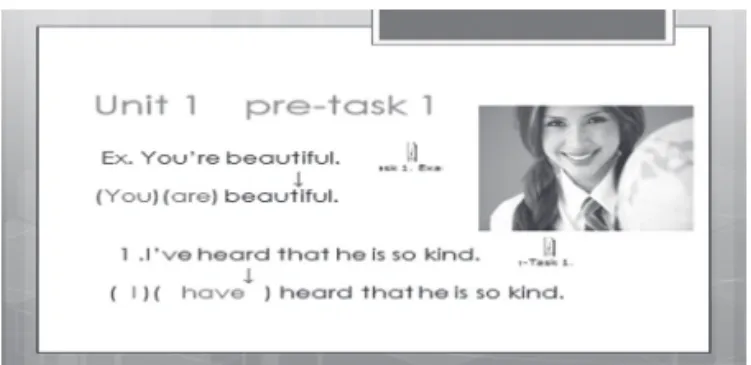
There are no explicit explanations of grammar in my material. In the present stage 1, after listening to two example sentences, the students were asked to do a fill-in-the-blanks activity. The students needed to divide each contraction into two words in present stage 1 while listening to the audio.
Present stage 1 Example:
You’re beautiful. → (You)( are) beautiful.
In present stage 2, the students were asked to do another fill-in-the-blanks activity. They needed to combine sets of two words to form contractions while listening to the audio.
Present stage 2 Example
You had better study hard. → (You’d)( better) study hard.
In Japanese junior high schools, although English teachers teach students contractions and tenses, some of my participants whose TOEIC scores were around 250 points had already forgotten many contractions and present perfect forms. These fill-in-the-blanks activities helped students to remember contractions and pay attention to tenses. In the present stage, I asked the students to fill in the blanks in the sentences to encourage them to notice contractions. These activities helped the beginning-level students to learn basic grammar and improve their listening. In fact, Cook (2008, p.126) insists that “grammar is not just in the back of our minds, but is active all the time we are listening.”
The Scale of the Students’ Impressions of the Online Resource with Automated Voices
Before the treatment, it was predicted that the ASVs would motivate the students and help them to focus on listening. After the treatment, the students’ impressions of ASVs were examined using a new scale. The students answered a questionnaire based on the new scale, which included the 12 questions in Table 2. These questions examined the students’ impressions of the ASVs compared to NSs using a five-point scale.
Cronbach’ s coefficient alpha was more than 0.8 (α=.873). The inter-scorer coefficient of the scale was high. The 12 questions were translated from English to Japanese when the beginning-level students answered the questionnaire.
The Procedure of the Experiment
Before beginning the experiment, the participants took an English listening comprehension pretest. Volume 2 of a TOEIC test practice book published by ETS was adopted to construct the pretest and posttest. After the treatment, the participants took a posttest that was at the same level as the pretest but with different questions. The length of each speech and the vocabulary used in the audio are almost the same as in listening section four of the TOEIC test. Both pretests and posttests consist of 20 questions
Figure 4. PowerPoint slide illustrating you’re and I’ve
(the maximum score is 20 points). Between April 2015 and July 2015, the students participated in a
90-minute TOEIC test class every week and used the new online resource with ASVs for about 30
minutes before listening to CDs with audio spoken by NSs.
The Procedure for My TOEIC Test Class
The aim of my lessons is to provide students with practice so that they can get higher scores in the listening part of the TOEIC test. As I have indicated, I used PPP as a framework for designing my lessons. In the production phase, it was expected that the students would be able to understand key sentences in order to answer multiple choice questions in the listening Part4 of the test. I divided my lessons into three stages: the present stage, the practice stage, and the production stage.
The present stage. In the present stage, students listened to the new online resource including ASVs.
While listening to the audio, the students did dictation and learned key vocabulary and sentences related to the topic (e.g., ordering food in restaurants, participating in business meetings). Key sentences that the students listened to were extracted from a textbook called Bottom Up Listening for the TOEIC Test. According to Hedge (2000), “content schemata” that include topic knowledge help students obtain “top down comprehension strategies.” Therefore, students should have existing knowledge of the topic before listening to Part4 of the listening section of the TOEIC test.
The practice stage. While listening to CDs with audio spoken by NSs, the students did dictation with
the same sentences that they learned in the present stage. The students did not panic when they listened to the native English speaker’s speech, because they had already learned the key vocabulary through the
Table 2 Questionnaire Concerning Students’ Impressions of the Online Resource with Automated Voices 1. It was easier for me to understand the online resource with automated voices than material spoken by a native English speaker.
2. Through the online resource with automated voices, I could learn new vocabulary.
3. Through the online resource with automated voices, I could understand contracted forms and could then follow contracted forms spoken by a native English speaker.
4. Through the online resource with automated voices, I could understand the linking words and then I could also catch up the linking words uttered by a native English speaker.
5. Through the online resource with automated voices, I could overcome my dislike of English.
6. Listening to the online resource with automated voices made me less nervous about English.
7. By listening to the online resource with automated voices, I could concentrate on my English class.
8 Listening to the online resource with automated voices made me feel like practicing the listening section of the TOEIC test more. 9 By listening to the online resource with automated voices, I could feel more confident about English listening. 10 By listening to the online resource with automated voices, I could more easily keep up with the audio spoken by native English speakers when practicing for the TOEIC test. 11 By listening to the online resource with automated voices, I could do dictation of the audio spoken by native English speakers more easily. 12 By listening to the online resource with automated voices, I could get a higher score in the listening section when practicing for the TOEIC test.
online resource with ASVs.
The production stage. In the production stage, the students listened to short speeches similar to those
from the practice stage in the actual TOEIC test. The short conversations included key vocabulary and sentences that they had learned in the present stage. After that, the students read the questions and chose the correct answers to multiple-choice questions. Three sentences were false and one sentence was correct. In addition, the students were encouraged to use the key vocabulary in sentences of their own for five minutes.
Results
The Results of the Pretest and Posttest
Table 3 shows the means and standard deviations for the pretest and posttest scores. The pretest scores for both groups did not show a statistically significant difference (F(1,43)=0.002, n.s. p=.967). An evaluation of the new teaching material was conducted using ANOVAs. The differences between the scores of the pretest and posttest showed statistical significance at the .05 level (see Figure 6) (F (1,43)
=4.923, p<.05). An interaction effect was found in the two groups. The results indicate that the members of the experimental group, who listened to ASVs in the present stage, could complete the listening comprehension posttest more accurately than the pretest.
Correlations of Impressions of the New Material with ASVs and Test Scores
After the treatment, the students completed the questionnaire, Concerning Students’ Impressions of the Online Resource with Automated Voices. The results showed that the students had favorable attitudes
towards the ASVs used in the present stage (see Table 4). Correlations of impressions of the online material with ASVs and test scores were examined. The difference between the pretest and posttest scores was not relevant to the points from the questionnaire results regarding the students’ impressions towards the online resource with ASVs (r=.313, n.s.). This means that during the three-month TOEIC
test classes, for Part4 of the TOEIC test, the students’ improvement in listening was not correlated with their impressions towards ASVs even though some students did not favor ASVs. There is a possibility that some students only tried their best in the posttest. However, the results of the posttest were not relevant to the points of the scale (r=.211, n.s.), suggesting that the usefulness of the material using
ASVs was not affected by students' preferences for ASVs.
Table 3 Pretest and Posttest Scores
Pretest Posttest
Group n M SD M SD
Experimental group 23 8.609 2.369 10.130 2.160
Conclusion and Discussion
Kumaravadivelu (2006) argues that teachers should focus on particular students and particular contexts in the post-method era; that is, teachers should not believe that there is one best method that can apply to all settings. In this research, I focused on students whose average TOEIC test scores are around
250/990 points. In the first place, the students’ motivation was evaluated based on ARCS. The students’
overall motivation was low because of their low English proficiency. Furthermore, I focused on the students’ particular environment, as they come from the information technology department and are familiar with online resources.
The new online resource equipped with ASVs was used in the present stage to encourage the students to learn key vocabulary and key grammar. Various tactics such as lowering the speed of the audio and the teacher’s instruction about the difference of pronunciation between ASVs and NSs were thought to have motivated the students.
The procedures of the instruction were divided into three parts: the present stage, practice stage, and production stage. To build students’ confidence, the stages were arranged from an easy stage to a difficult one. In my previous TOEIC test classes, many students had difficulty in dictation through audio with NSs when learning new key vocabulary and sentences. In contrast, in this classroom, practice participants were more successful in dictation thanks to the new technology with ASVs, and they enriched their vocabulary in the present stage. Adopting ASVs helped students with low English proficiency feel less anxious about listening to English.
Hirai and O’ki (2011) showed that 45 percent of the students with low English proficiency preferred ASVs to NSs or did not care about the speech type, while 70 percent of students with higher proficiency preferred NSs to ASVs. They noted that each word that ASVs produce is segmented so that the rate of speech is almost the same in all speech sections. In fact, the beginning-level students in my study seemed to prefer ASVs and were motivated to learn key words through listening to ASVs, according to the results of the questionnaire.
In the practice stage, the students did not panic when listening to CDs spoken by NSs. They could confidently do dictation of the same sentences that they had already learned during the present stage. In the production stage students listened to a short talk from Part4 of the listening section of the TOIEC test. The short talk includes identical key words and sentences that they learned in the present and practice stages. Thanks to those key words presented in the previous phases, they could successfully answer comprehension questions. The new material with ASVs assisted the students to prepare for listening to the audio of the TOEIC test spoken by NSs. According to the results of the pretests and
Table 4 Average scores towards ASVs on a five-point scale in this research
Group n M SD
posttests, the new online resource with ASVs was effective in improving introductory level students’
listening skills.
Hirai and O’ki (2011) conducted a series of experiments about comprehensibility of ASVs and NSs. However, the results of their study 1 and study 2 were confounded due to the familiarity with ASVs. They concluded that the trainings to comprehend ASVs were not enough for the participants in their study.
There was research about the effective training time for listening to ASVs. Winters and Pisoni (2003) insisted that the time span for listening training using ASVs should be more than six months. Although the students in this study were exposed to ASVs for three months, the training was achievable for them to comprehend ASVs and improve their English listening level. In fact, the experiments Winters and Pisoni (2003) referred to were conducted in the 1980s and 1990s, when the quality of ASVs was not as good as the quality we have today. The quality of ASVs has been better for decades. Hirai and O’ki (2011) stated that the upper-level learners in their study 2 rated an average of 4.00 towards ASVs on a five-point scale where prosody and segmental aspects of speech were concerned. The learners did not underestimate the naturalness of ASVs compared to NSs.
Before the experiment, it was predicted that some students would have a strange feeling toward ASVs and that they would not be able to concentrate on studying. However, the students’ preference for ASVs was not related to their score gain between the pretest and the posttest. By adopting ASVs, the anxiety of beginning-level students toward existing audio materials by NSs in the TOEIC test was relieved. Teachers do not always need to use audio CDs recorded by NSs for low-level students from the beginning of their class. Teachers need to pay more attention to students’ English level and should try new materials to motivate students according to their learning contexts.
Further Research
I plan to follow the study reported on in this article with one using a psychological scale related to anxiety toward English; I will use this scale before and after the classroom treatment where learners listen to ASVs. In this way, I may be able to analyze more objectively whether ASVs will encourage students to lower their affective filters.
It should be noted that we chose male ASVs for this study. However, in further research, audio including not only a male voice but also a female one will be used so that it will be possible to compare their effects on improving students’ listening skills and to survey students’ impressions of ASVs.
References
Bitner, M. J. (1992). Servicescapes: The impact of physical surroundings on customers and employees. The Journal of Marketing, 56(2), 57–71.
Blaha, D. L., & Shapley, B. J. (1998). U.S. Patent No. 5,729,600. Washington, DC: U.S. Patent and Trademark Office. Cook, V. (2008). Second language learning and language teaching. London: Hodder Education.
ETS (2013). (Retrieved, October 1, 2014, from http://www.toeic.or.jp/toeic/about/what.html)
Frymier, A. B., & Houser, M. L. (2000). The teacher-student relationship as an interpersonal relationship. Communica-tion EducaCommunica-tion, 49(3), 207–219.
Greaney, M. L., Puleo, E., Sprunck-Harrild, K., Bennett, G. G., Cunningham, M. A., Gillman, M. W., & Emmons, K. M. (2012). Electronic reminders for cancer prevention: Factors associated with preference for automated voice reminders or text messages. Preventive Medicine, 55(2), 151–154.
Harmer, J. (2001). The practice of English language teaching, third edition. Edinburgh: Pearson Education Limited. Hedge,T. (2000). Teaching and learning in the language classroom. Oxford: Oxford University Press.
Hirai, A., & O’ki, T. (2011). Comprehensibility and naturalness of text-to-speech synthetic materials for EFL listeners. JACET Journal, (53), 1–17.
Globalvoice English (Retrieved April 7, 2016, from http://voicetext.jp/)
Huett, J. B., Kalinowski, K. E., Moller, L., & Huett, K. C. (2008). Improving the motivation and retention of online stu-dents through the use of ARCS-based e-mails. The American Journal of Distance Education, 22(3), 159–176.
IiBC (2013). The Report of Research about How to Use English in Listed Companies [Joujoukigyo ni okeru eigo katsuy-ou jittai chkatsuy-ousa hkatsuy-oukokusho] (Retrrieved May 7, 2016, from http://www.toeic.or.jp/library/toeic_data/toeic/pdf/data/ katsuyo_2013.pdf)
IiBC (2007). Volume 2 of a new TOEIC Test Practice Book. [TOEIC test shin koushiki mondaishu]. Tokyo : ETS Independent (2011) (Retrieved April 16, 2016, from http://www.independent.co.uk/arts-entertainment/music/japan-3
-d-pop-avatar-a-real-world-hit-2299918.html)
Keller, J. M. (1987). Development and use of the ARCS model of instructional design. Journal of Instructional Develop-ment, 10(3), 2–10.
Keller, J. M. (1999). Using the ARCS motivational process in computer-based instruction and distance education. New Directions for Teaching and Learning, (78), 37–47.
Krashen, S. (1981). Second language acquisition and second language learning. Oxford: Pergamon.
Kumaravadivelu,B.(2006). Understanding language teaching: From method to postmethod. Mahwah, New Jersey: Law-rence Erlbaum.
McAllister, A. I., & Curry, J. E. (2002). U.S. Patent No. 6,385,584. Washington, DC: U.S. Patent and Trademark Office. Morishita, M., & Yamamoto, T. (2013). How syntactic processing training affects oral production of elementary level
Japanese EFL learners. Linguistic Research, 30(3), 435–452.
Roach,P. (2000). English phonetics and phonology: A practical course, third edition. Cambridge: Cambridge University Press.
Shellnut, B., Knowlton, A., & Savage, T. (1999). Applying the ARCS model to the design and development of comput-er-based modules for manufacturing engineering courses. Educational Technology Research and Development, 47(2),
100–110.
Simmons, E. (2002). Visualizing vocabulary, The Quarterly-Summer, 13–17 (Retrieved November 6, 2014, from http:// www.doralacademyprep.org/ourpages/auto/2009/9/30/42189662/Visualizing_Vocabulary__p_.pdf ).
Suzuki, K., & Keller, J. M. (1996). Creation and cross cultural validation of an ARCS motivational design matrix. In An-nual Meeting of the Japanese Association for Educational Technology. Retrieved 8(25), 8
Szlam, A., & Charles, L. W. I. (1994). U.S. Patent No. 5,309,505. Washington, DC: U.S. Patent and Trademark Office. Wik, L., Myklebust, H., Auestad, B. H., & Steen, P. A. (2002). Retention of basic life support skills 6 months after
Winters, S. J., & Pisoni, D. B, (2003). Perception and comprehension of synthetic speech, In Research on spoken lan-guage processing progress report, 26, 95–138. Bloomington, IN: Indiana University, Speech Research Laboratory. Yubune, E., Mine, S. & Kokubu,Y.(2013). E-Learning materials for learning bottom up listening strategy using the
TOE-IC Test. [TOETOE-IC enshu wo riyoushita bottom up shori ni motoduku choukairiyoku kyoka notameno e-larnning kyozai no kaihatsu] Journal of Toyo University, Institute of Human Sciences, [Toyo daigku ningenkagaku sougou kenkyusho kiyou] .15, 147–149.