ARTICLES
Limits to Agribusiness-led Development:
A Structural Analysis of the Malaysian Palm Oil Industry
Iwasa Kazuyuki
Introduction
In the agro-food sectors, East and Southeast Asian countries have experienced the pressure of global competition under the WTO regime, Free Trade Agreements (FTAs), Economic Partnership Agreements (EPAs), or the Trans-Pacific Partnership Agreement (TPP). Most of the countries have given high priority to large-scale export-oriented agriculture for the purpose of national development1. This paper focuses on Malaysian palm oil, one of the highest growth commodities in the world, and explores the role of palm oil-related agribusiness and its socio-political contradiction.
Palm oil is a variety of vegetable oil, made from the perennial oil palm tree. Recently it has been the most widely consumed among vegetable oils, and widely used worldwide for products such as cooking oil, confectionery, or detergents. In addition, it has drawn considerable attention as biodiesel, a substitute for petroleum. As we will note later, this demand has been supported by the massive supply from Southeast Asia since the 1960s, and Malaysia, in particular, has been the leading producer/exporter in the world. Malaysian Government and business circles have praised palm oil as the “Golden Gift,” and have actively promoted the agro-industrial development based on various business viewpoints2.
Despite this achievement, it is only one aspect to evaluate Malaysian palm oil as a “success story.” Behind its rapid industrial growth, large-scale development of oil palm plantations has brought about massive environmental destruction and social conflicts. Local communities and international NGOs have opposed such forms of development, and formulated anti-palm oil campaigns mainly in the EU3. With increased attention on issues related to development, International Organizations also address this issue to discuss and survey the current situation4. In Japan, Lion Corporation, one of the chemical
companies which have advertised palm oil-based detergents as “environment-friendly” was exposed to social criticism from environmental NGOs5, and, with the news about the problems having spread gradually, palm oil has become the center of concern from Japanese consumers invisibly connected with the production center.
This paper attempts to examine the structure, dynamics and contradictions of Malaysian export-oriented palm oil industry and its effects on local, national and international spheres. In particular, it offers an approach to understand the industrial trajectory from a critical analysis of agribusiness capital. By investigating characteristics and behavior of agribusinesses, which are the main driving forces of the development, the underlying structure not only of the “light” of industrial growth mechanism empha-sized by business circles but also of “shadows” or contradictions criticized by local people and international NGOs will be made clear.
After surveying the positions, roles and effects of Malaysian palm oil, this paper analyzes the structure and dynamics of agribusiness capital. Then, some socio-political contradictions arising from agribusiness-led development will be revealed. Lastly, conclusion and prospects will be expressed briefly.
1. Palm Oil Development and Transformation into NACs
Palm oil has experienced the biggest growth of agricultural exports from developing countries. Table 1 shows the long-term trend of world vegetable oil production and exports from 1965 to 2005. Palm oil production increased about 24 times during the past 40 years, and recently it surpassed soybean oil at the top of the world vegetable oil production. Palm oil exports also increased by 43 times, with the highest market share of 56% in 2005.
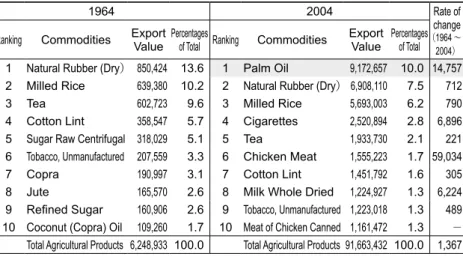
Not only in the oils and fats market, but the status of palm oil in the total agro-export commodities has also advanced. Table 2 shows the structural change of the top 10 agro-export commodities from Asian developing countries. The ranking of palm oil in the Asian agro-export market rose from 20th in the mid 1960s to the top in the mid 2000s, and now it has around a 10% share of the Asian total agro-export value, exceeding natural rubber, milled rice, tea and other items. It is obvious that palm oil represents an emerging commodity among Asian agro-food exports.
What is the background of its rapid growth? First of all, there are some character-istics peculiar to this commodity. Oil palm has the highest land productivity among oil crops because it can be produced all year round, and it has comparative advantage over soybean and other oils in commodity price. Besides price advantage, it is characterized
Table 1 World Vegetable Oil Production and Exports(1965-2005)
(1,000 tons; %)
Production Exports
Volume Percentagesof total Indexes Volume Percentagesof total Indexes 1965 2005 1965 2005 (1965= 100) 1965 2005 1965 2005 (1965= 100) Palm Oil 1,404 33,326 6.5 28.8 2,373.6 618 26,303 16.4 56.3 4,256.1 Soybean Oil 4,037 33,287 18.6 28.7 824.5 727 9,617 19.3 20.6 1,322.8 Rapeseed Oil 1,504 16,027 6.9 13.8 1,065.6 94 1,392 2.5 3.0 1,480.9 Sunflower Oil 3,072 9,681 14.2 8.4 315.1 326 3,054 8.6 6.5 936.8 Cottonseed Oil 2,699 5,033 12.4 4.3 186.5 349 174 9.3 0.4 49.9 Groundnut Oil 3,111 4,509 14.3 3.9 144.9 435 186 11.5 0.4 42.8 Palm Kernel Oil 397 3,906 1.8 3.4 983.9 96 2,027 2.5 4.3 2,111.5 Coconut Oil 2,032 3,143 9.4 2.7 154.7 462 2,090 12.3 4.5 452.4 Olive Oil 1,098 2,903 5.1 2.5 264.4 142 681 3.8 1.5 479.6 Corn Oil 458 2,099 2.1 1.8 458.3 41 741 1.1 1.6 1,807.3 Sesame Oil 506 823 2.3 0.7 162.6 1 34 0.0 0.1 3,400.0 Linseed Oil 1,042 607 4.8 0.5 58.3 311 111 8.2 0.2 35.7 Castor Oil 330 539 1.5 0.5 163.3 169 304 4.5 0.7 179.9 Total Vegetable Oils 21,690 115,883 100.0 100.0 534.3 3,771 46,714 100.0 100.0 1,238.8 Source:Prepared from Oil World 2012, 1994, MPOB, Malaysian Oil Palm Statistics 2005.
Table 2 Top 10 Agro-export Commodities from Asian Developing Countries
($1,000; %)
1964 2004 Rate of
change (1964 ~ 2004) Ranking Commodities Export Value Percentages of Total Ranking Commodities Export Value Percentages of Total
1 Natural Rubber (Dry) 850,424 13.6 1 Palm Oil 9,172,657 10.0 14,757 2 Milled Rice 639,380 10.2 2 Natural Rubber (Dry) 6,908,110 7.5 712 3 Tea 602,723 9.6 3 Milled Rice 5,693,003 6.2 790 4 Cotton Lint 358,547 5.7 4 Cigarettes 2,520,894 2.8 6,896 5 Sugar Raw Centrifugal 318,029 5.1 5 Tea 1,933,730 2.1 221 6 Tobacco, Unmanufactured 207,559 3.3 6 Chicken Meat 1,555,223 1.7 59,034 7 Copra 190,997 3.1 7 Cotton Lint 1,451,792 1.6 305 8 Jute 165,570 2.6 8 Milk Whole Dried 1,224,927 1.3 6,224 9 Refined Sugar 160,906 2.6 9 Tobacco, Unmanufactured 1,223,018 1.3 489 10 Coconut (Copra) Oil 109,260 1.7 10 Meat of Chicken Canned 1,161,472 1.3 - Total Agricultural Products 6,248,933 100.0 Total Agricultural Products 91,663,432 100.0 1,367 Note: Top 10 commodities excluding aggregated items.
Palm oil was 20th in 1964, only 1% share of the total value. Source: Prepared from FAO, FAOSTAT Database.
by having a high melting point similar with tallow, and is used for general purposes by controlling the melting point6. Therefore, as the amount of production and R&D made progress, palm oil has penetrated global spheres in various forms.
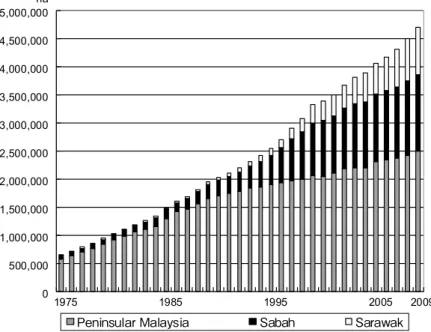
Another point is large-scale oil palm plantation development in Southeast Asia, which made palm oil supply to the world expand rapidly. In particular, Malaysia was the most successful country in introducing large-scale oil palm development policy at an early stage. From the 1960s, facing a price slump crisis of natural rubber, which was once a national prime export product, Malaysia regarded oil palm as an alternative crop of which planting conditions were similar with rubber. Clearing of tropical forests for the purpose of developing plantations in parallel with plantation conversion from rubber to oil palm were pushed forward. As a result, the cultivation area of oil palm for the years 1961-2009 enlarged from less than 100,000 ha to 4.69 million ha (see Figure 1). And, in conjunction with its expansion, palm oil production rocketed from 150,000 ton to 17.56 million ton during this period (Figure 2). This oil palm area accounts for about 60% of the total farmland, by which it can be imagined how oil palm has taken high priority over national development. 0 500,000 1,000,000 1,500,000 2,000,000 2,500,000 3,000,000 3,500,000 4,000,000 4,500,000 5,000,000 1975 1985 1995 2005 2009 ha
Peninsular Malaysia Sabah Sarawak
Figure 1 Oil Palm Planted Area in Malaysia
This rush to develop oil palm plantations has brought about various effects on both domestic and international spheres. First, Malaysia has established the leading producer/ exporter status in the world. Table 3 shows the changing composition of top 5 producers and exporters of palm oil. Malaysia was a mere fourth (export) /fifth (production) on the list in 1961, but from the 1970s through the 1990s it surpassed African countries, the oil palm’s place of origin, and rose to the top to include more than half of the world total. Along with such expansion of its volume, Malaysian export direction has also been extended. Table 4 indicates the major destinations of Malaysian palm oil exports. On the one hand, Malaysia has massively exported palm oil to populous countries such as China, Pakistan and India for manufacturing margarine and cooking oil. On the other hand, it has exported to industrialized countries for industrial uses as well as edible oil. As a result, Malaysia, together with Indonesia, is a hub in the global palm oil distribution network or “global palm connection”.
Second, palm oil contributes to the national economic development, and is literally referred to as the “golden crop.” For example, along with the expansion of production volume, agroindustry related to palm oil has also developed. Factory workers in the palm
Figure 2 Crude Palm Oil Production in Malaysia
Source: MPOB, Malaysian Oil Palm Statistics 2009.
0 2,000,000 4,000,000 6,000,000 8,000,000 10,000,000 12,000,000 14,000,000 16,000,000 18,000,000 20,000,000 1975 1985 1995 2005 2009 t
Table 3 Rankings of Top 5 Producers and Exporters of Palm Oil (%) Ranking 1961 1970 1980 1990 2000 2007 / 2008 Production of FFBs 1 Nigeria 49.5 Nigeria 35.5 Malaysia 42.9 Malaysia 50.9 Malaysia 47.0 Indonesia 41.1 2
Democratic Republic of the Congo
11.6 Malaysia 14.2 Indonesia 11.4 Indonesia 18.3 Indonesia 30.2 Malaysia 40.1 3 Indonesia 6.9
Democratic Republic of the Congo
9.8 Nigeria 19.3 Nigeria 10.2 Nigeria 6.8 Nigeria 4.1 4 Guinea 4.4 Indonesia 8.6 Côte d'Ivoire 3.6 Colombia 2.3 Thailand 2.8 Thailand 4.5 5 Malaysia Ghana 3.7 Ghana 4.6
Democratic Republic of the Congo
3.5 Côte d'Ivoire 2.1 Colombia 2.1 Colombia 1.5 W orld T otal 100.0 W orld T otal 100.0 W orld T otal 100.0 W orld T otal 100.0 W orld T otal 100.0 W orld T otal 100.0
Exports of Palm Oil
1 Nigeria 26.6 Malaysia 44.4 Malaysia 59.1 Malaysia 69.6 Malaysia 57.9 Malaysia 50.0 2
Democratic Republic of the Congo
24.5 Indonesia 17.6 Singapore 18.1 Indonesia 13.5 Indonesia 29.2 Indonesia 34.1 3 Indonesia 18.6 Singapore 14.7 Indonesia 14.1 Singapore 7.7 Netherlands 2.3 Netherlands 4.8 4 Malaysia 15.1
Democratic Republic of the Congo
13.1
Côte d'Ivoire
2.7
Côte d'Ivoire
1.6
Papua New Guinea
1.9
Papua New Guinea
1.4 5 Singapore 4.7 Netherlands 2.1 Netherlands 2.1 Netherlands 1.5 Singapore 1.2 Colombia 1.2 W orld T otal 100.0 W orld T otal 100.0 W orld T otal 100.0 W orld T otal 100.0 W orld T otal 100.0 W orld T otal 100.0 Note:
The latest 2007/2008 data are calculated as follows; production
2008; exports 2007.
Source: Prepared from F
AO, FAOST AT Database ( access Nov . 3 2010 ) .
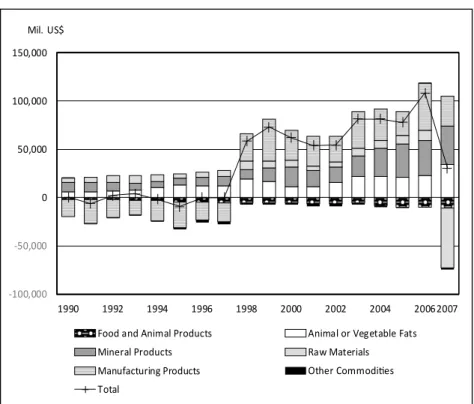
oil industry amounted to about 40,000 persons, and palm oil manufacturing reached RM 67.9 billion which accounted for about 10% of total manufacturing output in 20087. Moreover, palm oil serves as a valuable source of acquisition of foreign currency. Figure 3 shows Malaysian trade surplus by commodity groups. Palm oil consisted of 5% of the total export revenue, but over 30% of the trade surplus of the country in the late 2000s.
In the discourse related to the political economy of agriculture and food, some Third World countries based on export-oriented agriculture are referred to as NACs (New Agricultural Countries) to differentiate from NICs (Newly Industrializing Countries)8. Based on a big breakthrough in the national economy and the global marketplace, Malaysia has also been transformed into one of the NACs based on the emerging palm oil export9.
Table 4 Direction and Share of Malaysian Palm Oil Exports
(%) Ranking of Export Volume 1965 1975 1985 1995 2009 Palm Oil
1 Iraq (24.3) US (29.1) India (18.9) Pakistan (15.8) China (25.4) 2 UK (20.3) Netherlands (14.2) Pakistan (6.6) China (15.6) Pakistan (11.1) 3 Canada (5.1) UK (14.0) Japan (6.2) India (11.1) India (8.5) 4 Netherlands (1.6) Iraq (6.4) USSR (5.0) Japan (4.8) Netherlands (6.2)
5 - (-) Japan (5.2) US (4.4) Egypt (4.5) US (5.4)
Singapore (34.3) Singapore (13.4) Singapore (30.0) Singapore (5.5) Singapore (2.2)
Palm Kernel
Oil
1 US (38.4) Netherlands (41.6) US (21.2) US (20.4) 2 UK (26.6) US (29.4) Netherlands (12.7) China (16.7) 3 Netherlands (8.6) UK (4.2) Japan (11.8) Japan (6.8) 4 Canada (4.2) Italy (2.6) Turkey (7.9) Brazil (6.3) 5 Japan (1.0) Canada (2.4) South Africa (6.9) India (5.1) Singapore (9.6) Singapore (5.2) Singapore (9.3) Singapore (2.1) Note: Export data is based on volume.
Data of palm oil for 1965 and palm kernel oil for 1975 only include Peninsular Malaysia. Exports to Singapore include reexports from Singapore except 1975.
Source: 1995 & 2009: MPOB, Malaysian Oil Palm Statistics 2009, PORLA, Palm Oil Statistics 1996. 1985: Min. of Primary Industries Malaysia, Statistics on Commodities 1987 (Original Source: PORLA). 1965 & 1975: Dept. of Statistics Malaysia, Oil Palm, Coconut and Tea Statistics 1975 & 1970.
2. Structure and Dynamics of Agribusinesses in Malaysia
Based on the above understanding of palm oil development, we will focus on the key economic players involved in the palm oil industry. The palm oil industry consists not only of the agricultural sector itself, but of agroindustrial subsectors including the following; 1) the palm oil milling sector which extracts crude palm oil from fresh fruit bunches (FFBs) harvested in plantations; 2) the refinery sector which refines, bleaches, and deodorizes crude oil to manufacture processed palm oil; 3) the oleochemical sector which produces fatty acids and alcohols for industrial sources such as soap, detergent, and cosmetics; 4) the biodiesel sector which manufactures fuel for automobiles. In other words, commercialization of palm oil is based on close linkage between agricultural and processing sectors, and palm oil industry comprises various economic actors including large-scale plantations, smallholders and palm oil milling/refining factories.
-100,000 -50,000 0 50,000 100,000 150,000 1990 1992 1994 1996 1998 2000 2002 2004 20062007 Mil. US$
Food and Animal Products Animal or Vegetable Fats
Mineral Products Raw Materials
Manufacturing Products Other Commodities
Total
Figure 3 Malaysian Trade Surplus by Commodity Groups
Yet, most importantly, some large-scale agribusiness companies which combine each subsector play a leading role in the industry, and assert influence over the industrial structure. It is necessary to extract FFBs from palm oil within 24 hours after harvest to maintain the oil quality, and the smooth transportation from plantations to mills is indispensable. In addition, a large amount of quantity is also required in consideration of factory utilization. Therefore, plantation-based agribusiness companies, which have the ability to form vertical integration of the commodity chain, eventually predominate at the core of the industry. Already in the second half of the 1990s, Malaysia’s 10 largest companies had 45% of that country’s total oil palm area, while 16 companies accounted for 75% of refining by volume10.
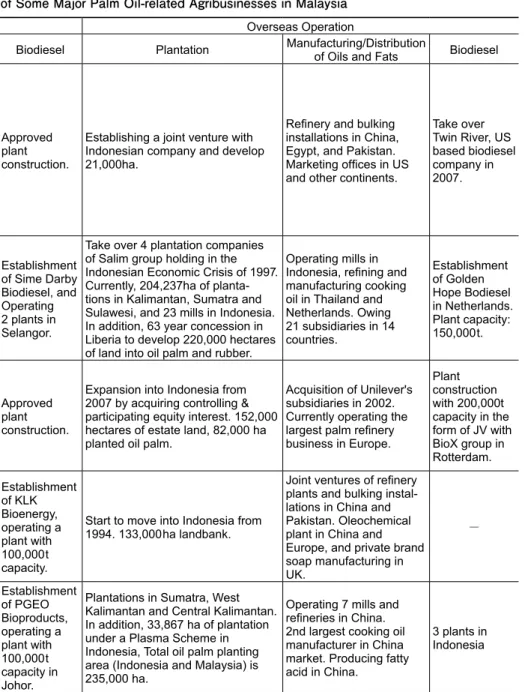
Table 5 arranges some recent strategies by major agribusinesses. First, each company tries to cover every sectors of the entire commodity chain. For example, FELDA (Federal Land Development Authority) is a government agency established in 1956 for the purpose of eradicating poverty by land development and resettlement of the rural landless poor, and of improving socioeconomic status through production of cash crops such as oil palm. But, as the scale of development has become larger, it has expanded into downstream sectors through establishment of subsidiaries and joint ventures with transnational corporations like P&G or Mitsui Co. Recently, FELDA has withdrawn from the settlement project for the rural poor, and, by establishing a public company called Felda Holdings in 2003, this agency transformed itself into one of the largest palm-oil related agribusiness capital in the world11.
Second, some companies are engaged in corporate M&A, and industrial concen-tration and centralization is under progress. In 2007, three plantation majors of Golden Hope, Kumpulan Guthrie and Sime Darby merged to operate as Sime Darby, the largest agriculture-based and plantation TNC ranked by foreign assets in the world12. In the same year, Singapore based Wilmar International, which was made a capital participant by U.S. agribusiness ADM, took over PPB group, affiliated business of the Kuok group. IOI Corporation also took over Pan Century, a major refinery company, and Unilever’s palm oil related business. These movements have resulted in corporate oligopolies and international industrial restructuring13.
Third, each company has been trying to move into overseas business. Concerning this strategy, two patterns are detectable. One is a pattern of establishing downstream refining and logistics/distribution facilities overseas for the purpose of securing the export market. Another is a pattern of upstream plantation development overseas. By the 1980s, they were running out of areas to develop plantations in Peninsular Malaysia, and also running out of labor power due to industrialization. Malaysian Agribusinesses
Table 5 Vertical Integration and Transnationalization of Some Major Palm Oil-related Agribusinesses in Malaysia Name of
Companies Corporate Overview
Domestic Operation (Malaysia) Overseas Operation
Plantation and
Milling Refinery Oleochemical Biodiesel Plantation Manufacturing/Distribution of Oils and Fats Biodiesel
FELDA
FELDA was founded in 1956. A government agency of land development and settlement for the purpose of rural landless poor. Currently FELDA ceased settlement for the poor and only manages own plantations. On October 3, 2003, FELDA estab-lished Felda Holdings Bhd., a public company with authorized capital of 5 billion ringgit. FELDA's production accounted for 6.9% of global production and 17.7% of Malaysia's output In 2009. Plantation 722,946ha; Mills 70 (2008). 4 refineries, including a joint venture with Mistui Co (Japan) and IFFCO (UAE). 11 bulking installations. Joint venture with P&G Approved plant construction.
Establishing a joint venture with Indonesian company and develop 21,000ha.
Refinery and bulking installations in China, Egypt, and Pakistan. Marketing offices in US and other continents.
Take over Twin River, US based biodiesel company in 2007. Sime Darby
Sime Darby was established in 2007 with the merger of Golden Hope, Kumpulan Guthrie, and Sime Darby. Largest public listed company, and world's largest agriculture-based and plantation TNC ranked by foreign assets.
Plantation 326,750 ha; Mills 41. 4 refinery companies JV with Cognis, German company. Establishment of Sime Darby Biodiesel, and Operating 2 plants in Selangor.
Take over 4 plantation companies of Salim group holding in the Indonesian Economic Crisis of 1997. Currently, 204,237ha of planta-tions in Kalimantan, Sumatra and Sulawesi, and 23 mills in Indonesia. In addition, 63 year concession in Liberia to develop 220,000 hectares of land into oil palm and rubber.
Operating mills in Indonesia, refining and manufacturing cooking oil in Thailand and Netherlands. Owing 21 subsidiaries in 14 countries. Establishment of Golden Hope Bodiesel in Netherlands. Plant capacity: 150,000t. IOI Corporation
IOI was founded in 1969, and real estate company from 1982. Chinese capital. From 1985 IOI started oil palm plantation activities by taking over plantation company. 44th largest agriculture-based and plantation TNC in the world by foreign assets.
Plantation 169,000 ha; Mills 12. Acquisition of Unilever's plantations in 2003. Acquisition of Palmco in 2001. Buyout of Unilever's refinery plant. Merger of Pan Century(Indian Company). Acquisition of Palmco in 2001, and Pan Century. Approved plant construction.
Expansion into Indonesia from 2007 by acquiring controlling & participating equity interest. 152,000 hectares of estate land, 82,000 ha planted oil palm.
Acquisition of Unilever's subsidiaries in 2002. Currently operating the largest palm refinery business in Europe. Plant construction with 200,000t capacity in the form of JV with BioX group in Rotterdam. KL Kepong
KL Kepong was founded in 1906. Chinese capital. 7th largest agriculture-based and plantation TNC in the world ranked by foreign assets. Plantations landbank 110,000ha; Mills 7. 2 refinery plants KL Oleo is one of the largest oleochemical manufacturer. Establishment of KLK Bioenergy, operating a plant with 100,000t capacity.
Start to move into Indonesia from 1994. 133,000ha landbank.
Joint ventures of refinery plants and bulking instal-lations in China and Pakistan. Oleochemical plant in China and Europe, and private brand soap manufacturing in UK.
-
Wilmar International
Wilmar is a Singaporean capital, established in 1991 as palm oil trading company. 21st largest agriculture-based plantation TNC in the world by foreign assets. ADM, US based agribusiness, made a capital participant.
Acquisition of Kuok Group's PPB in 2007 with 60,000ha plantations and 7 mills mainly in Sabah and Sarawak. 6 refinery plants - Establishment of PGEO Bioproducts, operating a plant with 100,000t capacity in Johor.
Plantations in Sumatra, West Kalimantan and Central Kalimantan. In addition, 33,867 ha of plantation under a Plasma Scheme in Indonesia, Total oil palm planting area (Indonesia and Malaysia) is 235,000 ha.
Operating 7 mills and refineries in China. 2nd largest cooking oil manufacturer in China market. Producing fatty acid in China.
3 plants in Indonesia
Note: Described only palm oil-related business.
Table 5 Vertical Integration and Transnationalization of Some Major Palm Oil-related Agribusinesses in Malaysia Name of
Companies Corporate Overview
Domestic Operation (Malaysia) Overseas Operation
Plantation and
Milling Refinery Oleochemical Biodiesel Plantation Manufacturing/Distribution of Oils and Fats Biodiesel
FELDA
FELDA was founded in 1956. A government agency of land development and settlement for the purpose of rural landless poor. Currently FELDA ceased settlement for the poor and only manages own plantations. On October 3, 2003, FELDA estab-lished Felda Holdings Bhd., a public company with authorized capital of 5 billion ringgit. FELDA's production accounted for 6.9% of global production and 17.7% of Malaysia's output In 2009. Plantation 722,946ha; Mills 70 (2008). 4 refineries, including a joint venture with Mistui Co (Japan) and IFFCO (UAE). 11 bulking installations. Joint venture with P&G Approved plant construction.
Establishing a joint venture with Indonesian company and develop 21,000ha.
Refinery and bulking installations in China, Egypt, and Pakistan. Marketing offices in US and other continents.
Take over Twin River, US based biodiesel company in 2007. Sime Darby
Sime Darby was established in 2007 with the merger of Golden Hope, Kumpulan Guthrie, and Sime Darby. Largest public listed company, and world's largest agriculture-based and plantation TNC ranked by foreign assets.
Plantation 326,750 ha; Mills 41. 4 refinery companies JV with Cognis, German company. Establishment of Sime Darby Biodiesel, and Operating 2 plants in Selangor.
Take over 4 plantation companies of Salim group holding in the Indonesian Economic Crisis of 1997. Currently, 204,237ha of planta-tions in Kalimantan, Sumatra and Sulawesi, and 23 mills in Indonesia. In addition, 63 year concession in Liberia to develop 220,000 hectares of land into oil palm and rubber.
Operating mills in Indonesia, refining and manufacturing cooking oil in Thailand and Netherlands. Owing 21 subsidiaries in 14 countries. Establishment of Golden Hope Bodiesel in Netherlands. Plant capacity: 150,000t. IOI Corporation
IOI was founded in 1969, and real estate company from 1982. Chinese capital. From 1985 IOI started oil palm plantation activities by taking over plantation company. 44th largest agriculture-based and plantation TNC in the world by foreign assets.
Plantation 169,000 ha; Mills 12. Acquisition of Unilever's plantations in 2003. Acquisition of Palmco in 2001. Buyout of Unilever's refinery plant. Merger of Pan Century(Indian Company). Acquisition of Palmco in 2001, and Pan Century. Approved plant construction.
Expansion into Indonesia from 2007 by acquiring controlling & participating equity interest. 152,000 hectares of estate land, 82,000 ha planted oil palm.
Acquisition of Unilever's subsidiaries in 2002. Currently operating the largest palm refinery business in Europe. Plant construction with 200,000t capacity in the form of JV with BioX group in Rotterdam. KL Kepong
KL Kepong was founded in 1906. Chinese capital. 7th largest agriculture-based and plantation TNC in the world ranked by foreign assets. Plantations landbank 110,000ha; Mills 7. 2 refinery plants KL Oleo is one of the largest oleochemical manufacturer. Establishment of KLK Bioenergy, operating a plant with 100,000t capacity.
Start to move into Indonesia from 1994. 133,000ha landbank.
Joint ventures of refinery plants and bulking instal-lations in China and Pakistan. Oleochemical plant in China and Europe, and private brand soap manufacturing in UK.
-
Wilmar International
Wilmar is a Singaporean capital, established in 1991 as palm oil trading company. 21st largest agriculture-based plantation TNC in the world by foreign assets. ADM, US based agribusiness, made a capital participant.
Acquisition of Kuok Group's PPB in 2007 with 60,000ha plantations and 7 mills mainly in Sabah and Sarawak. 6 refinery plants - Establishment of PGEO Bioproducts, operating a plant with 100,000t capacity in Johor.
Plantations in Sumatra, West Kalimantan and Central Kalimantan. In addition, 33,867 ha of plantation under a Plasma Scheme in Indonesia, Total oil palm planting area (Indonesia and Malaysia) is 235,000 ha.
Operating 7 mills and refineries in China. 2nd largest cooking oil manufacturer in China market. Producing fatty acid in China.
3 plants in Indonesia
Note: Described only palm oil-related business.
have moved into East Malaysia in places such as Sabah and Sarawak (see Figure 1), and further into Indonesia or other countries to develop new plantations in search for vast tracts of land and abundant cheap labor force. As shown in Table 3, this has resulted in Malaysia falling back to second place in world palm oil production, recently giving way to Indonesia. Yet, it is estimated that Malaysian capital accounts for about 30% of plantation development in Indonesia, which means that cross-border plantation devel-opment has become quite advanced14.
3. Agribusiness-led Development and Its Contradictions
Thus, development of the palm oil industry in Malaysia has brought about massive growth opportunities for agribusinesses. However, this agribusiness-led development has caused socio-political impacts and contradictions in Malaysia and in other countries. Most notably, upstream oil palm plantation development has had serious impacts on local people, communities, and environment in and around the development location. This is classified broadly into two types; impacts of plantation expansion and impacts in course of plantation management15.
The former impacts of the plantation development process include large-scale deforestation and related land disputes. Commodity characteristics and increased global demand lead to a vast oil palm monoculture, and tropical forest is a suitable target for development. This causes irreversible decline in the tropical forest ecosystem and biodi-versity. It is estimated that about 33% of forest was converted into oil palm plantations throughout Malaysia, and in Sarawak, the current national front of oil palm development (see Figure 1&2), emission of greenhouse gases leading to climate change as well as deforestation is further exacerbated due to clearing of peatland forest16.
In addition, this environmental destruction occurs in combination with many land disputes between local people and developers or governments. In Sarawak, native customary lands which indigenous people have historically used for planting and hunting are appropriated at the cost of oil palm plantations without any discussion or prior consent, and traditional life is drastically damaged due to destruction of planting areas or contamination of rivers without any compensation. Protests, demonstrations and blockages have been carried out repeatedly by local people against land appropriation and destructive development. According to the report by Forest Peoples Programme and Sawit Watch, there were about 40 lawsuits related to palm oil disputes by native plaintiffs from 1997 to 2007 (Figure 4). And, based on a comprehensive analysis of these conflicts, urgent solutions such as respect of native customary lands, open discussion and
information provision, prior consent, and people’s participation in socio-environmental assessment are also asserted17.
On the other hand, oil palm development also has had serious impacts on direct producers’ conditions in the course of plantation management. In the shadow of agribusiness growth, small farmers who are organized by government agencies to introduce oil palm as instructed often confront income instability and accompanying debt burden attributed to export price fluctuation. FELDA settlers, contrary to the public image of middle-class farmers, often feel reluctant to join the labor process and subcon-tract their labor due to the shaky foundation of economic life18. Moreover, many of them feel discontent to accept FELDA’s control of field labor organization and land ownership system because of a feeling of alienation from self-determination. After strong resis-tance against implementing a new land ownership system in the 1980s, some settlers dropped out of the scheme, which has lead to the current implementation of FELDA’s own plantation management19. After that, the Federal Court ordered FELDA to pay 354 settlers in Kelantan 11 million ringgit for cheating them by stating the grade of their oil palm fruit to be a lower grade in January 201020, and FELDA is now facing more legal suits from other settlers in Johor, Negeri Sembilan and Pahang21. This fact demonstrates that exploitation and proletarianization of settlers by means of labor command have continued behind FELDA’s capital accumulation, and settlers have held on to strong desire for their greater autonomy.
The status of plantation workers under private agribusinesses is more vulnerable than 0 1 2 3 4 5 6 7 8 1997 1998 1999 2000 2001 2002 2003 2004 2005 2006 2007 Number
Figure 4 Number of Lawsuits Related to Palm Oil Development in Sarawak
that of small farmers. Their working conditions are worse than those of workers in other industries, and the average wage of harvesters is said to be lower than RM 700 per month, and that of weeders is about RM 500, both of which are below the rural poverty line of RM72022. They also suffer from pesticide poisoning because of their lack of protection against pesticide dangers23. In recent years, due to a deep labor shortage in combination with avoidance of poor working conditions and drain of labor to industrial and urban worksites, foreign workers are massively imported at the bottom of the labor market.
Table 6 shows that the number of foreign plantation workers, as identified officially, is over 300,000, approximately 90% is Indonesian, and they become engaged in harvesting, spraying, and other field work under the poorest conditions. The number of the total labor force in the oil palm plantation is about 580,000. It is estimated that foreign labor makes up over half of the total work force in Malaysian plantations, especially 80% in East Malaysia24.
Further, Malaysian agribusinesses have become transnational and operating areas are more and more extensive. A set of contradictions such as deforestation, biodiversity loss, land dispute, plight of workers and small farmers also has become transnational. In fact, illegal logging, open burning and haze in Indonesia have been related to some Malaysian companies, and Indonesian plantation workers and smallholders are directly and indirectly related to Malaysian capital by way of employment of wage labor or the Nucleus Estate and Smallholder System (Perkebunan Inti Rakyat: PIR) agreement. As these contradictions thus intensify and extend across borders, palm oil is now exposed to a wave of international criticism against environmental destruction and human rights
Table 6 Foreign Plantation Workers in Malaysia
(Number; % ) Number of Persons Percentages of Total
2000 2004 2007 2000 2004 2007 Total 200,474 384,473 337,503 100.0 100.0 100.0 Indonesia 186,236 352,339 290,484 92.9 91.6 86.1 India 168 16,536 22,451 0.1 4.3 6.7 Bangradesh 9,959 2,592 14,207 5.0 0.7 4.2 Philippines 3,236 5,341 4,662 1.6 1.4 1.4 Nepal 228 5,159 2,584 0.1 1.3 0.8 Others 647 2,506 3,115 0.3 0.7 0.9
Note: This data is made by the Immigration Department. This doesn’t include undocumented workers. Source: Prepared from Ministry of Plantation Industries and Commodities, Statistics on Commodities 2008.
abuse25. Transnational political contradiction between Malaysian agribusinesses and local people in Indonesia as well as national contradiction reaches an intolerable level for everyone concerned with palm oil commodity chains.
Conclusion: Beyond Agribusiness-led Development
As we have seen, Malaysian export-oriented palm oil development has had positive impacts on Malaysia’s economic growth called NACs. In particular, agribusiness corpo-rations have played an important role in this remarkable development. As production has expanded, many agribusinesses have tried to apply the following strategies; 1) vertical integration of commodity chains from agriculture to value-added downstream sectors; 2) transnationalization of operations in search of developing plantations or market access. Only a few top plantation-based agribusinesses which secure raw procurement have competitive advantage to use these strategies.
But, contrary to agribusiness growth, upstream plantation expansion has caused contra-diction and limitation from the viewpoint of local people and communities. On the one hand, there is large-scale deforestation and related land disputes between agribusiness/ government and local communities due to land appropriation and destruction for the sake of plantation expansion. On the other hand, there are impacts of agribusiness on smallholders and plantation workers such as instability of economic life and alienation of self-determination. Besides this, as agribusinesses have been transnationalized in terms of imported foreign labor and plantation development overseas such as Indonesia, the contradiction of agribusiness-led development has also become transnationalized and, as a result, leads to international criticisms.
Finally, we will show some new trends which will influence on future palm oil development. First, Malaysian national biofuel policy was set up in 2006, and there was a biodiesel boom, centering on plant registration and construction. This resulted in soaring palm oil prices and a slowdown in the realization of plant operation. On the other hand, some agribusinesses are seeking overseas farmland in food importing countries to expand oil palm plantations for biodiesel, and so-called “Land Grabbing” raises additional concerns about threatening local livelihood and food security26. It is necessary to watch the biodiesel trend which has lead to new global demand and accompanying overexploitation of plantation development27.
Second, after the criticism against environmental destruction and political conflicts, a new framework to control overexploitation was set up called Roundtable on Sustainable Palm Oil (RSPO). RSPO was established in order to encourage participation from entire
stakeholders of palm oil commodity chains such as palm oil-related companies and associations, financial companies, social and environmental NGOs, and to discuss ways of ensuring sustainable palm oil production and utilization. Since its establishment, RSPO members have grown to 505 (ordinary members) and 95 (affiliate members) around the world, and, through consultation between RSPO members, principles and criteria for sustainable palm oil production were determined in 2005, and a program of certified sustainable palm oil was introduced in 200828. While this approach has just begun and there are some criticisms and limitations such as corporate greenwash29, we must observe what is possible to realize sustainable development.
That palm oil has become a global commodity means palm oil consumers throughout the world are connected by local contradictions in Malaysia and related production sites. By introducing an RSPO approach and building an international monitoring network of social and environmental NGOs, it is time to regulate agribusiness-led development and pursue new forms of development which are more sustainable and prevent victimization through overdevelopment.
Acknowledgement
This paper is based on the presentation at the JSPS Asian Core-Program Seminar “Local Politics and Social Cleavages in Transforming Asia (organized by JSPS Asian Core-Program, CSEAS and CAPAS)” held in Kyoto, December 17-18, 2010. This derives partly from research results of the “Globalization and Plantations in Southeast Asia: Oil Palm Transforming Economy, Nature and Community” project funded by the Suntory Foundation. The author would like to thank Okamoto Masaaki, the Seminar coordinator, and Hayashida Hideki, the principal investigator of the research project. And thanks also to Darren Lingley for his invaluable help and suggestions on my first draft.
Notes
1 For some recent analyses of Free Trade regimes and agro-food crisis, see Bello (2009); Murphy (2010).
2 For example, see Malaysian Palm Oil Board (2007); Yusof (2008).
3 See Wakker (2004); Millieudefensie, Sahabat Alam Malaysia, Friends of the Earth England, Wales and Northern Ireland, Friends of the Earth Europe & Friends of the Earth International (2008).
4 Tauli-Corpuz & Tamang (2007); United Nations Development Programme (2007), p.144; United Nations Environment Programme (2009), pp.63-71.
5 Global Environmental Forum, FoE Japan et al. (2006). 6 Kato (1990).
7 Ministry of Plantation Industries and Commodities Malaysia (2008); Department of Statistics Malaysia (2009).
8 NACs refer to a group of Third World Countries pursuing agroindustrialization and nontradi-tional agroexporting. For example, see McMichael (1996), pp.102-104.
9 Iwasa (2005), pp.17-21, 33-78. 10 For details, see Iwasa (2008a), pp.51-58. 11 Iwasa (2005), pp.145-180.
12 United Nations Conference on Trade and Development (2009), p.126 and Annex Table A.Ⅲ.4. 13 Iwasa (2008b), pp.163-167.
14 Iwasa (2008b), pp.167-172.
15 For my detailed analysis, see Iwasa (2008b), pp.183-189.
16 Millieudefensie, Sahabat Alam Malaysia, FoE England, Wales and Northern Ireland, Friends of the Earth Europe & Friends of the Earth International (2008), pp.14-34.
17 Colchester, Wee, Wong & Jalong (2007), pp.35-89.
18 For example, the settlers’ average gross income has became 4.3 hold increase from 758 to 3,278 ringgit in 2000-08, but next year the income sharply dropped to 1,953 ringgit (see Federal Land Development Authority (2009); Federal Land Development Authority (2010)). This income fluctuation is accounted for by the direct influence of world market volatility.
19 Halim (1992); Iwasa (2005), pp.181-218.
20 “Felda must pay settlers after losing in court,” New Straits Times, January 20, 2010. 21 “And now, Jengka Settlers hit Felda with Fraud Suit,” Malaysiakini, June 17, 2011.
22 “Malaysian Plantation Workers: Stop Lying to Us,” Malaysiakini, Nov 19, 2009 (reprinted in Committee for Asian Women Homepage, (http://www.cawinfo.org/2009/11/malaysian-plantation-workers-stop-lying-to-us/). Concerning this issue, a bitter dispute arose between Malaysian Plantation Industries and Commodities Minister and Parti Sosialis Malaysia. 23 For a representative study, see Tenaganita & Pesticide Action Network Asia & the Pacific
(2002).
24 “Labour Shortage Affecting Oil Palm Plantations,” The Star, February 9, 2010; Koo & Chandramohan (2002).
25 Not only international NGOs but also local NGOs such as Sawit Watch have played an important role to form transnational palm oil monitoring network. For example, see Colchester, Norman, Andiko, Sirait, Asep, Surambo & Pane (2006).
26 For example, Sime Darby has leased 220,000 ha of land in Liberia and is entering a deal to buy 300,000 ha in Cameroon. Following the implementation of a two-year ban on granting new concessions of forest areas in Indonesia, it has taken a strategy to invest in other land abundant countries for exporting the European biodiesel markets. See Levitt (2011).
27 For detailed analyses of Malaysian biodiesel, see Iwasa (2008b), pp.163-167; Pio Lopez & Laan (2008).
28 Roundtable on Sustainable Palm Oil (2011); Iwasa (2008b), pp.192-197. 29 World Rainforest Movement (2010).
References
Bello, Walden (2009) The Food Wars, London: Verso.
Colchester, Marcus, Norman Jiwan, Andiko, Martua Sirait, Asep Yunan Firdaus, A. Surambo & Herbert Pane (2006) Promised Land: Palm Oil and Land Acquisition in Indonesia Implications for Local Communities and Indigenous Peoples, Moreton-in-Marsh and Bogor: Forest Peoples Programme, Perkumpulan Sawit Watch, HuMA & World Agroforestry Centre.
Colchester, Marcus, Wee Aik Pang, Wong Meng Chuo & Thomas Jalong (2007) Land Is Life: Land Rights and Oil Palm Development in Sarawak, Bogor and Moreton-in-Marsh: Perkumpulan Sawit Watch & Forest Peoples Programme.
Department of Statistics Malaysia (2009) Report on the Annual Survey of Manufacturing Industries 2008, Putrajaya: Department of Statistics Malaysia.
Federal Land Development Authority (2010) FELDA Website (http:// www.felda.net.my). Federal Land Development Authority (2009) FELDA Information 2009, FELDA.
Global Environmental Forum, Friends of the Earth Japan et al. (2006) “Appeal against a TV Commercial for Lion’s ‘New Top’: An Socio-Environmental Assessment of Palm Oil’s Places of Origin,” Press Release, April 7 (in Japanese).
Halim, Salleh (1992) “Peasants, Proletarianisation and the State: FELDA Settlers in Pahang,” Joel Kahn & Francis Loh Kok Wah (eds.), Fragmented Vision: Culture and Politics in Contemporary Malaysia, Sydney: Allen & Unwin.
Iwasa, Kazuyuki (2005) Agricultural Development and Agribusiness in Malaysia: Light and Shade of Export-led Development, Kyoto: Houritsu Bunka Sya (in Japanese).
(2008a) “Export-Oriented Agriculture and Agribusiness in Southeast Asia: With Special Reference to Malaysian Palm Oil,” Kochi University Review of Social Science, No.91, March (in Japanese).
(2008b) “Palm Biodiesel in Southeast Asia,” Ban’nai Hisashi & Ohe Tetsuo (eds.), Fuel or Food?: A True Story of Bioethanol, Tokyo: Nihonkeizai Hyoron Sya (in Japanese).
Kato, Akio (ed.) (1990) Application of Palm Oil and Palm Kernel Oil, Tokyo: Saiwai Shobo (in Japanese).
Koo, Khee Ming & D. Chandramohan (2002) “Malaysian Palm Oil Industry at Crossroads and Its Future Direction,” Oil Palm Industry Economic Journal, Vol.2, No.2.
Levitt, Tom (2011) “Palm Oil Giants Target Africa in ‘Land Grab’ Following Indonesia Deforestation Ban,” Ecologist, March 25.
McMichael, Philip (1996) Development and Social Change: A Global Perspective, Thousand Oaks: Pine Forge Press.
Malaysian Palm Oil Board (2007) Leadership in Palm Oil Innovations: Empowering Change for the Palm Oil Industry, Selangor: Malaysian Palm Oil Board.
Millieudefensie, Sahabat Alam Malaysia, Friends of the Earth England, Wales and Northern Ireland, Friends of the Earth Europe & Friends of the Earth International (2008) Malaysian Palm Oil: Green Gold or Green Wash ?, Amsterdam: Friends of the Earth International.
Ministry of Plantation Industries and Commodities Malaysia (2008) Statistics on Commodities 2008, Putrajaya: Ministry of Plantation Industries and Commodities Malaysia.
Murphy, Sophia (2010) “Free Trade in Agriculture: A Bad Idea Whose Time Is Done,” Fred Magdoff & Brian Tokar (eds.), Agriculture and Food in Crisis: Conflict, Resistance, and Renewal, New York: Monthly Review Press.
Pio Lopez, Gregore & Tara Laan (2008) Biofuels: At What Cost?:Government Support for Biodiesel in Malaysia, Geneva: Global Subsidies Initiative of the International Institute for Sustainable Development.
Roundtable on Sustainable Palm Oil (2011) RSPO Website (http://www.rspo.org/).
Tauli-Corpuz, Victoria & Parshuram Tamang (2007) “Oil Palm and Other Commercial Tree Crop Plantations Monocropping,” Paper Presented to the Sixth Session, Permanent Forum on Indigenous Issues, New York, May 14-25.
Tenaganita & Pesticide Action Network Asia & the Pacific (2002) Poisoned and Silenced: A Study of Pesticide Poisoning in the Plantations, Kuala Lumpur: Tenaganita & Pesticide Action Network Asia & the Pacific.
United Nations Conference on Trade and Development (2009) World Investment Report 2009: Transnational Corporations, Agricultural Production and Development, New York and Geneva: United Nations.
United Nations Development Programme (2007) Human Development Report 2007/2008- Fighting Climate Change: Human Solidarity in a Divided World, New York: UNDP.
United Nations Environment Programme (2009) Assessing Biofuels: Towards Sustainable Production and Use of Resources, Paris: UNEP.
Wakker, Eric (2005) Greasy Palms: The Social and Ecological Impacts of Large-scale Oil Palm Plantation Development in Southeast Asia, London: Friends of the Earth.
World Rainforest Movement (2010) “The ‘Greening’ of a Shady Business: Roundtable for Sustainable Palm Oil,” Seedling, October 2010.
Yusof, Basiron (2008) “Malaysia’s Oil Palm: Hallmark of Sustainable Development,” Global Oils & Fats Business Magazine, Vol.5, Issue 4.