For Review Only
Hypercholesterolemia and Diabetic Retinopathy Study
Journal: Diabetes, Obesity and Metabolism Manuscript ID DOM-18-0767-OP.R1
Manuscript Type: Original Paper Date Submitted by the
Author: n/a
Complete List of Authors: Itoh, Hiroshi; Keio University School of Medicine, Department of Endocrinology, Metabolism and Nephrology
Komuro, Issei; The University of Tokyo
Takeuchi, Masahiro; Kitasato University, Graduate School of Phamaceutical Sciences
Akasaka, Takashi; Wakayama Medical University
Daida, Hiroyuki; Juntendo University School of Medicine, Cardiology Egashira, Yoshiki; Sakura Hospital
Fujita, Hideo; Jichi Medical University Saitama Medical Center Higaki, Jitsuo; Ehime University Graduate School of Medicine Hirata, Ken-ichi; Kobe University Graduate School of Medicine
Ishibashi, Shun; Jichi Medical University, Division of Endocrinology and Metabolism
Isshiki, Takaaki; Ageo Central General Hospital
Ito, Sadayoshi; Tohoku University Hospital., Division of Nephrology, Endocrinology and Vascular Medicine
Kashiwagi, Atsunori; Kusatsu General Hospital, director
Kato, Satoshi; The University of Tokyo Graduate School of Medicine Kitagawa, Kazuo; Tokyo Women's Medical University
Kitakaze, Masafumi; National Cerebral and Cardiovascular Center Kitazono, Takanari; Graduate School of Medical Sciences, Kyushu University
Kurabayashi, Masahiko; Gunma University Graduate School of Medicine, Department of Medicine and Biological Science
Miyauchi, Katsumi; Juntendo University School of Medicine, Department of Cardiology
Murakami, Tomoaki; Kyoto University Graduate School of Medicine Murohara, Toyoaki; Nagoya University Graduate School of Medicine Node, Koichi; Saga University, Cardiovascular & Renal Medicine Ogawa, Susumu; Tohoku Unvercity, Division of Nephrology, Endocrinology, and Vascular Medicine
Saito, Yoshihiko; Nara Medical University
Seino, Yoshihiko; Nippon Medical School Chiba Hokusoh Hospital Shigeeda, Takashi; Ideta Eye Clinic
For Review Only
Sugiyama, Seigo; Jinnouchi Hospital, Diabetes Care Center; Kumamoto University, Cardiovascular Medicine
Terauchi, Yasuo; Yokohama City University Graduate School of Medicine Tsutsui, Hiroyuki; Kyushu University
Ueshima, Kenji; Institute for Advancement of Clinical and Translational Science, Kyoto University Hospital
Utsunomiya, Kazunori; Jikei University School of Medicine, Division of Diabetes, Metabolism and Endocrinology, Department of Internal Medicine
Yamagishi, Masakazu; Kanazawa University Graduate School of Medicine, Division of Cardiovascular Medicine
Yamazaki, Tsutomu; The University of Tokyo Hospital Yo, Shoei ; Yo Clinic
Yokote, Koutaro; Chiba University Graduate School of Medicine Yoshida, Kiyoshi; Sakakibara Heart Institute of Okayama Yoshimura, Michihiro; The Jikei University School of Medicine Yoshimura, Nagahisa; Kitano Hospital
Nakao, Kazuwa; Kyoto University Graduate School of Medicine, Department of Medicine and Clinical Science
Nagai, Ryozo; Jichi Medical University
Key Words: cardiovascular disease, clinical trial, diabetic retinopathy, dyslipidaemia, lipid-lowering therapy
3 4 5 6 7 8 9 10 11 12 13 14 15 16 17 18 19 20 21 22 23 24 25 26 27 28 29 30 31 32 33 34 35 36 37 38 39 40 41 42 43 44 45 46 47 48 49 50 51 52 53 54
For Review Only
Article Type: Original Article
Title:
Achieving LDL-C target levels less than 70 mg/dL may provide extra cardiovascular protection in high-risk patients: exploratory analysis of the Standard Versus Intensive Statin Therapy for Patients With Hypercholesterolemia and Diabetic Retinopathy Study
Running title:
Treat-to-target statins in high-risk patients
Authors:
Hiroshi Itoh, MD1; Issei Komuro, MD2; Masahiro Takeuchi, ScD3; Takashi Akasaka, MD4;
Hiroyuki Daida, MD5; Yoshiki Egashira, MD6; Hideo Fujita, MD7; Jitsuo Higaki, MD8; Ken-ichi
Hirata, MD9; Shun Ishibashi, MD10; Takaaki Isshiki, MD11; Sadayoshi Ito, MD12; Atsunori
Kashiwagi, MD13; Satoshi Kato, MD14; Kazuo Kitagawa, MD15; Masafumi Kitakaze, MD16;
Takanari Kitazono, MD17; Masahiko Kurabayashi, MD18; Katsumi Miyauchi, MD19; Tomoaki
Murakami, MD20; Toyoaki Murohara, MD21; Koichi Node, MD22; Susumu Ogawa, MD23;
Yoshihiko Saito, MD24; Yoshihiko Seino, MD25; Takashi Shigeeda, MD26; Shunya Shindo,
MD27; Masahiro Sugawara, MD28; Seigo Sugiyama, MD29; Yasuo Terauchi, MD30; Hiroyuki
Tsutsui, MD31; Kenji Ueshima, MD32; Kazunori Utsunomiya, MD33; Masakazu Yamagishi,
MD34; Tsutomu Yamazaki, MD35; Shoei Yo, MD36; Koutaro Yokote, MD37; Kiyoshi Yoshida,
3 4 5 6 7 8 9 10 11 12 13 14 15 16 17 18 19 20 21 22 23 24 25 26 27 28 29 30 31 32 33 34 35 36 37 38 39 40 41 42 43 44 45 46 47 48 49 50 51 52 53 54
For Review Only
MD38; Michihiro Yoshimura, MD39; Nagahisa Yoshimura, MD40; Kazuwa Nakao, MD41; Ryozo
Nagai, MD42; for the EMPATHY Investigators
Affiliations:
1Department of Endocrinology, Metabolism and Nephrology, Keio University School of
Medicine, Tokyo, Japan
2Department of Cardiovascular Medicine, The University of Tokyo Graduate School of
Medicine, Tokyo, Japan
3Department of Clinical Medicine (Biostatistics and Pharmaceutical Medicine), School of
Pharmacy, Kitasato University, Tokyo, Japan
4Department of Cardiovascular Medicine, Wakayama Medical University, Wakayama, Japan 5Department of Cardiovascular Medicine, Graduate School of Medicine Juntendo University,
Tokyo, Japan
6Sakura Hospital, Fukuoka, Japan
7Department of Cardiology, Saitama Medical Center, Jichi Medical University, Saitama, Japan 8Department of Integrated Medicine and Informatics, Ehime University Graduate School of
Medicine, Toon, Japan
9Division of Cardiovascular Medicine, Department of Internal Medicine, Kobe University
Graduate School of Medicine, Kobe, Japan
10Division of Endocrinology and Metabolism, Department of Internal Medicine, Jichi Medical
University, Shimotsuke, Japan
11Division of Cardiology, Cardiovascular Center, Ageo Central General Hospital, Ageo, Japan
3 4 5 6 7 8 9 10 11 12 13 14 15 16 17 18 19 20 21 22 23 24 25 26 27 28 29 30 31 32 33 34 35 36 37 38 39 40 41 42 43 44 45 46 47 48 49 50 51 52 53 54
For Review Only
12Division of Nephrology, Endocrinology and Vascular Medicine, Tohoku University Graduate
School of Medicine, Sendai, Japan
13Kusatsu General Hospital, Kusatsu, Japan
14Department of Ophthalmology, The University of Tokyo Graduate School of Medicine, Tokyo,
Japan
15Department of Neurology, Tokyo Women’s Medical University School of Medicine, Tokyo,
Japan
16Division of Cardiology, National Cerebral and Cardiovascular Center, Suita, Japan
17Department of Medicine and Clinical Science, Graduate School of Medical Sciences, Kyushu
University, Fukuoka, Japan
18Department of Medicine and Biological Science, Gunma University Graduate School of
Medicine, Maebashi, Japan
19Department of Cardiology,Graduate School of Medicine Juntendo University, Tokyo, Japan 20Department of Ophthalmology, Kyoto University Graduate School of Medicine, Kyoto, Japan 21Department of Cardiology, Nagoya University Graduate School of Medicine, Nagoya, Japan 22Department of Cardiovascular Medicine, Saga University, Saga, Japan
23Division of Nephrology, Endocrinology and Vascular Medicine, Tohoku University Hospital,
Sendai, Japan
24First Department of Internal Medicine, Nara Medical University, Kashihara, Japan
25Department of Cardiology, Nippon Medical School Chiba Hokusoh Hospital, Inzai, Japan 26Ideta Eye Clinic, Kumamoto, Japan
27Department of Cardiovascular Surgery, Tokyo Medical University Hachioji Medical Center,
Hachioji, Japan 3 4 5 6 7 8 9 10 11 12 13 14 15 16 17 18 19 20 21 22 23 24 25 26 27 28 29 30 31 32 33 34 35 36 37 38 39 40 41 42 43 44 45 46 47 48 49 50 51 52 53 54
For Review Only
28Sugawara Medical Clinic, Tokyo, Japan
29Department of Cardiology, Jinnouchi Hospital, Kumamoto, Japan
30Department of Endocrinology & Metabolism, Yokohama City University School of Medicine,
Yokohama, Japan
31Department of Cardiovascular Medicine, Faculty of Medical Sciences, Kyushu University,
Fukuoka, Japan
32Department of EBM Research, Institute for Advancement of Clinical and Translational
Science, Kyoto University Hospital, Kyoto, Japan
33Division of Diabetes, Metabolism and Endocrinology, Department of Internal Medicine, The
Jikei University School of Medicine, Tokyo, Japan
34Department of Cardiovascular and Internal Medicine, Kanazawa University Graduate School
of Medicine, Kanazawa, Japan
35Clinical Research Support Center, The University of Tokyo Hospital, Tokyo, Japan 36Yo Clinic, Kyoto, Japan
37Department of Clinical Cell Biology and Medicine, Chiba University Graduate School of
Medicine, Chiba, Japan
38Sakakibara Heart Institute of Okayama, Okayama, Japan
39Division of Cardiology, Department of Internal Medicine, The Jikei University School of
Medicine, Tokyo, Japan
40Kitano Hospital, The Tazuke Kofukai Medical Research Institute, Osaka, Japan
41Medical Innovation Center, Kyoto University Graduate School of Medicine, Kyoto, Japan 42Jichi Medical University, Shimotsuke, Japan
3 4 5 6 7 8 9 10 11 12 13 14 15 16 17 18 19 20 21 22 23 24 25 26 27 28 29 30 31 32 33 34 35 36 37 38 39 40 41 42 43 44 45 46 47 48 49 50 51 52 53 54
For Review Only
Corresponding author:
Hiroshi Itoh
Department of Endocrinology, Metabolism and Nephrology, Keio University School of Medicine
35 Shinanomachi, Shinjuku-ku, Tokyo, 160-8582
Tel.: +81 3-5363-3795; Fax: +81 3-3354-7446; e-mail: [email protected]
Total word counts: 3,319 words including the abstract, text
Number of tables: 1 Number of figures: 4 Number of references: 12 3 4 5 6 7 8 9 10 11 12 13 14 15 16 17 18 19 20 21 22 23 24 25 26 27 28 29 30 31 32 33 34 35 36 37 38 39 40 41 42 43 44 45 46 47 48 49 50 51 52 53 54
For Review Only
Abstract
AimsEMPATHY, a multicenter, randomized, open-label, blinded-endpoint study, assessed the benefits of intensive statin therapy on reducing cardiovascular (CV) events in type 2 diabetic patients with hyperlipidemia and retinopathy in primary prevention in Japan. Intensive therapy (targeting LDL-C <70 mg/dL) was no more effective than standard therapy (LDL-C ≥100 to <120 mg/dL) in the intention-to-treat population. However, after 3 years, intergroup difference in LDL-C was only 27.7 mg/dL, and targeted levels were achieved in <50% of patients. We
hypothesized that the intergroup difference in CV events would have been statistically significant if more patients had been successfully treated to target.
Materials and methods
This exploratory post-hoc analysis focused on intergroup data from patients who achieved their target LDL-C levels. A Cox proportional hazards model was used to estimate HRs for incidence of the primary endpoint in patients who achieved target LDL-C levels in each group.
Results
Data were analyzed from 1909 patients (intensive: 703; standard: 1206) who achieved target LDL-C levels. LDL-C at 36 months was 59.7±11.6 mg/dL in the intensive group and 107.1±17.8 mg/dL in the standard group (P< .05). After adjusting for baseline prognostic factors, composite incidence of CV events or deaths associated with CV events was significantly lower in the intensive than the standard group (HR, 0.48; 95% CI, 0.28−0.82; P= .007).
3 4 5 6 7 8 9 10 11 12 13 14 15 16 17 18 19 20 21 22 23 24 25 26 27 28 29 30 31 32 33 34 35 36 37 38 39 40 41 42 43 44 45 46 47 48 49 50 51 52 53 54
For Review Only
Conclusions
This post-hoc analysis suggests that achieving LDL-C target levels <70 mg/dL may more effectively reduce CV events than achieving target levels ≥100 to <120 mg/dL in patients with hypercholesterolemia and diabetic retinopathy.
KEYWORDS
cardiovascular disease, clinical trial, diabetic retinopathy, dyslipidemia, lipid-lowering therapy
3 4 5 6 7 8 9 10 11 12 13 14 15 16 17 18 19 20 21 22 23 24 25 26 27 28 29 30 31 32 33 34 35 36 37 38 39 40 41 42 43 44 45 46 47 48 49 50 51 52 53 54
For Review Only
1 INTRODUCTION
Aging populations and modern lifestyles have been increasingly associated with higher levels of dyslipidemia and impairment of glucose metabolism in diseases such as type 2 diabetes around the world. Each of these conditions is a known risk factor for cardiovascular disease (CVD), and the risk of a cardiovascular (CV) event is even higher in patients with both conditions.1-3 Among
patients with diabetes, the CV risk is known to be further increased in patients whose diabetes is complicated by retinopathy; such patients are recognized to be at very high risk for CVD.4,5
The EMPATHY study is the first to assess the benefits of intensive statin therapy in type 2 diabetic patients with hyperlipidemia and diabetic retinopathy in a primary prevention setting, and also the first large-scale clinical study to evaluate the effectiveness of the treat-to-target approach. The study compared the benefits of intensive and standard statin therapy on reducing a composite of CV events or deaths from CV events (the primary endpoint). Analysis of the
intention-to-treat population showed that lipid-lowering therapy targeting <70 mg/dL of low-density lipoprotein cholesterol (LDL-C) did not have a more beneficial effect on the primary endpoint than therapy targeting ≥100 to <120 mg/dL (hazard ratio [HR], 0.84; 95% confidence interval [CI], 0.67−1.07; P= .15).6 These findings appeared to contradict earlier findings that
indicate the benefits of lower LDL-C in patients with diabetes.7-9
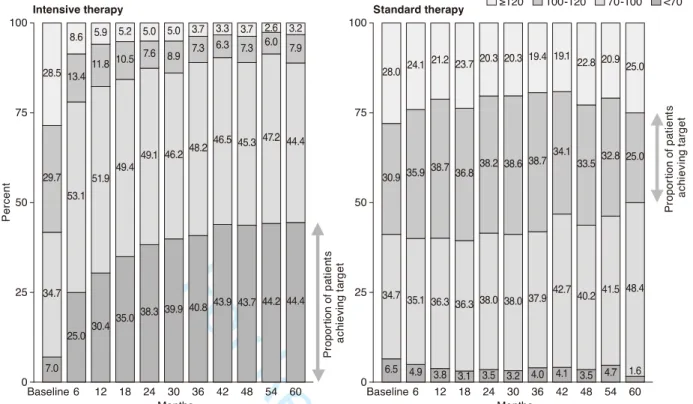
Notably, however, the LDL-C target in the EMPATHY study was achieved by less than half of the patients in either group. In addition, a large percentage of patients on standard therapy in the original study (targeting ≥100 to <120 mg/dL) actually achieved LDL-C levels below the target range (Figure 1). These factors may have contributed to masking the efficacy of the intensive therapy. 3 4 5 6 7 8 9 10 11 12 13 14 15 16 17 18 19 20 21 22 23 24 25 26 27 28 29 30 31 32 33 34 35 36 37 38 39 40 41 42 43 44 45 46 47 48 49 50 51 52 53 54
For Review Only
To further investigate the efficacy of intensive therapy, we conducted additional exploratory analyses of between-group comparisons. Although previous large-scale clinical studies of statins have included exploratory (post-hoc) analyses stratified by lipid levels achieved, in all cases these subanalyses were for dose comparison studies. More importantly, none of the studies assessed whether the patients achieved prespecified goals for LDL-C levels.10,11
We limited our subanalyses to those patients whose LDL-C levels were within the targeted range, in order to better assess the effects of the treat-to-target approach in these patient populations. Our hypothesis was that intensive therapy in patients who achieved their target (LDL-C <70 mg/dL) would be superior to standard therapy (LDL-C target ≥100 to <120 mg/dL) in reducing the incidence of composite CV events.
2 MATERIALS AND METHODS
2.1 Study designThe EMPATHY study was conducted to determine whether intensive lipid-lowering therapy is superior to standard therapy in reducing the incidence of CV events or death from CV events in type 2 diabetic patients with hyperlipidemia and diabetic retinopathy and without a history of CVD.6,12 The study used a multicenter, prospective, randomized, open-label, blinded endpoint
(PROBE) design. It was conducted in Japan in accordance with the Declaration of Helsinki and Japanese ethical guidelines for clinical studies. The protocol was reviewed and approved by the institutional review board of each participating center. The study was registered with the University Hospital Medical Information clinical trials registry (UMIN000003486).
3 4 5 6 7 8 9 10 11 12 13 14 15 16 17 18 19 20 21 22 23 24 25 26 27 28 29 30 31 32 33 34 35 36 37 38 39 40 41 42 43 44 45 46 47 48 49 50 51 52 53 54
For Review Only
The subanalysis design was based on the results of the primary analysis of the
EMPATHY study, in which patients were initially treated to ≥100 to <120 mg/dL (run-in period) and were then randomized (1:1) to intensive therapy targeting LDL-C <70 mg/dL or standard therapy targeting ≥100 to <120 mg/dL (treatment period). The primary endpoint was a composite of the incidence of CV events (cardiac, cerebral, renal, and vascular events) and death from CV events, compared between the two groups.
2.2 Patients
This subanalysis was performed on data collected from patients in the EMPATHY study who achieved mean LDL-C of <70 mg/dL in the intensive therapy group in the original study (the intensive group) and ≥100 to <120 mg/dL in the standard therapy group in the original study (the standard group). The mean LDL-C for each patient was defined as the mean value of
measurements obtained at scheduled visits, starting 6 months after randomization to the intensive therapy group or the standard therapy group in the original study and continuing to the final visit for those who developed no events or to the nearest day before onset for those who developed any events.
2.3 Procedures
Analysis included all patients who had at least one scheduled visit during the period starting 6 months after randomization. For reference, in comparison to these mean values, additional analysis was performed on data collected from patients who showed the target LDL-C level at their last visit. The last visit was defined to be the nearest day before onset of an event for patients who developed any events, or the date of the final visit for patients who did not develop any events during the scheduled visits, starting 6 months after randomization to a treatment group. 3 4 5 6 7 8 9 10 11 12 13 14 15 16 17 18 19 20 21 22 23 24 25 26 27 28 29 30 31 32 33 34 35 36 37 38 39 40 41 42 43 44 45 46 47 48 49 50 51 52 53 54
For Review Only
2.4 Outcomes
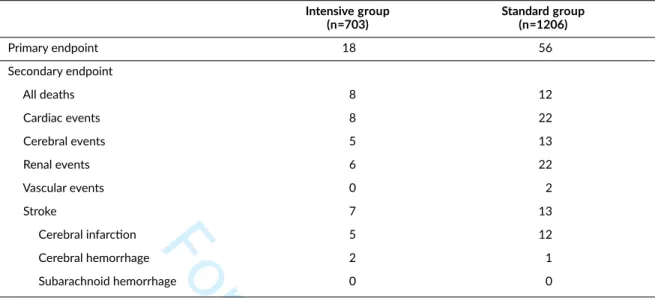
In the EMPATHY study, the primary outcome was the composite incidence of CV events, including cardiac, cerebral, renal, and vascular events, or death associated with CV events. The secondary outcomes included death from any cause; individual incidence of the events defined as CV events for the primary endpoint; incidence of stroke; change in laboratory variables related to chronic kidney disease; and safety. Primary and secondary endpoints were adjudicated by an event evaluation committee whose members were unaware of the treatment allocation. In this subanalysis, we analyzed only the primary outcome and safety because of the small number of CV events.
2.5 Statistical analysis
A Cox proportional hazards model was used to estimate HRs and 95% CIs for the incidence of the primary endpoint in patients who achieved target LDL-C levels in the intensive and standard groups. Because this additional analysis was performed in a sub-group of patients, a Cox
proportional hazards model was applied, with study group and baseline influencing factors as explanatory variables, to adjust for these factors.
A stepwise method was used with the Cox proportional hazards model in the full analysis set (intention-to-treat [ITT] population) to select influencing factors; the primary endpoint was the objective variable, and prognostic factors were the explanatory variables. In this analysis, fifteen potential prognostic factors were evaluated: gender, age, body mass index (BMI), compliance with lipid-lowering agents (including statins) from enrollment, smoking status (current smoker, past smoker, non-smoker), family history of coronary artery disease, family history of cerebrovascular disease, duration of diabetes, presence or absence of diabetic
nephropathy, presence or absence of diabetic neuropathy, presence or absence of hypertension,
3 4 5 6 7 8 9 10 11 12 13 14 15 16 17 18 19 20 21 22 23 24 25 26 27 28 29 30 31 32 33 34 35 36 37 38 39 40 41 42 43 44 45 46 47 48 49 50 51 52 53 54
For Review Only
funduscopic findings at enrollment (simple retinopathy, pre-proliferative retinopathy, proliferative retinopathy), hemoglobin A1c (HbA1c) at informed consent, LDL-C at randomization, and estimated glomerular filtration rate (eGFR) at enrollment (<60, ≥60 mL/min/1.73m2).
3 RESULTS
3.1 Study patientsOf the 5144 patients randomized to the intensive and standard therapy groups in the EMPATHY study, a total of 1909 patients were included in this subanalysis (703 in the intensive group and 1206 in the standard group). A total of 70 patients (25 in the intensive group and 45 in the standard group) had only one scheduled visit at least 6 months after randomization.
3.2 Baseline characteristics
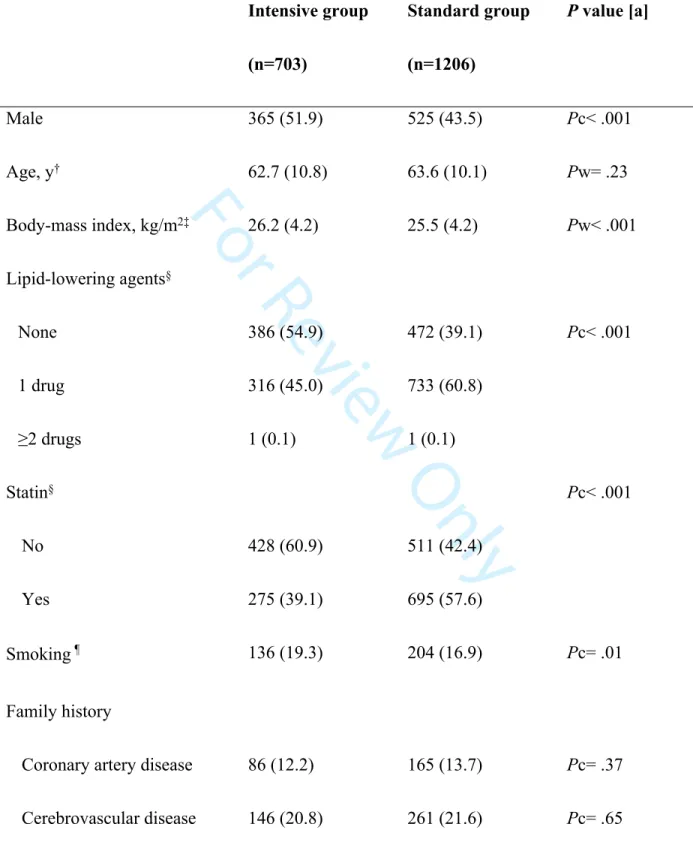
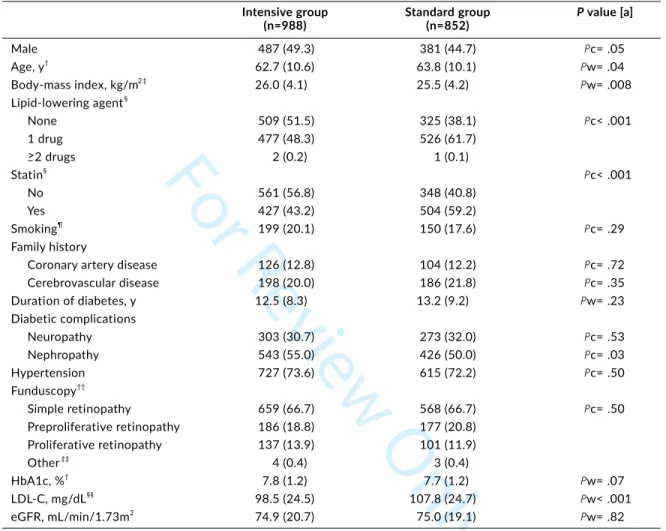
Some of the demographic characteristics of the patients in both groups at baseline were similar (age, family history of coronary artery disease and/or cerebrovascular disease, the presence of neuropathy and/or nephropathy, the severity of retinopathy, HbA1c levels, and eGFR), while other characteristics differed between the groups (Table 1). In comparison to the standard
therapy group, a higher proportion of patients in the intensive therapy group was male (51.9% vs. 43.5%), received no lipid-lowering treatment before study enrollment (54.9% vs. 39.1%), were current smokers (19.3% vs. 16.9%), and had hypertension at enrollment (75.7% vs. 70.6%). Other differences between the two groups included higher mean BMI in the intensive group, and longer duration of diabetes and higher mean LDL-C level at enrollment in the standard group.
3 4 5 6 7 8 9 10 11 12 13 14 15 16 17 18 19 20 21 22 23 24 25 26 27 28 29 30 31 32 33 34 35 36 37 38 39 40 41 42 43 44 45 46 47 48 49 50 51 52 53 54
For Review Only
The demographic characteristics of the patients who were at their target LDL-C level at the last visit were similar to those who were at their mean target LDL-C level, with the exception of nephropathy (Table S1).
The proportion of patients using atorvastatin, rosuvastatin, or pitavastatin was about the same in the two groups at baseline (48.2% in the intensive group and 53.1% in the standard group), and the proportion using pravastatin, fluvastatin, or simvastatin was 51.2% and 46.7%, respectively. At the end of the study, the proportion of atorvastatin, rosuvastatin, or pitavastatin users remained nearly unchanged in the standard group (50.9%) but had risen to 98.2% in the intensive group. Dose levels at baseline were similar in the intensive and standard groups for all statins. In the intensive group, the dose increased for all statin types over the course of the study. The doses did not change for the standard group (Table S2). It should be noted that the statin dose for “intensive” therapy in Japan is lower than in the U.S. and Europe.
3.3 Laboratory values
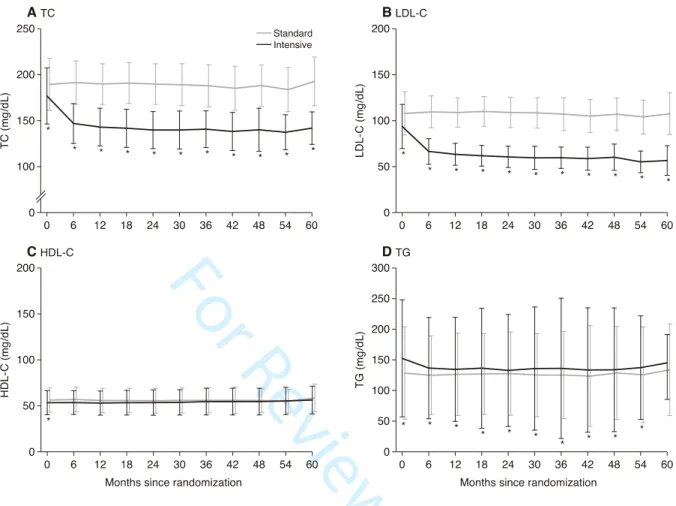
The changes in levels of LDL-C, total cholesterol (TC), high-density lipoprotein-cholesterol (HDL-C), and triglycerides (TG) in the subanalysis are shown in Figure 2. In the intensive group, the mean level of LDL-C decreased significantly from baseline (93.7±24.0 mg/dL) to the first measurement at 6 months (66.5±13.9 mg/dL) and then remained at this level or lower (59.7±11.6 mg/dL at 36 months) to 60 months after the start of treatment (56.6±16.1 mg/dL). In the standard group, the LDL-C level after 6 months of treatment was slightly higher (109.6±17.3 mg/dL) than the baseline level (107.9±23.5 mg/dL) and remained at or near that level (107.1±17.8 mg/dL at 36 months) throughout the course of the study to 60 months after the start of treatment, when it dropped slightly to near-baseline level (107.5±22.6 mg/dL). TC showed a similar pattern to LDL-C in both groups. TG was slightly higher in the intensive group at baseline, but that gap
3 4 5 6 7 8 9 10 11 12 13 14 15 16 17 18 19 20 21 22 23 24 25 26 27 28 29 30 31 32 33 34 35 36 37 38 39 40 41 42 43 44 45 46 47 48 49 50 51 52 53 54
For Review Only
diminished somewhat after the start of the study. HDL-C remained substantially unchanged throughout the study in both groups.
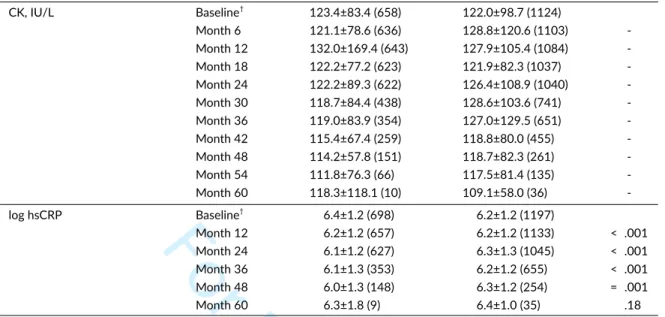
No changes were noted for either group during the study in blood pressure, HbA1c, creatinine (Cr), or creatine kinase (CK). However, in the intensive group, high-sensitivity C-reactive protein (hsCRP) levels were significantly reduced at all time points except 60 months, and there was a significant difference between the groups in hsCRP (Table S3).
3.4 Efficacy endpoints
Since stepwise variable selection showed that eight factors were statistically related to the primary outcome among the 15 potential prognostic factors, these variables were adjusted: gender; smoking status (current smoker, past smoker, non-smoker); presence or absence of diabetic nephropathy, neuropathy, or hypertension; funduscopic findings at enrollment; HbA1c at informed consent; and eGFR at enrollment (<60, ≥60 mL/min/1.73m2). Baseline LDL-C was
not found to be a prognostic factor. We adjusted for these eight prognostic factors to estimate HRs and 95% CIs for the incidence of CV events (the primary endpoint of the EMPATHY study).
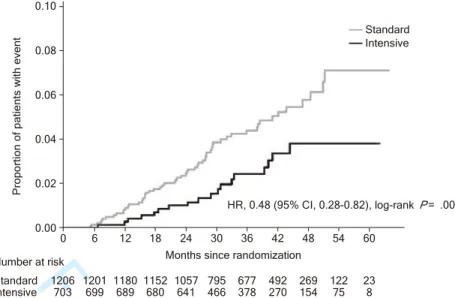
In this subanalysis, a significantly smaller proportion of patients in the intensive group (18/703 patients) experienced CV events or death associated with CV events than in the standard group (56/1206 patients) (HR, 0.48; 95% CI, 0.28−0.82; P= .007) (Figure 3, Table S4). This difference between the groups started at approximately 12 months after randomization. These findings remained unchanged even if baseline LDL-C was added as a ninth prognostic factor (data not shown).
In the above subanalysis, we used mean LDL-C values to determine whether each patient achieved the target range. We then repeated our analysis using LDL-C values at the last visit. We
3 4 5 6 7 8 9 10 11 12 13 14 15 16 17 18 19 20 21 22 23 24 25 26 27 28 29 30 31 32 33 34 35 36 37 38 39 40 41 42 43 44 45 46 47 48 49 50 51 52 53 54
For Review Only
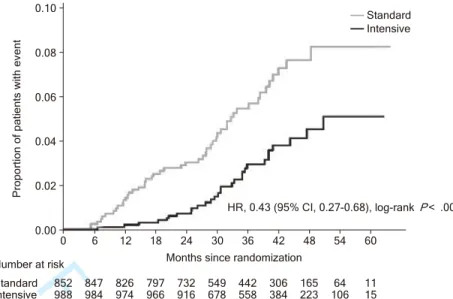
found that the significant difference in the primary endpoint between the intensive group and the standard group was also noted in this analysis (HR, 0.43; 95% CI, 0.27−0.68; P< .001) (Figure 4).
3.5 Safety
The safety endpoints examined in this analysis were adverse events (AEs), serious AEs, adverse drug reactions (ADRs), and serious ADRs. There was no significant difference in the incidence rates for each of these endpoints between the two groups. The major AEs were hepatobiliary disorders, renal and urinary disorders, rhabdomyolysis, myopathy, and cancer (Table S5).
Overall, the occurrence of these events in the two groups was similar except for renal and urinary disorders, which were more common in the standard group (9.2%) than in the intensive group (5.7%).
4 DISCUSSION
The EMPATHY study assessed the benefits of intensive statin monotherapy for lipid
management in type 2 diabetic patients with hypercholesterolemia and diabetic retinopathy in a primary prevention setting. The study also evaluated the appropriateness of the treat-to-target approach in this patient population. Results from the EMPATHY study showed that intensive lipid-lowering therapy targeting <70 mg/dL of LDL-C was no more effective in reducing a composite of incidence of CV events or death from CV events than standard therapy targeting ≥100 to <120 mg/dL (HR, 0.84; 95% CI, 0.67−1.07).6 However, the ITT method may lead to
underestimation of intergroup differences in efficacy in situations where the treatment goals have not been properly achieved. In our study, in particular, less than half of the patients in each group
3 4 5 6 7 8 9 10 11 12 13 14 15 16 17 18 19 20 21 22 23 24 25 26 27 28 29 30 31 32 33 34 35 36 37 38 39 40 41 42 43 44 45 46 47 48 49 50 51 52 53 54
For Review Only
had LDL-C within their target range, and nearly half in the standard group had LDL-C below the target.
Our planned between-group difference in LDL-C was about 40 mg/dL (< 70 mg/dL for the intensive therapy group vs. about 110 mg/dL for the standard therapy group) in the original study, with a predicted HR of 0.65. However, after 3 years of treatment, the actual LDL-C difference was 27.7 mg/dL (76.5 mg/dL vs. 104.1 mg/dL). We hypothesized that the smaller-than-expected difference may have been due at least in part to the unexpectedly low number of patients who achieved their LDL target. Our exploratory post-hoc analyses were designed to investigate this hypothesis by comparing findings between patients whose LDL-C was within the target range for their group.
The subanalysis involved differences in some prognostic factors between the patient group meeting their target LDL-C levels of <70 mg/dL under intensive therapy and the patient group meeting their LDL-C levels of 100 to 120 mg/dL under standard therapy. We adjusted for eight factors that had been identified as potentially affecting the primary endpoint: gender (male, female), smoking status, presence or absence of diabetic nephropathy, presence or absence of diabetic neuropathy, presence or absence of hypertension, funduscopic findings, baseline HbA1c, and eGFR. We also found some significant intergroup differences for BMI, use of lipid-lowering agents, use of statins, duration of diabetes, and baseline LDL-C level. However, since they did not affect the primary endpoints in this study, we did not adjust for those factors. After adjusting for the eight selected prognostic factors, the results of the analysis showed that the intensive lipid-lowering therapy targeting <70 mg/dL LDL-C significantly reduced the primary endpoint (the composite of incidence of CV events or death from CV events). Due to the low number of events (74), in this analysis we limited the number of factors, using a stepwise method for
3 4 5 6 7 8 9 10 11 12 13 14 15 16 17 18 19 20 21 22 23 24 25 26 27 28 29 30 31 32 33 34 35 36 37 38 39 40 41 42 43 44 45 46 47 48 49 50 51 52 53 54
For Review Only
adjustment in the analytical model. We did this to avoid potentially non-reproducible and unstable results. For further confirmation, we also performed an analysis with all variables included; similar results were obtained (HR, 0.51; 95% CI, 0.29-0.89, P< .05) (Table S6). Safety events occurred at approximately the same rate in the two groups.
We used mean values for LDL-C in patients who achieved their target levels because we thought it was important to ensure that patients were exposed to a specific concentration of LDL-C for a certain period of time. Our results, although exploratory, suggest that achieving a target of <70 mg/dL LDL-C lowers the risk of CV events significantly more than achieving a target of 100 to 120 mg/dL. For reference, we have also provided a summary of our findings for the proportion of patients who achieved their target LDL-C level at the last visit. Results were similar to those based on mean values.
In the main results paper, we performed post-hoc analysis, which involved classifying patient data into four subcategories (mean LDL-C <70, 70 to <100, 100 to <120, and ≥120 mg/dL during the study). That analysis tended to show event prevention at lower LDL-C values in both the intensive and standard therapy groups in the original study6; the results of the present
subanalysis are consistent with those findings. This fact supports the reliability of our
subanalysis. Although exploratory, we believe that these findings could meaningfully impact lipid management in clinical practice for the primary prevention of CV events in type 2 diabetic patients with hyperlipidemia and diabetic retinopathy.
Previous large-scale clinical studies of statins have also used LDL-C levels as a basis for post-hoc subanalyses,8-11 and usefulness was demonstrated in groups achieving lower target
levels. However, all of these subanalyses were in dose-comparison studies, and none assessed whether patients had achieved their target LDL-C levels. To the best of our knowledge, no other
3 4 5 6 7 8 9 10 11 12 13 14 15 16 17 18 19 20 21 22 23 24 25 26 27 28 29 30 31 32 33 34 35 36 37 38 39 40 41 42 43 44 45 46 47 48 49 50 51 52 53 54
For Review Only
analyses have been reported that show the effect of specified target LDL-C levels using statin monotherapy on the occurrence of CV events or CV-related deaths. Although this is an
exploratory analysis, our data are valuable when assessing the importance of the treat-to-target approach in lipid management.
In the ITT analysis for the EMPATHY study, the difference in LDL-C between the two groups was 27.7 mg/dL, and the HR for the primary endpoint was 0.84 (95% CI, 0.67−1.07; P= .15).6 In this subanalysis, LDL-C at 36 months was 59.7 mg/dL in the intensive group and
107.1 mg/dL in the standard group, a difference of 47.4 mg/dL (1.23 mmol/L) between the two groups, and the HR was 0.48 (95% CI, 0.28−0.82; P= .007). In this subanalysis, aggressive treatment with the goal of lowering LDL-C to 70 mg/dL was clearly effective in reducing the number of occurrences of the primary endpoint. The actual difference in LDL-C exceeded the planned difference of approximately 40 mg/dL, which meant that the actual HR was also higher than the planned HR of 0.65. The main analysis did not detect a significant difference in primary endpoint occurrence between the two groups. These subanalysis findings indicate that we were unable to obtain significant results from the main analysis because of failure to achieve target LDL-C levels.
No major differences were noted between groups in the incidence of AEs or ADRs. It thus appears unlikely that specific safety concerns will occur when intensive statin monotherapy is used to reduce LDL-C below 70 mg/dL. We found no marked increase in cerebral hemorrhage in the intensive group (2 patients in the intensive group, 1 patient in the standard group), nor any increase in HbA1c associated with statin use in this study.
These study findings are limited because they are derived from an exploratory analysis which included only those patients whose LDL-C was within the target range for their assigned
3 4 5 6 7 8 9 10 11 12 13 14 15 16 17 18 19 20 21 22 23 24 25 26 27 28 29 30 31 32 33 34 35 36 37 38 39 40 41 42 43 44 45 46 47 48 49 50 51 52 53 54
For Review Only
group: LDL-C <70 mg/dL in the intensive therapy group in the original study and ≥100 to <120 mg/dL in the standard therapy group in the original study. In the EMPATHY study, less than 50% of patients reached their target LDL-C. This can be attributed in part to the fact that over half of the investigators were general practitioners, rather than lipid specialists. Many Japanese physicians who treat hyperlipidemia as part of their routine clinical practice, are not lipid management experts and are concerned about adverse effects such as intracranial hemorrhage from intensive LDL-C lowering. Such concerns may have affected some of the investigators in this study, making them reluctant to prescribe high-dose statin therapy even when the protocol stipulated the aggressive target of 70 mg/dL. Due to the small number of events, secondary endpoints were not assessed (Table S4). In addition, although we detected and adjusted for eight prognostic factors, there may be additional unmeasured factors or confounding factors that should be considered.
In conclusion, the results from this exploratory post-hoc analysis suggest that
achievement of LDL-C levels below 70 mg/dL is associated with more effective reduction of CV events than levels of 100 to 120 mg/dL in type 2 diabetic patients with retinopathy and
hyperlipidemia who are at high coronary risk.4,5 There were no major increases in AEs or ADRs
when statin monotherapy was used to reduce LDL-C below 70 mg/dL. Our results indicate the importance of targeting LDL-C below 70 mg/dL, and then meeting that target consistently, for the reduction of CV events in this high-risk patient population. However, this analysis was exploratory and must be substantiated in randomized clinical trials. A feasible approach is also needed for achieving these target levels in a clinical setting.
ACKNOWLEDGMENTS 3 4 5 6 7 8 9 10 11 12 13 14 15 16 17 18 19 20 21 22 23 24 25 26 27 28 29 30 31 32 33 34 35 36 37 38 39 40 41 42 43 44 45 46 47 48 49 50 51 52 53 54
For Review Only
This study was funded by Shionogi & Co., Ltd. EDIT, Inc. (Tokyo, Japan) provided medical writing and editing.
Funding information
Shionogi & Co., Ltd. provided support for this research but was not involved in analysis, data interpretation, or manuscript preparation.
Conflict of interest
H.I. reports grants and personal fees from Shionogi & Co., Ltd., during the conducting of the study, and grants and personal fees from Takeda Pharmaceutical Company Limited, Nippon Boehringer Ingelheim Co., Ltd., Daiichi Sankyo Company, Limited, MSD K.K., Mitsubishi Tanabe Pharma Corporation, Shionogi & Co., Ltd., and Taisho Toyama Pharmaceutical Co., Ltd., grants from Sumitomo Dainippon Pharma Co., Ltd., Astellas Pharma Inc., Kyowa Hakko Kirin Co., Ltd., Teijin Pharma Limited, Mochida Pharmaceutical Co., Ltd., Ono Pharmaceutical Co., Ltd., Chugai Pharmaceutical Co., Ltd., Eli Lilly Japan K.K., and personal fees from Nipro Corporation and SBI Pharmaceuticals Co., Ltd. outside the submitted work. I.K. reports personal fees from Shionogi & Co., Ltd., during the conducting of the study, and grants and personal fees from Takeda Pharmaceutical Company Limited, Nippon Boehringer Ingelheim Co., Ltd.,
Astellas Pharma Inc., Daiichi Sankyo Company, Limited, and Otsuka Pharmaceutical Co., Ltd., grants from MSD K.K., Shionogi & Co., Ltd., GlaxoSmithKline K.K., Sanofi K.K., Genzyme Japan K.K., Sumitomo Dainippon Pharma Co., Ltd., Mitsubishi Tanabe Pharma Corporation, and Bristol-Myers Squibb Company outside the submitted work. M.T. reports personal fees from Shionogi & Co., Ltd., during the conducting of the study. T.A. reports personal fees from
3 4 5 6 7 8 9 10 11 12 13 14 15 16 17 18 19 20 21 22 23 24 25 26 27 28 29 30 31 32 33 34 35 36 37 38 39 40 41 42 43 44 45 46 47 48 49 50 51 52 53 54
For Review Only
Shionogi & Co., Ltd., during the conducting of the study, grants and personal fees from St. Jude Medical Japan Co., Ltd., Terumo Corporation, Daiichi Sankyo Company, Limited, and Abbott Vascular Japan Co., Ltd., grants from Goodman Co., Ltd., Otsuka Pharmaceutical Co., Ltd., Pfizer Japan Inc., Bayer Yakuhin, Ltd., and Boston Scientific Corporation, and personal fees from Nippon Boehringer Ingelheim Co., Ltd. outside the submitted work. H.D. reports grants and personal fees from Shionogi & Co., Ltd., during the conducting of the study, grants and personal fees from AstraZeneca K.K., Astellas Pharma Inc., Abbott Vascular Japan Co., Ltd., Otsuka Pharmaceutical Co., Ltd., Kaken Pharmaceutical Co., Ltd., Kissei Pharmaceutical Co., Ltd., Kyowa Hakko Kirin Co., Ltd., Kowa Pharmaceutical Company Ltd., Sanofi K.K., Daiichi Sankyo Company, Limited, Sumitomo Dainippon Pharma Co., Ltd., Takeda Pharmaceutical Company Limited, Terumo Corporation, Nippon Boehringer Ingelheim Co., Ltd., Bayer Yakuhin, Ltd., Pfizer Japan Inc., Philips Respironics GK, Bristol-Myers Squibb Company, Sanwa Kagaku Kenkyusho Co., Ltd., Mitsubishi Tanabe Pharma Corporation, MSD K.K., and GlaxoSmithKline K.K., grants from Eisai Co., Ltd., Teijin Pharma Limited, Nippon Shinyaku Co., Ltd., VitalAire Japan K.K., Fujifilm RI Pharma Co., Ltd., Boston Scientific Corporation, Fuji Chemical Industries Co., Ltd., Fukuda Denshi Co., Ltd., and Actelion Pharmaceuticals Japan Ltd., and personal fees from Aska Pharmaceutical. Co., Ltd., Chugai Pharmaceutical Co., Ltd., Taisho Toyama Pharmaceutical Co., Ltd., Toa Eiyo Ltd., Ono Pharmaceutical Co., Ltd., Medtronic Japan Co., Ltd., and Mochida Pharmaceutical Co., Ltd. outside the submitted work. Y.E. reports non-financial support from Shionogi & Co., Ltd. during the conducting of the study. H.F. reports other fees (consultant) from Mehergen Group Holdings, Inc., outside the submitted work. J.H. reports grants and personal fees from Shionogi & Co., Ltd., during the conducting of the study, and grants and personal fees from Astellas Pharma Inc., Nippon Boehringer-Ingelheim
3 4 5 6 7 8 9 10 11 12 13 14 15 16 17 18 19 20 21 22 23 24 25 26 27 28 29 30 31 32 33 34 35 36 37 38 39 40 41 42 43 44 45 46 47 48 49 50 51 52 53 54
For Review Only
Co., Ltd., Mochida Pharmaceutical Co., Ltd., Daiichi Sankyo Company, Limited, Takeda Pharmaceutical Company Limited, Sumitomo Dainippon Pharma Co., Ltd., MSD K.K., Teijin Pharma Limited, Actelion Pharmaceuticals Japan Ltd., Otsuka Pharmaceutical Co., Ltd., Novartis Pharma K.K., and Sanwa Kagaku Kenkyusho Co., Ltd., outside the submitted work. K.H. reports personal fees and non-financial support from Shionogi & Co., Ltd., during the conducting of the study, grants and personal fees from Daiichi Sankyo Company, Limited, Mochida Pharmaceutical Co., Ltd., grants from Actelion Pharmaceuticals Japan Ltd., Eisai Co., Ltd., Otsuka Pharmaceutical Co., Ltd., Sumitomo Dainippon Pharma Co., Ltd., Takeda
Pharmaceutical Company Limited, Nippon Boehringer Ingelheim Co., Ltd., Bayer Yakuhin, Ltd., Sysmex Corporation, Medtronic Japan Co., Ltd., and St. Jude Medical Japan Co., Ltd., and personal fees from Kowa Pharmaceutical Company Ltd. outside the submitted work. S.Is. reports grants and personal fees from Shionogi & Co., Ltd., during the conducting of the study, grants and personal fees from Amgen Astellas BioPharma K.K., Astellas Pharma Inc., Daiichi Sankyo Company, Limited, Eli Lilly Japan K.K., Kowa Pharmaceutical Company Ltd., Nippon
Boehringer Ingelheim Co., Ltd., Kissei Pharmaceutical Co., Ltd., MSD K.K., Novartis Pharma K.K., Mitsubishi Tanabe Pharma Corporation, Ono Pharmaceutical Co. Ltd., Sanofi K.K., Takeda Pharmaceutical Company Limited, Taisho Toyama Pharmaceutical Co., Ltd., and Teijin Pharma Limited, grants from Fujifilm Pharma Co., Ltd., Sumitomo Dainippon Pharma Co., Ltd., and Kyowa Hakko Kirin Co., Ltd., and personal fees from AstraZeneca K.K., Bayer Yakuhin, Ltd., Novo Nordisk Pharma Ltd., Pfizer Japan Inc., and Sanwa Kagaku Kenkyusho Co. Ltd. outside the submitted work. T.I. reports personal fees and non-financial support from Shionogi & Co., Ltd., during the conducting of the study, grants and personal fees from Sanofi K.K.,
Sumitomo Dainippon Pharma Co., Ltd., and Daiichi Sankyo Company, Limited, grants from
3 4 5 6 7 8 9 10 11 12 13 14 15 16 17 18 19 20 21 22 23 24 25 26 27 28 29 30 31 32 33 34 35 36 37 38 39 40 41 42 43 44 45 46 47 48 49 50 51 52 53 54
For Review Only
Takeda Pharmaceutical Company Limited and Mitsubishi Tanabe Pharma Corporation, and personal fees from Astellas Pharma Inc., AstraZeneca K.K., and MSD K.K. outside the submitted work. S.It. reports grants, personal fees and non-financial support from Shionogi & Co., Ltd. during the conducting of the study. A.K. reports personal fees and non-financial support from Shionogi & Co., Ltd., during the conducting of the study and personal fees from Astellas Pharma Inc., Sunstar Group Ltd., Eli Lilly Japan K.K., Sanofi K.K., AstraZeneca K.K., Takeda Pharmaceutical Company Limited, Taisho Toyama Pharmaceutical Co., Ltd., Nippon Boehringer Ingelheim Co., Ltd., Kowa Pharmaceutical Company Ltd., and Sanwa Kagaku Kenkyusho Co. Ltd. outside the submitted work. S.K. reports grants from Shionogi & Co., Ltd. during the conducting of the study. K.K. reports grants and personal fees from Shionogi & Co., Ltd. during the conducting of the study. M.Ki. reports grants and personal fees from Shionogi & Co., Ltd. during the conducting of the study, grants and personal fees from Astellas Pharma Inc., Sanofi K.K., Pfizer Japan Inc., Ono pharmaceutical Co. Ltd., Novartis Pharma K.K., Mitsubishi Tanabe Pharma Corporation, Kyowa Hakko Kirin Co., Ltd., Abbott Japan Co., Ltd., and Otsuka Pharmaceutical Co., Ltd., grants from the Japanese government, Japan Heart Foundation, Japan Cardiovascular Research Foundation, Calpis Co., Ltd., and Nihon Kohden Corporation, and personal fees from Daiichi Sankyo Company, Limited, Bayer Yakuhin Ltd., Nippon Boehringer Ingelheim Co., Ltd., Kowa Pharmaceutical Company Ltd., Sumitomo Dainippon Pharma Co., Ltd., Sawai Pharmaceutical Co., Ltd., MSD K.K., Shionogi & Co., Ltd., AstraZeneca K.K., Asahi Kasei Medical Co., Ltd., Novo Nordisk Pharma Ltd., Fujifilm RI Pharma Co., Ltd., and Japan Medical Data, outside the submitted work. T.K. reports grants and personal fees from Shionogi & Co., Ltd., during the conducting of the study, grants and personal fees from Daiichi Sankyo Company, Limited and Bayer Yakuhin Ltd., and grants from Merck & Co., Inc.,
3 4 5 6 7 8 9 10 11 12 13 14 15 16 17 18 19 20 21 22 23 24 25 26 27 28 29 30 31 32 33 34 35 36 37 38 39 40 41 42 43 44 45 46 47 48 49 50 51 52 53 54
For Review Only
Novartis Pharma K.K., Astellas Pharma Inc., and Pfizer Japan Inc. outside the submitted work. M.Ku. reports personal fees from Shionogi & Co., Ltd. during the conducting of the study and grants and personal fees from Shionogi & Co., Ltd. outside the submitted work. K.M. reports other (meeting attendance fee) from Shionogi & Co., Ltd. during the conducting of the study. T.Mura. reports personal fees from Shionogi & Co., Ltd. during the conducting of the study. T.Muro. reports personal fees from Shionogi & Co., Ltd. during the conducting of the study, grants and personal fees from Daiichi Sankyo Company, Limited, Pfizer Japan Inc., Kowa Pharmaceutical Company Ltd., MSD K.K., and Mitsubishi Tanabe Pharma Corporation, and personal fees from AstraZeneca K.K. outside the submitted work. K.N. reports non-financial support from Shionogi & Co., Ltd. during the conducting of the study. S.O. reports personal fees and non-financial support from Shionogi & Co., Ltd. during the conducting of the study. Y.Sa. reports grants, personal fees, and non-financial support from Shionogi & Co., Ltd. during the conducting of the study, grants, personal fees and other (advisory boards) from MSD K.K., Ono Pharmaceutical Co., Ltd., Mitsubishi Tanabe Pharma Corporation, Pfizer Japan Inc., Novartis Pharma K.K., grants and personal fees from Daiichi Sankyo Company, Limited, Bayer Yakuhin, Ltd., Otsuka Pharmaceutical Co., Ltd., Sumitomo Dainippon Pharma Co., Ltd., Astellas Pharma Inc., and Takeda Pharmaceutical Company Limited, and grants from Baxter Ltd., Kyowa Hakko Kirin Co., Ltd., Teijin Pharma Limited, Eisai Co., Ltd., Zeria Pharmaceutical Co., Ltd., Nihon Medi-Physics Co., Ltd., Chugai Pharmaceutical Co., Ltd., Genzyme Japan K.K., and Medtronic Japan Co., Ltd., outside the submitted work. Y.Se. reports personal fees from Shionogi & Co., Ltd. during the conducting of the study, grants and personal fees from Otsuka Pharmaceutical Co. and Ltd., Nippon Boehringer Ingelheim Co., Ltd., and grants from Mitsubishi Tanabe Pharma Co., Ltd., Fujifilm RI Pharma Co., Ltd., Roche Diagnostics K.K., MSD K.K., Pfizer
3 4 5 6 7 8 9 10 11 12 13 14 15 16 17 18 19 20 21 22 23 24 25 26 27 28 29 30 31 32 33 34 35 36 37 38 39 40 41 42 43 44 45 46 47 48 49 50 51 52 53 54
For Review Only
Japan Inc., Bayer Yakuhin, Ltd., and Shionogi & Co., Ltd. outside the submitted work. T.S. reports personal fees and non-financial support from Shionogi & Co., Ltd. during the conducting of the study. S.Sh. reports personal fees and non-financial support from Shionogi & Co., Ltd. during the conducting of the study. M.S. reports personal fees and non-financial support from Shionogi & Co., Ltd. during the conducting of the study. S.Su. reports personal fees from Shionogi & Co., Ltd. during the conducting of the study, and grants from The Ministry of Education, Culture, Sports, Science, and Technology in Japan outside the submitted work. Y.T. reports personal fees from Shionogi & Co., Ltd. during the conducting of the study, grants and personal fees from Astellas Pharma Inc., AstraZeneca K.K., Bayer Yakuhin, Ltd., Daiichi Sankyo Company, Limited, Sumitomo Dainippon Pharma Co., Ltd., Eli Lilly Japan K.K., Kissei Pharmaceutical Co., Ltd., Kowa Pharmaceutical Company Ltd., Kyowa Hakko Kirin Co., Ltd., MSD K.K., Mitsubishi Tanabe Pharma Corporation, Nippon Boehringer Ingelheim Co., Ltd., Novo Nordisk Pharma Ltd., Ono Pharmaceutical Co., Ltd., Sanwa Kagaku Kenkyusho Co., Ltd., Sanofi K.K., Shionogi & Co., Ltd., Taisho Toyama Pharmaceutical Co., Ltd., and Takeda
Pharmaceutical Company Limited, and personal fees from Novartis Pharma K.K. outside the submitted work. H.T. reports personal fees and non-financial support from Shionogi & Co., Ltd. during the conducting of the study, grants and personal fees from Daiichi Sankyo Company, Limited, and Takeda Pharmaceutical Company Limited, grants from Novartis Pharma K.K. and Astellas Pharma Inc., and personal fees from MSD K.K., Otsuka Pharmaceutical Co., Ltd., Pfizer Japan Inc., Mitsubishi Tanabe Pharma Corporation, Teijin Pharma Limited, Nippon Boehringer Ingelheim Co., Ltd., and Bayer Yakuhin, Ltd., BMS outside the submitted work. K.Ue. reports other (contracted work) from Shionogi & Co., Ltd. during the conducting of the study, and personal fees from Shionogi & Co., Ltd. outside the submitted work. K.Ut. reports personal fees
3 4 5 6 7 8 9 10 11 12 13 14 15 16 17 18 19 20 21 22 23 24 25 26 27 28 29 30 31 32 33 34 35 36 37 38 39 40 41 42 43 44 45 46 47 48 49 50 51 52 53 54
For Review Only
and non-financial support from Shionogi & Co., Ltd. during the conducting of the study, and grants from Sanofi K.K., MSD K.K., Taisho Toyama Pharmaceutical Co., Ltd., Nippon
Boehringer lngelheim Co., Ltd., Takeda Pharmaceutical Company Limited, Eli Lilly Japan K.K., and Novo Nordisk Pharma Ltd. outside the submitted work. M.Y. reports personal fees from Shionogi & Co., Ltd. during the conducting of the study, and other (donation) from Shionogi & Co., Ltd. outside the submitted work. T.Y. reports other (lecture fee) from Shionogi & Co., Ltd. during the conducting of the study. S.Y. reports other (contracted work) from Shionogi & Co., Ltd. during the conducting of the study. K.Yok. reports personal fees from Shionogi & Co., Ltd. during the conducting of the study, grants, personal fees, and non-financial support from MSD K.K., grants and personal fees from Astellas Pharma Inc., Daiichi Sankyo Company, Limited, Sumitomo Dainippon Pharma Co., Ltd., Kyowa Hakko Kirin Co., Ltd., Mochida Pharmaceutical Co., Ltd., Nippon Boehringer lngelheim Co., Ltd., Ono Pharmaceutical Co. Ltd., Pfizer Japan Inc., Shionogi & Co., Ltd., Taisho Toyama Pharmaceutical Co., Ltd., Takeda Pharmaceutical Company Limited, and Mitsubishi Tanabe Pharma Corporation, grants from Bristol-Myers Squibb Company, Eli Lilly Japan K.K., Teijin Pharma Limited, and Toyama Chemical Co., Ltd., and personal fees from AstraZeneca K.K., Eisai Co., Ltd., Kowa Company, Ltd., Kowa
Pharmaceutical Company Ltd., Sanofi K.K., and Sanwa Kagaku Kenkyusho Co., Ltd. outside the submitted work. K.Yos. reports personal fees and non-financial support from Shionogi & Co., Ltd. during the conducting of the study. M.Yo. has nothing to disclose during the conducting of the study, and reports grants and personal fees from Shionogi & Co., Ltd. outside the submitted work. N.Y. reports personal fees from Shionogi & Co., Ltd. during the conducting of the study, and personal fees from Shionogi & Co., Ltd. outside the submitted work. K.N. reports other (contracted) work from Shionogi & Co., Ltd. during the conducting of the study, and grants from
3 4 5 6 7 8 9 10 11 12 13 14 15 16 17 18 19 20 21 22 23 24 25 26 27 28 29 30 31 32 33 34 35 36 37 38 39 40 41 42 43 44 45 46 47 48 49 50 51 52 53 54
For Review Only
Takeda Pharmaceutical Company Limited and Fujifilm Pharma Co., Ltd. outside the submitted work. R.N. reports personal fees from Shionogi & Co., Ltd. during the conduct of the study, and personal fees from Astellas Pharma Inc., Sumitomo Dainippon Pharma Co., Ltd., MSD K.K., Ono Pharmaceutical Co. Ltd., Kowa Pharmaceutical Company Ltd., Mitsubishi Tanabe Pharma Corporation, Nippon Boehringer Ingelheim Co., Ltd., Toa Eiyo Ltd., Eisai Co., Ltd., Nippon Chemiphar Co., Ltd., outside the submitted work.
Author contributions
H.I., I.K., H.D., H.F., S.K., T.Muro., K.Ut., and T.Y. contributed to design, conduct/data
collection, and writing the manuscript. M.T. contributed to conduct/data collection, analysis, and writing the manuscript. T.A., J.H., T.I., A.K., M.Ki., T.K., M.Ku., K.No., S.O., Y.Sa., Y.Se., T.S., S.Sh., H.T., S.Y., and N.Y. contributed to writing the manuscript. Y.E. contributed to conduct/data collection. K.H., S.It., S.Su., K.Ue., K.Yok., K.Na., and R.N. contributed to design and writing the manuscript. S.Is., K.K., M.S., Y.T., M.Ya., K.Yos., and M.Yo. contributed to conduct/data collection and writing the manuscript. K.M. contributed to design and conduct/data collection. T.Mura. contributed to design.
3 4 5 6 7 8 9 10 11 12 13 14 15 16 17 18 19 20 21 22 23 24 25 26 27 28 29 30 31 32 33 34 35 36 37 38 39 40 41 42 43 44 45 46 47 48 49 50 51 52 53 54
For Review Only
REFERENCES
1. Turner RC, Millns H, Neil HA, et al. Risk factors for coronary artery disease in non-insulin dependent diabetes mellitus: United Kingdom Prospective Diabetes Study (UKPDS: 23). BMJ. 1998;316:823–828.
2. Sone H, Tanaka S, Tanaka S, et al; Japan Diabetes Complications Study Group. Serum level of triglycerides is a potent risk factor comparable to LDL cholesterol for coronary heart disease in Japanese patients with type 2 diabetes: subanalysis of the Japan Diabetes
Complications Study (JDCS). J Clin Endocrinol Metab. 2011;96:3448–3456.
3. Gæde P, Pedersen O. Intensive integrated therapy of type 2 diabetes: implications for long-term prognosis. Diabetes. 2004;53(Suppl 3):S39–S47.
4. Kramer CK, Rodrigues TC, Canani LH, Gross JL, Azevedo MJ. Diabetic retinopathy predicts all-cause mortality and cardiovascular events in both type1and 2 diabetes: meta-analysis of observational studies. Diabetes Care. 2011;34:1238–1244.
5. Ohno T, Kinoshita O, Fujita H, et al. Detecting occult coronary artery disease followed by early coronary artery bypass surgery in patients with diabetic retinopathy: report from a diabetic retinocoronary clinic. J Thorac Cardiovasc Surg. 2010;139:92–97.
6. Itoh H, KomuroI, Takeuchi M, et al; EMPATHY Investigators. Intensive treat-to-target statin therapy in high-risk Japanese patients with hypercholesterolemia and diabetic retinopathy: report of a randomized study. Diabetes Care. 2018;41:1275–1284.
7. Kearney PM, Blackwell L, Collins R, et al; the Cholesterol Treatment Trialists' (CTT) Collaborators. Efficacy of cholesterol-lowering therapy in 18,686 people with diabetes in 14 randomised trials of statins: a meta-analysis. Lancet. 2008;371:117–125.
3 4 5 6 7 8 9 10 11 12 13 14 15 16 17 18 19 20 21 22 23 24 25 26 27 28 29 30 31 32 33 34 35 36 37 38 39 40 41 42 43 44 45 46 47 48 49 50 51 52 53 54
For Review Only
8. LaRosa JC, Grundy SM, Kastelein JJ, Kostis JB, Greten H; Treating to New Targets (TNT) Steering Committee and Investigators. Safety and efficacy of atorvastatin-induced very low-density lipoprotein cholesterol levels in patients with coronary heart disease (a post hoc analysis of the treating to new targets [TNT] study). Am J Cardiol. 2007;100:747–752.
9. Shepherd J, Barter P, Carmena R, et al. Effect of lowering LDL cholesterol substantially below currently recommended levels in patients with coronary heart disease and diabetes: the Treating to New Targets (TNT) study. Diabetes Care. 2006;29:1220–1226.
10. Hsia J, MacFadyen JG, Monyak J, Ridker PM. Cardiovascular event reduction and adverse events among subjects attaining low-density lipoprotein cholesterol <50 mg/dl with rosuvastatin. The JUPITER trial (Justification for the Use of Statins in Prevention: an Intervention Trial Evaluating Rosuvastatin). J Am Coll Cardiol. 2011;57:1666–1675.
11. Olsson AG, Lindahl C, Holme I, et al; the Incremental Decrease in End Points Through Aggressive Lipid Lowering Study Group. LDL cholesterol goals and cardiovascular risk during statin treatment: the IDEAL study. Eur J Cardiovasc Prev Rehabil. 2011;18:262–269.
12. Ueshima K, Itoh H, Kanazawa N, et al; EMPATHY study group. Rationale and design of the Standard Versus Intensive Statin Therapy for Hypercholesterolemic Patients with Diabetic Retinopathy (EMPATHY) Study: a randomized controlled trial. J Atheroscler Thromb.
2016;23:976–990. 3 4 5 6 7 8 9 10 11 12 13 14 15 16 17 18 19 20 21 22 23 24 25 26 27 28 29 30 31 32 33 34 35 36 37 38 39 40 41 42 43 44 45 46 47 48 49 50 51 52 53 54
For Review Only
FIGURE 1 Distribution of LDL-C in the Intensive and Standard Therapy Groups in the Original Study
Abbreviations: LDL-C, low-density lipoprotein cholesterol.
3 4 5 6 7 8 9 10 11 12 13 14 15 16 17 18 19 20 21 22 23 24 25 26 27 28 29 30 31 32 33 34 35 36 37 38 39 40 41 42 43 44 45 46 47 48 49 50 51 52 53 54
For Review Only
FIGURE 2 Changes in Lipid Parameters Over Time
Data are mean values and SD.
*P< .05, calculated using a mixed model repeated measures (MMRM) approach. The model included group, observation time point, and interaction between group and observation time point as fixed effects.
Abbreviations: TC, indicates total cholesterol; LDL-C, low-density lipoprotein cholesterol; HDL-C, high-density lipoprotein cholesterol; TG, triglycerides; SD, standard deviation.
3 4 5 6 7 8 9 10 11 12 13 14 15 16 17 18 19 20 21 22 23 24 25 26 27 28 29 30 31 32 33 34 35 36 37 38 39 40 41 42 43 44 45 46 47 48 49 50 51 52 53 54
For Review Only
HR, 0.48 (95% CI, 0.28-0.82), log-rank P= .007 Number at risk 1206 1152 1057 677 269 23 Standard Intensive 703 1201699 1180689 680 641 795466 378 492270 154 12275 8 Months since randomization0.00 0.02 0.04 0.06 0.10 0.08 0 6 12 18 24 30 36 42 48 54 60 Standard Intensive P ro po rt io n of p at ie nt s w ith ev en t
FIGURE 3 Cumulative Event Curve for the Primary Endpoint in the Intensive and Standard Groups (Patients Achieving LDL-C Target, Mean Value)
HR (95% CI) and P value were estimated using a stratified Cox proportional hazards model with gender (male, female), smoking status, presence or absence of diabetic nephropathy, presence or absence of diabetic neuropathy, presence or absence of hypertension, funduscopic findings, and baseline hemoglobin A1c (<8.4, ≥8.4%) and estimated glomerular filtration rate (<60, ≥60 [mL/min/1.73m2]) as covariates.
Abbreviations: LDL-C, low-density lipoprotein cholesterol; HR, hazard ratio; CI, confidence interval. 3 4 5 6 7 8 9 10 11 12 13 14 15 16 17 18 19 20 21 22 23 24 25 26 27 28 29 30 31 32 33 34 35 36 37 38 39 40 41 42 43 44 45 46 47 48 49 50 51 52 53 54
For Review Only
Standard Intensive HR, 0.43 (95% CI, 0.27-0.68), log-rank P< .001 Number at risk 852 797 732 442 165 11 Standard Intensive 988 847984 826974 966 916 549678 558 306384 223 10664 15 Months since randomizationP ro po rt io n of p at ie nt s w ith ev en t 0.00 0.02 0.04 0.06 0.10 0.08 0 6 12 18 24 30 36 42 48 54 60
FIGURE 4 Cumulative Event Curve for the Primary Endpoint in the Intensive and Standard Groups (Patients Achieving LDL-C Target at the Last Visit)
HR (95% CI) and P value are estimated using a Cox proportional hazards model with gender (male, female), smoking status, presence or absence of diabetic nephropathy, presence or absence of diabetic neuropathy, presence or absence of hypertension, funduscopic findings, and baseline hemoglobin A1c [<8.4, ≥8.4 (NGSP%)] and estimated glomerular filtration rate [< 60, ≥60 (mL/min/1.73m2)] as covariates.
Abbreviations: LDL-C, low-density lipoprotein cholesterol; HR, hazard ratio; CI, confidence interval. 3 4 5 6 7 8 9 10 11 12 13 14 15 16 17 18 19 20 21 22 23 24 25 26 27 28 29 30 31 32 33 34 35 36 37 38 39 40 41 42 43 44 45 46 47 48 49 50 51 52 53 54
For Review Only
TABLE 1 Baseline Demographic Characteristics (Potential Prognostic Factors): for Patients Achieving LDL-C Target in Mean Value
Intensive group Standard group P value [a]
(n=703) (n=1206) Male 365 (51.9) 525 (43.5) Pc< .001 Age, y† 62.7 (10.8) 63.6 (10.1) Pw= .23 Body-mass index, kg/m2‡ 26.2 (4.2) 25.5 (4.2) Pw< .001 Lipid-lowering agents§ None 386 (54.9) 472 (39.1) Pc< .001 1 drug 316 (45.0) 733 (60.8) ≥2 drugs 1 (0.1) 1 (0.1) Statin§ Pc< .001 No 428 (60.9) 511 (42.4) Yes 275 (39.1) 695 (57.6) Smoking¶ 136 (19.3) 204 (16.9) Pc= .01 Family history
Coronary artery disease 86 (12.2) 165 (13.7) Pc= .37
Cerebrovascular disease 146 (20.8) 261 (21.6) Pc= .65 3 4 5 6 7 8 9 10 11 12 13 14 15 16 17 18 19 20 21 22 23 24 25 26 27 28 29 30 31 32 33 34 35 36 37 38 39 40 41 42 43 44 45 46 47 48 49 50 51 52 53 54
For Review Only
Duration of diabetes, y 12.3 (8.3) 13.4 (9.1) Pw= .02 Diabetic complications Neuropathy 217 (30.9) 382 (31.7) Pc= .71 Nephropathy 385 (54.8) 614 (50.9) Pc= .10 Hypertension 532 (75.7) 852 (70.6) Pc= .02 Funduscopy†† Simple retinopathy 454 (64.6) 785 (65.1) Pc= .99 Preproliferative retinopathy 141 (20.1) 243 (20.1) Proliferative retinopathy 103 (14.7) 170 (14.1) Other‡‡ 3 (0.4) 5 (0.4) HbA1c, %† 7.71 (1.20) 7.71 (1.19) Pw= .91 LDL-C, mg/dL§§ 93.7 (24.0) 107.9 (23.5) Pw< .001 eGFR, mL/min/1.73m2 75.1 (21.7) 74.6 (19.6) Pw= .81Abbreviations: LDL-C, low-density lipoprotein cholesterol; HbA1c, hemoglobin A1c; eGFR, estimated glomerular filtration rate; SD, standard deviation.
Data are mean (SD) or n (%).
[a] Pw, Wilcoxon rank sum test; Pc, Chi-square test without Yates’ correction. † Values were obtained at the time of consent.
‡ The body-mass index is the weight in kilograms divided by the square of the height in meters.
3 4 5 6 7 8 9 10 11 12 13 14 15 16 17 18 19 20 21 22 23 24 25 26 27 28 29 30 31 32 33 34 35 36 37 38 39 40 41 42 43 44 45 46 47 48 49 50 51 52 53 54
For Review Only
¶ Not including past smokers.†† Diagnosed by ophthalmologists based on the modified Davis classification.
‡‡ Includes 5 patients who had a history of laser therapy but no funduscopic findings at enrollment. The remaining 3 patients were found to be retinopathy-negative after enrollment. §§ Values were calculated using the Friedewald equation; LDL-C = total cholesterol (TC) - [high-density lipoprotein cholesterol (HDL-C) + triglyceride (TG)/5].
3 4 5 6 7 8 9 10 11 12 13 14 15 16 17 18 19 20 21 22 23 24 25 26 27 28 29 30 31 32 33 34 35 36 37 38 39 40 41 42 43 44 45 46 47 48 49 50 51 52 53 54
For Review Only
Contents
Leadership and Investigators 2 Supplementary Tables
TABLE S1 Baseline Demographic Characteristics (Potential Prognostic Factors):
for Patients Achieving LDL-C Target at the Last Visit 6 TABLE S2 Mean Dose by Statin Type at Baseline and Last Visit 7 TABLE S3 Non-lipid Parameters Over Time 8 TABLE S4 Events for Primary and Secondary Endpoints 10 TABLE S5 Adverse Events and Key Safety Data 11 TABLE S6 Intergroup Analysis of Primary Endpoint in Patients
Who Achieved Target LDL-C (including all covariates) 12
Supporting Information
Achieving LDL-C target levels less than 70mg/dL
may provide extra cardiovascular protection in high-risk patients: exploratory analysis of the Standard Versus Intensive Statin Therapy for
Patients With Hypercholesterolemia and Diabetic Retinopathy Study
3 4 5 6 7 8 9 10 11 12 13 14 15 16 17 18 19 20 21 22 23 24 25 26 27 28 29 30 31 32 33 34 35 36 37 38 39 40 41 42 43 44 45 46 47 48 49 50 51 52 53 54
For Review Only
Leadership and Investigators
Principal Investigators: Hiroshi Itoh and Issei Komuro. Supervisors: Ryozo Nagai and Kazuwa Nakao.
Steering Committee: Yoshiki Egashira, Jitsuo Higaki, Shun Ishibashi, Sadayoshi Ito, Atsunori
Kashiwagi, Satoshi Kato, Masafumi Kitakaze, Masahiko Kurabayashi, Toyoaki Murohara, Koichi Node, Yoshihiko Saito, Masahiro Sugawara, Yasuo Terauchi, Hiroyuki Tsutsui, Shoei Yo, Michihiro Yoshimura, Nagahisa Yoshimura.
Protocol Committee: Hideo Fujita, Ken-ichi Hirata, Katsumi Miyauchi, Tomoaki Murakami, Seigo
Sugiyama, Kenji Ueshima,* Kazunori Utsunomiya, Tsutomu Yamazaki,* Koutaro Yokote. (*: Chair)
Statistical analysis: Masahiro Takeuchi.
Event Evaluation Committee: Takashi Akasaka, Hiroyuki Daida, Takaaki Isshiki, Kazuo Kitagawa,
Takanari Kitazono, Susumu Ogawa, Yoshihiko Seino, Takashi Shigeeda, Shunya Shindo, Masakazu Yamagishi,* Kiyoshi Yoshida. ( *: Chair)
Independent Data Monitoring Committee: Tatsuro Ishibashi, Department of Ophthalmology,
Graduate School of Medical Sciences, Kyushu University; Yasushi Saito,* Chiba University Graduate School of Medicine; Lee-Jen Wei, Harvard School of Public Health; Junichi Yoshikawa, Nishinomiya Watanabe Cardiovascular Center. ( *: Chair)
Data Center: Mebix, Inc., Tokyo, Japan.
Investigators: Aya Abe, Toshiyuki Abe, Norio Abiru, Ken-ichi Aihara, Nobuyuki Aizawa, Masaki
Akahata, Hiroshi Akahori, Etsuko Akita, Kazumi Akiyama, Kuniki Amano, Jiro Ando, Jiichi Anzai, Hiromi Aoki, Keiko Arai, Masaru Arai, Tadashi Arai, Yoshiyuki Arai, Atsushi Araki, Zenei Arihara, Tetsuro Arimura, Shingo Asahara, Nobuteru Asahi, Takayuki Asahina, Taro Asakura, Akira Asano, Hiroshi Asano, Shogo Asano, Keiko Ashidate, Katsumi Aso, Kazuyoshi Aso, Keita Ato, Hiroshi Awasaki, Nobuyuki Azuma, Hidenori Bando, Yukihiro Bando, Toru Chiba, Rina Chin, Michiko Chosa, Hisashi Daido, Hirosuke Danno, Shuji Dodo, Kenji Doi, Kentaro Doi, Masatoshi Domen, Kenichi Doniwa, Kenji Dote, Isao Ebihara, Toyohisa Eguchi, Genshi Egusa, Yoichi Ehara, Mikiko Endo, Hiromitsu Enomoto, Tetsuya Enomoto, Kazuhiro Eto, Masahiro Eto, Hitomi Fujii, Yasuhiro Fujii, Makiko Fujikawa, Hiroshi Fujimoto, Yukari Fujimura, Kazuo Fujisawa, Motohiro Fujita, Nobuhiko Fujita, Hitoshi Fujiwara, Machiko Fukamizu, Yuka Fukazawa, Gen Fukuda, Ken Fukuda, Naofumi 3 4 5 6 7 8 9 10 11 12 13 14 15 16 17 18 19 20 21 22 23 24 25 26 27 28 29 30 31 32 33 34 35 36 37 38 39 40 41 42 43 44 45 46 47 48 49 50 51 52 53 54
For Review Only
Fukuda, Nobuo Fukuda, Shuichi Fukuda, Masataka Fukue, Takeshi Fukui, Toshiki Fukui, Yoshihide Fukumoto, Takashi Fukushima, Kumiko Furui, Kenji D Furukawa, Toyokazu Furumoto, Nobutoshi Fushimi, Hajime Goichi, Shigeki Gondo, Hiromasa Goto, Shinobu Goto, Takashi Goto, Yoshie Goto, Koro Gotoh, Tatsuya Haga, Shigeru Hagimoto, Tomomi Hakoda, Yutaka Hamano, Masao Hanaki, Hisato Hara, Masumi Hara, Yasuhiko Hara, Hirofumi Harada, Kazuhiro Harada, Atsushi Hasegawa, Hisayoshi Hasegawa, Koichi Hasegawa, Yasuhiro Hashiguchi, Kunihiko Hashimoto, Naotake Hashimoto, Yoshiaki Hashimoto, Sumiko Hasumi, Katsuhiro Hatao, Masahiro Hatazaki, Yuji Hatsushika, Satomi Hayakawa, Tetsuo Hayakawa, Hitoshi Hayashi, Masayuki Hayashi, Tatsunobu Hayashi, Tsutomu Hayashi, Kazuyuki Hida, Senshu Hifumi, Takayuki Higashi, Hiroshi Higashihara, Yoshiki Hirabayashi, Yoshio Hiraiwa, Kazuhiro Hiramine, Tsutomu Hirano, Kanna Hirasawa, Hiromi Hirata, Tadanori Hirata, Hiroyoshi Hirayama, Yoshihide Hirohata, Kenichi Hirose, Hisayoshi Hirota, Naoko Hisakawa, Toru Hiyoshi, Yasuko Hori, Yuhji Hori, Hiroaki Horie, Shuji Horinouchi, Tetsuo Hoshino, Akiko Hosokawa, Kazuhiro Hosokawa, Takeshi Hosoya, Kaori Hosoyamada, Yoshisuke Hotchi, Myung Woo Hwang, Toshiki Ichimori, Yumiko Ide, Masahiko Igarashi, Kiyoshi Iha, Junpei Iinuma, Takashi Iizuka, Motoyoshi Ikebuchi, Hiroshi Ikegami, Yasuhide Ikenaka, Kiyomitsu Ikeoka, Hideya Imai, Tatsuro Imajima, Minoru Imamura, Haruyo Imanari, Shinobu Imoto, Takeshi Inazawa, Ikuo Inoue, Mamoru Inoue, Mari Inoue, Masanori Inoue, Takeshi Inoue, Tatsuhide Inoue, Kenichi Ishibashi, Ryoichi Ishibashi, Kazufumi Ishida, Keiichi Ishida, Yasushi Ishigaki, Motoyuki Ishiguro, Hisamitsu Ishihara, Hajime Ishii, Hiroyuki Ishii, Masashi Ishikawa, Naoto Ishikawa, Norikazu Ishikawa, Masahiko Ishimura, Akihiro Isogawa, Yukinori Isomura, Motohide Isono, Naoki Itabashi, Tokushichi Itai, Yasunori Itakura, Midoriko Itano, Chikako Ito, Junko Ito, Shun Ito, Toru Ito, Takahiko Iuchi, Yasushi Iwaita, Gensho Iwami, Suzuko Iwami, Tomoyuki Iwasaki, Fumiko Iwashima, Masatora Iwashina, Michihiro Iwata, Miwa Izaki, Kiyohiro Izumino, Kiyoshi Izumino, Yumi Jimbu, Kenji Kahara, Shoko Kajiya, Hitoshi Kakimoto, Fumitaka Kamada, Tetsuro Kamada, Hiroki Kamata, Nozomu Kamei, Takashi Kamiyama, Reibun Kanbara, Tsugiyasu Kanda, Hirosumi Kaneko, Yoshihito Kaneko, Masahiro Kaneshige, Mizuki Kaneshiro, Hiroyuki Kanno, Yuya Karube, Jin Kasahara, Yasushi Kasai, Soji
Kasayama, Toshiyuki Kashiwagi, Hiromi Kato, Masakazu Kato, Sumio Kato, Taiya Katoh, Yasuhiro Katsura, Ikkyo Kawa, Toshihiro Kawabata, Ichiro Kawada, Kimiko Kawada, Toshio Kawada, Yasuhiko Kawade, Naoki Kawai, Toru Kawai, Shigeru Kawaida, Masahiro Kawakami, Akitoshi Kawakubo, Hideyasu Kawamura, Mitsunobu Kawamura, Tomonori Kawano, Satsuki Kawasaki, Yukinori Kawase, Kunihiro Kawashima, Osamu Kawashima, Kazuko Kawata, Hidenori Kido, Hajime Kihara, Noriyuki Kikuchi, Ryo Kikuchi, Takashi Kikuchi, Osamu Kimura, Shiro Kimura, Yuusuke Kimura, Mitsuo Kina, Saori Kinami, Kei Kiribayashi, Kiyohiko Kishi, Shiroshi Kitagawa, Hirohiko Kitakawa, Haruko Kitaoka, Kenichi Kobayashi, Kenji Kobayashi, Kunihisa Kobayashi, Kyoko Kobuke, Tetsuya Kogawa, Sawako Koishi, Kuniyoshi Kojima, Hitoshi Komaki, Rieko Komi, Manabu Komiyama, Yoshimi Komizo, Tadamitsu Komori, Eri Kondo, Hiroyasu Konishi, Ichiro Konno, Tadashi Konoshita, Hiroyuki Konya, Keisuke Kosugi, Kei Kotani, Hiroshi Kouno, Teruo Kowatari, Daisuke Koya, Kazunori Koyama, Kunihiko Koyama, Takeshi Kubota, Norishige Kudo, Isao Kumagai, Yuji Kumano, Makoto Kunishige, Hisamoto Kuroda, Norimitsu Kurogi, Shigetaka Kuroki, Teruji Kurosawa, Takaaki Kusaka, Masahiko 3 4 5 6 7 8 9 10 11 12 13 14 15 16 17 18 19 20 21 22 23 24 25 26 27 28 29 30 31 32 33 34 35 36 37 38 39 40 41 42 43 44 45 46 47 48 49 50 51 52 53 54