The Social Impact of Natural Disasters : The
Evidence from Japan
著者
Ye Maoxin
学位授与機関
Tohoku University
学位授与番号
11301甲第18981号
博士論文
THE SOCIAL IMPACT OF NATURAL DISASTERS: THE
EVIDENCE FROM JAPAN
(自然災害から社会に与える影響
−日本を例として−)
東北大学大学院文学研究科人間科学専攻
Maoxin YE
ACKNOWLEDGEMENT
First, I would like to express my sincere gratitude to my advisor Prof. Yoshimichi Sato for introducing me to the field of sociology, for his continual support of my Ph.D. study and related research, and for his patience, motivation, and immense knowledge. Without generous support from his program, I could not have completed my Ph.D. degree. His guidance helped me in my research and writing of this thesis, and he is the best advisor and mentor for my Ph.D. study.
I would also like to thank the other members of my thesis committee: Prof. Kikuko Nagayoshi and Prof. Hiroshi Hamada. Prof. Kikuko Nagayoshi always proposed meaningful, detailed advice to advance my research. She provided me with the valuable opportunity to publish my first academic paper and helped me with the writing. Without their support, I could not have achieved my potential as a scholar. Prof. Hiroshi Hamada advised me on methodology, which strengthened my work, and critiqued the logic of my research, which helped advance my research.
My sincere thanks also go to my colleagues Prof. Daniel P, Aldrich, and Prof. Xiaonan Wang, who provided me an opportunity to coauthor with them. Prof. Daniel P Aldrich even offered me a distinctly vital opportunity to conduct research at Northeastern University. I have learned much from him, such as advanced writing skills and behaviors of successful scholars.
I would also like to thank my friends. I am thankful to Sun Gong and Akira Igarashi, for their helpful feedback on my work during the Ph.D. program. I also received generous financial support from the Japan Society for the Promotion of Science grants and the Inter-Graduate School Doctoral Degree in Science for Global Safety program.
The two datasets for this secondary analysis, Questionnaire Survey on Work and Hopes following the Earthquake and Survey on the Image of Foreign Countries and Current Topics, was provided by the Social Science Japan Data Archive, Center for Social Research and Data Archives, Institute of Social Science, and the University of Tokyo.
Last but not least, I would like to thank my family, especially my parents for their spiritual support throughout writing this thesis and my life in general.
ABSTRACT
This dissertation aims to examine how natural disasters impact behavior toward foreigners, income inequality, and opposition party support.
Specifically, Chapter 3 seeks to test the disaster impact on the behaviors toward foreigners empirically. Using an original prefecture-level panel data in Japan, this chapter investigates whether natural disasters have influences on the discrimination against foreigners. The fixed-effect model yields two main findings: (1) natural disasters have a short-term effect on decreasing discrimination; (2) this type of effect only existed in extreme disasters. These results provide supportive evidence for the common ingroup identity model after disasters.
Chapter 4 attempts to explore how and why natural disasters impact income inequality from a micro perspective. A survey data collated after the Great Eastern Japan Earthquake and tsunami is applied to investigate the disaster impact on individual income. Both the logistical and OLS regression model is used, and the results provide three main findings: (1) people who were non-regularly employed indeed were more likely to lose job in the disaster comparing with regularly employed workers; (2) however, because of the employment habit of labor market, non-regularly employed workers are less difficult to return to the same or even become to a higher employment status comparing with regularly employed workers; (3) throughout this approach, in the long term, non-regularly employed workers have smaller difference in current individual income, while regularly employed workers have bigger difference when comparing with nonaffected people. In a broader view, because people with lower socioeconomic status increased, the macrolevels inequality of individual income also increase after the disaster. These results provide evidence to prove disaster may promote income inequality from an individual perspective.
Chapter 5 attends to estimate how the disasters influence the supports of the opposition parties. The datasets at both individual levels collated after the Great Eastern Japan Earthquake and tsunami and original prefectural level panel data are used for the analyses. The multinomial logistic regression model at the individual level and fixed-effect model at the macrolevel are applied, and they have yielded two main findings. First, when the Democratic Party of Japan was the ruling party, people were less likely to punish it when affected by natural disasters, while when the Liberal Democratic Party was the ruling party, people were more likely to punish it. Second, people, at least in Japan, who were affected by the disasters, have a higher probability
welfare issues rather than supporting the challenger parties. The results provided the empirical evidence to the issue owner theory, which indicates that parties hold economic growth and welfare issues will be supported when these issues become salient.
TABLE OF CONTENTS
CHAPTER 1 ... 7
Introduction: Background and Structure of This Study ... 7
CHAPTER 2 ... 12
Literature Review: Impact of Natural Disasters on Behaviors toward Foreigners, Income Inequality, and Opposition Party Support ... 12
2.1 Behaviors toward Foreigners... 12
2.2 Income Inequality ... 14
2.3 Opposition Party Support ... 16
CHAPTER 3 ... 20
Behaviors toward Foreigners ... 20
3.1 Introduction ... 20 3.2 Methods ... 20 3.2.1 Data ... 20 3.2.2 Measurements ... 21 3.2.3 Analytic Methods ... 23 3.3 Results ... 24 3.3.1 Preliminary Analyses ... 24
3.3.2 Effects of Disasters on Discrimination ... 25
3.4 Conclusion ... 28 CHAPTER 4 ... 30 Income Inequality ... 30 4.1 Introduction ... 30 4.2 Methods ... 32 4.2.1 Data ... 32 4.2.2 Measurements ... 32 4.2.3 Analytic Methods ... 34 4.3 Results ... 35
CHAPTER 5 ... 48
Opposition Party Support ... 48
5.1 Introduction ... 48
5.2 Party System and Parties in Japan ... 48
5.3 Methods ... 49
5.3.1 Data ... 49
5.3.2 Measurements ... 51
5.3.3 Analytic Methods ... 56
5.4 Results ... 57
5.4.1 Results at the Individual Level ... 57
5.4.2 Results at Prefectural Level ... 60
5.5 Conclusion ... 65
CHAPTER 6 ... 67
CHAPTER 1
Introduction: Background and Structure of This Study
Natural disasters are deemed “acts of God” (Black 1990), meaning that their occurrence is outside human control. As asserted by Alexander (1993, p4.), natural disasters are “quick-onset events with significant impacts on the natural environment upon the socioeconomic system”. In this sense, natural disasters can cause significant damage to society. Natural disasters mainly cause casualties and economic damage directly. According to the World Disasters Report, summarized by the International Federation of Red Cross and Red Crescent Societies (IFRC) (2015), from 2005 to 2014, over 800 natural disasters occurred and caused approximately 830,000 deaths and USD 1,622,000 million in economic damage. Generally, population and economic growth are the main reasons for rising losses; however, in recent years, because of the acceleration of global warming, extreme natural disasters are increasing rapidly and causing more casualties and financial losses (Botzen, Deschenes, and Sanders 2019).
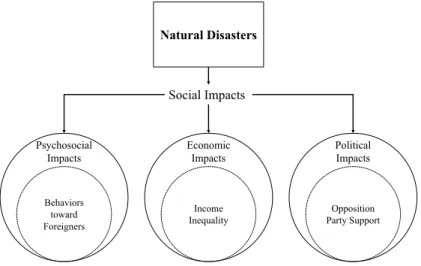
Indirect impacts, assessed as the aftermath of disasters, also have a significant effect on society (Lindell 2011). The first social scientific study of a disaster was by Rousseau, who attempted to observe the effect of the 1755 Lisbon Earthquake on residents’ evacuation (Dynes 2000). From then on, the following pioneer studies in this field started to treat disasters as the opportunity to investigate the collective behavior under extreme conditions (Quarantelli 1987). In recent research, according to Lindell (2011), the social impacts of natural disasters have been divided into three aspects: psychosocial impacts, economic impacts, and political impacts.
Psychosocial impacts refer to social behavior changes caused by natural disasters (Tierney 2007). Early publications focused on demonstrating social behaviors during or after disasters such as enhanced community connections, declines in crime and other antisocial behaviors, and the development of therapeutic communities (Fritz 1961; Barton 1969; Dynes 1970; Quarantelli and Dynes 1972). Additionally, researchers have systematically provided the empirical evidence that enabled this pioneering research by using collected datasets (e.g., Barton 1969; Calo-Blanco et al. 2017; Chang 2010; Fritz 1961; Lee and Freser 2019; Prelog 2016; Solnit 2009). However, these researchers focused on the effect of disaster impact on attitudes and behaviors by treating society as one group.
Obviously, many types of groups live in a society, and they have attitudes and behaviors toward each other, but how disasters impact intergroup behavior remains
only exist within ingroups, and to people from outgroups such as foreigners, these types of behaviors may be perceived as negative and exclusive (Green and Cooper 2015; Jha 2015). Studies have suggested that disasters may be an impetus for a better society, such as the aforementioned enhanced community connections (Fritz 1961; Barton 1969; Dynes 1970; Quarantelli and Dynes 1972). However, if the attitudes and behaviors among groups become negative after disasters, that evidence would contradict the evidence in the literature. Moreover, because of globalization, immigration is more frequent, and foreigners become a critical part of society. In this sense, managing the relationship between natives and foreigners, especially after disasters, is crucial for the government. In these contexts, understanding the behaviors of natives and foreigners is necessary.
Economic impacts include property damage and changes in wealth distribution (Lindell 2011). A study suggested that disasters expand the inequality of individual-possessed wealth, such as “checking and savings accounts, real estate holdings, vehicles, farms, businesses, stocks, annuities, and other savings” (Howell and Elliott 2018: p.5). However, this study did not include individual income in the measurement of possessed wealth. Income differs from possessed wealth or property because it depends on individuals’ employment and is property not already possessed. Disasters can only influence one’s income indirectly through effects on their employment, compared with the direct influence on possessed wealth. Therefore, the impact of disasters on individuals’ income differs from possessed wealth.
Regarding the influence of disasters on income inequality, most researchers have argued that it would increase after disasters (Fang et al. 2017; Guimaraes et al. 1993 Shaughnessy et al. 2010), whereas other researchers have indicated that disasters would decrease income inequality (Abdullah et al. 2016; Feng, Lu and Wang 2016; Keerthiratne and Tol 2018). The results in the literature are inconsistent, which may be caused by the level of analyses. All these researchers have conducted only macrolevel analyses; however, other factors at the macrolevel also caused by disasters may simultaneously affect income inequality. These factors cannot be avoided only through the analyses at the macrolevel. For instance, after disasters, some governments provide disaster aid to victims (Feng et al. 2016). This policy may decrease income inequality in disaster-affected areas. However, in cases where the government provides no disaster aid, income inequality may increase after disasters. The different results in the literature may be caused by these types of macrolevel factors. Thus, to avoid this disadvantage, analyses at the microlevel are necessary.
Furthermore, in the literature that has focused on analyses at the macrolevel, although the mechanisms they mentioned were all at the micro or individual level. This method is inappropriate because macrolevel data cannot avoid factors that may simultaneously influence income inequality. For instance, after disasters, population mobility becomes frequent (Elliott and Howell 2017; Landry et al. 2007), and people with lower socioeconomic status are more likely to move out of the affected areas. Therefore, the decline of income inequality may only be caused by population mobility and not the mechanisms assumed in the literature. The analyses at macro-level cannot decide whether the influence is caused by population mobility or mechanisms assumed only through macrolevel data. In this sense, the use of individual-level data is necessary to demonstrate the mechanisms of disasters that promote or reduce income inequality.
Political impacts refer to social activism resulting in political disruption (Lindell 2011). Studies, especially studies in the United States’ (US) social context, have concentrated on the punishment of the citizens by the incumbent government or party, and most have found that after natural disasters, people punish incumbent governments or parties (Cole et al. 2012; Gasper and Reeves 2011; Healy and Malhotra 2009, 2010). Furthermore, several researchers have noted that people would dismiss the incumbent party in support of the opposition party if the incumbent party inappropriately managed a disaster (Cavallo and Noy 2010; Chang and Berdiev 2015; Keefer et al. 2011; Vaugirard 2007). However, no studies have attempted to empirically demonstrate how disasters affect the support of opposition parties. In the US social context, two parties are the ruling parties, and the voters decide their degree of power in governance; therefore, disasters decrease support for the incumbent party and promote support of the opposition party. Compared with the two-party system in the US, most countries use a multiparty system, that is, a “regime where more than two political parties are in serious contention for power, alone or in coalition” (McLean and McMillan 2009: p: 46); thus, compared with the US, what type of opposition party is more likely to be supported after disasters in these countries remains unknown. Because disasters increase the likelihood of governmental replacement (Chang and Berdiev 2015), predicting the next ruling party is a crucial problem for laypeople and scholars. Therefore, an estimation of which opposition party is more likely to be supported after disasters is necessary.
According to the aforementioned information presented in the introduction, all the literature on the impacts of natural disasters on the three dimensions of societies have disadvantages, and these disadvantages are all crucial to academic and
to explore the impact of natural disasters on behaviors toward foreigners, income inequality, and opposition party supports by using Japan as an example.
Japan is an appropriate example for testing these demonstrations. First, Japan is the country affected by natural disasters, for example, typhoons, heavy snow, earthquakes, tsunamis, and volcanic eruptions. These disasters influence Japanese society, especially large-scale disasters. Thus, an exploration of how natural disasters impact Japanese society is necessary. Second, because Japan has no major minority groups, such as the Asian American population in the US, the central majority and minority groups are the Japanese and foreigners. These demographics make drawing conclusions on the attitudes and behaviors toward foreigners impacted by the natural disasters in Japan easier. Finally, Japan is a democracy with a multiparty system; thus, we can explore how disasters impact the support of opposition parties.
The structure of this study is as follows. At first, Chapter 2 presents a more detailed review of the literature. Then, the remaining three chapters present the empirical demonstrations: (1) using the panel data at the prefecture level of Japan, Chapter 3 investigates whether disasters increase or decrease discrimination by Japanese people against foreigners; (2) relying on the data at individual level, collected after the Great Eastern Japan Earthquake, an unpredictable and the biggest disaster in Japan since 1995, Chapter 4 estimates whether disasters increase or decrease income inequality at individual level; (3) utilizing both individual-level data collected after the Great Eastern Japan Earthquake and prefecture-level panel data, Chapter 5 explores how disasters influence the support of opposition parties, and which party is more likely to be the next ruling party after disasters. The structure of this study is shown in Figure 1.1.
Figure 1.1 Study Content
Natural Disasters Social Impacts Behaviors toward Foreigners Income
Inequality Party SupportOpposition
Psychosocial Impacts Economic Impacts Political Impacts
The results show the following: (1) natural disasters decrease rather than increase discrimination against foreigners; however, this decrease is observed only in large-scale disasters and in the short term; (2) natural disasters promote income inequality through influencing individuals’ employing replacement; (3) natural disasters only promote support for parties with salient concerns about economic growth and welfare. This study contributes to the literature by filling the gaps concerning the impacts of natural disasters on society. The implications of the results are discussed in Chapter 6.
CHAPTER 2
Literature Review: Impact of Natural Disasters on Behaviors toward
Foreigners, Income Inequality, and Opposition Party Support
2.1 Behaviors toward Foreigners
Disaster studies of the US have summarized that minority racial groups, such as African Americans and Latinos, are the most vulnerable groups before, during, and after disasters (Fothergill et al. 1999). This phenomenon occurs because these groups generally have low socioeconomic status (American Friends Service Committee 1972; Bolin 1993, 2007). Foreigners are also a type of vulnerable group both during and after disasters because of language barriers rather than socioeconomic status (Kawasaki et al. 2018). Another way that foreigners are exposed as a vulnerable group after disasters is the negative behavior toward them from native people.
Studies have demonstrated that native people affected by disasters are less likely to provide help to foreigners than to native people (Andrighetto et al. 2015) and that the mechanism of this finding could be interpreted as the intergroup threat theory (Stephan and Stephan 2000; Stephan et al. 2009), especially the realistic threat theory (Andrighetto et al. 2015). Realistic threats are “…threats to the very existence of the ingroup, threats to the political and economic power of the ingroup, and threats to the physical or material well-being of the ingroup or its members” (Stephan and Stephan 2000: 25). Indeed, disasters cause the social loss, which could lead the ingroup to treat outgroup as a threat to obtaining resources. Group conflict theory mentions that the negative attitudes and behaviors between groups will be promoted by competition for limited resources (LeVine and Cambell 1972; Sherif 1966); thus, the disasters or perceived disaster damage of individuals may promote negative attitudes and behaviors toward the outgroup.
Two incidents provide satisfactory examples of this theory. The first example is the Kantō Massacre (Aldrich 2012). After the 1923 Great Kantō Earthquake, anti-Korean riots occurred, and many Koreans were killed based on a rumor that Koreans would poison the wells. This catastrophe reflects the increasing discrimination of Japanese people toward other nationalities. The second example occurred recently in Japan (The Japan Times 2018). After the 2018 Osaka Earthquake, “scores of tweets were observed that labeled ethnic non-Japanese, particularly ethnic Koreans and Chinese, as criminals who may take advantage of post-quake confusion to loot banks and convenience stores, and commit other dangerous crimes” (The Japan Times 2018).
Because this incident aimed to the foreigners, it could be counted as the present of discrimination against foreigners.
By contrast, other theories imply that positive attitudes and behaviors toward outgroups are also possible during or after disasters. Studies have provided the common ingroup identity model (Gaertner and Dovidio 2000, 2012) to explain the altruistic behaviors between two different groups. The aforementioned intergroup threat theory is based on the remaining social identity that native people still categorize themselves as the ingroup compared with foreigners who are treated an outgroup. The social identity theory mentions that people improve their self-identity through membership in prestigious social groups (Tajfel and Turner 1979). Therefore, this self-identity causes social comparisons to distinguish the ingroup and outgroup. Furthermore, the self-categorization theory generalizes this theory of intergroup and intragroup processes and emphasizes cognitive processes (Turner et al. 1989). However, according to the common ingroup identity model, people affected by an external threat such as a terrorist attack (Dovidio et al. 2004) or earthquake (Vezzali et al. 2015) decategorize themselves as a member of the ingroup and become personalized to cooperate with other people from outgroup (Gaertner and Dovidio 2000, 2012). Furthermore, according to the contact hypothesis (Miller and Brewer 1984), this cooperation will disrupt the bias and improve the positive attitudes between the ingroup and outgroup, leading to fewer negative behaviors such as discrimination toward people from the outgroup. Consequently, through this mechanism, the disasters may improve positive attitudes and reduce discrimination toward the outgroup.
Evidence of this theory has been presented by several researchers. In the psychology literature, students have been the experimental target to explore whether the native students help students from outgroups during disasters or crises (Dovidio et al. 2004; Vezzali et al. 2015). They found that native students affected more by a crisis are more likely to provide help to students from outgroups. In addition, according to Takezawa (2007), in the Hanshin-Awaji Earthquake, the local Japanese residents in the affected areas treated the foreigners as the same group. This phenomenon also demonstrates that people affected by the disaster from both the ingroup and outgroup will treat each other without the categorization.
Regarding these two contrary theories, although the literature has presented several cases and experiments to support them, the evidence is insufficient to prove whether natural disasters promote or reduce discrimination against foreigners. The aforementioned cases are inconsistent within the same society—Japan (Aldrich 2012;
several cases is difficult. The experiments provided by psychologists have only focused on students (Dovidio et al. 2004; Vezzali et al. 2015). As aforementioned, native people discriminate against foreigners mainly because of the economic threat (Stephan and Stephan 2000; Stephan et al. 2009). Because students have no independent socioeconomic status, they are less likely to feel the economic threat from foreign students. Therefore, they tend to help foreign students in a crisis. However, the general situation of the whole society is unknown on the basis of these experiments, and further research is necessary to conduct a more comprehensive empirical demonstration to prove whether natural disasters promote or reduce discrimination against foreigners.
2.2 Income Inequality
Social vulnerability theory has indicated that natural disasters have a greater impact on poor agents (Alexander 2012; Cutter 2003; Fothergill and Peek 2004). Risk theory also suggests that the risk of disasters is concentrated in the lower classes (Breen 1997). The empirical studies have also provided the evidence for these theories (e.g., Kuznets 1955; Kawachi et al. 1997).
Regarding income inequality, the literature has also suggested that it expands after natural disasters (Fang, Wu, and Milijkovic 2017; Milijkovic and Milijkovic 2014; Yamamura 2015). However, few researchers have mentioned the mechanisms for why disasters increase income inequality. Following social vulnerability theory, Yamamura (2015) proposed a mechanism to explain this influence: poor people are more likely to be affected by disasters because they work in informal sectors, and rich people work in formal sectors. Informal sectors are less likely than formal sectors to ensure continuous operations after disasters; therefore, rich people can continue to earn money after disasters, whereas poor people become unemployed or are less likely to go back to work. Consequently, income inequality may increase after disasters.
Contrasting evidence has also demonstrated that natural disasters may decrease income inequality. Abdullah et al (2016) found that higher-income households were more vulnerable in a disaster because the damage costs for higher class were 42%, and this cost for middle and lower class was 16% and 15%, respectively. Consistent with this study, research on the Wenchuan Earthquake in China found that income inequality decreased after the disaster mainly because of the government aid (Feng et al. 2016). Likewise, in Sri Lanka, Keerthiratne and Tol (2018) found that income inequality, measured by the Gini coefficient, decreased after natural disasters. The mechanism that explains why disasters reduce income inequality was proposed by Keerthiratne and Tol (2018) and mentions that losses for people with higher socioeconomic status would be disproportionately greater because of natural disasters.
Studies that have explored the influence of disasters on income inequality have provided inconsistent results, and the reason for this consequence may be their use of macrolevel analyses. However, other macrolevel factors also caused by disasters may simultaneously affect income inequality and are avoided only through macrolevel analyses. For instance, after disasters, some governments provide disaster aid to the victims (Feng et al. 2016). This policy may help decrease income inequality in disaster-affected areas. However, when governments provide no disaster aid, income inequality may increase after disasters. The different results in the literature may be caused by these types of macrolevel factors. To avoid this disadvantage, analyses at the microlevel are necessary.
Moreover, the analyses conducted in literature have been at the macrolevel, but the mechanisms applied were at the microlevel. This method is inappropriate because macrolevel analyses provide an inaccurate demonstration of the mechanisms, that is, factors at macrolevel caused by the disasters may simultaneously affect income inequality. For instance, after disasters, population mobility increases in frequency (Elliott and Howell 2017; Landry et al. 2007), especially for people with lower socioeconomic status, who are more likely to move out of the affected areas. Therefore, the cause for the decline in income inequality may be population mobility rather than the mechanisms assumed in the literature; thus, whether the influence is caused by population mobility or the mechanisms remains unknown because an assumption is made based on only macrolevel data. Similarly, in this sense, individual-level data must be used to demonstrate the mechanisms that explain why disasters promote or reduce income inequality.
Estimations of whether disasters expand income inequality at the individual level must focus on employment status because income is mainly from wages. As aforementioned, people with lower socioeconomic status are more likely to lose jobs than people with a higher socioeconomic status (Elliott and Pais 2006; Yamamura 2015). People with lower socioeconomic status are also more likely to have non-regular employment or be unemployed compared with their higher socioeconomic counterparts; notably, regular employment status is an index for measuring socioeconomic status. In this sense, people who engage in non-regular employment or who are unemployed are more likely to lose jobs compared with people who have regular employment.
The employment of unemployed individuals is not affected by disasters; therefore, their cases are inconsistent with the mechanism that disasters influence individuals’ income through the effect on their jobs. Accordingly, in this study, to
purely explore the mechanism at the individual level, people unemployed before the disaster are excluded.
For non-regularly employed workers, in the short term, social vulnerability theory, which suggests that people with lower socioeconomic status are affected more in the disasters, may be correct; however, in the long term, it remains unknown. After disasters, people who lose their job must seek a new job to obtain the income required to sustain their life. Generally, non-regular employment is easier to obtain compared with regular employment because the former decreases labor costs for employers. Therefore, people engaged in non-regular employment before disasters can more easily return to their employment status after disasters compared with people engaged in regular employment before disasters, who may have difficulty returning to their employment status after disasters; thus, of the two groups, the regular employment group would be more likely to lose their employment status and become non-regularly employed or unemployed. Therefore, people engaged in non-regular employment before disasters may have the same or only a slightly lower level of income than before disasters, whereas people engaged in regular employment will have a much lower level of income than before disasters because regular employment provides a higher level of income than non-regular employment.
From this point of view, at the individual level, people who had a higher level of income before disasters drop to lower-income levels, and people who had lower incomes maintain their status. In this situation, although the total income difference between workers who were regularly and non-regularly employed will decrease after disasters, when expanding the view to the whole society, total income inequality will increase because the income of people with a lower socioeconomic status increased. Thus, for assessments of the impact of disasters on income inequality, empirical analyses should be conducted at the individual level.
2.3 Opposition Party Support
As mentioned in Chapter 1, natural disasters are deemed “acts of God” (Black 1990) because these events are beyond human control. Additionally, natural disasters are sometimes deemed “bad omens for governments” because they can change government stability (Abney and Hill 1966: 974). Studies have indicated that natural disasters alter politics by offering unexpected trial of governance for the incumbent parties (Gasper and Reeves 2011). In early studies, for instance, Barnhart (1925) indicated that drought decreased the voting share of Nebraska’s Republican Party in the 1890 election in the US. The research subsequent to that study started to explore the effect of natural disasters on the support, especially the voting share, for the incumbent
party or government (e.g., Achen and Bartels 2013; Gasper and Reeves 2011; Healy and Malhatra 2009, 2010; Healy et al. 2010).
This type of punishment for the incumbent party is summarized as retrospective voting (e.g., Kramer 1971; Fiorina 1981). Furthermore, other studies have indicated that people tend to punish the incumbent party because these voters are instrumentally rational (Hernández and Kriesi 2016), that is, they reward or punish incumbents with their vote when they perceive a situation is good or bad, respectively. Gasper and Reeves (2011) divided electorates into two types: responsive and attentive. Responsive electorates “punish the incumbent party based on the state of the world without regard for the responsibility of the incumbent in shaping it” (Gasper and Reeves 2011: p.341). In other words, responsive electorates punish the incumbent party after disasters, without considering the policies the party implemented before, during, and after the disaster.
Attentive electorates are attentive to “the actions of their elected officials and assign blame based on the authority and actions of the incumbent party” (Gasper and Reeves 2011: p.342). In other words, the punishment of voters after disasters depends on the actions taken by the incumbent party. Some researchers have found that if the incumbent party announces a declaration of the disaster immediately after the disaster, she or he will not be punished by the voters (Cole Healy and Werker 2012; Gasper and Reeves 2011). However, as mentioned by Healy and Malhotra (2009), voters are more likely to punish or reward incumbents according to the policies published after the disasters; by contrast, if disaster policies are published before disasters, voters do not tend to evaluate incumbents, even though the policies have a higher probability of protecting the voters against the negative effects of disasters. Healy and Malhotra (2009) call these voters myopic voters.
Studies have estimated whether and how citizens punish the incumbent party after disasters. The opposition parties tend to treat the punishment as an opportunity to assess blame (Quarantelli and Dynes 1976). Part of the literature has even noted that citizens might dismiss the incumbent party in support of the opposition party if the incumbent party did not manage the disasters appropriately (Cavallo and Noy 2010; Chang and Berdiev 2015; Keefer et al. 2011; Vaugirard 2007). Additionally, as indicated by Chang et al. (2015), natural disasters could also increase the probability of governmental replacement; thus, predicting the next ruling party becomes a crucial issue for the citizens after disasters. In the US social context, a two-party system, when the incumbent party is punished by the voters, the opposition party will surely gain
party will benefit from the disasters is difficult without research. Therefore, how to predict which opposition party is more likely to be supported after disasters is crucial.
Concerning this question of how, according to the literature, two types of theories can lead to two adverse results of a disaster’s impact on the support for opposition parties. The first adverse result is based on economic voting theory. According to studies on economic crises, economic crises have been suggested to increase support for the emerged-challenger parties (Bosch and Durán 2019; Hobolt and Tilley 2016). The reason in this case can also be explained by economic voting theory. Voters will “throw out the rascals (Hobolt and Tilley 2016: p. 972)” according to the poor economy. The “rascals” include not only the parties in the government but the mainstream parties in opposition because they have also been involved in formulating the economic policies. Voters are unsatisfied with the existing political situation and want to support a new political party that provides policies that differ from the government and mainstream parties. Thus, the challenger parties will provide policies that conform more to the voters’ expectations to obtain a greater voting share. In this situation, the voters support the challenger parties. For instance, recently, because of economic depression and an increased number of refugees, most people in European countries have voted for and elected challenger parties, such as Alternative (Germany), the Five Star Movement (Italy), and Podemos (Spain) (Hobolt and Tilley 2016). According to the general demonstration, the literature also found that economic crises increase support for challenger parties (Bosch and Durán 2019; Hobolt and Tilley 2016). In this sense, voters are more likely to support challenger parties after a crisis.
Natural disasters affect society because they cause poor economic performance, such as a lower unemployment rate, and property damage; thus, economic voting theory is likewise appropriate to apply in cases of natural disasters, that is, natural disasters may promote support for challenger parties. Because challenger parties are newly emerged, they have no experience in governance before being elected as the ruling party. Thus, although they propose policies to manage the crisis, people do not know their real ability to resolve problems. Compared with economic voting theory, ownership theory provides another possibility for opposition party support after disasters.
According to the literature, ownership theory suggests that political parties receive support based on the issues for which they have a power of competence (Budge and Farelie 1983; Petrocik 1996). This type of support only occurs when the issues are salient (Bélanger and Meguid 2008). For instance, in the US, the Democratic Party is known as the party to manage “education, welfare, and civil rights”, whereas the Republican Party has been known as the party to deal with “foreign affairs, national
defense, and crime” (Petrocik 1996: p.837). In the context of issue ownership theory, people allocate issue ownership to the parties based on their understanding of the governance of these parties. In other words, parties who possess the issues already have experience as a ruling party. This phenomenon differs from economic voting theory, which indicates that people would support the parties without governing experience.
According to the literature, two topics become salient after natural disasters: economic growth and welfare (e.g., Oliver and Reeves 2015). Regarding economic growth, because disasters cause significant economic damage, how to return to normal life and how to recover from the damage are critical problems. As indicated by Visconti (2018), disaster victims make political decisions based on the expected benefits they will receive because welfare can help people recover from a disaster; thus, welfare is a focus of policy after disasters. Accordingly, based on issue ownership theory, the existing opposition parties that possess a reputation of competence concerning these two topics are more likely to be supported by people. To demonstrate whether economic voting theory or issue owner theory is more suitable to assess the impact of disasters on opposition party support, an empirical analysis is necessary.
CHAPTER 3
Behaviors toward Foreigners
3.1 Introduction
Using an original prefecture-level panel data in Japan, this chapter attempts to estimate the social impact of natural disasters on the behaviors of natives toward foreigners. According to the literature (e.g., Doidio et al. 2010), three types of attitudes and behaviors are taken by native people toward foreigners: prejudice, stereotyping, and discrimination. Because discrimination is a behavior that appears to harm to foreigners; therefore, it is the most important index to indicate the relationship between native people and foreigners. For this reason, this study uses the discrimination of native people toward foreigners as an indicator to measure behavior.
Furthermore, as disaster researchers have mentioned (e.g., Keerthiratne and Tol 2018; Matsubayashi, Sawada, and Ueda 2013; Yamamura 2015), the impact of disasters is not limited into the short-term, that is, long-term effects on society are also possible. Therefore, to explore the long-term effect of disasters on discrimination, this study also applies the time lag of a disaster’s impact in the analyses. Additionally, as indicated by Matsubayashi, Sawada, and Ueda (2013), who used prefecture-level panel data, the general effect of disasters on societies may be strongly altered by extreme disasters. Extreme disasters, such as the Great East Japan Earthquake, damage societies more than smaller disasters; thus, the total effect of disasters on societies may only be attributed to extreme disasters. To identify this point, a comparative analysis must be conducted with and without extreme disasters.
The outline of this chapter is as follows. First, the methods that include the dataset, variable measurement, and analytical methods are presented. Then, the results are divided into three parts: 1) the results without time lag; 2) the results with time lag; and 3) the results with a time lag and without the year with extreme disasters. Finally, a short conclusion is provided.
3.2 Methods
3.2.1 Data
This chapter uses the original panel dataset collected from the 47 prefectures in Japan from 1999 to 2015. The total number of observations is 799 prefecture-years. The period of analyses was determined based on the availability of discrimination data. The discrimination data is collected by the Ministry of Justice (Hōmusho) in Japan, and the name of the set of statistics is Human Rights Violations (Jinken Shinpan Tōkei). The cases of discrimination against foreigners are counted based on the incidents judged to
concern discrimination behaviors against foreigners such as refusing to allow foreigners to participate in social organizations. The data of disaster impact is collected by the Fire Disaster Management Agency (Shōbōcho), and the name of the set of statistics is the White Paper on the Fire Service (Shōbōhakusho). Other sources of this dataset are shown in Table 3.1.
Table 3.1 Sources of the Dataset
Variables Source
Discrimination toward foreigners
From the Human Right Violations (Jinken Shinpan Tōkei) published by the Japanese Ministry of Justice (Hōmusho)
(http://www.moj.go.jp/housei/toukei/toukei_ichiran_jinken.html) Disaster-affected
household number
From the White Paper on the Fire Service (Shōbōhakusho) published by Disaster Management Agency (Shōbōcho) (https://www.fdma.go.jp/publication/#whitepaper)
Household number
From the National Survey on Household Change (Setai Dotai Chōsa) published by the National Institution of Population and Social Security Research
(http://www.ipss.go.jp/site-ad/index_Japanese/cyousa.html)
Total population From the Japan Statistical Yearbook (Nihon Tōkei Nenkan) published by Statistics Bureau of Japan (https://www.stat.go.jp/data/index.html)
Area
From the Research of Prefecture Area (Zenkoku Todōfuken Shikuchōsonbetsu Mensekichō) published by Geospatial Information Authority of Japan
(https://www.gsi.go.jp/KOKUJYOHO/MENCHO-title.htm) Population of
foreigners
From the Japan Statistical Yearbook (Nihon Tōkei Nenkan) published by Statistics Bureau of Japan (https://www.stat.go.jp/data/index.html)
gross domestic product (GDP)
From the Statistics on Economy of Citizens (Kenmin Keizai Seisan) published by Cabinet Office of Japan
(https://www.esri.cao.go.jp/jp/sna/data/data_list/kenmin/files/contents/main_h27.html)
Disaster recovery expenditure
From the White Paper on Local Public Finance (Chihō Zaisei Hakusho) published by the Ministry of Internal Affairs and Communications
(http://www.soumu.go.jp/menu_seisaku/hakusyo/index.html)
NPO number
From the Statistics of NPO (NPO Tōkei Jyōhō) published by Cabinet Office, Government of Japan, NPO page
(https://www.npo-homepage.go.jp/about/toukei-info)
3.2.2 Measurements
Dependent Variable
As mentioned in section 3.1, the discrimination of native people, namely, the Japanese against foreigners, is applied as the behavior toward foreigners. It is calculated by the division between the discrimination cases and the foreigner population norming the discrimination cases against the broader population in the prefecture. The equation is as follows.
!"#$= &'()#*+)( -#./(#0#+1$#'+ 21.).34
&'()#*+)( 5'6781$#'+34 (3.1)
Where !"#$ represents foreigner discrimination, and it is calculated as the ratio between the number of accepted and disposed foreigner discrimination and the foreigner population.
Independent Variable
This paper references the literature (Matsubayashi, Sawada, and Ueda 2013) and uses the proportion of households affected by natural disasters in prefectures each year as the disaster impact variable. It is calculated based on equation (3.2):
"9:;:<=> ?@A;B<#$ = -#.1.$)( 1CC)/$)D E'7.)F'8D G70H)(34
E'7.)F'8D G70H)(34 (3.2)
Controlling Variables
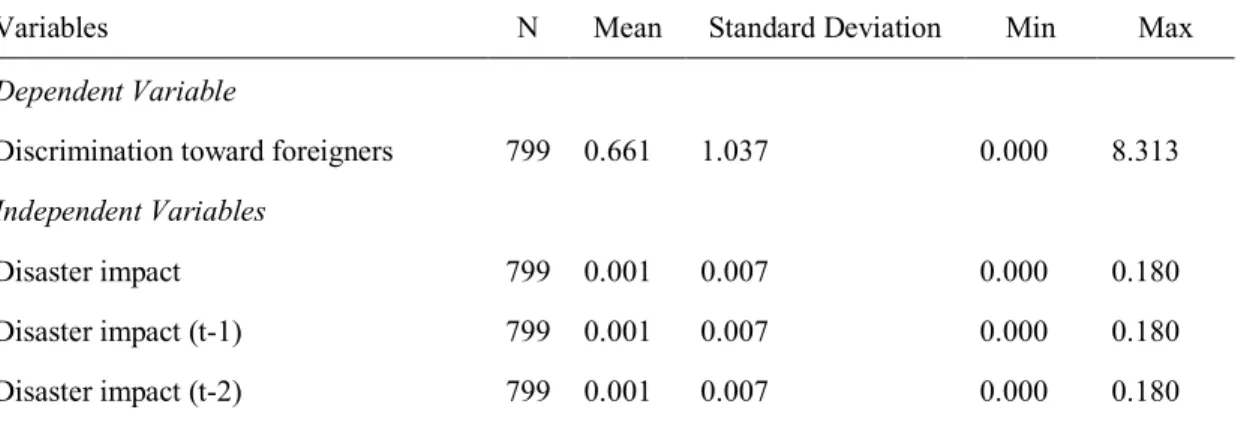
To control the characteristics that may affect both the dependent and independent variables, this study also includes controlling variables, based on the literature. The controlling variables are population density, women, elderly individuals (aged over 65 years), foreigner, disability (sum of population of physically handicapped persons, mentally handicapped persons, and cerebrally handicapped persons) proportion, employment rate, gross domestic product (GDP) per person, disaster recovery expenditure rate, and Nonprofit Organization (NPO) per person. The descriptive statistics of the variables are shown in Table 3.2.
Table 3.2 Descriptive Statistics of Variables
Variables N Mean Standard Deviation Min Max
Dependent Variable
Discrimination toward foreigners 799 0.661 1.037 0.000 8.313
Independent Variables
Disaster impact 799 0.001 0.007 0.000 0.180 Disaster impact (t-1) 799 0.001 0.007 0.000 0.180 Disaster impact (t-2) 799 0.001 0.007 0.000 0.180
Disaster impact (t-3) 799 0.001 0.007 0.000 0.180
Controlling variables
Population density (log) 799 1.197 0.982 -0.376 4.122 Women proportion 799 0.517 0.010 0.492 0.534 Elderly proportion 799 0.230 0.039 0.121 0.336 Foreigner proportion 799 0.012 0.007 0.002 0.034 Disability proportion 799 0.047 0.011 0.019 0.075 Employment rate 799 1.629 1.712 0.396 8.141 GDP per capita 799 3.696 0.772 2.523 8.325 Disaster recovery expenditure rate 799 0.008 0.014 0.000 0.190 NPO per person 799 0.000 0.000 0.000 0.001
3.2.3 Analytic Methods
To explore the relationship between natural disasters and discrimination against vulnerable groups, this study references by Matsubayashi, Sawada, and Ueda (2013) and uses the pooled regression model and fixed-effect model as the methods for analyses to check the robustness of results. To increase the clarity of this method, the equations and the meanings are as follows.
The pooled regression model can be generally expressed as follows: "#$ = IJ + IL"?#$+ MNONOPQ+ IRS#+ ITU$+ V#$ (3.3)
Where "#$ represents the discrimination against foreigners; "?#$ equals the disaster impact, and NOPQ is the vector of the control variables; IL and MNO represent the
regression coefficients of "?#$ and NOPQ. S# is year-specific fixed effects, and U$ indicates prefecture-specific fixed effects. V#$ expresses the error term, including time < and prefecture 9.
Additionally, as mentioned in section 3.1, the literature concerning disasters has suggested that disasters may have a long-term effect on discrimination (Keerthiratne and Tol 2018; Matsubayashi, Sawada, and Ueda 2013; Yamamura 2015), and this study also applies a three time-lagged variable of disaster impact to the analyses. The equation can be expressed as follows:
For the fixed-effect model, the equations can be expressed as follows: ∆"#$ = IL∆"?#$ + MNO∆NOPQ + IR∆S#+ ∆V#$ (3.5)
∆"#$ = IL∆"?#$+ IR∆"?#$WL+ IT∆"?#$WR+ IX∆"?#$WT+ MNO∆NOPQ+ IY∆S# + ∆V#$ (3.6)
The models are basically the same as the pooled regression. Because the fixed-effect model attempts to eliminate the time-invariant effect of the regression model, each of the variables included in the equations is subtracted by their year-average with the mark of ∆. Additionally, because the prefecture-specific fixed effects have already been controlled by the subtraction, they will not be involved in the model again.
3.3 Results
3.3.1 Preliminary Analyses
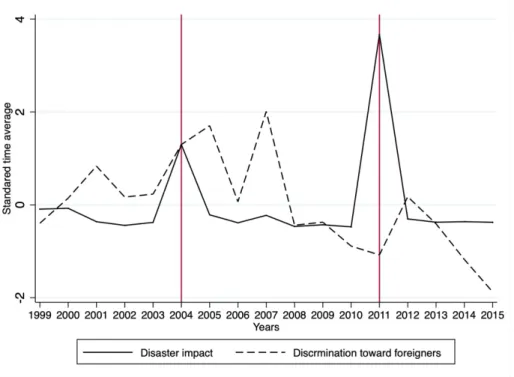
Before the estimation of the pooled regression and fixed-effect model, to check the time trend of the main dependent and independent variables, the time trend of averaged dependent and independent variables is shown in Figure 3.1.
Figure 3.1 Time Trend of the Disaster and Discrimination against Foreigners The standardized time-averaged variables of disaster impact and discrimination toward foreigners are included in Figure 3.1. The solid line is the time trend of disaster impact. There are two huge increases in disaster impact in 2004 and 2011, marked by the vertical lines. These two increases are caused by two huge earthquakes: the 2004
Chūetsu Earthquakes and the 2011 Great East Japan earthquake. Figure 3.1 also shows no potential relationship in the time trend between disaster impact and the discrimination against foreigners because the trend of the lines is different and irregular. However, this study includes the time variable to statistically control the potential relationship of the time trend for the statistic check.
3.3.2 Effects of Disasters on Discrimination
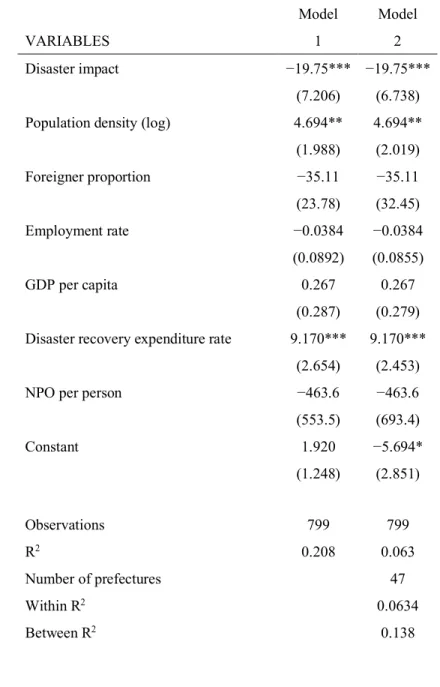
In this section, the relationship between disaster impact and discrimination is estimated through both the pooled regression and the fixed-effect model. At first, the disaster impact only at time t is included in the estimation, and the results are shown in Table 3.3.
Table 3.3 Results of the relationship between Disaster Impact and Discrimination against Foreigners
Model Model
VARIABLES 1 2
Disaster impact −19.75*** −19.75*** (7.206) (6.738) Population density (log) 4.694** 4.694**
(1.988) (2.019) Foreigner proportion −35.11 −35.11 (23.78) (32.45) Employment rate −0.0384 −0.0384 (0.0892) (0.0855) GDP per capita 0.267 0.267 (0.287) (0.279) Disaster recovery expenditure rate 9.170*** 9.170***
(2.654) (2.453) NPO per person −463.6 −463.6 (553.5) (693.4) Constant 1.920 −5.694* (1.248) (2.851) Observations 799 799 R2 0.208 0.063 Number of prefectures 47 Within R2 0.0634
Overall R2 0.0179
Year fixed effect Yes Yes Prefecture fixed effect Yes Yes Robust standard errors in parentheses
*** p < 0.01, ** p < 0.05, * p < 0.1
Two models are included in Table 3.3. Model 1 shows the results of pooled regression, and Model 2 shows the results of the fixed-effect model. In both models, after controlling all other variables, disaster impact has a negative and significant effect on the discrimination against foreigners, and the regression coefficients of disaster impact in these two models are also similar. These results mean that when one unit of disaster impact increases, approximately 19.75 units of discrimination will decrease.
Second, to explore the long-term effect of the disaster, the disaster impact at t - 1, 2, and 3 is included in the analyses. The results are shown in Table 3.4.
Table 3.4 Results of the relationship between Disaster Impact and Discrimination against Foreigners (with Time Lag)
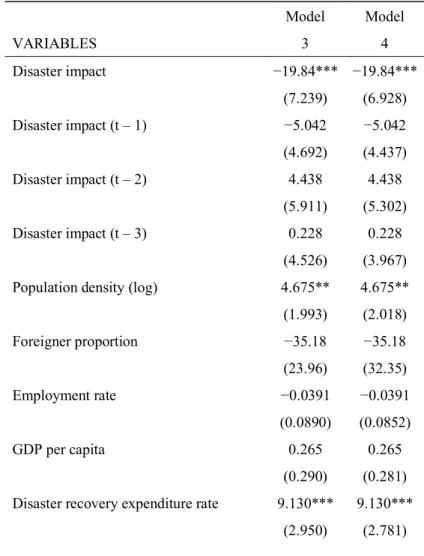
Model Model VARIABLES 3 4 Disaster impact −19.84*** −19.84*** (7.239) (6.928) Disaster impact (t – 1) −5.042 −5.042 (4.692) (4.437) Disaster impact (t – 2) 4.438 4.438 (5.911) (5.302) Disaster impact (t – 3) 0.228 0.228 (4.526) (3.967) Population density (log) 4.675** 4.675**
(1.993) (2.018) Foreigner proportion −35.18 −35.18 (23.96) (32.35) Employment rate −0.0391 −0.0391 (0.0890) (0.0852) GDP per capita 0.265 0.265 (0.290) (0.281) Disaster recovery expenditure rate 9.130*** 9.130***
NPO per person −468.7 −468.7 (566.6) (695.4) Constant 1.929 −5.654* (1.250) (2.860) Observations 799 799 R2 0.210 0.066 Number of prefectures 47 Within R2 0.0657 Between R2 0.138 Overall R2 0.0177
Year fixed effect Yes Yes Prefecture fixed effect Yes Yes Robust standard errors in parentheses
*** p < 0.01, ** p < 0.05, * p < 0.1
Similar to Table 3.3, Table 3.4 has two models, and the results of the pooled regression and fixed-effect model are shown in Models 3 and 4, separately. Based on these results, in these two models, the disaster impact at t−1, 2, and 3 does not have significant effects on discrimination, whereas the disaster impact at t still has a negative and significant effect on discrimination. These results demonstrate that disasters have only a short-term, rather than a long-term, effect on discrimination.
Finally, to explore whether this impact on discrimination is altered by extreme disasters, an additional analysis is conducted that excludes the years 2004 and 2011, when 2004 Chūetsu Earthquakes and 2011 Great East Japan Earthquake occurred. The results are shown in Table 3.5.
Table 3.5 Results of the relationship between Disaster Impact and Discrimination against Foreigners (without 2004 and 2011)
Model Model VARIABLES 5 6 Disaster impact 74.67 74.67 (70.79) (74.41) Disaster impact (t − 1) −4.690 −4.690 (4.618) (4.539) Disaster impact (t − 2) 4.806 4.806
Disaster impact (t − 3) 0.359 0.359 (4.288) (3.706) Population density (log) 5.037** 5.037** (2.124) (2.430) Foreigner proportion −42.71* −42.71 (25.15) (32.40) Employment rate −0.0401 −0.0401 (0.0898) (0.0742) GDP per capita 0.317 0.317 (0.297) (0.247) Disaster recovery expenditure rate 8.583*** 8.583***
(2.829) (2.626) NPO per person −458.7 −458.7 (576.2) (634.1) Constant 1.755 −6.203** (1.319) (3.068) Observations 705 705 R2 0.228 0.068 Number of prefectures 47 Within R2 0.0683 Between R2 0.118 Overall R2 0.0169
Year fixed effect Yes Yes Prefecture fixed effect Yes Yes Robust standard errors in parentheses
*** p < 0.01, ** p < 0.05, * p < 0.1
In Table 3.5, two models are included, and they are Models 5 and 6, separately. The results show that after excluding the years 2004 and 2011, the effect of disaster impact becomes nonsignificant; thus, this effect is altered by extreme disasters. This finding implies that only huge disasters will have a decreasing effect on discrimination, whereas when small disasters occur, no changes will be observed in discrimination.
3.4 Conclusion
The major objective of the research in this chapter is to investigate whether and how disasters influence the behavior toward foreigners. Studies have argued that
disasters may increase (Andrighetto et al. 2015) or decrease the negative attitudes and behaviors toward people from outgroups (Dovidio et al. 2004; Vezzali et al. 2015) on the basis of group threat theory (Stephan and Stephan 2000; Stephan et al. 2009) and the common ingroup identity model (Gaertner and Dovidio 2000, 2012); however, none have generally demonstrated the influence. This study used original panel data collected from the prefectures in Japan from 1999 to 2015 to empirically demonstrate the influence of disasters on the discrimination of native people against foreigners.
The results of both the pooled regression and fixed-effect model showed that natural disasters have a short-term effect of decreasing discrimination, and this effect was only observed in extreme disasters. The reason for these two appearances is discussed in Chapter 6. The results in this chapter provide empirical supportive evidence for the common ingroup identity model after disasters.
CHAPTER 4
Income Inequality
4.1 Introduction
As aforementioned, this study attempts to explore whether disasters decrease or increase income inequality from an individual perspective. The survey data collected to study society after the Great Eastern Japan Earthquake and tsunami is used as the dataset at the individual level. Because the questions in this data include employment status during and after the disaster, and unemployment affected by the disaster, an investigation into how the disaster affects income inequality through individuals’ employment status is possible.
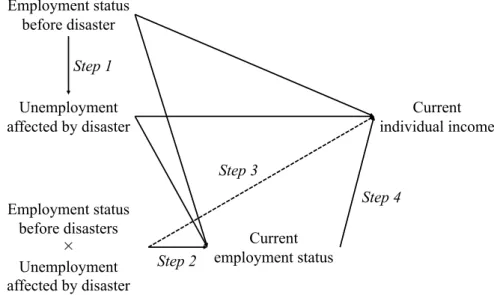
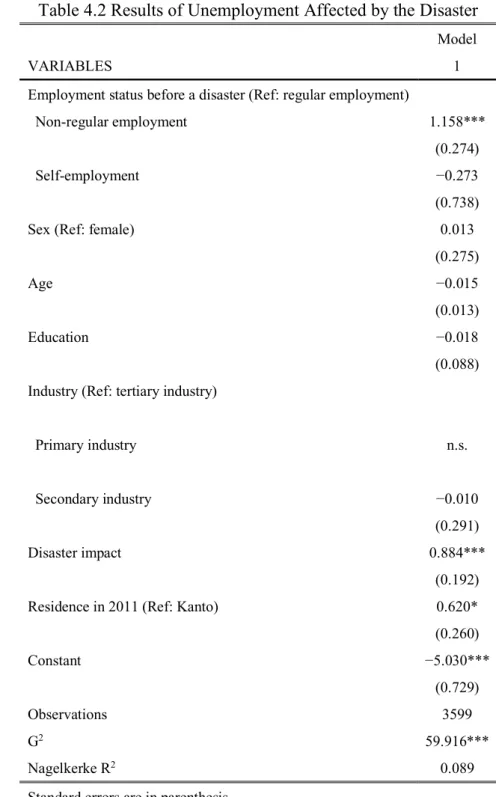
For the analyses, because this study attempts to completely reveal how disasters affect income inequality through the influence on individuals’ employment and provide an empirical demonstration of the mechanism of this effect, four steps are progressively conducted in the analysis. The first step is to confirm social vulnerability theory in the short term. Studies have mentioned that people with lower socioeconomic status are more vulnerable, that is, more likely to lose their jobs in disasters. To confirm whether this theory is appropriate, analyses for the relationship between the employment status before a disaster and unemployment affected by a disaster will be conducted. If the results show that non-regularly employed workers have a higher probability to lose their job in a disaster, social vulnerability theory is valid.
The second step is to explore who is less likely to return to the same employment status after losing their job in a disaster. As mentioned in Chapter 2, according to the employment convention of the labor market, that is, employers prefer to hire non-regular employees to decrease costs, workers who were non-regularly employed are more likely to return to non-regular employment, and workers who were regularly employed are less likely to return to regular employment. An analysis of current employment status is conducted, and the interaction between unemployment affected by a disaster and employment status before a disaster is included. If the results show that compared with regularly employed workers, non-regularly employed workers are more likely to return to the same employment status, the market convention hypothesis is demonstrated.
The third step compares the income between disaster-affected non-regularly and regularly employed workers. Because non-regularly employed workers are more likely to return to the same employment status, compared with workers who were also non-regularly employed and not affected by the disaster, a notable difference in income
is not observed. Because regularly employed workers are less likely to return to the same employment status, compared with workers who were also regularly employed and not affected by the disaster, income has a relatively huge difference.
The final step explores the mediating effect of current employment status. Because the different impact of disasters on individual income between regularly and non-regularly employed workers is caused by the difference in current employment status, the interaction effect between unemployment affected by the disaster and employment status before the disaster will be mediated by the current employment status. The analyses for individual income are conducted, and the interaction term between unemployment affected by disaster and employment status before the disaster, and current employment status, will be included. Figure 4.1 presents the aforementioned steps.
Figure 4.1 Analytic Structure of Chapter 4
The outline of this chapter is as follows. The chapter begins with a brief introduction to the dataset used for the analyses. Next, it empirically estimates the influence of disaster on income inequality by following the aforementioned three steps. To test the mediating effect of current employment status in the final step, the Wald test is to compare the regression coefficients of the interaction term in the two models. Finally, a short conclusion is provided as the last part of this chapter.
Employment status before disaster Unemployment affected by disaster Employment status before disasters × Unemployment affected by disaster Current employment status Current individual income Step 1 Step 2 Step 3 Step 4
4.2 Methods
4.2.1 Data
Survey dataset called the Questionnaire Survey on Work and Hopes following the Earthquake is used in this study. The survey was conducted by Yuji Genda, a professor at the University of Tokyo, and implemented by an internet survey company in Japan. This survey aims to understand the changes in people’s work and lifestyle three years after (2014) the Great Eastern Japan Earthquake and Tsunami. The survey range of this data is the Tohoku and Kanto regions in Japan, which were largely affected and damaged by the earthquake and tsunami. The population was the residents aged from 20 to 59 years (except students) of the Tohoku and Kanto regions. The number of respondents was 13,793, and the number of valid answers was 10,466 (collecting rate: 75.9%).
As mentioned in Chapter 4, because the mechanism of the influence of disasters on income inequality at the individual level focuses on the change in individuals’ employment status. If people were unemployed before the disaster, they would not be affected by the disaster from the perspective of employment status. Additionally, because they were unemployed, they correspondingly did not have an individual income. This case is based on our aforementioned mechanism; thus, people who were unemployed before the disaster were excluded from our dataset.
4.2.2 Measurements
Dependent Variables
The main dependent variable is current individual income. This variable is measured by the question “Please tell me your individual income in the last year (2013)”. The answer was from “No Income” to “JPY 15 million” in 13 categories. The median of each category is used as the income of that response.
Independent Variables
The analyses mainly use two independent variables: employment status in 2011 and unemployed in disaster. The employment status in 2011 is measured by the question “What is your current job?”. The categories of this variable are “Company executive or manager,” “Regular employee,” “Part-time,” “Arubaito (also part-time),” “Temporary,” “Hijyōkin (also part-time),” “Daily-employed,” “Dispatched employee,” “Contract,” “Contract employment,” “Shokutaku (also part-time),” “Freeter (also part-time),” “Free-lance,” “Independent contract,” “Self-employment,” “Family worker,” “Side job,” “Others.” Finally, these categories are summarized as “Regular Employment,” “Non-regular Employment,” and “Self-employment.”
The variable of unemployment affected by disaster is measured by the question “How was your work affected by the disaster: resignation.” The categories were 1 “Yes” and 0 “No.”
Mediating Variable
The mediating variable is the current employment status. It was asked in the same manner as the variable of employment status in 2011, and the categories are also the same. Therefore, also the summarized categories— “Regular Employment,” “Non-regular Employment,” “Self-employment,” and “Unemployment”—are used in the analyses.
Controlling Variables
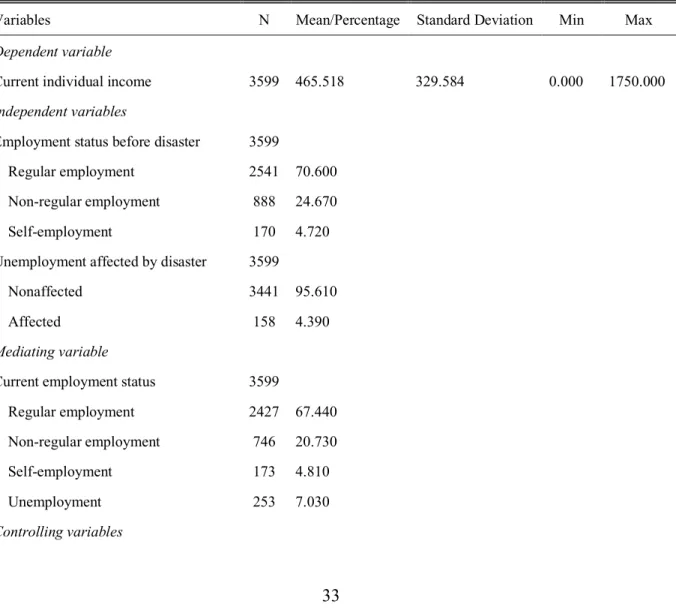
Considering that several confounder variables may simultaneously affect the independent and dependent variables, these variables are also included in the analyses, to control the confounding effect. These variables are sex, age, education, industry of job, general disaster impact, and residence in 2011. The descriptive statistics of the variables are summarized in Table 4.1.
Table 4.1 Descriptive Statistics of Variables
Variables N Mean/Percentage Standard Deviation Min Max
Dependent variable
Current individual income 3599 465.518 329.584 0.000 1750.000
Independent variables
Employment status before disaster 3599
Regular employment 2541 70.600 Non-regular employment 888 24.670 Self-employment 170 4.720 Unemployment affected by disaster 3599
Nonaffected 3441 95.610 Affected 158 4.390
Mediating variable
Current employment status 3599
Regular employment 2427 67.440 Non-regular employment 746 20.730 Self-employment 173 4.810 Unemployment 253 7.030
Sex 3559 Male 2166 60.860 Female 1393 39.140 Age 3599 40.775 9.318 20.000 59.000 Education 3599 3.986 1.380 1.000 6.000 Industry of job in 2011 3599 Primary 24 0.670 Secondary 976 27.120 Tertiary 2599 72.210
Perceived disaster impact 3599 1.312 0.506 1.000 3.000 Residence in 2011 3599
Kanto 2961 82.270
Tohoku 638 17.730
4.2.3 Analytic Methods
Because there are three steps in the analysis, the methods are introduced in three parts. The first part concerns the relationship between employment status before a disaster and unemployment in a disaster. Because unemployment in a disaster is a binomial variable, the method of logistic regression should be applied for analyses, and the equation is as follows:
\] ^ _` (b3cd-)
LW_` (b3cd-)f = IJ+ ILgh2011# + MNONOP (4.1)
In equation 4.1, \] ^ _` (b3cd-)
LW_` (b3cd-)f represents the logarithm of the odds ratio between
unemployment being affected by a disaster or not. IJ expresses the constant of the model; gh2011# and NOP represent the employment status before a disaster and the
vector of the controlling variables, respectively; IL and MNO are their coefficients.
The second part is the interaction effect between unemployment in a disaster and employment status to current employment status. Because the employment status change is also a multinomial variable, the method of multinomial logistic regression is applied to the analyses, and the equation is as follows:
\] ^_` (b3cG'+W()*781() _` (b3cl)*781() f = ILJ+ ILLgh2011#+ ILRm"# + ILTgh2011#∗ m"# + MoNONOP \] ^_` (b3cp)8CW)068'q0)+$) _` (b3cl)*781() f = IRJ + IRLgh2011# + IRRm"# + IRTgh2011# ∗ m"# + MrNONOP \] ^_` (b3cd+)068'q0)+$) _` (b3cl)*781() f = ITJ+ ITLgh2011#+ ITRm"# + ITTgh2011# ∗ m"# + MsNONOP (4.2)
In this equation, the regular employment of current employment status is set as the reference category for the dependent variable, and it is represented as Pr (v# = w=xy\;>) in equation (4.2). Additionally, Pr (v# = z{] − >=xy\;>) represents the probability of non-regular employment; Pr (v# = h=\} − =@A\{~@=]<) is the probability of self-employment; and Pr (v# = m]=@A\{~@=]<) expresses the probability of unemployment. gh2011#∗ m"# represents the interaction term between unemployment affected by a disaster and employment status before a disaster, and ILT, IRT, and ITT are its regression coefficients.
The third- and fourth-part focus on the interaction effect between unemployment in a disaster and employment status before a disaster on current individual income, and the mediating effect of current employment status. Because individual income is a continuous variable, the OLS regression is conducted in the analysis, and the equation is as follows:
•??# = IJ+ ILgh2011# + IRm"# + ITgh2011#∗ m"# + MNONOP+ V# (4.3) •??# = IJ+ ILgh2011#+ IRm"# + ITgh2011# ∗ m"# + IX•gh# + MNONOP+ V# (4.4) In equations 4.3 and 4.4, •??# represents current individual income. In equation 4.4, the •gh#, which represents the current employment status, is added into the model, and IX is its regression coefficient. By comparing the IT in equation 4.3 and IT in equation 4.4, whether the interaction effect is mediated by the current employment status can be understood.
4.3 Results
Again, because the analyses are divided into three parts, the results are shown in three parts. The first part shows the result of the relationship between employment