RECENT
PROGRESS
OF NONCOMMUTATIVE DIMENSION
THEORYTAKAHIRO SUDO $(_{/r}^{/}/H_{\backslash }\ovalbox{\tt\small REJECT} |^{7}\xi’\uparrow’-)\neg\underline{\backslash }$
Department ofMathematics, Tokyo Metropolitan University
$\mathrm{M}.\mathrm{A}$
.
Rieffel [Rf] initiated stable rank of$C^{*}$-algebras which is considered as complexdimension ofnon commutative topological spaces. Successively, $\mathrm{L}.\mathrm{G}$
.
Brown and $\mathrm{G}.\mathrm{K}$.
Pedersen [BP] introducedreal rank of$C^{*}$-algebras, i.e. non commutativereal dimension.
These ranks are recently regarded as one of important indices for mild classification of
$C^{*}$-algebras, in particular, simple $C^{*}$-algebras.
In [Rf],Rieffelproposed a problem such as describing stable rank ofgroup$C^{*}$-algebras
ofLie groupsin terms ofgroups. For this problem, H. Takai and the author [ST1], [ST2]
studiedstable rank ofgroup$C^{*}$-algebras of connected, solvableLie groupsof type I. The
author [Sdl], [Sd2] extended partially their results to the case of amenable Lie groups
of typeI, and also considered the case ofnon amenable Lie groups of type I.
This talk is organized as follows: First of all, we review classes and examples of
connected Lie groups, and some formulas of stable rank of group $C^{*}$-algebras of type
I. Secondly, we give some new results for stable rank of the $C^{*}$-algebras of certain
connected Liegroups of type I. Finally, we give sometables of both stable and real rank for some classes of $C^{*}$-algebras which includes some very important examples.
Definition. For a unital $C^{*}$-algebra $\mathfrak{U}$, its stable rank $\mathrm{s}\mathrm{r}(\mathfrak{U})$ is defined by $\min$
{
$n\in \mathrm{N}|L_{n}(\mathfrak{U})$ is dense in $\mathfrak{U}^{n}$}
Awhere A means minimum and $a=(a_{i})_{i=1}^{n}\in L_{n}(\mathfrak{U})$ means that $\sum_{i=1}^{n}a_{i}a^{*}i$ is invertible
in $\mathfrak{U}$
.
We define real rank $\mathrm{r}\mathrm{r}(\mathfrak{U})$ of $\mathfrak{U}$ by$\min$
{
$n-1\in\{0\}\cup \mathrm{N}|L_{n}(\mathfrak{U}_{sa})$ is dense in $(\mathfrak{U}_{sa})^{n}$}
A $\infty$where $\mathfrak{U}_{sa}$ is the set of all self-adjoint elements of$\mathfrak{U}$
.
For a non unital $C^{*}$-algebra$\mathfrak{U}$, wedefine $\mathrm{s}\mathrm{r}(\mathfrak{U})=\mathrm{s}\mathrm{r}(\mathfrak{U}^{+}),$ $\mathrm{r}\mathrm{r}(\mathfrak{U})=\mathrm{r}\mathrm{r}(\mathfrak{U}^{+})$with $\mathfrak{U}^{+}$ the unitization of$\mathfrak{U}$
.
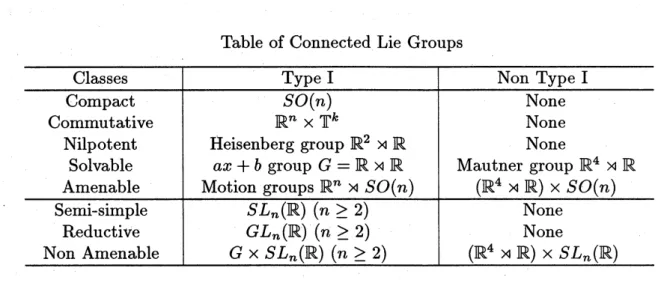
We give some important examples of connected Lie group as follows:Table of Connected Lie Groups
where lower classes in each perpendicular section are wider than upper classes except for ”Compact”.
Notations. We denote by ${ }$ maximum.
For a topological space $X$, we let $\dim_{\mathbb{C}}X=[\dim X/2]+1$ where $[\cdot]$ is the Gauss
symbol.
For a Lie group $G$, denote by $[G, G]$ its commutator subgroup and by $\hat{G}_{1}$ the space
of all 1-dimensional representations of$G$, and let $Z$ the center of $G$. Let $C^{*}(G),$ $C_{r}*(G)$
be the full, reduced group $C^{*}$-algebra of $G$ respectively.
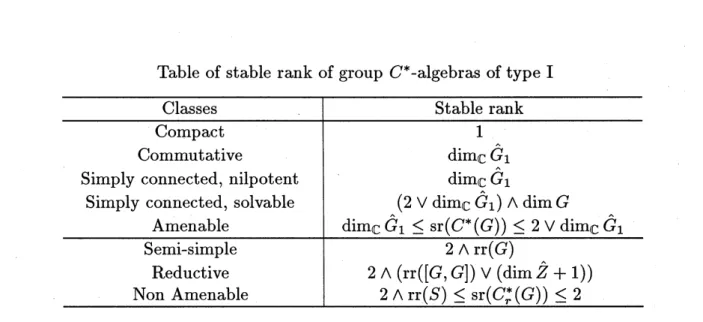
Table of stable rank of group $C^{*}$-algebras of type I
where $S$ is the quotient semi-simple Lie group of $G$ by its radical, and lower classes in
each perpendicular section are wider than upper classes except for ”Compact”.
Remark. If$G$ is the generalized motion group, then $\mathrm{s}\mathrm{r}(C^{*}(G))=1=\dim_{\mathbb{C}}\hat{G}_{1}$.
If $G$ is the direct product ofthe real $ax+b$ group and $SL_{n}(\mathbb{R})$, then $\mathrm{s}\mathrm{r}(C_{r}^{*}(c))--2$.
New viewpoint. Let $G$ be a connected Lie group
of
type I. Then$\dim_{\mathbb{C}}\hat{G}_{r,1}\leq \mathrm{s}\mathrm{r}(c_{r}^{*}(G))\leq 2\dim_{\mathbb{C}1}\hat{c}_{r}$
,
where $\hat{G}_{r,1}$ is the space
of
all 1-dimensional representations in the reduced dual $\hat{G}_{r}$.
Lemma 1 [ST2]. Let$G$ be a simply connected, solvable Lie group. Then$\mathrm{s}\mathrm{r}(C^{*}(G))=1$
if
and onlyif
$G\cong \mathbb{R}$.Remark. In the proof of Lemma 1, we showed that for a crossed product of the form
$\mathfrak{U}=C_{0}(\mathbb{R}^{n})\rangle\triangleleft \mathbb{R},$ $\mathrm{s}\mathrm{r}(\mathfrak{U})=1$ ifand only if$\mathfrak{U}=C_{0}(\mathbb{R})$.
Lemma 2. Let$G$ be a connected solvable Lie group, and$\tilde{G}$
its universal covering group.
If
the center $Z$of
$\tilde{G}$is connected, then $\mathrm{s}\mathrm{r}(C^{*}(G))=1$
if
and onlyif
$G$ is isomorphic toProof.
If $G$ is commutative, then $G\cong \mathbb{R}^{k}\mathrm{x}\mathrm{T}^{s}$ for some $k,$$s$. Then $\mathrm{s}\mathrm{r}(c^{*}(G))=1$ ifand only if $G\cong \mathbb{R}$ or $\mathrm{T}^{s}$ or $\mathbb{R}\cross \mathrm{T}^{s}$
.
Suppose that $G$ is non commutative. Let $\mathrm{r}$ be a discrete central normal subgroup of
$\tilde{G}$
such that $\tilde{G}/\Gamma\cong G$
.
By the third homomorphism theorem, $\tilde{G}/Z\cong(\tilde{G}/\Gamma)/(Z/\Gamma)\cong$$G/(Z/\Gamma)$
.
Hence, there exists a surjective $*$-homomorphism from $C^{*}(G)$ to $C^{*}(\tilde{G}/Z)$.Since $Z$ is connected, $\tilde{G}/Z$is a simply connected, solvable Lie group by homotopy exact
sequence. By [Lemma 1], one has that $\mathrm{s}\mathrm{r}(C^{*}(\tilde{c}/Z))=1$ ifand only if$\tilde{G}/Z\cong \mathbb{R}$
.
In thiscase, $\tilde{G}\cong Z\rangle\triangleleft \mathbb{R}\cong \mathbb{R}^{k}\rangle\triangleleft \mathbb{R}$for some $k$
.
Then $G\cong(\mathbb{R}^{k-s}\cross \mathrm{T}^{s})\rangle\triangleleft \mathbb{R}$ for some $s$ since $\Gamma$ iscentral. Itfollows that $C^{*}(G)\cong C\mathrm{o}(\mathbb{R}^{k-s}\cross \mathbb{Z}^{s})\rangle\triangleleft \mathbb{R}$
.
Since$\mathbb{R}^{k-s}\cross\{0\}$is.invariant
underthe action of$\mathbb{R}$, and closed in $\mathbb{R}^{k-s}\cross \mathbb{Z}^{s}$, then $C_{0}(\mathbb{R}^{k-}s)\rangle\triangleleft \mathbb{R}$is a quotient $C^{*}$-algebra of
$C^{*}(G)$
.
If$k-s\geq 1$, then $\mathrm{s}\mathrm{r}(C_{0}(\mathbb{R}^{ks}-)\rangle\triangleleft \mathbb{R})\geq 2$ by [Remark of Lemma 1]. If$k-s=0$
,then $C^{*}(G)\cong\oplus_{\mathbb{Z}^{s}}C^{*}(\mathbb{R})$, which is commutative. $\square$
Remark. If $G=\mathbb{R}^{2}\mathrm{x}_{\beta}\mathbb{R}$where $\beta$ is rotation on
$\mathbb{R}^{2}$, then its center is isomorphic to Z.
This example is the non exponential, simply connected, solvable Lie group unique up to isomorphisms with dimension $\leq 3$
.
It is known that connected is the center ofany connected, nilpotent Lie group.
Corollary 3. Let$G$ be aconnectednilpotentLie group. Then the following are equivalent:
(1) $\mathrm{s}\mathrm{r}(C^{*}(G))=1$
.
(2) $G$ is isomorphic to either$\mathbb{R}\cross \mathrm{T}^{k}$ or$\mathbb{R}$ or$\mathrm{T}^{k}$
.
(3) $\dim_{\mathbb{C}}\hat{G}_{1}=1$
.
that connected is the center ofany connected, nilpotent Lie group.
The implication (2) $\Rightarrow(3)$ is trivial. But the converse isnontrivial. We must consider
the structure of $G$. But we omit it. $\square$
Theorem 4. Let $G$ be a connected nilpotent Lie group. Then
$\mathrm{s}\mathrm{r}(c^{*}(G))=\dim_{\mathbb{C}}\hat{G}_{1}$
.
Remark. This is a generalization of the main theorem in [ST1] which states that the above equality holds for any simply connected, nilpotent Lie group.
Using the inequality in the amenable class in the table of stable rank of group $C^{*}-$
algebras of type I, and by Lemma 2, we obtain the following:
Theorem 5. Let $G$ be a connected, solvable Lie group
of
type I.If
the centerof
$\tilde{G}$is connected, then
$\mathrm{s}\mathrm{r}(c*(G))=\{$
1
if
$G\cong \mathbb{R}$ or $\mathbb{T}^{s}$ or$\mathbb{R}\cross \mathrm{T}^{s}$. 2 $\dim_{\mathbb{C}}\hat{G}_{1}$ otherwise.
Problem.
If
$G$ is a simply connected, solvable Lie groupof
non type $I$, then$\mathrm{s}\mathrm{r}(C^{*}(G))=$?
In this case, one can show that $\mathrm{s}\mathrm{r}(C^{*}(G))\geq\dim_{\mathbb{C}}\hat{G}_{1}$.
Example 6. If$G$is the Mautner group, then$\mathrm{s}\mathrm{r}(C^{*}(G))=2\geq 1=\dim_{\mathbb{C}}\hat{G}_{1}$
.
Moreover,one has $\mathrm{s}\mathrm{r}(C^{*}(G\cross K))=2$ for any compact group $K$, and $\mathrm{s}\mathrm{r}(C^{*}r(G\cross SL_{n}(\mathbb{R})))=2$
.
As another example of non type I, let $G$ bethe Dixmier group which is the semi-direct
Table of Discrete Groups
where $G_{1},$ $G_{2},$$H$ are countable discrete groups.
Problem. Let $G$ be a discrete group. Then $\mathrm{s}\mathrm{r}(C_{r}*(G))=$?
Example 7. Let $G=\mathbb{Z}^{n+1}\rangle\triangleleft \mathbb{Z}^{n}$ be the generalized, discrete
Heisenberg group. Then
$G/[G, G]\cong \mathbb{Z}^{2n}$
.
It follows that $C^{*}(\mathbb{Z}^{2n})$ is a quotient $C^{*}$-algebra of $C^{*}(G)$.
Hence$\mathrm{s}\mathrm{r}(C^{*}(G))\geq\dim_{\mathbb{C}}\mathrm{T}^{2n}=n+1$.
$\mathrm{D}\mathrm{y}\mathrm{k}\mathrm{e}\mathrm{m}\mathrm{a}- \mathrm{H}\mathrm{a}\mathrm{a}\mathrm{g}\mathrm{e}\mathrm{r}\mathrm{u}\mathrm{p}- \mathrm{R}\emptyset \mathrm{r}\mathrm{d}\mathrm{a}\mathrm{m}$ [DHR] showed that
$\mathrm{s}\mathrm{r}(C^{*}(rG_{1}*G_{2}))=1$ for discrete
groups $G_{i}$ with $|G_{1}|\geq 2$ and $|G_{2}|\geq 3$. In particular, since the free groups $F_{n}(n\geq 2)$
is isomorphic to $\mathbb{Z}*\cdots*\mathbb{Z}$ ($n$ times), $\mathrm{s}\mathrm{r}(C_{r}*(F_{n}))=1$
.
Since $PSL_{2}(\mathbb{Z})\cong \mathbb{Z}_{2}*\mathbb{Z}_{3}$, then$\mathrm{s}\mathrm{r}(C_{r}^{*}(PSL2(\mathbb{Z})))=1$
.
On the other hand, $SL_{2}(\mathbb{Z})$ is isomorphic to the amalgam $\mathbb{Z}_{4}*_{\mathbb{Z}_{2}}\mathbb{Z}_{6}$ where $\mathbb{Z}_{2},$ $\mathbb{Z}_{4}$
and $\mathbb{Z}_{6}$ are respectively generated by
Moreover, $SL_{3}(\mathbb{Z})$ is not an amalgam, i.e. not isomorphic to $G_{1}*_{H}G_{2}$.
Nagisa [Ng] showed that $\mathrm{s}\mathrm{r}(C^{*}(\mathbb{Z}m*\mathbb{Z}_{n}))=\infty$ for $2\leq m,$$n\leq\infty,$
$m+n>4$
andNotations. Denote by $\mathrm{K}$ the $C^{*}$-algebra of all compact operators on a Hilbert spaces
and by $\mathrm{B}$ the $C^{*}$-algebra of all bounded operators on a
$\infty$-dimensional Hilbert space.
Table of Stable Rank
where $\mathfrak{B}$ is the Bunce-Deddens algebra and
$\mathfrak{U}_{\theta}$ is the irrational rotation algebra. It is
known that they are AT-algebras, i.e. inductive limits of the form $\lim_{arrow}\oplus_{k=1}^{r_{m}}M_{n}k(C(\mathrm{T}))$
.
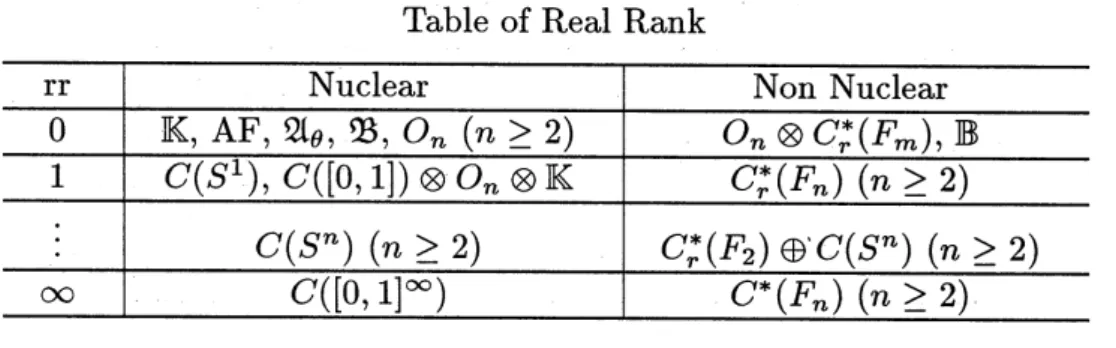
Table of Real Rank
Remark. Choi-Elliott [CE] provedthat $\mathrm{r}\mathrm{r}(\mathfrak{U}_{\theta})=0$. Blackadar and Kumjian showed that
the Bunce-Deddens algebras $\mathfrak{B}$ of type $2^{\infty}$ have real rank zero. Nagisa [Ng] showed that
$\mathrm{r}\mathrm{r}(C^{*}(F_{n}))=\infty$
.
By Nagisa-Osaka-Phillips, $\mathrm{r}\mathrm{r}(c([\mathrm{o}, 1])\otimes \mathfrak{U})\geq 1$ for any $C^{*}$-algebra$\mathfrak{U}$.Beggs-Evans [BE] proved $\mathrm{r}\mathrm{r}(\mathfrak{U}\otimes \mathrm{K})\leq 1$.
where $B\mathcal{L}$is the Blackadar’s simple unital projectionless $C^{*}$-algebra which is the
induc-tive limit of mapping cones associated with an $\mathrm{A}\mathrm{F}$-algebra, and $\mathcal{V}\mathcal{L}_{k}$ is the Villadsen’s
simple unital $\mathrm{A}\mathrm{H}$-algebra with stable rank $k(2\leq k<\infty)$ [V1].
Table of stable rank of finite simple unital $C^{*}$-algebras
Remark. For any simple and infinite $C^{*}$-algebra $\mathfrak{U}$, we have $\mathrm{s}\mathrm{r}(\mathfrak{U})=\infty$
.
$\mathrm{R}\emptyset \mathrm{r}\mathrm{d}\mathrm{a}\mathrm{m}$ [Rd]showedthat if$\mathfrak{U}$is simple and stablyfinite, and$\mathfrak{D}$ is a UHF-algebra, then $\mathrm{s}\mathrm{r}(\mathfrak{U}\otimes \mathfrak{D})=1$.
Table of real rank of simple $C^{*}$-algebras
Remark. Any simple, purely infinite $C^{*}$-algebra has real rank zero. Lin and Zhang
constructed some simple $C^{*}$-algebras $\mathfrak{U}$ with $\mathrm{r}\mathrm{r}(\mathfrak{U})\neq 0$ and $\mathrm{r}\mathrm{r}(M(\mathfrak{U})/\mathfrak{U})=0$, where $M(\mathfrak{U})$ is the multiplier of $\mathfrak{U}$
.
In fact, $\mathfrak{U}$ is a hereditary $C^{*}$-subalgebra of the tensorproduct of an $\mathrm{A}\mathrm{H}$-algebra and aUHF-algebra.
An $\mathrm{A}\mathrm{H}$-algebra $\mathfrak{U}$ is the inductive limit of the form
$\lim_{arrow}(\mathfrak{U}_{n}, \Phi_{m,n})$ where $\mathfrak{U}_{n}=$
$\oplus_{j=}^{r_{n}}1C(\Omega_{n,j,[n,j]}M)$ with $\Omega_{n,j}$ connected, compact $T_{2}$-spaces, and $\Phi_{m,n}$ : $\mathfrak{U}_{n}arrow \mathfrak{U}_{m}$
$(m\geq n)$ unital homomorphisms. If $\sup_{n,jn,j}\dim\Omega<\infty$, we call $\mathfrak{U}$ of bounded
dimen-sion. We say that $\mathfrak{U}$ has slow dimension growth if $\lim_{narrow\infty}\max_{j}(\dim\Omega_{n},j/[n, j])=0$.
$\sup\dim\Omega_{n,j}<\infty$
.
Note that if $\mathfrak{U}$ is simple, $\dim\Omega_{n,j}<\infty$ and $\mathfrak{D}$ is a UHF-algebra,then $\mathfrak{U}\otimes \mathfrak{D}$ is written as an inductive limit with slow dimension growth.
Table of stable rank of simple AH-algebras
Remark. Dadarlat-Nagy-Nemethi-Pasnicu [DNNP] showed the above case of bounded dimension. The caseof slowdimension growth is proved by$\mathrm{B}\mathrm{l}\mathrm{a}\mathrm{c}\mathrm{k}\mathrm{a}\mathrm{d}\mathrm{a}\mathrm{r}- \mathrm{D}\mathrm{a}\mathrm{d}\mathrm{a}\mathrm{r}\mathrm{l}\mathrm{a}\mathrm{t}- \mathrm{R}\emptyset \mathrm{r}\mathrm{d}\mathrm{a}\mathrm{m}$
[BDR].
A $C^{*}$-algebra $\mathfrak{U}$ has the property (STP) (separating traces by projections) if equal
are any two traces $\tau_{i}$ of
$\mathfrak{U}$ satisfying $\tau_{1}(p)=\tau_{2}(p)$ for every projection $p\in \mathfrak{U}$.
Table of real rank of simple AH-algebras
Remark. $\mathrm{B}\mathrm{l}\mathrm{a}\mathrm{c}\mathrm{k}\mathrm{a}\mathrm{d}\mathrm{a}\mathrm{r}-\mathrm{B}\mathrm{r}\mathrm{a}\mathrm{t}\mathrm{t}\mathrm{e}\mathrm{l}\mathrm{i}-\mathrm{E}\mathrm{l}\mathrm{l}\mathrm{i}_{\mathrm{o}\mathrm{t}\mathrm{t}}$-Kumjian [BBEK] showed the case of simple
AT-algebras. The case of slow dimension growth is obtained by $\mathrm{B}\mathrm{l}\mathrm{a}\mathrm{C}\mathrm{k}\mathrm{a}\mathrm{d}\mathrm{a}\mathrm{r}- \mathrm{D}\mathrm{a}\mathrm{d}\mathrm{a}\mathrm{r}\mathrm{l}\mathrm{a}\mathrm{t}- \mathrm{R}\emptyset \mathrm{r}\mathrm{d}\mathrm{a}\mathrm{m}$
[BDR].
REFERENCES
[BE] E.J. BeggsandD.E. Evans, The real rank ofalgebras ofmatrix valued functions, Internat. J. Math. 2 (1991), 131-138.
[BDR] B. Blackadar, M. Dadarlat and M. $\mathrm{R}\emptyset \mathrm{r}\mathrm{d}\mathrm{a}\mathrm{m}$, The real rank of inductive limit $C^{*}$-algebras,
Math. Scand. 69 (1991), 211-216.
[BBEK] B. Blackadar, O. Bratteli, $\mathrm{G}.\mathrm{A}$. Elliott and A. Kumjian, Reduction ofreal rank in inductive
limits of$C^{*}$-algebras, Math. Ann. 292 (1992), 111-126.
[BP] $\mathrm{L}.\mathrm{G}$. Brown and $\mathrm{G}.\mathrm{K}$. Pedersen, $C^{*}$-algebras of real rank zero, J. Funct. Anal. 99 (1991),
131-149.
[CE] M. D. Choiand G. A. Elliott, Density ofthe self-adjoint elements withfinite spectrum in an
irrational rotation$C^{*}$-algebra, Math. Scand. 67 (1990), 73-86.
[DNNP] M. $\mathrm{D}\dot{\mathrm{a}}\mathrm{d}\dot{\mathrm{a}}\mathrm{r}\mathrm{l}\mathrm{a}\mathrm{t}$, G. Nagy, A. N\’emethi and C. Pashicu, Reduction oftopological stable rank in
inductive limits of$C^{*}$-algebras, Pacific J. Math. 153 (1992), 267-276.
[Dv] K. R. Davidson, $C^{*}$-Algebras by Example, Amer. Math. Soc., 1996.
[DHR] K. Dykema, U. Haagerup and M. $\mathrm{R}\emptyset \mathrm{r}\mathrm{d}\mathrm{a}\mathrm{m}$, The stable rank ofsomefree product$C^{*}$-algebras,
Preprint (1996).
[EE] G. A.ElliottandD. E. Evans, The structure ofthe irrational rotation$C^{*}$-algebra,Ann. Math.
138 (1993), 447-501.
[Ng] M. Nagisa, Stable rank ofsomefullgroup$C^{*}$-algebras ofgroups obtained by the freeproduct,
Preprint (1991).
[Ns] V. Nistor, Stablerankfora certain class oftype $I$ $C^{*}$-algebras,J. Operator Theory 17 (1987),
365-373.
[$\mathrm{R}\mathrm{r}$ $\mathrm{M}.\mathrm{A}$. Rieffel, Dimension and stable rank in the$K$-theoryof$C^{*}$-algebras,Proc. London Math.
Soc. 46 (1983), 301-333.
[Rd] M. $\mathrm{R}\emptyset \mathrm{r}\mathrm{d}\mathrm{a}\mathrm{m}$, On the structure ofsimple $C^{*}$-algebras tensored with a $UHF$-algebra, J. Funct.
[Sh] A.J-L. Sheu, A cancellationtheoremfor modules over the group $C^{*}$-algebras ofcertain
nilpo-tent Lie groups, Can. J. Math. 39 (1987), 365-427.
[Sdl] T. Sudo, Stable rank of the reduced $C^{*}- algeb\dot{r}$as of non-amenable Lie groups of type $I$, to
appear in Proc.
Amer..,
Math. Soc.[Sd2] –, Stable rank ofthe $C^{*}$-algebras of amenable Lie groups oftype $I$, Preprint (1996).
[ST1] T. Sudo and H. Takai, Stable rank of the $C^{*}$-algebras of nilpotent Lie groups, Internat. J.
Math. 6 (1995), 439-446.
[ST2] –, Stable rank of the $C^{*}$-algebras of solvable Lie groups of type $I$, to appear in J.
Operator Theory.
[V1] J. Villadsen, The stable rank ofsimple $C^{*}$-algebras, Preprint (1996).
DEPARTMENT OF MATHEMATICS, TOKYO METROPOLITAN UNIVERSITY, 1-1 MINAMI OHSAWA,
HACHIOJI-SHI, TOKYO 192-03, JAPAN.
$E$-mail address: [email protected] Homepage, http:$//\mathrm{w}\mathrm{w}\mathrm{w}.\mathrm{m}\mathrm{a}\mathrm{t}\mathrm{h}.\mathrm{m}\mathrm{e}\mathrm{t}\mathrm{r}\mathrm{o}- \mathrm{u}.\mathrm{a}\mathrm{C}.\mathrm{j}\mathrm{P}/\sim \mathrm{s}\mathrm{u}\mathrm{d}_{0}\mathrm{h}$ (in preparation)