Voronoi
$\backslash d$を用いた多次元
$\overline{7}^{--}\backslash \backslash$タの補間
Interpolation of Multivariate
DataUsing Voronoi Diagrams
日吉久礎1 杉原厚吉2
HisamotoHIYOSHI $\mathrm{K}\mathrm{o}\mathrm{k}\mathrm{i}\mathrm{c}\mathrm{l}\dot{\mathrm{u}}$
SUGIHARA
東京大学大学院工学系研究科
〒 113-8656東京都文京区本郷7-3-1
[email protected]
$z_{\mathrm{S}\mathrm{u}\mathrm{g}\mathrm{s}}\mathrm{i}\mathrm{h}\mathrm{a}\mathrm{r}\mathrm{a}@\mathrm{i}\mathrm{m}\mathrm{P}^{1\mathrm{t}\mathrm{O}}\mathrm{e}\mathrm{x}.\mathrm{t}.\mathrm{u}-\mathrm{k}\mathrm{y}\mathrm{o}.\mathrm{a}\mathrm{C}$ ipAbstract: This paper presents a general framework for constructing a variety of
multi-dimensional interpolants based on Voronoi diagrams. This fr\v{c}unework includes previously
known methods such as Sibson’s interpolant and Minkowski’s interpolant;
moreover
itcon-tainsinfinitelymanynewinterpolants. Computational experiments suggest that the
smooth-nessimproves by theproposed generalization. Hence. this framework gives a newand
promis-ingdirection of researcll on the interpolation based on the Voronoidiagrams.
Keywords: Voronoi diagram, multivariate data interpolation. spatial surface.
1
Introduction
Interpolation is an extremely important
tech-nique to solve various problems in engineering
suchas differential equations and geometric
mod-cling. The finite element method is one of the
most practical approaches to the interpolation
problem, and is well-established today. However,
there is an alternative approach to the
interpo-lation problem, which utilizes Voronoi diagrams.
In this paper, we call this approach the Voronoi
diagram approach. See, for example, [1, 5, 6] for
the theory of the Voronoi diagrams.
Theinterpolation problem is formulated in the
following way. Let $\varphi$ :
$\mathrm{R}^{d}arrow \mathrm{R}$ be a function,
whose value is known onlyon the points $P_{1},$
$\ldots$ ,
$P_{n}$
.
These points are called the data sites. The(exact) interpolation problem is to find a good
function $\tilde{\varphi}$ such that
$\tilde{\varphi}(P_{i})=\varphi(P_{i})$
for$\dot{i}=1,$
$\ldots,$$n$. The meaning of the word “good”
dependson the context.
Thiessen first applied Voronoi diagrams to the
interpolation problem [11]. Let $P$ be the target
point the valueon whichisto beestimated. In his
method, theVoronoidiaglam for the data sites is
constructed. Assume that the point $P$ bclongs
to the Voronoi region of $P_{i}$
.
Then, the value at$P$ is estimated at the value at the point $P_{i}$
.
Bythe definition, Thiessen’s interpolant is a
picce-wise constant function.
Recently, Sibson found anotller intcrpolation
method $[8, 9]$
.
In his method, the Voronoidia-gram for $\{P_{1,}\ldots.’.P_{n}, P\}$ is constructed. If the
Voronoi regions of $P$ and $P_{i}$ arc adjacent via a
$(d-1)$-dimensionalfacet, wecall$P_{i}$ aneighbor of
$P$. The critical fact he found is that the position
vector of $P$ can be expressed as a convex
com-bination of the position vectors of$P’ \mathrm{s}$ neighbors
with the coefficients computed from the
second-order Voronoi diagram [8]. Hence we can
inter-pret the coefficients of this convex combination
as
the coordillates of $P$. Sibson constructcd $\mathrm{C}^{0}$and$\mathrm{C}^{1}$ interpolants basedonthis coordinate
sys-tem. Sibson’s interpolation method
was
furtherpro-posed another $\mathrm{C}^{1}$
interpolant $\mathrm{b}\mathrm{a}s$ed
on
theBern-stein polynomial [2].
On the other hands, Hiyoshi and Sugihara
found another coordinate system, and proposed a $\mathrm{C}^{0}$
interpolant [3, 4, 10]. We call this
sys-tem Minkowski’s coordinate syssys-tem, because it
is based on the Minkowski’s theorem on convex
polytopes.
Compared with the finite element
interpola-tion, the Voronoi diagram approach has a lot
of virtues [9]. For example, interpolants based
on the Voronoi diagram approach behaves
con-tinuously when the data sites move. However,
the Voronoi diagram approach is less flexible in
some points: for example, it is difficult to
con-struct even $\mathrm{C}^{2}$
interpolants by tlle Voronoi
dia-gram approach, as explained in Section 2. The
main reason, we guess, is that the number of
the coordinatesystems that thc Voronoi diagram
approach stands on is too few. In this paper,
we generalize the coordinate systems in order to
make the Voronoi diagram approach more
flexi-ble,concentratingonthecasewhen$d=2$
.
$\mathrm{I}\mathrm{n}\mathrm{d}$.eed
we construct a large class of interpolants based
on the Voronoi diagram approach, which
con-tains both Sibson’ and Minkowski’s interpolants,
and which contains infinitely many other
inter-polants. Computationalexperimentssuggest that
the smoothness improves by the proposed
gener-alization. Hence, this generalizationgives a new
and promising direction ofresearch on the
inter-polationbased on the Voronoi diagrams.
Section 2 reviews Sibson’s coordinate system
and Minkowski’s coordinate system. Section 3
gives another proofto Sibson’sresult, which
pro-vides the basic idea of
our
generalization.Sec-tion4 proposes the generalization. Section5 gives
some
computational experiments. Section 6con-cludes
our
research.2
Previous Works
In this section, we review the previous works
briefly.
2.1
Notations
First, let us introduce some notations.
Assume that a finite number of points $P_{1},$
$\ldots$ , $P_{n}\in \mathrm{R}^{2}$ aregiven. $P_{i^{\mathrm{S}}}$’ arecalled the generators.
Let $V(P_{i})$ be the set of all the points $Q\in \mathrm{R}^{2}$
such that $\mathrm{d}(Q, P_{i})<\mathrm{d}(Q_{B}.P_{j})$ for $j\neq\dot{i}$, where
$d(P, Q)$ denotes the Euclidean distance between
two points $P$ and $Q$
.
Wecall
$V(P_{i})$ the Voronoiregion of the generator $P_{i}$
.
By the definition,the boundary of eacll $V(P_{i})$ is a convex polygon.
The Euclideanplane$\mathrm{R}^{2}$is almostpartitionedinto
$V(P_{1})’\ldots$
.
$,$
$V(P_{lt})$, that $\mathrm{i}\mathrm{S},\cdot$ the
measure
of the setof all the point that does not belong to any $V(P_{i})$
is
zero.
The collection of all $V(P_{i})’ \mathrm{s}$ is denotedby $\mathcal{V}(P_{1}, \ldots’.P_{n})$ and is called the Voronoi $d\dot{i}a-$
gram for the generator set $\{P_{1,}\ldots. , P_{n}\}$. When
two Voronoi regions$V(P_{i})$ and$V(P_{j})$
are
adjacentvia some open line segment, this line segment is
called the Voronoi
ed.
$qe$ between $P_{i}$ and $P_{j}$, andis denoted by $E(P_{i}, P_{j})$
.
If$E\langle P_{i},$ $P_{j}$) exists, $P_{j}$ iscalled a neighbor of$P_{i}$ (and vice versa).
For $i\neq j$, let $V(P_{i}, P_{j})$ be the set of all the
points $Q\in \mathrm{R}^{2}$ such that
$\mathrm{d}(Q\text{ノ}.P_{i})<\mathrm{d}(Q, P_{j})<\mathrm{d}(Q, P_{k})$
for $k\neq i,j$
.
$V(P_{i}, P_{j})$ is called the second-orderVoronoi region of the ordered pair $(P_{i}, P_{j})$
.
Bythe definition, each $V(P_{i})$ is almost partitioned
into $V(P_{i}, P_{j}),$ $i\neq j$
.
The collection of all$V(P_{i}, P_{j})\prime \mathrm{s}$ is called the second-order Voronoi
di-agram for the generator set $\{P_{1}, \ldots, P_{n}\}$.
See, for example, [1, 5,6] for the detail of the
Voronoi diagram theory.
2.2
Sibson coordinates
Now let us describe Sibson’s interpolation
method $[8,9]$ briefly.
Let $P_{1},$
$\ldots$
,
$P_{n}\in \mathrm{R}^{2}$ be the given data sites,and let $y_{1},$ $\ldots$
,
$y_{n}\in \mathrm{R}$ be the data valueassoci-ated with $P_{1},$
$\ldots,$ $P_{n}$, respectively. Assume that.
we walltto evaluate the valueonthe target point
It follows from the definition that
Figure 1. The $\mathrm{V}\mathrm{o}\mathrm{l}\cdot \mathrm{o}\mathrm{n}\mathrm{o}\mathrm{i}$ region $V(P)$ is
parti-tioned into $\mathrm{t}\mathrm{l}$
)$\mathrm{e}$ subregions $V(P, P_{i})$.
the
convex
hull of$P_{1\cdot*},$.
, $P_{n}$, but does not equalto any of$P_{1_{B}}.\ldots,$ $P_{n}$
.
According to Sibson [8], the Voronoi diagram
$\mathcal{V}(P_{1}\ldots..P_{l},, P)$ is constructed. Each $V(P_{i})$ is
not necessarily bounded, but $V(P)$ is always
bounded because $P$ is an ipner point of the
con-vex hull of $P_{1_{\mathrm{P}}}.\ldots$ , $P_{1},$
.
Now partition $V(P\rangle$ into $V(P, P_{i})\mathrm{s}$, and let $s_{i}^{1}(P)$ denote themeasure
of$V(P, P_{i})$
.
Note that $s_{i}^{1}(P)>0$ if and only if$P_{i}$ isa neighbor of$P$.
Figure1 shows this situation. Inthisfigure, the
Voronoiregion$V(P)$ is partitioned into the
subre-gions $V(P, P_{i})$. The boundaries of this paltition
are drawn by the dashed lines.
Let $x_{1},$ $\ldots$
,
$x_{r\iota}$ and $x$ denote the positionvec-tors of$P_{1},$
$\ldots$
,
$P_{tl}$ and$P$, respectively. Sibson [8]proved the following identity:
$\sum_{i=1}^{n}s_{i}(1P)x=\sum_{i=1}^{n}s^{1}i(P)\%$. (1)
We will give another proof of thisidentity in
Sec-tion $3\text{ノ}$
.
which gives the basic idea of thegeneral-ization we propose. Now define that
$\hat{s}_{i}^{1}(P\rangle=s^{1}i(P)/\sum^{n}s_{j}(1P)j=1^{\cdot}$
$\sum_{i=1}^{n}\hat{S}i(1P)=1$, $0\leq\hat{s}_{i}^{1}(P)\leq 1$
.
Thus $x$ is expressedas the following
convex
com-bination:
$x= \sum_{i=1}\hat{S}_{i(}^{1}P)x_{\iota}n$.
We call$\hat{s}_{i}^{1}(P)\mathrm{i}\mathrm{s}$thc Sibson coordinates of the point $P^{1}$
.
Note that $\hat{s}_{j}(P)arrow\delta_{ij}$ as $P$ approaches $P_{i}$.Therefore we dcfine
$\hat{s}_{7}^{1}(P)=\delta_{i;}$
wllen $P$ coincideswith $P_{i}$
.
From the Sibson coordinates, Sibson
con-structed the following $\mathrm{C}^{0}$ interpolant:
$\tilde{\varphi}^{1}(P)=\sum_{i=1}^{n}yi\hat{S}^{1}i(P)$
.
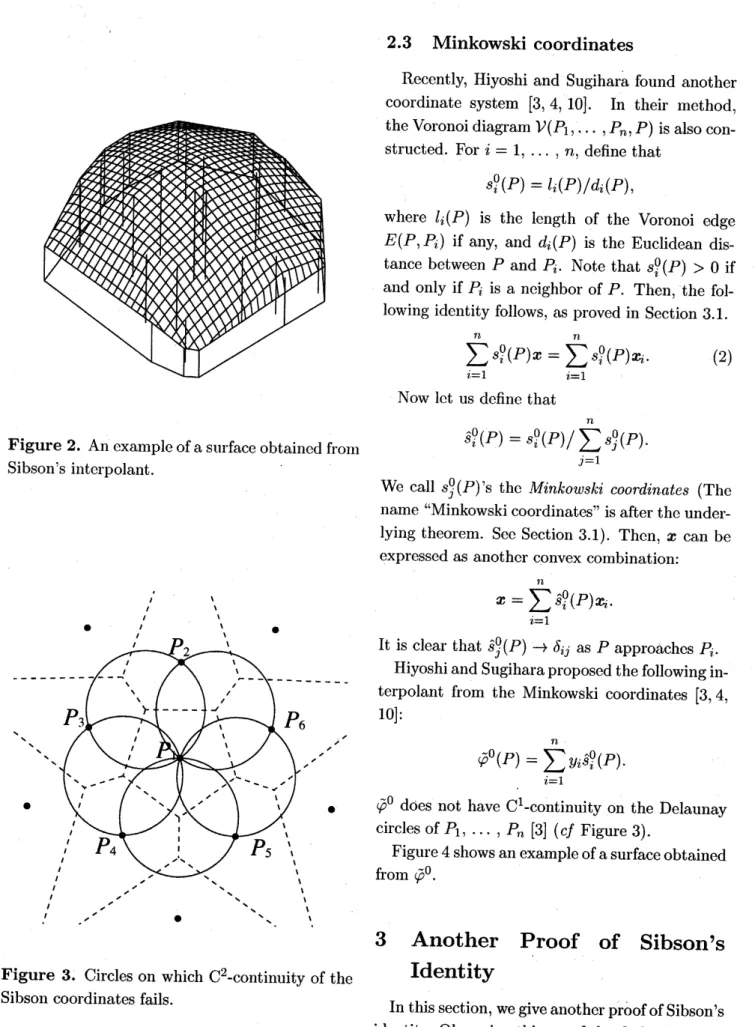
Figure 2 shows an example ofa surface obtained
from the aboveinterpolant.
Although $\mathrm{C}^{1}$ interpolants has been also
pro-posed by Sibson [9] and Farin [2], it is difficult
to construct interpolants that have higher-order
continuity. This difficulty
comes
from a globalproperty of $\hat{s}_{i}^{1}$. Piper showed that $\hat{s}_{i}^{1}\mathrm{s}$
are
dif-ferentiable everywhere except the points $P_{i\mathrm{p}}$. but
$\mathrm{C}^{2}$-continuity fails on the Delaunay circles of the
data sites [7]. Devising a technique to avoid this
non-smoothness is difficult.
Figure 3 shows where $\mathrm{C}^{2}$-continuity fails. In
this figure, the Voronoi diagram for the 11 data
sites is drawn by dashed lines. In particular, the
generator $P_{1}$ has five neighbors $P_{2},$ $\ldots$ , $P_{6}$. In
other words, the boundary of the Voronoi region
of$P_{1}$ is a pentagon. Hence, there
are
fiveDelau-nay circles that
are
concernedwith $P_{1}$, on whichthe $\mathrm{C}^{2}$-continuity of$\hat{s}_{1}^{1}$
.
1wealso call$s_{i}^{1}(P)’ \mathrm{s}$ the Sibson coordinates when there
is llo collfusion. Isfact, $(s_{1}^{1}, \ldots , s_{n}^{1})$ and $(\hat{s}_{1}^{1}, \ldots,\hat{s}_{n}^{1})$
de-note thesamepointin the$(n-1)$-dimensionalreal projec-tive space.
2.3
Minkowski coordinates
Figure 2. Anexampleofasurface obtained from
$\mathrm{S}\mathrm{i}\mathrm{b}\mathrm{S}\mathrm{o}\mathrm{n}\mathrm{s}$ interpolant.
Recently, Hiyoshi and Sugihara found another
coordinate system [3, 4, 10]. In their method,
theVoronoi diagram$\mathcal{V}(P_{1}, \ldots’.P_{n,}.P)$ isalso
con-structed. For $\dot{i}=1,$ $\ldots \mathrm{l}n$, define that
$s_{i}^{0}(P)=l_{i}(P)/di(P)$,
where $l_{i}(P)$ is the $1\mathrm{C}\mathrm{n}\mathrm{g}\mathrm{t}1_{1}$ of the Voronoi edge
$E(P, P_{i})$ if any, and $d_{i}(P)$ is the Euclidean
dis-tance between $P$ and $P_{i}$
.
Note that $s_{i}^{0}(P)>0$ ifand only if$P_{i}$ is a neighbor of$P$
.
Then, thefol-lowing identity follows,
as
proved in Section 3.1.$\sum_{i=1}^{n}s_{i}(P0)X=\sum_{i=1}^{n}S_{i}(0P)\%$
.
(2)Now let us define that
$\hat{s}_{i}^{0}(P)=S_{i}^{0}(P)/\sum_{j=1}^{n}s_{j}P0_{(})$
.
We call $s_{j}^{0}(P)_{\mathrm{S}}$’ the Minkowski coordinates (The
name “Minkowskicoordinates” is after the
under-lying theorem. See Section 3.1). Then, $x$ can be
expressed as anotherconvexcombination:
$x= \sum_{1i=}^{l}’\hat{s}i(0P)\mathfrak{B}$
.
It is clear that $\hat{s}_{j}^{0}(P)arrow\delta_{ij}$ as $P$ approaches $P_{i}$
.
Hiyoshi and Sugiharaproposedthefollowing
in-tcrpolant from the Minkowski coordinates [3, 4,
10]:
$\tilde{\varphi}^{0}(P)=\sum_{=i1}ny_{i}\hat{s}^{0}i(P)$
.
$\tilde{\varphi}^{0}$ does not have $\mathrm{C}^{1}$
-continuity on the Delaunay
circles of$P_{1},$
$\ldots$
,
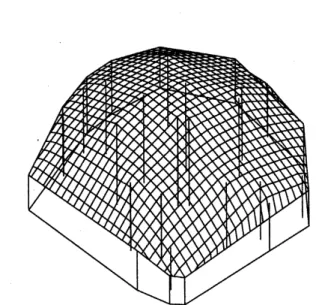
$P_{n}[3]$ ($cf$ Figure 3).Figure4 shows
an.example
ofa
surfaceobtainedfrom $\tilde{\varphi}^{0}$
.
Figure 3. Circles
on
which $\mathrm{C}^{2}$-continuity of the
Sibson coordinates fails.
3
Another
P.roof
of
Sibson’s
Identity
In this section,
we
give anotherproofofSibson’sidentity. Observing this proof closely leads to the
this fact and Minkowski’s theorem, we get
Figure 4. An exampleofasurface obtained from
the Minkowski’s interpolant.
3.1
Proof
of the identity for theMinkowski coordinates
At first, let us give a proof ofthe identity (2),
which comes from Hiyoshi-Sugihara [4]. For this
purpose, the following lcmma is used as a
funda-mental tool, which is known as Minkowski’s
the-orem:
Lemma 1 For any rcgion $V\subseteq \mathrm{R}^{d}$
.
the followingequation holds:
$\int_{Q\in\partial V}n\mathrm{d}S=0$, (3)
where $\partial V$ denotes the boundary
of
$V,$ $n$ denotesthe unit outer normal vector to $\partial V$ at $Q$, and$\mathrm{d}S$
denotes the
infinitesimal surface
element at Q. $\square$Let $P_{p(1)},$ $\ldots$ , $P_{\iota(k)}$ be the neighbors of the
tar-get point $P$
.
In general, the boundary of theVoronoi region of some generator $Q$ is a
(possi-bly unbounded) polygon each edge of which is a
part of the perpendicular bisector of the line seg-ment $\overline{QQ’}$ with another generator $Q’$
.
Therefore,the unit outer normal vector to the Voronoi edge
$E(P, P_{\iota}(i))$ is denoted by $(1/d_{L}))^{\frac{1}{PP_{\ell(i)}\prime}}(i$
.
$\mathrm{E}^{\backslash }\mathrm{o}\mathrm{m}$$\sum_{i=1}^{k}\frac{l_{\iota(i)}}{d_{\iota(i\rangle}}=0\frac{1}{PP_{\iota(i)}\prime}$
.
Note that $l_{i}=0$ if $P_{i}$ is not a neighbor of $P$.
Hencewe get
$\sum_{i=1}^{n}\frac{l_{i}}{d_{i}}x=\sum_{i=1}^{n}\frac{l_{i}}{d_{i}}x_{?}.$
.
which proves (2).
3.2
Proof of Sibson’s
identityObserving the proof we gave in Section 3.1
closely, we notice that the crucial fact is that for cach$P^{}\mathrm{s}$neighbor$P_{i}$, theVoronoiedge$E(P, P_{i})$ is
perpendicular to the vector $\frac{}{PF_{i}^{J}}$. Therefore, ifwe
find a polygoneach of whose edges is
perpendic-ular to the vector$\frac{}{PP_{i}}$ with someneighbor$P_{i}$, we
can obtain another coordinate $\mathrm{s}\mathrm{y}\mathrm{s}\mathrm{t}_{\mathrm{C}\mathrm{I}}\mathrm{n}$ from that
polygon.
At first, we describe a procedure for
construct-ing such polygons. Forthis purpose. the Voronoi
diagram $\mathcal{V}(P_{1}\ldots.’.P_{n}, P)$ is constructed. We
de-note$P\mathrm{s}$neighbors by
$P_{\iota(1)},$ $\ldots,$ $P_{\iota(k)}$ inthe
coun-terclockwise order. Without loss of generality,
we assume that $P_{\iota(1)}$ is the nearest generator to
$P$ (choose arbitrary one if not unique).
Parti-tion $V(P)$ into the subregions $V(P.P_{\iota}(1\rangle)’\ldots$ , $V(P, P_{t(k)})$
.
Let $S_{i}\in\overline{V(P,P_{\iota})(i)}$bethe pointfur-thest from the line containing$E(P.P)\iota(i).\mathit{1}$ and let $t_{l_{i}}$ be the distance of $S_{i}$ from the line containing
$E(\dot{P}, P_{\iota(}i))$
.
Let
us
pay attention to $V(P, P_{t(1)})$.
Since $P_{\iota(1)}$is the nearest generator to $P,$ $\overline{V(P,P_{\iota(1\rangle})}$
con-tains the target point $P$. We start
construct-ing the polygon by strokconstruct-ing its first edge inside
$V(P, P_{\iota})(1)$. The following procedure outputs the
vertices ofa desired polygon.
1. Let $L_{1}$ be the line perpendicular to $\frac{\iota}{PP_{\iota(1)}\prime}$
suchthat $L_{1}\cap V(P, P_{\iota}(1))$ is not empty.
2. Let $\{Q_{1}, Q_{2}\}=\partial V(P, P_{\iota(1\rangle})\cap L_{1}$ sucll that
3. Set $\dot{i}\vdash 2$and$j\vdash 2$
.
4. Let $L_{i}$ be the line that is perpendicular to
$\frac{\backslash }{PP_{L(i\rangle}\prime}$ and that contains
$Q_{i}$
.
5. If$L_{i}\cap V(P, P_{\iota(}i))$ is empty, go to
7.
6. Set$jarrow j+1$
.
Let $Q_{j}$ be the other endpointof the line segment $L_{i}\cap V(P, P_{t(i)})$
.
7. Set $\dot{i}\succ\dot{i}+1$
.
8. If$\dot{i}\leq k’$
.
go to 4. Otherwise output $Q_{1},$$\ldots$ ,
$Q_{?}-1$ and terminate.
We denote the obtained polygon by $C(t)$, where
theparameteris determined in the following
man-ner. For$\dot{i}=1,$ $\ldots k_{t}\neq$
.
lct$u_{i}$denote the distance ofthe line segments $V(P, P_{\iota})(i)\cap C(t)$, ifany. from
the Voronoi edge $E(P, P_{p(}i))$
.
Then, $t$ is set to$(h_{1}-u_{1})/h_{1}$
.
It follows from the definition tllat$0<t<1$
.
Note that $C(t)$ tends to the boundaryof $V(P)$ as $tarrow 1$
.
In fact, the abovc procedurecan be seenas the $\mathrm{i}\mathrm{n}\mathrm{c}\mathrm{l}\cdot \mathrm{C}m\mathrm{C}\mathrm{n}\mathrm{t}\mathrm{a}\mathrm{l}$algorithm for
con-structing Voronoi diagrams.
By setting $\partial V=C(i)$ in Lemma 1,
we
get thefollowing identity:
$\sum_{i=1}^{n}S_{i}(t;P0)x=\sum_{i=1}^{n}g_{i}(0P)t;xi_{J}$. (4)
where
$s_{i(;}^{0}tP)=l_{i}(t;P)/d_{i}(P)’$.
$l_{i}(t;P)=$ ($\mathrm{t}\mathrm{h}\mathrm{e}$length of
$C(t)\cap V(P_{i})$).
Wecall $s_{i}(0t;P)_{\mathrm{S}}$’ the weak Minkowski coordinates
with parameter $t$
.
Note that $s_{i}^{0}(t;P)arrow s_{i}^{0}(P)$ as$tarrow 1$. Hence
we
define $s_{i}^{0}(1;P)=s_{i}^{0}(P)$ andinterpret $s_{i}^{0}(P)$ as the special c\v{c}lse of the weak
Minkowski coordinates.
For the purpose of proving Sibson’s identity,we
require another fact. Let $e_{i}(t)$ denote the line
segment $V(P_{i})\cap C(t)$
.
Lemma 2 Two polygons $C(t)$ and $C(t+\mathrm{d}t)$
given,
assume
that the edges$e_{i}(t)_{!}$.
$e_{i}(t+\mathrm{d}t),$ $ej(t)$,and$e_{j}(t+\mathrm{d}t)$ exist. Let $\mathrm{d}u_{i}$ be the w\’idth between
Figure 5. Consecutive edges of $C(t)$ and $C(t+$
$\mathrm{d}t)$.
$e_{i}(t)$ and $c_{i}(t+\mathrm{d}t)$
.
and let $\mathrm{d}u$; be the widthbe-tween $e_{j}(t)$ and $e_{j}(t+\mathrm{d}t)$
.
Then,$d_{i}\mathrm{d}u_{i}=d_{j}\mathrm{d}u_{j}$
.
Proof. Let $b$ denote the perpendicular bisector
of the line scgment$\overline{P_{i}P_{j}}$
.
Then, theVoronoi edge$E(P_{i}.P_{j})$ is a part of $b$
.
Let $\theta_{i}$ denote tlle anglegeneratedbythe lines$b\mathrm{a}\mathrm{n}\mathrm{d}\overline{PP_{i}}$, and lct
$\theta_{j}$ denote
the angle generated by the lines$b$ and $\overline{PP_{j}}$
.
SeeFigure 5.
It is clear that
$\frac{\mathrm{d}u_{i}}{\cos\theta_{i}}=\frac{\mathrm{d}u_{j}}{\cos\theta_{j}}$
.
Since$b\perp\overline{P_{i}P_{j}}$, the followingequations hold:
$\angle PP_{i}P_{j}=90^{0}-\theta_{i}$, $\angle PP_{j}P_{i}=90^{0}-\theta_{j}$
.
On the other hand, the sine theorem on the
tri-angle $PP_{i}P_{j}$ yields the equation $\frac{d_{j}}{\sin\angle PPiPj}=\frac{d_{i}}{\sin\angle PP_{j}P_{i}}$.
From the above equations,
we
get$d_{i}\mathrm{d}u_{i}=d_{j}\mathrm{d}u_{j}$
.
Now wegive another proofof Sibson’s identity.
Minkowski’s theorem guarantees (4) for any $0<$
$t<1$
.
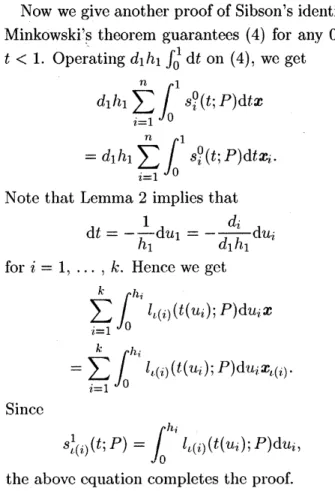
Operating $d_{1}h_{1} \int_{0}^{1}\mathrm{d}t$on (4), we get $d_{1}h_{1} \sum_{i=1}^{n}\int_{0}^{1}s_{i}^{0}(t;P)\mathrm{d}t_{X}$$=d_{1}h_{1} \sum_{i=1}^{n}\int_{0}^{1}s_{i}^{0}(t;P)\mathrm{d}tx_{l}$.
Note that Lemma 2 implies that
$\mathrm{d}t=-\frac{1}{h_{1}}\mathrm{d}u_{1}=-\frac{d_{\mathrm{i}}}{d_{1}h_{1}}\mathrm{d}u_{i}$
for $\dot{i}=1,$ $\ldots$
,
$k$. Hence we get $\sum_{i=1}^{k^{\alpha}}\int_{0}h_{\dot{\tau}}l_{(i}(l)t(ui);P)\mathrm{d}u_{i}x$$= \sum_{i=1}\int 0u_{i}khil_{p(i}()t();P)\mathrm{d}uiX(i)l$
.
Since
$s_{\iota(i)}^{1}(t;P \rangle=\int_{0}^{h_{i}}l_{\iota}(?.\rangle(t(u_{i});P)\mathrm{d}ui$,
the aboveeqllation completes tlle proof.
4
Generalization
of
Coordinate
Systems
Observing the proof given in Section 3.2
care-fully, we notice that Sibson’s coordinate system
is not the ollly one that we can obtain; other
co-ordinate systems can be obtained by modifying
the expression slightly. The followingare typical
lnodifications:
1. Any subinterval $(a, b)$ of$(0,1)$ is available as
the integration interval.
2. Furthermore,any interval $(a, b)$ with$0<a<$
$b$is available when we extend $C(t)$ naturally
for $t>1$
.
$C(t)$ with $t>1$ lies outside theVoronoi regioll $V(P)$.
3. In the integration step, the weight function
$w(t)$ can be multiplied.
4. Multiple integration. We
can
construct othercoordinate systems by integrating previously
obtained coordinatesrepeatedly.
4.1
Standard
interpolantsAlthough a lot of coordinate systems
can
beconstructed by combining the above modifica-tions, we guess the following subclass of $s_{i}^{k}(P)$
is especially important. Each $k=0,1,$ $\ldots$
,
thecoordinate$s_{i}^{k}(P)$ is calculated in the following
re-cursion:
$s_{i}^{k}(P)=s_{i}^{k}(1;P)$
.
where
$s_{i}^{k}(t;P)=d_{1}h_{1} \int_{0}^{t}s_{i}h-1(s;P)\mathrm{d}S$ for $0<t<1$ .
We call $s_{i}^{k}(P)$ the order-k standard coordinates.
Minkowski’s coordinate system and$\mathrm{S}\mathrm{i}\mathrm{b}\mathrm{S}\mathrm{o}\mathrm{n}\mathrm{S}$
coor-dinate systemarethe$\mathrm{f}\mathrm{i}1^{\cdot}\mathrm{s}\mathrm{t}$twocoordinatesystems
in this subclass. The corresponding interpolant
$\tilde{\varphi}^{k}(P)=.\sum_{=?1}’ y_{i}s_{i}^{k}(P)l$ (5)
is called the order-k standard interpolant.
5
Computational
Experiment
In this section, we present some computational
results about the order-k standard interpolant.
Assume that the data$y_{j}=\delta_{ij}$ for sonle $\dot{i}=1$
.
.
. .
,
$n$ are given. Then we obtain the function$\tilde{\varphi}^{k}(P)=\hat{s}_{i}^{k}(P)$ as the result. Therefore, we give
$\hat{s}_{i}^{k}$ the alias
‘
hat function”. The hat functionsare
important because the standard interpolant is a
linear combination of the hat functions.
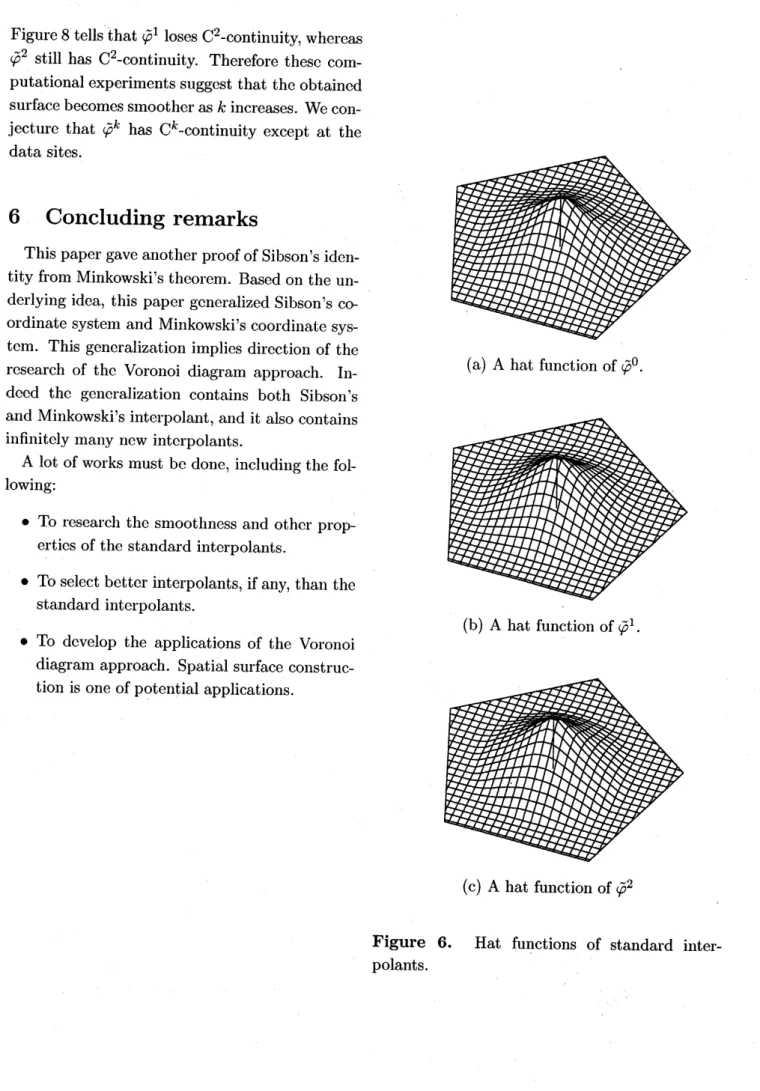
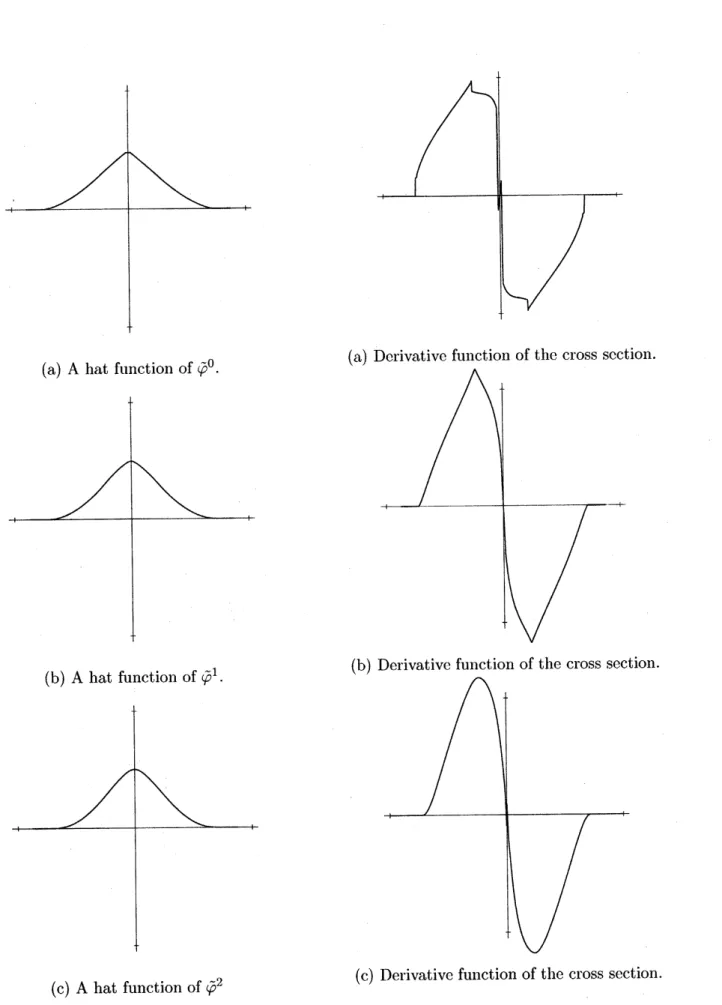
Figure6 describesexamplesof hat functions of
$\tilde{\varphi}^{0},\tilde{\varphi}^{1}$ and$\tilde{\varphi}^{2}$ for the datasites drawn in$\mathrm{F}\mathrm{i}\mathrm{g}\mathrm{U}1^{\backslash }\mathrm{e}3$
.
Although
our
eyes can hardlysee
the differenceamong the figures. the following discussion clari-fies their difference.
Figure7describes thecrosssections of hat
func-tions cut by
a
vertical plane. Ifwesee
thecross
scction of $\tilde{\varphi}^{0}$, we notice that some non-smooth
points, as explained in Section 2. The slopcs of
these
cross
sections are drawn in Figure 8. TheFigure8 tellsthat$\tilde{\varphi}^{1}$ loses$\mathrm{C}^{2}$-continuity,
whereas
$\tilde{\varphi}^{2}$ still has $\mathrm{C}^{2}$
-continuity. Therefore these
com-putational experimentssuggest that the obtained
surfacebecomessmootheras $k$increases. We
con-jecture that $\tilde{\varphi}^{k}$ has $\mathrm{C}^{k}$
-continuity except at the
data sites.
6
Concluding
remarks
This
paper
gave anotherproofofSibson’siden-tity from Minkowski’s theorem. Based
on
theun-derlyingidea, this paper generalized Sibson$\mathrm{s}$
co-ordinate system and Minkowski’scoordinate
sys-tem. This generalization implies direction of the
research of the Voronoi diagram approach.
In-deed the generalization contains both Sibson’s
and Minkowski’s interpolant, andit also contains
infinitely many new interpolants.
A lot of works must be done, including the
fol-lowing:
(a) A hat function of$\tilde{\varphi}^{0}$
.
$\bullet$ To research the smootllness
and other
prop-ertics of the standard interpolants.
$\bullet$ To select better interpolants, if
any,than the
standard interpolants.
$\bullet$ To develop the applications
of the Voronoi
diagram approach. Spatial surface
construc-tionis one ofpotential applications.
(b) A hat function of$\tilde{\varphi}^{1}$
.
(c) A hat function of$\tilde{\varphi}^{2}$
Figure 6. Hat
functions
of standard(a) A hat function of$\tilde{\varphi}^{0}$.
(b) A hat function of$\tilde{\varphi}^{1}$.
(c) A hat function of$\tilde{\varphi}^{2}$
(c) Derivative function of the
cross
section.Figure 8. Derivative functions of the
cross
sec-Figure 7. Cross sections of hat functions.
References
[1] H. Edelsbrunner, Algorithms in
Combinato-rial Geometry, Springer-Verlag,Berlin, 1987.
[2] G. Farin, Surfaces
over
Dirichlettessella-tions, Computer Aided $Geometr\dot{i}c$ Design 7
(1990) 281-292.
[3] H. Hiyoshi and K. Sugihara, Another
inter-polant using Voronoi diagrams, IPSJ SIG
Notes 98-AL-62 (1998) 33-40, in Japanese.
[4] H. Hiyoshi and K. Sugihara, Two
generaliza-tions ofan intcrpolant basedon Voronoi
dia-grams, International Journal
of
ShapeMod-eling, to print.
[5] A. Okabe, B. Boots and K. Sugihara,
Spa-tial Tessellations: Concepts and Applications
of
Voronoi Diagrams, John Wiley&Sons.
Chichester, 1992.
[6] F. P. PreparataandM. I. Shamos,
Computa-tional Geometry, Springer-Verlag,NewYork,
1985.
[7] B. Piper, Properties of local coordinates
based on Dirichlet tessellations, in G. Farin,
H. Hagen and H. Noltemeicr, eds.,
Geomet-ric Modelling, Springer-Verlag, Wien (1993) 227-239.
[8] R. Sibson, A vector identity for the
Dirich-let tessellation, Mathematical Proceedings
of
Cambridge Philosophical Society 87 (1980)
151-155.
[9] R. Sibson, A brief description of natural
neighbour interpolation, in V. Barnett, ed.,
.
Interpreting Multivariate Data, Johm Wiley&Sons,
Chichester (1981) 21-36.[10] K. Sugihara, Surface interpolation based on
new local coordinates, Computer-Aided
De-sign 31 (1999) 51-58.
[11] A. H. Thiessen, Precipitation averages for
largc areas, Monthly Weather Report 39