本論文は、参加人数が多く、様々な英語能力と年齢層が在籍する連続3日間の「基礎英語」の 面接授業の難しさを克服するための対策研究であり、学習者たちを積極的に授業に参加させ、厭 きさせないための、より効果的なカリキュラム作りを目指すものである。結論を出すに当たって は、Stern, Johnson, Ellis, Nunan, Krashen, Prabhu など英語教育学者たちの教育理念と、過 去の教育経験、英語関連項目との接触頻度、好き嫌い、得手不得手など個々の学習者から収集し たデータ分析を参考にした。
1. Introduction
In the ordinary English language class the real needs of the students are too often ignored or at best are acknowledged on the surface only. If we are to develop a suitable curriculum, we must take the students’ views into account. If they are ignored, the students will not be fully motivated to participate.
I am of the opinion that the language teacher needs to draw on a wide variety of disciplines and theories in order to be successful in the classroom. Sticking to one theory is limited and not productive. Reading some sections of Stern (1983), who gives a very useful overview of the multidisciplinary approach to language learning, has helped me to be aware of the psychological (especially motivational) aspects of language acquisition from a variety of viewpoints. I agree with Johnson when she says, “It is important to realize that
A Modified Learner-centered Curriculum
Development based on a Needs Analysis
ニーズ分析に基づく学習者主導型修正カリキュラム開発
MORI Yoko
森 容子
no single view or set of questions from a single discipline can account for the complex and interacting social, cultural, cognitive and linguistic processes involved in L2 use and learning.” (Johnson, 1992, p.16) I have therefore taken an eclectic position.
I have been interested in the social and cultural factors in language acquisition as a necessary element in understanding language. There are numerous cases in which an individual learner has sufficient knowledge of a particular language structure but is baffled by its use in a particular social or cultural context. Without enough knowledge of the social / cultural context, the learner may be confused or embarrassed and at the far extreme it may be fatal (as exemplified by the famous “Freeze!” case involving a Japanese exchange student.) Johnson also supported the importance of social and cultural factors stating “In the last two decades, however, researchers have given increasing attention to the roles of social and cultural factors in language learning… sociolinguistics, psycholinguistics, and social psychology, as well as cognitive psychology, have been particularly influential in contributing insights into L2 and FL learning.” (1992, p.14) She also notes (1992, p.15) “social psychologists have focused a great deal of attention on the role of motivation in L2 learning. (Brown, 1987)”
Motivation is very important. It is very necessary to motive the student to study on their own initiative outside the class. Nunan (1987, p.3) puts it this way. “…given the constraints that exist in most learning contexts, it is impossible to teach learners everything they need to know in class.”
Now let us consider what is meant by curriculum. Nunan (1988, p.2) states “…the key difference between learner-centered and traditional curriculum development is that, the curriculum is a collaborative effort between teachers and learners, since learners are closely involved in the decision-making process regarding the content of the curriculum and how it is taught.”
In the present paper I have developed a curriculum for a three day intensive course for junior college students. The curriculum which I have developed might be called a modified learner-centered curriculum. It is based on a relatively extensive needs analysis based on a questionnaire filled out by ninety eight representatives of the target student population and a number of intensive interviews with these students and teachers who are also in
charge of this intensive course. Student suggestions have been actively incorporated into the curriculum. One such example is the adoption of a student’s suggestion of Mariah Carey’s “Dream Lover” as a suitable and up-to date song for class presentation.
In order to determine the needs of the target students I developed a questionnaire, a description of which follows.
2. The Questionnaire
The questionnaire of twenty-one questions was given to ninety-eight people. Those people are correspondence course students of a junior college who were attending a three-day intensive English lesson. None of them were English majors.
The twenty-one questions on the questionnaire are as follows :
(1) Age (2) Male / Female (3) Occupation (4) Number of years you have studied English Where? (5) Do you use your English now? If so, where? (6) Do you like English? Why? (7) Rate your English ability : A(good) / B(average) / C(poor) (8) Name of qualifications you have to show your English ability e.g.-STEP Test Level 3 (9) The weakness of your English ability in descending order. Fill in parenthesis with the appropriate number : Reading ( ) Writing ( ) Speaking ( ) Listening ( ) (10) Give the bad points and good points of your English studying experiences in junior high school (11) Give the bad points and good points of your English studying experiences in senior high school (12) The area of English you want to learn (13) The foreign countries you want to visit (14) The foreign countries you have visited (15) Which kind of movies do you like best, foreign movies or Japanese movies? (16) The name(s) of your favorite movies (17) Which music do you like best, foreign music or Japanese music? (18) The title of your favorite music (19) Do you think you need English? Why? (20) What do you think about using a DVD to learn English? (21) The questions or problems about your English studies.
3. The Analysis and Results
3.1 Subjects (Learners)
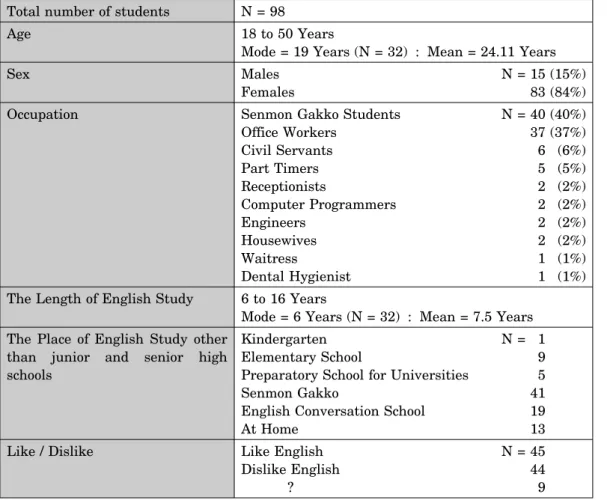
Table 1 shows the learners’ data of age, sex, occupation, the length and the place of their English study other than junior and senior high schools and English like/dislike.
The age of the learners varied from eighteen years old to fifty years old. There were thirty-three teenagers, forty-six in their twenties, eleven in their thirties, seven in their forties and one fifty year old woman. The figure above shows that almost four fifths of the learners were in their teens or twenties. The majority of them were nineteen-year old
Table 1 The 98 learners’ Data
Total number of students N = 98
Age 18 to 50 Years
Mode = 19 Years (N = 32) : Mean = 24.11 Years
Sex Males N = 15 (15%)
Females 83 (84%)
Occupation Senmon Gakko Students N = 40 (40%)
Office Workers 37 (37%) Civil Servants 6 (6%) Part Timers 5 (5%) Receptionists 2 (2%) Computer Programmers 2 (2%) Engineers 2 (2%) Housewives 2 (2%) Waitress 1 (1%) Dental Hygienist 1 (1%)
The Length of English Study 6 to 16 Years
Mode = 6 Years (N = 32) : Mean = 7.5 Years The Place of English Study other
than junior and senior high schools
Kindergarten N = 1
Elementary School 9
Preparatory School for Universities 5
Senmon Gakko 41
English Conversation School 19
At Home 13
Like / Dislike Like English N = 45
Dislike English 44
? 9
N=the number of the learners
learners who amounted to thirty-two. Among those learners, eighty-three learners were women and fifteen learners were men : three nineteen-year old men, five men in their twenties, four in their thirties and three in their forties. The majority of the learners were Senmon Gakko (vocational school) students who are taking the correspondence course in addition to improve their qualifications. Next come office workers and part timers, the content of whose job is almost the same as that of office workers. Among the learners, most of them were nineteen year old students who were in the first year of Senmon Gakko (vocational school) and generally speaking, their English is at a fairly low level.
The number of years the learners have studied English is : six years, six point five years, seven years, eight years, nine years, ten years, eleven years, thirteen years, fifteen years and the longest is sixteen years. The table shows that the majority of learners (32 learners) studied for six years. This data suggests that most of them did not study English any more after studying for six years at junior and senior high schools where English is taught as a compulsory subject. Seven years of study (26 learners) and eight years of study (21 learners) come next in frequency.
The places where the learners studied English before and after junior and senior high schools are : (1) kindergarten (2) elementary school (3) preparatory school for universities (4) senmon gakko or vocational school (5) English conversation school (6) at home (private study). Private study at home includes studying by TV, radio, English books and newspapers and preparation for some examinations.
Forty-five learners like English and forty-four dislike English. Nine learners are neutral. The reasons why they like English are : (1) a dream and desire to have smooth communication with foreigners (16 learners)― ‘A person who speaks English fluently looks very smart.’, ‘It is a dream for me to be able to speak English freely.’, ‘I wish I could communicate with foreign people in English some day.’, ‘It would be enjoyable to speak and listen to English.’ etc. (2) interest in foreign countries (13 learners) ― ‘I’m interested in countries outside Japan.’, ‘I want to know foreign countries through English language (3) enjoyment of learning foreign language (8 learners) ― ‘I like learning foreign languages.’, ‘English expressions are different from Japanese ones and I enjoy learning them.’ etc. (4) interest in foreign music and movies (2 learners) and (5) other reasons (6 learners)― ‘we
can broaden our outlook by learning a foreign language.’, ‘I enjoy talking in English.’, ‘I can make friends all over the world.’, ‘I am interested in English.’, ‘English is a rhythmical language.’, ‘I just like English.’ The reasons why they do not like English are : (1) no understanding (13 learners) (2)complexity of English grammar (8 learners) (3)difficulties (7 learners) (4) poor academic records (6 learners) (5)difficulties with English conversation (3 learners) (6) difficulties with pronunciation (3 learners) and (7) loss of interest due to few opportunities to speak English. (2 learners) These seven reasons can be classified into three large groups, that is, no understanding (poor grades), difficulties, and no interest. The items which they find difficulty with are English as a whole, grammar, English conversation and pronunciation in descending order.
3.2 The Learners’ English Ability
The letters A (good), B (average), C (poor) were used in order to get the learners to judge their own English ability by themselves.
As a result, three learners answered A, thirty-three learners answered B and sixty-two answered C. According to these results, 63.3% of the learners consider their English abilities at the lower level and only 3% of them think their English ability is good. It seems difficult to completely trust these learners’ self-judgments about their ability since three of learners who had passed STEP (Society for Testing English Proficiency) Test level 2 also judged their ability as B, but at least it is remarkable that more than half of them think their English is not good.
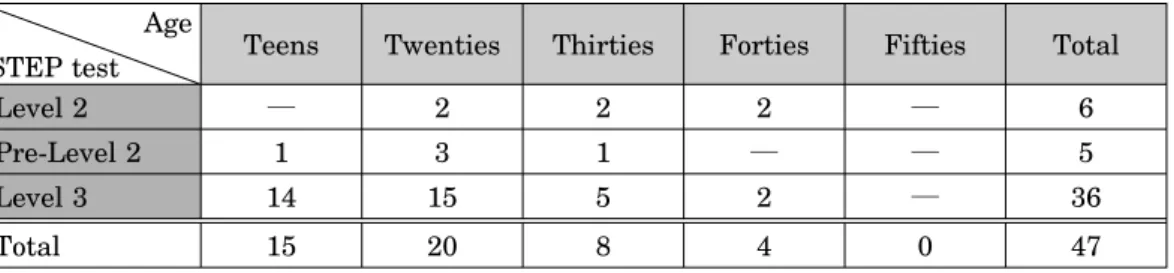
Though there are quite a few English certificate examinations held in Japan to judge people’s English ability, the nationwide one is the practical English skill certificate examination well known as the STEP test. It is divided into seven levels from Level 1 to Level 5 including Pre-Level 1 and Pre-Level 2. Most people at the junior college level take Level 3, Level 2 and Pre-Level 2. The examinations at those levels consist of written tests and interview tests. We have to pass both of these tests in order to obtain these certificates. The total number of applicants was 4,525,173 in 2009 and the ratio of successful applicants was 26% for Level 2, 36% for Pre-Level 2 and 54% for Level 3. Table 2 shows the number of the learners who have already passed the STEP test. According to
Table 2 The number of learners who have obtained the STEP Test English certificate Age
STEP test Teens Twenties Thirties Forties Fifties Total
Level 2 ― 2 2 2 ― 6
Pre-Level 2 1 3 1 ― ― 5
Level 3 14 15 5 2 ― 36
Total 15 20 8 4 0 47
the table, the English of six learners has reached level 2, the English of 5 learners has reached pre-level 2 and thirty-six learners’ English ability is at level 3. I, therefore, categorized the eleven learners with the level 2 and pre-level 2 certificate under A and thirty-six learners with level 3 certificate under B. Among the other fifty-one learners who have not obtained any STEP Test certificates, five learners passed other certificate examinations and twelve learners judge their English as B, so I put those seventeen learners in category B. Consequently, the learners’ English levels are categorized as follows : A for eleven learners, B for fifty-three learners and C for thirty-four learners.
3.3 The Weakness and the Strength of the Learners’ English Skills
Figure 1 shows four English learning skills from the point of view of what the learners think is the most difficult skill and the easiest skill.
The results show that speaking (46 learners), writing (28 learners), listening (17
Figure 1 Learners’ Weakness & Strengths in the Four English Skills
learners), and reading (7 learners) are the most difficult in descending order. On the other hand, when looked at from the point of view of what the students consider their best areas, the results are as follows : reading (45 learners), listening (25 learners), writing (16 learners) and speaking (12 learners) in descending order. As shown in Figure 1, what the learners think is the lowest level skill and the highest level skill in descending order coincide exactly. In short, most learners think the lowest skill is speaking, and the highest skill is reading.
3.4 Language Needs
Ninety-four learners agree that English is necessary, which is 97% of the total learners who answered this questionnaire, for the following reasons : (1) necessary for work (2) international communication (3) experience in foreign countries (4) cultural exchange (5) catching up with internationalized society (6) foreign travel.
Among ninety-four learners who answered English is necessary, forty-two of them actually use English at present. Their purposes in using English are (1) in the English conversation lesson in schools ― Senmon Gakko (21 learners) and English conversation school (3 learners), (2) needed for their work (13 learners), ― telephone conversation, computer programs, order taking, business letters including typing, reading English documents, etc., (3) to communicate with foreign friends (2 learners), (4) as a hobby (5 learners) ― traveling abroad, listening and watching English programs on the radio and TV.
3.5 Learners’ Past Experiences in the English Education Systems
The data gained from the questionnaires states that grammar is the main item taught in Japanese junior and senior high schools. Listening and writing in English lessons have been neglected. English conversation was adopted as part of the English lessons twenty years ago and most schools nowadays have a native English speaker as an English teacher in addition to the Japanese English teachers while there were no English conversation lessons at all when the learners of over forties were in junior and senior high schools and Japanese teachers mainly taught grammar and reading comprehension sticking to the text
books. Generally speaking, a greater variety of content is available nowadays in comparison with the past English education system where grammar was mainly taught.
Comparing junior high school education with senior high school, junior high school teaches the fundamental elements of English and as a natural result they are likely to stick to more grammar and the text book while senior high school focuses on the more practical side, such as English conversation or reading comprehension. Pronunciation is taught in junior high school but senior high school does not deal with pronunciation. It is interesting to find out the reason why grammar was given less weight in the teaching content of English lessons in both junior and senior high schools when learners in their forties were in school though the data obtained is not sufficient to give us a comprehensive picture. The bad points and good points of the English study experiences these learners mentioned are as follows :
Good Points Number of Learners
*J *S
1a I learned lots of vocabulary. 13 0
2a I could learn the fundamentals of English. 12 0
3a It was enjoyable. 6 7
4a I was able to improve my memorization. 4 3
5a The teacher’s explanation is easy and suitable to understand. 6 0
6a I improved my listening ability of English. 2 1
7a I enjoyed learning English songs. 4 0
8a There were fewer grammar lessons. 2 0
9a I enjoyed games. 0 1
10a I learned practical English (conversation). 1 9
11a Teacher used English all the time.
(including native English teacher) 1 3
12a I learned what was necessary for the entrance examination. 1 1
13a I liked the teacher’s pronunciation. 1 1
14a I could learn English pronunciation. 2 1
15a Lessons were very easy. 2 0
16a I got good academic grades. 1 0
*J=in Junior high school *S=in Senior high school
Concerning the good points, thirteen learners mentioned learning vocabulary (1a) and twelve learners mentioned the fundamentals of English (2a) regarding the junior high school education they received though those items seem to be rather hard and boring. The reason for this is considered to be that everything is new and fresh in the early stages of learning, which naturally makes learners more interested in engaging in even difficult and boring tasks. Since they teach the fundamentals in junior high schools, teachers teach English using easy explanations (5a) and learners find the lessons very easy (15a). They can even got good academic grades (16a). Learning vocabulary, however, becomes no longer interesting for high school students as four learners pointed it out as a bad point of their high school education. Instead, nine learners mentioned learning English
Bad Points Number of Learners
*J *S
1b I had to learn lots of vocabulary. 2 4
2b The teacher always stuck to the text book. 2 3
3b Lessons were uninteresting. 4 1
4b There was too much memorization. 1 6
5b The teacher was not good at teaching. 3 1
6b I did not learn English listening comprehension. 5 4
7b There were not enough grammar lessons. 0 1
8b There was too much grammar. 11 9
9b I did not understand grammar. 1 5
10b I did not learn English conversation. 23 11
11b English lesson was useless and not applicable. 6 8 12b English lesson focused on the entrance examinations. 5 5
13b The teacher’s pronunciation was bad. 6 4
14b There were no pronunciation classes. 2 3
15b The class went too fast for me to follow. 8 11
16b I got bad academic grades in English. 0 1
17b The lessons were stressful. 1 0
18b I could not translate English sentences well. 1 0
19b The teacher taught only reading. 0 3
20b There were too many tests. 0 2
*J=in Junior high school *S=in Senior high school
conversation (10a) as a good point in what they learned during their high school English education. The good response that ‘the teacher used English all the time (11a) was mentioned by three learners and it is considered to be in the same category as (10a).
Concerning the bad points, twenty-three learners concerning their junior high school education and eleven learners when in senior high school mentioned that the bad point of their English lessons was not to have English conversation lessons (10b). This fact also supports the above findings that they like to learn English conversation (10a). Other bad points mentioned by most learners are : too much grammar teaching (8b) ; problems with understanding (15b) ; useless and inapplicable lessons (11b) ; and examination-focused lessons (12b).
With 3a and 3b, 5a and 5b, 6a and 6b, 8a and 8b, 10a and 10b, 13a and 13b, 14a and 14b, 16a and 16b, most of good points mentioned by learners become bad points if they are not included in their English lessons. In other words, English lessons which mirrored the students’ desires were considered to be good lessons and English lessons which did not reflect such desires were considered to be bad points. We can discover learners’ desires regarding their English education by summarizing the above information as follows : 1) They like enjoyable and entertaining lessons (including songs and games)
2) They like to learn the more practical aspects of English such as listening, speaking, and pronunciation.
3) They want to have a good English teacher (good at explaining, able to make it enjoyable, without stress)
4) They like grammar lessons least. 5) They like to get good academic grades.
6) They like English if they can understand it easily. 7) They do not like tests or preparation for tests.
However, people do not always have the same desires. In other words, even if the same content of the English lessons is taught it becomes a negative point for some of the learners while it can become a good point for others. For example, thirteen learners appreciated that ‘they had learned lots of vocabulary’ (1a) but six learners complained about ‘learning lots of vocabulary’ (1b), and twenty learners complained that ‘there was too much grammar’
(8b) while one other learner complained ‘there were not enough grammar lessons’ (7b). It may be up to the teacher’s teaching abilities whether it becomes a good point or a bad point.
3.6 Favorite Movies and Favorite Music
With regard to the question ‘Which kind of movies do you like best, Western movies or Japanese movies’, ten answered ‘Japanese movies’ and four answered ‘both kinds of movie’, so the answers of ‘both kinds of movie’ are included in both categories. Consequently, the learners who like Western movies come to eighty-eight (90%) and the ones who like Japanese movies come to fourteen (14%). Their favorite Western movies are ‘Harry Potter’, ‘The Devil Wears Prada’, ‘Sex and the City’, ‘Twilight’, ‘High school Music’, ‘Back to the Future’, ‘Toy Story’, and ‘Roman Holiday’. Most of them are love stories. This gives us some clue when we choose a particular DVD as a teaching material.
Although the findings of the questionnaire show that more learners like Western movies than Japanese movies, their answers about music indicate the opposite, that is, fifty-one learners prefer Japanese music whereas thirty-three learners prefer Western music. Fourteen learners like both, so the total number of people who like Japanese music comes to sixty-five (66%) and the people who like Western music comes to forty-seven (47%). Their favorite Western singers or groups are Lady Gaga, Bon Jovi, Mickael Jackson, The Offspring, Katy Perry, the Beatles, Madonna, The Carpenters, and Mariah Cary.
So far as movies are concerned, there are only ten learners who prefer Japanese movies and among those ten learners eight learners (80%) also prefer Japanese music. Thirty-one learners out of thirty-three learners (94%) who prefer Western music also prefer Western movies. Concerning these learners who prefer both Western movies and Western music, twenty-one learners (68%) like English and five of them passed STEP test level 2. The total number of learners who have passed STEP test level 2 is six out of ninety-eight as shown Table 2, so we can conclude from the above results that most of the learners whose English is good are likely to prefer both Western movies and Western music.
3.7 Desire for Foreign Travel and Foreign Travel Experiences
Ninety-three learners (95%) want to go abroad and five learners (5%) do not want to go
abroad. When those ninety-three learners who want to go abroad were asked where they want to visit, most of them answered more than one country. The majority of the learners want to visit English-speaking countries such as America (25 learners), Australia (25 learners), England (24 learners) and Canada (19 learners) and next come European countries such as France (16 learners), Switzerland (14 learners), Spain (6 learners), Germany (4 learners) and Egypt (11 learners). Asian countries such as Hong Kong (4 learners), India (3 learners) and Singapore (3 learners) where English is also spoken are popular.
Now let’s look at the learners travel experiences. Fifty learners have been abroad and forty-eight learners have never been in foreign countries. Among those fifty who have experienced foreign travel, about three fifths of the learners visited more than one country (average is 2.7 countries). The most popular countries for them were also English speaking countries (the number of learners who visited each English speaking country : America-15, Singapore-12, Hawaii-11, Australia-11, England-8, Guam-8, Hong Kong-7, Canada-4, Saipan-3, New Zealand-1) Among eight learners who have never been abroad, forty-four learners want to go abroad and forty-four learners have no desire to go abroad.
3.8 The Use of DVD as Teaching Material
Seventy-three learners find DVDs are useful as a teaching aid for the following reasons : (1) We can understand English more easily because it appeals to our visual and auditory senses. (e.g. - even if we cannot follow the spoken words we can guess the content if we see the picture or scene on the screen) (2) We can see the same scene repeatedly. (3) We can enjoy learning. (4) It is useful to hear native speakers’ natural English in an actual situation.
Eight learners agree with using the DVDs as teaching material under the following conditions : (1) It depends on the contents of the DVD. (2) It depends on the learners’ readiness to receive it, i.e., it is not effective if learners are passive or just watch the DVD for fun.
3.9 Fields of English the Learners want to learn
Sixty-two learners want to learn English conversation. If we count listening comprehension (10 learners) and pronunciation practice (3 learners) in the field of conversation, seventy-five learners find it interesting to learn English conversation, which is 77% of the total number of learners who answered the questionnaire. Next comes the field which is connected with hobbies such as English in movies (10 learners), English songs (7 learners), travel English (7 learners) and reading English books (4 learners). Eight learners are interested in news, so they want to learn how to read English newspapers (6 learners) and how to watch CNN, BBC and FEN news (2 learners). The data shows that those learners who are interested in understanding English news are quite good at English. Some of them want to learn English useful for their office work such as business English (5 learners), business English letter writing (1 learner) and English computer words (2 learners). In addition to the above fields of study, four learners answered English for specific examinations (certificates), three for English fundamentals and one learner for grammar.
3.10 Problems the Learners have
The problems they raised are as follows : (1) I do not know how to study English (English conversation, pronunciation, listening) effectively and successfully. (23 learners) (2) I forget vocabulary quickly though I work hard to learn them or I cannot memorize English words easily. (19 learners) (3) I do not have opportunities to use English. (5 learners) (4) I have studied English for many years, but still cannot speak fluently. (4 learners) (5) English is too difficult to learn. (8 learners) (6) I’m allergic to English. (1 learner) (7) I can not speak English because English grammar and Japanese words come first whenever I make English sentences. (2 learners) (8) I cannot speak English because I am too shy. (1 learner) (9) I do not have time to study English. (3 learners)
4. Goals
With reference to the above data gained from ninety-eight questionnaires, I set up the following five goals for a three-day intensive English course.
1) The teacher motivates the students to learn English and encourages them to study English actively and voluntarily outside the classroom in their leisure time. Since students have very limited class time during the three days, we can not expect them to learn many things during class hours. The most important goal to be aimed at is, therefore, to interest students in English so that they are willing to study it voluntarily outside the classroom by means of the materials which are easily available in everyday life such as English movies, English music, English books and English newspapers. I maintain that this ‘voluntary’ and ‘active’ attitude to learning is a crucial factor for L2 acquisition because “…there is often no sharp distinction between tutored and untutored learning, even in classrooms ; both kinds of learning occur in formal institutional settings in and out of classrooms. Indeed, much of what is taught in classrooms is not learned, while much that is learned was not explicitly taught.” (Johnson, D.M., 1992, p.11)
2) The students will learn easy English conversation which will be useful during travel abroad. Since almost all the learners (93 learners) want to travel to foreign countries where the native language is English, it will be very useful to teach them travel English. In fact, seven learners on the questionnaires specifically mentioned that they want to learn it.
3) The students will be able to manage easy English conversation in their office environment. There are thirty-seven office workers, six civil servants, five part timers who may receive telephone calls from foreigners and business letters from foreign countries. It will also be useful for the forty-one senmon gakko students, most of who are going to work at offices after graduation, to know some basic knowledge about business English.
4) The students will learn about foreign cultures. As I mentioned in the introduction it is essential to make students aware of the cultures of English speaking countries in order
to aid smooth communication in English and to avoid international misunderstandings. 5) The students learn study skills. As we have seen from the data, many students do not
know how to study English, so the teacher must also be a good counselor to solve the problems his/her students are facing at the moment. From that point of view, whether the teacher teaches those students effectively or not depends on his/her “…counseling skills and attributes ― warmth, sensitivity, and acceptance.” (Richards, J.C. & T.S. Rodgers, 1986, p.24)
5. Objectives
The following eleven “objectives” are designed to match the curriculum goals mentioned above, that is, by the end of the three day intensive course, the students will be able to : 1) introduce themselves as well as their friends with 80% accuracy.
2) write a personal letter to a new pen pal by introducing themselves with 80% accuracy. 3) learn some forms of business letters and common expressions used in business letters
with 70% accuracy.
4) fully comprehend the story of Fun Volga’s ‘I’m a Sandwich’ and the new vocabulary (100% accuracy) and understand foreign culture in comparison with Japanese culture through the story.
5) manipulate easy telephone conversations by mastering common phrases for telephone conversations with 90% accuracy.
6) memorize short shopping conversations and use them in actual situations― buy various items by manipulating the conversations. (memorization of the conversation with 90% accuracy)
7) understand the announcements often heard at the airport with 80% accuracy and manipulate short conversations at the customs in actual situations with 90% accuracy. 8) order what they want freely from a restaurant menu with 90% accuracy.
9) understand the lyrics of Mariah Cary’s ‘Dream Lover’ and the Carpenters’ ‘Yesterday Once More’ with 80% accuracy.
10) understand the cultural aspects of dating behavior and the vocabulary required for dating by watching DVD of Rowan Atkinson (Mr. Bean) and studying the DVD script.
(it is expected that they will get at least 80% of the answers correct)
11) find some hints or solutions to the problems they are facing concerning their English studies and make them interested in English. (the target is that 80% of the students will benefit)
6. Materials (Task Sheets)
In my selection of tasks and materials for inclusion in this project, I have been influenced by the discourse and interaction theories which put a strong emphasis on conversational interaction. Ellis (1985) and Gass & Madden (1985) are particularly influential in this respect.
(1) ‘I’m a Sandwich’― this is the story taken from the book called Domo Domo Paradise by Fun Volga who has been living and working in Japan for eight years and writes about his own experiences in Japan though foreigner’s eyes. I have chosen this because it is written in easy English and the topic is familiar to Japanese people. It also tells us about foreign cultures in comparison to Japanese culture and what is more, we can enjoy reading the humorous description “No matter where you go, there will always be someone able to share a joke with you. It does not matter if you can not speak the other person’s language, as long as you can reach his heart.” I believe that the easiness and humorous content of the story ‘lowers the affective filter’ and to lower any barriers that there might be to L2 learning increases motivation as Krashen (1987) mentioned. (2) ‘Dating’ ― The task provided under the section on “Dating” enables the students to
engage in conversational activities in pairs and/or small groups and the inclusion of materials designed to stimulate questioning is especially valuable to the Japanese student of English since they are forming their own questions and using the language to actually communicate. I have developed this task as a warm up activity before watching the DVD of Rowan Atkinson.
(3) ‘Elementary Courting For Men’― There is one DVD script sheet from “Rowan Atkinson Live” and two question sheets to check their comprehension of the DVD. I have decided to use this DVD for the same reason as choosing ‘I’m a Sandwich’ as reading material. In other words, this DVD is humorous and easy to understand because there are lots of gestures with few English words, which I believe, will motivate students’ desire to improve their English.
7. Conclusion
From the results of the questionnaire which show a correlation between a liking for Western music and Western movies and a liking of English, it is not too much to say that there is a strong possibility that a greater exposure to Western movies and Western music in the classroom will increase interest in and desire to learn more English. Of course, this needs to be tested out in a proper controlled experiment with suitable control groups. It would be interesting to try such an experiment with learners who prefer Japanese music and Japanese movies in one experimental group as opposed to those who already prefer the Western brands of music and movies and those who are neutral and those who like both.
Many learners mention as their weak points their difficulties in speaking and writing but at the same time say their strength is reading. This has a strong correlation with their past experiences in the English language education system. Specifically, the main focus of the system is grammar and reading and sticking to the text book. It is only recently that English conversation was introduced into the system.
The above facts can be clearly supported by the data collected concerning fields of English study which the students wish to study. If we go into specifics, it was found that 77% of the learners wanted to study spoken English. In addition, students want to learn the more practical aspects of English. For them, they consider the study of English to be the practical side of language usage as opposed to the study of grammar. Many learners complain that grammar is both useless and difficult and even if we do study it, it will not help us to actually speak English. However, since grammar is essential for language
production (spoken or written) it is very necessary for the teacher to present it in such a way as to avoid making it boring or burdensome. I, therefore, avoid teaching grammar itself explicitly in a traditional approach, but have tried to teach new structures as naturally as possible in the P(Presentation) P(practice) P(production) model. I fully agree with Krashen (1987) and Prabhu (1987) who suggest grammar will be learned naturally and automatically.
From the analysis of the data, we can conclude that the best way to teach English to such learners is :
1) Motivate the student to learn by setting the pace and difficulty level at the point where it is not too easy but not too difficult for the learner.
2) The teacher must present the material in such a way as to interest the learner and thus must be a good actor and entertainer and planner. The teacher has a very great influence on whether students will like or dislike English.
3) The teacher must meet the needs and desires of the students if the teacher is to be effective as we have seen above.
4) The teacher should teach more practical English such as everyday English, travel English, business English and if possible the class should be conducted in English as much as possible. Since the learners are interested in music and movies, the utmost use of these avenues should be utilized. In addition full use should be made of radio and TV and DVD because most learners feel this is a good method and also they have been brought up surrounded by these media. Grammar and vocabulary should be taught using the above mentioned media and through songs etc. rather than being taught as grammar and vocabulary per se.
The learner faces many problems while learning the language as has been pointed out above. It is very important for the teacher to be an expert problem solver and consultant especially in the area of study tactics through his own experience and knowledge and to give constant encouragement and praise.
After going through the process of conducting a needs analysis, the setting of goals and objectives, developing and finding some materials, I have developed a curriculum for the three day intensive English course on the next page.
I have included many conversational practices in this curriculum in accordance with students’ requests. There are three factors I feel it is necessary to bear in mind to make the optimum curriculum. They are ‘practical in actual situations’, ‘interesting’ and ‘not too difficult’. I have also designed review tests for use at the end of the first day and second day to check their understanding. From the results of each test, those items on which most of the students gave incorrect answers are to be reviewed in class the next morning. The students are required to write their problems regarding their English studies in the space provided on the first day test papers so that the teacher can give them some ideas or solutions to their problems in the first period of the second day.
The Curriculum for a Three Day Intensive English Course Day
Time Day 1 Day 2 Day 3
9 : 00 ~ 10 : 45 Conversation Introduction ―self ―friends Review of Day 1 and Problem Solving Forms Business Letters Review of Day 2 and Problem Solving Conversation at a Restaurant ―ordering ―paying 11 : 00 ~ 12 : 30 Writing Personal Letter Conversation Telephone Conversation at the office Conversation ‘Dating’ DVD ‘Elementary Courting For Men’ 13 : 30 ~ 15 : 00 Reading ‘I’m a Sandwich’ Conversation Shopping ―buying things Conversation At the Airport ―airport announcement ―at the customs 15 : 15 ~ 17 : 00 Song
‘Dream Lover’ by Mariah Carey Test and Problems
Song
Yesterday Once More by Carpenters Test
Final Exam
In order to make this curriculum for the three day intensive course more effective and successful based on the data analysis, I focus on the following points. (1) The choice of useful conversations and a variety of materials, which will prevent students from getting bored with one continuous lesson. (2) Careful selection of the members of each group : the students’ English ability differs quite a lot so if we select very carefully the members of each group (with mixed level students) in conversational practice sessions, it will solve the problem of differing ability levels. (3) Selection of interesting topics : the problem of this course is there are too many students which always make it difficult to keep the attention of all the students, but a selection of interesting topics may be the answer. (4) Songs and DVDs as teaching materials : it will help students to relieve stress due to having to concentrate on lessons all day and (5) Review Test : it is a good idea to give tests to check their understanding at the end of each day and review these at the beginning of next day before continuing with new material.
As we have seen so far, the most important goal of this curriculum is to give students motivation for their English studies because the teachers’ “…responsibility goes beyond the language classroom.” And “…our task is to provide the students with the tools they need to continue improving without us.” (Krashen, 1987, p.76) Krashen also states the importance of the topic. He mentions “if the topic being discussed is at all interesting, and if it is comprehensible, much of the ‘pressure’ normally associated with a language class will be ‘off’, anxiety will be lowered, and acquisition will result.” (1987, p.74)
I intend to test out my curriculum with junior college students in the near future and as I mentioned before in the objectives if 80% of the students who attend this three day intensive English course become motivated to improve their English studies through the lessons under the above curriculum, I should think my course will have been successful.
Reference :
Beebe, L.M. 1987. Issues in Second Language Acquisition : Multiple Perspectives. New York, Newbury House.
Brown, J.D. 1987. Principles of Language Learning and Teaching. Englewood Cliffs, NJ, Prentice Hall.
Ellis, R. 1985. Understanding Second Language Acquisition. Oxford, Oxford University Press. Gass, S.M. & Madden, C.G. 1985. Input in Second Language Acquisition. Rowley, MA, Newbury
House.
Jonson, D.M. 1992. Approaches to Research in Second Language Learning. New York / London, Longman.
Krashen, S. 1987. Principles and Practice in Second Language Acquisition. Englewood Cliffs, NJ, Prentice-Hall.
Nunan, D. 1988. The Learner-Centered Curriculum. Cambridge, Cambridge University Press. Prabhu, N.S. 1987. Second Language Pedagogy. Oxford, Oxford University Press.
Richards, J.C. & Rodgers, T.S. 1986. Approaches and Methods in Language Teaching. Cambridge, Cambridge University Press.
Stern, H.H. 1983. Fundamental Concepts of Language Teaching. Oxford, Oxford University Press.