西 南 交 通 大 学 学 报
第 56 卷 第 2 期
2021
年 4 月
JOURNAL OF SOUTHWEST JIAOTONG UNIVERSITY
Vol. 56 No. 2
Apr. 2021
ISSN: 0258-2724 DOI:10.35741/issn.0258-2724.56.2.10
Research article Social Sciences
H
APPINESS AND
S
ATISFACTION AFTER
1
Y
EAR OF THE
COVID-19
P
ANDEMIC
新冠肺炎大流行 1 年后的幸福感和满意度
Diena Dwidienawati a, *, David Tjahjana b, Dyah Gandasari c, M Faisal d
a Department of Management, BINUS Business School Undergraduate Program, Bina Nusantara University
Jakarta, Indonesia, diеna.tjiptа[email protected]
b Universitas Multimedia Nusantara
Tangerang, Indonesia, dаvid.tjahjа[email protected]
c Polbangtan Bogor, Indonesia, dyаh.gandа[email protected] d Institute Pertanian Bogor, Indonesia, muhаmadfа[email protected]
Received: January 29, 2021 ▪ Review: March 8, 2021 ▪ Accepted: April 11, 2021 ▪ Published: April 30, 2021
This article is an open-access article distributed under the terms and conditions of the Creative Commons Attribution License (http://creativecommons.org/licenses/by/4.0)
Abstract
The impact of the COVID-19 pandemic is on human health and other aspects of human life. The government's most common action to prevent the spread of the infection is mobility restriction. The implication of this mobility restriction is the limitation of social activities can be done. Mobility restriction was implemented in Jakarta and its surrounding cities and impacted more than 20 million people. The previous study showed that mobility restriction impacted people's happiness and life satisfaction. After one year of COVID-19 measure implementation, is the adaption effect applied? This study aims to see whether, after one year of the COVID-19 pandemic, people are starting to adapt, and their well-being level is improving compared to the beginning of the COVID-19 pandemic. A survey was conducted in February - March 2021. Happiness and satisfaction with life were measured using the Subjective Happiness Scale and Satisfaction with Life Scale. The reliability and validity of measures were analyzed with SPSS. The study reveals that the participant's happiness level was only slightly happy, and the level of satisfaction was only slightly satisfied. The participants claim that their happiness has deteriorated during mobility restriction (58%). Fifty-eight percent felt their satisfaction has deteriorated. The student's group is shown as the most impacted group in their happiness and life satisfaction scale.
Keywords: Happiness, Mobility Restriction, COVID-19, Satisfaction, Well-Being
摘要 新冠肺炎大流行的影响对人类健康和人类生活的其他方面。政府防止感染传播的最常见措施 是限制流动性。这种流动性限制的含义是可以完成社交活动。雅加达及其周边城市实施了出行限
Dwidienawati et al. / Journal of Southwest Jiaotong University / Vol.56 No.2 Apr. 2021 112 制,影响了超过 2000 万人。先前的研究表明,行动不便会影响人们的幸福感和生活满意度。实施 新冠肺炎措施一年后,是否会应用适应效果?这项研究旨在观察在发生新冠肺炎大流行一年之后 ,人们是否开始适应,并且其健康水平与新冠肺炎大流行开始时相比有所改善。在 2021 年 2 月至 2021 年 3 月进行了一项调查。使用主观幸福感量表和对生活的满意度量表测量了幸福感和对生活 的满意度。用 SPSS 对措施的信度和效度进行了分析。研究表明,参与者的幸福水平仅略微感到 满意,而满意度则仅略微感到满足。参与者声称,在行动受限期间,他们的幸福感有所下降(58 %)。58%的人感到他们的满意度下降了。在他们的幸福感和生活满意度量表中,学生组显示为 受影响最大的组。 关键词: 幸福,行动不便,新冠肺炎,满意度,幸福感
I. INTRODUCTION
Studies [1] and [2], which were conducted just Studies [1] and [2], which were conducted just about the pandemic started, showed that the impact of COVID-19 is not only on human health and business. Those studies show COVID-19 pandemic has an impact on human well-being. [3] quoted from COVID Response Tracking Study also claimed that only 14% of American adults are happy compared to 31% two years ago. In Indonesia, the measure to prevent COVID-19 from spreading by mobility restriction has been implemented for one year. On March 2nd, 2020, the government announced the first 2 cases of COVID-19 in Indonesia. Afterward, the number of cases has become escalating. Social distancing measures were implemented soon afterward. Schools were shifted to the online method. Government institutions and private sectors implemented work from home and alternate working arrangements. Nevertheless, some businesses still worked as usual with workspace arrangements.
In Jakarta and its surrounding cities, the striker mobility restriction was implemented. More than 20 Million people get affected by the policy. Mobility restriction has caused significant disruption of people's activities, the first is being able to go out, and the second is interacting with other people. Not being able to go out has limited people's physical activity. Mobility restriction only allows limited physical activity, mostly in the house. Studies from [4], [5], [6] showed that being able to be outdoor and doing physical activities influence people's happiness, satisfaction, and mental health.
People are social creatures. Being connected to others is one of the psychological needs of a human being. Indonesia is known as people with collectivist culture. They are close-knit to the family as well as close acquaintances. They meet their friends and family frequently. Not being
able to maintain the connection to others will influence people's well-being.
The other factor that will influence people's well-being during the COVID-19 pandemic is the high uncertainty level. The world has faced several crises recently. However, the crisis caused by the COVID-19 pandemic catches everyone by surprise. No one can understand all of the situations. It impacts a particular area or region and everyone worldwide on a large scale. It takes an extended period, one year so far, and changes every aspect of people's lives. The uncertainty involved includes how the disease spread, disease management, and how long this pandemic will last.
At the beginning of the pandemic, [1] and [2] have conducted a study that showed that well-being is deteriorating. However, people tend to adapt to a significant life event, whether positive or negative. It is referred to as the adaption effect. This study aims to see whether, after one year of the COVID-19 pandemic, people are starting to adapt, and their well-being level is improving compared to the beginning of the COVID-19 pandemic. There are currently limited studies that provided field evidence on the well-being of people who do not have a viral infection but are confined for a very long time.
The next session presents the literature review of mobility restriction, happiness, and life satisfaction. After that, the methodology of the descriptive quantitative study is described, and the findings are presented. Finally, the conclusion, limitation, and recommendation for further research are drawn.
II. LITERATURE REVIEW
Mobility restriction has been widely accepted as one of the measures implemented to prevent the spreading of COVID-19 disease. This restriction includes staying at home as long as possible, working from home, studying online, avoiding crowds, limiting the number of
interactions with people, touching and hugs others, and grocery shopping. However, being confined in one place for a long time is not a natural condition for a human being. The human being as a social creature needs to interact with others.
Studies from [1] and [2], which were conducted just about the pandemic started, showed that the impact of COVID-19 is not only on human health and business. Those studies show that mobility restriction has an impact on human well-being. A study from [1] revealed that 33% of people were not leaving their homes for one month, 38% were WFH, and 25% stopped working during the outbreak. The study also revealed that the distress level and satisfaction level of people were low. The score was the lowest of the people who stopped working. [1] further claimed that his study provides evidence that the pandemic affects people infected by the disease and other people with less physical activity.
The study from [2] in Indonesia also reveals a similar result. After two months of the pandemic, 41% of people felt that their happiness is deteriorating, and 34% of people feel that their satisfaction with life is deteriorating. The study also revealed that the deterioration of happiness and satisfaction was more prominent in students. This study backed the study from [1] that mobility restriction indeed impacts people's well-being. Students who mainly come from Generation Z who are physically active in the normal situation are the ones who get the most impact.
Well-being has a holistic outlook that promises the connection of mind, body, and spirit in overcoming the division integral to post-enlightenment modernism [7]. The study of well-being is one of the focuses of positive psychology, which directly focuses on promoting what is good in life [8] and optimal human functioning [9]. The interest of what is good about life and optimal human functioning has gone way back to Aristotle with eudaimonia or general well-being, in his phrase, "living well and doing well" [10]. The study showed that people's well-being could be enhanced if people meet the four psychological needs: security and safety, competence and efficacy, connection to others, and autonomy and authenticity [9]. Well-being has two aspects which are cognitive and subjective. In this study, the focus will be on the subjective aspect of well-being, which will measure happiness and satisfaction in life [11], [12].
Happiness is a part of a person's overall well-being [13], [14]. Happiness is a narrower concept of subjective well-being (SWB). Happiness is "'happiness' as an Aristotelian eudaimonia or general well-being involving, in his phrase, "living well and doing well" by enjoying goods of the mind (e.g., wisdom, moral virtue, and pleasure), goods of the body (e.g., physical beauty, health, and pleasure again) and external goods (e.g., wealth and adequate material resources, good parents and families, good friends, peace and security within and between communities, and well-governed communities” [10]. The state of happiness is not steady. Being happy can fluctuate over time. Happiness is influenced by many valued domains of life [14]. However, happiness is known as an essential indicator of human well-being [13].
Kahneman and Krueger define life satisfaction as "...is a global retrospective judgment, which in most cases is constructed only when asked and is determined in part by the participant's current mood and memory, and by the immediate context" [12]. In this study, the focus will be on subjective satisfaction. The subjective satisfaction of life measurement is to assess people's life satisfaction as a whole. Even though the measure does not include the assessment of satisfaction with life domains such as health or finances, subjective satisfaction with life measurement allows the integration and weight of these domains in whatever way they choose [15].
During the COVID-19 pandemic, two prominent factors affect people's well-being. The first one is uncertainty and the second one is mobility restriction. Mobility restriction provides security and safety from being infected by the disease. However, unlike any other crisis, this crisis caused by the COVID-19 pandemic catches everyone by surprise. No one has a complete understanding of the situation. The situation is unknown with high uncertainty.
Uncertainty is defined by Fergus [16] "as the dispositional fear underlying emotional difficulties and resulting in anxiety in cases where the unknown is perceived intensely". Uncertainty had a significant direct effect on mental well-being. The mechanism is by how during the pandemic, people are contemplating and facing unended fear of COVID-19. In times of uncertainty, the brain demands extra energy from the body. However, if the brain is not successfully reduced uncertainty, it will develop a persistent energy crisis [17]. A study from [18] revealed in a working environment, if the uncertainty is being well managed, the well-being
114 Dwidienawati et al. / Journal of Southwest Jiaotong University / Vol.56 No.2 Apr. 2021
of the employee would improve. Studies also prove that uncertainty, cultural context, and significant life events such as separation, illness, and monetary losses impact people's well-being [19]. The impact of uncertainty on well-being is also confirmed by [20]. After the Fukushima disaster, people did not know whether to return home or not have a well-being reduction. Uncertainty reduces people's well-being because it threatens security as one of four psychological needs to be fulfilled in well-being.
How mobility restriction influences people's well-being? Research also reveals that if people can fulfill the four psychological needs: security and safety, competence and efficacy; connection to others; and autonomy and authenticity, their well-being will be enhanced [9]. [10] states that people living conditions affect how they feel good about themselves.
Nevertheless, being confined is limiting people's connection to others. Indonesian is known to be one with the highest sociability score (0,79). Moreover, based on Hofstede's cultural 6D model, Indonesia has a low score in individualism. Indonesian belongs to a collectivist society. They are close-knit to the family as well as close acquaintances. On average, an Indonesian spends time every week with friends from social circles [21]. Indonesian often meet with friends, colleagues, and other community members. They meet on various occasions such as small reunions, friends 'arisan' (gathering), family 'arisan', and religious group small gathering.
The mobility restriction prohibits them from doing so. Some are now replaced with hanging out in zoom meeting, which is yet still less satisfactory. With high sociability characteristics, being restricted at home makes happiness and satisfaction deteriorated [2].
Mobility restriction limits people from enjoying being outdoors and doing physical activities. There is a bonding between humans and nature. In the 1860s and 1870s, Frederick Law Olmsted professed that an environment with many forms of nature "employs the mind without fatigue and yet exercises it; tranquilizes it and yet enlivens it; and thus, through the influence of the mind over body, gives the effect of refreshing rest and reinvigoration to the whole system" [22]. Previous studies showed that there are many physical and psychological benefits of nature. Nature provides serenity and peacefulness [22]. The study from [4] shows that being outdoor makes people feel happy.
Mobility restriction also limits physical activities. Studies show that physical activities
influence people's well-being. Physical activities have been recognized to influence people's physical and mental health. Regular physical activities lower the risk of coronary heart disease, type 2 diabetes, osteoarthritis, and dementia. Regular physical activities are also known to reduce the risk of depression [23]. [6] states that physical inactivity was linked to a lower level of positive mental health. [24] in their study at University, staff revealed that there is a relationship between physical activity and well-being. The study showed that the low physical activity level was related to lower well-being scores. [25] showed that physical activity had a strong effect on self-efficacy. They used social cognitive theory to explain the relationship between physical activity and well-being. [5] claimed that children with less physical activities have lower life satisfaction.
Well-being outcomes include reducing the risk of physical and mental illness, better social functioning, higher academic achievement, and reducing mortality [6]. [26] shows that the risk of death of not happy people is 14% higher than very happy people. Well-being is also associated with a lower count of white blood cells, independent of mental ill-health [27].
III. RESEARCH METHOD
This study's objective was to provide empirical data on well-being in terms of happiness and life satisfaction in Indonesia after one year of the COVID-19 outbreak. A descriptive quantitative study was conducted to see the people's well-being during mobility restriction. This study used a structured questionnaire as an instrument. Questionnaires were distributed online. Due to resources and time limitations, this study used a convenience sampling method. Questionnaires were sent to people in big cities in Indonesia. The returned questionnaires will be screened based on completeness. If there are more than two missing data for each item (Happiness and Satisfaction), the questionnaires will be omitted.
At the beginning of the questionnaire, the participants were provided with a brief explanation of the study. Participants are explained about the term of anonymity, confidentiality, and publication of the research. Participants should also give their consent in writing, which was provided in the questionnaire. Any questionnaires without informed consent would be excluded from further analysis.
A. Measures
The well-being was measured by happiness and satisfaction with life. The happiness measurement used the Subjective Happiness Scale (SHS) [17]. Participants were asked to self-rate with 1 (not at all) to 7 (a great deal) to four statements. Those statements include "In general, I consider myself"; "Compared to most of my peers, I consider myself"; "Some people are generally very happy. They enjoy life regardless of what is going on, getting the most out of everything. To what extent does this characterization describe you?"; "Some people are generally not very happy. Although they are not depressed, they never seem as happy as they might be. To what extent does this characterization describe you?".
The satisfaction measure was using the Satisfaction with Life Scale (SWL). This scale was developed by [15]. There were five statements in which participants need to self-rate on a scale of 1 (strongly disagree) to 7 (strongly agree). The five statements include "In most ways, my life is close to my ideal"; "The conditions of my life are excellent"; "I am satisfied with my life"; "So far I have gotten the important things I want in life" and "If I could live my life over, I would change almost nothing". Participants were also asked to rate their level of happiness and satisfaction compared to normal conditions. Additional demographic information such as gender, educational background, and current status was also asked.
B. Data Analysis
SPSS analyzed the reliability and validity of happiness and satisfaction measures. The assessment of happiness and satisfaction for each group was conducted based on the score of happiness and well-being of total participants and groups of participants.
IV. RESULT
There were 263 questionnaires returned. Five participants were not given informed consent; therefore, only 256 questionnaires were eligible to be analyzed further. Of the total participants, 43% were male, 56% were female, and 2% were preferred not to answer (Table 1).
Twenty-nine participants are from Generation X, 23% are from Generation Y, 45% are from Generation Z, and the remaining ones are from other generations (younger or older). The participants were from all over Indonesia, such as Sumatera, Kalimantan, Sulawesi, Central Java, West Java, East Java, and Jakarta. However, most questionnaires returned 79%) were from
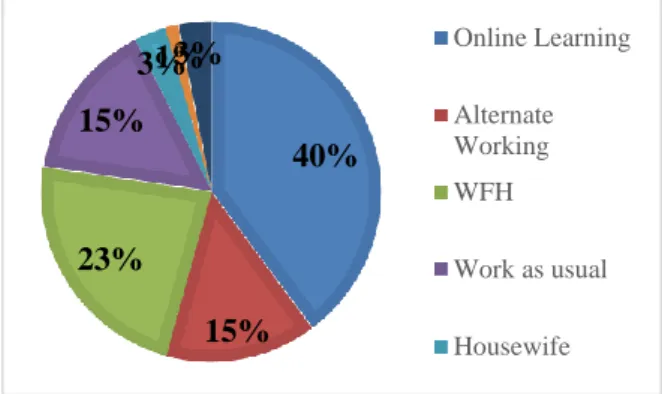
Jakarta and its surrounding cities such as Bogor, Bekasi, Tangerang, Depok. Only twenty-one percent came from other parts of Indonesia. Thirty-six percent of participants are university students. Thirty-three percent hold bachelor's degrees. Eighteen percent hold master's degrees, and four percent from doctoral degrees. Of the total participants, 23% were WFH now, 40% were online students, 15% were alternate working, 15% were working as usual, and 7% others (retirements, housewives, and not working) (Figure 1). Table 1. Demographic profile Demographic Gender Female 143 56% Male 109 43% Prefer Not to Say 4 2% 256 100% Year of Birth 1965-1976 75 29% 1977-1994 59 23% 1995-2005 114 45% Others 8 3% 256 100% Location Jakarta 73 29% Greater Jakarta 129 50% Others 54 21% 256 100% Education University Student 93 36% Bachelor Degree 84 33% Master Degree 46 18% Doctoral Degree 11 4% Others 22 9% 256 100%
The SPSS analysis showed that the measurement of happiness was valid and reliable. The Pearson correlation for four indicators of happiness was above 0.304. Therefore, it can be concluded that the measurements of satisfaction are valid. Cronbach's alpha value for all indicators of satisfaction was > 0.5. Therefore, the happiness measurements had internal consistency (Table 2).
Figure 1. Current status
40% 15% 23% 15% 3%1%3% Online Learning Alternate Working WFH Work as usual Housewife
First author et al. / JournalofSouthwestJiaotongUniversity/ Vol.__ No._Dec. 2019
116
Table 2.
Pearson correlation of happiness measurement
Correlations SHS01 SHS02 SHS03 SHS04 Total SHS01 Pearson Correlation 1 .667** .539** .214** .776** Sig. (2-tailed) .000 .000 .001 .000 N 256 256 255 255 256 SHS02 Pearson Correlation .667** 1 .618** .313** .830** Sig. (2-tailed) .000 .000 .000 .000 N 256 256 255 255 256 SHS03 Pearson Correlation .539** .618** 1 .369** .801** Sig. (2-tailed) .000 .000 .000 .000 N 255 255 255 254 255 SHS04 Pearson Correlation .214** .313** .369** 1 .650** Sig. (2-tailed) .001 .000 .000 .000 N 255 255 254 255 255
Total Pearson Correlation .776** .830** .801** .650** 1
Sig. (2-tailed) .000 .000 .000 .000
N 256 256 255 255 256
Table 3.
Pearson correlation of satisfaction measurement
Correlations SWL01 SWL02 SWL03 SWL04 SWL05 Total SWL01 Pearson Correlation 1 .553** .450** .518** .207** .730** Sig. (2-tailed) .000 .000 .000 .001 .000 N 256 256 256 256 256 256 SWL02 Pearson Correlation .553** 1 .498** .571** .210** .754** Sig. (2-tailed) .000 .000 .000 .001 .000 N 256 256 256 256 256 256 SWL03 Pearson Correlation .450** .498** 1 .629** .260** .772** Sig. (2-tailed) .000 .000 .000 .000 .000 N 256 256 256 256 256 256 SWL04 Pearson Correlation .518** .571** .629** 1 .258** .801** Sig. (2-tailed) .000 .000 .000 .000 .000 N 256 256 256 256 256 256 SWL05 Pearson Correlation .207** .210** .260** .258** 1 .584** Sig. (2-tailed) .001 .001 .000 .000 .000 N 256 256 256 256 256 256
Total Pearson Correlation .730** .754** .772** .801** .584** 1
Sig. (2-tailed) .000 .000 .000 .000 .000
N 256 256 256 256 256 256
Participants scored their happiness with an average score of 4.81 from score range 1-7, or participants agreed that they were slightly happy. Each group's happiness score was then compared with the total group score. Comparison between each group to total group score showed that group of online students and work, as usual, seemed to have happiness scores less than the total participant score (mean value 4,5 online students vs. 4,81 total participants; mean value work as usual 4,71 vs. 4,81 total participant) (Figure 2). When asked, "how is their happiness status compared to normal condition?", fifty-eight percent of participants evaluated that their happiness somehow has deteriorated (from slightly deteriorated to very much deteriorated) (Figure 3).
Figure 2. Happiness score
4,486 5,21 4,98 4,71 5,85 5,2 4,81 0 2 4 6 8 ONLINE STUDENTS WFH ALTERNATE WORKING WORK AS USUAL HOUSEWIFE NOT WORKING/RETIRED TOTAL
Figure 3. Deterioration of happiness
Figure 3 showed % of participants who claimed their happiness are deteriorated (from slightly deteriorated to very much deteriorated) by each group. The group with the most percentage of deteriorated happiness was online students (68%), followed by group work as usual. Only 25% of housewives claimed their happiness is declining (Figure 4).
Figure 4. % of deterioration of happiness in each group
For satisfaction score, the average score of participant satisfaction was 4.57 from score range 1-7, or participants agreed that they were slightly satisfied. Comparing each group to total group score, the group of not working/retired has the lowest satisfaction scores (mean value 3,9 not working/retired vs. 4.57 total participants) (Figure 5). When asked, "how is their satisfaction with life status compared to normal condition?" fifty-eight percent of participants evaluated that their satisfaction somehow has deteriorated (from slightly deteriorated to very much deteriorated) (Figure 6).
Figure 5. Satisfaction with life score
Figure 6. Deterioration of satisfaction with life
Figure 7 showed % of participants who claimed their satisfaction are deteriorated (from slightly deteriorated to very much deteriorated) by each group. The group with the most percentage of satisfaction deteriorated was work as usual (68%), followed by online students (57%).
Students and people who work as usual rated themselves 3.8 and 3.9 (slightly deteriorated-no change) respectively for happiness. The value was the lowest compared to other groups. However, there was no significant difference compared to overall rates. Students and people who work as usual also rated themselves the lowest for satisfaction. However, there was also no significant difference compared to overall rates.
Figure 7. % of deterioration of satisfaction in each group
V. DISCUSSION
It has been a year since the first case was reported in Indonesia in March 2020. One of the measures implementing by the Indonesia Government is implanting social distancing. Work from Home (WFH) was enforced to government institutions and private sectors with the full implementation or alternate work. In Greater Jakarta, mobility restriction was implemented and affected more than 20 million people.
COVID-19 has caused uncertainty and limited people to move around. Previous studies have shown that uncertainty and mobility restriction 8% 14% 36% 14% 10% 14% 4% Very Much Deteriorating Deteriorating Slightly Deteriorating No change 68% 53% 50% 55% 25% 40% 0% 20% 40% 60% 80% ONLINE STUDENTS WFH ALTERNATE WORKING WORK AS USUAL HOUSEWIFE NOT WORKING/RETIRED 4,40 4,91 4,62 4,57 4,85 3,9 4,57 0,00 2,00 4,00 6,00 ONLINE STUDENTS WFH ALTERNATE WORKING WORK AS USUAL HOUSEWIFE NOT WORKING/RETIRED TOTAL 5% 22% 31% 13% 11% 13% 5% Very Much Deteriorating Deteriorating Slightly Deteriorating No change Slightly Improved 57% 56% 50% 68% 38% 40% 0% 20% 40% 60% 80% ONLINE STUDENTS WFH ALTERNATE WORKING WORK AS USUAL HOUSEWIFE NOT WORKING/RETIRED
118 Dwidienawati et al. / Journal of Southwest Jiaotong University / Vol.56 No.2 Apr. 2021
have influenced people's well-being [9], [10]. A study from [1] and [2] claimed that COVID-19 impacted people's well-being. This study has confirmed the previous studies that uncertainty and mobility restriction due to the COVID-19 pandemic have impacted people's well-being. After one year of the COVID-19 pandemic, this study showed that people are only slightly happy. Fifty-eight percent of participants claimed that their happiness was deteriorating. The group that showed the lowest score was the group of online students. This trend was also seen in people's life satisfaction.
[2] showed that after two months of the COVID-19 pandemic in Indonesia, the happiness score was higher than in this study, and only 41% of participants claimed their happiness was deteriorating. It seemed that the longer people experience the COVID-19 pandemic, the score is worse. These phenomena contradict the adaption effect. Studies on the adaption effect have shown that people tend to adapt to significant changes in our life, whether positive or negative (The word counts). After a period of grieve or increased happiness, people will return the happiness to the previous level. That is called human being resilience. The human brain will reduce the effect of the environment on our emotions to make us adapt to the new situation.
However, this is not the case for the COVID-19 pandemic. There is a component of newness in the COVID-19 pandemic. Unlike any other crisis, this crisis caused by the COVID-19 pandemic catches everyone by surprise. No one has a complete understanding of the situation. The situation is unknown with high uncertainty. With COVID-19, the uncertainty has built over time. The disease's management is still uncertain; even with the vaccine, it is still unknown whether it can bring us to the normal condition. From the policy point of view, the management is not equally effective. In Jakarta, the implementation of mobility restriction did not necessarily reduce the new cases of COVID-19 infection.
Uncertainty is known to have a significant direct effect on mental well-being. The mechanism is by how during the pandemic, people are contemplating and facing unended fear of COVID-19. In times of uncertainty, the brain demands extra energy from the body. However, if the brain is not successfully reduced uncertainty, it will develop a persistent energy crisis [28]. [18] and [29], in their studies, showed that uncertainty indeed influences people's well-being.
One of four psychological needs for well-being is well-being connected to others [9]. This need is universally applied. Moreover, Indonesian is known to be one with the highest sociability score (0,79). Indonesian spends at least once every week socializing with friends from social circles [21]. Indonesian often meet with friends, colleagues, and other community members. They meet on various occasions such as small reunions, friends 'arisan', family 'arisan', and religious group small gatherings. The mobility restriction banned them from socializing with their social circles. Yes that in fact, some of those activities were replaced by socializing online with zoom meetings. However, it seemed that online socializing does not have the 'feel and touch' effect; therefore, it can not replace face-to-face socializing. A study from [30] on online learning revealed that the lack of direct interaction was one of the top factors that both students and lecturers dislike about online learning. Moreover, for human beings, for people with high sociability characteristics, not being able to interact with others directly can deteriorate their happiness and satisfaction.
Mobility restriction has limited people in doing physical activities. The prohibition of people gathering has limited people in doing activities such as going to the gym, walking and jogging during the car-free day at weekends, and going to a shopping mall. Studies from [5] and [6] show that physical activities' limitation negatively impacts human well-being. The limitation of physical activities has also resulted in a lack of outdoor activities. Being outdoor increases people's well-being. The limitation of physical activities has a significant negative impact on human well-being. [4] suggest that being outdoor increase well being with direct biophilia pathways or indirect effect through physical activities and social interaction.
As the study by [2], the group most affected by this mobility restriction was students. A study from [30] on e-learning during the COVID-19 pandemic has shown that students do not like most about this mobility restriction was the lack of interaction with friends. The university students are mainly from the youngest generation, Generation Z. This generation, even though it is known to be tech-savvy and hyperconnected to the internet, is also sociable [31]. Another study on WFH [32] reveals that one of the most unsatisfied groups during WFH is family with children above 15 years old. People who do not have children at home or have children below 15 years old claim that they are somewhat satisfied with WFH. Children above 15 years old have
their own needs to socialize with friends; therefore, being confined at home makes them feel unhappy and unsatisfied with life, affecting parents' satisfaction even though they are WFH.
Well-being is known to link with health [6], [26], [27]. The deterioration of well-being might have an impact on people's general health. The study results showed that students should be one of the groups to get a priority for support to help them cope with the condition.
VI. CONCLUSION
This study showed that even after one year, people tried to adapt to new conditions during the COVID-19 pandemic, their happiness and life satisfaction were still not improving. These phenomena contradict the adaption effect. After one year COVID-19 pandemic, the happiness level was only slightly happy, and the level of satisfaction was only slightly satisfied. Fifty-eight percent felt that their happiness has deteriorated during mobility restriction. Furthermore, fifty-eight percent felt their satisfaction has deteriorated. The most impacted group in their scale of well-being was students. Their happiness and satisfaction were the lowest compared to other groups' happiness and satisfaction scores.
This study showed that having mobility restrictions and facing uncertainty caused the deteriorating of happiness and life satisfaction. Mobility restriction does not allow people to have a connection with others. Uncertainty makes people feel their security and safety are threatened. Those two, being connected and feeling secure and safe, are two psychological factors that make people feel good about themselves. Being confined at home limits people's physical activity, which will lead to declining in happiness.
Well-being is known to link with health. The deterioration of well-being might have an impact on people's general health. There are several novelties of this study. The first one is that this study showed that the adaption effect does not apply to high uncertainty. The second one is that this study contributes to the literature on well-being. Significant life events influence people's well-being. From the managerial perspective, this study's findings can give policymakers insight into implementing restrictive measures. This study gives an insight into which of the groups to get a priority for support to help them cope with the condition.
This study's limitation is that it is a cross-sectional study; therefore, it can not be compared across the timeline. This study was not designed
as a mixed-method to dig further into the situation. Further studies to understand people's conditions and reasoning will be beneficial. The scope of this study is only applied to people with experience mobility restriction during the COVID-19 pandemic, moreover for people from collectivist culture. In this study, participants were also mainly from Jakarta and its surrounding cities; therefore, it can not be generalized to the Indonesian population where measures of COVID-19 are less strict.
REFERENCES
[1]
ZHANG, S.X., WANG, Y., RAUCH,
A., and WEI, F. (2020) Health, distress and
life satisfaction of people in China one month
into
the
COVID-19
outbreak.
SSRN
Electronic
Journal.
Available
from
https://papers.ssrn.com/sol3/papers.cfm?abstr
act_id=3555216.
[2]
TJAHJANA, D., DWIDIENAWATI,
D., MANURUNG, A., PRADIPTO, Y.D.,
and GANDASARI, D. (2020) Does people's
well-being get impacted by COVID-19
pandemic measure in Indonesia?
[3]
HELLIWELL,
B.J.F.
(2021)
Coronavirus has left Americans unhappier
than ever. But here’s why things are looking
up.
[Online]
Available
from:
https://www.nbcnews.com/think/opinion/cor
onavirus-has-left-americans-unhappier-ever-here-s-why-things-ncna1232903
[Accessed
12/03/21].
[4]
MACKERRON, G. and MOURATO,
S. (2013) Happiness is greater in natural
environments. Global Environmental Change,
23 (5), pp. 992–1000.
[5]
GARCÍA-HERMOSO,
A.,
HORMAZÁBAL-AGUAYO,
I.,
FERNÁNDEZ-VERGARA, O., OLIVARES,
P.R., and ORIOL-GRANADO, X. (2020)
Physical activity, screen time and subjective
well-being among children. International
Journal of Clinical and Health Psychology,
20 (2), pp. 126-134.
[6]
TAMMINEN, N., REINIKAINEN, J.,
APPELQVIST-SCHMIDLECHNER,
K.,
BORODULIN, K., MÄKI-OPAS, T., and
SOLIN, P. (2020) Associations of physical
activity with positive mental health: A
population-based study. Mental Health and
120 Dwidienawati et al. / Journal of Southwest Jiaotong University / Vol.56 No.2 Apr. 2021
[7]
WHITE, S.C. (2010) Analysing
well-being: A framework for development
practice. Development in Practice, 20 (2), pp.
158–172.
[8]
TAL, A. and KERRET, D. (2020)
Positive Psychology as a Strategy for
Promoting Sustainable Population Policies.
Heliyon, 6 (4), e03696.
[9]
LINLEY, P.A. and JOSEPH, S.
(2004) Positive Psychology in Practice.
Hoboken, New Jersey: John Wiley & Sons.
[10]
MICHALOS, A.C. (2008) Education,
happiness and well-being. Social Indicators
Research, 87 (3), pp. 347–366.
[11]
VAN DER WEELE, T.J.,
TRUDEL-FITZGERALD, C., ALLIN, P., FARRELLY,
C., FLETCHER, G., FREDERICK, D.E.,
HALL, J., HELLIWELL, J.F., KIM, E.S.,
LAUINGER,
W.A.,
LEE,
M.T.,
LYUBOMIRSKY, S., MARGOLIS, S.,
MCNEELY, E., MESSER, N., TAY, L.,
VISWANATH,
V.,
WĘZIAK-BIAŁOWOLSKA, D., and KUBZANSKY,
L.D. (2020) Current recommendations on the
selection of measures for well-being.
Preventive Medicine, 133, 106004.
[12]
MATHEWS, G. (2012) Happiness,
culture, and context. International Journal of
Wellbeing, 2, pp. 299–312.
[13] CONCEIÇÃO, P. and BANDURA, R.
(2008) Measuring Subjective Well-being: A
Summary Review of the Literature. New
York: Office of Development Studies, United
Nations Development Programme.
[14]
JONGBLOED, J. and ANDRES, L.
(2015) Elucidating the constructs happiness
and well-being: A mixed-methods approach.
International Journal of Wellbeing, 5 (3), pp.
1–20.
[15]
DIENER,
E.,
EMMONS,
R.A.,
LARSEN, R.J., and GRIFFIN, S. (1985) The
Satisfaction with Life Scale. Journal of
Personality Assessment, 49, pp. 71–75.
[16] SATICI, B., SARICALI, M., SATICI,
S.A.,
and
GRIFFITHS,
M.D.
(2020)
Intolerance of Uncertainty and Mental
Well-being: Serial Mediation by Rumination and
Fear of COVID-19. International Journal of
Mental Health and Addiction. Available from
https://link.springer.com/article/10.1007%2F
s11469-020-00305-0.
[17]
ORTH, P., SCHNAPPINGER, D.,
SUM, P.-E., ELLESTAD, G.A., HILLEN,
W., SAENGER, W., and HINRICHS, W.
(1999) Crystal structure of the tet repressor in
complex with a novel tetracycline, 9-(N,
N-
dimethylglycylamido)-6-demethyl-6-deoxy-tetracycline. Journal of Molecular Biology,
285 (2), pp. 455-461.
[18]
AGARWAL, P. (2021) Shattered but
smiling: Human resource management and
the well-being of hotel employees during
COVID-19.
International
Journal
of
Hospitality Management, 93, 102765.
[19]
STAMBOR, B.Z. (2007) Is our
happiness set in stone ? Money, 26 (1), pp. 2–
5.
[20]
MURAKAMI, M., TAKEBAYASHI,
Y.,
ONO,
K.,
KUBOTA,
A.,
and
TSUBOKURA, M. (2020) The decision to
return home and well-being after the
Fukushima disaster. International Journal of
Disaster Risk Reduction, 47, 101538.
[21]
LUSSIER, D.N. (2016) Constraining
Elites in Russia and Indonesia. Cambridge
University Press.
[22]
OTHMAN, A.R. and FADZIL, F.
(2015) Influence of Outdoor Space to the
Elderly Well-being in a Typical Care Centre.
Procedia - Social and Behavioral Sciences,
170, pp. 320–329.
[23]
NHS (2021) Benefits of exercise.
[Online]
Available
from:
https://www.nhs.uk/live-well/exercise/exercise-health-benefits/
[Accessed 12/03/21].
[24]
COOPER, K. and BARTON, G.C.
(2015) An exploration of physical activity
and well-being in university employees.
Perspectives in Public Health, 136 (3), pp.
1757–9139.
[25]
NETZ, Y., WU, M.J., BECKER, B.J.,
and TENENBAUM, G. (2005) Physical
activity and psychological well-being in
advanced
age:
A
meta-analysis
of
intervention studies. Psychology and Aging,
20 (2), pp. 272–284.
[26]
LAWRENCE, E.M., ROGERS, R.G.,
and WADSWORTH, T. (2015) Happiness
and longevity in the United States. Social
Science & Medicine, 145, pp. 115–119.
[27]
FANCOURT, D. and STEPTOE, A.
(2020) The longitudinal relationship between
changes in well-being and inflammatory
markers: Are associations independent of
depression? Brain, Behavior, and Immunity,
83, pp. 146–152.
[28]
PETERS, A., MCEWEN, B.S., and
FRISTON, K. (2017) Uncertainty and stress:
Why it causes diseases and how it is
mastered
by
the
brain.
Progress
in
Neurobiology, 156, pp. 164–188.
[29]
MURAKAMI, M., TAKEBAYASHI,
Y.,
ONO,
K.,
KUBOTA,
A.,
and
TSUBOKURA, M. (2020) The decision to
return home and well-being after the
Fukushima disaster. International Journal of
Disaster Risk Reduction, 47, 101538.
[30]
DWIDIENAWATI,
D.,
ABDINAGORO, S.B., TJAHJANA, D., and
GANDASARI,
D.
(2020)
E-Learning
Implementation during The COVID-19
outbreak:The Perspective of Students and
Lecturers. Journal of Social Sciences, 48, pp.
191–196.
[31]
DWIDIENAWATI,
D.
and
GANDASARI, D. (2018) Understanding
Indonesia’s generation Z. International
Journal of Engineering & Technology, 7
(3.25), pp. 245-252.
[32]
DWIDIENAWATI, D., TJAHJANA,
D., PRADIPTO, Y.D., and GANDASARI, D.
(2020) Is Your Work from Home Job
Satisfying? Lesson Learned from Work from
Home during COVID-19 Outbreak in
Indinesia. Journal of Social Sciences, 48 (3),
pp. 743–752.
参考文:
[1] ZHANG S.X。,WANG, Y.,RAUCH,
A. 和 WEI, F.(2020)新冠肺炎爆发一个
月后,中国人的健康,痛苦和生活满意度。
SSRN
电
子
期
刊
。
可
从
https://papers.ssrn.com/sol3/papers.cfm?abstr
act_id=3555216 获得。
[2] D. TJAHJANA,D. WIDIENAWATI,
D 。 MANURUNG , Y.D 。 PRADIPTO 和
D. GANDASARI(2020)在印度尼西亚,
新冠肺炎大流行对人们的福祉有影响吗?
[3] HELLIWELL,B.J.F。(2021)冠状病
毒使美国人比以往任何时候都更加不高兴。
但是,这就是事情不断增长的原因。[在
线 ] 可 从 以 下 网 站 获 得 :
https://www.nbcnews.com/think/opinion/cor
onavirus-has-left-americans-unhappier-ever-here-s-why-things-ncna1232903 [ 已 访 问
12/03/21]。
[4] MACKERRON,G. 和 MOURATO,S.
(2013)在自然环境中幸福感更大。全球
环境变化,23(5),第 992-1000 页。
[5]
A.
GARCÍA-HERMOSO , I 。
HORMAZÁBAL-AGUAYO
,
O
。
FERNÁNDEZ-VERGARA
,
P.R.
OLIVARES 和 X. ORIOL-GRANADO 。
(2020)儿童的体育锻炼,放映时间和主
观幸福感。国际临床与健康心理学杂志,
20 (2),第 126-134 页。
[6] N. TAMMINEN,J。REINIKAINEN,
K。APPELQVIST-SCHMIDLECHNER,K。
BORODULIN , T 。 MÄKI-OPAS 和 P.
SOLIN(2020)体育活动与积极精神健康
的关联:一种基于人群的研究。心理健康
和体育活动,18,100319。
[7] WHITE,S.C.(2010)分析福祉:发
展实践的框架。在实践中发展,20(2),
第 158-172 页。
[8] TAL,A. 和 KERRET,D.(2020)积
极心理学作为促进可持续人口政策的战略。
赫里永,6(4),e03696。
[9] LINLEY,P.A. 和 JOSEPH,S.(2004)
积极心理学在实践中。新泽西州霍博肯:
约翰·威利父子公司。
[10] MICHALOS,A.C。(2008)教育,
幸福与福祉。社会指标研究,87(3),
第 347–366 页。
[11] 范德韦勒(T.J.),特鲁德·菲茨杰拉
德(TRUDEL-FITZGERALD),C。,阿
林,P。,法拉利,C。,弗莱彻,G。,
弗雷德里克,德,霍尔,J.,HELLIWELL,
J.F.,KIM,E.S.,LAUINGER,华盛顿州
华盛顿州的李,山姆,柳布米尔斯基,马
格里斯,南卡罗来纳州,梅瑟,北卡罗来
纳 州 , 塔 伊 , L 。 , 维 斯 瓦 纳 特 , V 。
(2020)有关选择福祉措施的最新建议。
预防医学,133,106004。
122 Dwidienawati et al. / Journal of Southwest Jiaotong University / Vol.56 No.2 Apr. 2021