Study Note
NUE Journal of International Educational Cooperation, Volume 8, 47-62, 20141. Overview
Comparative Study of Elementary Science Curriculum
and Textbook Production of Laos and Japan
KHANTHA VY Houmphanh "**, TAMURA Kazuyuki***, TERASHIMA Yukio*** and KOZAr Takeshi***
• Science Education Specialist, Ministry of Education and Sports, Lao PDR, •• Research Student, Naruto University of Education
*** Faculty, Naruto University of Education
Abstract:
We compared the contents of science curriculum and textbook production processes between Lao People's Democratic Republic (Lao PDR) and Japan to find out what is necessary for Laos to improve its Science Education. We u~ed curriculum guideline and Course of Study to compare educational goals and teaching contents in science education, and visited a Japanese textbook publisher. From these, we found that science in Lao PDR emphasize Basic Leaining Competencies where knowledge, skills and attitude-value are the key factors, yet the actual contents are placed in textbooks without thinking the learning processes or scientific theories connecting different topics. Japanese science education, on the other hand, defines specific levels of problem solving abilities for each grade and contents of textbooks are selected to match for specific skills at each level.
Comparing textbook production in both countries also revealed significant difference between two countries. Laos, where textbooks are reviewed, rewritten, and published within a single year, has various issues for improving the quality and contents of textbooks. Japanese textbook production, to begin with, are scheduled to spend 4 years as a cycle and repeated every 4 years. Also, unlike a single textbook by the government in Laos, private publishers are competing each other to create a better textbook under a strict supervision and approval by the Japanese government and Ministry of Education, Culture, Sports, Science and Technology.
In this paper, we therefore summarized the difference between Laos and Japanese for various issues and how we can improve science education in Laos.
Keywords: Science curriculum, World Around Us, Textbook Production, Lao PDR, Japan
The 21" century is the century of progress in science. Science and science education spread around the world because scientific knowledge and the role of science as one of the pillars for development are now recognized by almost all nations. Countries, big and small, rich and poor strive for the development
of their science programs, For example, scientific development enables all countries to provide good living conditions for their citizens and to achieve international status and economic stability.
Japanese government enhances Science and Technology (S&T) for the resource limited country to maintain its international competitiveness and a vigorous society and economy. For this reason,
KHANTHA VY Houmphanh, TAMURA Kazuyuki, TERASHIMA Yukio & KOZAI Takeshi
it is important for Japan to lead the world in S&T capabilities, Even in the new growth strategy approved by cabinet in December 2009, the importance of S&T has been afforded a renewed recognition, As one of the "Platforms to Support Growth", the "S&T oriented nation strategy" offered two further strategies for "Growth Driven by Japan's strengths", namely the ~"strategy for becoming an environment and energy power through green innovation" and the "health power strategy through life innovation" (Ministry of Education, Culture, Sports, Science and Technology (MEXT), 2014a).
Japanese S&T administration operates under the basic policies of the Council for Science and Technology Policy chaired by the Prime Minister, and works to promote S&T in coordination with related ministries. The MEXT (1) plans and formulates basic policies concerning S&T policy, (2) produces concrete plans concerning promotion, research and development. and (3) coordinates with related government agencies in relation to promotion of S&T (MEXT,2014a).
Starting 2013, the Lao People's Democratic Republic (Lao PDR) emphasizes strengthening in fields of S&T since these sectors are important for development, especially for industrialization, as well as to motivate socio-economic development (Ministry of Science and Technology (MOST), 2014). Lao government aims to bring up the levels of science, technology and innovation of Lao PDR up to those of surrounding countries in Asia. Moreover, the Ministry of Education and Sports (MOES) is focusing on development of the new curriculum and is implementing the three characters of National. Science-Modern and Public as well as the five education pillars of Moral. Intellectual, Labor, Physical, and Aesthetic.
During 2006 through 2015, Lao government implements the National Education System Reform Strategy (NESRS), where an overall goal for the education has been set, directions and strategies has been established and a plan for implementation of the strategy has been prepared. In this way, the NESRS aims to gradually improve the riational education system leading to better growth and quality and to move the education system towards international standards. In other words, the NESRS aims to contribute to the socio-economic development of the
country until 2020.
Recently, the Lao education system has adjusted its structure of general education to from ll-year system to 12-year system by adding one year in lower secondary school. As a result, Lao school system becomes five years of elementary school. four years of lower-secondary school, and three years of upper-secondary school. At the same time, the compulsory schooling is extended to five years
(MOES, 2013, see Table 1 for details).
To support Lao government for its success on goals of educational development plans and improving quality of education, Japan International Cooperation Association orCA) has been continuing cooperation with MOES, Lao PDR. MOES has scheduled a project to improve quality of the Textbooks 'and Teachers' Guide of sciences and mathematics for elementary - for the consistency, we use the word "elementary" throughout this paper instead of "primary" - education in 2016 by reviewing and revising context of them. Currently, staff members of the MOES and Research Institute . for Education Science (RIES) are studying with . experts about curriculum development for science and mathematics - the main author of this paper is from Science Education, MOES, Lao PDR - at the Naruto University of Education in Japan. Through this program, we are going to upgrade our knowledge, ability, and learn techniques how to improve quality of science curriculum, textbooks and teachers' guide in elementary education level.
2_ Objective
This paper is therefore important to improve the Science curriculum in Laos and to update and rewrite the science curriculum and textbooks by the first author and staff members of MOES. Even thought this paper focuses on the topics of science education, it is not taught as an individual subject as Science in the Lao PDR. Instead, science in Laos is taught as a part of the subject "World Around Us (WAU)", which consists of Natural Science, Health, Environment Studies and Soci;U Studies.
In this study, we will first examine the good curriculum practices that can be adapted from both countries, and then identify areas for improvement needed, especially for Lao PDR. We will also compare
Comparative Study of Elementary Science Curriculum and Textbook Production of Laos and Japan
the process of textbook production to learn what is necessary for revising Lao science textbooks in the future. We will also study how the textbooks are used in Japanese schools for the maximum efficiency
in Lao PDR.
3. Method
The research methodology for this study includes reviewing development history of Science education as well as comparing contents of Science curriculum and textbook publishing procedure. As a part of this study, we visit one of many Japanese textbook publishers to learn about how Japanese textbooks are written, authorized, and selected for each school in Japan.
4. Development History of Science Curriculum
In this section, we will discuss about histories how science curriculum became to take current form in both Lao PDR and Japan.
4.1. In Laos
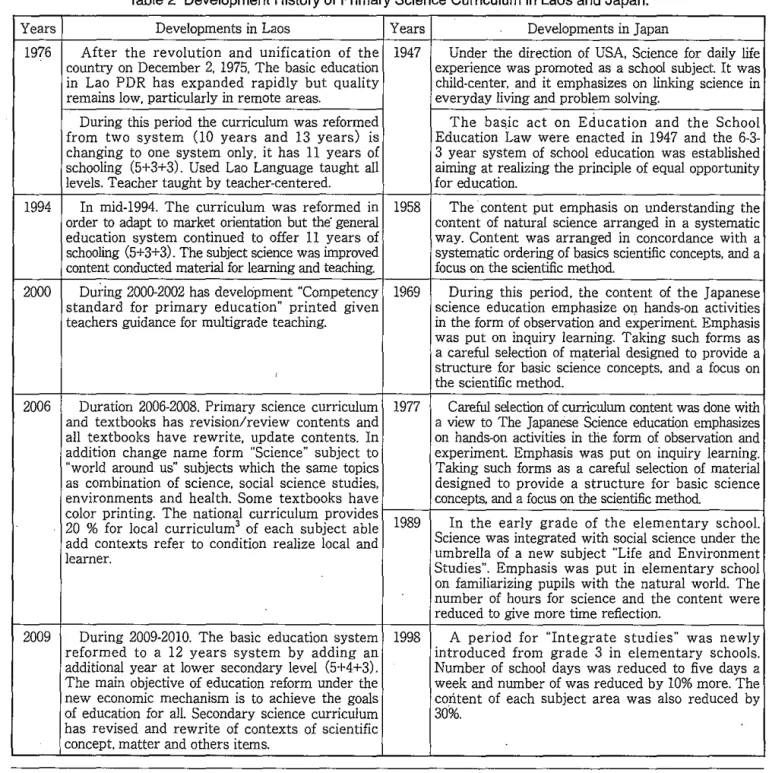
Science curriculum in Laos has revised. total of four times since its independenc.e in 1975 until now as indicate in the left column of Table 2. The contents of elementary science curriculum was revised/improved three times, first in 1994, then in
2006 and finally in 2009.
The original science curriculum created in 1976 was very low in quality. More significant issue was that its implementation was very low especially at remote areas of Laos.
In the first curriculum revision, Science subject contents were imported and translated from a foreign language to Lao Language.
In the second revision of 2006, the "Science" received a major update of contents under policies as adapting tq market orientation and changed its name from "Science" to "World Around Us (WAU)" by combining subjects of Natural Science, Social Studies, Environment Studies and Health. Many things have been improved in these updates and some textbooks had even started being printed in color.
A significant change happened in 2009, when Lao education system was reformed from total of 11 years to 12 years by adding one year in lower
secondary level, converting the schooling from 5-3· 3 to 5-4-3 year system. However, while the RIES has been revised the contents of national curriculum and rewrite textbooks for the secondary education, curriculums in elementary education remained basically unchanged ..
Since the Law of Education mentions the necessity of reviewing and revising.of the curriculum in every 10 years, it is al!llost the time-currently 9 years since 2006 - for the W AUto be revised.
4.2. In Japan
Current Japanese education system has been established in 1947, after the end of Word War II,
under the direction of the United States of America (USA). Since then Japanese schooling system takes the 6-3-3 year system-6 years of elementary, 3 years of lower secondary and 3 years of upper secondary schools - with the compulsory education for the first 9 years.
In compliance with the Education Law of Japan, current Japanese national curriculums for all subjects are revised approximately every 10 years. Since 1947, the postwar development of elementary science curriculum has been ongoing. In these years, . Japanese curriculum has been revised seven times in years of 1947, 1958, 1969, 197,7, 1989, 1998 and 2008 to reflect the trends of the time (see the right column of Table 2).
Curricula and textbooks were revised referring to government policies, conditions of vigorous society and economy and the concept of S&T as one of the "Platforms to Support Growth" of the "Science- and Technology-oriented Nation Strategy".
In the most recent education reform of 2008, new concept of educational content enhances teaching through method of inquiry and problem solving and experience with activities (Table 2). In this reform, Japanese Government has promoted child-centered science through everyday experience by emphasizing the links between science and daily life.
Currently, Science is taught as an independent subject startirig grade 3 on. For the 1" and 2'" graders, science is now integrated with a new subject "Living Environment Studies" that is similar to the WAD in Laos, and actually focuses more on surrounding everyday environment of children than scientific knowledge based on scientific facts and theories.
KHANTHAVY Houmphanh, TAMURA Kazuyuki, TERASHIMA Yukio & KOZAI Takeshi
5, Curriculum Structures
Curriculum is the official document that states the educational objectives, contents, teaching-learning methods, as well as activities for teaching-learning measurement and assessment, and teaching evaluation representing the full cycle process of education. In this section, we compare the curriculum between Laos and Japan.
Since our research focus On elementary science education, even though science is taught in both lower- and upper-secondary schools as well, we are going to analyze only for the elementary science curriculum in this section.
5.1. In Laos
Pupils enter to elemeritary school at the age of 6 years old. Elementary (primary) education is the first stage of general education, for a period of 5 years. These 5 years are compulsory in Lao PDR. Yet due to various reason, e.g., poverty or distance to nearest school. not all children can start their elementary education at 6 years old. Even though this remains one of the significant issues in Laos, it is beyond the scope of this paper, and therefore we do not discuss further about it here.
The curriculum. as shown in Table 4, is designed to give general knowledge to pupils in:
1) Lao Language, 2) Mathematics, 3) Moral Education, 4) World Around Us, 5) Arts Education, 6) Music,
7) Handicraft.
8) Physical Education, and 9) English.
Curriculum for elementary education has ~otal of 9 subjects as listed above. At the elementary education, an academic year consists of 33 weeks, with 5-6 ·hours per day (4 period in the morning and a few period in the afternoon) for 5 days a week, where one period equals to 45 min in elementary school. An academic year is divided into 2 terms as first term is from September to January and second term is from February to middle May. And at the end of the year, pupils have end-of-the-year examination.
5,2. In Japan
The children who turned to the age of 6 are required to attend elementary school for six years in Japan. The education at the elementary level is designed for children's mental and physical development (see Table 3 for details).
The curriculum at elementary education consists of 13 subjects as listed below and as shown in Table 4:
1) Japanese,
2) Social Studies, 3) Mathematics,
4) Science (only for 3" grade and up),
5) Living Environment Studies (only for 1" and 2" grads),
6) Music,
7) Arts and Handicraft, 8) Home Economics, 9) Physical Education, 10) Moral Education, ll) Special Activities, 12) Integrated Studies, and 13) English Activities.
In Japanese education, Science is formally introduced as a subject in grade 3 and up. However, even though it is does not appear in subject tiles, basic science is integrated in the subject of "Living Environment Studies" at grade 1 and 2, where the learners are asked to look at their daily living environments and consider their surroundings from social and scientific viewpoints.
Japanese academic year is usually divided into 3 terms, or trimester system, from April to July, from August to December and from January to March. Since as long as the amount of allocated number of classes can be taught during an academic year, some elementary schools start adopting semester system (from April to September and from October to March) rather than regular trimester system recently.
In Japan, an academic year is decided to be 35 weeks of class with 5 days a week and 4 period in the morning and 1 or 2 periods (depend on grade leveD in the afternoon. Duration of one period is equal to 45 min as in Laos (increases to 50 min in lower and upper secondary schools).
Comparative Study of Elementary Science Curriculum and Textbook Production of Laos and Japan
6. Goa!s of Science in Elementary Curriculum
In this section. we focus on the Science curriculum. especially on the aims or goals in both countries.
6.1. In Laos
The main goal of science curriculum in Laos is to develop pupils' ability to research nature through observations and experiments. These activities should enhance their understanding of phenomena of the natural world, nurtures a rich desire to respect and love nature, and make them want to live as part of it
Pupils also develop their knowledge and understandings of their own and other societies, of local and national environments, and of the interdependence between people, their society and their environments. These promote knowledge, skills, attitudes and values that lead to active participation in their local and the global society (Table 5).
6.2. In Japan
The main goal of the curriculum in Japan is to enable pupils to become familiar with nature and to carry out observations and experiments with their own prospectus, as well as to develop their problem-solving abilities and nurture hearts and minds that are filled with an affection for the natural world. At the same time, it aims to develop a realistic understanding of natural phenomena, and to foster scientific perspectives and ideas for each pupiL
To achieve these goals, each grade has separate objectives based on different developing stage of pupils. For example, the objectives for grade 3 are to develop perspectives and ideas about the properties and functions of weight, wind, force of rubber, light, and magnets and electricity through investigation comparing phenomena involving these matters, and through probing the identified problem and making learning material with interest.
7. Contents of Science Curriculum
Here, we take a look at details of what are exactly in the topics of curriculum in both countries.
7.1. In Laos
The content of WAU curriculum has 3 parts, or strands: 1) Living Things, 2) Non-Living Things, and 3) Lao PDR. These strands are the same for all grades. All of these strands contain smaller parts. For example, a strand of "Living Things" contains 4 smaller parts: 1) our body and our health, 2) plants and their uses, 3) animals and their behaviors, and 4) relationships between living things (see Figure 1 for other strands).
The subject WAU is a combination of Science, Social Studies, Environment and Health at the primary school leveL As indicated in figure 1, the content of W AU curriculum emphasizes the Basic Learning Competencies (BLC) for each grade. Introducing all of these BLC is beyond the scope of this paper and hence will be introduced in the sequential paper by Tamura et a1. (accepted for publication in Research Bulletin of Naruto University of Education). As a result, the context is mostly based on theories rather than science activities and focuses to simply developing knowledge, skills, attitude and values of pupils.
7.2. In Japan
In Japanese Science curriculum, contents varie grade by grade. For example, even though pupils learn about "mater and energy" thro~gh grade 3 to 6, contents are different in each grade. Instead, each contents is linked by science concepts at its base, and the level of goals and skill that pupils should acquire are increasing grade .by grade. These contents are aligned so that pupils can develop their ideas with realistic understanding of natural phenomena. Detailed contents are published in the curriculum guideline by MEXT and can be downloaded through the Internet'.
7.3. Annual Class Periods for Laos and Japan
Figure 2 shows the number of periods for 3 strands of W A U in Laos. For a set of 3 bar graphs, blue (left) indicate the number of periods for "Living Things", which contains topics related to biology and health, in an academic year. Red (center) indicates the number of periods for "Non-Living Things" with
1 MEXT "The New Curriculum Guideline (English Translation) ": http://www.mext.go.jp/a_menu/shotou/new-cs/youryou/
KHANTHAVY Houmphanh, TAMURA Kazuyuki, TERASIDMA Yukio & KOZAI Takeshi
lIo. Curriculum EmpbUls Bille learnIng Compe\lllncles for each gradI
•• •• " ... "combloalkln 010' Science, Social Studies, Envltonmenl and Health
/,',.
"""'~
th'm~I,,,
'"' th, ,",;ro,m'"tOurS and OUf Honlth / / the nature oftbc relatIOnships between enVIronments and hvingthi!!gs
_. Plants and lh8jrUs~s
!
{World Around U. ,) K _ .... ~ ... their own culture and community- . , . ,. r O ....
"",ge,"-Anlmalsand IhcirB.9lJp.Yi!!~.~ ~{!WWPW
!
---_________ /
changing environment lind sociel}'.fuJ.!i!!iOnshi belwocn liviD Thl S ••••
I
-L / "
~ tbe body and ways to achieve good hcnllhMatter and Its Uses
~
.'~ . ':" 10 research nalural through obset\'ed and ~perimenl Enerpy md Chemicals IejliMWij ", ... Aims _ III solve problems using approprlat& methodsGeogra.phyand History I _ ,
I
~'"...
Skills I abllty w 10 research tocallvwllh environmental, !lumen and textresourteS \0 find lnf0f!l1sUMSocIal OrganiZallon r:~~ ... ... I to communicate research IlndInas In words.labl&S, araDlls.diaClrams and other scienUncfcrms
malter/E .•••.• :.:.. to usa, develOll_and apply sclenUDcknoWtedoe In dil!~'life
lore cI end love nature
T,~
)
l
\0 active partlclpaUon in their local and the global society~{selenc;e Atliludes.&Valuesl· Inlerast In and euriosi about natural and 5elenlific roaISSilS
>~ .... ,... Ares nslble and cartn aWtude towards themselves, Oillor
••••. Japan Curriculum Emphasis ObJectiYes and
Ie and !he envirDnmBnl TodeV9 arealisllc;undel'$lendln ofnlllllrol henomena ~,~ectIves
To foster sclanUfiC ctiVIIlI end Ideas.
Contlnt for .aet! grad.
Figure 1: Relationships of Science curriculum contents of both countries. topics related to physics and chemistry. And green
(right) indicates the number of periods for "Lao PDR" that is about social studies and history.
World Around Us(WAU)
"Living ThIngs • Non'llvingThings 1:1 L~oPDR: Our People ~nd Our Environment
2 3 4 5
Grade
Figure 2: Number of periods for 3 strand of WAU for each grade in Laos
As can be seen in Figure 2, while topics about "Living Things" are taught for about 30 hours (periods) in each grade, topics about "Non-Living Things" are not allocated with sufficient number of period necessity for development of S&T. In other words, the Science education in Laos is taught at the minimal level, and need to increase in teaching time for the future.
Figure 3 shows the companson of annual number of periods for science class in both Laos and Japan, The period for Laos is a combination of scientific topics, i.e .. "Living Things" and "Non-Living Things", excluding the periods for "Lao PDR". On the other hand. Japanese period is the total hours allocated for the Science class, hence it does not have any class hours for grades 1 and 2.
WAU Vs Science
t3 WAU(Living thing, Non·llving thing) of l.<Ios • Science of J<lp<ln
.. .... ~~~~~.~;;~ ...
l. ,ubjott,ofJ'pon f
... :.:.::, ..
s Grade
Figure 3: Comparison of annual number of periods for scientific topics between Laos and Japan
As seen in this figure, Japan teaches' total of at least 90 hours of science in grade 3, and it increases to 105 hours in later grades. Comparing to 54 periods of Lao grade 3, this 90 hours of grade 3. Science is 36 hours more than what Lao pupils are educated. Not only that, Japanese 54 hours is pure science that is based on various scientific theories supporting S&T rather than W A U that is also mixed with topics in everyday environments.
By updating the new curriculum, the MOES is implementing the 3 characteristics of:
1) National.
2) Science-Modern, and 3) Public,
as well as 5 pillars of education:
1) Moral, 2) Intellectual, 3) Labor. 4) Physical, and 5) Aesthetic.
Comparative Study of Elementary Science Curriculum and Textbook Production of Laos and Japan
basic knowledge and content by combination of natural science, health, environment studies and social studies in to each grade to improve the S&T level of Lao PD R.
7.4. Issues with Science Topics in WAU
To show some example of issues that Lao W AU have, we use the topic of "Plants and their Uses" first.
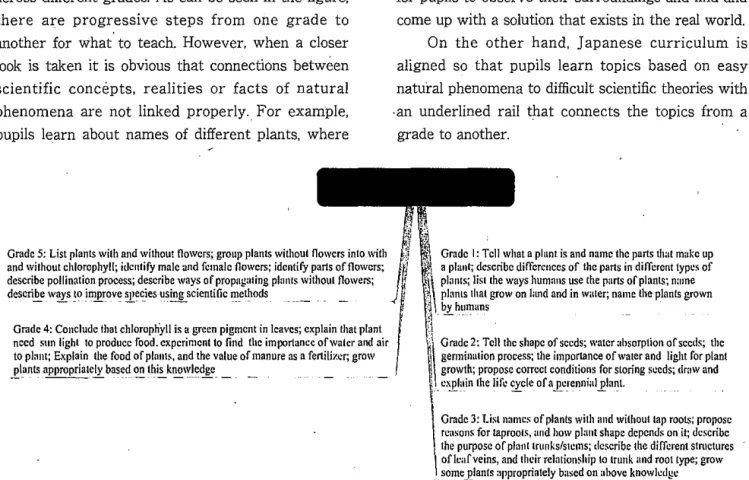
Figure 4 shows the mind mapping of the topic acrOss different grades. As can be seen in the figure, there are progressive steps from one grade to another for what to teach. However, when a closer look is taken it is obvious that connections between scientific concepts, realities or facts of natural phenomena are not linked properly. For example, pupils learn about names of different plants, where
Grade 5: List plants with and without flowers; group plants without flowers into with and without chlorophyll; identify male and fcmale flowers; identify parts of flowers; describe pollination process; describe ways ofproplIgllling plnnl!' without flowers;
descri~ W~S~? .im..£.rove ~~~ies using scientific l11~thods
Grade 4: Conclude that chloropnyll is a green pigment in leaves; explain Ihat plant need slIn light to produce food. experiment to find the importance of water and air to plunt; Explain the food ofplnnl!', and the value of manure as a fertilizer; grow .£1_an15 appropriale~ based ~ t~~ k~'~!_~~
__
they grow in grade 1, and about shapes of seeds, importance of water and light for growth of plants
in grade 2. However, textbooks for grade 1 and 2 do not explain any connection between two grades.
As a result, even though pupils learn various topics about "Plants and their Uses" across different grades, the knowledge that pupils accumulated tend to be independent and does not connect to each other. At the same time, since the connection between different concepts is not linked, it is hard for pupils to observe their surroundings and find and come up with a solution that exists in the real world.
On the other hand, Japanese curriculum is aligned so that pupils learn topics based on easy natural phenomena to difficult scientific theories with ·an underlined rail that connects the topics from a
grade to another.
Grade I: Tell what a plant is and name the parts thnt make up
a plant; describe differences of the parts in different types of pl,lIIts; list the ways humans use the parts of plants; nmne plums Ihat grow on land and in wiLter; name the plants grown
· ~ h~l~ans
Grade 2: Tell the shape of seeds; water 'Ihsorption of seeds; t11e germination process; the importance of water and light for plant growth; propose correct conditions for storing seeds; dmw and
· e~I!lin the life :Icle ofa..£.e!enllial.Eln~t.
Grade 3: List mImes of plants with nnd without lap roots: propose reasons for taproots, lind how pl'lIlt shape depends on it; describe the purpose of phHlllrunks!slcms; describe the different stmctures
of leaf veins, and thcir relationship to trunk lind rool type; grow
· someJ:lants nppr~riate.!r based on above knowlc~g~_
Figure 4: Topics taught in section of "Plants and their Uses" in WAU.
Section of "Matter and its Use" is another example to show some issues in W AU, where pupils learn about energy and chemistry. Details about this will be discussed further in future (Houmphanh et aI. in prep), so we only introduce the idea here very briefly.
The main problem for this topic is that while the. concepts in this section is very important for S&T, allocated chapters, or periods, for this topic is at the minimal level. As a result, various concepts and basic theories are simply placed within textbook where they can without any consideration for the order and connections of topics.
In Laos, pupils learn names of different light
sources, report on experiments with light, study simple mechanics and natural forces and create simple toys that use forces in grade 3. Then they conduct experiments on properties of light and , reflection in grade 4. During the same academic year, pupils also study about heat and conduction of heat, sound and its effects, and straight line. In the final grade of elementary school. pupils study about electricity, namely about alternate current (AC) and direct current (DC), electric appliances used locally, and advantages/disadvantages/dangers of electricity. Another topic pupils learn in grade 5 is about chemicals that they use in daily life, e.g" read and, analyze the labels on products, study how to use
KHANTHAVY Houmphanh, TAMURA Kazuyuki, TERASHIMA Yukio & KOZAI Takeshi
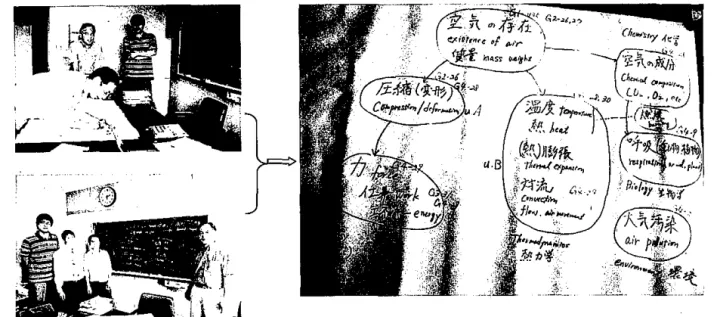
Figure 5: A scene how we create a mind map of a certain topic, "Characteristics of Air" and topics relates to it, across different grades, The blue writing on right picture, e.g" "G4-29" means this topic is taught in grade 4 unit 29,
these chemicals and identify positive and negative aspects of using chemicals.
7,5, Japanese Curriculum Structure
In Japan, scientific contents are introduced to pupils with different skill levels at different grades, Namely, the levels of problem solving abilities to be achieved at different grades 'are defined by MEXT' as follows:
1) grade 3: Pupils can examine natural objects and phenomena familiar to them by comparison,
2) grade 4 : Pupils are able to examine natural objects and phenomena in terms of their functions and temporal aspects,
3) grade 5 : Pupils are able to examine changes and functions of natural objects and phenomena by paying attention to related conditions (e,g., how these conditions affect?), and
4) grade 6 : Pupils can examine natural objects and phenomena by deducing related factors, regularities and relationships.
For instance, pupils in grade 3 simply observe properties and characteristics of various objects by e.g., comparing weight of different material objects, force of wind and rubber, characteristics of light, magnet and electricity. In grade 4, pupils
learn properties of different states of object (gas, liquid and solid) and temperature, function of electricity through motor and battery, In grade 5, pupils dissolve substance to cold and hot water, experiment with various pendulums and somewhat complicated electric circuits, And in grade 6, pupils study about mechanics of combustion, properties of aqueous solutions, and regularity of a lever and use of electricity.
Figure 6 shows what topics are taught under "Plant" across different grades in Japan. Comparing with the levels of problem solving abilities defined by MEXT, it is clear that as grade goes up, the content of topics progressively becomes more complicated.
At grade 3, pupils start studying about basic knowledge about plants and their body parts simply by observation. Grade 4 does not have any content about plant in the textbook and curriculum, but this is because pupils are introduced to other topics that were not introduced in grade 3. Once pupils become grade 5, they learn germination process and the necessary conditions for proper and successful germination and. growth. of a plant. Finally in grade 6, pupils study detailed structure and function of plants, So far, we have discussed about the content and structure of Science curriculum in both Laos and Japan, It is clear that while Japanese science education and curriculum structure are based on a
2 MEXT "The government course/curriculum guideline for Elementary Science Education" English Translation version:
Comparative Study of Elementary Science Curriculwn and Textbook Production of Laos and Japan
Grode 3: I~nts:
'[ To develop pupUs' ideas about growlh patterns and body structures by findIng and raIsing plants, and by exploring Ihe processes of
i their growth and body struclure.
"-(a) Plants g,row in accordance with a fixed order of growth, and their body parts consisl of roots, sIems and leaves.
I
Grade 5: Germination. growth and 'mllion of plants:-,:-)
:';';\ ".; <'.":.' .':( ... :i., '. !TO develop pupils' ideas about the condilions of germination,
g~th
and fruition by raiSing plants, and by exploring their germination, growth and fruition. ["~'¥J'[Jif:::;"J (a) Plants germinate by using the nulrltlon in seeds""",:~'~':'~-'!rt';~;~ .:, (I» It is water, air and lemperature Ihallnnuence plant germination. . .
I (~ Suntrght and fertilizer affect plant growth.
I
(d) Some flowers have slamen and pistil; when pollen sticks to the stigma of Ihe plSlil, ils base develops Inlo the fruit, and the seeds are produced In the frullI
i Grade.6: NulriUon of plants and pathway of water:
To develop pupils' Ideas about the structure and function of plants, by observing plants and by examinIng the pathway of water In plants and the function of creating nu!rJtlon in leaves.
Figure 6: How the topicS are included under "Plant" across different grades in Japan. firm underlying concept of learning theory, current
science curriculum in Laos are not properly aligned and need a thorough revision to rearrange content itself and the order of it. From the following section, we now move on to the comparison of textbook production process in Laos and Japan.
8. Textbook Production Process
In this section we leave the science curriculum and education, arid now focus on how textbooks are developed in both countries.
B.1. In Laos:
The National Educational System Reform Strategy (NESRS) sets a long term national goal to secede from the educationally least developed countries by 2020. Lao government also plans to build a basic human and physical infrastructure to shift the nation towards industrialization and modernity
(MOES, 2008).
To achieve these goals, the national curriculum has been reviewed, revised. and rewritten its contents following government policies. Teaching materials have also been updated and reproduced for each grade to increase the quality of general education. These tasks are conducted by councils and committees, e.g., Committee for the Approval of Curriculum and Instructional materials (CACIM), set up by MOES. Writers of curriculum and textbooks are invited from educational institutes, universities, public and private schools across the country. Figure 7 summarizes how these organizations are related to each other.
Under direction of minister of MOES. RIES started "national seminar about National Curriculum
reform". M embers of this seminar includes committee members, education administrators, and experts on each subjects from universities, colleges and publici private schools. These people come up, select and screen contents of the new curriculum. Then RISE sets a schedule of framework and amount of editing. and then assigns an editor in chief and writers of curriculum arid textbooks, where usually about 6 people are selected for each subject.
'During textbook (and teacher's guide) production, there are various steps. First writers meet to analyze the curriculum. Once everyone understands what the content should be, they write a draft version of textbooks. After content is completed, writers check them with a list created based on the curriculum. First version of competed textbooks are then distributed to selected teachers for a tryout and evaluation. After minor fixes and finalization, textbooks are checked and approved by CACIM and distributed nationwide. These textbooks are supposed to be distributed to all elementary schools regardless of public or private for free.
A t the same time, new textbooks are tested through teacher training. Through this experimental use, if some problem or areas in need of improvements are found, then it go through some revision process as indicated in Figure 7.
As written so far, this textbook production process seems to be decent and reasonable. However, the main issue in this process is that the whole process is conducted from the beginning to the end in less than a year. This is because the funding for reviewing and revising the curriculum and textbooks are available only for a period of one academic year. As a result a project can only be supported
KHANTHAVY Houmphanh, TAMURA Kazuyuki, TERASHIMA Yukio & KOZAl Takeshi
Problem & issues
Council for Curriculum Reform
Member estimate 70 people, chairman by Minister of MOES, education administrator as chief of department and Province level, subject expert, etc.
2
- Government change policy, growth soclo-economic, etc . • Education Law.
C~iculum development
The subject expert estimate 40 people from DES, RIES. University. College and sChools.
t
il_
!.h~ !::':..n _w~~ .!,a!:e.J13!! .!i~!:.3
Textbooks, Teacher guide production
+---,
One subject writer estimates 6 people per :
Try out with teachers who are
teaching at school level by Invite
them to join a meeting.
(5 Evaluation 10
4
~~a~:~ f~:~~:!~p~e:~ ~~~r~J:~.depend 1
,
,
,
,
,
______________ 1All books screening by the CACIM to Committee for the approval of curriculwn approval, member from MOES and and instructional Materials (CACIM)
subject expert around 2 weeks for
L-=====:':':-:==-=="'---'
screening or more time.Teacher Training use new
textbooks Use textbooks
Figure 7: Processes of curriculum and textbook production in Lao PDR.
for a year at most. In the following section, we now summarize how Japanese curriculum and textbooks are reviewed and revised,
8,2, In Japan
One of the biggest differences between Laos and Japan is the time that two countries spend for improving their curriculum and textbooks, While Laos spends only one year as written in the previous section, Japan spends full 4 years as indicated in Figure 8. And this cycle repeats every 4 years,
Another important difference is that while textbooks are published by the government in Laos, therefore only one kind of textbook, textbooks are published by private companies in Japan. One advantage of having multiple publishers - average of 5 per subject -is that each publisher creates textbooks that are easy to use and easy to understand for both teachers and pupils. Also, since the publisher whose textbooks are adopted gains a huge .profit, private publishers compete to make better textbooks than the other companies.
Yet, this does not mean publishers can write whatever they want in the textbooks, Contents of textbooks are strictly specified by the government 'course/curriculum guideline (Course of Study)
and commentary to the curriculum guideline, For example what kind of experiment and what kind
of equipment and tools are supposed to use in that experiment are specifically mentioned in these
.
. curriculum guideline and commentary for Science Education. Also once textbooks are written, they are screened by Textbook Authorization Research Council (T ARC), a committee within MEXT, whether they follow the curriculum guideline and commentary before publication. Detailed textbook publication process is summarized in Figure 9.As indicated in Figure 9, only textbooks authorized by T ARC are allowed to be used in Japanese schools, The members of this council are selected from university and college professors, public and private school teachers, and various specialists in their fields. Once T ARC has decided which textbooks meats the standards, it reports to . the minister of MEXT. Once the minister approved textbooks, T ARC notifies publishers with the results. Now, we are going to take a look from publishers' side. When publishers prepare to create new textbooks, the senior specialists for each subject group hired by a publisher start studying the current ,issues and necessary improvements, Once' new textbooks are ready, publisher submit a "White Book", or a textbook without its cover or publisher's name, to T ARC for review, If some corrections are necessary, publisher fixes the issues pointed out or commented by T ARC and re-submit for re-screening.
Comparative Study of Elementary Science Curriculum and Textbook Production of Laos and Japan
ptyear 4th year I
April I March April
I
March AprilI
March AprilI
MarchI
y .
"-jWriting and editing
I
c=:>
I
Authorization f---..,...fAdoption ~r-,--L_r--.J..L-, I~ .~ ~an.ufa~tl.lreanc! ~ I Usec!lstnbLrtiOIl I ~'r I_...-t '0
"
" "
~-g • ~-
o~~
...
0 ~"
o , • 0 ~ ~B 0 ~ " " " D • 0 ~.
~ ~ 0 -5] " ·0 .~ ::c-c"
"
J; " 0 ~ ""
;;"
" 2 ~ o 0.0-':; ~-
c.:o " 0 " E·5
~ "5.5 cri~
~ ~ '----~.-
.
~ " 0 0 0 t 0."
" ~ D 0 ~ " 0 0 D r ~ 0"
g
.~ ~ ~ ~C - o :;; ~
"
l"- I"- Source: Textbook policy. MEXT.z~
0 ~
0 ~
Figure 8: Process of textbook revision in Japan. It is not indicated in the figure above, but since the same textbooks are used for 4 years, teachers have at lest 3 years for coming up the issues and problems with the current in-use version of textbook before the next version come out.
Publishers
Application for veriJication
(I) Members council estimates 30 people'. (2)Members of extraordinary committee estimate 120
people, (3) expert committee member estimate J 02 people and (4) senior specialist for textbook
research the sample which is submitted by publishers estimate 50 people.
r - - - -,- - - - - - - -]-'
'~TextbOOkAuthorization Research Council (TARC) contain 10 Sections as Japanese; Social Study; :
: Mathematics; Science: Music; Drawing and Arts and Calligraphy; Foreign Language; Physical Education, I
: Information and Communication Technology and Vocational Education; Life Environment Study and Life. :
I
1
3
:
Approval Disapproval I (I) (3) Publishers (2),
,
--- ---~[
submittin~ ~.e note] of oPPosItionSubmitting the calibration card
Approvul
.,---Determination that TARe llPproVC he screening the textbook
ubmitting the sample of textbooks
Determination that TARe disapproval he screeninl! the textbook
Re:lpplication (option)
Figure 9: Textbook production process in Japan.
principle, publishers can retreat the application. At this time, publishers have opportunity to object
the decision by T ARC and MEXT for the fairness. This way, the procedures include a system that fully respects the applicants' right as well as ensuring a prudential authorization process. Or, if the issue is too big to fix by the deadline for resubmission, or suggestions by T ARC are against publisher's'
Once textbooks are authorized or approved by MEXT, the list and· samples of textbooks are sent to municipal Board of Education of each city, towns and villages during months of June and July. During a limited period of time all textbooks are displayed at one place, e.g., at town library, and teachers
KHANTHAVY Houmphanh, TAMURA Kazuyuki, TERASHIMA Yukio & KOZAI Takeshi
have chance to take a look at them and submit their individual preference to municipal Board of Education (BoE) , Each municipal BoE then decide which textbook are best for the district and submits the request of which textbooks are preferable to the prefectural BoE by mid September. Once all requests are arrived at the prefectural BoE, it decides which textbook should be selected for each subject (Figure 10), where textbook from different publisher can be used for different subject but no subject is allowed to use two textbooks from different publishers.
Above is for the public (municipal) schools only, For national and private schools, principal has the authority to decide the textbook to be used in their schools regardless of decision by BoE.
This selection process and being selected is very important for textbook publishers. As indicated at the beginning of this section, Japanese school uses same textbook and hence publishers for each subject for 4 years. Assuming each school has about several hundred to nearly 1000 students and each prefecture have tens and hundreds of pubic schools, getting selected creates a huge profit for a textbook publisher, Even though a publisher get profits from being selected, textbooks for elementary and lower secondary schools, 1" to 9th grade or during
compulsory education, are distributed for free to pupils. The cost is paid from government as a national expenditure. The only time when pupils, and their parents, have to pay for textbooks are if pupils lost their textbook and need a replacement
g, Conclusion
Both Lao and Japanese governments recognize enhancing the education is a key to develop' human resources and industry to improve the quality and level of socio-economy development in current world, Since the end of the World War IT, especially in 21" century, Japan started promoting children centered education. and links between science and everyday life,
Lao government, on the other hand, started . enhancing its new curriculum development with 3 characteristics and 5 pillars of education since 2009. Therefore, Laos has so many things to learn from Japanese education, especially about science education. One of the most important aspect that Laos can
(J)Subjects submitted (3) Sample extbooks Bent MinisUyofEducation, Culture, S ScicnccandTecbnolo (2) Catalogs ~ent (4) Report __________ _ submitted I Textbookselection-: I council I L __________ I I AssellSlllcntreport I '
t ___
d.!a~!1!P ___ : (5) Instruction . lludAdvice I---:--~ I Adoptiondistrict I committee '-1":Mmi::---C·",,-P'l::boMd-'-o-:' "'-:'-'-:'ti:-on-i I Selection board (6)Adoption I t ISource: Lecture at Keirinkan Textbooks Company.: ___ ~~~o!y_~~d ___ ~
Figure 10: Textbook Adoption System, Source: Lecture at Keirinkan Textbooks Company.
learn from Japan is that Japanese science education are based on solid content with underlying theories and systematic learning order. In other words, level of problem solving abilities and contents necessary for specific abilities are in accordance with Japanese course/curriculum guideline (Course of Study) ,
Using Japanese curriculum and learning contents as a possible standard, Lao curriculum needs to be improved to increase the time and content from the current minimal, or even deficient level of science education.
Lao government or MOES also have many things to learn from Japanese textbook production process. Instead of MOES creating the only textbook for the entire nation, introducing private companies for publishing textbooks as in Japan might be better to create, high-.quality textbooks.
Also instead of completing the improvement pr?cess within a single year, it might be much better to spend multiple years (4 years for Japan) to review and revise the textbook content. I~ all process are forced to complete within a year, many steps that requires several months. especially the processes of reviewing old textbook contents, evaluating and revising the newly prepared textbooks during tryouts the quality of final product are without a doubt much lower than]apanese textbooks.
By comparing Lao and Japanese Science education and textbook production processes. we therefore found out that Lao government and MOES need a significant effort to reach its goals of improving the science education in Laos to help develop its S&T knowledge and skills to improve the whole nation.
Comparative Study of Elementary Science Curriculum and Textbook Production of Laos and Japan
Table 1 Basic Education System in Laos
Type of Program (Public and Private) Total schools admission (age) Qualification for Duration of Course Number of subjects
. nursery school Public: 1.509 - 3months to 2 years -
-- Kindergarten Private: 293 - from 3-5 year of age 3 years 8 Units
Elementary School Public: 8731 Age 6 5 years 9
Private: 196
Lower secondary Public: 1.383 Age 11 4 years 9
schools Private: 78
Upper secondary Public: 1.071 Age 15 or more 3 years 14
schools Private: 34
Source: MOES (2013) and RIES (2013)
Table 2 Development History of Primary Science Curriculum in Laos and Japan.
Years Developments in Laos Years Developments in Japan
1976 After the revolution and unification of the 1947 Under the direction of USA. Science for daily life country on December 2. 1975. The basic education experience was promoted as a school subject It was in Lao PDR has expanded rapidly but quality chlld·center, and it emphasizes on linking science in remains low, particularly in remote areas. everyday living and problem solving.
During this period the curriculum was reformed The basic act on Education and the School
from two system 00 years and 13 years) is Education Law were enacted in 1947 and the
6-3-changing to one system only. it has 11 years of 3 year system of school education was established schooling (5+3+3). Used Lao Language taught all aiming at realizing the principle of equal opportunity
levels. Teacher taught by teacher-centered. for education.
1994 In mid-1994. The curriculum was reformed in 1958 The content put emphasis on understanding the
order to adapt to market orientation but the' general content of natural science arranged in a systematic education system continued to offer 11 years of way. Content was arranged in concordance with a schooling (5+3+3). The subject science was irnproved systematic ordering of basics scientific concepts, and a content conducted material for learning and teaching. focus on the scientific method.
2000 During 2000-2002 has development "Competency 1969 During this period. the content of the Japanese standard for primary education" printed given science education emphasize on hands·on activities
teachers guidance for multigrade teaching. in the form of observation and experiment Emphasis
was put on inquiry learning. Taking such forms as a careful selection of material designed to provide a
,
structure for basic science concepts, and a focus on the scientific method.2006 Duration 2006-2008. Primary science curriculum 1977 Careful selection of curriculum content was done with and textbooks has revision/review contents and a view to The J apam:ise Science education emphasizes all textbooks have rewrite. update contents. In on hands·on activities in the form of observation and addition change name form "Science" subject to experiment. Emphasis was put on inquiry learning. "world around us"' subjects which the same topics Taking such forms as a careful selection of material as combination of science, social science studies, designed to provide a structure for basic science environments and health. Some textbooks have concepts, and a focus on the scientific method.
color printing. The national curriculum provides
1989 In the early grade of the elementary school.
20 % for local curriculum' of each subject able
add contexts refer to condition realize local and Science was integrated with social science under the
learner. umbrella of a new subject "Life and Environment
Studies". Emphasis was put in elementary school on familiarizing pupils with the natural world. The number of hours for science and the content were reduced to give more time reflection.
2009 During 2009-2010. The basic education system 1998 A period for "Integrate studies" was newly
reformed to a 12 years system by adding an introduced from grade 3 in elementary schools.
additional year at lower secondary level (5+4+3). Number of school days was reduced to five days a
The main objective of education reform under the week and number of was reduced by 10% more. The
new economic mechanism is to achieve the goals coritent of each subject area was also reduced by of education for all. Secondary science curriculum 30%.
has revised and rewrite of contexts of scientific concept, matter and others items.
3 Rural curriculum means curricula level of province, capital and schools. Rural curricula development by carry contexts of
KHANTHAVY Houmphanh, TAMURA Kazuyuki, TERASHIMA Yukio & KOZAI Takeshi
Years Developments in Laos Years Developments in Japan
2009 At the same time the' Science curriculum was 2008 New concept of revision in educational content to
review and revised. Content was improved and enhancement of teaching through method of inquiry rewrote of natural science. Conducted material and problem solving.
for learning and teaching and Emphasis was Development of language activities. math and put on learner-center. Completed new textbooks science education. experience activities. New production of lower secondary education. establishment o(foreign language activities.
2013 According to education reform 2009, the MOES Increase of hours of class sessions through a year.
Reduction of hours of class session for period of continuing revision/review contents, Textbooks integrated study (from 105 and 110 hours decrease
production in the upper secondary education
70 hours). and will be using new textbooks in the school's
academic years 2015-2017.
-Source: Lao PDR (2007), Somsanith (2009), MEXT (2014c)
Table 3 Basic Education System in Japan
Type of Program (Public and Private) Total schools admission (age) Qualification for Duration of Course Number of subjects
-nursery school - - from 0 to 2 years - .
-Kindergarten National 49 from 3-5 year of age Kinder 1 1 year 5 Parts
Local: 4,924 Kinder 2 1year
Private: 8.197 Kinder 3 1 year
Elementary School National: 74 Age 6 6 years 12
Local: 21,166 (Science start from
Private: 220 grade 3 tQ grade 6)
Lower secondary National: 73 Age 12 3 years 11
schools Local: 9,860
Private: 766
Upper secondary National: 15 Age 15 or more 3 years 11
schools Local: 3,688
Private: 1,319 Source: MEXT (2011. 2012),
Table 4 The Structure of Curriculum for Elementary in Laos & Japan
Lao Grade Japanese Grade
Subjects
I IT ill N V Subjects I IT ill N V VI
L Lao Language 396 330 264 198 198 LJapanesse 306 315 245 245 175 175
2. Mathematics 99 132 165 198 198 2. Social studies - - 70 90 100 105
3. Moral 33 33 33 33 33 3. Mathematics 136 175 175 175 175 175
4. The World Around Us 66 66 66 99 99 4. Science - - 90 105 10 105
5. Arts Education 33 33 33 33 33 5. Living environment 102 105 -
-
--studies
6. Music 33 33 33 33 33, 6, Music 68 70 60 60 50 50
7, Handicraft 33 66 66 66 66 7. Arts and handicrafts 68 70 60 60 50 50
8. Pbysical Education 66 66 66 66 66 8. Home Economics -
-
- - 60 559, Englisb
-
- 66 66 66 9. Physical Education 102 105 105 105 90 90School Activities 66 66 66 66 66 10, Moral Education 34 35 35 35 35 35
Total contact hours 825 825 858 858 858 11. Special Activities 34 35 35 35 35 35
Extracurricular
4 hours/month 12. Integrated studies 70 70 70 70
activities -
-13. English Activities
-
-
--
35 35Comparative Study of Elementary Science Curriculum and Textbook Production of Laos and Japan
Table 5 Goals of Science Curriculum of Lao and Japan
Country Goal of curriculum
Laos World Around Us develops pupils' ability to research nature through observations and expenmentation. It
Japan
enhances their understanding of phenomena of the natural world, nurturing a rich desire to respect and love,
nature, and lives as part of it. Pupils also develop their knowledge and understandings of their own and other
societies, of local and national environments, and of the interdependence between people, their society and their environment It promotes knowledge, skills, attitudes and values that lead to active participation in their local
and the global society. Knowledge
- Understanding of themselves and the environment.
- Knowledge of (J) the nature of the' relationships between environments and living things; (2) Changing environment and society; (3) Their own culture and community; (4) Social diversity and social cohesion; (5) societies outside Lao PDR; (6) the body and ways to achieve good health,
Skills
Ability to (J) question how and why things are as they are; (2) plan and undertake investigations and
inquiries into topics and issues, and gather valid information, with an appreciation of or control of the variable
involved; (3) observe, appraise (measure and evaluate), analyze (e.g. classify, interpret data) and take
action; (4) use simple research tools and scientific equipment; (5) research locally with environmental, human
and text resources to find information; (6) predict (using results to hypothesize, give reasons) and explain (describe processes) from inquiry; (7) think critically, basing opinions on supportable and reliable evidence; (8) communicate research findings in words, tables, graphs, diagrams and other scientific forms; (9) work with others; work together and share ideas; (10) use, develop and apply scientific knowledge in daily life; (I~ solve problems; Uz) make informed health choices in life
Attitudes & Values
(I) Interest in and curiosity about natural and scientific processes; (2) a scientific approach to finding out and problem solving; (3) respect for the views of others and the culture of others; (4) Creativity in problem solving: (5) Pride in own self, in culture and nation; (6) Care for the resources of Lao PDR; (7) A responsible and caring attitude towards themselves, other people and the environment; (8) An openness to new ideas, and intellectual
honesty and rig our
To enable pupils to become familiar with nature and to carry out observations and experiments with their own prospectus, as well as to develop their problem-solving abilities and nurture hearts and minds that are filled with an affection for the natural world, and at the same time, to develop a realistic understanding of natural phenomena, and to foster scientific perspectives and ideas.
And also each grade has especially' objective as in grade 3 To develop perspectives and ideas about the
properties and functions of weight, wind, force of rubber, light, and magnets and electricity through
investigation comparing phenomena involving these matters, and through probing the identified problem and making learn~ng material with interest.
Reference: - (2012) School Basic Survey
--- (2014a) Science and Technology Policies, Last Kozai Takeshi (2014) Local Education Administration.
Lecture on Education and culture in Japan, May 19, 2014, Naruto University of education.
Lao People's Democratic Republic (Lao PDR) (2007) Law of Education
- (2010) Primary Curriculum Education
Ministry of Education, Culture, Sports, Science and Technology (MEXT) (200S) Rang by Grade Level in Class Hour .of Curriculum (Elementary school) act.
-- (2011) Curriculum of Pre-school, elementary and secondary education. Last visited July 2014; http;!1 www.mext.gojp/a_menu/shotou/new-cs/youryou/ eiyaku/1261037.htm
visited on July 15, 2014; http://www.mext.go.jp/ english/science_technology/13037SS.ht.m
-- (2014b) Elementary Curriculums, Last visited on July 15, 2014; http;llwww,mext.gojp/a_menu/ shotou/new-cs/youryou/eiyaku/1261037.ht.m) --- (2014c) Principles Guide Japan's Educational·
System. Last visited in July 2014; http://www. mext.go.jp/engjish/introductionlI303952htm Ministry of Education and Sports (MOES) (200S)
National education reform system strategy 2006-2015. Vientiane capital city, Sisavanh printing house,
- (2009) Education Sector Development Framework 2009-2015, Last Visited in July 2014; http://www.
KHANTHAVY Houmphanh, TAMURkKazuyuki, TERASHIMA Yukio & KOZAI Takeshi
moe,gov.lalindex.php/lang-en/publications,
. --- (2013) Education Statistics Information and Tecbnology Center. Last visited in July 2014 http://www.moe.gov.la/data/pu blica tionsl Brochure_7 _years_foceducation_oL!aos.pdf Ministry of Science and Technology (MOST) (2014)
Science and technology strategy in Lao PDR during 2013-2020 and vision until to 2030. Last
visited on July 7,2014: http://www.most.gov.la Research Institute for Education Science (RIES)
(2013) Curriculum of Pre-school, primary and secondary education Last visited in July 2014: http://www.moe.govJa/rieslindex.php/en/ curriculum-tb-and-tg
Somesanith (2009) Curriculum history. Handout, National meeting at Thalat, Feb 26-27, 2009.