The Effect of SME Financing Programs on Job
Opportunities in Malaysia: A Panel-Data
Analysis
著者
Rika Nakagawa
journal or
publication title
The Economic Review of Toyo University
volume
46
number
2
page range
81-99
year
2021-03-10
The Effect of SME Financing Programs on Job
Opportunities in Malaysia: A Panel-Data Analysis
Rika Nakagawa
Abstract
The purpose of this paper is twofold: to evaluate impacts of SME financing programs of the government on employment in Malaysia and to draw policy implications from the analysis. This paper focuses on the financing programs through development financial institutions (DFIs). This study applied the instrumental variables method to deal with the problem of self-selection and estimate effectiveness of SME financing programs of the government. The result revealed that the support through DFIs did not contribute to job creation. Rather, investments in fixed assets had a positive relation with job creation of SMEs. This implies that SMEs increased employment as well as expenditures for fixed assets when SMEs had been trying to meet greater demands for goods and services in markets. This paper finally drew the following policy implication for better SME financing programs of the government. Public financial support should be directed to SMEs with prospects for business expansion, not to SMEs that are falling into decline.
Keywords: Development Financial Institutions (DFIs), Malaysia, SME financing programs, program evaluation, small and medium-sized enterprises (SMEs)
JEL Classification: G21 G32, H81, O16, O53
1. Introduction
In developing countries, encouragement of the private sector as an engine of economic growth has been a critical issue; however, it is not realistic to consider that local private enterprises are automatically growing. At the initial stage of the startup, the size of a company is most often small in terms of assets and/or employment. The government needs to take necessary steps to encourage business activities of small and medium-sized enterprises (SMEs). The universal role of the government for SMEs is sound macroeconomic management. In addition to this, the government is expected to create a level playing field for the private sector regardless of the company size. SMEs often find it difficult to compete effectively in markets due to
their size; therefore, it is also essential for the government to provide policy assistance for SMEs (Nakagawa [2011]).
Asian Development Bank [2009] put an emphasis on SMEs as engines for job creation, and the government should create opportunities to match potential labor with SMEs. Formerly impoverished people can spend money for their lives if they earn income through their jobs. This results in poverty reduction in developing countries. In this sense, it is a critical issue to facilitate support for SMEs in terms of employment generation. SMEs, however, often face difficulties in financial markets due to problems in information asymmetry. Private banks cannot obtain enough information to judge the viability of each SME s project. Moreover, the loan amount is relatively smaller than that of large enterprises; therefore, small business loans are not profitable for banks. For these reasons, banks are not willing to give loans to SMEs. The government needs to play an important role in providing financial assistance to remove obstacles to SME s business. The Malaysian government has a long history of planning and implementing financing programs to encourage SMEs. One prominent feature of the case of Malaysia is that the government has been providing financial assistance for SMEs not only through government-funded banks, the so-called Development Financial Institution (DFIs), but commercial/Islamic banks, government affiliated institutions, and a Ministry (Nakagawa [2015]). These financing schemes, in which money must flow through complicated channels, have made program evaluation difficult, although the government is required to pursue accountability of the programs. Based on this background, the purpose of this paper is twofold: to evaluate impacts of SME financing programs by the government on employment and to draw policy implications from the analysis. In other words, this study examines the claim of Asian Development Bank [2009], to evaluate whether SMEs supported by the government have generated job opportunities. If SME financing programs by the Malaysian government contributed to an increase of employment, the government should provide more finance for SMEs. Policy implications, drawn from the Malaysian experience, embody good lessons for other developing countries to follow. If, on the other hand, Malaya s policy is not generating employment opportunities, the Malaysian government might be better to modify or reform SME financing programs. Among some channels of the SME financing scheme, this study focuses on the financing channel of DFIs, which have been established by the government to achieve particular policy goals, such as SME facilitation. DFIs simply utilize government funds for SME lending, while commercial/Islamic banks have accepted private deposits and they utilize private sources for SME loans. Therefore, on a technical aspect, it is hard to distinguish whether sources of funds of commercial/Islamic banking loans for SMEs are from the government or private savings. Secondly, the author sheds light on an impact of the government s financial assistance on employment of SMEs. As has been noted earlier, government support of SMEs is expected to lead to employment generation (Asian Development Bank
[2009]). Therefore, the effect of government SME promotion on employment should be a primary concern. The structure of this paper is as follows. Section 2 reviews the theoretical argument about public support for SMEs, methods of program evaluation, and empirical research. Section 3 outlines SME financing assistance implemented by the Malaysian government. This section demonstrates that the government has tried to pursue two goals under SME development policies simultaneously: poverty alleviation of Bumiputera communities and economic development. Then, section 4 illustrates an analytical framework. The following section interprets the result of the empirical analysis. This part reveals that SME financing programs by the government did not show positive evidence of increased levels of employment of SMEs. Rather, investments in fixed assets had a positive impact on employment. From this empirical result, the last section summarizes this paper and draws policy implications. The author also points out further directions for this research.
2. Literature Review
2.1. Theoretical Review of SME Financing by the Government1)
This section reviews theoretical discussion regarding the government s financial assistance for SMEs. The most reasonable cause for the government to support SMEs is related to strategies to deal with a market failure due to a problem of asymmetric information. It occurs when two parties, a seller and a buyer, don t have the same amount of information about goods and services traded in a market. In the context of SMEs in a loan market, they know their financial situation and business risks; however, it is sometimes difficult for banks to obtain correct and comprehensive information of SMEs due to some reasons, such as insufficient accounting and disclosure systems in the economy. In this situation, banks are hesitant about providing loans to SMEs. Therefore, many SMEs need to do business under tight financial constraint due to unbalanced information between borrower (SMEs) and lender (banks) in the loan market.
A shortage of collateral is another problem of SMEs. It causes more serious challenges for SMEs to finance their business. Collateral plays a crucial role in the loan market to solve the problem of asymmetric information. Banks have the possibility of recovering the principal and interest of the loan if they sell off collateral under SMEs default in repayment of the loan. This means that collateral reduces risks of loans to SMEs and they can borrow more money from banks if they have more collateral. Many SMEs, however, sometimes suffer from having fewer assets for collateral.
Furthermore, banks find it difficult to enjoy economy of scale in lending to SMEs. The principal loan
1) For more details, please refer to Nakagawa [2012] summarizing the theoretical argument for government support for SMEs.
amount is smaller than that for large enterprises. This, coupled with SMEs reduced security, leads to excess demand over supply of loans in the banking sector. As a result, SMEs are generally not able to obtain enough financing to continue or expand their businesses.
For these reasons, the loan market often fails to allocate funds effectively and efficiently. Castillo, et. al. [2010] agrees that policy assistance for SMEs is necessary to find a solution to difficulties in the loan market for SMEs.
2.2 Empirical Studies of Program Evaluation
As noted in the first section, the purpose of this research is to evaluate whether the SME financing programs of the Malaysian government to SMEs were effective for generating job opportunities. Program evaluation is significant for the government to show accountability of their activities; however, it has often been executed improperly even in developed countries. Storey [1998] reviewed program evaluation of small business promotion in OECD countries and argued that the governments only monitored and did not evaluate the programs (Storey [1998], p. 35).
Recent development of methodology for program evaluation since the 1990s enables us to estimate the effect of government programs. There are two categories of program evaluation: randomized field experiment and quasi-experiments. These methods have become popular in labor economics and development economics; however, fewer studies related to SME promotion have applied these evaluation methods (McKenzie [2009], p. 227). In an experimental design, a sample is divided into two groups, treatment and control groups, by a statistical method. Propensity score matching (PSM) is one prevalent method in which relevant information related to particular subjects̶such as operation years, ownership, location, and others̶are applied to groupings. After grouping with the PSM method, a researcher observes an impact of a program on the treatment group and compares it with the control group. This analysis is focusing on differences of policy impacts between treatment and control groups, so it is called a difference-in-difference (DID) method. Lerner [1999] refers the PSM for grouping and compares the impact of subsidies on employment and sales of SMEs in the U.S. manufacturing sector. This research showed that the subsidy program positively contributed to employment and sales. Benavente, Crespi, and Maffioli [2007] conducted program evaluation of subsidies for a technology development program in Chile. The analysis found that the grant had a positive impact on process innovation; however, its impact on new product development was not statistically significant. In addition, the government financial support was effective on employment, sales, and exports; however, there was no influence on productivity. DeNegri, Maffioli, Rodrigues, and Vázquez [2011] analyzed effects of the government s financing programs on employment, export, and labor productivity in Brazil from
1997 to 2007. The research pointed out that the programs had positive effects on employment and export; however, the result related to labor productivity was statistically insignificant.
Uesugi, Uchida, and Mizusugi [2014] analyzed effectiveness of SME financing programs through Japan Finance Corporation, a government-owned financial institution, on business performance of SMEs in Japan. The focal point of this research was to understand results of the programs on investments in fixed assets, employment, and profitability. The authors first divided the study subject into treatment and control groups by the PSM method, then conduced the DID analysis. The estimation reported that the programs had positive impacts on investments in fixed assets and employment. This study seemed to be successful in reflecting the real situation of SMEs in Japan; however, it has difficulty in reproducing the analysis due to the unpublished raw data used in the study.
In program evaluation, the most critical issue is how to correct selectivity bias̶in other words, self-selection problems̶in econometrics. Wooldridge [2013] explains [l]iterally, the term comes from the fact that individuals self-select into certain behaviors or programs: participation is not randomly determined (Wooldridge [2013], p. 255). In the context of the government s financing programs for SMEs, eligibility criteria set by the government cause a self-selection problem. Only SMEs fulfilling the criteria have a chance to apply for the program and some other SMEs are excluded from the data set under the sample selection process. The exclusion of the data set causes a problem in estimation. In order to deal with self-selection problems, Storey [1998] suggested a panel data analysis with the two-step Heckman estimation, the so-called Heckit method. Roper and Hewitt-Dundas [2001] utilized the Heckit method to analyze the effects of subsidies to SMEs in Ireland during 1991-1994. As a result, the authors discovered that the subsidy programs had positive impacts on performance of SMEs in the country; however, the analysis did not confirm any statistically significant impacts on sales and profit rates.
Ibarrarán, Maffioli, and Stucchi [2009] was a unique study conducting program evaluation with cross section data. This study applied a few methods to analyze the impact of SME policies on productivity with specific focus on Latin American and Caribbean countries in 2006. First, they analyzed the impact by utilizing the instrumental variables method. The result of the estimation was not statistically significant. Second, the Heckit method showed some statistically significant results. Assistance of the government on human resource training, obtaining ISO (International Organization for Standardization) certification, and product innovation for SMEs showed larger impacts than that of large enterprises. The results contain two important implications. First, the result of program evaluation varied according to methodology applied. Second, cross section analysis may cause misinterpretation. There might be a time-lag to show some changes due to the government s program, so the study suggested the panel data analysis was more appropriate for program evaluation.
The instrumental variables (IVs) estimation is another acceptable approach to solve endogenous regressions, including the self-selection problem, although it is hard to find IVs in practice. IVs must satisfy three conditions. First, the IV does not appear in the estimation equation. Second, IVs must have no correlation with the error term in the equation. Third, IVs need correlation with endogenous independent variables (Wooldridge [2013], p. 850). In other words, IVs have an influence on a dependent variable through endogenous independent variables.
Some studies are notable because they were able to tackle the difficulty of finding reasonable IVs. Wallsten [2000] examined the effect of the U.S. federal subsidy on R&D activities of SMEs during 1990 and 1992 with the IV method. As a result, the study found that there was a positive relationship between subsidies and employment. The research also pointed out that the program might cause a crowd-out of private investments in R&D, however.
Nemoto, Fukanuma, and Watanabe [2006] investigated one role of financing programs on business performance of SMEs in Japan. This research directed its attention to young SMEs from 1980 to 2003 and conducted a panel data analysis to confirm the impact of the program on growth of SMEs. They revealed that at the initial stage of their business, the growth rate of SMEs with the government s support was relatively lower than that of SMEs receiving loans from private banking institutions; however, it slowly started to increase the growth rate as time passed.
Behr, Norden, and Noth [2013] also applied the IV method to test whether state-owned banks could help SMEs ease financial constraints in Germany. SMEs often face financial problems as they continue or expand their business. This paper utilized firm-level data in Germany from 1995 to 2007 and concluded that state-owned banks contributed to alleviation of financial constraints of SMEs by 3-10%, if SMEs increased the ratio of loans from state-owned banks to total loans by 10%. The analysis, however, concluded that loans of private banks did not mitigate financial constraints of SMEs.
3. SME Financing Programs in Malaysia 3.1 Background of Small Business Assistance
Since the 1950s, the government of Malaysia has supported small business in various ways, such as human resource development, research and development, product improvement, financial assistance, and so on. In the early stage of assistance, the purpose was emphasized as poverty alleviation of Malay and indigenous people in Malaysia, the so-called Bumiputera, who are the majority ethnic group in the country2). It pointed out that
gov-income level of most Bumiputera was lower than that of other ethnic groups. The government recognized that it was important to solve economic inferiority of Bumiputera. In order to deal with this issue, the government focused on two aspects: the development of rural areas, where relatively more Bumiputera were resident, and the promotion of small business, which was expected to encourage Bumiputera participation in business activities. In the 1970s, the government became eager to support Bumiputera through small business development. One significant trigger was a riot in 1969, which was caused by income disparity among ethnic groups. In 1971, the government launched the New Economic Policy (NEP) to upgrade the economic position of Bumiputera. Since then, the Bumiputera-oriented policies embodied in the NEP and later policies have had great impacts on every aspect of the Malaysian economy.
The government has expanded the scope of small business development since the mid-1980s. Malaysia enjoyed massive inflows of foreign direct investments and accepted multinational manufacturing corporations to promote export-oriented industrialization. This became an enormous opportunity for Malaysia to facilitate SMEs supplying parts to multinational corporations, so the government expanded the target of assistance to SMEs in the manufacturing sector.
After 2000, the most relevant issue for the government has become to achieve Vison 2020 , which specifies three main goals for Malaysia to become a fully developed country in terms of income level as well as psychological health and national dignity. The government announced that more than 6% of economic growth for consecutive years was crucial to become a fully developed country (Economic Planning Unit [2010], pp. 68-70), and small business development was highlighted as a priority area expected to perform its role as an engine of economic growth and development. Even after the millennium, the aim of SME development in Malaysia has had two core goals: to balance income level among ethnic groups, in particular Bumiputera, and to achieve economic development.
3.2 Financial Assistance for Small Business
A SME census conducted in 2010 concluded that many SMEs were limited and depending on two financing channels: self-finance and borrowing from friends and/or family members (Department of Statistics [2012]). Financing through these channels is often insufficient for a large-scale investment in business. Besides, many SMEs cannot receive ample loans from private banks. Therefore, government SME financing programs are indispensable for doing business.
ernment of Malaysia categorized Malay and indigenous people as Bumiputera, accounting for 60% of its population. The concept of Bumiputera has had significant impacts on politics, economy, and other issues in Malaysia.
Table 1 shows SME financing programs through DFIs and government agencies in Malaysia, and the programs have been provided by 25 institutions, including development financial institutions (DFIs), government-owned institutions, Bank Negara Malaysia (BNM), and a Ministry. The total number of programs were 147 as of March 2017, of which 87 programs were provided by DFIs. Among them, Export-Import Bank of Malaysia Bhd. supplied the largest number of programs (30 programs) for small business finance. SME Bank Malaysia Bhd., Bank Pertanian Malaysia Bhd. (Agrobank) and Credit Guarantee Corporation provided 10 or more programs (19, 14, and 10 programs respectively). Regarding program type, some institutions had multiple types, for example, Malaysian Technology Development Corporation set three types of programs: loan, grant, and guarantee. Perbadanan Nasional Bhd. also supplied three types of programs: loan, grant, and venture capital.
Table 1. SME financing programs through DFIs and government agencies in Malaysia
Institution ProgramNo. of Loan Grant Guarantee Venture Program Type capital
Amanah Ikhtiar Malaysia 1
Bank Kerjasama Rakyat Malaysia Bhd. 3
Bank Negara Malaysia 4
Bank Pembangunan Malaysia Bhd. 2
Bank Pertanian Malaysia Bhd. 14
Bank Simpanan Nasional 3
Cradle Fund Sdn. Bhd. 1
Credit Guarantee Corporation 10
Export-Import Bank of Malaysia Bhd. 30
Kumpulan Modal Perdana Sdn. Bhd. 1
Majlis Amanah Rakyat 5
Malaysia Debt Ventures Bhd. 2
Malaysia Venture Capital Management Bhd. 5
Malaysian Biotechnology Corporation 1
Malaysian Green Technology Corporation 2
Malaysian Industrial Development Finance Bhd. 6
Malaysian Technology Development Corporation 8
Ministry of Science, Technology, and Innovation 4
Perbadanan Nasional Bhd. 9
Perbadanan Usahawan Nasional Bhd. 5
PROKHAS Sdn. Bhd./ Syarikat Jaminan Pembiayaan Perniagaan Bhd. 2
Sarawak Economic Development Corporation 1
SME Bank Malaysia Bhd. 19
SME Corporation Malaysia 3
TEKUN Nasional 6
Total 147 19 4 5 4
Source: SME Corp. Malaysia
(https://www.smecorp.gov.my/index.php/en/programmes/2015-12-21-09-39-08/access-to-financing, last cited on March 21, 2018).
4. Analytical Framework and Data
4.1 Analytical Framework
4.1.1 Instrumental Variables and Two-Stage Least Squares Methods
The most difficult aspect in conducting program evaluation is to select an appropriate method. The World Bank [2012] published quantitative methods of impact evaluation with specific focus on financial assistance for SMEs3).
It declared that there are various options open to evaluators if impact evaluation is planned before execution of the program. The experimental design is ideal; however, it often has ethical problems in practice. Furthermore, many conditions have affected program evaluation. In most cases, the government does not plan to conduct program evaluation. This causes serious problems due to insufficient data and information for evaluation.
A self-selection problem may arise from the nature of government SME financing programs. The government usually sets criteria for their financial support, such as industry, usage of funds, and so on. SMEs can apply for public credit programs only if they fulfill the criteria. Thus, it is impossible to implement the programs for randomly selected SMEs, which results in a bias of empirical analysis.
This study employs the IV methods to solve the problem for the following reasons. First, SME financing programs of the government have not planned quantitative evaluation. Experimental approaches or randomized control trials are not suitable for this analysis. Second, this study randomly collected firm-level data from financial statements, and it is very hard to collect enough data for categorizing treatment and control groups. For these reasons, the IV method is optimal for this study.
The regression equation is written as follows, where x and u are correlated4).
y =β0+β1 x + u, where Cov (x, u) ≠
0
(Equation1
)In ordinary least squares (OLS), x and u should not be correlated to obtain solid estimations. The IV method, however, is useful to obtain compatible estimations of β0 and β1 in the case that x is correlated with u.
If it is possible to observe another variable z which fulfills at least the following two conditions, z can be used as an instrumental variable for x.
3) International development financial institutions, such as the World Bank, often use the term impact evaluation , which is the same as program evaluation in this study. Impact evaluation focuses more on the effect of foreign aid programs. On the other hand, program evaluation covers a broader sense of the effect of government policies.
Condition 1: Cov (z, u) = 0 Condition 2: Cov (z, x) ≠0
The first condition means that z and u are not correlated, the other is that z is correlated with x. It means that the instrumental variable z can influence y through x. A simple regression to test z and x is useful to check whether z is correlated with x (Equation 2).
x =π0 +π1 z + v(Equation 2)
If π1≠0, condition 2 is valid, because π1 is expressed as Cov(z, x)/Var (z). The null hypothesis (H0 :π1 =
0) can be rejected against the alternative hypothesis (H1 : π1≠0) at a substantially significant level. In this
circumstance, it is plausible to consider that condition 2 is valid.
In empirical studies in the field of social science, finding the best instrumental variables is challenging. Economic issues, for example, involve various factors, which are interrelated as well. Hence the two stage least squares (2SLS) is better to apply to an empirical study when one independent variable may have more than two instrumental variables.
The method of the 2SLS starts with the following regression equation5).
y1 =β0 +β1 y2 +β2 z1 +β3 z2 + u1(Equation 3)
where z1 and z2 in equation 3 are exogenous and suppose there are more exogenous variables, z3 and z4 for
example, which are not included in equation 3. Equation 3 can be estimated by OLS if y2 does not correlate with
u1. To confirm whether y2 is endogenous, a comparison of OLS and 2SLS estimates is viable as Hausman [1978]
indicated. If the estimation of OLS and 2SLS are different with a statistical significance, it is clear that y2 is
endogenous, which means the zj are exogenous. The following equation 4 is estimated to verify this point.
y2 =π0 +π1 z1 +π2 z2 +π3 z3 +π4 z4 + v2(Equation 4)
A primary concern here is whether v2 and u1 are uncorrelated. If v2 is not correlated with u1, it is fair to
describe y2 is not correlated with u1 because each zj does not correlate with u1. u1 is expressed as equation 5,
where e1 does not correlate with v2 and has zero mean. u1 and v2 are not correlated on condition that δ1 = 0.
u1 =δ1 v2 + e1(Equation 5)
v2, however, is the error term and unobserved, then the reduced form for y2 needs to be estimated by OLS to
obtain the reduced form residuals of v2. Equation 3 can be modified by substituting equation 5 for equation 3.
y1 =β0 +β1 y2 +β2 z1 +β3 z2 +δ1 v2 + error(Equation 6)
A null hypothesis to test here is H0 :δ1 = 0. If H0 is rejected at a statistically significant level, endogeneity of
y2 is satisfactorily confirmed since v2 and u1 are not correlated. The test of H0 is conducted by utilizing a t test.
In case of multiple independent variables, the reduced form of each dubious endogenous variable is estimated to obtain the reduced form residuals. Afterwards, joint significance of all residuals in the structural form are investigated with an F test.
4.1.2 Test of Overidentification Restrictions
As has been explained in the previous section, the 2SLS is a more reasonable method when multiple endogenous variables are suspected in the model. For example, in a multiple independent variables model in a social science, each independent variable may have several possible IVs. In this case, the 2SLS method must consider an overidentification problem, which arises in cases where the number of independent variables is not the same as that of instrumental and exogeneous variables. An analysis must confirm whether all IVs are not redundant6).
Suppose a general case that there are q more instruments than parameters to estimate; in other words, the number of endogenous independent variables subtracted from the number of IVs is q. For instance, three possible IVs for one endogenous independent variable, the overidentification problem occurs as q=3-1=2. If q is more than two, making a comparison of several IV estimates is too complicated. It is rather fine to conduct a simple test based on the 2SLS residuals. A fundamental idea of this is that if all IVs are exogenous, the 6) In other words, the number of endogenous and exogenous variables in the whole system is M and K respectively, whereas the number of endogenous and exogenous variable in a particular model is m and k , the following three cases are specified (Matuura & Mckenzie [2001], pp. 196-197).
m+k-1<K, or M-1<(M+K)-(m+k): over-identification m+k-1>K, or M-1>(M+K)-(m+k): under-identification
2SLS residuals is not correlated with IVs (Wooldridge [2013], p. 536).
Redundancy of IVs are examined by the Sargan test, in which IVs are uncorrelated with the structural error term. Wooldridge [2013] describes three steps to test overidentifying restrictions. First, the structural model is estimated by 2SLS to obtain residuals of the 2SLS. Next, a regression of the residuals on all exogenous variables is conducted and the R-squared (R2) is obtained. Then, whether the null hypothesis is
rejected or not is examined. Here, the null hypothesis (H0) is that all IVs are not correlated with the residuals,
nR12~xq2, where q is a difference between the number of IVs and that of endogenous independent variables.
If nR12 is greater than the 5% critical value in the xq2 distribution, H0 can be rejected. It is satisfactory for
confirming that some IVs are not exogenous (Wooldridge [2013], p. 537).
4.2 Data
Data utilized in this paper was collected from audited financial statements of companies submitted to the Companies Commission of Malaysia, namely Suruhanjaya Syarikat Malaysia (SSM)7). The audited financial
statements contain a balance sheet, an income statement, a cash flow statement, and a statement of changes in equity, and notes to financial statements. The SSM also has other information such as members of boards of directors, start-up date, significant changes of company, etc.
As for data collection, financial statements from 1999 to 2015 of 341 SMEs were randomly selected from an open access directory of SME Corp. Malaysia. In Malaysia, there is a well-developed accounting and disclosure system for listed companies. This, however, is not necessarily the same for unlisted companies, including SMEs. Financial statements of many SMEs don t include all necessary information for this analysis. For example, some companies haven t disclosed the number of employees, because it is not compulsory information for an annual audit of financial statements. For these reasons, this study conducts an empirical analysis on unbalanced panel data.
4.3 Empirical Model: Contribution to Employment Generation
This study carries out an empirical analysis to confirm the impact of SME financing programs by the Malaysian government on employment generation. SMEs that enjoy the benefit of financing programs have 7) SSM is an agency under the Ministry of Domestic Trade, Co-operatives and Consumerism. The agency started its
oper-ation in April 2002, as a result of a merger between the Registrar of Companies and the Registrar of Business in Malay-sia. Companies under relevant laws need to register with SSM and listed and unlisted companies are required to submit substantial documents, including audited financial statements, to SSM. For more details about the agency, please visit their website (https://www.ssm.com.my/en).
greater possibilities for easing financial constraints on their operations, which may result in them being able to hire more labor to expand their business. The growth rate of employment is utilized as a dependent variable, and the SME financing dummy, the growth rate of fixed asset and revenue are exploited as independent variables. The last two variables are closely related to employment. An increase of fixed asset has both positive and negative effects on employment. If a private company increases an investment in labor-saved fixed assets, it may cause a decrease of employment. On the other hand, if the private company increases an investment in fixed assets, such as machines or machinery, which need more labor for operation, the company may cause an increase of employment. With regard to revenue, an increase of revenue may result in relaxing financial constraint; therefore, the company may be able to hire more labor. In addition, the models include regional dummies following five classifications of the Malaysian government: North, Central, South, East, and Borneo8)
. The core interest of this model is the coefficient of β1, which is expected to be positive if the
government s SME financing programs contributed to an increase in employment. G(emp)i, t =β0+β1govi, t+β2G(FA)i, t +β3G(rev)i, t + ui, t (1)
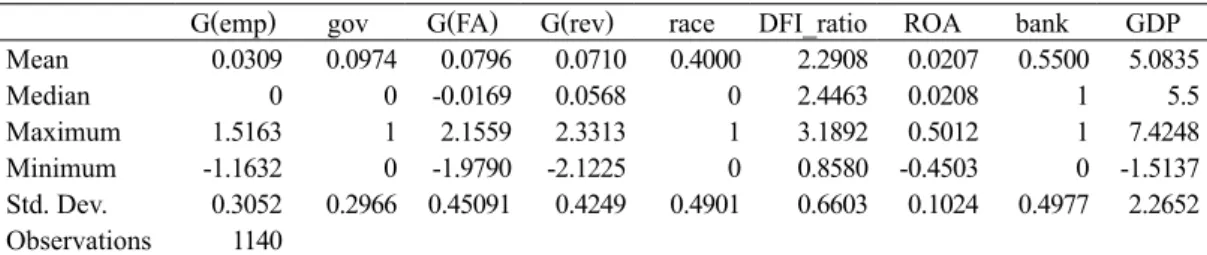
Table 2 provides descriptive statistics for the main variables after removing outlier data identified by the Grubbs Test. Standard deviation of ROA (0.1024) is the smallest, whereas that of GDP (2.2652) was the biggest. The GDP growth rate varies more than other variables9).
8) The north area covers State of Perlis, Kedah, Penang, and Perak. The central area covers State of Selangor, Negri Sem-bilan, Malacca, and Federal districts (Kuala Lumpur, Putrajaya, and Labuan). The south area covers State of Johor. East area covers State of Kelantan, Terengganu, and Pahang. The Borneo area covers State of Sabah and Sarawak. 9) Unless otherwise noticed, EViews 9.5 was utilized for estimation in this research.
Table 2. Descriptive statistics
G(emp) gov G(FA) G(rev) race DFI_ratio ROA bank GDP
Mean 0.0309 0.0974 0.0796 0.0710 0.4000 2.2908 0.0207 0.5500 5.0835 Median 0 0 -0.0169 0.0568 0 2.4463 0.0208 1 5.5 Maximum 1.5163 1 2.1559 2.3313 1 3.1892 0.5012 1 7.4248 Minimum -1.1632 0 -1.9790 -2.1225 0 0.8580 -0.4503 0 -1.5137 Std. Dev. 0.3052 0.2966 0.45091 0.4249 0.4901 0.6603 0.1024 0.4977 2.2652 Observations 1140
Notes: Variables are defined as follows: emp is the number of employees, gov is a dummy variable of direct credit provided for SMEs, race is a dummy variable of Bumiputera, who were appointed as members of boards of directors, FA is the amount of fixed assets, rev is revenue, DFI_ratio is the share of DFIs branches to the total number of bank branches per state, ROA is return of assets, bank is a business relation dummy with commercial/Islamic banks, GDP is the GDP growth rate. G( ) denotes the growth rate of each variable.
This study sets seven instrumental variables against three independent variables. Race is a dummy variable for Bumiputera on boards of directors. Nakagawa [2018] revealed that race and return on assets (ROA) had positive relations with gov, a dummy variable of the SME financing programs, therefore, these variables are plausive IVs. This paper follows Behr, Norden, and Noth [2013] and applies DFI_ratio, indicating the share of branches of DFIs relative to the total number of all bank branches per state. SMEs are likely to have more chances to access financial support from the government if more branches of DFIs are located in the same state. Bank is a dummy variable for a business relation between commercial and/or Islamic banks and SMEs. SMEs with more business relations with commercial and/or Islamic banks are better able to ease financial constraint in their business. As for GDP, it is obvious that sales by companies depend on the economic situation; GDP growth rate has a positive impact on revenue of SMEs. In addition to these variables, this analysis applies lagged variables of fixed assets and revenue because lagged variables are often included in the IV method. Most essential, these IVs must be exogenous to the dependent variable of each enterprise, as has been explained in 4.1. As for the first step of the analysis, this paper conducted a test to identify endogeneity of independent variables in a regression model as explained in 4.1. If independent variables in a multivariate regression model are endogenous, the variables are correlated with u and the result of the analysis has a problem of credibility. Endogeneity occurs in one of three ways: omitted variables, measurement error, and simultaneity (Wooldridge [2010], pp. 54-55). In addition to this, sample selection bias is another cause of endogeneity in a model. This study deals with SME financing programs given by the government, in which they usually set criteria of financial support for SMEs. Recipients of the support are not randomly selected, and this process results in sample selection bias10).
It may be safer to check endogeneity of independent variables to obtain a robust result of the analysis.
The analytical model of this research contains multiple independent variables, so the study needs to start with an estimation of the reduced form for each suspected endogenous variable and acquire the reduced form residuals. The null hypothesis (H0) of the test is that independent variables are not exogenous (H0 :β1+β2+
β3=0). Table 3 shows a result of the endogeneity test, the so-called Wald test, that the null hypothesis is rejected at the 5% statistical level, which means that all independent variables of model (1) are endogenous.
10) Sample selection bias is a bias in the OLS estimator which is induced by using data that arise from endogenous sample selection (Wooldridge [2013], p. 857).
Table 3.Result of the Wald test
Null hypothesis: β1=β2=β3=0
F-statistic 3.6023 Probability 0.0131
Chi-square 10.8069 Probability 0.0128
5. Results of the Empirical Analysis
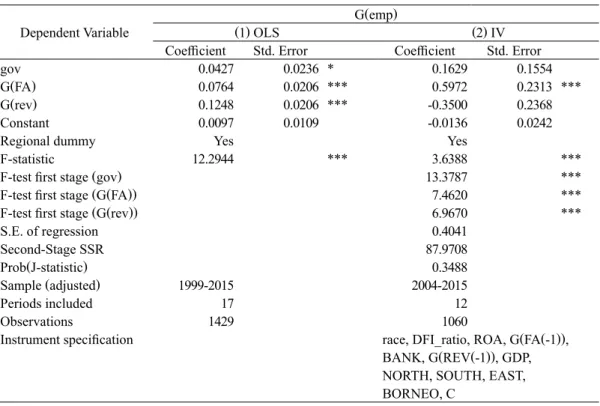
The estimates of model (1) with instrumental variables are shown as Table 4. As Table 4(2) shows, the growth rate of fixed assets had a positive relation with that of employment at a statistically significant level, although a sign of fixed assets was expected to be negative because fixed assets can be a substitute for labor, in general. For one reason, most fixed assets possessed by SMEs in Malaysia are shop-houses and/or plants, not labor-saving equipment, such as robots or automation of factories. The result implies that SMEs increasing investments in fixed assets tried to expand their production facilities in response to sales, and those SMEs are attempting to increase the number of employees. The coefficient of gov, however, appears statistically insignificant, representing that SMEs financing programs of the government had not contributed to the growth rate of employment. As the author explained earlier, the government can justify providing financial support for SMEs from a viewpoint of employment generation by quoting an argument of the Asian Development Bank [2009]. However, in the case of Malaysia, the empirical analysis unfortunately resulted in no positive relation between government s financial support and the employment growth rate at SMEs.
Table 4. Results of analyses1
Dependent Variable (1) OLS G(emp) (2) IV
Coefficient Std. Error Coefficient Std. Error
gov 0.0427 0.0236 * 0.1629 0.1554
G(FA) 0.0764 0.0206 *** 0.5972 0.2313 ***
G(rev) 0.1248 0.0206 *** -0.3500 0.2368
Constant 0.0097 0.0109 -0.0136 0.0242
Regional dummy Yes Yes
F-statistic 12.2944 *** 3.6388 ***
F-test first stage (gov) 13.3787 ***
F-test first stage (G(FA)) 7.4620 ***
F-test first stage (G(rev)) 6.9670 ***
S.E. of regression 0.4041 Second-Stage SSR 87.9708 Prob(J-statistic) 0.3488 Sample (adjusted) 1999-2015 2004-2015 Periods included 17 12 Observations 1429 1060
Instrument specification race, DFI_ratio, ROA, G(FA(-1)),
BANK, G(REV(-1)), GDP, NORTH, SOUTH, EAST, BORNEO, C
Notes: 1. White period standard errors & covariance (d.f. corrected)
2. ***, **, and * denote significance at the 1%, 5%, and 10% level respectively. Source: Author s estimation.
Since the analytical model consists of more IVs than the number of independent variables, seven IVs per three independent variables, overidentification restrictions need to be tested, as has been noted in 4.1.2. The validity of instrumental variables is secured only if those variables are exogenous. Residuals of 2SLS were regressed with exogeneous and instrumental variables, then the p-value was inspected. A null hypothesis (H0)
in this case is that instrumental variables are exogeneous. The overidentification restrictions test follows the procedure explained in 4.1.2 and Wooldridge [2013]. Table 5 shows the Sargan statistic, indicating 4.4812 at p-value of 0.3448. It concludes that H0 is rejected and that it is fair to declare that instrumental variables are
exogeneous. Moreover, the test suggested that there is no overidentification problem.
6. Summary and Policy Implications
The Malaysian government has implemented SME development programs for a long time. Private local companies have been expected to be an engine of economic activities in the country and the government emphasized SME facilitation for their economic development. In the case of Malaysia, it is notable that the government has connected SME development and poverty alleviation of Bumiputra. SME financing programs have been focused on the development of Bumiputera communities. This idea has been a fundamental principle of the SME promotion policy in the country.
Financial support has been one of the most significant measures of SME facilitation. A noteworthy feature of SME financing programs in Malaysia is that monetary assistance has been provided through various financial and government institutions. This study focused on financial support of the government through DFIs as an initial procedure of program evaluation.
The 2SLS method with IVs was applied for the empirical analysis to solve a self-selection problem. The result indicated that the government financial support for SMEs through DFIs did not contribute to job creation. Rather, investments in fixed assets had a positive relation with job creation by SMEs. This implies that SMEs increased employment as well as expenditures for fixed assets when SMEs have been trying to meet greater demands for goods and services in markets.
The SME financing support has likely been focusing on ethnicity, as Nakagawa [2018] revealed that DFIs have been providing financial assistance mostly for SMEs with Bumiputera Board members. This study, as a result of the analysis shown in table 4(2), suggests that it is possible to draw an important policy
Table 5.Results of the Sargan test
Sargan statistic 4.4812
p-value 0.3448
implication for better SME financing programs in the country. The government should review the ethnicity-based financial assistance and the public financial support should be directed to SMEs with prospects for business expansion, which are expected to hire more labor. In order to provide effective financial assistance, the government needs to inspect SMEs and their business circumstances; for example, contents of a project, business status, character of the CEO and board members, financial situation, and other information of SMEs must be examined as much as possible, then SMEs need to be screened very carefully. This can also bring about the additional positive effect of better accountability of the government programs.
Moreover, the analysis implies that the government should reconsider whether financial assistance for SMEs is a good means to achieve two different goals referred in section 3: to balance income level among ethnic groups, in particular Bumiputera, and to achieve economic development. The former goal cannot be realized unless financial assistance of the government contributes to job opportunities for Bumiputera. The latter one may not be attained if the government puts a too much emphasis on ethnicity, because SMEs managed by other ethnic groups with high potential to expand their business may be excluded from government assistance.
As a final remark, further analysis regarding government financial assistance through commercial/Islamic banks is necessary to discuss the effectiveness of the government financing programs. As has been mentioned, the Malaysian government has been providing financing programs for SMEs through various financial institutions, not only DFIs focused in this study but commercial/Islamic banks and so on. In addition, many SMEs receiving financial support of the government have had business relationships with commercial/Islamic banks. Therefore, further analysis may help us understand more detailed effects of SME finance in the country.
References
Asian Development Bank [2009], Enterprises in Asia: Fostering dynamism in SMEs, Key Indicators for Asia and the
Pacific 2009. Manila: Asian Development Bank.
Behr, Patrick, Lars Norden, and Felix Noth [2013], Financial constraints of private firms and bank lending behavior,
Journal of Banking and Finance, 37(9), 3472-3485.
Benavente, José Miguel, Gustavo Crespi, and Alessandro Maffioli [2007], Public support to firm-level innovation: An evaluation of the FONTEC program, Working paper OVE/WP-05/07, Inter-American Development Bank. Retrieved from http://www.economia.gob.cl/cnidweb/wp-content/uploads/sites/35/2015/10/Public-Support-to-Firm-Level-Innovation_2007.pdf, (August 15, 2015).
Castillo, Victoria, Alessandro Maffioli, Ana P. Monsalvo, Sofia Rojo, and Rodolfo Stucchi [2010], Can SME policies improve firm performance? Evidence from an impact evaluation in Argentina, Working Paper OVE/WP-07/10, Inter-American Development Bank. Retrieved from http://www.iadb.org/ove/Documents/uploads/cache/35545433.pdf, (February 25, 2012).
De Negri, Joao Alberto, Alessandro Maffioli, Cesar M. Rodriguez, and Gonzalo Vázquez [2011], The impact of public credit programs on Brazilian firms, Working papers No. IDB-QP-293, December 2011, Inter-American Development Bank. Department of Statistics [2012], Economic Census 2011: Profile of Small and Medium Enterprises. Putrajaya: Department of
Statistics.
Economic Planning Unit [2010], Tenth Malaysia Plan 2011-2015. Putrajaya: Economic Planning Unit, Prime Minister s Department
Hausman, Jerry A. [1978], Specification tests in econometrics, Econometrica, 46(6), 1251-1271.
Ibarrarán, Pablo, Alessandro Maffioli, and Rodolfo Stucchi [2009], SME policy and firms productivity in Latin America, IZA Discussion Paper No. 4486, Retrieved from http://papers.ssrn.com/sol3/papers.cfm?abstract_id=1493862, (August 5, 2015) . Lerner, Josh. [1999], The government as venture capitalist: The long-run impact of the SBIR program, The Journal of
Business, 72(3), 285-318.
McKenzie, David J. [2009], Impact Assessments in Finance and Private Sector Development: What Have We Learned and What Should We Learn? The World Bank Research Observer, 25(2), 209-233.
Matsuura, Katsumi and Colin McKenzie [2001], EView ni yoru keiryo keizai bunseki (in Japanese), Tokyo: Toyo-keizai Shinpo-sha.
Nakagawa, Rika [2011], The Government s Policy on Facilitating Competitive SMEs: A Literature Review, (in Japanese),
The Economic Review of Toyo University, 37(1), 75-86.
--- [2012], The policy approach in promoting small and medium sized enterprises in Japan, International Business and
Economics Research Journal, 11(10), 1087-1098.
--- [2015], The Recent Development of Access to Financing of Small and Medium-sized Enterprises in Malaysia, (in Japanese), The Economic Review of Toyo University, 41(1), 1-15.
--- [2018], An Empirical Study of SMEs Access to Finance in Malaysia: A Case of Development Financial Institutions, (in Japanese), The Economic Review of Toyo University, 43(2), 48-59.
Nemoto, Tadanobu, Hikari Fukanuma, Wako Watanabe [2006], Sogyo-ki ni okeru sefu-kei kinyu kikan no yakuwari, (in Japanese), RIETI Discussion Paper Series 06-J-004. Retrieved from http://www.rieti.go.jp/jp/publications/dp/06j004. pdf, (April 19, 2015).
Roper, Stephen and Nola Hewitt-Dundas [2001], Grant assistance and small firm development in Northern Ireland and the Republic of Ireland, Scottish Journal of Political Economy, 48(1), 99-117.
Storey, David J. [1998], Six steps to heaven: Evaluating the impact of public policies to support small business in developed economies, CSME Working Papers No. 59. Warwick Business School, University of Warwick. Retrieved from http://www2.warwick.ac.uk/fac/soc/wbs/research/ei/research/working_papers/wp59-six_steps.pdf, (July 13, 2015). The World Bank [2012], Impact assessment framework: SME finance. October 2012. Retrieved from http://www.gpfi.org/sites/
default/files/documents/SME%20Finance%20Impact%20Assessment%20Framework%20GPFI.pdf, (July 15, 2015). Uesugi, Iichiro, Hiroshi Uchida, Yuta Mizusugi [2014], Nihon-seisaku kinyu koko tono torihiki kankei ga kigyo
performance ni ataeru kouka no kensho, (in Japanese), RIETI Discussion Paper Series 14-J-045. Research Institute of Economy Trade and Industry. Retrieved from http://www.rieti.go.jp/jp/publications/dp/14j045.pdf, (April 23, 2015). Wallsten, Scott J. [2000], The effects of government-industry R&D programs on private R&D: The case of the small
business innovation research program, The RAND Journal of Economics, 31(1), 82-100.
Wooldridge, Jeffrey M. [2010], Econometric Analysis of Cross Section and Panel Data. 2nd edition. Cambridge: The MIT Press.
--- [2013], Introductory Econometrics: A Modern Approach. 5th edition. Mason: South-Western.
<Web site>
SME Corp. Malaysia https://www.smecorp.gov.my