
資源制約付プロジェクトスケジューリング問題の拡張モデルに対するヒューリスティックな解法
4
0
0
全文
(2) 3. minimize z = max { j. tmax X−1. txjt + pj }. (1). t=0. subject to tmax X−1. txst ≤. tmax X−1. t=0. txjt + pj + wjs ,. t=0. j ∈ J, s ∈ Sj tmax X−1. txst ≥. tmax X−1. (2). txjt + pj + ajs ,. t=0. t=0. j ∈ J, s ∈ Sj n−1 Xj −1) X min(t,p j=0. (3). djru xj(t−u) ≥ lrt ,. u=0. tmax X−1. t ∈ T, s ∈ Sj. (4). j∈J. (5). j ∈ J, t ∈ T. (6). xjt = 1,. t=0. xjt ∈ {0, 1},. Here, meaning of each constants and variable are as follows: • n : Number of activities. • m : Number of kind of renewable resources.. The Algorithm. In this section, we propose an algorithm for the RCPSP/τ +. We consider two phases, initial solution phase and improvement phase. 3.1 Initial Solution To construct the initial solution, we implement the single path method with tabu list. First, we try to dispatch activities using single path method. If a feasible solution is obtained, this phase terminates. Otherwise, we record predecessor of activities which has not been dispatched and its start time to the tabu list. Let J − be the set of activities which was not dispatched. If |J − | ≥ 2, select one activity j ∈ J − which has the highest priority in J − and all its predecessors have been dispatched. Here, we assume that activity j − ∈ J − is selected. Let Pj , Pjw and Pja be the set of all predecessors of activity j, which are imposed whithin constraint and which are imposed after constraint, respectively. Select one activity k ∈ Pj − according to steps below. step 1 If |Pj − | = 0 is satisfied, go to step 3. Otherwise if |Pjw− | ≥ 1, select k which has the smallest value of (7), terminate.. • J : Set of all activities.. tmax X−1. • tmax : The project term length. • T : Set of time periods in term of project. T = {0, . . . tmax − 1} • pj : Processing time of activity j. • Sj : Set of successors of activity j. • wjs : Grace of starting of activity s ∈ Sj after completion of activity j. The activity s ∈ Sj must start from completion of activity j to elapse of wjs time periods. • ajs : Waiting time of starting of activity s ∈ Sj after completion of activity j. The activity s ∈ Sj can start after elapse of ajs time periods from completion of activity j. • djru : Activity j’s request of resource r in uth period of its processing time. • lrt : Limit of renewable resource r at time t. • xjt : If the activity j starts at time t, then 1, otherwise 0.. Inequalities (2) and (3) are within, after constraint, respectively. Inequality (4) is resource constraint, and inequalities (5) and (6) are nonpreemptive constraint.. txkt + pk + wkj − , k ∈ Pj −. (7). t=0. Otherwise, go to step 2. step 2 If |Pjw− | = 0 and |Pja− | ≥ 1 are satisfied, select k ∈ Pja− which has the smallest starting time and the highest priority, terminate. Otherwise, go to step 3. step 3 Search the activity k ∈ S0 \ j − according to priority descending order. If k ∈ S0 \ j − which has been imposed after constraint is found, select it. Otherwise, select one which has the highest priority. Terminate.. After recording attribute to the tabu list, iterate the single path method referring to the tabu list. If the record of activity j and its starting time t is found in tabu list, activity j is not allowed to be dispatched at starting time t. This iteration terminates when a feasible solution is found or the number of iteration exceeds the upper limit given in advance. We call this dispatching rule Single Path Method with Tabu list 1 (SPMT1). We give the priority used in SPMT1. At the first trial in iteration of SPMT1, priority. –2– −18−.
(3) is given exceptionally in the ascending order of value stated as follows, j −1 m−1 ∑ p∑. drju .. Expression (8) represents the sum of the required resources of each activity j. From the second trial onward, we give the priority as descending order of the sum of predecessors and successors which are imposed within constraint. SPMT1 outputs feasible or infeasible solution and dispatching sequence of activities. 3.2 Improvement of Solution Next, we try to improve the schedule obtained from SPMT1. Since a schedule which SPMT1 outputs is made from a dispatching sequence, we change the dispatching sequence and try to build solution. Changing dispatching sequence is implemented according as each neighborhood discussed below. After doing neighborhood operation, we execute dispatching called SPMT2. SPMT2 is the same as SPMT1 except that it is not allowed to change the dispatching sequence in SPMT2. SPMT2 use the dispatching sequence instead of priority of activities. If SPMT2 cannot build a feasible solution using any dispatching sequence, SPMT2 outputs value of expression (9) as objective function value.. tmax (1 −. tmax ∑−1. xjt ). (9). t=0. j=0. 3.3 The Neighborhood In this subsection, we present three neighborhoods for the RCPSP/τ +. These neighborhoods are defined as changing dispatching sequence. Let π(i) be activity whose sequence number is i, and 0 for each k ∈ J, let jk := π(k). First, let us introduce 2swap neighborhood. We show the step of 2swap neighborhood operation below. step 1 Select two activities whose numbers of dis0 patching sequences are i1 and i2 . Let be j1 := 0 π(i1 ) and j2 := π(i2 ). Go to step 2. 0. 2. 3. 4. 5. 6. 7. 1. 2. 6. 4. 5. 3. 7. (8). r=0 t=0. n−1 ∑. 1. 0. step 2 Let π(i1 ) = j2 and π(i2 ) = j1 , terminate.. –3– −19−. Figure 1: 2swap neighborhood. 1. 2. 3. 4. 5. 6. 7. 8. 1. 2. 3. 4. 5. 6. 7. 8. 1. 2. 6. 7. 3. 4. 5. 8. Figure 2: 3select neighborhood An example of neighborhood operation in the case of i1 = 3 and i2 = 6 is shown in Figure 1. Second, let us introduce 3select neighborhood. We show the step of 3select neighborhood operation below. step 1 Select three activities whose number of sequence are i1 , i2 and i3 , where i1 , i2 , i3 ∈ J \ {0, n − 1} Assume that i1 < i2 < i3 . Let i := 0. Go to step 2. 0. step 2 Let π(i) := ji . If i = n − 1, terminate. Otherwise, go to step 3. step 3 If i ∈ {i1 , i2 , i3 }, go to step4. Otherwise, let i := i + 1 and go to step2. step 4 If i = i1 , let i = i2 + 1. Else if i = i3 , let i = i1 + 1. Else if i = i2 , let i = i3 + 1. Go to step 2.. An example of neighborhood operation in the case of i1 = 2, i2 = 5 and i3 = 7 is shown in Figure 2. 3.4 Tabu Search We implemented tabu search algorithm using the above three neighborhoods, i.e. shift/insertion, 2swap and 3select. For each neighborhood, attribute recorded in tabu list is different. Attribute of shift/insertion neighborhood is activity and its new number of dispatching sequence. As attribute of 2swap, we use the two activities which is exchanged number of sequence, and.
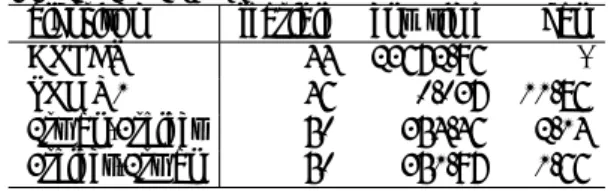
(4) that of 3select is three numbers of dispatching sequence of selected activities. If dispatching sequence which improve objective function value is found in neighborhood, these are updated immediately. The algorithm terminates if number of iteration exceeds the upper limit given in advance.. 4. Numerical Experiment. We generated 50 RCPSP/τ + instances randomly. These instances include dummy activities. All 50 instances have the value of tmax = 400. These are based on bench mark instances which are released from PSPLIB. Using these instances, we compared our algorithms with ILOG CPLEX 8.0. The maximum computational time of ILOG CPLEX is 50000 seconds for each instance. So, solution of ILOG CPLEX is not exactly optimal solution in some instances. All instances have feasible solution. Algorithms examined are SPMT1 and tabu search. All tabu search used dispatching sequence of SPMT1 as initial condition. The neighborhoods implemented to tabu search are 3select after 2swap (2swap-3select TS), and 2swap after 3select (3select-2swap TS). For each algorithms, we use parameters presented as follows. Number of iterations of SPMT1 and SPMT2 is 500. Length of tabu list used in ins. TS and 2swap TS is 50, used in 3select TS is 10. Maximum iteration number of tabu search using one neighborhood is 100 and using two neighborhoods is 50 for each neighborhoods. For example, in the case of ins.-2swap TS, 2swap TS is iterated 50 times after iterating ins. TS 50 times. ILOG CPLEX was executed on a Red Hat Linux, Pentium III 1GHz CPU, 1GB memory. Our algorithms are implemented on Windows XP SP1, Pentium 4 2.6GHz CPU, 1GB memory with C language. In table 1, the column “feasible” represents a number of feasible solution which each algorithms produced. The column “cpu time” represents average cpu time[sec]. The column “gap” represents the average of relative gap[%] of objective function value. In addition, ILOG CPLEX failed to give optimal solution about some instances.. Table 1: Result of each algorithm and comparison with ILOG CPLEX algorithm feasible cpu time gap CPLEX 44 23672.96 SPMT1 46 0.037 11.86 2swap-3select 50 354.46 2.14 3select-2swap 50 351.97 1.66 ILOG CPLEX gave the feasible solution to 44 instances of 50. CPU time of SPMT1 is very fast. But gap is not good. 3select-2swap TS outputs a good result.. 5. Conclusions. In this paper, we presented ERCPSP/τ + which is an extended model of RCPSP and formulated this problem as a 0-1 integer programming problem. We then proposed a tabu search algorithm and presented result from computational experiments. The parameter setting and implementation of the algorithm superseding the SPMT2 are left for further research.. References 1) Jos´e A. and Daecheol Kim, Parallel machine scheduling with earliness-tardiness penalties and additional resource constraints. Computers & Operations Research 30, pp. 1945-1958, 2003. 2) Nonobe K. and Ibaraki, T., Formulation and tabu search algorithm for the resource constrained project scheduling problem. Essays and Surveys in Metaheuristics (MIC’99), pp. 557-588, 2002. 3) S. Harthman, Project Scheduling under Limited Resources Models, Methods, and Applications. Springer-Verlag Berlin, Heidelberg, 1999. 4) Vicente Valls, Sacramento Quintanilla and Francisco Ballest´ın, Resource-constrained project scheduling: A critical activity reordering heuristic. European Journal of Operational Research 149, pp. 282-301, 2003.. – 4 -」 −20−.
(5)
図
関連したドキュメント
Under the assumption that we can reach from any feasible state any feasible sequence of states in bounded time, we show that every e ffi cient solution is also overtaking, thus
This theorem tells us that a Jacobi function may be called a theta zero-value on the analogy of the terminology used for elliptic theta functions... As
If the S n -equivariant count of points of this space, when considered as a function of the number of elements of the finite field, gives a polynomial, then using the purity we
In this paper, we study the generalized Keldys- Fichera boundary value problem which is a kind of new boundary conditions for a class of higher-order equations with
(Robertson and others have given examples fulfilling (a), and examples fulfilllng (b), but these examples were not solid, normed sequence spaces.) However, it is shown that
Using the results proved in Sections 2 and 3, we will obtain in Sections 4 and 5 the expression of Green’s function and a sufficient condition for the existence and uniqueness
“Breuil-M´ezard conjecture and modularity lifting for potentially semistable deformations after
His idea was to use the existence results for differential inclusions with compact convex values which is the case of the problem (P 2 ) to prove an existence result of the
