
Data on the Civil‑Religious Organization of the Highland Mixe Society of Oaxaca, Mexico
著者(英) Etsuko Kuroda
journal or
publication title
Senri Ethnological Studies
volume 2
page range 197‑246
year 1979‑02‑10
URL http://doi.org/10.15021/00003476
Data Mixe
on the Civil‑Religious Organization of the Highland Society of Oaxaca, Mexico
ETsuKo KuRODA
IVtitional Mltseum of Ethnology
"
The purpose of the present paper is simply to present data and commentaries on the civil‑religious organization of the highland Mixe society of Oaxaca, Mexico. The first part of this paper presents a traditional organization in which the civil and religious organizations are functioning in unison based on a civil‑religious hierarchy sustained by the "egalitarian" economy of the fiesta.
In this organization the rituals fbr the oMce‑holders enrich the annual ritual cycle of the community. The second part of the paper presents a changing organization in which the civil organization of the municipio is separated from the religious organization of the church and the two tend to be in conflict.
Here the remnants of the economy of prestige persist but it no longer influences the civil and religious organizations. In this situation the rituals of the oMce‑holders tend to decline and to become politically tinged. In the transition from traditional organization to changing organization, we find complexities of changes in the civil‑religious organization of the highland Mixe society of today.
t
INTRODUCTION
The civil‑religious organization, characteristic of the Mesoamerican Indian community social structure, has been well classified and discussed on its organization‑
al aspects by Camara [CAMARA 1952] and Cancian [CANciAN 1965, 1967] and on its historical dimensions by Carrasco [CARRAsco 1961]. However, the data on the Mixe society cited in these discussions [CAMARA 1952: 144; CANciAN 1967: 297‑298]
are limited to Ayutla as of 1933 as reported by Ralph Beals [BEALs 1945]. The purpose of the present paper is to present data and commentaries on the civil‑religious organization found in the highland Mixe society of today. A part of the economy of the fiesta system as it is interwoven with the civil‑religious hierarchy is treated in this paper, but the discussion of the fiesta system as a whole will be left for another paper.
In the first part of this paper the civil‑religious organization in Tlahuitoltepec of 1973 and 1974 (hereafter abbreviated as Tlahui) is presented. The second part attempts to fo11ow the process of change which has occurred in the civil‑religious organization of Ayutla during the forty years from 1933 to around 1973‑74. Tlahui represents the majority type of the economically and politically peripheral communiti‑
198 E. KuRoDA es of the highland Mixe [KuRoDA l976b] and Ayutla that of the acculturated major Mixe market center. In Tlahui the civil and religious organizations are functioning in unison based on a civil‑religious hierarchy sustained by the "egalitarian" economy of the fiesta, and the rituals for the oMce‑holders enrich the annual ritual cycle of the community. In Ayutla as of 1973‑74 the civil organization of the municipio is sepa‑
rated from the religious organization of the church and the two tend to be in conflict.
Here persist the remnants of the economy of prestige sustained by the "capitalistic"
orientation of the people, though it is greatly modified by the model of the
"egalitarian" economy of the Tlahui type. The economy of prestige no longer infiuences the civil and religious organizations. In this situation the rituals of the oMce‑holders tend to decline and to become politically tinged. I am tempted to suppose a traditional‑acculturated continuum in the transition from Tlahui to Ayutla [KuRoDA 1975]. The general data on the two communities permit this supposition.
However, this does not mean that Tlahui will become like Ayutla. What can be said is limited to the fact that in the future Tlahui will follow a similar course of change with that of Ayutla.
The paper is organized as fo11ows:
Tlahuitoltepec: a Traditjonal Organization
1. The Civil‑Religious Hierarchy and Types of Offices 1) TheTraditionalOflices
(1) Offices in the Hierarchy ‑L
A. MunicipalOffices B. Offices ofthe Church C. Civil‑ReligiousOffices
(2) Specialists Outside the Hierarchy A. Specialists on the Civil Side
B. Specialists on the Religious Side ‑
2) The New Offices
(1) The New OMces on the Civil Side (2) The New Offices on the Religious Side 2. RecruitmentofOfficials
1) Recrujtment of the Tradjtional OMcjals 2) Recruitment of Specialists
3) RecruitmentofNewOMcials
3. The Economic Burden of the Officials and the Egalitarian Economy of the Fiesta
4. NewTendencies 5. RitualsoftheOfficials
1) Dates for the Changes of the Officials 2) Rituals for the Changes of the Officials
(1) November 1: The First Presentation of the OMcials (2) December 25: The Second Presentation of the OMcials
(3) New Year's Day: The Fiesta of the Officials
(4) January 15: The Fiesta of the Officials of the Church
3) 7‑lequio as Ritual Representation of Community Solidarity and the Power of the OMcials
Ayutla: a Changing Organization
1. The Civil‑Religious Hierarchy and the Mayorclomias in 1933 1) The Civil‑Religious Hierarchy in 1933
2) The Mayorclomias in 1933
2. The Civil‑Religious Hierarchy around 1960
3. Changes in the Civil‑Religious Organization and the Mayordomias after 1962 4. The Civil and Religious Organizations, the Remnants of the MayordomZas and the Rituals of the OMcials in 1973 and 1974
1) Breakdown of the Civil‑Religious Hierarchy 2) Secularization ofthe Mayordomias
3> Politicization of the Rituals of the Officials
(1) Dates for the Rituals .
(2) Rituals of the OMcials A. TheElection
B. The Change of the Officials on December 31
C. The Fiesta of the Officials '
D. The Decline of the 71equio Concluding Remarks
The ethnographic present of this study is 1973 and 1974. I visited Ayutla for the first time on December 12, 1972, and began to live there on January 15, 1973.
I continued the field work from that date to January 15, 1975. My first visit to Tlahui was made in early February 1973 and after November of that same year my main interests were directed towards Tlahui. I travelled back and forth between the two villages to observe and participate in the rituals fbr the office‑holders in Ayutla and Tlahui. December 1973 was an especially busy month. A short trip of nine days was made in October 1976 on my way back from the field work on the Albuquerque Chicanos. The data collected on this occasion are used as the basis fbr some comments in the concluding remarks.
The technique of my field work is participant‑observation. Since my knowledge of the Mixe language had not reached even the elementary level, data gathering was done through Spanish. To cover the drawback resulting from the language barrier, I always tried to get and confirm the data by participant‑observation. I did not depend upon any specific interpreter. Thanks to my "fblk‑level" lifie among the people, I could get help from the bilingual Mixe. Details on the field work will be provided in a monograph now being prepared.
It would be impossible fbr me to enumerate here all the people to whom my acknowledgements should go, but I am especially indebted to Professor Chie Nakane
200 E. KuRoDA and Professor S. Masuda of the University of Tokyo, Dr. F. Camara, then the sub‑
director of the instituto IVacional cle Antropologia e Historia in Mexico, Dr. M.
Nolasco, then the head of the Departamento de Antropologia Social of the same institute, Father L. Ballesteros and Sister M. Garzafox in Tlahui, Father Andres Cervantes and the family of Sra. Petronila Ramirez Olivera in Ayutla, and to Dr. Sam Stanley at the Small Fund Program of Urgent Anthropology at the Smithsonian . Institute which partially sponsored my study in 1974.
For the arrangement and presentation of the data in this paper, I am deeply indebted to the articles of Professors F. Cancian, F. Camara and P. Carrasco. I also would like to thank the members of the New World Studies group at the National Museum of Ethnology fbr the comments they gave me. I also would like to express my gratitude to Professor T. Sofue of the National Museum of Ethnology who kindly read and commented on my paper.
TLAHUITOLTEPEC: A TRADITIONAL ORGANIZATION
1. The Civil‑Religious Hierarchy and Types of OMees
In Mesoamerican ethnography the oMce in the civil‑religious hierarchy is usually called cargo, but in Tlahui as well as in the other Mixe communities the term autoridod js commonly used to denote an oMce as well as an oMce‑holder. I will present the various offices in Tlahui first.
1) THE TRADITIONAL OFFICES (1) Offices in the Hierarchy
When the people say "autoridacles," they usually refer to the traditional oMces.
They have been and still are the core of the civil‑religious hierarchy of the community.
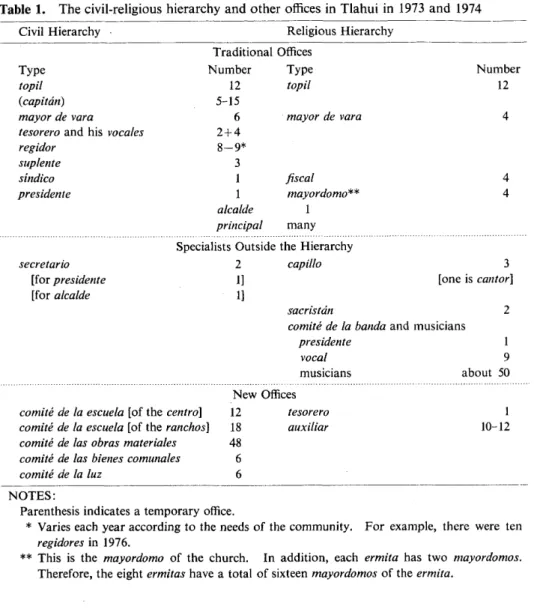
A listing is given in Table 1.
As is shown in Table 1, the traditional oMces are divided into two categories:
first, the offices in the hierarchy, which are further subdivided into municipal oMces and offices of the church, and second, the specialists outside the hierarchy. Each oMcial has his work and obligatory services for the benefit of the community.
A. Municipal OMces
7bpil
Young men start their first service as topiles. They are the assistants to the mayor cle vara. The service is performed in two groups which alternate weeklong duty. There are a variety of services assigned to them:
1. They bring letters from the post oflice in Ayutla;i)
2. They cut and bring firewood to the houses of the presidente and the secre‑
tarlos ;
1) In January 1975 a branch post oMce was opened in Tlahui. Up to that time only Ayutla had had a post oMce, from which letters were distributed to the other Mixe MUMCrpIOS.
Table 1. The civil‑religious hierarchy and other oMces in Tlahui in 1973 and 1974
Civil Hierarchy ・ Religious Hierarchy
Type
topil (capitdn) mayor de vara tesorero and his vocales regridor
suplente sindico presidente
secretarlo [for presidente Efor alcalde
Traditional OMces
Number 12 5‑15
6 2+4 8‑9*
3
1 1 alcalde principal
Type
topil
'mayor cle vara
fiscal
mayordomo**
1 many
Specialists Outside the Hierarchy
comite de la escuela [of the centro]
comite de la escueta [of the ranchos]
comite de las obras materiates comite de las bienes comunates comite de la luz
2
1]
1]
capilto
sicicristdn
Number 12
4
4 4
3
[one is cantor]
2
comite de la bancla and musicians
presidente 1
vocal 9
musicians about 50
New OMces
12 tesorero 118 auxitiar 10‑12
48 6 6
NOTES:
Parenthesis indicates a temporary oMce.
* Varies each year according to the needs of the community. For example, there were ten regidores in 1976.
** This is the mayordomo of the church. In addition, each ermita has two mayordomos.
Therefore, the eight ermitas have a total of sixteen mayordomos of the ermita.
3. They repair footpaths and bridges damaged by heavy rain;
4. They carry baggage and personal belongings of teachers, musicians and oMcial visitors from the federal and state governments;
5. At the major fiestas they bring branches of trees and flowers to adorn the plaza. For the fiesta of Guadalupe, especially, they cut trees at the rancho near the footpath leading from the centro to Rancho Flores, and bring them to the plaza to build a corral for the bullfight. They also let off the sky‑rockets at the fiestas and
important communlty meetmgs; ..
6. They announce the community meetings to each famiiy;
7. They announce the tequio so that every family can send one adult for com‑
munal work. In 1974 Tlahui needed teguio for construction of a road and for repair
202 E. KuRoDA of the roof of the church. After the Sunday mass all the participants in the mass were obliged to carry sand and gravel. The topiles, holding their batons ofcommand in their hands, stand at the main and side doors of the church so that they can prevent the communicants from escaping from the tequio ; and
8. They also work as policemen. Under the direction of the mayor de vara, topiles put into jail those who are adjudged to be in error by thepresidente. At the major fiestas, topiles are on duty watching the drunkards. Sometimes the higher officials, whom the topiles have to obey, get drunk and the topiles must rush to the parish house for consultation regarding the treatment of the culprit. At the fiesta of Guadalupe the bullfight attracts so iarge an audience that the topiles cannot control it. Some young men, therefore, are chosen to temporarily help the topiles. They patrol the plaza with batons much shorter than those of the regular topiles.
Sometimes topiles are sent to other municipios to prevent the people of Tlahui from getting into trouble. On June 2, 1974, many people ofTlahui visited Tamazulapam for the fiesta of the Espiritu Santo. The presidente advised the people not to drink much in Tamazulapam and sent topiles to this neighboring village so that ‑they could prevent people of Tlahui from being jailed by the topiles of Tamazulapam.
Copitan
This is an appointive temporary office for sponsoring the fiestas of the major saints. Five to fifteen capitanes are appointed by the' alcaltle, the presiclente, the sindico and their suplentes for the fiestas of the major saints of Ascensi6n, Asunci6n and Guadalupe. They are obliged to make expenditure, and serve food to the visiting musicians, The number of capitanes appointed is determined by the number of bands invjted. The expenditure for each capitan ranges from 1,OOO to 1,500 pesos.
This office is sometimes called caporal.
Mayor de vara
Under the direction of the sindico the mayores cle vara are in charge of the municipal jail. They command the topiles in fulfi11ing their duties.
71esorero and his Vbcales
They keep account of the monetary income and expenditure of the municipio.
Each week a tesorero and two vocales are engaged in the collection of the market tax : 2 to 5pesos from each stall (puesto) and a smaller amount from each vendor, accord‑
ing to the amount of his sales. For example, 1 peso from a woman who sells a guojolote (Mexican turkey) for 100 pesos and 1 peso from a vendor of wild plants.
They are also obliged to collect the municipal tax. Usually they find the taxpayers at the market of Tlahui, but sometimes they have to visit the market of Ayutla to collect tax from those people of TIahui who, because of their residence being near Ayutla, are regular commuters to the market ofAyutla rather than to that of Tlahui.' Regidor
They have civil and religious duties. As civil duties they have to inspect the
communal construction and organize the teguio under the direction of the sindico.
As a religious duty they assist the alcalde in the management of the religious ‑rituals.
In theory they belong to the alcaltle, but recently their civil duties have been increasing.
Suplente
There are three smplentes: one for the sindico, one for the presidente and one for the alcalde. Each one assists his superior.
Sinttico
Under the direction of the presiclente, he is responsible for the administrative work in cooperation with the regidores, tesoreros, mayores and topiles.
Presiclente
He is responsible for the administratiori of the community and represents the community to the outside worl,d.
B. Oflices of the Church 7bpil
They work fOr the church and the priest. Four of the twelve topiles belong to the.fiscales, the remaining eight to the mayores de vara. They are divided into two groups which alternate weeklong duty, and have a variety of duties assigned to them:
1. Daily ringing of the church bell;
2. Bringing firewood to the parish house and chopping it near the kitchen;
3. Buying things necessary for the church at Ayutla, Tamazulapam or Oaxaca;
4. Helping the priest to carry things brought from Oaxaca by his truck;
5. Taking care of the mules, chickens, rabbits and cows belonging to the church, and giving them food and cleaning the stable and barn.
6. Carrying the priest's baggage and belongings on his visits to the villages in the parish when they do not send their own topiles to Tlahui to attend the priest
during his journeys; .
7. Cleaning the cemetery, especially before All Saints' Day;
8. Removing dogs from the church during the mass.
9. Decorating the church, the parish house and the house of the religious sisters for the fiesta; and
10. Bringing firewood to the houses of the .mayordomos and fiscales, who are too occupied with their own duties to provide their kitchens with firewood.
Mayor de vara
Under the direction of the fiscales and mayordomos they order the topites in their duties. Each of the four mayores is assisted by two topiles. Two mayores are on duty each wee'k and they have to provide food for the topiles subordinate to them.
rvscal
They have fairly specialized duties:
1. Every year at harvest time they collect the tithe (diezmo), one almud of corn
204 E. KuRoDA from each family and half an almud from single women. Each of the four .f7scales is assigned ranchos from which he collects the tithe. During the period from November to January they bring sacks of corn to the parish house, under the
direction of the presiclente, alcalde and sindico ;
2, Each Saturday, the market day of Tlahui, they walk around the plaza to find a girl who can grind the corn in the kitchen of the parish house. The young girl thus appointed works as molinera for one week. This molinera service was also required for the federal school teachers, who were usually from other regions. How‑
ever, since about fifteen years ago, as Tlahui began to acquire Mixe teachers who lived with families or who could eat with a Mixe family, the service of molineras for teachers has been eliminated'
'
3. At Christmas they have to find pacfrinos for the posadu ritual;
4. For funerals, one of the fiscales, bearing a eantor, goes to the house of the deceased, and leads the coffin to the church, After the deceased receives benediction at the church, thefiscal, holding his baton ofcorona in his hand, walks with the cantor at the head of the funeral procession and attends the burjal at the cemetery ; and 5. 0n all Saints' Day the fiscales have the privilege of receiving offerings from
the family altar of each house.
Mayordomo (of the church)
They are responsible for the management of the church. Each week one mayordomo lives in the house of the mayordomos which stands in front of the church.
He takes care of the church, sweeping the floor and putting flowers at the altar.
They manage the fund of the mayordomos in cooperation with the priest and the tesorero of the church. Their major economic source is the sale of candles which they produce using a bamboo circle called torno at the house of the mayordomos.
The candles are sold, but many of the people of Tlahui like to rent them. A medium‑
sized candle rents for 25 centa vos. One who rents candles is called a cofacle. Usual‑
ly, a cqfrade rents three candles, two for his own prayer and one for a relative, friend, or neighbor who cannot come to church. He pays 75 centavos, takes the candles to the church, lights them for prayer, and goes back to the house of the mayordomos to return them.
Candles are the symbol of the authority of the mayordomos. When someone dies, a mayordomo visits the house the day before the funeral, bringing two candles as an jnvjtation to the benedictjon at the church.
Mayordomo (of the ermita)
The mayordomos of the eight ermitas belong to the mayordomos of the church.
Each ermita has two mayordomos. They manage the fund fbr the saint enshrined at the ermita and celebrate the fiesta on the day of the saint. The mayordomos of Ermitas Flores and Santa Cruz receive a monthly visit by the priest of Tlahui.
The priest chose these two ermitas for his visits because of the concentration of inhabitants in these ranchos, an important factor in attracting the people to the mass at the ermita.
The authority of the mayordomos of the ermitas rests on that of the alcalde and the mayordomos of the church. This is well exemplified by an incident at the time of the construction of Ermita Flores. When the people of Rancho Flores constructed an ermita without the permission of neither the alcalcle nor of the mayordomos of the church, the three men responsible fOr the construction were put into jail by order of the alcalde and the mayordomos.
C, Civil‑ReligiousOffices
The offices of alcalde and principal integrate the civil and religious hierarchies.
Alcalde
The alcalcle with his suplente, secretario and regidores composes an informal group in the civil‑religious hierarchy. He is responsible for justice in cases where the presiclente cannot give sanction. He is also responsible for communal rituals.
In the rituals of Lent and Holy Week and at the fiestas of the major saints, the alcalcle actively organizes and promotes the rituals as leader of the religious hierarchy.
The alcalde has authority to talk against the priest. For example, in about 1960 the alcalde did not want to accept a priest sent by the Salesian bishop and asked the bishop to replace him with another.
Principal
These are respected elders who have completed their service to the community, climbing the civil‑religious hierarchy from the lowest oMce of topil to the highest of alcalde. They are not organized as a formal group as reported from some Meso‑
american communities {CANciAN 1967: 287], but they influence the decision‑making of the community, implicitly consulting the oMcials and leading public opinion at communal meetings. They are exempt from teeuio by virtue of their long service to the community.
(2) Specialists Outside the Hierarchy
In addition to the traditional oMces, which compose the core of the civil‑religious hierarchy, there are specialists, who, as "intellectuals," associate with the traditional oMcials in the management of civil and religious administration and rituals.
A. Specialists on the Civil Side Secretario
There are two secretarios, one for the presiclente and another for the alcalde.
They are responsible for correspondence, birth certificates, marriage certificates, death certificates, and the like. They get paid by those who ask them for these services at the municipio. They are fluent in Spanish and erlj'oy a level of prestige among the illiterate inhabitants.
B. Specialists on the Religious Side Capillo
Every year three capillos are appointed, and by turns one of them plays the role
206 E. KuRoDA of cantor who is obliged to pray during liturgical rituals and at funeral processions and burials. On All Saints' Day, the capillos and cantor have the privilege of getting offeriRgs from the family altars of the community, as a reward for their service of praying responsos and salves.
Sacristan
This is a permanent office. In the past there were eleven sacristanes and five or six of them alternated weeklong duties. At present two men serve as sacristan.
They know the details of the fiestas and rituals celebrated in the past, and sometimes inform the priest of past customs. They take care of the ornaments and instruments of the church, and with the acolytes assist the priest in the mass.
Comite de la Bando (Committee for the Musical Band)
The band is an element indispensable to the civil and reljgjous rituals of the community. It is under the direction of the Comite de la Bando which js composed of a presidente, three capillos and nine vocales. The presictente and the capillos invite the musicians to their houses for rehearsal. Each week three vocales pass nights at the Salesian kindergarten to guard and take care of the musical instruments kept there. They help the musicinas to carry the instruments and music stands.
They summon the musicians from the ranchos to the centro when they are needed.
There are about fifty musicinas in all, composed of youths and adults. They com‑
pose a great block of solidarity in a small community like Tlahui. They rehearse at the houses of the capillos and thepresidente, play at the fiestas and for the communal rituals, and visit other villages to participate in their fiestas.
The Comite cle la Bando and the musicians serve the community as a whole, but originally the musicians belonged to the church and they were headed by the capillos, the specialists of church music.
2) THENEwOFFICES
New oflices were created to meet the situation of the 1970's [KuRoDA 1976c].
(1) The New Offices on the Civil Side
Comite de la Elscuela (Committee for the School)
The federal school gets local cooperation through this committee, which is composed of a presiclente, a suplente, two mayores and eight topiles. In addition to these offices at the commity level, each rancho has a committee composed of a presidente, tesorero, secretario and fifteen vocales.
Comite de las Obras Materiales (Committee for Construction)
There has recently been a need for a large amount of public construction, such as opening the road leading to the centro from the main road, the construction of a water tank, the new municipio, the Conasupo (CompafiZa Aibcional cle Subsistencias Populares, National Company of Popular Subsistence), and the CAPFCE (Comite
Aciministrativo para el Plan Ilecleral cle Construceio'n cie Iiscuelas, Administrative Com‑
mittee for the Federal Plan for Construction of Schools) school. In this situation,
where the traditional officials could not satisfy the needs of the community, this new committee was organized. It is composed ofapresidente, two suplentes, and forty‑
five vocales‑out of which twenty belong to the centro and twenty‑five to the ranchos.
Comite de Bienes Comunales (Committee for Communal Property)
The DAAC (Departamento de Asuntos Agrarios y Colonizacio'n, Department of Agrarian Affairs and Colonization) requested the municipio to organize a local committee that could cooperate with the DAAC to increase the efficiency of its activities in the Mixe region. This committee was organized to meet this request.
It is composed of a'Presiclente, suplente, tesorero, secretario and two vocales.
COmite de la Luz (Committee for Electricity)
The road was opened in 1974, though it was not yet officially inaugurated, and the introduction of electricy is only a question of time. Under these circumstances, the municipio organized a committee composed of a presidente, suplente, tesorero, secretario and two vocales.
(2) The New Offices on the Religious Side 71esorero
The office of tesorero was added less than ten years ago. This official serves for three years, and manages the fund of the mayordomos, loaning money at five percent interest to increase the fund.
' Auxiliar
They assist the priest in the mass, serving him as interpreter and prayer reciter (rezadbr). In Tlahui there are ten to twelve in all. In February, the Salesians give them special instructions as well'as instructing the other auxiliares belonging to the parish of Tlahui. They are the intermediaries between the missionaries and the monolingual Mixe,
2. RecruitmentofOMcials
The general principle for the recruitment of officials is not one of competition but rather one of distribution of the communal obligation among the limited human resources. Only in the recruitment for the traditional oflicials in the civil‑religious hierarchy do principles of implicit competition and achievement exist. Specialists outside the hierarchy are chosen on the basis of'Personal inclination to do the work.
The new officials are selected from those who have considerable experience in the civil and religious offices or from those wh6 are going to enter the higher offices in the hierarchy.
1) RECRUITMENTOFTHETRADITIONALOFFICIALS
In theory, every male adult member of the municipio of Tlahui is expected to climb the "ladder" of oMces from the lowest topil to the alcalde, pinnacle of the hierarchy (Table 1). In practice, however, steps can sometimes be skipped, and progress from a lower to higher office is not rigidly set. There fOllows an enumera‑
208 E. KuRoDA tion of some prominent features of the methods of climbing the ladder in Tlahui : 1. A young man begins his service in the office of topil, either of the municipio
or of the church:
2. 0ne is not required to progress through the hierarchy alternating between civil and religious offices. Some men rose to presidente without any experience in a religious oMce.
3. To secure the oMce ofmayor de vara in the civil hierarchy, one js expected to complete the office of capitan at some fiesta of a major saint. This is a preference, not a norm. But the capitan is the office which any male adult is required to complete to be eligible for higher offices, This is the one and only rigid regulation in the civil‑regilious hierarchy. After completing capitan, one is allowed to skip several offices, depending on ability and community need. As far as actual data are concerned, one can skip up to suplente or sindico.
4. The highest religious oMce of mayordomo is considered to be of a sacred character and, therefore, in the consciousness of the people, this oMce has prestige equal to that ofpresidente, though the latter eojoys more social and economic prestige.
In some cases a man became mayordomo after completing the office ofpresiclente.
This process functions without breakdown as far as the present Tlahui is concern‑
ed. There are no demographic problems as in Yacochi or Huitepec where the same person has to be presidente two or three times because of the small number of inhabitants. Besides, there is no problem of monopolization of a higher oflice as in Cacalotepec, a village in the midlands, where the same man, called "eaeique" by the villagers, controls the village and occupies the oMce ofpresidente for two years.
Special mention should be made of the relationship between the selection of officials and the geographic divisions of the community. Geographic divisions are not a determining factor in the selection of officials. Higher officials such as alcalde, presidente and sinctico are chosen regardless of where they live, whether in the centro or in a rancho. During the past seven years two presidentes were from the centro and five from the ranchos. The other civil and religious oMcials are distributed rather evenly between the centro and the ranchos, and, as a result, the municipal administration functions smoothly without causing a need to create officials in ranchos, such as was done in Ayutla,
Each year, in August or September, a communal meeting is held at the grounds ofthe municipio. The date for this meeting varies from year to year, and it is extreme‑
ly difficult to know the date in advance. Three pairs ofpresiclente and sindieo for the coming three years are selected at this meeting. The selection of three pairs is under‑
standable, considering the possibility of death of a presidente or sZndico as happened in 1973, when the presiclente died after fa11ing from an aguacate (avocado) tree. The candidate for presiclente for 1974 immediately filled his position. Any head of a family can recommend a candidate. The village, that is to say, all the adult partici‑
pants in the meeting, chooses the three pairs. The voice of the people thus makes the selection in accordance with the popular vote. The actual method is by a show of hands. This is the traditional norm. In reality, thepresidente, the sindico and their
suplentes tend to recommend those who enter. Their influence is so conspicuous that someprincipales, who know the traditional norm is not in accordance with the present form of election, commented: "Before, the election of the high officials rested on the free voice of the people. Now, in the name of administrative eMciency,.everything is decided by the oMcials. This is lamentable."
After this meeting, and until November 1, thepresidente and sindico who are going to enter next year look for their suplentes. The presiclente, along with the s2ndico, looks for alcalde. The alcalde looks for the smplente and regidores who will belong to him. Following the traditional Mixe way of fbrmal visiting, one has to bring a bottle of mezcal and three boxes of cigarettes to the house of the candidate for oMce. However, for proposals for oMces in the lower category they bring only a quarter liter of mezcal to formalize the visit.
Selection of the oMcials of the church does not need the voice of the people;
the alcalde together with the presidente looks for them.
̀2) RECRUITMENT OF SPECIALISTS
Specialists are recruited on the basis of personal talent and their inclination to do the work.
The secretarios of the municipio tend to be chosen from among young men fiuent in Spanish, such as federal school teachers and promotores of the INI (instituto IVacional Ihdigenista) and IIISEO (Ihstituto cle Ihvestigacio'n e Ihtegracio'n Social clel Elstado cle Oaxaca).2) In the past the presiclente himself looked for his secretario and the alcalde looked for his ovvn also. Today, however, two secretarios are voted in by a show of hands at the communal meeting. In reality, appropriate candidates are recommended by thepresidente and the alcaldb, and approved at the meeting.
The capillos are recommended by the alcalde, the presidente and the priest. The people just give their consent to their choices. There are not many who are well acquainted with the work of the capillo.
The sacristan is a permanent office. Some children begin their career as acolyte from a very young age, continue to be interested in the liturgical rituals and then tend to work as sacristan until they become old. At present there are two sacris‑
tanes;. The older one began to dedicate himselfto this office when he was fifteen years old. He was also successfu1 enough to achieve the office ofpresitlente about ten years ago. In some communities of Mesoamerica the oMce of sacristan is open to persons who are not inclined to climb the civil‑religious hierarchy [CANciAN 1967:
287]. But this is not so in Tlahui. Another sacristan is a middle‑aged man greatly devoted to the duty. His son serves as acolyte. As a reward for their services they enjoy the moral support of the missionaries.
3) RECRUITMENT OF NEW OFFICIALS
This recruitment shows that the wave of nationalization is coming even to the 2) The IIISEO was consolidated with the INI in 1974 and its promotores were registered as belonging to the INI around September of the same year.
210 E. KuRoDA Mixe region. The Comite de las Obras Materiales, the Comite de Bienes Comunales and the Comite cie la Luz share simiiar features in recruiting their officials. The presidentes for these new committees are chosen from among men who can com‑
municate in Spanish with the "agats" (a Mixe term which means non‑Mixe) about administrative matters. In due course, those who have completed the office of presiciente or alcalde, or those who will hold these oMces in the near future, can be
suitable candidates for the presiclentes of these committees. The names of the candidates are suggested by the municipal presiclente and then consented to by the people. The other ofiicials in these committees are nominated by the alcalde, pre‑
sidente, sindico and their suplentes, and the presiclentes of the committees. All are annual offices except that of thepresidente of the Comite cle Bienes Comunales. The presidente of this committee is also the presidente of the Comite cle Bienes Comunales
cle los Cinco Pueblos (Committee for Communal Property of the Five Pueblos) of Tlahui, Ayutla, Tamazulapam, Tepantlali and Tepuxtepec [KuRoDA 1976a]. He will also hold this position in 1975. At the same time, he will be municipalpresidente in Tlahui for 1975.
The selection of the Comite de la Elscuela does not need the vote of the village.
Committee members are nominated by the presidente, the sindico and their suplentes.
Among the new officials, the tesorero of the church is somewhat special. This oMce requires an honest and considerate personality who can cooperate with the mayordomos and the priest. In theory, anyone who knows how to count can be the tesorero but in reality, the tesorero tends to be chosen from among the princi‑
pales by a show of hands at the communal meeting, held on January 15, in front of the church.
Auxiliares are chosen by the priest from among young biiingual Mixe interested in religious practices. Thejr institutional position is sti}1 obscure. The missionaries are planning to give them an official position and better training.
Owing to the increase in the number of new officials, Tlahui will not suffer a shortage of oMces, either civil or religious, as reported by Cancian from Zinacantan [CANciAN 1965]. But Tlahui may suflk)r an abundance of offices to be fi11ed from a limited pool of human resources.
3. The Economic Burden of the OMcials and the Egalitarian Economy of the Fiesta The civil‑religious hierarchy is interwoven with the fiesta system, so the economy of the fiesta is outlined before the economic burdens of the officials are discussed.
Compared with the competitive and stratified fiesta system, as reported by Cancian from Zinacantan [CANciAN 1965], Tlahui is characterized by the "egalitarian" econo‑
my of the fiesta in which the expenditures tend to be shared collectively by the members of the community, so that the economic obiigations will not be too heavy for particular members. The details ofthe expenditures for each fiesta will be treated in another paper, so only a brief note on the general features of communal expendi‑
tures is given here.
The minor fiestas are managed by the fund of the mayordomos without causing
any economic burden to the people. This system of mayordomos is found also in Yalalag, where the civil‑religious hierarchy is similar to Tlahui [dE LA FuENTE 1949:
219‑226]. According to de la Fuente, the mayordomla (of the prestige economy) did not exist in Yalalag already at the end of the 19th century [DE LA FuENTE 1949: 276].
I am inclined to suppose there is a line of influence from Yalalag to the highland Mixe villages but there are no data to verify this hypothesis. Among the minor fiestas, Santa Cecilia is expensive, but it is sponsored by the capillos who can depend on the alms they collect on All Saints' Day. Also the mass for this saint is collectively sponsored by a group of women, each of whom must pay about 10 pesos.
Holy Week is one of the major fiestas which demands a large expenditure, but it is covered by contributions collected from each family which pays 1 or 2pesos.
Christmas needs eight padkinos for the posada who, however, are expected to pay only for cofue and bread for one night of the posadu. Even the fiestas of the major saints of Ascensi6n, Asunci6n and Guadalupe are carefu11y planned so that they do not cause a heavy economic burden, other than to the capitan for the band. The mass js collectively sponsored by ten to twenty madrinas, each of whom pays 10 to 15 pesos.
Their little fiesta with coffee, bread and tepach,e is also collectively paid for by them.
The fireworks are also collectively sponsored by four to ten single women who have to pay 80 to 200 pesos to cover the 800 pesos cost. The premium for the bulifight is sponsored by the municipio. The basketball game is sponsored by the Comite del Campeonato de Basguetbol (Committee fbr the Basketball Game) which is temporarily organized to cooperate with the municipio. The municipio, along with the macb'inas for basketball, who are obliged to contribute 10pesos, helps this committee.
This careful distribution of communal expenditures, reviewed above, is in strong contrast to the consumption of 1,OOO to 1,500 pesos imposed on some of the officials.
All the offices are time‑consuming, but not all of them are economically heavy. The oMces which demand heavy expenditures are the higher categories like alcalde, presi‑
dente andsindico. These officials have to pay for the mass, drinks and meals on the days of the presentation of the officials: November 1, December 25 and New Year's Day. The three officials get together the mon,ey to be paid for the mass. On these days the outgoing and incoming oMcials visit the houses of the new, higher officials, and the latter have to entertain them with tepache, mezcal, coffie, tortillas, ,frijol soup, tamales and cigarettes. The expenditure varies from year to year, but in general they consume 1,OOO to 1,500 pesos on these occasions.
The capitan for the band is an economically heavy oflice. At each fiesta for a major saint five to fifteen capitanes are nominated, whose number varies depending on the scale of the fiesta. A capitan performs food service to one of the visiting bands every day during the fiesta, or he performs it once or twice for all the visiting bands.
The patterns of food service vary from fiesta to fiesta, depending on the economic conditions of the year and on the willingness of the people. In either case, a capitan spends about 1,500 pesos for tepache, mezcal, coffee, tortillas,fr(iol soup, and machu‑
cqdo (chilaquiles a la mixe).
The religious officials are not generally required to make any personal expendi‑
212 E, KuRoDA
tures except for the mayor de vara, who is expected to give food to the topiles attending him. The mayordomos of the church have to sponsor the fiestas of the minor saints and the mayordomos of the ermitas must sponsor those of the saints enshrined at the ermitas. They pay for the mass, sky‑rockets, and some ornaments. For these ex‑
penditures they can depend on the fund of the mayordomos whose income is based on . alms and the sale of candles and prints of the images of the saints (estampas) in the case of the mayordomos of the chruch, and on alms only in the case of the mayordomos of the ermitas.
i Capillos are outside the hierarchy, but this office demands a fairly large amount of expenditure. They have to serve coffee, tepaehe, mezcal, cigarettes and food to l the musicians who rehearse for the fiestas and other rituals. The capillos also sponsor the fiesta of Santa Cecillia, the patron saint of the musicians. For this purpose, however, they can depend on the alms received on All Saints' Day.
From the above data, it appears that the upper limit of expenditures for the officials is about 1,500 pesos. To give an idea of the value of 1 peso, I will refer to the payments made to the Mixe by government agencies like Coconal (Compahia cle Construccio'n Aiacional), SOP (Secretaria de Obras Ptiblicas) and the Comisio'n clel Papaloapan. They pay 20 to 27 pesos a day, depending on age and the type of work.
According to this pay scale, 1,500 pesos corresponds to working for 56 to 75 days, or the total earnings during a period of two to three months. This is minor in compari‑
son with the cases which correspond to one to ten years of wage work reported in some ethnographic records [CANciAN 1967: 288, cases of Cheran, Chenalh6 and Zinacantan], but it is still a heavy burden on the people of Tlahui who are accustomed to an egalitarian distribution of communal expenditures.
In spite of the economic burdens, people are willing to accept the offices. In Tlahui there are no social classes, but there is an economic diflerentiation between "the poor" and "the ones who have something." Some families who suffer illness or natural calamities lose money, whereas others can accumulate ・it. The latter are those successfu1 in harvesting, the federal school teachers, and the promotores of the INI with salaries, and the owners of the shops called easeteros. They are under social pressure to assume economically burdensome oflices. The candidates nomi‑
nated should conceal their ambition for the offices, but contrary to a superficial selfl negation, most are ambitious enough to do service for the community and to obtain more success than their predecessors. The customary expression of the people appointed to the offices of the higher category runs : "I myself did not want to accept this office, because it robs me of time and money, But the people chose me, so I will
do my best. Why not?"
The social pressure which drives people to accept communal service is so strong that the accomplishment of it is understood as a virtue. Nobody can escape from the orders of the officials. For instance, the molineras, who are sought by the fiscal each Saturday at the market, go to the parish house to grind corn without any protest to the .fiscal, irrespective of the types of girls chosen, traditional or "agatsi‑
zados" (modern). The girls who like to escape from this obligation suffer the reproach of the people.
Prestige and satisfaction enjoyed by the oMcials are the other side of their obligation. Those who are in ofEice or who have completed them are proud enough to express their satisfaction. A .fiscal of the church in 1974 expressed this in his peculiar Spanish: "I have the right to beafiscal. Why not? Ihave an exciting and nicejob (7;engo clerecho clelfiscal. d'Cbmo que no? 7Zengo un trabojo calie,nte y sabttroso)."
4. NewTendencies
In this century of tremendous social changes, traditional Indian communities have no other choice than confronting the impacts from outside in a positive manner.
Tlahui is making this choice and is in the process of modifying its civil‑religious organization. This modification has not yet reached the stage of mestizoization which is marked in Ayutla. Some aspects of the modification are:
1. Skipping of the oMces from the capitdn for the band to the higher offices has already been reported, but recently this phenomenon has become rampant. This may be attributed to first to the necessity of having the presictente, the sindico and their suplentes.endowed with the knowledge and experience which enables them to get along with the world of the "agats," and secondly to the increase in new offices, which demands a smooth recruitment. These circumstances work to ignore the traditional requirements for a personal career in the hierarchy. The offices, in all, higher and lower, traditional and new, amount to more than 240 in 1974 and the necessity of filling the list of offices tends to permit a more frequent skipping of offices than before.
2. Recently thepresidente, the sinctico and their suplentes tend to be chosen from the shopkeepers (caseteros). In 1974 and 1975 this was already a fact. They are economically better off than the others and have broad experience in contacting the "agats." For these two reasons they are valuable candidates for the higher posltlons.
3. The municipal secretarios tend to be chosen from among young bilingual Mixe such as the teachers and the promotores of the INI. The secretarios thus chosen influence older officials. Sometimes, they are so influential that they invite the anger of the pld‑timers, who murmur, "Before there was only one command from the presidente. Now there are too many. Who governs the village, the presidente or the secretario?"
4. There used to be meetings composed of the higher officials such as the alcalde, the presiclente, the sindico, their suplentes and the principales to discuss urgent issues. Recently the teachers and thepromotores of the INI have been added to these members in the hope that these well‑educated young with their modern ideas will help the village. In 1974 this meeting was called many times to get communal decisions on the repair of the Coconol work camp and on various requests from the Coconal engineers and the Comisio'n del Papaloapan.
5. The operations of the PRI (Partido Revolucionario Ihstitueional) in the
214 E. KuRoDA Mixe region have already
deeply into Tlahui, but in begun.
a short
The authority of the PRI has not yet penetrated time it will extend its activities there.
5. Rituals of the OMcials
Each year the changes of the officials enrich the calendar of Tlahui with a variety of rituals. The period of two or three months before November 1, the first date for the change of some of the officials, is the "liminal phase" in the definition of Arnold van Gennep [vAN GENNEp 1960]. During this period the social order is debilitated due to the tiredness and irresponsibility of the oMcials who have been holding their offices for more than half a year. This is the period in which the people begin to complain about them. It is a period of decadance 'in the social order which the officialsestablished on New Year's Day. This disorder continues until November 1, after which, with the recruitment of some new officials, the community is reoriented to the new order for the coming year. The establishment of the new order is dra‑
matically acted out at the fiesta of the o{Iicials on New Year's Day. From New Year's Day, the political and moral order of the community, thus rejuvenated, moves forward until around August or September when the presiclente and the sindico of the coming year are appointed at a communal meeting.
The rituals of the changes of the officjals are described and analyzed below.
Along with the rituals on November 1, December 25, New Year's Day, and January 15, the tequio is dealt with as a ritualistic representation of the power and solidarity of the oMcials.
1) DATES FOR THE CHANGES OF THE OFFICIALS The dates of the rituals run as follows:
November 1 : Presentation of the mayores and topiles of the ‑municipio; the mayores of the church and their eight topiles; and the Comite de la Escuela (of the ranchos).
December 25: Presentation of the alcalde, the officials of the municipio higher than the mayores and of the two secretarios of the municipio ; and the Comite
cie la Elscuela (of the centro). ・
New Year's Day: Fiesta to celebrate the New Year by the officials of the municipio and of the church, and the Coinite de la Escuela who were presented to the community on November 1 and December 25.
January 15: Presentation of the mayordomos of the church, thefiscales, four topiles belonging to them, the capillos and the Comite de la Bando.
November 1 is New Year's Day in the ・Mixe calendar [WEiTLANER AND WEiTLANER 1963: 48]. This might not be a mere coincidence with the fact that November 1 is the date for the first presentation of officials, though there are no speci‑
fic data to verify this supposition. People have their own explanation for the selection of this date. November 1 faIIs on All Saints' Day, on which, according to the way of thinking of the people, they can act out the handing over (entrega) of the batons (bastones) of the officials under the eyes of the dead grandfathers. Besides, in terms
![Table 3. The civil‑religious hierarchy in Ayutla in 1933 [Revised]](https://thumb-ap.123doks.com/thumbv2/123deta/6759773.2217082/35.706.105.546.101.454/table-the-civil-religious-hierarchy-in-ayutla-revised.webp)
