Levels of Electrons Trapped on Liquid Helium
Author K. M. Yunusova, D. Konstantinov, H. Bouchiat, A. D. Chepelianskii
journal or
publication title
Physical Review Letters
volume 122
number 17
page range 176802
year 2019‑05‑03
Publisher American Physical Society
Rights (C) 2019 American Physical Society Author's flag publisher
URL http://id.nii.ac.jp/1394/00000990/
doi: info:doi/10.1103/PhysRevLett.122.176802
Coupling between Rydberg States and Landau Levels of Electrons Trapped on Liquid Helium
K. M. Yunusova,1,2 D. Konstantinov,3 H. Bouchiat,1 and A. D. Chepelianskii1
1LPS, Universit´e Paris-Sud, CNRS, UMR 8502, F-91405 Orsay, France
2Institute of Physics, Kazan Federal University, Kazan 420008, Russian Federation
3Okinawa Institute of Science and Technology (OIST) Graduate University, Onna, Okinawa 904-0412, Japan
(Received 2 November 2018; revised manuscript received 5 February 2019; published 3 May 2019) We investigate the coupling between Rydberg states of electrons trapped on a liquid helium surface and Landau levels induced by a perpendicular magnetic field. We show that this realizes a prototype quantum system equivalent to an atom in a cavity, where their coupling strength can be tuned by a parallel magnetic field. We determine experimentally the renormalization of the atomic transition energies induced by the coupling to the cavity, which can be seen as an analog of the Lamb shift. When the coupling is sufficiently strong, the transition between the ground and first excited Rydberg states splits into two resonances corresponding to dressed states with vacuum and one photon in the cavity. Our results are in quantitative agreement with the energy shifts predicted by the effective atom in a cavity model where all parameters are known with high accuracy.
DOI:10.1103/PhysRevLett.122.176802
The realization of high purity two-dimensional electron systems (2DES) has led to the discovery of fundamental new states in condensed matter physics, like integer and fractional quantum Hall effects[1–5], as well as to the more recent discovery of two-dimensional topological insulators [6]. Electrons on liquid helium were one of the first historical realizations of the 2DES [7–10]. This system is formed due to the attractive interaction between electrons and their image charge inside liquid helium; it achieves an exceptional purity and still gives the best known electronic mobilities for a 2DES[11]. Electrons on helium enabled the first observation of Wigner crystallization [12,13], edge magnetoplasmons [14], and other exciting many-electron phenomena [15–19]. Considerable efforts were also devoted to study the interaction between electrons on helium and millimeter-wave photons aiming for applica- tions in quantum computing[20,21]. This research direc- tion recently revealed a rich nonequilibrium physics, showing microwave-induced oscillations (MIRO)[22–26], zero-resistance states [27–29], and incompressible elec- tronic behavior [30–32] under excitation by millimeter- wave photons. In the present Letter, we show that electrons on helium also allow us to realize a model system for an atom interacting with an oscillator (cavity) and to explore its physical properties, directly controlling their coupling with a parallel magnetic field. Such systems have been embodied, for example, in atomic physics[33]and quan- tum optics, as well as with superconducting circuits [34,35]. We demonstrate that, for weakly coupled electrons, the quantum electrodynamics (QED) Hamiltonian repro- duces quantitatively the spectroscopic properties of our system. This opens a doorway to study quantum
phenomena in an ensemble of interacting atoms in a cavity system by tuning the strength of electron-electron interactions.
Before presenting our experimental results, we describe the derivation of the QED Hamiltonian for electrons on helium. The electric field of an electron polarizes the liquid helium around it and creates an image charge that attracts it towards the helium surface; a steep electron-volt high energy barrier prevents it from penetrating inside the liquid helium. The interaction with the image charge gives rise to a one-dimensional Coulomb potential, which leads to the quantization of the vertical motion and to the formation of a Rydberg series of bound states for a one-dimensional hydrogenlike atom. This series will play the role of the atomic degree of freedom in our QED model. A pressing perpendicular static electric fieldE⊥ is also present in the experiments, it allows us to shift the Rydberg levels through the linear Stark effect[36]. The spectroscopic positions of the Rydberg states is well described by a one-dimensional Schrödinger equation for vertical motion,
Ha¼−ℏ2 2m
∂2
∂z2þVaðzÞ ¼X
α
εαjαihαj; ð1Þ
where we introduced z as the vertical distance of the electrons to the helium surface, the eigenstates for the vertical motion jαi, and their eigenenergies ϵα. Above the helium surface, for z >0, the confinement potential VaðzÞ is the sum of the interaction with the image charge and with the perpendicular electric field V0aðzÞ ¼−Λ=z−eE⊥z with Λ¼ ½e2ðε−1Þ=16πðεþ1Þ
PHYSICAL REVIEW LETTERS 122, 176802 (2019)
and whereε is liquid helium’s dielectric constant. On the energy scale of the bound states (∼7K), we can set VaðzÞ ¼∞inside liquid helium forz <0. We introduced a subscriptV0aðzÞto the potential since we will show later that VaðzÞ is renormalized when an in-plane magnetic field is present. For usual pressing electric fields E⊥∼2V mm−1, the main contribution to the confinement potential for the lowest eigenstates comes from the inter- action with the image charge.
In addition to their vertical motion, electrons on helium move horizontally as free particles—electrons with their bare electronic mass m. A perpendicular magnetic field applied to 2DES induces the Landau quantization of horizontal motion and the formation of equidistant Landau levels, and the Hamiltonian for horizontal motion (up to a constant) then becomes Hl¼ℏωcaˆþa, whereˆ ωc¼eBz=mis the cyclotron frequency. This term has the same form as the Hamiltonian of a resonant cavity in QED.
The Landau level index then plays the role of the number of light quanta in the cavity. With only a perpendicular magnetic field and in the limit of weak electron-electron interaction, the Landau levels and Rydberg states are not coupled. A tunable coupling can be introduced by applying an in-plane magnetic field[37,38]. Indeed a magnetic field applied in theydirection will tend to turn a vertical velocity towards thexdirection due to cyclotron motion along they axis induced by the parallel field. This coupling has been investigated in double quantum wells in a regime with many occupied Landau levels [39–41]. In this Letter, we focus instead on the limit where only the lowest Landau level is occupied. The quantitative form of the interaction induced by the in-plane field can be obtained as follows.
We write the total Hamiltonian H¼ ½ðp−eAÞ2=2mþ V0aðzÞ, using the Landau gaugeA¼ByzexþBzxey, where the vector potential does not have any component along the z axis motion. This Hamiltonian can be expanded in the powers ofBy: to the lowest order, we haveHˆ ¼HˆaþHˆl. The first order inBy introduces an atom-cavity interaction termHˆc ¼−eByzpˆx=m. WritingHˆcin terms of the Landau level creation and annihilation operators, we obtain the following expression:
Hˆ ¼ℏωcaˆþaˆþX
α
εαjαihαj þℏωy
ffiffiffi2
p ðaˆþþaˆÞ zˆ lB
: ð2Þ
In this equation, we introduced the cyclotron frequency along the in-plane field ωy ¼eBy=m, as well as the magneticffiffiffiffiffiffiffiffiffiffiffiffiffiffiffiffiffiffilength for the perpendicular field lB¼
ℏ=ðmωcÞ
p . The notationzˆ stands for the matrix elements of thezoperator on the vertical eigenstatesjαi. It plays here the role of the dipole moment operator in quantum electrodynamics. The QED Hamiltonian (2) appears in models where a photon mode (harmonic oscillator, Landau levels in our experiment) is coupled to an atom (qubit) provided by Rydberg states. The strength of the interaction,
which would be the vacuum Rabi splitting in atomic physics, is directly controllable and proportional to By, allowing, in principle, couplings of arbitrary strength.
This Hamiltonian may seem valid to first order in By; however, the second-order diamagnetic termmω2yz2=2only renormalizes the vertical confinement potential VaðzÞ ¼ V0aðzÞ þmω2yz2=2. Thus, Eq.(2)remains valid for arbitrary interaction strength, keeping in mind that the in-plane magnetic field then not only controls the coupling strength between the atom and Landau levels, but also changes the atom energiesϵαand the dipole momentum matrixz, whichˆ can still be obtained easily by solving the one-dimensional Schrödinger equation (1) in the modified confinement potential.
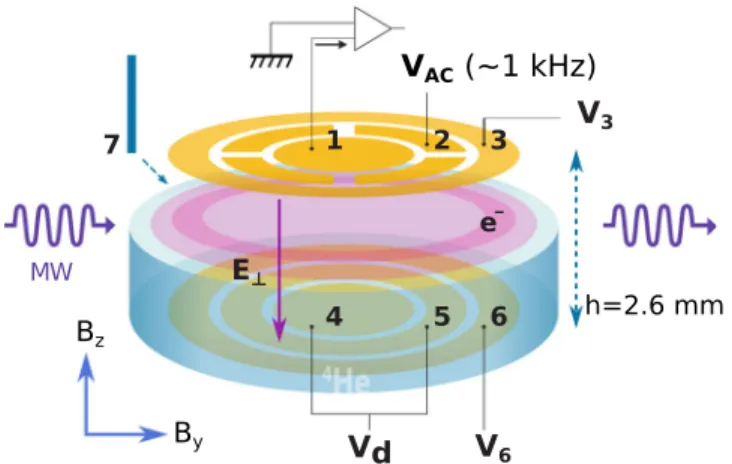
To check if the QED Hamiltonian quantitatively describes the energy of the transitions between Rydberg states, we perform Stark effect spectroscopy. Electrons on helium form a static dipole with their image charge, and the Stark effect due to the perpendicular electric fieldE⊥leads to a linear displacement of the Rydberg energy levels, which can bring these atomic transitions in resonance with the external millimeter-wave excitation. At resonance, a change of resistivity occurs due to MIRO, allowing us to detect the position of the energy levels. Our experimental setup consists of a cavity with Corbino electrodes, the layout of which is shown in Fig. 1. This cavity is half filled with liquid helium by condensing helium vapor and
FIG. 1. Schematic diagram of the experimental cell. The top electrodes 1 and 2 are dc grounded and are used for the ac measurements. A positive dc voltageVdis applied to electrodes 4 and 5, confining the electrons into the center of the cell and fixing E⊥¼Vd=h. Electrodes 3 and 6 are used as a guard with negative potential. To ensure an homogeneousE⊥, we fixedV6−V3toVd (andVd−V6¼6V). The admittanceYof the cell is obtained by applying a 10 mV ac voltage at 1137 Hz to the segmented electrode 2 and measuring the induced pickup voltage on electrode 1 with a lock-in amplifier. It depends on the in-plane conductivity of the electrons under magnetic field as obtained from Corbino measurements with Ohmic contacts on conven- tional 2DES. Microwave (MW) power was sent into the cell through a waveguide and electrode 7 is the filament (e−source).
176802-2
monitoring the capacitance between top and bottom elec- trodes. Electrons are then deposited by thermal emission from a heated filament and are trapped on the surface by the pressing electric fieldE⊥. They form a 2DES that behaves, for in-plane transport, as an effective resistance R placed between two contacts with capacitanceC. This resistance can then be determined by measuring the admittance of the cellYbetween the two inner Corbino contacts from the top electrodes at frequencies comparable with the RC relaxa- tion time (we used 1137 Hz). To extract the MW-dependent (MIRO) admittance δY, MW power is modulated at a frequency of 17 Hz and a double demodulation technique is used. Real and imaginary parts of δY give very similar line shapes. In our measurements, the electron gas density was ne≃1.5×107 cm−2, with a total number of4×107 electrons trapped in the cloud.
The conversion between Stark shifts and transition energies is obtained from a calibration experiment where we excite the electrons with photons at different energies and measure the electric field at resonance (see Fig. 2).
For weak parallel magnetic fields, the transition from the groundjgito the first excited Rydberg statejeimanifests as a resonance of the microwave-induced change in admit- tance as function ofE⊥. The resonance position at energy hν0¼ϵe−ϵgshifts linearly withE⊥, and the slope can be obtained from the Schrödinger equation (1) with small deviations due to uncertainties on geometrical parameters.
This slope is almost independent of By [see Fig. 2(a)];
indeed, for By≤1 T, the coupling term of the QED Hamiltonian ðℏωy= ffiffiffi
p2
Þðhejˆzjgi=lBÞ≲10GHz is small compared to hν0≃140GHz and does not change the vertical dipole moment significantly. While the slope as a function of E⊥ remains unchanged, an overall energy shiftδϵis visible. It appears due to the coupling between Rydberg states and Landau levels at finite By. In the following, we present a careful experimental investigation
of the coupling-induced energy shift and show that it can be understood quantitatively from the QED Hamiltonian.
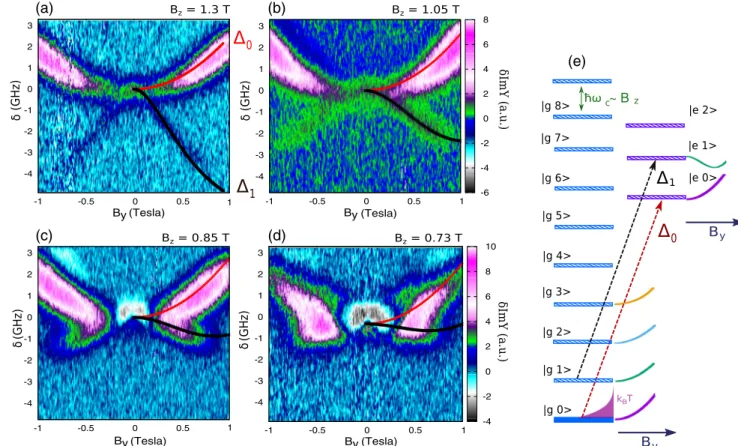
To study the evolution of the jgi→jei transition with By, we take advantage of the linear dependence of the energy shifts onE⊥, which enables us to fix the excitation frequency tof¼139GHz and change onlyE⊥. We define δ as the detuning induced by the Shark shift due to the deviation ofE⊥ from its resonant value at the excitation frequencyfforBy ¼0;δis thus the difference betweenE⊥ and its value at resonance ≃2Vmm−1 times (minus) the slope measured in Fig.2(a). All the collected data are then transformed into a map where the change in admittance is plotted as function ofBy and of the detuningδ. The maps that we obtained for Bz¼1.3 and 1.05 are displayed in Figs.3(a) and 3(b). When increasingBy, we can resolve two transitionsΔ0andΔ1. The energy of the more intense transition called Δ0 increases with By, quadratically at weakBy with a crossover to a more linear dependence at the highest fields. In addition to this main transition, a weaker transitionΔ1splits off from the main transition as Bybecomes stronger. (As will be shown later,Δ1is visible only at the highest microwave excitation power, which was here fixed to its maximal value of 10 mW.) This Δ1 transition becomes as visible as the main transition at lower Bz [Figs.3(c) and3(d) forBz¼0.85and 0.73 T] giving two mutually inverse curves with a characteristic“butter- fly” pattern. The coupling strength dependence of Δ0 is almost the same for allBzin our dataset. On the contrary, forΔ1, the slope of the transition line as a function of the coupling strength increases significantly withBz.
The splitting of the Rydberg transition can be understood from the energy level diagram in Fig.3(e), which shows how the energy levels from the QED Hamiltonian evolve with the coupling strength. For each atomic statejαi, the manifold of dressed states consists of a ladder of Landau levelsjα; miwith MW exciting transitions that conserve the Landau level number m (between states with the same number of photons in the cavity). Without a parallel magnetic field, the energy of thejg; mi→je; mitransition is not dependent onm. The coupling lifts this degeneracy, making transitions associated with different Landau levels spectroscopically distinguishable. In the special case of the m¼0 transition jg;0i→je;0i with energy Δ0, the renormalization of the transition energy is due to an interaction with the lowest Landau level. It can be seen as an effective Lamb shift in analogy with atomic physics, circuit QED [42,43], and physics of electrons coupled to phonons or ripplons [44,45]. A similar renormalization occurs for all the transitions jg; mi→je; mi, and simu- lations are thus needed to identify the observed spectro- scopic lines as one of the transitionsΔm.
The QED Hamiltonian gives a quantitative prediction on the renormalization of the transition energies Δm. We emphasize that all the parameters appearing in the model involveE⊥, the applied magnetic field, the liquid helium
2.4 2.6 2.8 3 3.2 3.4
⊥ ⊥
142 143 144 145 146
2.5 3
(a) (b)
FIG. 2. (a) The shift of thejgi→jeitransition energy due to Stark effect at Bz¼0.73T for By¼0 and By¼0.25T. The slope is the same for both lines, but a small energy shiftδϵis observed. (b) The Stark shift as seen from rawδYdata atBy¼0. The dashed line displays the shift of the resonance withByfor f¼141.6GHz, andδϵcan also be deduced from the value of this Stark shift.
dielectric constantϵ, and fundamental constants, thus there are no fitting parameters. The values ofΔmcan be obtained from the numerical diagonalization of Eq. (2). To obtain accurate values, we had to include Rydberg states and Landau levels at an energy scale higher than ℏν0 from jg;0>. In the simulations shown here, we used a basis set of 100 Landau levels and 20 Rydberg states. Results of our simulations for transitions Δ0;1 are overlaid on top of the experimental data. We see that they reproduce accurately both upper and lower “butterfly wings,” including the striking increase ofΔ1ðByÞwithBz, which contrasts with the Δ0 transition that is almostBz independent.
The transitions Δm between states jg; mi→je; mi can only be observed if the initial statejg; miis populated. At the experiment temperature T ¼0.3K only the ground state jg;0i is populated in equilibrium (the thermal pop- ulation ofjg;1iatT ¼0.3K andBz¼1T is only 1%). As a consequence, the transitions Δm with m≥1 require an external excitation to become visible. In Fig.4(a), we show that, indeed, these transitions physically appear only when the MW power is high enough, as opposed to the Δ0 transition, which is present even at low MW power. Two possible mechanisms to populate the jg;1i level may be taken into consideration. The first assumes an in-plane
component of the MW electric field populating ajg;1ilevel nonresonantly from the initial jg;0i level. The second one is illustrated with dashed lines in Fig. 4(b). When the energy of the transitions Δ0;1 is sufficiently close (at (a)
(Tesla) (Tesla)
(Tesla) (Tesla)
(b)
(e)
(c) (d)
FIG. 3. Evolution of thejgi→jeiresonance withByshowing that this resonance splits into two branches. The color maps represent δYas function ofByand detuningδfor (a)Bz¼1.3, (b) 1.05, (c) 0.85, and (d) 0.73 T. Red and black curves give the QED Hamiltonian predictions for theΔ0andΔ1transitions drawn in (e) between statesjn; mi, where the first quantum number gives the atomic state andm is the Landau level number (number of photons in the cavity). The calculated evolution of individual levels (rescaled for visibility) with By up to 1 T is shown by colored lines.
(a) (b)
FIG. 4. (a) Dependence of the Δ0;1 resonances on MW excitation power at Bz¼1T, By¼0.5T. The Δ1 transition disappears at low power. (b) Illustrates how theΔ0transition can populate the jg;1i level. If the energies Δ0;1 are close, MW photons at the Δ1 energy can also induce the Δ0 transition, providing the nonequilibrium population needed to see the resonance atΔ1.
176802-4
low By), a Δ1 energy MW photon can also excite a transition into the je;0i state. Scattering can then transfer some population into a nearbyjg; mi level, leading (after relaxation) to a finite population in thejg;1i state, which makes the transitionΔ1visible. In Fig.3we see that, asBy increases, the Δ1 transition disappears faster than the Δ0 transition. This observation can be understood within the population mechanism forjg;1ishown in Fig.4(b). Indeed, at larger By, the energies of the Δ0;1 transitions become different and the MW excitation at theΔ1frequency can no longer excite the Δ0 transition that populates the jg;1i level. The state jg;1i then remains empty, leading to the disappearance of the Δ1wings.
In conclusion, we have shown that 2DES on liquid helium can form a prototype quantum system of an atom coupled to an oscillator with the coupling directly controllable by the parallel magnetic field. Our spectro- scopic results compare very accurately to theoretical predictions with no adjustable parameters. Control of the population transfer between dressed states could enable tunable millimeter-wave lasers, and future experi- ments at high electron densities may reveal a rich quantum many-body physics.
We acknowledge discussions with K. Kono, and D. L.
Shepelyansky who stimulated these experiments, as well as support from N. Vernier, V. P. Dvornichenko, Okinawa Institute of Science and Technology (OIST) Graduate University, and ANR SPINEX.
[1] K. v. Klitzing, G. Dorda, and M. Pepper,Phys. Rev. Lett.45, 494 (1980).
[2] D. C. Tsui, H. L. Stormer, and A. C. Gossard, Phys. Rev.
Lett.48, 1559 (1982).
[3] J. K. Jain, Composite Fermions (Cambridge University Press, Cambridge, England, 2007), p. 1225.
[4] K. Novoselov, A. Geim, S. Morozov, D. Jiang, M.
Katsnelson, I. Grigorieva, S. Dubonos, and A. Firsov, Nature (London)438, 197 (2005).
[5] Y. Zhang, Y.-W. Tan, H. L. Stormer, and P. Kim, Nature (London)438, 201 (2005).
[6] M. König, S. Wiedmann, C. Brüne, A. Roth, H. Buhmann, L. W. Molenkamp, X.-L. Qi, and S.-C. Zhang,Science318, 766 (2007).
[7] R. Williams, R. S. Crandall, and A. H. Willis, Phys. Rev.
Lett.26, 7 (1971).
[8] W. T. Sommer and D. J. Tanner,Phys. Rev. Lett.27, 1345 (1971).
[9] T. R. Brown and C. C. Grimes, Phys. Rev. Lett. 29, 1233 (1972).
[10] C. C. Grimes, T. R. Brown, M. L. Burns, and C. L. Zipfel, Phys. Rev. B13, 140 (1976).
[11] K. Shirahama, S. Ito, and H. e. a. Suto,J. Low Temp. Phys.
101, 439 (1995).
[12] C. C. Grimes and G. Adams, Phys. Rev. Lett. 42, 795 (1979).
[13] D. S. Fisher, B. I. Halperin, and P. M. Platzman,Phys. Rev.
Lett.42, 798 (1979).
[14] C. C. Grimes and G. Adams, Phys. Rev. Lett. 36, 145 (1976).
[15] M. I. Dykman and L. S. Khazan, Sov. Phys. JETP77, 1488 (1979).
[16] M. I. Dykman, M. J. Lea, P. Fozooni, and J. Frost, Phys.
Rev. Lett.70, 3975 (1993).
[17] D. Konstantinov, M. I. Dykman, M. J. Lea, Y. Monarkha, and K. Kono,Phys. Rev. Lett.103, 096801 (2009).
[18] H. Ikegami, H. Akimoto, D. G. Rees, and K. Kono,Phys.
Rev. Lett.109, 236802 (2012).
[19] D. G. Rees, N. R. Beysengulov, J.-J. Lin, and K. Kono, Phys. Rev. Lett.116, 206801 (2016).
[20] P. M. Platzman and M. I. Dykman, Science 284, 1967 (1999).
[21] D. I. Schuster, A. Fragner, M. I. Dykman, S. A. Lyon, and R. J. Schoelkopf, Phys. Rev. Lett. 105, 040503 (2010).
[22] M. A. Zudov, R. R. Du, J. A. Simmons, and J. L. Reno, Phys. Rev. B64, 201311(R) (2001).
[23] P. Ye and L. Engel,Appl. Phys. Lett. 79, 2193 (2001).
[24] R. G. Mani, A. N. Ramanayaka, and W. Wegscheider,Phys.
Rev. B84, 085308 (2011).
[25] D. Konstantinov and K. Kono,Phys. Rev. Lett.103, 266808 (2009).
[26] Y. P. Monarkhaa,Low Temp. Phys.37, 655 (2011).
[27] R. G. Mani, J. H. Smet, K. von Klitzing, V. Narayanamurti, W. B. Johnson, and V. Umansky,Nature (London)420, 646 (2002).
[28] M. Zudov, R. Du, L. Pfeiffer, and K. West,Phys. Rev. Lett.
90, 046807 (2003).
[29] D. Konstantinov and K. Kono,Phys. Rev. Lett.105, 226801 (2010).
[30] D. Konstantinov, A. Chepelianskii, and K. Kono,J. Phys.
Soc. Jpn.81, 093601 (2012).
[31] A. D. Chepelianskii, M. Watanabe, K. Nasyedkin, K. Kono, and D. Konstantinov,Nat. Commun.6, 7210 (2015).
[32] Y. P. Monarkha,Low Temp. Phys.42, 441 (2016).
[33] S. Haroche,Rev. Mod. Phys.85, 1083 (2013).
[34] J. M. Fink, L. Steffen, P. Studer, L. S. Bishop, M. Baur, R.
Bianchetti, D. Bozyigit, C. Lang, S. Filipp, P. J. Leek, and A. Wallraff,Phys. Rev. Lett.105, 163601 (2010).
[35] A. Bienfait, J. J. Pla, Y. Kubo, X. Zhou, M. Stern, C. C. Lo, C. D. Weis, T. Schenkel, D. Vion, D. Esteve, J. J. L. Morton, and P. Bertet,Nature (London)531, 74 (2016).
[36] E. Collin, W. Bailey, P. Fozooni, P. G. Frayne, P. Glasson, K. Harrabi, M. J. Lea, and G. Papageorgiou,Phys. Rev. Lett.
89, 245301 (2002).
[37] T. M. Fromhold, L. Eaves, F. W. Sheard, M. L. Leadbeater, T. J. Foster, and P. C. Main, Phys. Rev. Lett. 72, 2608 (1994).
[38] D. L. Shepelyansky and A. D. Stone,Phys. Rev. Lett. 74, 2098 (1995).
[39] G. S. Boebinger, A. Passner, L. N. Pfeiffer, and K. W. West, Phys. Rev. B43, 12673 (1991).
[40] W. Mayer, J. Kanter, J. Shabani, S. Vitkalov, A. K. Bakarov, and A. A. Bykov,Phys. Rev. B93, 115309 (2016).
[41] W. Mayer, S. Vitkalov, and A. A. Bykov,Phys. Rev. B96, 045436 (2017).
[42] P. W. Milonni,The Quantum Vacuum: An Introduction to Quantum Electrodynamics (Academic Press, New York, 2013).
[43] A. Wallraff, D. I. Schuster, A. Blais, L. Frunzio, R.-S.
Huang, J. Majer, S. Kumar, S. M. Girvin, and R. J.
Schoelkopf,Nature (London)431, 162 (2004).
[44] A. J. Ramsay, T. M. Godden, S. J. Boyle, E. M. Gauger, A.
Nazir, B. W. Lovett, A. M. Fox, and M. S. Skolnick,Phys.
Rev. Lett.105, 177402 (2010).
[45] M. I. Dykman, K. Kono, D. Konstantinov, and M. J. Lea, Phys. Rev. Lett.119, 256802 (2017).
176802-6