Sci. Repo I.ianaza)¥ra Uni、¥ Vol. 41, N o. 2, pp. 77‑115
December 1996
むSTRACODEFOSSILS :FROM THE J...ATE PLIOCENE 1'0 EARLY PLEISTOCENJE O M M A I,'ORMATION IN THE HOKURIKU DISTRICT, CENTRAL JAPAN
日irokazuOZA W A
11
Deparlment 01 Earth Sciences, Faculiy 01 sαence, K.anazawa U:幻iversity,Kakuma, Kanazawa, 920‑11
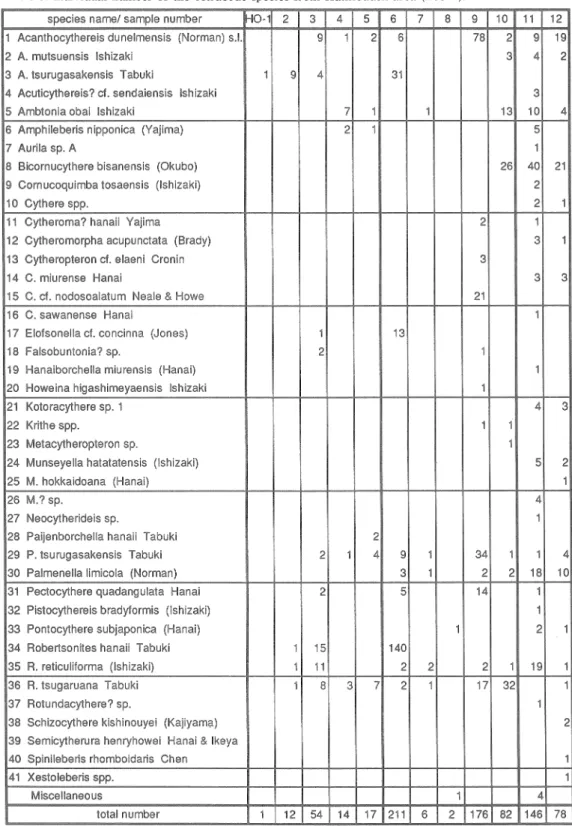
AbstJrad: From the late Pliocεne to eal"ly Pleistocene Omma Formation, 240 ostracoc1e species belonging to 100 g巴neraare recognized in 159 samples collected at five localities loc丘t巴dat Kanazawa and Oy日bεCitiesin th巴Hokurikudistrict on th己]apanS巴aside of central ]apan. The ostracode species from this strata ge口己rallyconsists of thre日different fossil groups. The first group was consider巴dto be inhabiting in the inner bay environρ ment, and the second contains sp巴ciξsliving in th巴opens巴a. The third group has both elements of the two groups
K吃v.woTds: Ostracoda, latεPliocene to early Pleistocene, Omm旦Formation 1. Introduction
The late Pliocene to early Pleistocene 2園1~O.8 Ma) Omma Fcっrmationis distributed in the basal area of the Noto Peninsula, the eastern part of Ishikawa Prefecture and western part of Toyam3. Prefectuτe on the J apan Sea coasts of central J apan. The Formation is a representative of the Plio‑Pleistocene shallow marine strata widely dis白
tributed along the J apan Sea coasts from the southwestern Hokkaido to the Cheju Island at the Tsushima Strait. The Formation is well known for the abundant occurrence of shallow marine calcareous fossi1s, such as Mollusca, Foraminifera, N annoplankton and Ostracoda (e. g. Yokoyama, 1927; Kaseno and Matsuur札 1965;Hasegawa, 1979; Matsuura,
Cronin and Ikeya, 1987; Takayama et al., 1988; K.itamura and Kondo, 1990; Ishizaki et al., 1993). A couple of datum plains werεwell studied in the Omma Formation by the nannofossil analysis (e. g. Takayama et 1988). In addition to the biostratigraphical correlation, the correlation of tuff layers between several localities provide other controlled time plains (Okubo, 1995 Kitamura, 1996). As a result, these featur眉esmake this stratum an excellent material for the detailed discussion on the shallow water environ‑ ments and oceanography in the J apan Sea of this area during the late Pliocεne and early Pleistocene. Ostracode fossil assemblages on five areas, which were correlated to the
78 Hirokazu OZAWA
lower and the base of the middle parts of Kitamura and Kondo (1990), were studied in this paper. The purpose of this study is to know the species occurrence in detail and give photographies of ostracode fossils, which wi11 be fundamental and essential data for the future paleoenvironmental work in this area.
2. Outline of geology
Omma Formation which belongs to the Himi Group is widely distributed in the southern part of Kanazawa City in Ishikawa Prefecture and Oyabe City in Toyama Prefecture, on the J apan Sea side of central J apan (Fig. 1) (Motizuki, 1930; Hasegawa, 1979). This stratum mainly consists of blueish fine‑grained sandstone and silty sandstone, and yields abundant molluscan fossils which are so called Omma‑Manganjian Molluscan Fauna" 1927; Kaseno and 1965; Ogasawara, 1977; Matsuura, 1985). The thickness of the Omma Formation attains about 210 m at the type locality in Kanazawa City and about 250 m in the southern part of City (Hasegawa, 1979; Kitamura and Kondo, 1990), and has mainly NE‑SW strike with 5‑750 dip to the northwest.
The Formation covers unconform司
the middle Miocene Saikawa Formation at the type locality (Okuwa area, Fig. 1, Loc. 1)
i, 1930;
Ogasawar孔 1977) and middle Miocene and early Pliocene Takakubo Forma‑
tion (Ito, 1986) in the southern part of Ka nazawa City (Sugimoto, 1994). The Omma Forma‑
tion around Ha‑
kkouden area 1, Loc. 4) covers the Takakubo Forma‑
tion. The strati graphic relationship
口鵬lr州 formations
Omma Formation
o 5 km
陸益重量五本冨画面軍益還;;1
Fig. 1: Simplified geological map of the Omma Formation around Kana‑ zawa and Oyabe Cities, central ]apan, modified from Hasegawa
(1979), with investigated localities in this study. Loc.l: Okuwa (type locality), Loc. 2: Yuhidera, Loc. 3: Kofutamata, Loc. 4・Hakkouden, and Loc. 5: Sakuramachi.
OSTRACODE FOSSILS FROlVI THE OlVIlVIA FORlVIA TION 79
between the Omma and Takakubo Formations is still under debate. The Omma Formation around Sakuramachi area (Fig. 1, Loc. 5) is considered to be bounded by Yachi Formation
(Pliocene?) in faults (Hasegawa, 1979; Takata, 1994 MS)
The middle Pleistocene Utatsuyama Formation over1ies unconformalコlythe Omma Formation around the type locality (Kitamura and Kondo, 1990). The middle Pleistocene Hanyu Formation covers the Omma Formation around Hakkouden area with unconformity (Hasegawa, 1979; Furuya, 1990 MS). At Sakuramachi area, the calcareous fine sandstone layers which have 0.3‑2.2 m thickness are interleaved (Takata, 1994 MS).
Sumi et al. (1989) described that this calcareous fine sandstone around Sakuramachi area was a distal part of the Zukawa Formation which was distributed in Takaoka City, 10 km NE of Sakuramach. i
The Omma Formation contains four white tuff layers that are named01 to 04 tuff layers" in upward sequence by Hasegawa (1979). The 02 tuff layer is widely distributed in the southern part of Kanazawa and Oyabe Cities (Hasegawa, 1979; Okubo, 1995 MS;
Ishikawa, 1995 MS). Okubo (1995 MS) reidentified the tuff layers and reported that the
o 1 and 0 2 tuff layers were found at Kofutamata area (Fig. 1, Loc. 3) and the 0 2 tuff layer at Hakkouden area (Fig. ,1Loc. 4) in addition to the type locality (Fig. 1, Loc. 1)
The geological age of the Omma Formation was studied by several workers and plural biostratigraphic datum plains of calcareous nannofossils have been identified (Takayama et al., 1988; Shida et al., 1989; Takata, 1994 MS; Yamamoto and Ozawa, 1996). According to these studies, the Omma Formation of Sakuramachi area was deposited during about 2.1‑1.3 Ma, and of Hakkouden area was deposited in about 1.7 ‑1.3 Ma. The Omma Formation exposed at the type locality was deposited in about 1.4‑0.8 Ma. The fission track age of the 0 2 tuff layer was 1.4土0.2Ma (Ohmura et al., 1989). Taking all data into consideration, the Omma Formation was concluded to deposit during the late Pliocene and early Pleistocene, but it began to deposit slightly earlier in the eastern area (Oyabe) than in the western area (Kanazawa) as Shida et al. (1989) indicated.
3. Material and method
Fossil Ostracoda from five localities were investigated in this study. They were the lower and partly the middle parts of Okuwa (Loc. 1 in Fig. 1; type locality of the Omma Formation), Yuhidera (Loc. 2), Kofutamata (Loc. 3), Hakkouden (Loc. 4) and Sakura‑ machi (Loc. 5). Field works were carried out for all areas in order to observe the lithology and molluscan fossils and collect samples except Sakuramachi area where the outcrops were lost at present.
A total of 52 sediment samples for the ostracode fossil analysis were collected from Kofutamata (Loc. 3) and Hakkouden (Loc. 4) areas by the author. Samples were collected carefully parallel to the bedding plane within a 15 cm in thickness to obtain contemporane. ous sediments. Burrows fi1led with subsequent sediments were carefully excluded. After