Acta Med. Nagasaki 64: 1−7
Introduction
As of September 15, 2018, 28.1% of the Japanese popula- tion was elderly (≥65 years old) according to the website of the Statistics Bureau of the Ministry of Internal Affairs and Communications, making Japan a hyper-aged society. With the progressive aging of society, the incidence of colorectal cancer in elderly patients and the associated mortality rate are increasing (1,2).
Since the ASCO2012 presentation of the AVEX trial (3), bevacizumab (Bmab)+capecitabine (Cape) has been widely used as a first-line treatment for elderly patients (≥70 years old) with metastatic colorectal cancer (mCRC). However, it
is associated with a high incidence of hand-foot syndrome (>50%) and a reduced quality of life (QOL) in patients with grade 3/4 hand-foot syndrome (3).
In Japan, UZEL/UFT (tegafur-uracil) or S-1 has been widely used to treat mCRC. These agents are dihydropyrimidine dehydrogenase (DPD)-inhibitory fluoropyrimidines (DIFs) and consist of tegafur, which is a prodrug of 5-FU, and a DPD inhibitor,which maintains a high blood concentration of 5-FU and are associated with reduced incidences of digestive tract toxicity and hand-foot syndrome (4,5). Several phase II trials of Bmab+DIFs for elderly patients with mCRC have shown favorable results of good feasibility and a prolonged survival (6, 7). Capecitabine or oral-5-FU+Bmab
MS#AMN 07242
Bevacizumab +oral 5-fluorourasil versus intensive chemotherapy for the treatment of elderly patients with metastatic colorectal cancer
Kazuma K
obayashi, Hanako T
eTsuo, Shun y
amaguchi, Shinichiro i
To, Yasuhiro T
orashima, Yusuke i
noue, Satomi o
Kada, Takahiro e
njoji, Sayaka K
uba, Taiichiro K
osaKa, Tomohiko a
dachi, Masaaki h
idaKa, Kosho y
amanouchi, Kengo K
aneTaKa, Mitsuhisa T
aKaTsuKi, Susumu e
guchiDepartment of Surgery, Nagasaki University Graduate School of Biomedical Sciences, Nagasaki, Japan
Aim: This study compared the efficacy and safety of Bmab+oral 5-Fluorourasil (Bmab+o-5-FU) including Bmab+Capecitabine (Cape) with that of intensive chemotherapy including L-OHP or CPT-11 for patients with metastatic colorectal cancer (mCRC).
Methods: Between January 2006 and February 2017, 40 elderly (≥70 years) chemotherapy-naïve patients with mCRC (male/
female=22/18; median age, 76.0 years) were retrospectively reviewed. The treatment regimens were Bmab+o-5-FU (n=19) and intensive regimens (n=21). Intensive regimens comprised 17 L-OHP and 4 CPT-11 doublet chemotherapies.
Results: The median progression-free survival (PFS) with Bmab+o-5-FU and intensive regimens was 281 and 215 days, respectively. The median survival time with Bmab+o-5-FU and intensive regimens was 961 and 1,002 days, respectively. No significant differences were observed in the overall survival or PFS between Bmab+o-5-FU and the other regimens. The disease control rate was 94.7% with Bmab+o-5-FU and 81.0% with intensive regimens. The rate of grade ≥3 hematological adverse events was 5.3% for Bmab+o-5-FU and 15.8% for intensive regimens.
Conclusions: With its similar survival benefit to intensive regimens, high disease control rate and good feasibility, Bmab+o- 5-FU seems a fine treatment choice for elderly mCRC patients.
ACTA MEDICA NAGASAKIENSIA 64: 1−7, 2020 Key words: elderly patient; colorectal cancer; bevacizumab; o-5-FU
Address correspondence: Kazuma Kobayashi, M.D., Ph.D. Department of Surgery, Nagasaki University Graduate School of Biomedical Sciences 1-7-1 Sakamoto, Nagasaki city, Nagasaki 852-8501, Japan
Phone: (Japan code) 95-819-7316, Fax: (Japan code) 95-819-7319, E-mail: [email protected] Received June 10 2019; Accepted March 10, 2020
2 Kazuma Kobayashi et al.: Bmab+o-5-FU for elderly pts with mCRC
has therefore been a standard chemotherapy regimen for patients who are not eligible for intensive treatment according to the 2016 Japanese guidelines for the treatment of colorectal cancer (8).
We previously reported the efficacy of Bmab+DIFs for late-stage elderly patients compared to other regimens (1).
However, we focused too much on Bmab+DIFs, excluding Bmab+Cape from the study despite it being widely used for such patients. Control regimens were varied and included oral 5-fluorourasil alone as well as molecular-targeting agents+doublet chemotherapy, which were heterogenous in not only the anti-tumor effect but also adverse events.
Therefore, we reviewed the efficacy and feasibility of Bmab+o-5-FU including Cape for elderly (≥70 years old) patients with mCRC versus intensive chemotherapy such as L-OHP- or CPT-11-based doublet ± molecular-targeting agents.
Patients and Methods
Elderly (≥70 years old) chemotherapy-naïve patients with mCRC who were treated between January 2006 and February 2017 and who received at least one course of chemotherapy were enrolled as into this study as eligible subjects. Those patientsʼ medical records were retrospectively reviewed to compare the results of chemotherapy with those of Bmab+o- 5-FU and other regimens.
The median survival time (MST) and median progression- free survival (mPFS) were calculated by the Kaplan-Meier method for the survival analysis. Other factors, such as the transition rate to second-line therapy, were evaluated by Fisherʼs exact test. The Stat View J 5.0 software package (Abacus Concepts, Stat View.; Abacus Concepts, Inc., Berkeley, CA, USA) was used to perform the statistical analyses. P values of <0.05 were considered to indicate a statistically significant difference. ere considered to indicate a statistically significant difference.
The National Cancer Institute-Common Toxicity Criteria (NCI-CTC) ver.4.0 and the response evaluation criteria for solid tumors (RESIST) were used to evaluate adverse events and anti-tumor effect of each chemotherapy regimen group.
Results
Patientsʼ characteristics
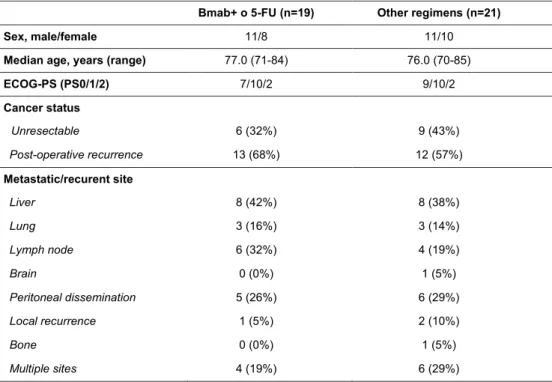
Forty patients (male, n=22; female, n=18) satisfied the eligibility criteria. Nineteen and 21 patients received Bmab+o- 5-FU and intensive regimens, respectively. The characteristics of the patients are shown in Table 1. There were no statistically significant differences in any of the factors between regimens.
The detailed regimens are shown in Table 2. Six patients received capecitabine, five received UZEL/UFT (L-leucovorin/
tegafur-uracil), and eight received Bmab+o-5-FU.
Table 1. Patient Characteristics
15
Table 1. Patient Characteristics
Bmab+ o 5-FU (n=19) Other regimens (n=21)
Sex, male/female 11/8 11/10
Median age, years (range) 77.0 (71-84) 76.0 (70-85)
ECOG-PS (PS0/1/2) 7/10/2 9/10/2
Cancer status
Unresectable 6 (32%) 9 (43%)
Post-operative recurrence 13 (68%) 12 (57%)
Metastatic/recurent site
Liver 8 (42%) 8 (38%)
Lung 3 (16%) 3 (14%)
Lymph node 6 (32%) 4 (19%)
Brain 0 (0%) 1 (5%)
Peritoneal dissemination 5 (26%) 6 (29%)
Local recurrence 1 (5%) 2 (10%)
Bone 0 (0%) 1 (5%)
Multiple sites 4 (19%) 6 (29%)
3 Kazuma Kobayashi et al.: Bmab+o-5-FU for elderly pts with mCRC
Response and time-to-event measurements
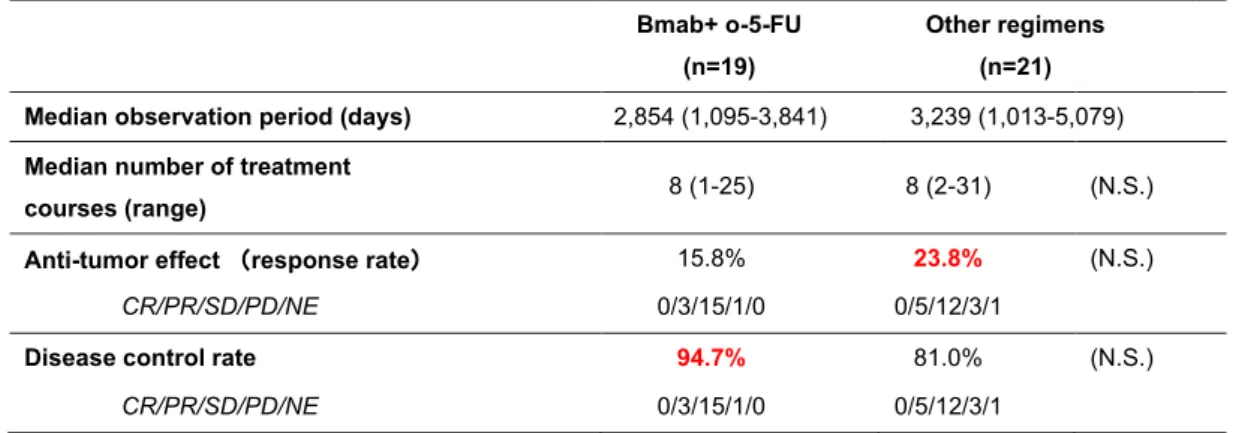
The median follow-up period with Bmab+o-5-FU and intensive regimens was 2,854 days (range: 1,095-3,841) and 3,239 days (range: 1,013-5,079) days, respectively. The median progression-free survival (PFS) with Bmab+o-5-FU and intensive regimens was 281 and 215 days, respectively.
The median number of treatment courses was eight with both Bmab+o-5-FU and intensive regimens. The response rate (RR) with Bmab+o-5-FU was 15.8% (complete response [CR], n=0; partial response [PR], n=3; stable disease [SD], n=15; progressive disease [PD], n=1, not evaluable [NE], n=0), while that for intensive regimens was 23.8% (CR, n=0;
PR, n=5; SD, n=12; PD, n=4; NE, n=1). The disease control rate (DCR) was 94.7% with Bmab+o-5-FU and 81.0% with other regimens (Table 3). There were no significant differences in terms of the antitumor effects or the DCR between the two groups. Metastatectomy and radiofrequency ablation (RFA) therapy were performed in two patients with liver metastasis who received intensive regimens.
The median PFS was 254 days, and the MST was 961
days among all 40 patients. Figure 1 shows the treatment- specific PFS and overall survival (OS). The mPFS with Bmab+o-5-FU was 281 days, while that with intensive regimens was 215 days (Fig. 1a). The MST with Bmab+o-5- FU was 961 days, and that with intensive regimens was 1,002 days (Fig. 1b). The difference was not statistically significant.
Adverse events
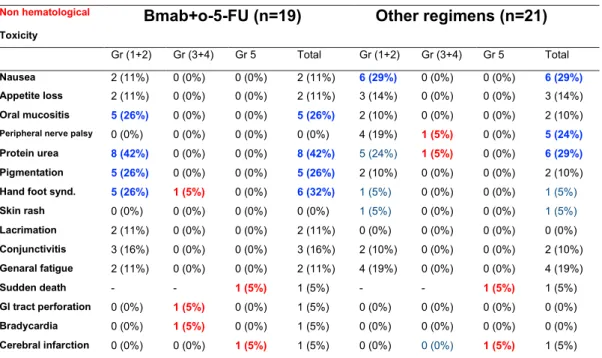
As shown in Tables 4a and 4c, the overall incidence of hematological toxicities was markedly higher in both incidence and grade in the intensive regimens than in Bmab+o-5-FU.
Both the incidence and grade of non-hematological toxicities of Bmab+o-5-FU were almost the same as with the intensive regimens (Tables 4b and c). The specific adverse events are shown in Tables 4a and 4b. The incidence of protein urea due to Bmab in Bmab+O-5-FU was remarkable; however, the severity of all adverse events was lower than grade 3.
The incidence of oral mucositis and pigmentation, events typical of 5-FU, was relatively high but less than grade 3. No peripheral nerve palsy, which was typical of L-OHP and associated with a reduced QOL, was observed in Bmab+O- 5-FU. Grade 1 or 2 hand-foot syndrome occurred in two patients treated with Bmab+S-1 and another two treated with Bmab+Cape. Grade 3 hand-foot syndrome occurred in one patient treated with Bmab+Cape. Hand-foot syndrome occurred in 50% (3/6) of patients treated with Bmab+Cape;
however, all were manageable. Conjunctivitis and lacrimation, which were associated with a reduced QOL, in patients who received Bmab+o-5-FU were exclusively observed in those treated with S-1. Two deaths occurred (cerebral infarction [CT], n=1; unknown etiology, n=1) in patients who received Bmab+o-5-FU, and 2 deaths occurred (CT, n=1; unknown etiology, n=1) in patients who received intensive regimens.
Table 2. Treatment Regimens
16 Table 2. Treatment Regimens
Bmab+o-5-FU (n=19) Other regimens (n=21)
Bevacizumab (n=19) L-OHP base (n=17)
capecitabine 6 FOLFOX alone 3
UZEL/UFT 5 Bmab+FOLFOX 11
S-1 8 Bmab+CapeOX 1
Pmab+FOLFOX 2
CPT-11 base (n=4)
FOLFIRI alone 1
Bmab+FOLFIRI 1
SU+FOLFIRI 1
Cmab+IRIS 1
Table 3. Anti-tumor effect and Disease control of each regimen
Bmab+ o-5-FU (n=19)
Other regimens (n=21) Median observation period (days) 2635 (459-3622)
Median number of treatment
courses (range) 8 (1-25) 8 (2-31) (N.S.)
Anti-tumor effect (response rate) 15.8% 23.8% (N.S.)
CR/PR/SD/PD/NE 0/3/15/1/0 0/5/12/3/1
Disease control rate 94.7% 81.0% (N.S.)
CR/PR/SD/PD/NE 0/3/15/1/0 0/5/12/3/1
Table 3. Anti-tumor effect and Disease control of each regimen
16 Table 2. Treatment Regimens
Bmab+o-5-FU (n=19) Other regimens (n=21) Bevacizumab (n=19) L-OHP base (n=17)
capecitabine 6 FOLFOX alone 3
UZEL/UFT 5 Bmab+FOLFOX 11
S-1 8 Bmab+CapeOX 1
Pmab+FOLFOX 2
CPT-11 base (n=4)
FOLFIRI alone 1
Bmab+FOLFIRI 1
SU+FOLFIRI 1
Cmab+IRIS 1
Table 3. Anti-tumor effect and Disease control of each regimen
Bmab+ o-5-FU (n=19)
Other regimens (n=21)
Median observation period (days) 2 (-3)
Median number of treatment
courses (range) 8 (1-25) 8 (2-31) (N.S.)
Anti-tumor effect (response rate) 15.8% 23.8% (N.S.)
CR/PR/SD/PD/NE 0/3/15/1/0 0/5/12/3/1
Disease control rate 94.7% 81.0% (N.S.)
CR/PR/SD/PD/NE 0/3/15/1/0 0/5/12/3/1
(-)
4 Kazuma Kobayashi et al.: Bmab+o-5-FU for elderly pts with mCRC Table 4. Adverse Events
17
Table 4. Adverse Events (a)
Hematological Toxicity
Bmab+o-5-FU (n=19) Other regimens (n=21)
Gr (1+2) Gr (3+4) Gr 5 Total Gr (1+2) Gr (3+4) Gr 5 Total
Leukopenia 2 (11%) 1 (5%) 0 (0%) 3 (16%) 2 (10%) 9 (43%) 0 (0%) 11 (52%)
Neutropenia 2 (11%) 1 (5%) 0 (0%) 3 (16%) 2 (10%) 9 (43%) 0 (0%) 11 (52%)
Febrile neutropenia 0 (0%) 0 (0%) 0 (0%) 0 (0%) 0 (0%) 1 (5%) 0 (0%) 1 (5%)
Anemia 1 (5%) 0 (0%) 0 (0%) 1 (5%) 4 (19%) 2 (9%) 0 (0%) 6 (%)
Thrombocytopenia 1 (5%) 0 (0%) 0 (0%) 1 (5%) 5 (24%) 0 (0%) 0 (0%) 5 (24%)
(b)
Non hematological Toxicity
Bmab+o-5-FU (n=19) Other regimens (n=21)
Gr (1+2) Gr (3+4) Gr 5 Total Gr (1+2) Gr (3+4) Gr 5 Total
Nausea 2 (11%) 0 (0%) 0 (0%) 2 (11%) 6 (29%) 0 (0%) 0 (0%) 6 (29%)
Appetite loss 2 (11%) 0 (0%) 0 (0%) 2 (11%) 3 (14%) 0 (0%) 0 (0%) 3 (14%) Oral mucositis 5 (26%) 0 (0%) 0 (0%) 5 (26%) 2 (10%) 0 (0%) 0 (0%) 2 (10%)
Peripheral nerve palsy 0 (0%) 0 (0%) 0 (0%) 0 (0%) 4 (19%) 1 (5%) 0 (0%) 5 (24%)
Protein urea 8 (42%) 0 (0%) 0 (0%) 8 (42%) 5 (24%) 1 (5%) 0 (0%) 6 (29%)
Pigmentation 5 (26%) 0 (0%) 0 (0%) 5 (26%) 2 (10%) 0 (0%) 0 (0%) 2 (10%)
Hand foot synd. 5 (26%) 1 (5%) 0 (0%) 6 (32%) 1 (5%) 0 (0%) 0 (0%) 1 (5%)
Skin rash 0 (0%) 0 (0%) 0 (0%) 0 (0%) 1 (5%) 0 (0%) 0 (0%) 1 (5%)
Lacrimation 2 (11%) 0 (0%) 0 (0%) 2 (11%) 0 (0%) 0 (0%) 0 (0%) 0 (0%)
Conjunctivitis 3 (16%) 0 (0%) 0 (0%) 3 (16%) 2 (10%) 0 (0%) 0 (0%) 2 (10%) Genaral fatigue 2 (11%) 0 (0%) 0 (0%) 2 (11%) 4 (19%) 0 (0%) 0 (0%) 4 (19%)
Sudden death - - 1 (5%) 1 (5%) - - 1 (5%) 1 (5%)
GI tract perforation 0 (0%) 1 (5%) 0 (0%) 1 (5%) 0 (0%) 0 (0%) 0 (0%) 0 (0%)
Bradycardia 0 (0%) 1 (5%) 0 (0%) 1 (5%) 0 (0%) 0 (0%) 0 (0%) 0 (0%)
Cerebral infarction 0 (0%) 0 (0%) 1 (5%) 1 (5%) 0 (0%) 0 (0%) 1 (5%) 1 (5%)
■:incidense≧20%, ■:grade≧3,
18 (C)
Adverse Events of Bevacizumab+DIF group and Other regimens
Hematological Toxicity Non-hematological Toxicity Bmab+o-5-FU Other regimens Bmab+o-5-FU Other regimens
overall 8.4% 32.4% 13.7% 10.8%
≤ grade 2 6.3% 20.0% 11.9% 9.5%
≥ grade 3 5.3% 15.8% 1.8% 1.0%
Table 5. Results of the oral 5-FU-specific analysis (Bmab+o-5FU)
Capecitabine (n=6)
UZEL/UFT (n=5)
S-1 (n=8) Response rate
CR/PR/SD/PD/NE
16.7%
0/1/4/1/0
0.0%
0/0/5/0/0
25.0%
0/2/6/0/0 N.S.
median PFS (days) range
187 (49-745)
175 (140-770)
310
(116-833) N.S.
MST (days) range
997 (399-1086)
Not reached (140-1183)
904
(343-1795) N.S.
Figure legends
Figure 1. Results of the survival analysis (treatment-specific). Kaplan-Meier curves of
5 Kazuma Kobayashi et al.: Bmab+o-5-FU for elderly pts with mCRC
Transition to a second-line treatment
The transition rate to second-line treatments tended to be higher in the patients who received Bmab+o-5-FU (68.4%:
13/19) than in those who received intensive regimens (38.1%: 8/21) (p=0.0551).
Survival analyses (performance status [PS]- and treatment- specific)
We examined the associations between the survival and PS and treatment (Figure 2). As shown in Figure 2a and 2b, neither the PFS nor OS was associated with either the PS or
!"#$%&'()(*+$,-*+./)/$0'#1)2#-3/4#5)6)57
!"#$ %&'()&*+,-&./01(223
!"#$ %&')4&*+,-&.221)5/673
8!+9:;141#<&.=%)03 >=?@=->A@&B@C>!@=-&.=%')3
89% :%
D$E&%&07)&*+,-&.)/61)5F043 D$E&%&)566'&*+,-&.221)544/3
!"#$%&
' (' )'
*' +' ,''
!-&
' )'' +'' ,('' ,*''
' (' )'
*' +' ,''
!"#$%&
' .'' ,''' ,.'' ('''
!-&
;<%< ;<%<
9)1&'#$=<
0*7 0>7
Figure 1. Results of the survival analysis (treatment-specific). Kaplan-Meier curves of the progression-free survival (a) and overall survival (b) on comparing the Bmab+o-5-FU and intensive regimens.
!"#$%&'()*$+,-,./0123%4500000000000000000!"#$%&6278296:80;8<6(8290123%=5
!">&'()*$+,-,./0123>500000000000000000000000!">&6278296:80;8<6(8290123>5
!"#$%&'()(*+$,-*+./)/$01%2 *-3$'#4)5#-2/6#7)8)79
1:% ;%
<=%=
<=%=
!"#$%&
' (' )'
*' +' ,''
!-&
' )'' +'' ,('' ,*''
!"#$%&
' (' )'
*' +' ,''
!-&
' .'' ,''' ,.'' ('''
:)4&'#$>=
0*9 0?9
!"#&'()*$+,-,./012345
?"@A0%B4=-0C)D9
E7F8;90123GG5
?"@A0=H%0C)D9
!"#&'()*$+,-,./012345 (!."A0G=40C)D9
E7F8;90123GG5 (!."A0>%-0C)D9
1:% ;%
!"#$%&
' (' )'
*' +' ,''
!-&
' )'' +'' ,('' ,*''
!"#$%&
' (' )'
*' +' ,''
!-&
' .'' ,''' ,.'' ('''
6@A=>>BC 6@A=DEFG
079 039
!"#&'()*$+,-,./0000000000 E7F8;9000000000000
Figure 2. Results of the survival analysis (PS- and treatment-specific). Kaplan-Meier curves of the progression-free sur- vival (a) and overall survival (b) in Bmab+o-5-FU and intensive regimens in relation to the PS and treatment as well as in PS0+ Bmab+o-5-FU and Others patients including Bmab+o-5-FU with PS1-2 and intensive regimens with PS0-2) (c) and (d).
6 Kazuma Kobayashi et al.: Bmab+o-5-FU for elderly pts with mCRC
treatment. We then created a Kaplan-Meier curve divided by PS0 and Bmab+o-5-FU and included the other PSs and treatment regimens (Others). As shown in Figures 2c and 2d, both the PFS and OS tended to be longer in the patients with PS0 who received Bmab+o-5-FU than in Others; however, the difference was not statistically significant.
Anti-tumor effects and survival analyses in Bmab+o-5-FU (oral 5-FU-specific)
The results of the oral 5-FU-specific analysis are shown in Table 5. The RR, PFS and OS of S-1 were favorable, but no factors were statistically significant.
Discussion
The inferiority of the overall survival and superiority of the transition rate to second-line Bmab+o-5-FU compared to other intensive regimens are thought to be important. In addition, the fact that Bmab+o-5-FU is less toxic than those intensive regimens is also important.
In the present study, we achieved an MST of 961 days and an mPFS of 254 days. The MST of our study is equivalent to that of the FOLFIRI+Bmab arm in the WJOG4407G trial of patients 20-75 years of age with mCRC (9). These results showed that chemotherapy improves the survival of elderly patients with mCRC as well as younger ones. The RR was higher with intensive regimens than with Bmab+o-5-FU. In addition, metastatectomy and radiofrequency ablation (RFA) therapy were performed in two patients with liver metastasis who received intensive regimens. Therefore, when attempting to perform conversion therapy, intensive chemotherapy including L-OHP, CPT-11 and a molecular-targeted agent might be appropriate for aged patients with ARCC, as conversion treatment creates the chance to achieve a cure.
Regarding the lack of a significant difference in the PFS and OS between patients who received Bmab+o-5-FU and
those who received intensive regimens, we concluded that Bmab+o-5-FU was not the only optimal regimen for elderly patients with mCRC. However, given the high DCR of 94.7%
and the high transition rate to second-line treatment, Bmab+o- 5-FU might be useful as a treatment of choice for elderly patients. Based on the results of this study, Bmab+o-5-FU might be the first choice for patients with PS0 if the treatment strategy does not include the provision of conversion therapy.
Bmab+o-5-FU might also be useful as a prelude to intensive chemotherapy given the high transition rate. Bmab+o-5-FU treatment was associated with good compliance in view of 18 of 19 patients receiving more than 2 courses of treatment with median 8courses (range: 1-25), and the adverse effects were either tolerable or controllable. These features of Bmab+o-5-FU thus make it possible to utilize all available agents in the treatment courses, and thereby a good disease control of such elderly patients may be attained (10, 11) However, age alone did not contraindicate intensive chemotherapy, such as Bmab+FOLFOX/FOLFIRI, in elderly patients with mCRC (12). Combination chemotherapies have been reported to achieve a longer PFS in elderly patients than 5-FU alone; however, such therapies tend to be associated with severe toxicities, especially with the addition of CPT-11 (13).
Doublet chemotherapy including Bmab was also found to be tolerable in elderly patients; however, such patients should be carefully monitored in order to detect the development of arterial or venous thrombosis (14). Instances of hand- foot syndrome of Bmab+Cape in the present study were manageable.
As shown in Table 5, the efficacy of Bmab+o-5-FU was not correlated with specific o-5-FU agents. We can therefore freely select o-5-FU in accordance with patientsʼ desires or adverse event profiles.
The limitations of this study are 1) it focused on only age without any geriatric assessments, 2) the number of cases are small, and 3) it was a retrospective study with unavoidable biases. We intend our next study to focus on not only age but also frailty using geriatric assessment tools.
Table 5. Results of the oral 5-FU-specific analysis (Bmab+o-5FU)
18 (C)
Adverse Events of Bevacizumab+DIF group and Other regimens
Hematological Toxicity Non-hematological Toxicity Bmab+o-5-FU Other regimens Bmab+o-5-FU Other regimens
overall 8.4% 32.4% 13.7% 10.8%
≤ grade 2 6.3% 20.0% 11.9% 9.5%
≥ grade 3 5.3% 15.8% 1.8% 1.0%
Table 5. Results of the oral 5-FU-specific analysis (Bmab+o-5FU)
Capecitabine (n=6)
UZEL/UFT (n=5)
S-1 (n=8) Response rate
CR/PR/SD/PD/NE
16.7%
0/1/4/1/0
0.0%
0/0/5/0/0
25.0%
0/2/6/0/0 N.S.
median PFS (days) range
187 (49-745)
175 (140-770)
310
(116-833) N.S.
MST (days) range
997 (399-1086)
Not reached (140-1183)
904
(343-1795) N.S.
Figure legends
Figure 1. Results of the survival analysis (treatment-specific). Kaplan-Meier curves of
7 Kazuma Kobayashi et al.: Bmab+o-5-FU for elderly pts with mCRC
References
1.Kobayashi K, Fujita F, Inoue Y, et al. Bevacizumab (Bmab) +Dihydro- pyrimidine Dehydrogenase (DPD) Inhibitory Fluoropyrimidine (DIF) Combined Chemotherapy for the Treatment of Late-Stage Elderly Patients with Advanced/Recurent Colorectal Cancer (ARCC). Adv Oncol Res Treat 2: 119. doi: 10.4172/2572-5025.1000109 2018;
2. CANCER STATISTICS IN JAPAN 2017 Edited by The Editorial Board of the Cancer Statistics in Japan Date of publication: March, 2018 Foundation for Promotion of Cancer Research (FPCR) c/o National Cancer Center HP: https://ganjoho.jp/data/reg_stat/statistics/brochure/2017 3. Cunningham D, Lang I, Marcuello E, et al. Bevacizumab plus capecitabine
versus capecitabine alone in elderly patients with previously untreated metastatic colorectal cancer (AVEX): an open-label, randomized phase
3 trial. Lancet Oncol 14: 1077–85, 2013
4. Shirasaka T. Development History and Concept of an Oral Anticancer Agent S-1 (TS-1®): Its Clinical Usefulness and Future Vistas. Jpn J Clin Oncol 39: 2–15, 2009
5. Douillard JY, Hoff PM, Skillings JR, et al. Multicenter Phase III Study of Uracil/Tegafur and Oral Leucovorin Versus Fluorouracil and Leucovorin in Patients With Previously Untreated Metastatic Colorectal Cancer. J Clin Oncol 20: 3605-3616, 2002
6. Yoshida M, Muro K, Tsuji A, et al. Combination chemotherapy with bevacizumab and S-1 for elderly patients with metastatic colorectal cancer (BASIC trial). Eur J Cancer 51:935-941, 2015
7. Nishina T, Moriwaki T, Shimada M, et al Uracil-Tegafur and Oral Leucovorin Combined With Bevacizumab in Elderly Patients (Aged ≥ 75 Years) With Metastatic Colorectal Cancer: A Multicenter, Phase II Trial (Joint Study of Bevacizumab, Oral Leucovorin, and Uracil-Tegafur in Elderly Patients [J-BLUE] Study) Clinical Colorectal Cancer 15:
236-242, 2015
8. Watanabe T, Muro K, Ajioka Y, et al. Japanese Society for Cancer of the Colon and Rectum. Japanese Society for Cancer of the Colon and Rectum (JSCCR) guidelines 2016 for the treatment of colorectal cancer.
Int J Clin Oncol DOI 10.1007/s10147-017-1101-6, 2017
9. Yamazaki K, Nagase M, Tamagawa H, et al. (2016) Randomized phase III study of bevacizumab plus FOLFIRI and bevacizumab plus mFOLFOX6 as first-line treatment for patients with metastatic colorectal cancer (WJOG4407G) Ann Oncol 27: 1539–1546, doi:10.1093/annonc/mdw206, 10. Grothey A, Sargent D, Goldberg RM, etal. Survival of Patients With 2016 Advanced Colorectal Cancer Improves With the Availability of Fluorouracil- Leucovorin, Irinotecan, and Oxaliplatin in the Course of Treatment J Clin Oncol 22:1209-1214. 2004
11. Koopma M, Antonin NF, Douma J, etal. Sequential versus combination chemotherapy with capecitabine, irinotecan, and oxaliplatin in advanced colorectal cancer (CAIRO): a phase III randomised controlled trial Lancet 2007; 370: 135-42
12. Papamichae D, Audisio RA, Glimelius B, et al. Treatment of colorectal cancer in older patients: International Society of Geriatric Oncology (SIOG) consensus recommendations 2013. Ann Oncol 26: 463-476, 13. Landre T, Uzzan B, Nicolas P, et al. Doublet chemotherapy vs. single-2015
agent therapy with 5FU in elderly patients with metastatic colorectal cancer. a meta-analysis. Int J Colorectal Dis. 30:1305-1310, 2015 14. Bosse D, Vickers M, Lemay F, Beaudoin A Palliative chemotherapy for
patients 70 years of age and older with metastatic colorectal cancer: a single-centre experience. Curr Oncol 22: e349-e356, 2015
Conclusions
These findings suggest that Bmab+o-5-FU is a promising candidate for the treatment of mCRC in elderly patients due to it having the same survival benefit as an intensive regimen with good feasibility and a smooth transition to second-line chemotherapy.
The essence of this study was presented by co-author Tetsuo Hanako at the 56th Annual Meeting of Japan Society of Clinical Oncology, Yokohama, Japan, on 2018/10/19
Acknowledgments
We thank the medical writing expert Brian Quinn of Japan Medical Communication.
This study was completed by only the listed authors.
The authors declare that they have no conflicts of interest.
The findings of this study were ordinary clinical practice
covered by national medical insurance, so we do not receive
any funds or financial support.
8 Kazuma Kobayashi et al.: Bmab+o-5-FU for elderly pts with mCRC