九州大学学術情報リポジトリ
Kyushu University Institutional Repository
DEVELOPMENT OF FUNCTIONAL PROTEIN POLYMERS PREPARED BY A LACCASE-CATALYZED CROSS-LINKING REACTION
ダニ, ペルマナ
http://hdl.handle.net/2324/4110488
出版情報:九州大学, 2020, 博士(工学), 課程博士 バージョン:
権利関係:
DEVELOPMENT OF FUNCTIONAL PROTEIN POLYMERS PREPARED BY A LACCASE-CATALYZED
CROSS-LINKING REACTION
DANI PERMANA
Graduate School of Engineering
Department of Chemical System & Engineering Kyushu University
2020
In the name of Allah, The Most Beneficent and The Most Merciful
This thesis is fully dedicated to my beloved parents and family
TABLE OF CONTENTS
CHAPTER I GENERAL INTRODUCTION ... 1
1.1 Introduction ... 1
1.2 Cross-Linking Reaction of Proteins ... 7
1.2.1.1 Primary amines ... 10
1.2.1.2 Thiols ... 11
1.2.1.3 Phenols ... 12
1.2.1.4 Carboxyl group ... 13
1.2.1.5 Other reactive groups ... 13
1.2.2 Enzymatic Cross-Linking Reaction of Proteins ... 15
1.2.2.1 Transferases ... 17
1.2.2.2 Hydrolases... 18
1.2.2.3 Ligases ... 19
1.2.2.4 Oxidoreductases ... 20
1.2.3 Effect of structure of model proteins on the reactivity of laccase ... 23
1.2.4 Phenolic acids-assisted cross-linking reaction of proteins... 25
1.3 Laccase-Catalyzed Site-Selective Cross-Linking Reaction of Protein ... 27
1.3.1 Laccase-catalyzed site-selective cross-linking of tyrosine-tagged proteins ... 28
1.3.2 Controlling laccase-catalyzed cross-linking reaction ... 29
1.4 Aim and Outline of the Thesis ... 29
1.5 References ... 31
CHAPTER 2 LACCASE-CATALYZED BIOCONJUGATION OF TYROSINE- TAGGED FUNCTIONAL PROTEINS ... 44
2.1 Introduction ... 44
2.2 Materials and Methods ... 47
2.2.1 Material ... 47
2.2.2 Construction of expression plasmids of BAPs and pG2pAs ... 47
2.2.3 Expression and purification of BAPs and pG2pAs ... 48
2.2.4 Polymerization of proteins ... 50
2.2.5 Western blotting analysis on BAP/pG2pA polymers ... 50
2.2.6 Activity assay of BAP ... 51
2.2.7 ELISA assay of BAP/pG2pA polymers ... 51
2.2.8 Statistical analysis ... 52
2.3 Results ... 52
2.3.1 Laccase-catalyzed site-specific cross-linking of Y-tagged proteins ... 52
2.3.2 Effect of pH on the cross-linking of Y-tagged proteins catalyzed by TL ... 53
2.3.3 Time-dependence of TL-catalyzed cross-linking reaction of Y-tagged proteins ... 54
2.3.4 TL-catalyzed co-cross-linking of BAP-Y and Y-pG2pA-Y and ELISA using the BAP/pG2pA copolymer ... 56
2.4 Discussion... 60
2.5 Conclusions ... 62
2.6 References ... 63
CHAPTER 3 POLYMERIZATION OF HORSERADISH PEROXIDASE BY A LACCASE-CATALYZED TYROSINE COUPLING REACTION ... 68
3.1 Introduction ... 68
3.2 Materials and Methods ... 71
3.2.1 Preparation of Y-tagged HRPs... 71
3.2.2 Activation of Y-tagged HRPs ... 73
3.2.3 Activity assay of HRP ... 73
3.2.4 Polymerization of HRPs ... 74
3.2.5 ELISA assay of HRP polymers... 74
3.2.6 Statistical analysis ... 75
3.3 Results and Discussion ... 75
3.3.1 The activity of silkworm-expressed Y-tagged HRPs ... 75
3.3.2 Polymerization of Y-tagged HRPs... 77
3.3.3 Comparison of self-cross-linking and TL-catalyzed cross-linking of Y-tagged HRPs ... 79
3.3.4 HRP/HRP-pG polymers exhibit excellent functionality in ELISA ... 82
3.4 Conclusions ... 83
3.5 References ... 83
CHAPTER 4 LINEAR POLYMERIZATION OF PROTEIN BY STERICALLY CONTROLLED ENZYMATIC CROSS-LINKING WITH A TYROSINE- CONTAINING PEPTIDE LOOP ... 90
4.1 Introduction ... 90
4.2 Materials and Methods ... 93
4.2.1 Materials ... 93
4.2.2 Preparation of Y-tagged proteins ... 94
4.2.3 Enzymatic assay of BAPs ... 94
4.2.4 TL-catalyzed polymerization of proteins ... 96
4.2.5 Scanning probe microscopy (SPM) imaging of the BAP polymers ... 96
4.2.6 ELISA using BAP polymers ... 96
4.2.7 Size exclusion chromatography (SEC) of BAP copolymers ... 97
4.2.8 Statistical analysis ... 97
4.3 Results and Discussion ... 98
4.3.1 The enzymatic activity of recombinant BAPs ... 98
4.3.2 TL-catalyzed polymerization of BAPs ... 99
4.3.3 Scanning probe microscopy (SPM) of BAP polymers ... 101
4.3.4 TL-catalyzed copolymerization of Y-tagged proteins ... 103
4.3.5 Performance of the BAP-Loop-Y/pG2pA-Y copolymers as protein probes in an ELISA ... 105
4.3.6 BAP-Loop-Y/pG2pA-Y copolymers prepared with various molar ratios... 107
4.4 Conclusions ... 110
4.5 References ... 111
CHAPTER 5 SUMMARY AND FUTURE PROSPECTIVES ... 116
ACKNOWLEDGEMENTS ... 119
ABOUT THE AUTHOR ... 122
CHAPTER I GENERAL INTRODUCTION
1.1 Introduction
Protein is a well-defined biopolymer showing specific biological functions. One of the most useful functionalities of proteins, especially enzymes, is its ability to become a probe molecule in diagnostic applications. The catalytic activity of enzymes for specific substrates is an important feature to develop molecular probes in diagnostic applications such as enzyme immunoassay (EIA) and enzyme-based biosensors. The use of enzymes as probes in EIA includes two common examples: enzyme-linked immunosorbent assay (ELISA) and enzyme- multiplied immunoassay test (EMIT). Alkaline phosphatases (AP), ꞵ-galactosidases, and peroxidases are the common enzymes applied as probes or reporter enzymes in ELISA [1].
Some other proteins are also applicable as probes in bioimaging applications. Nowadays, researchers are trying to improve the activity as well as functionality of proteinaceous probes by conjugating enzymes with a docking protein or fusing the enzymes to prepare a multimeric or polymeric enzyme. Conjugation of some units of protein into polymeric form is a potent strategy to improve the functionality and activity of protein probes because substrate conversion could be accelerated when different protein units are properly connected.
Conjugation and polymerization of protein are thus a potent strategy to solve the functionality limitation of proteinaceous probes leading to the design of an artificial enzyme [2,3]. However, joining two or more proteins to create polymeric protein exhibiting intended functionality remains challenging for researchers [4,5]. Therefore, the preparation of polymeric proteins needs careful consideration in the design of protein units and the strategy of polymerization reaction.
Preparation of polymeric proteins is possible by engineering the proteins using some strategies such as genetic fusion or conjugation reaction of proteins [6-8]. Conjugation of proteins to form artificial protein conjugates has been developed to expand the functionalities of proteins or to create a unique and novel property of the conjugates. Genetic modification via tandem fusion of proteins is one of the widespread strategies to design artificial protein conjugates [4,9-11]. The genes encoding the protein of interests (POIs) can be expressed in one expression cassette and joined by adding some flexible linkers [10-14]. However, this strategy only works if the POIs folded appropriately. The number of protein units to be fused or conjugated is limited. Some unexpected results might occur in this strategy, such as deactivation, misfolding, and problems in protein expression and purification [4,15,16].
Moreover, the genetic fusion only works for preparing protein fusion and cannot be directly applied for preparing protein-polymer conjugates, protein-DNA hybrids, or protein- immobilized nanoparticles (NPs) [3,6,17,18]. Therefore, it is essential to choose an accurate strategy of protein conjugation reaction that can be applied for preparing different types of protein-based materials.
Post-translational modification (PTM) is another common strategy that can be applied to form protein polymers. In general, PTMs refers the covalent modification of proteins after they are biosynthesized. Proteins may undergo PTMs to become their mature forms after being synthesized by ribosomes. PTMs occur at its N- or C-terminus or on the internal side chains of amino acids [19] and modify the existing functional group of amino acids covalently. Inspired by nature, the researchers have developed some methods of PTMs that can be applied and performed through in vitro reaction. The PTMs can avoid the problems in protein expression of fusion proteins that commonly appeared in the preparation of tandem fusion. Compared to the tandem fusion which has a limit number of fused proteins, the PTMs enable a higher degree of conjugation such as polymerization of protein. This strategy provides some advantages such
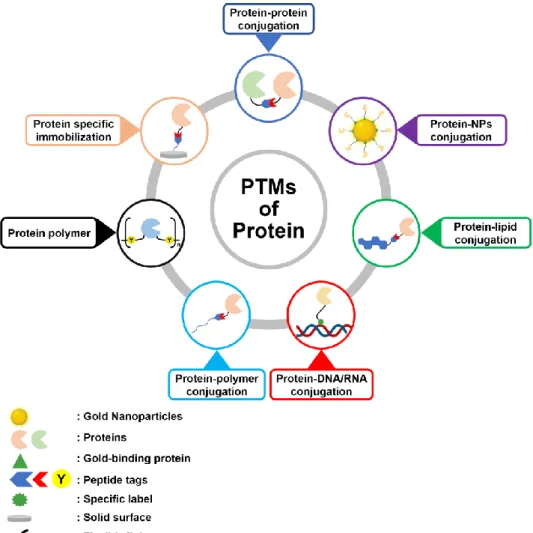
as wide options of catalyst, the high yield of conjugates, and a simple reaction. The concept of natural PTMs also can be applied for the preparation of broad types of artificial protein conjugates, including protein-protein [20-22], protein-NPs [23,24], protein-polymer [25-27], protein-lipid [28,29] and protein-nucleotides conjugates [30] as well as specific protein immobilization on a specific solid surface (Figure 1.1) [31]. The PTMs have also been extended to broad methods of protein conjugates preparation such as chemical, enzymatic, chemo-enzymatic, metal and photo triggered cross-linking, and self-assembly. Therefore, the idea of PTMs are useful and effective for modification and conjugation of proteins.
Figure 1.1 A variety of proteinaceous materials prepared through post-translational modifications (PTMs). Native and engineered proteins can be employed as protein targets or models in the PTMs.
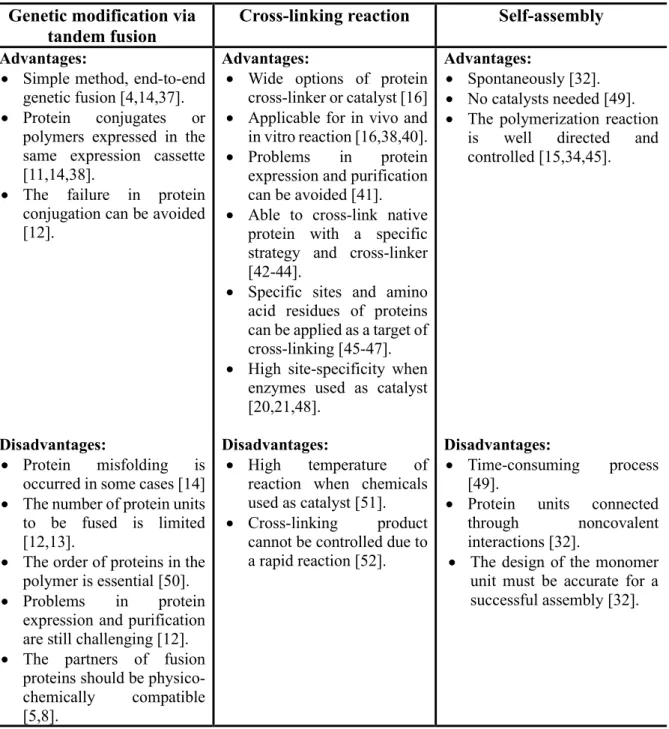
Cross-linking reaction and self-assembly of proteins are two primary methods that commonly applied in the preparation of protein polymers. Both methods offer simplicity and specificity of the reaction. Importantly, compared to genetic modification, both methods are also applicable to avoid problems in protein expression. The cross-linking reaction of proteins is a powerful method for preparing many types of protein conjugates and protein polymers as well, which offers covalent bond formation to connect protein units of protein polymers. It needs a catalyst to perform the cross-linking reaction. While self-assembly of protein units to form protein polymers via noncovalent interactions offers some benefits such as spontaneous, controlled, designed, and self-organized reactions (Figure 1.2) [32]. It utilizes the noncovalent interactions to supervise the self-assembly of protein units, which offers the possibility to imitate the characteristics of native proteins. The non-covalent interactions are applied to control the assembly by facilitating the connection of protein units [33]. Compared to the covalent polymerization using chemicals or enzymes, self-assembly processes are reversible, dynamic, and directional [15,34,35]. Besides, the self-assembly method endows new non- covalent protein polymers with some attractive properties such as self-healing, stimuli- responsiveness, processability, recyclability etc. [36]. However, self-assembly needs an accurate design of the monomer unit. According to the simplicity, accessibility, and availability of catalyst of reaction provided by cross-linking reaction methods, makes it a better strategy in the preparation of protein conjugates and polymers. Table 1.1 shows the summary of the comparison of both strategies in the preparation of protein polymer. The cross-linking reaction methods provide more advantages than genetic medication via tandem fusion methods.
Figure 1.2 Three common strategies in the preparation of protein conjugates or protein polymers. Genetic modification through tandem fusion is a method commonly used for protein fusion preparation. Two or more genes encoding proteins were fused and engineered to one expression cassette. There are neither covalent nor noncovalent bond formation involved in this method. Another two common strategies are cross-linking and self-assembly of reaction of proteins. The protein cross-linking reaction is a method of joining protein that can be conducted through in vivo or in vitro reaction. Chemicals and enzymes commonly catalyze the formation of a covalent bond between protein units. The self-assembly methods are also applicable in the preparation of protein conjugates and polymers. It provides some options for noncovalent interactions to connect the protein units in the polymers. Both cross-linking and self-assembly reactions need genetically engineered proteins to perform the reaction. Proteins with specific peptide tags or sequences can assist the site-specific cross-linking or self- assembly reaction. The arrow in blue, red, and yellow; red circle; yellow and green rectangular indicating the peptide tags for cross-linking and self-assembly reaction.
Table 1.1 Comparison of two common strategies in the preparation of protein polymer Genetic modification via
tandem fusion
Cross-linking reaction Self-assembly Advantages:
• Simple method, end-to-end genetic fusion [4,14,37].
• Protein conjugates or polymers expressed in the same expression cassette [11,14,38].
• The failure in protein conjugation can be avoided [12].
Advantages:
• Wide options of protein cross-linker or catalyst [16]
• Applicable for in vivo and in vitro reaction [16,38,40].
• Problems in protein expression and purification can be avoided [41].
• Able to cross-link native protein with a specific strategy and cross-linker [42-44].
• Specific sites and amino acid residues of proteins can be applied as a target of cross-linking [45-47].
• High site-specificity when enzymes used as catalyst [20,21,48].
Advantages:
• Spontaneously [32].
• No catalysts needed [49].
• The polymerization reaction is well directed and controlled [15,34,45].
Disadvantages:
• Protein misfolding is occurred in some cases [14]
• The number of protein units to be fused is limited [12,13].
• The order of proteins in the polymer is essential [50].
• Problems in protein expression and purification are still challenging [12].
• The partners of fusion proteins should be physico- chemically compatible [5,8].
Disadvantages:
• High temperature of reaction when chemicals used as catalyst [51].
• Cross-linking product cannot be controlled due to a rapid reaction [52].
Disadvantages:
• Time-consuming process [49].
• Protein units connected through noncovalent interactions [32].
• The design of the monomer unit must be accurate for a successful assembly [32].
The advantages offered by the cross-linking reaction make them the most recommended and useful in the preparation of protein polymers. However, due to its wide option of catalysts, the strategy in the preparation of protein models or target as well as the catalyst selection needs carefully considerations. Thus, a proper strategy and catalyst are the two most important factors for a successful cross-linking reaction for protein polymers preparation.
1.2 Cross-Linking Reaction of Proteins
The cross-linking reaction of protein is described as the reaction of joining two or more proteins through covalent bonds. It can create newly assembled macromolecules that have functionalities and physicochemical characteristics that are originated from the individual protein units [16]. However, in some cases, the characteristics of cross-linked proteins are different from the single unit of protein depending on the structure of the polymeric products.
Notably, the protein cross-linking reaction to form a large biomolecule has a substantial impact on the characteristics of proteins monomers due to the multivalency effect of the protein units in the resulting polymeric structure of proteins [2,15]. This effect may lead to the different functionality and activity of the protein polymer with its monomers.
The new covalent bonds between protein monomers comprising of a protein polymer can be formed by the catalyzation of chemicals [53-55], enzymes [22,45,56,57], chemoenzymatic [58,59], metals [2,60] and lights [61]. While fusion proteins prepared by genetic fusion did not involve the covalent bond formation to connect the protein units. The crucial step is designing a peptide linker to connect the protein units (Figure 1.2). The sequence of amino acids, flexibility, and properties of the linker can affect the preparation of protein fusion [4,11-13].
Moreover, compared to tandem fusion for protein conjugation, which only can be done through in vivo reaction, the cross-linking reaction can be conducted by in vivo and in vitro reaction.
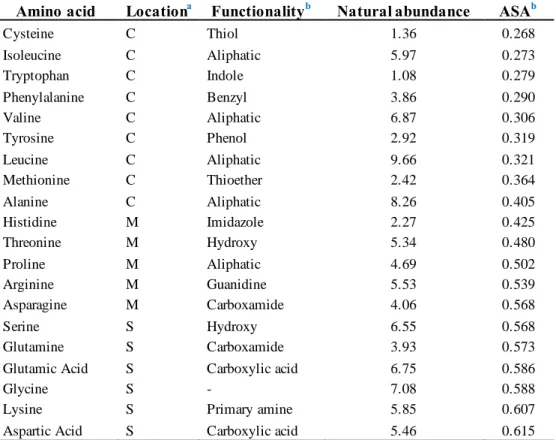
The cross-linking reaction also can target some natural amino acids (NAA) for modification sites. However, not all amino acids are accessible due to the location of amino acids on the surface of proteins and their abundance as well. Some natural amino acids: serine, glutamine, glutamic acid, glycine, lysine, and aspartic acid, were located on the surface of proteins (Table 1.2). They also have a high value of average surface accessibility (ASA), which means that they can be recognized and reacted with the catalyst in a cross-linking reaction. Another amino acid also can be targeted as the modification site; however, further modifications are needed
[62]. Some researchers also applied non-natural amino acids (NNAA) for cross-linking reaction or specific labeling of proteins. However, engineering a protein with NNAA needs careful consideration, since most enzymes cannot recognize it. The further chemical reaction is needed to modify or to cross-link NNAA of a protein. Thus protein cross-linking through existing NAA is preferable for most researchers.
Table 1.2 The amino acids used as a target in protein cross-linking reaction: amino acid, location, functionality, natural abundance, and their average surface accessibility.
aLocation of the amino acids in the core (C), intermediate (M) and surface (S)
bAverage surface accessibility
Reprinted from ref. 62. Copyright 2011 with permission from Springer Nature.
Amino acid Locationa Functionalityb Natural abundance ASAb
Cysteine C Thiol 1.36 0.268
Isoleucine C Aliphatic 5.97 0.273
Tryptophan C Indole 1.08 0.279
Phenylalanine C Benzyl 3.86 0.290
Valine C Aliphatic 6.87 0.306
Tyrosine C Phenol 2.92 0.319
Leucine C Aliphatic 9.66 0.321
Methionine C Thioether 2.42 0.364
Alanine C Aliphatic 8.26 0.405
Histidine M Imidazole 2.27 0.425
Threonine M Hydroxy 5.34 0.480
Proline M Aliphatic 4.69 0.502
Arginine M Guanidine 5.53 0.539
Asparagine M Carboxamide 4.06 0.568
Serine S Hydroxy 6.55 0.568
Glutamine S Carboxamide 3.93 0.573
Glutamic Acid S Carboxylic acid 6.75 0.586
Glycine S - 7.08 0.588
Lysine S Primary amine 5.85 0.607
Aspartic Acid S Carboxylic acid 5.46 0.615
1.2.1 Chemical Cross-Linking Reaction of Proteins
The application of enzymes as a catalyst for synthetic organic chemistry has increased significantly for the past three decades. Most of the nonspecific approaches of the chemical cross-linking reaction of proteins are to observe the effect of cross-linking reaction on the protein stability, designing novel enzymes or proteins with high selectivity, activity, and stability. The cross-linking reaction can be accomplished by a massive variety of chemicals as cross-linkers with distinct properties and aim for different reactive groups on the proteins [56].
It is ranging from organic to inorganic chemical reagents. Some commercial products of protein cross-linkers are now also available and provide a high yield of protein conjugates. However, the use of chemicals as a catalyst in the protein cross-linking reaction is not site-specific, fairly high temperature of the reaction, and organic solvents that requires to solubilize chemicals can cause protein deactivation and denaturation in most cases. Therefore, the selection of strategy and chemical reagents is a crucial step in the preparation of chemical cross-linking of proteins.
Table 1.3 shows the reactive groups that commonly become the target in chemical cross- linking as well as protein modifications. The reactive groups that commonly used are —NH2,
—COOH, —SH, —OH, and aryl—OH. Even though other amino acids have a lower value of ASA, it is still possible to become a target of a cross-linking reaction. Some reactive groups such as thioether, imidazole, and guanidino were rarely used and reported due to the lack option of chemicals. Small chemical molecules can avoid the steric hindrance of the proteins and react with the hidden amino acids.
Most of the chemical reactions that involve in protein cross-linking reaction are substitution, oxidation, and an addition reaction. In consequence, the substitution and addition reaction involve the leaving groups, which is varied based on the chemicals used. Moreover, activation of nucleophiles also needed and essential to initiate the reaction. Such activation requires some catalyst and specific solvent and temperature. It makes the chemical cross-
linking takes more time than enzymatic cross-linking that can proceed within minutes. In the next session, the reactive groups that commonly used in the chemical cross-linking of proteins are briefly explained.
Table 1.3 List of chemical agents that used as a catalyst in cross-linking reaction.
1.2.1.1 Primary amines
The conventional methodologies for the cross-linking reaction of protein are selected by taking advantage of the functional groups reactivity of the said chain of amino acids [78]. A typical
Reactive group Amino acid Chemical agents
Primary amine
N-Terminus
ε-amino group of Lysine
Triazolecarbaldehyde [63], Glutaraldehyde [51], Formaldehyde [64], Isothiocyanate [65], Sulfonyl chloride [65], Disuccinimidyl suberate [66], Succinimidyl acetate [67], N-hydroxy- sulfosuccinimide (Sulfo-NHS) [68]
Guanidino group
Arginine α-dicarbonyl compounds through Maillard reaction [69-71]
Thiol
Cysteine Maleimide, haloacetamides [53], vinyl sulfone [72]
Hydroxyl
Serine Threonine
Hydrazide [73]
Phenol
Tyrosine Metalloporphyrins [55], Palladium porphyrins [61], thioesters of glutathione (GS-thioesters) [74], formaldehyde through Mannich-Type reaction [75]
Thioether
Methionine Iodoacetic acid [76]
Imidazole
Histidine 4-hydroxynon-2-enal (HNE) [77]
Carboxylic acid
C-Terminus Aspartic acid Glutamic acid
1-ethyl-3-(3-dimethylaminopropyl) carbodiimide (EDC) [68]
cross-linking reaction based on NAAs is commonly simple and easy to conduct. It does not require specialized techniques. The primary amines of proteins can provide reactivity by just becoming reactive nucleophiles. Lysine exists in most of proteins and is commonly on the protein surface. Lysine comes up with approximately 10% of the overall amino acid sequence of a protein [31]. It has good stability and very reactive against electrophilic agents without any activation steps. Therefore, lysines are the most used for the nonspecific covalent cross- linking reaction.
N-hydroxysuccinimide (NHS) esters are the most used chemicals to react with primary amine groups to form a stable peptide bond. This method has been reported by Wang Group, who immobilized a protein called ricin. Ricin is a protein that inhibits the synthesis of protein.
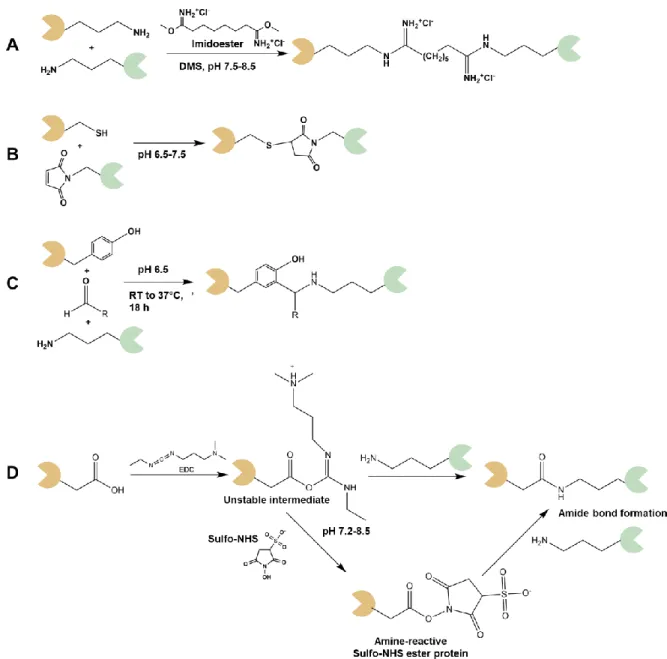
They used NHS ester to cross-link ricin on a gold surface. Ricin has nine exposed lysine residues and can react with NHS ester [68]. The reaction of ricin with NHS ester also can be applied to analyze the side of the ricin structure. The AFM analysis observed that single ricin molecules have different structures because of the covalent coupling of the lysines. Imidoesters also applicable to cross-link the protein through primary amines or lysines (Figure 1.3A). The amine group of a protein could attack the carbonyl groups of imidoesters to form a stable intermediate. Another carbonyl can be attacked by another protein to form protein conjugates.
Therefore, the amine–amine coupling is useful and not involving the prior modification of proteins.
1.2.1.2 Thiols
The thiol is a stronger nucleophilic than a primary amine (at pH below 9.0 lysines are protonated). Cysteine could become a promising tag for protein cross-linking reactions because multiple contacts can be avoided. If the proteins do not have free cysteines, it could be inserted by a site-directed mutagenesis method. A typical chemical cross-linker to cross-link or
coupling the protein via thiols groups is that of maleimides (Figure 1.3B) [53]. It reacts with cysteines stoichiometrically with high efficiency and specificity. The reduced protein is commonly used in maleimide-cysteine coupling reactions. Dithiothreitol (DTT) is commonly applied to prevent the disulfide bridges formation and inactivate the cysteines. The removal of those reducing agents is mandatory for avoiding the rivalry among the target thiol and thiol of the reducing agent. The cross-linking reaction must be conducted instantly right after DTT removed to prevent reoxidation of the thiols. The maleimide-modified proteins can react with other thiols groups and connect the proteins covalently. Ménard and co-workers reported a site- specific reaction of a cytochrome P450 enzyme from human through a maleimide-cysteine coupling [53]. The cytochrome P450 enzyme was cross-linked on agarose beads and silica microspheres that functionalized with maleimide. They mutated other cysteines, allowing the cytochrome P450 enzyme to cross-link on the solid supports site-specifically. Interestingly, cytochrome P450 enzyme was found to still be active after the cross-linking reaction.
1.2.1.3 Phenols
The existence of tyrosines on protein surfaces is moderately rare. It has a low value of ASA and commonly located in the core part of proteins. However, it is possible to introduce it to the protein surface genetically, without changing the redox sensitivity or overall charge state.
Tyrosines are frequently overrepresented close to the protein active sites. Therefore, aiming tyrosine residues for cross-linking reaction requires thorough attention.
Francis and co-workers reported an interesting reaction of protein cross-linking using tyrosine. They applied the Mannich-type reaction for selective bioconjugation of protein through tyrosine residues (Figure 1.3C). Interestingly, they finished the reaction in mild conditions of reaction (pH 6.5 at RT to 37°C). However, reaction time still becomes a problem.
It took 18 hours to complete the reaction [75]. This reaction is going to substitute the common reaction, which requires significant heating and concentrated formaldehyde.
Kim and co-workers reported another approach in the protein cross-linking through tyrosine residues in 2011. They used a special chemical Pd(II)-5,10,15,20-tetra- (methylpyridinium)porphyrin (Pd(II)TMPyP). An electron acceptor was also added to the reaction to mediate the formation of free tyrosil radicals from tyrosine residues of proteins. The formation of radical porphyrin cation was led by the transfer of electron from the palladium porphyrins to ammonium persulfate (APS) as an electron acceptor. This reaction is swift; only 5 seconds required to connect the protein through cross-linking reaction. However, this reaction is the requirement of an electron acceptor, which may oxidize the protein target or some cellular components if we used membrane proteins as the target [61].
1.2.1.4 Carboxyl group
The protein cross-linking reaction utilizing the carboxylic acid reactive group is interesting and promising since the aspartic and glutamic acid found a main portion of the surface exposed amino acids. The carboxyl group can react with amines using the common coupling reagents, which also used for peptide synthesis. The EDC or N,N-dicyclohexyl carbodiimide (DCC) is commonly used to activate the carboxyl group and resulting in the peptide bond formation of proteins (Figure 1.3D) [68].
1.2.1.5 Other reactive groups
Tryptophan is another attractive target of amino acid for the modification of proteins. The use of rhodium carbenoid reagents has been reported to modify protein through the indole side- group and resulted in the formation of alkylated indoles. However, this reaction requires low pH conditions (pH 1.5−3.5), which could have unfavorable effects on the proteins [75].
Figure 1.3 Schematic reaction of some common chemical cross-linking reactions targeting some reactive groups. (A) the reaction of imidoester with primary amine groups in DMS. (B) the reaction of the thiol group of protein with a maleimide-modified protein in a mild condition reaction. (C) the reaction of tyrosine and lysine in the presence of formaldehyde (Mannich reaction) proposed by Francis and co-worker. This reaction conducted in mild conditions of reaction and takes 18 hours. (D) reaction if the carboxyl group with EDC. It produces a reactive intermediate product which can react further with sulfo-NHS or with a primary amine group of lysine, resulting in a newly formed amide bond.
The site-specificity is still a significant concern in the chemical cross-linking reaction of proteins—lack of specificity resulting in the formation of heterogeneous products. The selective modification of a protein by using chemicals is possible and to be successful for reactions that used engineered proteins, for example, the engineered protein with site-directed
mutagenesis or specifically labeled-proteins. Chemical cross-linking reaction of genetically engineered proteins is a better strategy than the use of native proteins as a target of proteins.
One of the common approaches is the alkylation reaction of tyrosine or cysteine-modified proteins due to the low abundance of cysteines and strong nucleophilicity of the thiolate anion.
However, once again, the site-specificity and effectivity of the chemical cross-linking reaction of proteins will be determined by the catalyst. Thus, the selection of a catalyst is a crucial issue in the chemical cross-linking of proteins.
Enzymes are known as better options to substitute chemical agents in most of chemical reactions including the cross-linking reaction of peptides, proteins, and chemicals. The site- specific reaction is the most interesting feature of enzymes in the cross-linking reaction of proteins. The enzymes will only recognize and react with a specific residue or sequence of the proteins, which is very useful in the design of the protein targets. Although the enzyme options for the cross-linking reaction of proteins are not as much as chemical agents, however, it is not a limitation to applying it as a catalyst in the cross-linking reaction of proteins.
1.2.2 Enzymatic Cross-Linking Reaction of Proteins
Enzymatic cross-linking reaction for protein modifications has been attracting researchers due to its high site-specificity of reaction. The amino acid targets in the enzymatic cross-linking reaction of proteins are not as much as a chemical cross-linking reaction. It is reasonable since a large molecule and complex structure of enzymes cannot recognize and react with hidden amino acids. Enzymes would be a powerful catalyst for the cross-linking reaction of proteins if it reacted with genetically modified target proteins, which harboring specific peptide or sequence tags [7,16,18,21]. Reactive and specific peptides or sequence tags are essential for enzymatic cross-linking. For example, the protein cross-linking reaction catalyzed by horseradish peroxidase (HRP) [21,57,79-81], laccase [48,52,82-84], lysyl oxidase [85],
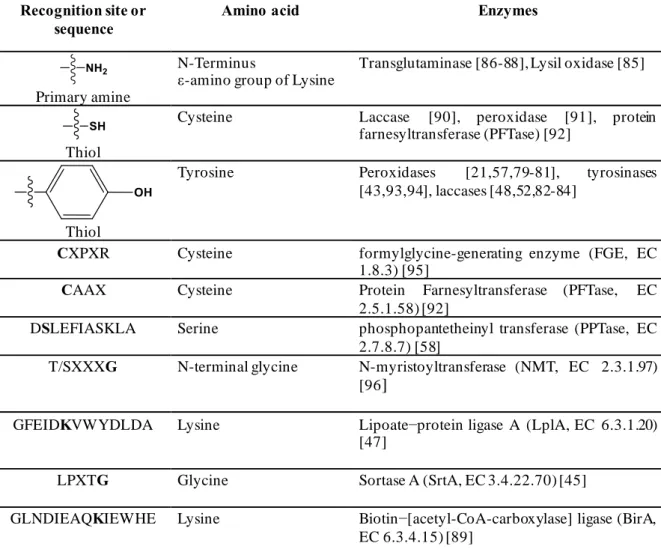
transglutaminase [86-88], lipoic acid ligase [47], biotin ligase [89], bacterial sortase [45], and phosphopantetheinyl transferase (PFTase) [58] require additional peptide or sequence tags for successful site-specific cross-linking reaction. However, the protein ubiquitination, which involves enzymatic cascade reaction, has not been considered for cross-linking applications due to its complexity of the enzymes and the ATP dependence reaction. The cross-linking reactions can be distinguished based on the reaction mechanism, i.e., (1) covalent bond formation through reactive intermediates or species catalyzed by oxidoreductases, and (2) direct covalent bonding formation catalyzed by transferases, hydrolases, and peptidase via proteinyl–enzyme–thioester intermediates.
Table 1.4 List of enzymes that used as catalyst in cross-linking reaction.
Recognition site or sequence
Amino acid Enzymes
Primary amine
N-Terminus
ε-amino group of Lysine Transglutaminase [86-88], Lysil oxidase [85]
Thiol
Cysteine Laccase [90], peroxidase [91], protein farnesyltransferase (PFTase) [92]
Thiol
Tyrosine Peroxidases [21,57,79-81], tyrosinases [43,93,94], laccases [48,52,82-84]
CXPXR Cysteine formylglycine-generating enzyme (FGE, EC 1.8.3) [95]
CAAX Cysteine Protein Farnesyltransferase (PFTase, EC 2.5.1.58) [92]
DSLEFIASKLA Serine phosphopantetheinyl transferase (PPTase, EC 2.7.8.7) [58]
T/SXXXG N-terminal glycine N-myristoyltransferase (NMT, EC 2.3.1.97) [96]
GFEIDKVWYDLDA Lysine Lipoate−protein ligase A (LplA, EC 6.3.1.20) [47]
LPXTG Glycine Sortase A (SrtA, EC 3.4.22.70) [45]
GLNDIEAQKIEWHE Lysine Biotin−[acetyl-CoA-carboxylase] ligase (BirA, EC 6.3.4.15) [89]
1.2.2.1 Transferases
Transferases catalyze a reversible transfer of chemical groups from a molecule to other molecules. Transpeptidation reaction is one of the examples which has been investigated to connect two different proteins through two peptide sequences. Fructosyltransferase and transglutaminase are some of the typical industrial transferases. They are commonly used in food processing industry: another transferase, carbohydrate transferases, also applicable to cross-link proteins with glycans.
Transglutaminases (TGs, EC 2.3.2.13) is an acyltransferase that catalyzes the transfer reaction of a γ-carboxyamine group of glutamines to the ε-amine group of lysines (Figure 1.4A). Some of TGs are calcium-dependent enzymes. TGs catalyzes the deamination of glutamine by water-assisted hydrolysis if there are no amine substrates in the mixture. Some transferases require a peptide sequence for their activity in PTMs. One of example is protein farnesyltransferase (PFTase) (EC 2.5.1.58), which catalyzes the transfer of farnesyl diphosphate analogs to protein substrates on a cysteine residue of CAAX recognition sequence from C-terminus (Figure 1.4B) [92]. Another example is phosphopantetheinyl transferase (PPTase) (EC 2.7.8.7), which catalyzes the transfer coenzyme A to the protein for the further installation of the 4′-phosphopantetheine to a serine residue on the POI. The transfer of 4′- phosphopantetheine is releasing ADP to the conserved DSLEFIASKLA motif (Figure 1.4C) [58].
N-myristoyl transferase (NMT) (EC 2.3.1.97) is an enzyme that can catalyze the addition of myristic acid analogs to proteins through an N-terminal glycine residue transformation of proteins through a T/SXXXG signaling motif (Figure 1.4D) [96]. Lipoate−protein ligase A (LplA) (EC 6.3.1.20) is an enzyme that catalyzes the acylation of lysine residues of the GFEIDKVWYDLDA tag. Interestingly, azide acid and coumarin analogs are also recognized by LplA, given a suitable length of the methylene linker (Figure 1.4E) [47].
Figure 1.4 Schematic illustration of the enzymatic cross-linking reaction catalyzed by transferases. (A) transglutaminases (TGs) catalyze the transfer reaction of a γ-carboxyamine group of glutamines to the ε-amine group of lysines to form cross-linked proteins. (B) The PFTase catalyzes the transfer of farnesyl diphosphate analogs to protein substrates on a cysteine residue of the CAAX recognition sequence from C-terminus. (C) PPTases which catalyze the transfer coenzyme A to the protein for the further installation of the 4′- phosphopantetheine to a serine residue on the POI. The transfer of 4′-phosphopantetheine is releasing ADP to the conserved DSLEFIASKLA motif. (D) is an enzyme that can catalyze the addition of myristic acid analogues to proteins through a T/SXXXG signaling motif. (E) Lipoate−protein ligase A that catalyzes the acylation of lysine residues of the GFEIDKVWYDLDA tag.
1.2.2.2 Hydrolases
The hydrolases have been used in various industries, including fine chemical production, leather, food, textiles, and animal nutrition. Most of the hydrolases are produced on a large scale, delivering rapid access to the researchers. Hydrolases catalyze hydrolysis reaction of specific bonds, such as hydrolysis of C−N bonds of a peptide by the peptidases. Hydrolases cover approximately 75% of commercial hydrolytic enzyme sales. Hydrolases mostly applied for cutting existing peptide bonds rather than forming them.
A common hydrolase that applied for protein cross-linking experiments is sortase. Sortases catalyze the cross-linking reaction of proteins that signaling a specific sequence, LPXTG. It is a calcium-dependent enzyme. Sortase A (SrtA) (EC 3.4.22.70) is the best example of sortases which isolated from Staphylococcus aureus [45]. It has been used widely by researchers for modifying proteins. Although SrtA is more appropriately defined as a transpeptidase. The cysteine residues on the active site of SrtA cleaves the amide bond of Thr−Gly of LPXTG of the target protein, to form an intermediate called protein-enzyme-thioester. Next, the amine as a nucleophile attacks the intermediate of enzyme-acyl-protein to form a peptide bond. The amine group of the oligoglycine then catalyzes the discharge of the protein from SrtA. This mechanism involving polyglycine inspired the researchers to design accurate substrates for SrtA-catalyzed cross-linking reaction.
Figure 1.5 A common hydrolase that applied for protein cross-linking experiments is sortase.
Sortases catalyze the cross-linking reaction of proteins that signaling a specific sequence, LPXTG
1.2.2.3 Ligases
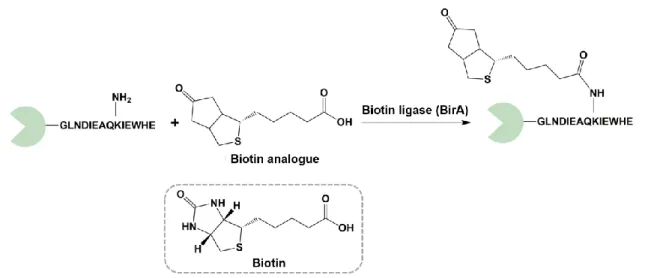
Ligases are enzymes that catalyze the bond formation between two molecules. Because they require ATP or expensive cofactor rejuvenation for their enzymatic activity, it makes them rarely employed in industrial processes. The biotin−ligase (BirA) EC 6.3.4.15) from Escherichia coli is a ligase cofactor that playing an essential role in the biotin covalent attachment to a lysine within a long peptide sequence tag GLNDIEAQKIEWHE [89]. It is most
studied by researchers due to its functionality to recognize biotin analogs, which enables the biorthogonal fusion of chemical derivatives into the peptide backbone of the POI.
Figure 1.6 The biotin−ligase is a cofactor ligase that playing an essential role in the biotin covalent attachment to a lysine within a long peptide sequence tag GLNDIEAQKIEWHE.
The three major groups of enzymes above are beneficial in the preparation of protein conjugates and protein labeling. However, they cannot be employed in the polymerization reaction of proteins due to their limitation in the reaction. They cannot conduct oxidation reactions on the substrates to form a reactive free radical, which is required for non-enzymatic polymerization reaction of proteins. There are some enzymes in oxidoreductases family which can oxidize substrate and form free radicals, which initiates the cross-linking reaction between proteins. The free radicals coupling occurs non-enzymatically without the formation of tripartite complexes like other enzymes. Therefore, oxidoreductases could become good options to be employed as a catalyst in the polymerization reaction of proteins.
1.2.2.4 Oxidoreductases
Oxidoreductases (EC1) are well known as enzymes that catalyze reduction and oxidation (redox) reactions. The members are tyrosinases, laccases, peroxidases, catalases, and glucose oxidases. Most of them are produced on an industrial scale. There are also some commercially
available oxidative enzymes for protein functionalization, such as lysyl oxidase, sulfhydryl oxidase, and formylglycine-generating enzyme (FGE).
Tyrosinases (EC 1.14.18.1) catalyze the four-electron oxidation of tyrosine residues to o- quinones. It also oxygen-dependent enzymes. The formed quinones can easily cross-link with cysteinyl, lysyl, or tyrosyl residues (Figure 1.5A) [97]. Tyrosinase-catalyzed cross-linking reaction of proteins is an appealing transformation for the pharmaceutical or food company because they produce water as a sole byproduct.
Lysyl oxidases (EC 1.4.3.13) are amine oxidases. It also copper-dependent enzymes, as same as other oxidoreductases. It is found in the cross-linking reaction of elastin chains and collagen, followed by a simultaneous reduction of O2 to H2O2. The lysine side chain oxidized by lysil oxidase to formaldehyde, which applicable to produce cross-linked products through two different pathways (Figure 1.7B). In the first pathway, the aldehyde (from oxidation reaction of amine) can react with other aldehyde groups of protein to form an aldol product.
The second pathway, a Schiff base formation through the reaction with amine of the second lysine with the aldehyde [85].
Sulfhydryl oxidases (EC 1.8.3.2) are another oxidoreductase, which provides site-specific oxidation reaction [91]. It is a flavin-dependent oxidase. It catalyzes the oxidation of cysteine residues of proteins to form disulfide bonds by using molecular oxygen and produced H2O2 as a byproduct. Sulfhydryl oxidases are interesting biocatalysts due to its activity to catalyze intra- and intermolecular disulfide bond formation of proteins.
Peroxidases (EC 1.11.1.7) also form free radicals from proteins that can cross-link the proteins. It typically reacts not only with tyrosine but also with lysine and cysteine and resulting in heterogeneous products. However, tyrosine residues are preferable to react with peroxidases than other residues (Figure 1.7C). Further protein modifications are needed to proceed with the site-specific cross-linking of protein catalyzed by peroxidases. For example, introducing
tyrosine residues exposed to the surface of the proteins [22,79,98]. The significant problem of peroxidases in the H2O2 which is required in the reaction as an electron acceptor. The extra amount of H2O2 is harmful and unacceptable in food and pharmaceutical products.
Laccases (EC 1.10.3.2) are multi-copper enzymes that primarily employed textile and pulp industries as a catalyst for the degradation of aromatic polymers. It catalyzes the oxidation reaction of phenolic compounds using molecular oxygen results in the formation of free radicals and water (Figure 1.7C). The free radicals can undertake radical reactions, such as polymerization, hydration, disproportionation, and fragmentation. Laccase-catalyzed cross- linking reaction is commonly producing heterogeneous products, guiding to the dityrosine, isodityrosine formation, or a higher degree of tyrosine coupling, and disulfide intermolecular bonds of proteins. Laccases become an exciting option for the food industry because the sole by-product is water. Thus, recent reports on laccase-mediated modification of food proteins show a promising strategy and results which will expand the utility of laccases in PTMs.
Figure 1.7 Schematic illustration of the enzymatic cross-linking reaction catalyzed by oxidoreductases. (A) The oxidation reaction of phenolic moieties of tyrosine by tyrosinase to form a quinone and further protein cross-linking with another protein. (B) Lysil oxidase oxidizes the protonated primary amine group to form an aldehyde group, which followed by the polymerization reaction of protein through two pathways. (C) laccases and peroxidases
Peroxidases and laccases are a promising catalyst for the polymerization reaction of proteins due to their activity to catalyze the oxidation reaction of the substrate to form very reactive free radicals. They also commercially available, which makes them easier to be applied in the various polymerization reaction of proteins. Peroxidases have been applied in many polymerization reactions of proteins than laccases. Although they have the same mechanism of the reaction, however, one of the major differences is the source of oxygen for the oxidation reaction. Laccases use O2 as its terminal oxidant, while peroxidases use H2O2. The presence and excessive concentration of H2O2 are harmful to most protein and unacceptable in food and pharmaceutical products. Therefore, laccases can become an alternative and replace the use of peroxidases in the polymerization reaction of proteins.
1.2.3 Effect of structure of model proteins on the reactivity of laccase
Laccases can oxidize some amino acid residues, including tyrosine, cysteine, and tryptophan.
According to Table 1.1, those amino acids are in the core domain of most proteins. Additionally, their ASA value is extremely low, which is mean that it is hard to be recognized and reacted with a massive molecule like enzymes. Modification of protein is required to perform the cross- linking reaction catalyzed by laccase. Mattinen and co-workers investigated the effect of the structure of the protein model, coactosin, on the laccase-catalyzed cross-linking reaction. There are four tyrosines, two cysteines, and two tryptophan, on the structure of coactosin. However, only tyrosine residue at the position 137 of amino acid sequence or Y137 is exposed to the surface of coactosin (Figure 1.8A) [90]. Tyrosine is preferable to oxidize by laccase than other amino acids. It is reasonable since the oxygen consumed less oxygen than other amino acids, which makes the reaction faster and efficient (Figure 1.8B). However, coactosin also perform better in oxygen consumption experiment than cysteine and tryptophan due to the presence of Y137. The presence of Y137 was also responsible for the formation of dimer, trimer, and
tetramer of coactosin (Figure 1.8C). The Trametes hirsuta laccase (ThL) recognized and oxidized Y137 to form oligomers of coactosin. Interestingly, the absence of Y137 in truncated coactosin resulted in an unreacted monomer of coactosin (Figure 1.8D). It suggests that ThL reacted with coactosin site-specifically only with Y137. There are another three tyrosine residues on the coactosin; however, ThL did not recognize it as its substrate. The position of tyrosine residues and steric hindrance could become the reasons that caused this finding.
Another problem is that the activity of ThL in the polymerization reaction of coactosin was prolonged. Regarding the oxygen consumption results, it takes more than 2 hours to oxidize the coactosin. Figure 1.8C shows that the dimers of coactosin were formed after 2 hours of reaction. While trimer and tetramer were formed after 3 hours of reaction. It suggests that the structure of coactosin also affected its reactivity against ThL. These findings were clearly showing the importance of the protein structure and available tyrosine for a successful laccase- catalyzed polymerization reaction of proteins. The proper structure of the protein model could improve the reactivity of protein against laccase, which may lead to a rapid polymerization reaction of proteins.
Figure 1.8 (A) the 3-D structures of coactosin (full-length); tyrosine residues (four) are shown in purple, cysteine residue (two) in yellow, and tryptophans (two) in blue. (B) time course experiment of oxygen consumption in Trametes hirsuta laccase (ThL)-catalyzed reactions with tyrosine, cysteine, and tryptophan and coactosin. (C) results of SDS-PAGE analysis of cross- linking reaction coactosin catalyzed by ThL. In lanes 4−9: incubation time (2, 3, 4, 5, 6, and 24 h); and lane 10: sample from the oxygen consumption measurement. (D) results of SDS- PAGE analysis of cross-linking reaction of truncated coactosin. In lanes 4−10: incubation time (1, 2, 3, 4, 5, 6, and 24 h). Reproduced from ref.90 Copyright with permission from the American Chemical Society (ACS).
1.2.4 Phenolic acids-assisted cross-linking reaction of proteins
Most of the reports on laccase-mediated protein cross-linking reaction employed some chemical mediators to assist reaction. The mediators are useful to cross-link of native or unmodified proteins. The mediators are commonly phenolic acids, such as ferulic acid [82,99- 101], p-coumaric acid [43,101,102], caffeic acid [103], vanillic acid [42,101,104,105], and hydrolyzed oat spelt xylan (hOSX) [82]. Commonly it is added to the reaction mixture containing laccase and protein models. However, Hairan Ma and co-workers proposed a different approach in the use of a mediator. They employed a phenolic mediator, vanillic acid (VA), to modify the whey protein isolate (WPI) through a chemical reaction using NHS-ester,
to form a VA-modified WPI. The VA was attached to the lysine residues of WPI (Figure 1.9A). To confirm the attachment of VA to the MPI, they analyzed the MPI using a MALDI- TOF mass spectrum (Figure 1.9B). The changes in mass spectra confirmed the attachment of VA to MPI. The VA-MPI was then employed as a protein target in cross-linking reaction catalyzed by laccases. The reaction of unmodified MPI with laccase resulted in no oligomers and polymers formed. The MPI was remaining intact. It suggests that the laccase did not recognize MPI as a substrate (Figure 1.9C and F). While the additional free VA to the mixture also cannot cross-link the MPI. Although they increase the concentration of laccase from 0.15 to 0.60 U/mg of laccase, the MPI did not cross-link by laccase (Figure 1.9D and G). This result suggests that the additional mediators might somehow be not working to assist the laccase- catalyzed cross-linking reaction. Probably there are no tyrosine residues exposed to the surface that can react with free tyrosyl radicals of VA. The VA-MPI samples showed interesting results—cross-linked MPI with high molecular weight observed after incubated for 2 hours (Figure 1.9E). By increasing the incubation time, more polymeric MPI obtained, and almost all MPI monomer reacted with laccase. Additionally, the reaction time becomes shorter when the concentration of laccase increased four times from 0.15 to 0.60 U/mg of laccase. The polymeric MPI formed within 10 minutes (Figure 1.9H). These results suggest that modification of protein models is essential for the successful protein polymers formation. The modification also could minimize or even eliminate the use of mediators in laccase-catalyzed protein cross-linking reaction. Therefore, laccase, as well as enzymes-catalyzed cross-linking reaction is a combination of genetic modification of protein target and site-specific cross- linking reaction of enzymes. The genetic modification and strategy of the enzymatic reaction requires a careful consideration.
Figure 1.9 (A) Structure of vanillic acid, a mediator for a laccase in the cross-linking reaction of proteins. (B) Results of MALDI-TOF mass spectra analysis. Unmodified α-lactalbumin (a);
unmodified β-lactoglobulin (b); VA modified α-lactalbumin (A); VA modified β-lactoglobulin (B). (C-E) results of SDS-PAGE analysis of cross-linking reaction of unmodified and modified WPI with laccase (0.15 U/mg). (C) WPI+laccase; (D) WPI+2 mM free VA+laccase; (E) VA- WPI+laccase. (F-H) results of SDS-PAGE analysis of cross-linking reaction of unmodified and modified WPI with laccase (0.60 U/mg). (F) WPI+laccase; (G) WPI+2 mM free VA+laccase;
(H) VA-WPI+laccase. (C-E) Reaction time: lane 2-7, 0, 2, 4, 8, 6, 12, and 24 h. (F-H) Reaction time: lane 1-8, 0, 10, 20, 30 min, 1, 2, 4, 12 h. Reprinted from ref. 54. Copyright with permission from the American Chemical Society (ACS).
1.3 Laccase-Catalyzed Site-Selective Cross-Linking Reaction of Protein
Laccases were first isolated in 1883 from the lacquer tree, Rhus vernicifera [106]. It catalyzes the one-electron oxidation of substrates followed by four-electron reduction reaction of oxygen to form water. Laccase can also oxidize a broad range of inorganic and organic substrates, such as aromatic amines, phenol, non-phenols, and their derivatives. Laccase has been found in wide distribution in various fungi, some of higher plants, and bacteria [106]. White-rot fungi (WRF) are the most efficient laccase producers. WRF species were known can produce laccase, such
as Pycnoporus cinnabarinus, Trichoderma atroviride, Polyporus sp, Cladosporium cladosporioides, P. sanguineus, Trametes trogii, T. versicolor, Cerrena sp, and Ganoderma lucidum [107]. Peptides and proteins are known as weak substrates for laccases. It needs mediators, generally phenolic acids, to assist it in an enzymatic reaction against peptide or protein substrates. The good and GRAS grade of laccase has been developed by some companies, including Novozymes (Denmark) and Amano Enzyme Japan Co. Ltd. It is mostly employed in the baking industries.
1.3.1 Laccase-catalyzed site-selective cross-linking of tyrosine-tagged proteins
The use of enzymes can substitute the chemical agents that commonly and widely used in the cross-linking reaction of proteins. Enzymes offer a high site-specificity of the cross-linking reaction of proteins. It also offers mild conditions and rapid reaction. Laccases and peroxidases have the same mechanism of the reaction. They catalyze the oxidation of phenolic compounds to form free radicals, commonly free tyrosyl radicals, which will initiate the coupling reaction through a free radical mechanism. However, peroxidases require a chemical, hydrogen peroxide (H2O2), as an initiator to start the oxidation reaction. It became the most essential disadvantage of peroxidases.
Our research group has been employed a peroxidase, horseradish peroxidase (HRP), as catalyst for the cross-linking reaction of proteins [21,79,98] and preparation of redox- responsive hydrogels [108,109]. HRP provides a rapid protein cross-linking reaction. It also offers a site-specific cross-linking reaction of tyrosine-tagged (Y-tagged) proteins. Minamihata and co-workers in 2011 modified an Escherichia coli alkaline phosphatase (BAP) by adding a flexible linker with a tyrosine residue called Y-tag at the C-termini, which can be recognized by HRP. The Y-tagged BAPs was showing a significant reactivity against HRP and formed branched polymeric BAPs. However, they found that the enzymatic activity HRP-treated BAP
was slightly decreased after the reaction. The additional H2O2 could be responsible for the activity changes of BAPs. Another possibility is the large and branched polymeric structure of BAPs might affect its enzymatic activity.
Herein an alternative enzyme for the cross-linking reaction of proteins is explored.
Laccases are good candidates that can become an alternative or even substitute HRP in the preparation of protein polymers. Laccase provides the same site-specificity as HRP. One of the advantages of laccases is it only uses oxygen as the oxidant for the oxidation reaction of phenolic compounds. According to the site-specificity of laccases against tyrosine, tyrosine- modified proteins will become a good substrate for laccases.
1.3.2 Controlling laccase-catalyzed cross-linking reaction
Controlling free radicals-mediated polymerization reaction is of proteins is still become a problem. The use of chemicals to control or stop the enzymatic polymerization reaction could become an interesting approach. However, the chemical could deactivate and denature the protein polymer and the enzyme as well. The use of molecular quenchers should become another alternative strategy to control the free radicals-mediated polymerization reaction of proteins. One of the options of molecular quenchers is cysteine. The thiol group of cysteine could capture the radicals and utilize it to form a disulfide bond. Another appropriate strategy is by modifying the protein target to mediate the controllable protein cross-linking, which required accurate design and strategy of the protein models and reaction.
1.4 Aim and outline of the thesis
This research aims to develop protein polymers prepared by a laccase-catalyzed site-specific cross-linking reaction. The protein polymers then applied as diagnostic probes in enzymatic immunoassay (EIA).
In the Chapter 2, the potential of a laccase, Trametes sp. laccase (TL), as catalyst for the site-specific cross-linking reaction of proteins was studied. The engineered bacterial (Escherichia coli) alkaline phosphatase (BAP) and chimeric antibody-binding protein (pG2pAs) was applied as model proteins. Both proteins were engineered by adding a flexible linker containing tyrosine residue (Y-tags). The TL expected to recognize and oxidize the tyrosine residues of Y-tags to the formation of protein polymers. Unmodified BAP and pG2pA are used to validate site-specificity of TL-catalyzed protein cross-linking reaction.
In the Chapter 3, the recombinant HRPs fused with single or double Y-tag were constructed and expressed in silkworm, Bombyx mori. TL was used as catalyst the formation of free tyrosyl radicals from Y-tagged HRPs, which initiated the random nonenzymatic radical polymerization of the HRP units through the tyrosine coupling of Y-tags. The covalent dityrosine bond also can be formed through an HRP-catalyzed self-cross-linking reaction in the presence of H2O2. The self-polymerization of Y-tagged HRPs by the addition of H2O2 is compared with TL-catalyzed polymerization of Y-tagged HRP to check the site-selectivity, mild reaction conditions and activity retention of the polymeric products.
In the Chapter 4, a new strategy for the formation of linear polymerization of BAP through the site-specific cross-linking reaction catalyzed by TL was demonstrated. A peptide loop containing a tyrosine residue (Y-Loop) was introduced to BAP to construct BAP-Loop- Y mutant. The BAP-Loop-Y is expected to form protein polymers with different morphology due to the rigid and short structure of Y-Loop. The performance of resultant polymers and copolymers is validated by an immunoassay due to its ability to bind the analytes with a better conformation.
Finally, in the Chapter 5 the findings of this research are summarized and briefly discussed further direction related to this research.
1.5 References
[1] Raja, M. M. M.; Raja, A.; Imran, M. M.; Santha, A. M. I.; Devasena, K. Enzymes Application in Diagnostic Prospects. Biotechnology 2011, 10 (1), 51–59.
[2] Albayrak, C.; Swartz, J. R. Direct Polymerization of Proteins. ACS Synth. Biol. 2014, 3 (6), 353–362.
[3] Kim, C. H.; Axup, J. Y.; Schultz, P. G. Protein Conjugation with Genetically Encoded Unnatural Amino Acids. Curr. Opin. Chem. Biol. 2013, 17 (3), 412–419.
[4] Yu, K.; Liu, C.; Kim, B. G.; Lee, D. Y. Synthetic Fusion Protein Design and Applications. Biotechnol. Adv. 2015, 33, 155–164.
[5] Joly, J. C.; Wickner, W. The SecA and SecY Subunits of Translocase Are the Nearest Neighbors of a Translocating Preprotein, Shielding It from Phospholipids. Embo J 1993, 12 (1), 255–263.
[6] Wang, T.; Fan, X.; Hou, C.; Liu, J. Design of Artificial Enzymes by Supramolecular Strategies. Curr. Opin. Struct. Biol. 2018, 51, 19–27.
[7] Foley, T. L.; Burkart, M. D. Site-Specific Protein Modification: Advances and Applications. Curr. Opin. Chem. Biol. 2007, 11 (1), 12–19.
[8] Bell, M. R.; Engleka, M. J.; Malik, A.; Strickler, J. E. To Fuse or Not to Fuse: What Is Your Purpose? Protein Sci. 2013, 22 (11), 1466–1477.
[9] Bartels, L.; Ploegh, H. L.; Spits, H.; Wagner, K. Preparation of Bispecific Antibody- Protein Adducts by Site-Specific Chemo-Enzymatic Conjugation. Methods 2019, 154, 93–101.
[10] Wang, R.; Xue, Y.; Wu, X.; Song, X.; Peng, J. Enhancement of Engineered Trifunctional Enzyme by Optimizing Linker Peptides for Degradation of Agricultural By-Products. Enzyme Microb. Technol. 2010, 47 (5), 194–199.
[11] Rizk, M.; Antranikian, G.; Elleuche, S. End-to-End Gene Fusions and Their Impact on
the Production of Multifunctional Biomass Degrading Enzymes. Biochem. Biophys.
Res. Commun. 2012, 428, 1–5.
[12] Rullán-Lind, C.; Pietri, R. B.; Vázquez-Cintrón, M.; Baerga-Ortiz, A. Fused Dimerization Increases Expression, Solubility, and Activity of Bacterial Dehydratase Enzymes. Protein Sci. 2018, 27 (5), 969–975.
[13] Fan, L.; Wang, Y.; Tuyishime, P.; Gao, N.; Li, Q.; Zheng, P.; Sun, J.; Ma, Y.
Engineering Artificial Fusion Proteins for Enhanced Methanol Bioconversion.
ChemBioChem 2018, 19 (23), 2465–2471.
[14] Chen, X.; Zaro, J. L.; Shen, W.-C. C. Fusion Protein Linkers: Property, Design and Functionality. Adv. Drug Deliv. Rev. 2013, 65 (10), 1357–1369.
[15] Petkau-Milroy, K.; Uhlenheuer, D. A.; Spiering, A. J. H.; Vekemans, J. A. J. M.;
Brunsveld, L. Dynamic and Bio-Orthogonal Protein Assembly along a Supramolecular Polymer. Chem. Sci. 2013, 4 (7), 2886.
[16] Heck, T.; Faccio, G.; Richter, M.; Thöny-Meyer, L. Enzyme-Catalyzed Protein Cross- linking. Appl. Microbiol. Biotechnol. 2013, 97 (2), 461–475.
[17] Domeradzka, N. E.; Werten, M. W. T.; Wolf, F. A. d.; de Vries, R. Protein Cross- Linking Tools for the Construction of Nanomaterials. Curr. Opin. Biotechnol. 2016, 39, 61–67.
[18] Hussain, A. F.; Amoury, M.; Barth, S. SNAP-Tag Technology : A Powerful Tool for Site Specific Conjugation of Therapeutic and Imaging Agents. Curr. Pharm. Des. 2013, 19, 5437–5442.
[19] Chou, K. C. Progresses in Predicting Post ‑ Translational Modification. Int. J. Pept.
Res. Ther. 2020, 26, 873–888.
[20] Jia, L.; Minamihata, K.; Ichinose, H.; Tsumoto, K.; Kamiya, N. Polymeric SpyCatcher Scaffold Enables Bioconjugation in a Ratio-Controllable Manner. Biotechnol. J. 2017,
12 (12), 1–8.
[21] Minamihata, K.; Goto, M.; Kamiya, N. Site-Specific Protein Cross-Linking by Peroxidase-Catalyzed Activation of a Tyrosine-Containing Peptide Tag. Bioconjug.
Chem. 2011, 22 (1), 74–81.
[22] Minamihata, K.; Goto, M.; Kamiya, N. Site-Specific Conjugation of an Antibody- Binding Protein Catalyzed by Horseradish Peroxidase Creates a Multivalent Protein Conjugate with High Affinity to IgG. Biotechnol. J. 2015, 10 (1), 222–226.
[23] Chen, R.; Huang, X.; Xu, H.; Xiong, Y.; Li, Y. Plasmonic Enzyme-Linked Immunosorbent Assay Using Nanospherical Brushes as a Catalase Container for Colorimetric Detection of Ultralow Concentrations of Listeria Monocytogenes. ACS Appl. Mater. Interfaces 2015, 7 (51), 28632–28639.
[24] Janib, S. M.; Gustafson, J. A.; Minea, R. O.; Swenson, S. D.; Liu, S.; Pastuszka, M. K.;
Lock, L. L.; Cui, H.; Markland, F. S.; Conti, P. S.; et al. Multimeric Disintegrin Protein Polymer Fusions That Target Tumor Vasculature. Biomacromolecules 2014, 15 (7), 2347–2358.
[25] Breslow, R. Artificial Enzymes. Science (80-. ). 1982, 218, 532–537.
[26] Wang, Y.; Wu, C. Site-Specific Conjugation of Polymers to Proteins.
Biomacromolecules 2018, 19 (6), 1804–1825.
[27] Wakabayashi, R.; Yahiro, K.; Hayashi, K.; Goto, M.; Kamiya, N. Protein-Grafted Polymers Prepared Through a Site-Specific Conjugation by Microbial Transglutaminase for an Immunosorbent Assay. Biomacromolecules 2017, 18 (2), 422–
430.
[28] Takahara, M.; Kamiya, N. Synthetic Strategies for Artificial Lipidation of Functional Proteins. Chem. Eur. J. 2019, 26 (21), 4645–4655.
[29] Chernomordik, L. V.; Kozlov, M. M. Protein-Lipid Interplay in Fusion and Fission of