• 検索結果がありません。

固体高分子形水電解セルの高温条件下での最適化

N/A
N/A
Protected

Academic year: 2021

シェア "固体高分子形水電解セルの高温条件下での最適化"

Copied!
157
0
0

読み込み中.... (全文を見る)

全文

(1)

九州大学学術情報リポジトリ

Kyushu University Institutional Repository

固体高分子形水電解セルの高温条件下での最適化

李, 樺

https://doi.org/10.15017/1866298

出版情報:Kyushu University, 2017, 博士(工学), 課程博士 バージョン:

権利関係:

(2)

Optimization of polymer electrolyte membrane water electrolysis under

high temperature condition

Examiner: Prof. Kohei Ito

Co-examiner: Prof. Hiroshige Matsumoto Prof. Hideo Mori

HUA LI

Department of Hydrogen Energy Systems Graduate School of Engineering

Kyushu University

Japan

(3)

i

Contents

Contents ... i

List of figures. ... iv

List of tables ... vi

Acknowledgement ... vii

1. Introduction ... 1

1.1 Greenhouse effect and hydrogen ... 1

1.2 Hydrogen production and the polymer electrolyte membrane water electrolysis ... 2

1.3 Aim of this study ... 3

1.4 Outlines ... 5

Figures and tables ... 7

References ... 8

2. Evaluation systems and cell components ... 15

2.1 Evaluation systems of the PEMWE ... 15

2.2 Details about the fabrication of CCMs ... 20

2.3 Cell components of the PEMWE cell used in this study ... 23

2.4 Conclusion ... 24

Figures and tables ... 26

References ... 29

3. Optimization of the working conditions ... 34

3.1 Introduction ... 34

3.2 Cell components and operating conditions ... 36

3.3 Flow patterns in the anode flow channel ... 37

3.4 Results and discussion ... 40

(4)

ii

3.4.1 Current density-Voltage (I-V) characteristics ... 40

3.4.2 Impact of water flow rate ... 43

3.4.3 Impact of pressure ... 47

3.4.4 Optimal operating condition ... 48

3.5 Conclusion ... 51

Figures and tables ... 53

References ... 63

4. Optimization of the anode and cathode current collectors ... 67

4.1 Introduction ... 66

4.2 Properties of current collectors and operation condition ... 69

4.3 Results and discussion ... 70

4.3.1 Impact of ACC’s average pore diameter and thickness on the electrolysis cell performance at 80 ... 70

4.3.2 Elevating temperature up to the boiling point of water ... 71

4.3.3 Impact of ACC’s average pore diameter and thickness on the electrolysis cell performance up to the boiling point of water. ... 72

4.3.4 Impact of contact angle on the electrolysis cell performance. ... 75

4.3.5 Optimum combination between anode and cathode current collectors. ... 76

4.4 Conclusion ... 77

Figures and tables ... 79

References ... 89

5. Optimization of the flow-field pattern ... 93

5.1 Introduction ... 93

5.2 Working conditions and details of flow-field pattern ... 96

5.3 Results and discussion ... 97

5.3.1 Impact of the cathode flow-field pattern ... 97

(5)

iii

5.3.2 Impact of the anode flow-field pattern ... 99

5.3.3 Impact of the flow configuration ... 102

5.4 Conclusion ... 104

Figures and tables ... 105

References ... 113

6. Summary ... 120

Appendix A. Theoretical analysis for the effect of anode flow field patterns on the electrolysis performance ... 123

Figures and tables ... 139

References ... 144

(6)

iv

List of figures

Figure 1.1 Schematic figure of a PEMWE cell 7

Figure 2.1 Experimental setup used for evaluating the performance of a

PEMWE cell in this study. 26

Figure 2.2 Process of fabricating the CCM. 27

Figure 3.1 Effect of temperature on the electrolysis performance for a water flow rate of 0.1 mL/min and pressure of 0.1 MPa. 53 Figure 3.2 Effect of the water feed flow rate on the electrolysis performance

for a pressure of 0.1 MPa and temperature of 100 . 54 Figure 3.3 Effect of the pressure on the electrolysis performance for a water

flow rate of 0.1 mL/min and temperature of 100 . 56 Figure 3.4 Effects of the temperature and pressure on the cell voltage at

1 A/cm

2

. 58

Figure 4.1 Experimentally obtained I-V and I-HFR characteristics at 80

with different anode current collectors. 78 Figure 4.2 Effect of increasing temperature from 80 up to the boiling

point on the electrolysis cell performance. 79 Figure 4.3 The effect of thickness and pore diameter at 100 . 80 Figure 4.4 Effect of pore diameter at 100 when the thickness is 200 μm. 82 Figure 4.5 Impact of wettability when the average pore diameter and

thickness are 15 μm and 200 μm, respectively. 84 Figure 4.6 Electrolysis cell performance with different combinations of

current collectors. 86

Figure 5.1 Flow field patterns examined in this study. 105

Figure 5.2 Flow configurations. 106

Figure 5.3 Impact of the cathode flow field patterns on electrolysis

performance 107

Figure 5.4 Under-rib flow, which occurs in the serpentine and cascade

channel pattern 109

Figure 5.5 Impact of the anode flow field patterns on electrolysis

performance 110

Figure 5.6 Impact of the flow configuration on the electrolysis performance 112 Figure A.1 Domains of theoretical analysis for the O bubble model

developed in this study 139

(7)

v

Figure A.2 The HFR value under 80 and 0.1MPa with using serpentine

and parallel flow field patterns. 140

Figure A.3 Non-linear overpotential characteristics 140

Figure A.4 Comparison between simulation result and experimental result 141

(8)

vi

List of tables

Table 1.1 Advantages and disadvantages of PEMWE and AWE 7

Table 2.1 Properties of the evaluated PEMWE 28

Table 3.1 Geometrical and operating parameters 59

Table 3.2

Values of the superficial gas velocity (j

G

; m/s), superficial liquid velocity (j

L

m/s), and the ratio β (= j

G

/( j

G

+ j

L

)) at the outlet of

anode flow channel. The characteristics of the flow pattern determined on the basis of these values are also show

60

Table 3.3 OCV at different temperature and pressure. 61 Table 4.1 Properties of the anode (CC1-CC4-4) and the cathode (CC5 and

CC6) current collectors 87

Table 4.2 Treatments applied to the titanium meshes 87 Table A.1 Reynolds number of two-phase flow in serpentine and parallel

channel 142

Table A.2 Geometrical and operating parameters, and physical properties 142

(9)

vii

Acknowledgement

After an intensive period of several months, today is the day: writing this note of thanks is the finishing touch on my thesis. Writing this thesis has had a big impact on me. I would like to reflect on the people who have supported and helped me so much throughout this period.

I would first like to thank my thesis advisor Professor Ito Kohei. The door to Prof.

Ito office was always open whenever I ran into a trouble spot or had a question about my research or writing. He consistently allowed this paper to be my own work, but steered me in the right the direction whenever he thought I needed it.

I would also like to thank Assistant Professor Nakajima Hironori. He supported me greatly and were always willing to help me.

I would also like to thank my parents for their companion by my side for years. I would also like to thank Chinese Scholarship Council and Chinese Government, who sponsors me for my Ph.D study.

I would also like to thank my best friends: Wang Jing, Zhou Junlong, Li Xiaowei,

Duan Rongzhou, Sun Chao, Pang Kuo, Zhang Shaolong, Chen Yao and other persons

who are always there for me. Finally, I would like to give special thank to my girl, He

Fangrong. It is just your companion light my last Ph.D period and complete me.

(10)

1

Chapter 1 Introduction 1.1 Greenhouse effect and hydrogen

In the most recent decades, the hotspots related to greenhouse effect change from

“global warming” to “climate change” [1]. The climate changes triggered by the greenhouse effect not only threat the human survival, but also hamper the economic and social development [2]. Therefore, the global researchers for a sustainable development vision of our future should center on the need to reduce global greenhouse gas emissions and ensure security of energy supply.

Therefore, renewable energy sources are attracting significant attention, as they may help to solve the environmental and energy issues [3-4]; and lead to a society where the renewable energy sources are the primary sources of electricity [5-7]. However, the production of the renewable energy depends on circumstance, and the sources spread heterogeneously, those situations result in a mismatch between the energy supply and demand [4-7].

Hydrogen is regarded as the optimal energy carrier that can help us overcome the

supply-demand mismatch issue [4-7]. Because it can be produced from renewable

resources (hydro, wind, solar, biomass, geothermal) and can be conveniently transported

to the places where need energy [5-7]. High-efficiency power generation systems,

(11)

2

including fuel cells, vehicular transportation and distributed electricity generation, can utilize hydrogen to generate electricity and power [3-7].

1.2 Hydrogen production and the polymer electrolyte membrane water electrolysis

Splitting water with renewable energy, of which reaction is shown in Equation [1], is believed as a competitively alternative method of producing hydrogen.

→ 1

2 1

The cost of hydrogen produced by this route is several times higher than that produced from fossil fuels [8-10], but the commercial production of hydrogen by electrolysis of water can achieve an efficiency of 70–75% with near zero emission [10].

In different types of water electrolysis technologies, alkaline water electrolysis (AWE) and polymer electrolyte membrane water electrolysis (PEMWE) attract most attentions from researchers. Table 1.1 shows the advantages and disadvantages of AWE and PEMWE.

Based on the Table 1.1, the PEMWE is more competitive than the AWE in massive

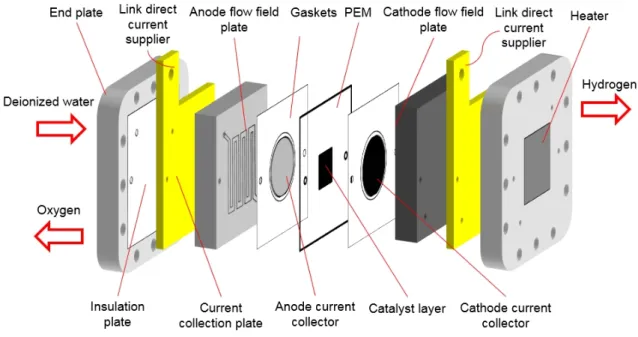
production due to its large current density. Fig. 1.1 shows a schematic of a common

PEMWE, which consists of two clamping plates, two flow field plates, two current

collectors, and a membrane electrode assembly (MEA). The MEA consists of a catalyst

(12)

3

coated membrane (CCM), anode and cathode current collectors. Referring to Fig. 1.1, deionized water only enters anode flow field plate, then flows through the anode current collector, and finally reaches the catalyst layer, where the oxygen evolution reaction (OER) takes place to generate oxygen, proton and electrons as shown in Equation [2].

→ 1

2 2 2 2

The electrons and oxygen also transport through anode current collector which is a porous media between the catalyst layer and flow field plate. The produced electrons transport through anode current collector and flow field plate, finally flow to the cathode catalyst layer under the driving force of the external direct current supplier. At the cathode catalyst layer, the protons and electrons recombine during the cathode hydrogen evolution reaction (HER) as shown in Equation [3].

2 2 → 3

Finally, in the cathode, the hydrogen and electro-osmosis water flow out of the cathode flow channel; in the anode, the oxygen and surplus water drain through the anode flow channel.

1.3 Aim of this study

To promote the marketization of the PEMWE, researchers try to cut down its cost

(13)

4

through raising its electrolysis performance. Su et al. [11], Chen et al. [12] and Wittstadt et al. [13] have proposed new catalyst layer structure. Ito et al. [14], Hwang et al. [15, 16], Ioroi et al. [17] and Grigoriev et al. [18] attempted to optimize the wettability and the pore size distribution of the anode current collector. Some researchers have investigated the impact of the flow field pattern on the electrolysis performance [19-21]. Also some researchers examined the impact of ionomer content in the cathode and anode catalyst layers [22-23].

Even though there have been so many approaches for improving the performance of the PEMWE from different aspects, few studies systematically investigate the optimal method for managing water in the PEMWE. The water (both liquid and gas phase) is the only reactant in the PEMWE. Therefore, the management method of water has a large impact on the electrolysis performance. However, the aforementioned researches reveal conflict or even controversial results, and their conclusions vary with the working conditions (operation pressure, operation temperature and water flow rate) [11-23].

The operation temperature and pressure are related with the water flow pattern in

the PEMWE cell. For example, low temperature keeps membrane hydrated but introduces

high activation overpotential; elevating the operation temperature decreases the activation

overpotential but also possibly reduces the ratio of liquid water around the membrane,

(14)

5

causing its water content and ionic conductivity to decrease [24-27]. Recent researchers suggest that besides of decreasing the activation overpotential, elevating temperatures can benefit the PEMWE in other aspects: (1) benefiting heat recovery and thermal management [28-30], (2) reducing the amount of noble metal used and thus its cost [31- 32], and (3) allow for a compact structure for the PEMWE [33-34].

Taking above benefits of high temperature into account, this study investigates the optimal method of managing water in the PEMWE at high temperature, including operation condition, current collectors and flow field patterns.

1.4 Outlines

Including this chapter, this study consists of 6 Chapters. Chapter 2 exhibits the detail information about experimental facilities in the evaluation system, experimental drugs used for fabricating the CCM, fabrication process of the CCM, and assembling conditions of the PEMWE cell.

From the Chapter 3 to Chapter 5, this study investigates the impact of optimizing

the operation conditions and cell components on overpotential. The Chapter 3 investigates

the effect of operation pressure, operation temperature and water flow rate on electrolysis

performance. This part of study also confirms the durability of the CCM under the high

(15)

6

temperature in order to research the practicability. Chapter 4 studies the effect of structural properties of both anode and cathode current collectors on water transport and overpotential by liquid water depletion. This part of study also shows that operating the cell at boiling temperature of water can decrease the open circuit voltage to a large extent.

Chapter 5 reveals the effect of flow configurations, anode and cathode flow field patterns

on the electrolysis performance. Finally, Chapter 6 summarizes the conclusions and

explains the future works.

(16)

7

Figures and tables

Figure 1.1 Schematic figure of a PEMWE cell

Table 1.1 Advantages and disadvantages of the PEMWE and AWE [4-12].

PEMWE AWE

Current density Better Response speed Better

Compact Better

Purity Better Efficiency Better

Economy Better

Commercialization Better

(17)

8

References

[1] Huibin Du, Bingli Li, Marilyn A. Brown, Guozhu Mao, Raufdeen Rameezdeen, Hao Chen. Expanding and shifting trends in carbon market research: a quantitative bibliometric study. Journal of Cleaner Production, 103, 104-111 (2015).

[2] Intergovernmental Panel on Climate Change (IPCC), 2014. Climate Change 2014:

Impacts, Adaptation and Vulnerability, IPCC.

[3]. Zhao, J., Hobbs, B.F., Pang, J.S. Long-run equilibrium modeling of emissions allowance allocation systems in electric power markets. Oper. Res. 58 (3), 529-548 (2010).

[4] Zhen-Yu Zhao, Jian Zuo, Lei-Lei Fan, George Zillante. Impacts of renewable energy regulations on the structure of power generation in China e a critical analysis. Renew.

Energy, 36 (1), 24-30 (2011).

[5]. Zhen-Yu Zhao, Jian Zuo, Lei-Lei Fan, George Zillante. A critical review of factors affecting the wind power generation industry in China. Renew. Sustain. Energy Rev., 19, 499-508 (2013).

[6].Purohit, P.. Economic potential of biomass gasification projects under clean development mechanism in India. J. Clean. Prod. 17 (2), 181-193 (2009).

[7]. Frano Barbir. PEM electrolysis for production of hydrogen from renewable energy

(18)

9

sources. Solar Energy, 78, 661–669 (2005).

[8]. King, D.A.. Environment—climate change science: adapt, mitigate, or ignore?

Science, 303, 176–177 (2004).

[9]. Chaudhry, R., Fischlein, M., Larson, J., Hall, D.M., Peterson, T.R., Wilson, E.J., Stephens, J.C.. Policy stakeholders' perceptions of carbon capture and storage: a comparison of four US States. J. Clean. Prod., 52, 21-32 (2013).

[10]. John A. Turner. A Realizable Renewable Energy Future. Science, 285, 687-689 (1999).

[11]. Huaneng Su, Vladimir Linkov, Bernard Jan Bladergroen, Membrane electrode assemblies with low noble metal loadings for hydrogen production from solid polymer electrolyte water electrolysis. International Journal of Hydrogen Energy,38, 9601-9608 (2013).

[12]. Guohua Chen, Xueming Chen, Po Lock Yue, Electrochemical behavior of novel Ti/IrO

x

-Sb

2

O

5

-SnO

2

anodes. Journal of Physical Chemistry B,106, 4364-4369 (2002).

[13]. U. Wittstadt, E. Wagner, T.Jungmann. Membrane electrode assemblies for unitized regenerative polymer electrolyte fuel cells. Journal of Power Sources, 145, 555-562 (2005).

[14]. Hiroshi Ito, Tetsuhiko Maeda, Akihiro Nakano, Chul Min Hwang, Masayoshi Ishida,

(19)

10

Atsushi Kato, Tetsuya Yoshida, Experimental study on porous current collectors of PEM electrolyzers, International Journal of Hydrogen Energy, 37, 7418-7428 (2012).

[15]. Chul Min Hwang, Masayoshi Ishida, Hiroshi Ito, Tetsuhiko Maeda, Akihiro Nakano, Yasuo Hasegawa, Naoto Yokoi, Atsushi Kato, Tetsuya Yoshida. Influence of properties of gas diffusion layers on the performance of polymer electrolyte-based unitized reversible fuel cells. International journal of hydrogen energy, 36, 1740-1753 (2011).

[16]. Chul Min Hwang, Masayoshi Ishida, Hiroshi Ito, Tetsuhiko Maeda, Akihiro Nakano, Atsuhi Kato, Tetsuya Yoshida. Effect of titanium powder loading in gas diffusion layer of a polymer electrolyte unitized reversible fuel cell. Journal of Power Sources, 202, 108- 113 (2012).

[17] Tsutomu Ioroi, Takanori Oku, Kazuaki Yasuda, Naokazu Kumagai, Yoshinori Miyazaki, Influence of PTFE coating on gas diffusion backing for unitized regenerative polymer electrolyte fuel cells. Journal of Power Sources, 124, 385-389 (2003).

[18] S.A. Grigoriev, P. Millet, S.A. Volobuev, V.N. Fateev, Optimization of porous current collectors for PEM water electrolysers. International Journal of Hydrogen Energy, 34, 4968-4973 (2009).

[19] Yoshinori Tanaka, Sakae Uchinashi, Yasuhiro Saihara, Kenji Kikuchi, Takuji Okaya,

Zempachi Ogumi. Dissolution of hydrogen and the ratio of the dissolved hydrogen

(20)

11

content to the produced hydrogen in electrolyzed water using SPE water electrolyzer.

Electrochimica Acta, 48, 4013-4019 (2003).

[20] Jianhu Nie, Yitung Chen. Numerical modeling of three- dimensional two-phase gas- liquid flow in the flow field plate of a PEM electrolysis cell. International Journal of Hydrogen Energy, 35, 3183-3197 (2010).

[21] H. Ito, T. Maeda, A. Nakano, Y. hasegawa, N. Yokoi, C.M. Hwang, M. Ishida, A.

Kato, T. Yoshida. Effect of flow regime of circulating water on a proton exchange membrane electrolyzer. International journal of hydrogen energy, 35, 9550-9560 (2010).

[22]. Wu Xu, Keith Scott. The effects of ionomer content on PEM water electrolyser membrane electrode assembly performance. International Journal of Hydrogen Energy, 35, 12029-12037 (2010).

[23]. Lirong Ma, Sheng Sui, Yuchun Zhai. Investigations on high performance proton exchange membrane water electrolyzer. International Journal of Hydrogen Energy, 34, 678–684 (2009).

[24]. V. Antonucci, A. Di Blasi, V. Baglio, R. Ornelas, F. Matteucci, J. Ledesma-Garcia, L.G. Arriaga, Aricò AS. High temperature operation of a composite membrane-based solid polymer electrolyte water electrolyser. Electrochimica Acta 2008;53:7350-7356.

[25] V. Baglio, R. Ornelas, F. Matteucci, F. Martina, G. Ciccarella, I. Zama, L.G. Arriaga,

(21)

12

V. Antonucci, A.S. Aricò. Solid polymer electrolyte water electrolyser based on Nafion- TiO

2

composite membrane for high temperature operation. Fuel Cells 2009;9: 247-252.

[26] Xu Wu, Keith Scott, Suddhasatwa Basu, Performance of a high temperature polymer electrolyte membrane water electrolyser. Journal of Power Sources 2011;196: 8918-8924.

[27]. A.S. Aricò, V. Baglio, A. Di Blasi, V. Antonucci, L. Cirillo, A. Ghielmi, V. Arcella.

Proton exchange membranes based on the short-side-chain perfluorinated ionomer for high temperature direct methanol fuel cells. Desalination, 199 (2006), pp. 271–273.

[28]. Junyuan Xu, Qingfeng Li, Martin Kalmar Hansen, Erik Christensen, Antonio Luis Tomás García, Gaoyang Liu, Xindong Wang, Niels J. Bjerrum. Antimony doped tin oxides and their composites with tin pyrophosphates as catalyst supports for oxygen evolution reaction in proton exchange membrane water electrolysis. International Journal of Hydrogen Energy, 37 (2012) 18629-18640.

[29]. Martin Kalmar Hansen, David Aili, Erik Christensen, Chao Pan, Søren Eriksen, Jens Oluf Jensen, Jens H. von Barner, Qingfeng Li, Niels J. Bjerrum. PEM steam electrolysis at 130 using a phosphoric acid doped short side chain PFSA membrane. international journal of hydrogen energy, 37 (2012) 10992-11000.

[30]. S. Siracusano, V. Baglio, E. Moukheiber, L. Merlo, A.S. Aricò. Performance of a

PEM water electrolyser combining an IrRu-oxide anode electrocatalyst and a short-side

(22)

13

chain Aquivion membrane. International Journal of Hydrogen Energy, 40(2015) 14430- 14435.

[31].Hua Li, Akiko Inada, Tsuyohiko Fujigaya, Hironori Nakajima, Kazunari Sasaki, Kohei Ito. Effects of operating conditions on performance of high-temperature polymer electrolyte water electrolyzer. Journal of Power Sources, 318 (2016), 192–199.

[32]. Anita Skulimowska, Marc Dupont, Marta Zaton, Svein Sunde, Luca Merlo, Deborah J. Jones, Jacques Rozirè. Proton exchange membrane water electrolysis with short-side- chain Aquivion® membrane and IrO2 anode catalyst. International Journal of Hydrogen Energy 39 (2014) 6307-6316.

[33]. Byung-Seok Lee, Hee-Young Park, Insoo Choi, Min Kyung Cho, Hyoung-Juhn Kim, Sung Jong Yoo, Dirk Henkensmeier, Jin Young Kim, Suk Woo Nam, Sehkyu Park, Kwan-Young Lee, Jong Hyun Jang. Polarization characteristics of a low catalyst loading PEM water electrolyzer operating at elevated temperature. Journal of Power Sources, 309 (2016), 127-134.

[34]. Junyuan Xu, David Aili, Qingfeng Li, Erik Christensen, Jens Oluf Jensen, Wei Zhang, Martin Kalmar Hansen, Gaoyang Liu, Xindong Wang and Niels J. Bjerrum.

Oxygen evolution catalysts on supports with a 3-D ordered array structure and intrinsic

proton conductivity for proton exchange membrane steam electrolysis. Energy Environ.

(23)

14

Sci., 7(2014), 820–830.

(24)

15

Chapter 2

Evaluation systems and cell components

This chapter instructs the experimental system for evaluating the high temperature PEMWE (HT-PEMWE) performance. In this evaluation system, the temperature controlling unit is focused firstly, because the operation temperature varies in a large range and the precision of controlling temperature determines the reliability of the final results. Besides the temperature controlling unit, the CCM in the PEMWE is also the key of the evaluation system, because its properties decide the cell performance and durability.

Therefore, the details of the CCM, such as PEM, components of the anode and cathode catalyst layers and catalyst fabrication process, are explained specially. The other important cell components, such as current collectors and flow field patterns, are also briefly explained in this chapter.

2.1 Evaluation systems of the PEMWE

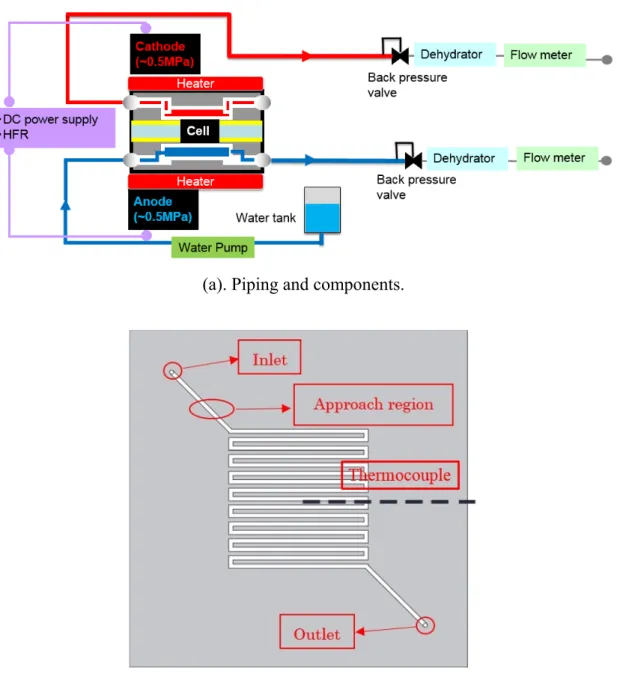
Figure 2.1(a) shows the set up used to evaluate the performance of the PEMWE

cell. The piping for both the cathode and the anode links the cell, a back pressure valve,

a dehydrator, and a mass flow meter. A water pump is built into the anode piping. The

hydrogen gas produced by electrolysis drains through the back pressure valve, and water

(25)

16

involved is removed from the gas at the dehydrator for normal operation of mass flow meter. The produced hydrogen and oxygen gases boost the pressure themselves in the anode and cathode, respectively, with controlled by the back pressure valves. The pressure values are evaluated by pressure gauges built in the inlet and outlet in both anode and cathode sides. The precision of the pressure gauge is 0.01MPa. In this study, “Pa” is used as the pressure unit for fluid; and all the values on the pressure means absolute value.

For every pressure conditions evaluated in this study, the cell pressure (nominal pressure) is determined by the indicated value by pressure gauge located at the outlet of cell. The reason is that value at the outlet is the same as that at the inlet within 5% and this tendency holds for both anode and cathode sides, which means the pressure loss in both anode and cathode flow channels can be ignored. At the same time, the outlet pressure at the cathode side is also the same as that at the anode side within 5% in experiment. It means the pressure difference between anode side and cathode side can also be ignored. Therefore, the outlet pressure of either the anode or cathode sides can represent the cell pressure.

The flow rates of the hydrogen and oxygen gases are measured using a flow meter located in the downstream of the dehydrator in order to confirm the current efficiency.

Due to the fluctuations, the hydrogen and oxygen flow rates are determined by averaging

(26)

17

the data recorded for 10 min.

A high frequency resistance (HFR) meter (Frequency: 10kHz; Model: 356E;

Tsuruga electric CO., JAPAN) measures ohmic resistance, categorized as linear component resistance in cell. The ohmic resistance comprises contact resistances between each cell components and ionic resistance through polymer electrolyte membrane (PEM).

Because the cell components are carefully assembled, and the contact resistance appeared is rather small and stable when cell temperature is higher than 100 , the ohmic resistance with the HFR meter can be assumed to be ionic resistance through the PEM.

During water electrolysis, electrochemical analysis on the overpotential is conducted to evaluate the electrolysis performance. The overpotential consists of three parts: the ohmic overpotential, the activation overpotential related to catalyst activity and the overpotential by liquid water depletion. To separate these three types of overpotential, electrolysis voltage and ohmic resistance are measured for each specific current densities.

For experiment under a specific operation condition, this study repeat three times. The

reproducibility was 5 mV for electrolysis voltage and 1 mΩ for HFR. This study

took the average value of the experiments as final result. It is noticed that non-linear

overpotential can be estimated by subtracting the Nernst voltage and ohmic overpotential

from the electrolysis voltage. The non-linear components correspond the activation

(27)

18

overpotential and overpotential by liquid water depletion. The specific value of the aforementioned two overpotentials can be calculated according to the non-linear overpotential characteristics [1]. In small current density region (for example, <1A/cm ), the slope of the linear part represents catalyst activity corresponding to Tafel region, because the reactant supply is relatively sufficient in that region, and the impact of reactant concentration is negligible. In the high current density region of the non-linear Tafel plots (for example, >1 A/cm ), the overpotential by liquid water depletion is superimposed on the activation overpotential, and the value of this overpotential can also be read out from the non-linear Tafel plots.

As aforementioned, special attentions are paid on the temperature control. During the experiment, we use the set of rubber heater and thermal couple to control the cell temperature. The rubber heater is attached onto central part of the end plate at each electrode side to heat the cell. As shown in Fig. 2.1 (b), the thermal couple is inserted in the flow field plate, and placed just below the central place to monitor the cell temperature.

The precision of the thermal couple is 0.1 . After the temperature controlling facilities, the followings will explain why the cell temperature thus measured can be considered as nominal temperature.

In our study, the deionized water is fed into cell directly without preheater, though

(28)

19

the existence of preheater will be very helpful for controlling the water temperature at inlet and inside of the cell. The specific points of the water flow rate and flow field can help clarify the concern of controlling temperature.

First, relatively small flow rates of water are chosen in our experiment. Under 1 A/cm

2

condition, the water utilization defined in dividing electrolyzed water by fed water is 2% and 20% for water feeding of 1.0 and 0.1 mL/min, respectively. This water utilization is much larger than that in conventional operation which is no more than 0.5%

[2-9], and suggests that water flow rate in our experiment is quite small.

Moreover, to promise the cell temperature the same with the nominal temperature, we also pay special attentions on flow field structure. The approach region running from cell inlet to flow channel is long, as shown in Fig. 2.1 (b). Taking into the consideration of small amount of water feeding, the long approach will give enough time to heat the fed water before the water reach the catalyst region so that the temperature of fed water can be equilibrium to the nominal temperature.

These specific experimental conditions and cell configuration promise that the

temperature of water in the flow channel is close to the nominal temperature, which

corresponds to the temperature measured by thermocouple embedded in flow field plate.

(29)

20

2.2 Details about the fabrication of CCMs

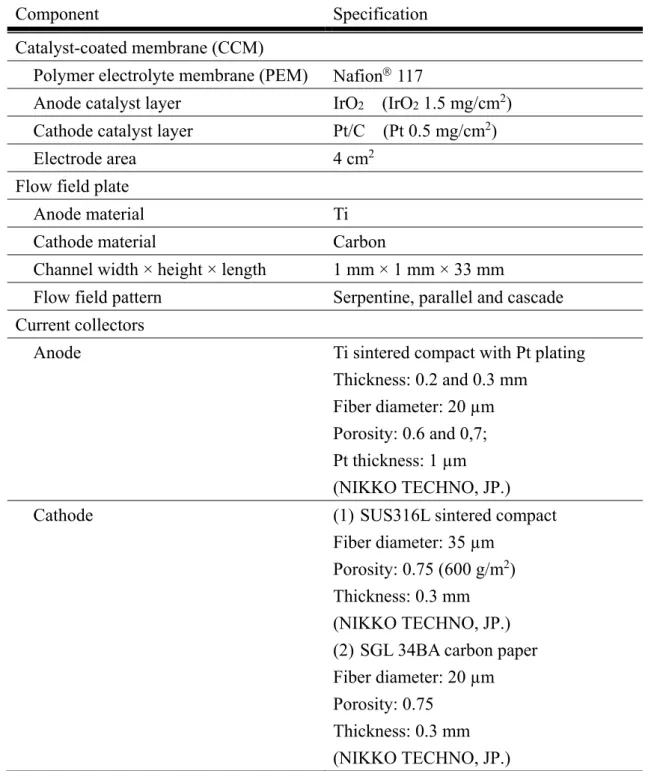
The CCM comprises a polymer electrolyte membrane (PEM) and two catalyst layers formed on the membrane surfaces. Generally, the CCM determines the performance of PEMWE, because electrochemical reaction and proton conduction occur there. The major electrochemical reactions in the PEMWE are oxygen evolution reaction (OER) in the anode side and hydrogen evolution reaction (HER) in cathode side. Table 2.1 shows the specific materials chosen for our experiment, and explanations of choosing these materials are shown in follows.

The anode side usually use IrO

2

as the catalyst. Besides of IrO

2

, there are also other candidates, such as Pt or RuO

2

, but they suffer from the drawback of corrosions or low OER catalytic activity. For example, the Pt has lower catalytic activity than IrO

2

, according to the catalytic activity order of IrO

2

≅ RuO

2

> Pt [10]; and the RuO

2

corrodes at an appreciable rate with oxygen evolution while IrO

2

is very stable [11]. Therefore, we select IrO

2

as the state-of-the-art for the OER in PEMWE.

The cathode side usually use Pt/C as the catalyst. There also are some candidates

such as IrO

2

or RuO

2

, but the authors comment that Pt beats other candidates in terms of

durability and catalytic ability [12]. Usually, to expand the electrochemical specific

surface area, the Pt powder is usually deposited on carbon powder to form Pt/C [13]. But

the carbon material supporter cannot be used in anode due to high overpotential [6-13].

(30)

21

Therefore, this study use Pt/C as the HER catalyst.

Nafion® 117 membrane is selected as the PEM in our study. The Nafion® series membranes are used in researchers mostly. Under conventional temperature ( 100 °C), researchers also use other candidate membranes [1-15]. The thick membrane suffers from high ohmic resistance, and thus thin membrane is preferable. However, under high temperature, thin membrane suffers from short durability. For example, the time for Nafion® 117 thinning half of the thickness at 100 is only 1/4 of that at 353 under 1 A/cm

2

[15]. It means elevating operation temperature accelerates the membrane degradation [13-15], and thinner membrane has shorter durability. Taking into the consideration of the durability and ohmic resistance, we select the Nafion® 117 due to its medium thickness (178 μm) among the Nafion® series membranes which ranges from 50 to 400 μm in the thickness [11-15].

As mentioned, the aforementioned catalyst layers fabricated on the surface of Nafion®117 membrane form a CCM. In this study, spraying and hot pressing are used to fabricate the CCM. Followings describe the preparation and fabrication process in detail:

First, prior to fabrication of the CCMs, the 64 cm

2

PEMs (Nafion®117) are treated

according to standard procedures to eliminate any organic and inorganic contaminants

[16]. Because such contaminants, such as Fe

3+

and Mg

2+

et al., will accelerate the

(31)

22

membrane degradation [17]. The standard process are shown as follows [16, 17]: rinse membranes in the solutions composed of 5 wt. % H

2

O

2

for 1 hour at 80 ; and wash them in deionized water for 1 hour at room temperature; and rinse them in 8 wt.% H

2

SO

4

for 1 hour at 80 ; and finally wash them in deionized water for 1 hour at room temperature.

Second, as shown in Fig. 2.2 (a), a slurry consisting of catalyst (IrO

2

powder, type IV, Tokuriki Co., Japan) and Nafion® ionomer (5 wt% Ion Power solution) in deionized water and ethanol is prepared and sprayed onto one face of the membrane to form the anode catalyst layer. Commercial 46% Pt/C (Tanaka Kikinzoku Kogyo Co. Japan) powder is used as the catalyst for the cathode catalyst layer. This slurry is sprayed onto the other face of the membrane to fabricate the cathode catalyst layer as shown in Fig. 2.2(b). The loading rate of IrO

2

was 1.5 mg/cm

2

, whereas that of Pt was 0.5 mg/cm

2

. The area of the catalyst layers for the anode and the cathode was 4 cm

2

.

Finally, the sprayed slurry is fixed onto the membrane by hot pressing in Fig. 2.2(c).

The hot press temperature, pressure and time ranges from 100 to 150 °C, 1 to 3 MPa, and

120 to 240 s according to references [18-22]. In our study, the hot-press conditions is 190

s at 2 MPa and 130 °C. The CCM was hot pressed at aforementioned conditions to form

the final product in Fig. 2.2(d).

(32)

23

2.3 Cell components of the PEMWE cell used in this study

In the PEMWE, the CCM fabricated above is sandwiched by anode and cathode current collector (CC), resulting in a form of membrane electrode assembly (MEA). The current collector is a porous media placed between the CCM and the flow field plate at both electrodes, and its functions are (1) transferring the product and supplying the reactant effectively, (2) providing mechanical support for the membrane, and (3) collecting the current. As for the cathode current collector, stainless steel mesh (SUS316L, Nikko tech Co.) and carbon paper (type 34BA, SGL Co.) were used due to different experiment purpose; as for the anode current collector (ACC), titanium mesh (Platinum plating, Nikko tech) with different thickness and porosity were selected, also due to different experiment purposes.

Material choice for current collector is significant for durability, especially for anode ACC. Usually a titanium mesh is used as an ACC due to the high voltage in the anode side, the high oxygen concentration, and the severely acidic environment on the anode side. However, voltage in the cathode side and oxygen concentration are near zero [23], therefore the carbon paper (SGL 34BA) is suitable as the cathode current collector (CCC).

To form a PEMWE cell, the MEA was sandwiched by two flow field plates. Carbon

(33)

24

material plate was used as cathode flow field plate; and titanium, anode flow field plate.

The anode flow field plate usually used titanium material due to the high voltage there, but the cathode side use conventional graphite material plate due to the low voltage in the cathode [23]. As for the flow field pattern, Chapter 3 and Chapter 4 used serpentine flow field pattern in both anode and cathode sides; but Chapter 5 uses three different types of flow field patterns (serpentine, parallel and cascade). The details of the flow field patterns will be specified in Chapter 5. Finally, all the components were sandwiched between a pair of fastening plates and tightened them by 12 sets of bolt and nut at the torque of 4 Nm. This procedure and the area of flow field plate (64 cm

2

) made the tightening pressure to be about 3 MPa. With these assembling and tightening process, ohmic resistance between the components is stable during operation.

2.4 Conclusion

This chapter explains the experimental system and cell structure for evaluating the

HT-PEMWE. Some crucial components of the system and the cell are especially

explained, such as the temperature and pressure controlling units. The approaching region

and small water flow rate, which are intentionally introduced, are significant to conduct

HT-PEMWE. These efforts and concerns promise that the cell temperature are the

(34)

25

nominal temperature. Some important components, such as CCs and flow field patterns

of anode and cathode, are only briefly explained here, because they are parameters in the

following chapters and will be carefully explained in their own chapters.

(35)

26

Figures and tables

(a). Piping and components.

(b) Flow field plate used in this study.

Figure 2.1 Experimental setup used for evaluating the performance of a PEMWE

cell in this study

(36)

27

(a) Catalyst ink

(b) Spray the catalyst ink onto the membrane

(c) Hot-press the CCM

(d) Product CCM

Figure 2.2 Process of fabricating the CCM

(37)

28

Table 2.1 Properties of the evaluated PEMWE.

Component Specification Catalyst-coated membrane (CCM)

Polymer electrolyte membrane (PEM) Nafion

117

Anode catalyst layer IrO

2

(IrO

2

1.5 mg/cm

2

) Cathode catalyst layer Pt/C (Pt 0.5 mg/cm

2

)

Electrode area 4 cm

2

Flow field plate

Anode material Ti

Cathode material Carbon

Channel width × height × length 1 mm × 1 mm × 33 mm

Flow field pattern Serpentine, parallel and cascade Current collectors

Anode Ti sintered compact with Pt plating

Thickness: 0.2 and 0.3 mm Fiber diameter: 20 µm Porosity: 0.6 and 0,7;

Pt thickness: 1 µm (NIKKO TECHNO, JP.) Cathode (1) SUS316L sintered compact

Fiber diameter: 35 µm Porosity: 0.75 (600 g/m

2

) Thickness: 0.3 mm (NIKKO TECHNO, JP.) (2) SGL 34BA carbon paper Fiber diameter: 20 µm Porosity: 0.75

Thickness: 0.3 mm

(NIKKO TECHNO, JP.)

(38)

29

References

[1]. M. Chandesris , V. Médeau, N. Guillet, S. Chelghoum, D. Thoby, F. Fouda-Onana.

Membrane degradation in PEM water electrolyzer: Numerical modeling and experimental evidence of the influence of temperature and current density. International Journal of Hydrogen Energy 40 (2015) 1353-1366.

[2]. Huaneng Su, Vladimir Linkov, Bernard Jan Bladergroen. Membrane electrode assemblies with low noble metal loadings for hydrogen production from solid polymer electrolyte water electrolysis. International journal of hydrogen energy 38 (2013) 9601- 9608.

[3]. Huaneng Su, Bernard Jan Bladergroen,Vladimir Linkov, Sivakumar Pasupathi, Shan Ji. Study of catalyst sprayed membrane under irradiation method to prepare high performance membrane electrode assemblies for solid polymer electrolyte water electrolysis. International journal of hydrogen energy 36 (2011) 15081-15088.

[4]. Huaneng Su, Bernard Jan Bladergroen, Sivakumar Pasupathi, Vladimir Linkov, Shan Ji. Performance Investigation of Membrane Electrode Assemblies for Hydrogen Production by Solid Polymer Electrolyte Water Electrolysis. International Journal of Electrochemical Science (2012) 4223-4234.

[5]. Junyuan Xu, Ruiying Miao, Tingting Zhao, Jun Wu, Xindong Wang. A novel catalyst

layer with hydrophilic-hydrophobic meshwork and pore structure for solid polymer

(39)

30

electrolyte water electrolysis. Electrochemistry Communications 13 (2011) 437-439.

[6]. J. C. Cruz, V. Baglio, S. Siracusano, R. Ornelas, L.Ortiz-Frade, L. G. Arriaga, V.

Antonucci, A. S. Aricò. Nanosized IrO

2

electrocatalysts for oxygen evolution reaction in an SPE electrolyzer. J Nanopart Res (2011) 13: 1639-1646.

[7]. Jinbin Cheng, Huamin Zhang, Haipeng Ma, Hexiang Zhong, Yi Zou. Study of carbon-supported IrO

2

and RuO

2

for use in the hydrogen evolution reaction in a solid polymer electrolyte electrolyzer. Electrochimica Acta 55 (2010) 1855–1861.

[8]. Junyuan Xu, Qingfeng Li, Martin Kalmar Hansen, Erik Christensen, Antonio Luis Tomás García, Gaoyang Liu , Xindong Wang, Niels J. Bjerrum. Antimony doped tin oxides and their composites with tin pyrophosphates as catalyst supports for oxygen evolution reaction in proton exchange membrane water electrolysis. International journal of hydrogen energy, 2012; 37; 18629-18640.

[9]. Omer F. Selamet, M. Said Ergoktas. Effects of bolt torque and contact resistance on the performance of the polymer electrolyte membrane electrolyzers. Journal of Power Sources 281 (2015) 103-113.

[10] Miles MH, Thomason MA. Periodic variations of overvoltages for water electrolysis

in acid solutions from cyclic voltammetric studies. Journal of the Electrochemical Society

1976;123(10):1459-1461.

(40)

31

[11] Kötz R, Stucki S. Stabilization of RuO

2

by IrO

2

for anodic oxygen evolution in acid- media. Electrochimica Acta Oct 1986;31(10):1311-1316.

[12] Damjanov A, Dey A, Bockris JOM. Electrode kinetics of oxygen evolution and dissolution on Rh Ir and Pt-Rh alloy electrodes. Journal of the Electrochemical Society 1966; 113(7):739.

[13] Marcelo Carmo, David L. Fritz , Jürgen Mergel, Detlef Stolten. A comprehensive review on PEM water electrolysis. International Journal of Hydrogen Energy, 38 (2013), 4901-4934.

[14]. Adriano C. Fernandes, Edson Antonio Ticianelli. A performance and degradation study of Nafion 212 membrane for proton exchange membrane fuel cells. Journal of Power Sources 193 (2009) 547–554.

[15]. M. Chandesris, V. Médeau, N. Guillet, S. Chelghoum, D. Thoby, F. Fouda-Onana.

Membrane degradation in PEM water electrolyzer: Numerical modeling and experimental evidence of the influence of temperature and current density. International Journal of Hydrogen Energy. Volume 40, Issue 3, 21 January 2015, Pages 1353–1366.

[16]. Sarawalee Thanasilp, Mali Hunsom. Effect of MEA fabrication techniques on the

cell performance of Pt–Pd/C electrocatalyst for oxygen reduction in PEM fuel cell. Fuel

89 (2010) 3847-3852.

(41)

32

[17]. Amanda Collier, Haijiang Wang, Xiao Zi Yuan, Jiujun Zhang, David P. Wilkinson.

Degradation of polymer electrolyte membranes. International Journal of Hydrogen Energy 31 (2006) 1838-1854.

[18] M. Prasanna, E.A. Cho, T.-H. Lim, I.-H. Oh. Effects of MEA fabrication method on durability of polymer electrolyte membrane fuel cells. Volume 53, Issue 16, 30 June 2008, Pages 5434–5441

[19] Banyong Nakrumpai, Kejvalee Pruksathorn, Pornpote Piumsomboon. Optimum condition of membrane electrode assembly fabrication for PEM fuel cells. Korean J.

Chem. Eng., 23(4), 570-575 (2006).

[20] Apichai Therdthianwong, Phochan Manomayidthikarn, Supaporn Therdthianwong.

Investigation of membrane electrode assembly (MEA) hot-pressing parameters for proton exchange membrane fuel cell. Energy 32 (2007) 2401–2411.

[21] Jing-Chie Lin, Chien-Ming Lai, Fu-Ping Ting, San-Der Chyou, Kan-Lin Hsueh.

Influence of hot-pressing temperature on the performance of PEMFC and catalytic activity. J Appl Electrochem (2009) 39:1067–1073.

[22] Maryam Yazdanpour, Ashkan Esmaeilifar, Soosan Rowshanzamir. Effects of hot

pressing conditions on the performance of Nafion membranes coated by ink-jet printing

of Pt/MWCNTs electrocatalyst for PEMFCs. International Journal of Hydrogen Energy,

(42)

33

Volume 37, Issue 15, August 2012, Pages 11290–11298.

[23] Xu Wu, Keith Scott, Suddhasatwa Basu, Performance of a high temperature polymer electrolyte membrane water electrolyser. Journal of Power Sources 2011;196: 8918-8924.

(43)

34

Chapter 3

Optimization of the working conditions

This chapter focuses on the impact of working conditions (operation temperature, operation pressure and water flow rates) on the electrolysis performance. We analyzed how the overpotential changes under a wide range of temperatures, pressures and water flow rates through evaluating the experiment data of ohmic resistance and electrolysis voltage. Finally, we suggest a set of data about the optimal working conditions.

3.1 Introduction

Elevating temperatures can improve the performance, cut down the amount of noble metal catalyst and lead a compact size; but it also leads a complicated flow and dehydrates the membrane [1-7]. To solve the dehydration, some researchers suggested developing composite membranes which based on the Nafion

®

series of membranes [3–

6]; and other some researchers pay their attentions on alternative electrolyte membranes,

such as Aquivion® series membrane [7-14]. Even though these efforts help the membrane

get excellent proton conductivity at high temperature, but composite membrane suffers

from complicated fabrication processes and short durability [3-6]; and the alternative

membrane, such as Aquivion® series membrane, costs higher than Nafion® series

membrane [7-14].

(44)

35

The pressurization of a PEMWE can overcome the drawbacks of membrane dehydration under elevating temperatures without using composite membranes.

Membrane dehydration, which means low water content in membrane, decrease the

proton conductivity of membrane. Increasing temperature above boiling temperature

decreases the liquid water ratio in the vapor/liquid two-phase flow, which results in a low

water content in membrane. However, elevating pressure can keep the fed water in the

liquid phase when temperature is above boiling point of water, resulting in a high water

content in the membrane. Some researchers have proven that the elevating temperature

and pressure simultaneously can decrease activation overpotential without membrane

dehydration. Antonucci [4], Baglio [5] and Xu [6] measured the performance of a

PEMWE by increasing the pressure at high temperatures (from 80 to 120 °C). In

Antonucci’s and Baglio’s study [4, 5], the PEMWE with using Nafion® 115 operating at

120 °C displayed about 6 times large of the ohmic resistance at 0.1 MPa compared to that

obtained at 0.3 MPa. Their study also shows that electrolysis voltage decreases about 270

mV at 0.8 A/cm

2

under 0.3 MPa when temperature increases from 80 to 120 °C due to

the decrease of activation overpotential. Xu et al. [6] also studied the impact of pressure

in a PEMWE. Xu et al. reported that the higher PEMWE performance with an increased

pressure (from 0.15 to 0.3 MPa) is attributed to the condensation of water vapor

(45)

36

throughout their membrane. The pressurization improved the proton transfer rate.

Above researchers confirm the effect of operation condition on the linear overpotential, but its effect on the nonlinear overpotential is still not clear. When the gaseous oxygen produced at the anode by OER is released towards the current collector, its stream toward the flow channel unavoidably hinders the counter flow of the water (the reactant). Furthermore, the liberation of oxygen from the anode is severely limited, causing oxygen gas to accumulate in and near the catalyst layer and subsequently preventing water from accessing the active sites catalyst layer. Therefore, the mass- transfer, including the liquid water and gaseous oxygen transport to and from the catalyst layer should considerably affects the nonlinear overpotential [4-8].

This chapter focuses on the effect of operation conditions on nonlinear overpotential and challenges to optimize the operation conditions. Thereby, PEMWE cell was electrochemically characterized under a wide range of temperature and pressure conditions. In conclusion, a strategy for improving the performance of PEMWEs at high temperature operation is suggested.

3.2 Cell components and operating conditions

The components as shown in Table 2.1 of Chapter 2 is embedded and forms a

(46)

37

PEMWE cell. Among the candidates of current corrector, stainless steel mesh (material:

SUS316L; thickness: 0.3 mm; porosity: 0.75; Nikko tech Co.) is used as cathode current collector, and titanium mesh (material: Titanium; thickness: 0.3 mm; porosity: 0.7; Nikko tech Co.) is used as anode current corrector. Among the choices of flow field pattern, the serpentine flow field pattern is selected.

The experimental apparatus shown in Fig. 2.1 of Chapter 2 controls the operation condition of the cell. The temperatures range is adjustable between 80–130 °C and pressures range is between 0.1–0.5 MPa. Deionized water at 20 °C was fed into the anode at flow rates of 0.1 mL/min and 1 mL/min. As mentioned in Chapter 2, under 1 A/cm

2

condition, the water utilization defined in dividing electrolyzed water by fed water is 2%

and 20% for water feeding of 1.0 and 0.1 mL/min, respectively..

3.3 Flow patterns in the anode flow channel

As aforementioned, to control the cell temperature, the water flow rates in this study

are lower than that used under normal operation. If the water flow rate was high, the cell

temperature would either decrease or become unstable because of the sensible and latent

heat of the fed water. Small flow rate means the flow phase pattern in the flow channel

may become one-phase flow at high temperatures due to evaporation and high water

(47)

38

utilization. The water behavior is important to help us analyze and understand the electrolysis performance. Therefore, before conducting the experiment, we should calculate the probable flow pattern in the cell. Because the cathode overpotential is near zero [5, 6], only the flow pattern in the anode channel is focused.

The probable flow pattern in the anode channel are calculated as follows. The flow patterns are predicted for the corresponding operation conditions in the range of 80–130

C and 0.1–0.5 MPa as mentioned above. The assumptions made for the prediction are as

follows: (i) Faraday’s electrolysis law is in effect; (ii) the current density is 0.5 A/cm

2

for determining the molar flow rate of oxygen gas, which is assumed to be an ideal gas; and (iii) the water in the channel could be described by the water phase equilibrium diagram at the nominal temperatures and pressures. With these considerations, the comprehensive computation procedure is explained in the following.

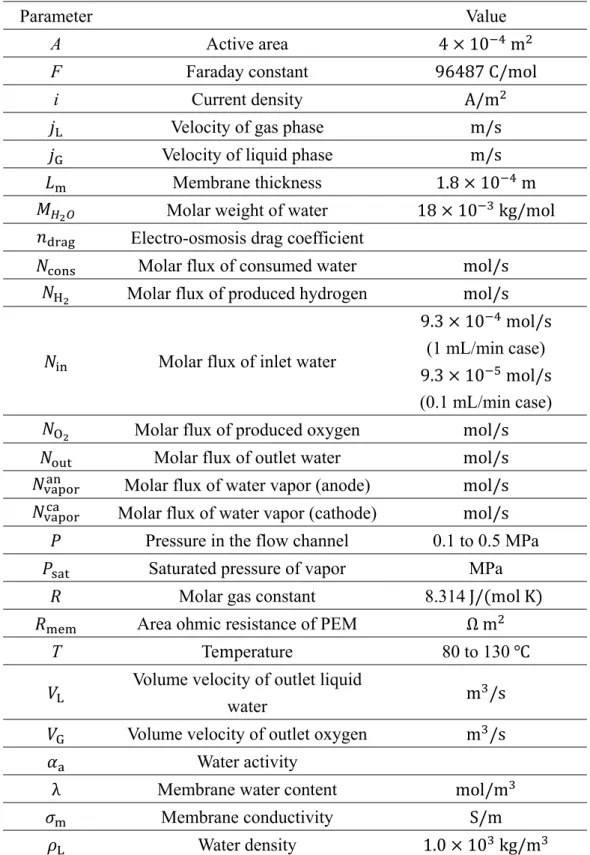
Molar flux of produced oxygen gas ( ) and consumed water ( ) in anode channel is calculated with Faraday’s law,

4 3.1

2 3.2

Where, i is the current density, A is the active area of catalyst layer, F is the Faraday

constant.

(48)

39

The molar flux of water vapor at outlet of anode channel is

3.3

Where, is the total pressure of gas in the flow channel, is the saturated pressure of vapor, and can be calculated as follow [15].

2846.4 411.24 10.554 0.16636 10 3.4

Where, T is the operation temperature of cell, and its unit is .

If the , where is the molar flux of liquid water at the inlet of anode channel, the molar flux of liquid water ( ) at the outlet in anode channel is,

3.5

The volume velocity of liquid water in flow channel is,

3.6

Where, is the density of liquid water, is the molar weight of water.

If the , all the liquid water is evaporated. Then,

3.7 0 3.8 The volumetric flow rate of gas phase is,

273 3.9

(49)

40

Where, R is the molar gas constant.

Thus, the superficial velocity of gas phase is,

3.10

Where, S is the area of cross section. The superficial velocity of liquid water.

3.11

The superficial gas and liquid velocities calculated in the above equations are listed in Table 3.2. Moreover, the pair of the superficial gas and liquid velocity for a specific pair of temperature and pressure condition is available to find the flow pattern via referring [16]. A two-phase flow is observed in the cases where the saturated pressure determined on the basis of the temperature is lower than the pressure. All the two-phase flows in the channels can be categorized as slug flows. This is because the superficial velocities of gases are two to three orders of magnitude higher than the superficial velocities of liquids. On the other hand, a single-phase flow (e.g., a gas flow) is observed in the opposite case, that is, when the saturated pressure determined on the basis of the temperature is higher than the pressure.

3.4 Results and discussion

3.4.1 Current density–Voltage (I–V) characteristics

(50)

41

As stated previously, PEMWE operation at high temperatures causes PEM to dehydrate and thus it increases the ionic resistance of the PEM. The degree of the dehydration is expected to rise when the water flow rate is low. Whether this is indeed, the case was determined experimentally by increasing the operating temperature while keeping the flow rate low (0.1 mL/min) at 0.1 MPa.

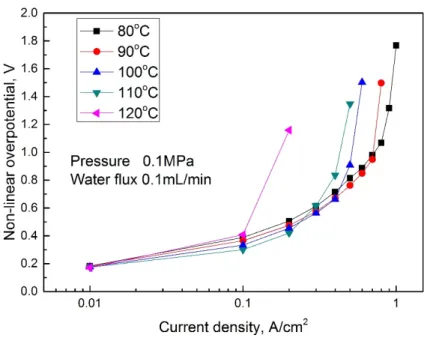
The I-V characteristics and I-HFR characteristics and non-linear overpotential characteristics of the cell at various operation temperatures are shown in Fig. 3.1(a), Fig.

3.1(b) and Fig. 3.1(c). In Fig. 3.1(c), the vertical axis on this figure is the non-linear

overpotential, which is calculated by subtracting the ohmic overpotential and Nernst

voltage from the electrolysis voltage. As shown in Fig. 3.1(a), the rising temperature

progressively decreases the open circuit voltage (OCV), confirming the thermodynamic

expectations as shown in Table 3.3. When the temperature increases from 80 to 130 ,

the theoretical OCV decreases about 40 mV. But as shown in Fig. 3.1(a), low OCV cannot

promise low electrolysis voltage; and the OCV difference is much smaller than the

difference of non-linear overpotential at high current density which is more than 400 mV

as shown in Fig. 3.1(c). Also, in Fig. 3.1(a), the I–V characteristics in the low-current-

density region were similar to those of a conventional PEMWE. However, the I–V

characteristics change in the high-current-density region. For instance, at 80 °C, the cell

(51)

42

voltage started to increase sharply at 0.8 A/cm

2

. With the elevation in the temperature, the point, at which the sharp increase appears, shifts towards the lower current-density region.

Although the sharp increase in the voltage might suggests the dehydration of the PEM because of the high temperature and the low water flow rate, Fig. 3.1(b) shows contradicting results. The ohmic resistances for the different temperatures and current densities spread from 330 to 370 mΩ cm

2

, revealing a rise of 40 mΩ cm

2

at most. This ohmic resistance rise corresponds to only a change of 20 mV in the cell voltage at 0.5 A/cm

2

. On the other hand, the sharp increase in the cell voltage is of the order of several hundreds of millivolts. Thus, changes in the ohmic resistance, which depends on the degree of dehydration of the PEM, do not explain the large increase in the cell voltage.

The difference between the small ohmic voltage and the sharp voltage rise can be attributed to the concentration overvoltage. This attribution is justified in the following.

As the data at 0.1 MPa in Table 3.2(a) show, increasing the temperature converts the water phase from a binary (vapor/liquid) phase to a single vapor phase at around 100

C. But the temperature is not the only factor which determines the water phase in flow

channel. Current density also has an impact on the water phase change, because the more liquid water is consumed in the flow channel when current density become larger.

Although the case of 100 °C in Table 3.2(a) suggests two-phase (liquid water remains),

(52)

43

this holds under the current density of 0.5 A/cm

2

. Once the current density increases higher than 0.5 A/cm

2

, the two-phase turns to single phase; at the same time, the non- linear overpotential also shows a sharp increase in region of higher current density as shown in Fig. 3.1(c). It means the sharp increase of electrolysis voltage is attributed by the overpotential related with liquid water depletion. The temperature, at which the phase change occurs, decreases in the region of higher current density. Thus, Table 3.2(a) with the impact of both current density and temperature on phase change is responsible for the unique I-V characteristics shown in Fig. 3.1(a).

3.4.2 Impact of water flow rate

The overpotential by liquid water depletion is ascribed to a shortage of the reactant water in the catalyst layer. An increase in the water supply, i.e., a rise in the water flow rate is anticipated to decrease this overpotential.

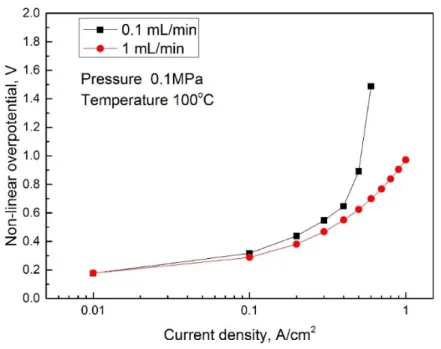
Figures 3.2(a), 3.2(b) and 3.3(c) show the effect of the water flow rate on the I–V

characteristics, I-HFR characteristics and non-linear overpotential characteristics for the

pressure of 0.1 MPa and temperature of 100 °C, respectively. In the whole range of the

current density, the cell voltage for 1.0 mL/min is lower than those for 0.1 mL/min

corresponding to the case of 100 °C shown in Fig. 3.1(a). It should be noted that, for a

(53)

44

flow rate of 1.0 mL/min, there is no sharp increase in the cell voltage. Furthermore, the current density reaches higher in the case of 1.0 mL/min. Because the temperature and pressure corresponding to the flow rates of 1.0 and 0.1 mL/min were the same, it can be concluded that higher water flow rate diminishes the overpotential by liquid water depletion, and thus allowing for the higher current density operation.

A comparison of the data in Tables 3.2(a) and 3.2(b) confirms the conclusion drawn from the effect of the water flow rate. According to the data corresponding to 0.1 MPa and 100 °C, the flow patterns for 0.1 and 1.0 mL/min are single-phase vapor and two- phase vapor/liquid flows, respectively.

Although the flow behavior in the catalyst layer at the anode is not known in practice, the two-phase flow is expected to provide a higher amount of water being available at the catalyst layer. Thus, the higher flow rate of 1.0 mL/min reduces the overpotential by liquid water depletion and suppresses the sharp rise in the cell voltage.

Figure 3.2(b) presents the ohmic resistances for the flow rates of 1.0 and 0.1 mL/min. It is worth noting that the drop in the ohmic resistance of the cell by the increase in the water flow rate is so small that it does not impact the I–V characteristics significantly. The major overpotential comes from the non-linear part as shown in Fig.

3.2(c). For example, the difference in the ohmic resistances for the two cases

(54)

45

corresponding to 0.6 A/cm

2

is approximately 60 mΩ cm

2

; this is equivalent to a difference of 36 mV in the cell voltages. This difference is smaller than the difference of 800 mV in non-linear overpotential observed in Fig. 3.2(c). Therefore, as mentioned above, the reason for the increase in the cell voltage in the case of 0.1 mL/min must be the overpotential by liquid water depletion, not the dehydration of the PEM.

In addition, Fig. 3.2(b) displays that the ohmic resistance decreases as the current density grows. As can be seen from the experimental setup in Fig. 3.1(a), no water is supplied to the cathode. This means that the PEM is supposed to become dehydrated, especially at the cathode side. On the other hand, the electro-osmosis transport of water is expected to hydrate the PEM at the cathode side when the electrolysis current is applied.

This process, in which the electro-osmosis of water hydrates PEM, is thought to function in this experiment. As a result, the ohmic resistance decreases with an increase in the current density.

In summary, the aforementioned findings indicates that the overpotential is mainly constituted by the overpotential by liquid water depletion. As proved in Fig. 3.2(a), this overpotential can be suppressed by increasing the water flow rate.

This result is here compared with some related studies [12], which also evaluated

PEMWE performance under vapor electrolysis condition (temperature of 130 °C and

(55)

46

pressure of 0.1 MPa) and liquid water electrolysis condition (temperature of 80 °C and pressure of 0.1 MPa). The study figured out that electrolyzing water at vapor phase performed worse due to a high ohmic overpotential. Whereas, in our study, high nonlinear overpotential caused by insufficient water supplement to catalyst layer is the main reason for high cell voltage in vapor electrolysis case. The difference between the two studies is considered to attribute to different types of membranes used in present study and Xu et al.’s [12]. Our study used Nafion® 117, but Xu et al. used Aquivion

TM

membrane in 80 °C case and H

3

PO

4

doped Aquivion

TM

membrane in 130 °C case. Generally, the properties of membrane has a large impact on both ohmic overpotential and non-linear overpotential [4, 5]. Thus, the different membranes and their properties possibly cause the different result.

As mentioned in section 3.2, decreasing the water flow rate is the key to ensure the

high-temperature operation of PEMWEs. This is because the fed water, which is supposed

to be at room temperature, cools the cell owing to its latent and sensible heats. The latent

and sensible heat give a rise to temperature fluctuations within the cell, making it difficult

to maintain high temperatures. It is worth noting that increasing the water flow rate to

levels higher than 1.0 mL/min did not decrease the cell voltage in other experiments [6-

10]. Thus, it can be concluded that the water flow rate of 1.0 mL/min, which corresponds

(56)

47

to a water utilization rate of 2%, is the appropriate one for ensuring high-temperature PEMWE cell operations while suppressing the overpotential by liquid water depletion.

3.4.3 Impact of pressure.

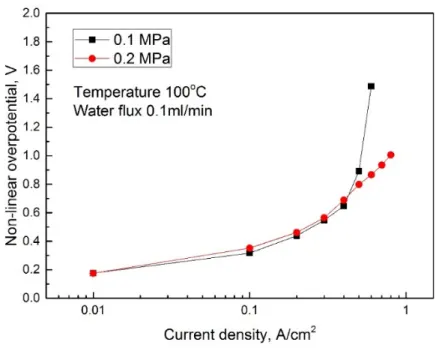
Higher pressures are also thought to be effective in reducing the overpotential by liquid water depletion. At a certain temperature, an increasing pressure changes the water phase from vapor to liquid. As shown in Table 3.2(a), rising the pressure from 0.1 to 0.2 MPa at 100 converts the water phase from the vapor phase to the vapor/liquid phase (i.e., slug phase). Such a phase change is expected to increase the amount of water available at the anode catalyst layer, reducing the overpotential by liquid water depletion.

Figures 3.3(a), 3.3(b) and 3.3(c) illustrate the effect of the pressure on the I–V

characteristics, I-HFR characteristics and non-linear overpotential at a temperature of

100 and water flow rate of 0.1 mL/min. The pressure-rise means that the pressure at

both the anode and the cathode elevates from 0.1 to 0.2 MPa. Although this rise in the

pressure makes the OCV slightly higher according to thermodynamics prediction (so

called Nernst voltage) as shown in Table 3.3, the sharp increase in the cell voltage

disappears; and the current-density region becomes larger. Thus, raising the pressure is

an effective method for transporting water in liquid phase from the channel to the catalyst

(57)

48

layer in the anode, and thus suppressing the overpotential by liquid water depletion as shown in Fig. 3.3(c).

The pressure has also a positive influence on the ohmic resistance, as shown in Fig.

3.3(b). As is known, when the water around the PEM changes from vapor to liquid, the water content and hence the ionic conductivity in the PEM becomes higher [9].

Accordingly, the decreasing ohmic resistance with the increasing pressure is attributed to hydrating PEM with liquid phase water.

3.4.4 Optimal operating condition

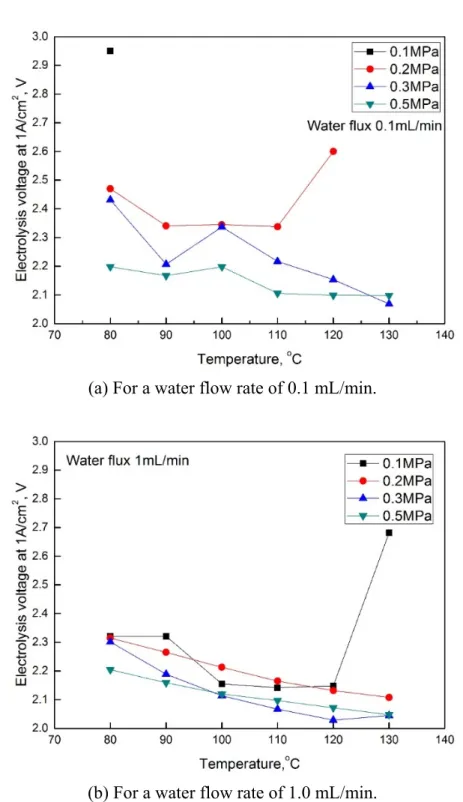
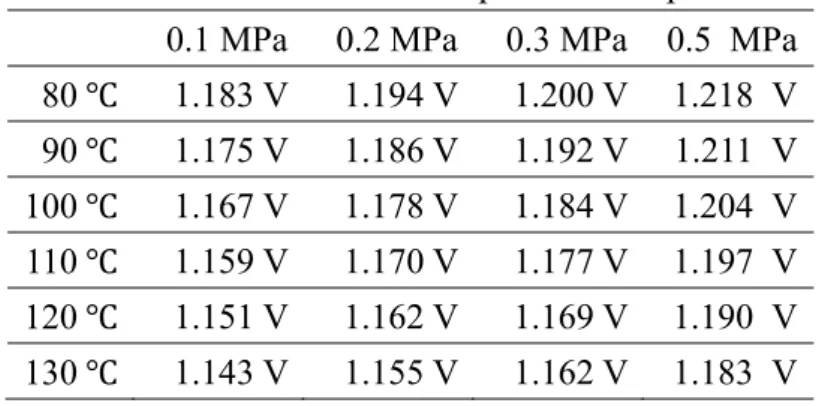
Figure 3.4(a) shows the cell voltage for an electrolysis current of 1.0 A/cm

2

and water flow rate of 0.1 mL/min. The data shown correspond to the cases when the cell voltage was lower than 3.0 V. The data in Table 3.2(a) suggest that the flow pattern corresponding to the data plotted in Fig. 3.4(a) can be categorized as a two-phase flow;

an exception is the case at 120 °C and 0.2 MPa. Although the data are scattered in Fig.

3.4(a), generally higher temperatures and pressures decrease the cell voltage, resulting in better cell performance. The impact of the temperature can be primarily attributed to the change in the activation overpotential.

As mentioned above, the change in the water phase from the single vapor phase to

Figure 1.1 Schematic figure of a PEMWE cell
Figure 2.1 Experimental setup used for evaluating the performance of a PEMWE  cell in this study
Figure 2.2 Process of fabricating the CCM
Table 2.1 Properties of the evaluated PEMWE.
+7

参照

Outline

関連したドキュメント

In this paper, taking into account pipelining and optimization, we improve throughput and e ffi ciency of the TRSA method, a parallel architecture solution for RSA security based on

This paper intended to present a set of heuristic urban street speed functions under mixed traffic flow by taking into account integrative impacts of curb parking, including the

The goal of this work is to study the performance of the estimates produced by the EM algorithm, taking into account the method of moments and a random initialization method to

This article is organized as follows: In section 2, the model coupling 3D Richards equation with the Dupuit horizontal approximation is introduced; consequences taking

We study the basic preferential attachment process, which generates a sequence of random trees, each obtained from the previous one by introducing a new vertex and joining it to

In this paper we develop a general decomposition theory (Section 5) for submonoids and subgroups of rings under ◦, in terms of semidirect, reverse semidirect and general

Thus, the present study is actually quite different and can be considered as an improvement of [6] and a generalization of [3] to quasilinear (monotone operators in the gradient)

Then it follows immediately from a suitable version of “Hensel’s Lemma” [cf., e.g., the argument of [4], Lemma 2.1] that S may be obtained, as the notation suggests, as the m A