Structured Parallel Programming with Trees
(木を用いた構造化並列プログラミング)
A dissertation by
Sato, Shigeyuki
(佐藤 重幸)
Submitted to the
Department of Communication Engineering and Informatics in Partial Fulfillment of the Requirements for the Degree of
Doctor of Philosophy
in the subject of
Engineering
The University of Electro-Communications
March 2015
Committee
Professor Hideya Iwasaki
Professor Rikio Onai
Professor Tetsu Narumi Professor Masayuki Narumi Associate Professor Yasuichi Nakayama
For refereeing this doctoral dissertation, entitled,Structured Parallel Programming with Trees.
Copyright
⃝c 2015 Sato, Shigeyuki(佐藤 重幸)
All rights reserved.
Abstract
High-level abstractions for parallel programming are still immature. Computations on complicated data structures such as pointer structures are considered as irregular algorithms. General graph structures, which irregular algorithms generally deal with, are difficult to divide and conquer. Because the divide- and-conquer paradigm is essential for load balancing in parallel algorithms and a key to parallel program- ming, general graphs are reasonably difficult. However, trees lead to divide-and-conquer computations by definition and are sufficiently general and powerful as a tool of programming. We therefore deal with abstractions of tree-based computations.
Our study has started from Matsuzaki’s work on tree skeletons. We have improved the usability of tree skeletons by enriching their implementation aspect. Specifically, we have dealt with two issues.
We first have implemented the loose coupling between skeletons and data structures and developed a flexible tree skeleton library. We secondly have implemented a parallelizer that transforms sequential recursive functions in C into parallel programs that use tree skeletons implicitly. This parallelizer hides the complicated API of tree skeletons and makes programmers to use tree skeletons with no burden.
Unfortunately, the practicality of tree skeletons, however, has not been improved. On the basis of the observations from the practice of tree skeletons, we deal with two application domains: program analysis and neighborhood computation.
In the domain of program analysis, compilers treat input programs as control-flow graphs (CFGs) and perform analysis on CFGs. Program analysis is therefore difficult to divide and conquer. To resolve this problem, we have developed divide-and-conquer methods for program analysis in a syntax-directed manner on the basis of Rosen’s high-level approach. Specifically, we have dealt with data-flow analysis based on Tarjan’s formalization and value-graph construction based on a functional formalization.
In the domain of neighborhood computations, a primary issue is locality. A naive parallel neighbor- hood computation without locality enhancement causes a lot of cache misses. The divide-and-conquer paradigm is known to be useful also for locality enhancement. We therefore have applied algebraic for- malizations and a tree-segmenting technique derived from tree skeletons to the locality enhancement of neighborhood computations.
Quick Overview In Japanese 並列プログラミングでは高水準の抽象化が十分に確立しておらず,複 雑な構造を用いる計算は,不規則アルゴリズムと一括りに扱われている.しかし,木構造を扱う計算は,自 然な分割統治が定義できるために,系統的な抽象化を期待できる.そこで本研究は,木を用いる並列計算 の抽象化を扱う.まず,松崎による木スケルトンの成果を出発点とし,実装面を充実させることで,その 使いやすさを向上させた.しかし,実用性は十分ではなかったので,そこで得られた知見や培った技法を 元に,2つの問題領域に取り組んだ.1つはプログラム解析領域において,構文主導型分割統治手法を開発 した.もう1つは,空間上の近傍計算において,キャッシュ効率化手法を提案した.
i
Contents
Abstract i
Acknowledgments vii
1 Introduction 1
1.1 Background and Motivation . . . 1
1.2 Overview of This Dissertation . . . 2
1.3 Contributions and Organization of This Dissertation . . . 2
I Programming With Tree Skeletons 5
2 Tree Skeletons 7 2.1 What Is the Skeleton? . . . 72.2 Formalization with Data Structures . . . 8
2.3 Divide and Conquer on Segmented Trees . . . 10
2.3.1 Segmented Trees . . . 10
2.3.2 Properties of Segmented Trees . . . 11
2.4 Tree Contraction Operations . . . 11
2.5 Definitions of Tree Skeletons . . . 12
3 Interface Between Data Structures and Skeletons 17 3.1 Introduction . . . 17
3.2 Tree Skeleton Library . . . 18
3.3 Our Interface of Trees . . . 19
3.3.1 Iterators over a Tree . . . 19
3.3.2 Global Iterators and Local Iterators . . . 19
3.3.3 Tree Construction . . . 20
3.4 Our Implementation . . . 20
3.4.1 Template-based Implementation of Our Tree Interface . . . 21
3.4.2 Generic Implementation of Tree Skeletons . . . 23
3.4.3 Type Checking of Tree Skeletons . . . 23
3.5 Benefits of Our Design . . . 25
3.5.1 Specialization of Representation . . . 25
3.5.2 Multiple Views . . . 26
3.6 Preliminary Experiments . . . 27
3.6.1 Overhead of Our Interface . . . 27
3.6.2 Flexibility from Our Interface . . . 28
3.6.3 Avoidance of Data Restructuring . . . 28
3.7 Related Work . . . 29
3.8 Conclusion . . . 30 iii
4 Tree Skeleton Hiding 31
4.1 Introduction . . . 31
4.2 Deriving Operators from Multilinear Computation . . . 32
4.2.1 Multilinear Computation on Trees . . . 32
4.2.2 Auxiliary Operators in Multilinear Computation . . . 33
4.3 Proposed Parallelizer . . . 34
4.3.1 Fundamental Design . . . 34
4.3.2 Compiler Directives for Parallelization . . . 35
4.3.3 Algorithm Descriptions . . . 37
4.3.4 Implementation Overview . . . 38
4.4 Underlying Binary Tree Skeleton . . . 42
4.4.1 Definition . . . 42
4.4.2 Specialization to Multilinear Computations . . . 44
4.4.3 Library Implementation . . . 45
4.5 Preliminary Experiments on Parallel Execution . . . 46
4.6 Benefits of Hiding Tree Skeletons . . . 46
4.6.1 Entanglement of Operators for Tree Skeletons . . . 47
4.6.2 Trade-off between Generality and Simplicity . . . 47
4.6.3 Abstraction Layer between Specifications and Skeletons . . . 47
4.6.4 Implicitly Skeletal Programming on Trees . . . 48
4.7 Related Work . . . 48
4.8 Conclusion . . . 49
5 Limitations of Tree Skeletons 51
II Syntax-Directed Programming 53
6 Syntax-Directed Computation and Program Analysis 55 6.1 Motivation for Program Analysis . . . 556.2 High-Level Program Analysis . . . 55
7 Syntax-Directed Divide-and-Conquer Data-Flow Analysis 57 7.1 Introduction . . . 57
7.2 Formalization of Data-Flow Analysis . . . 58
7.3 Syntax-Directed Parallel DFA Algorithm . . . 60
7.3.1 Syntax-Directed Construction of Summaries . . . 60
7.3.2 Calculating Join-Over-All-Paths Solutions . . . 64
7.3.3 Construction of All-Points Summaries . . . 64
7.3.4 Interprocedural Analysis . . . 65
7.4 Elimination of Labels . . . 65
7.5 Experiments . . . 66
7.5.1 Prototype Implementations . . . 66
7.5.2 Experimental Setup . . . 66
7.5.3 Experimental Results . . . 67
7.6 Related Work . . . 68
7.7 Conclusion . . . 68
8 Syntax-Directed Construction of Value Graphs 69 8.1 Introduction . . . 69
8.2 Value Numbering and Value Graphs . . . 70
8.2.1 Value Numbering . . . 70
8.2.2 ϕ-Function . . . 72
8.2.3 Definition and Formalization of Value Graphs . . . 74
CONTENTS v
8.3 Construction Algorithm to the While Language . . . 74
8.3.1 Syntax-Directed Formulation . . . 75
8.3.2 Implementation Issues . . . 77
8.4 Taming Goto/Label Statements . . . 78
8.4.1 Difficulty of Goto/Label Statements . . . 78
8.4.2 Syntax-Directed Approach to Single-Entry Multiple-Exit ASTs . . . 79
8.4.3 Tolerating Multiple-Entry ASTs by Reduction . . . 82
8.5 Related Work and Discussion . . . 84
8.6 Conclusion . . . 86
9 Lessons from Syntax-Directed Program Analysis 87
III Programming With Neighborhood 89
10 Neighborhood Computations 91 11 Time Contraction for Optimizing Stencil Computation 93 11.1 Introduction . . . 9311.2 Loop Contraction: Reduction of Iterations . . . 94
11.2.1 Explanation by Example . . . 94
11.2.2 Target of Application . . . 95
11.2.3 Problem Statement . . . 96
11.3 Time Contraction: Optimization for Stencil Loops . . . 96
11.3.1 Our Key Observations and Solution . . . 96
11.3.2 Precomputing Stencil Coefficients . . . 97
11.3.3 Advantages of Time Contraction . . . 99
11.3.4 Complexity Analysis . . . 100
11.3.5 Extension and Applicability . . . 101
11.3.6 Drawback: Lowering Precision . . . 102
11.4 Tuning Based on Time Contraction . . . 103
11.4.1 Parametricity onk . . . 103
11.4.2 Affinity for Unroll-and-Jam . . . 103
11.4.3 Affinity for Divide-and-Conquer . . . 104
11.5 Experiments . . . 105
11.5.1 Experimental Library . . . 105
11.5.2 Experimental Settings . . . 105
11.5.3 Experimental Results . . . 105
11.6 Discussion . . . 107
11.6.1 Related Work . . . 107
11.6.2 Future Work . . . 109
12 Locality Enhancement based on Segmentation of Trees 113 12.1 Introduction . . . 113
12.2 Preliminaries . . . 114
12.2.1 Segmentation of Trees . . . 114
12.2.2 m-Bridge . . . 114
12.3 Iterative Tree Traversal . . . 115
12.4 Proposed Data Structures . . . 117
12.4.1 Simply Blocked Tree . . . 117
12.4.2 Recursively Segmented Tree . . . 118
12.4.3 Buffered Recursively Segmented Tree . . . 119
12.4.4 Parallel Implementation . . . 121
12.5 Applications . . . 122
12.5.1 Batch Processing with Range Queries . . . 122
12.5.2 N-body Problem . . . 123
12.5.3 Ray Tracing . . . 124
12.5.4 Nearest-Neighbor Classifiers . . . 125
12.6 Related Work . . . 126
12.6.1 Enhancing Locality in Tree Traversal . . . 126
12.6.2 Cache-Efficient/-Oblivious Trees . . . 126
12.6.3 Iterative Search . . . 127
12.6.4 Data-Parallel Skeletons . . . 127
12.7 Conclusion . . . 127
13 Towards Neighborhood Abstractions 129 14 Conclusion 131 14.1 Summary of Contributions . . . 131
14.2 Retrospection . . . 131
Bibliography 133
Acknowledgments
Many people helped me complete my doctoral research. I would like to express my gratitude to them here.
First of all, I would like to thank my supervisor, Professor Hideya Iwasaki, for his patience in providing me with an ideal milieu for research and in guiding me with his educational consideration even in matters of my life as well as research. His great tolerance for me was indispensable for my research activities.
I would also like to express my deepest gratitude to the co-authors of the publications in my doctoral research, Lecturer Akimasa Morihata of The University of Tokyo and Associate Professor Kiminori Matsuzaki of Kochi University of Technology. They were the ones beyond co-authors for me. They always kindly taught me both technical and non-technical perspectives of research and correct attitudes to research. They even gave me their time to discuss my personal concerns with me. They have been exemplary researchers that had had an invaluable influence on me.
I am very grateful to Professor Zhenjiang Hu of National Institute of Informatics, Assistant Professor Kento Emoto of Kyushu Institute of Technology, and Professor Munehiro Takimoto of Tokyo University of Science. Professor Hu always encouraged me in my research with expecting my success, and gave me many opportunities to attend seminars, workshops, conferences even with financial aids. Assistant Professor Emoto’s discussions, comments, and criticisms on my studies and presentations were always helpful to me. Professor Takimoto always encouraged me in my studies on data-flow analysis and gave me his time to discuss them with me.
I am very thankful to Associate Professor Tomoharu Ugawa, Associate Professor Keisuke Nakano, and Associate Professor Yoshihiro Oyama. Associate Professor Ugawa’s comments on implementation issues on software systems, especially, memory management were insightful and beneficial to me. Associate Professor Nakano’s comments on my presentations were correct, reasonable, and helpful to me. Associate Professor Oyama had interest in my observations on parallel computing and gave me his time to discuss them with me.
I am grateful to Associate Professor Miyako Satoh of The University of Electro-Communications for discussions with me on English and for her kind instruction on my linguistic usage. I am thankful to Assistant Professor Kazutaka Matsuda of The University of Tokyo and Yasunao Takano of my colleagues for their talks and discussions with me that were a beneficial, refreshing, or enjoyable time for me.
Last but not least, those whom I cannot name, my heartfelt thanks go to members of the Iwasaki laboratory, ones of the IPL seminar, and many others for their mental stimulation to me.
vii
Chapter 1
Introduction
1.1 Background and Motivation
In the history of computer science, parallel computing and parallel machines are classic topics. In the research on programming languages, parallel programs (i.e., programs exploiting parallel machines) and parallel programming (i.e., to develop parallel programs) are never new topics. However, the current status of parallel programming is very immature. The most popular language used in practice for describing parallel programs is FORTRAN, which is one of the oldest programming languages, together with MPI, which is a low-level communication construct. Abstractions for parallel programming are very limited and low-level compared with sequential (i.e., non-parallel) programming. Therefore, parallel programming is considered as a research problem for the next 50 years [HPP09].
Automatic parallelization and optimization are closely relevant to parallel programming because these promote high-level programming that is oblivious of low-level issues that compilers can resolve. Auto- matic parallelization and optimization for index access to arrays in nested for loops were well studied [AK01, BHRS08, GGL12, YFRS13]. For good or ill, they help FORTRAN survive so far. Meanwhile, although accumulative computation is generally difficult to parallelize, methods for automatic paralleliza- tion of accumulative linear recursions were developed [MMM`07, MM10, SI11a, FG94, RF00]. In this sense, the foundations of the abstractions for parallel programming on linear structures are now available.
However, more complicated structures are difficult to deal with in parallel programming. Foundations for dealing systematically with them have not been solidly established.
Actually, problems/algorithms that involve more complicated structures, e.g., linked structures and sparse representations than random-access arrays are called irregular ones in the context of parallel programming1. A systematic approach to implementing irregular algorithms is a big issue in parallel programming and a hot topic in recent studies [KBI`09].
The computational structure in irregular problems forms a graph. Since (general) graphs do not have recursive structures, irregular algorithms are not recursively defined in general. This means that irregular algorithms are generally not contained in the divide-and-conquer paradigm. Divide and conquer is, however, essential to parallel computing and has been used as the key notion extensively in parallel programming [BFGS12, FLR98, BCH`94, Ski93]. Irregular problems/algorithms are therefore inherently difficult to deal with in parallel programming.
Instead of general irregular algorithms, we focus on tree-based algorithms. Although tree-based algorithms are usually considered as irregular ones, their computational structures are based on trees but not (general) graphs. Trees have recursive structures and tree-based algorithms utilize this trait. As a result, the large part of a tree-based algorithm is recursively defined and adopts the divide-and-conquer paradigm. Tree-based algorithms are therefore relatively tractable in parallel programming.
Computations with trees are of high importance. Trees are fundamental data structures in functional programming because they by definition match recursive functions. It is no exaggeration to say that computations with trees cover the core part of functional programming. In parallel programming, trees
1http://www.cs.cmu.edu/~scandal/alg/whatis.html
1
work as abstractions for load balancing [MM11b, MMHT09, Mor13] and scheduling [LKK13] because they can represent divide-and-conquer structures directly. These facts promise that high-level abstractions and systematic methods for computations with trees are useful for a wide range of applications. In particular, we can even expect that these lead to a versatile method for divide-and-conquer load balancing.
1.2 Overview of This Dissertation
In this dissertation, we deal with parallel programming with trees in a divide-and-conquer manner, which leads to good load balancing. Our study has started from Matsuzaki’s work [Mat07b] on tree skeletons [Ski96, GCS94], which are divide-and-conquer parallel patterns on trees. Although Matsuzaki’s work investigated the theoretical aspect of tree skeletons, it left much room for improvement on the practical aspect, especially usability. We therefore have improved the usability of tree skeletons on two aspects.
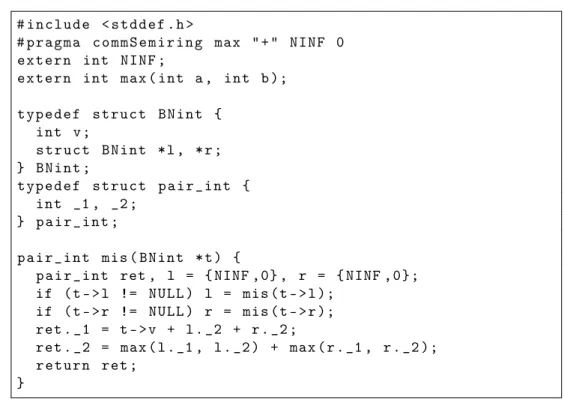
One is the modularity and flexibility of library implementation [Mat07a]. We have achieved loose coupling between tree data structures and tree skeletons in our library implementation. Our library is consequently more flexible than existing ones. The other is the complicated APIs of tree skeletons. We have developed a parallelizer that transforms sequential recursive functions in C into tree skeleton calls on the basis of the formalization by Matsuzaki at al. [MHT06]. Our parallelizer hides the complicated API of tree skeletons from programmers and enables programmers to use tree skeletons implicitly.
Although we have improved the usability of tree skeletons on the two aspects successfully, program- ming with tree skeletons is still not useful in practice. We have noticed that a purely structural approach that tree skeletons adopt per se is counter-intuitive and it is important to examine the interpretations of trees and the underlying data of trees. This observation suggests the fundamental importance of application domains. We therefore have determined to distance ourselves from Matsuzaki’s work on tree skeletons and focused on two domains: program analysis and spatial computation.
We have dealt with program analysis based on abstract syntax trees (ASTs) because its computational structure is similar to tree skeletons. Specifically, we have dealt with data-flow analysis and value-graph construction, which are the foundations of compiler optimizations. In AST-based approaches, goto/label statements are troublesome because a syntax-directed handling of them is difficult. From the perspective of irregular algorithms, goto/label statements cause computations on general graphs and become an obstacle to divide-and-conquer computations. In fact, compilers use control-flow graphs, which are general directed graphs, as input programs to most kinds of program analysis. As a result, they are difficult to parallelize in a divide-and-conquer manner. On the basis of the notion of Rosen’s high-level data-flow analysis [Ros77, Ros80], which does not deal with goto/label statements, we have developed a mostly divide-and-conquer method for data-flow analysis and and value-graph construction to ASTs containing few goto/label statements.
We have dealt with spatial computation based on neighborhood (or simply neighborhood computa- tion) because of its practical importance in various applications. Although this computation is usually trivial to perform in a divide-and-conquer manner, its naive divide-and-conquer implementation is in- sufficient. Because cache efficiency is of high importance for this computation, a cache-efficient divide- and-conquer implementation like cache-oblivious algorithms [FLPR99, BGS10] is desired. We therefore have investigated cache-efficient divide-and-conquer approaches to two kinds of neighborhood compu- tations. We first have dealt with stencil computation, which is a regular array-based computation but very popular in scientific computing, and have developed a linear algebraic optimization for enhancing its cache efficiency. We secondly have dealt with iterative traversal of space-partitioning trees, which is a typical algorithmic pattern found in N-body problems and machine learning, and have developed a skeleton-based technique for enhancing its cache efficiency.
Through the practice of parallel programming in the two domains, we have confirmed our observation on parallel programming with trees.
1.3 Contributions and Organization of This Dissertation
This dissertation consists of three parts:
1.3. CONTRIBUTIONS AND ORGANIZATION OF THIS DISSERTATION 3
• Part I deals with programming with tree skeletons. This part is overall based on Matsuzaki’s work [Mat07b] on tree skeletons (Chapter 2). We deal with problems on the usability of tree skeletons.
We present a tree interface to achieve loose coupling between the implementation of trees and that of tree skeletons (Chapter 3). We present a parallelizer for recursive functions in C to enable implicit use of tree skeletons (Chapter 4). We describe observations on programming with trees from limitations of tree skeletons (Chapter 5).
• Part II deals with syntax-directed programming in the domain of high-level program analysis (Chapter 6). On the basis of the notion of Rosen’s high-level data-flow analysis [Ros77, Ros80], we present syntax-directed methods for data-flow analysis (Chapter 7) and for value-graph construction (Chapter 8). These methods perform mostly in a divide-and-conquer manner by taming goto/label statements.
• Part III deals with cache-efficient divide-and-conquer programming in the domain of neighbor- hood computations (Chapter 10). We present a linear algebraic optimization for enhancing the cache complexity of stencil computation (Chapter 11) and present a skeleton-based technique for enhancing the cache complexity of iterative traversal of space-partitioning trees (Chapter 12).
The individual results above have been published or presented. Chapter 3 was published in [SM14a], Chapter 4 was published in [SM13], Chapter 7 was published in [SM14b], Chapter 8 was presented in [Sat14b], Chapter 11 was presented in [SI11b], and Chapter 12 was presented in [Sat14a].
Part I
Programming With Tree Skeletons
5
Chapter 2
Tree Skeletons
In this chapter, we introduce tree skeletons [Ski96, GCS94], which are background knowledge for Part I.
Refer to Matsuzaki’s Ph.D. thesis [Mat07b] for more details.
2.1 What Is the Skeleton?
Algorithmic skeletons [Col89] (or simply skeletons) are patterns of parallel computing. Skeletons are high- level abstractions for parallel programming. By composing skeletons, we can develop parallel programs in a high-level and structured manner [DGTY95].
There are roughly two kinds of skeletons [RG02, GVL10]: task-parallel ones and data-parallel ones.
Task-parallel skeletons, or task skeletons for short, represent and manipulate tasks. Typical task skeletons arepipeandfarm, which respectively correspond to serial composition of tasks and parallel composition.
A structure that task skeletons construct is an analogy to a circuit. Task skeletons exploit parallelism of computations represented by this circuit; e.g., pipe exploits parallelism in pipelining. We use the term parallelism as a synonym for independence of (sub)computations. Although serial compositions bypipedo not have so-called parallelism in their circuits, pipelined computations on their circuits have parallelism.
Data-parallel skeletons manipulate collections in parallel. More precisely, they are collective parallel operations on a certain data structure. The most popular data-parallel skeleton is map: it takes a unary function and a collection, and yields a new collection consisting of the results that we obtain by applying the given function to each element of the given collection. mapcan be defined over various data structures. For example, ifmaptakes a list and yields a new list, this mapis called a list skeleton (i.e., a collective parallel operation over lists). Data-parallel skeletons are thus classified by their target data structures.
We deal with data-parallel skeletons in this dissertation. Readers may consider task skeletons to be more general than data-parallel skeletons. This is true in the sense that task skeletons are independent of target data structures. Although individual data-parallel skeletons have more specific purposes than task skeletons, data-parallel skeletons per se are no less versatile. The difference between both is essen- tially in formalization of computation. When we use data-parallel skeletons, we first formalize target computation as a data structure. For example, if the specification of target computation is a linear recursion (or, a sequence of functions), we may use a list(s) to formalize it. We then use list skeletons to describe the specification as a parallel program. That is, data-parallel skeletons do not always handle data structures that are input/output in target computations. Formalization with data structures is essential for programming with data-parallel skeletons. This introduces rich computational structures into specifications. In this sense, programming with data-parallel skeletons is more structured than doing with task skeletons, and therefore we deal with it.
7
2.2 Formalization with Data Structures
To explain the importance of computational structures formalized by data structures, we briefly introduce lists and list skeletons [Ski93] based on functional programming. We write a list by enumerating elements with commas and enclosing them with brackets; e.g.,r0,1,2s. We call a list in this form alist literal.
We first describe a notation for data types of trees in this dissertation. We use a restricted form of context free grammars for defining a data type as a nonterminal symbol. A lowercase term (e.g.,αand x) denotes a metavariable. A capitalized term that is not defined in grammars, i.e., does not appear in the left-hand side of any production rule, denotes a terminal symbol, and a capitalized term that is defined in grammars denotes a nonterminal symbol that denotes a data type. Terminal symbols may have argument lists like functions to specify associated metavariables and symbols. The production rules of any nonterminal symbol can be distinguished from its leftmost terminal symbol as in LL grammars.
Pattern matching on the data type is therefore deterministic.
The data type of lists is usually defined as the following grammar:
Listα“Conspx,Listαq, wherexis of typeα, Listα“Nil.
Here,xdenotes a metavariable over list elements. Nildenotes the empty list (i.e.,rs). Conspx, yqdenotes a list whose head is xand whose tail isy; e.g., Conspa1,ra2, a3sq “ ra1, a2, a3s. This is called the cons list. For example, a list (literal)ra1, a2, a3sis a synonym of the unique cons list:
Conspa1,Conspa2,Conspa3,Nilqqq.
The data type of lists can be also defined as the following grammar:
JListα“JoinpJListα,JListαq,
JListα“Singletonpxq, wherexis of typeα, JListα“Nil.
Singletonpxq denotes a singleton list (i.e.,rxs). Joinpx, yq denotes the concatenation of two listsxand y; Joinpra1s,ra2, a3sq “ ra1, a2, a3s. This is called the join list. In contrast to the cons list, ra1, a2, a3s can be represented by, for example, the following four join lists:
JoinpSingletonpa1q,JoinpSingletonpa2q,Singletonpa3qqq, JoinpJoinpSingletonpa1q,Singletonpa2qq,Singletonpa3qq,
JoinpJoinpSingletonpa1q,Singletonpa2qq,JoinpNil,Singletonpa3qqq, and JoinpSingletonpa1q,pJoinpSingletonpa2q,JoinpSingletonpa3q,Nilqqqq.
We can understand this equivalence from the algebraic property of the interpretation of Join, i.e., the concatenation of two lists. For example, we can define a concatenation operator `` over lists by using list literals as follows:
ra1, . . . , ans `` rb1, . . . , bms “ ra1, . . . , an, b1, . . . , bms, x`` rs “x,
rs ``x“x,
where m, n ě 1 and x denotes a list. It is important that `` is associative; for any x, y, and z, x`` py``zq “ px``yq ``z, and that rs is the identity of ``. By using ``, we can confirm the equivalence among the four join lists as follows:
ra1s `` pra2s `` ra3sq “ ra1, a2, a3s, pra1s `` ra2sq `` ra3s “ ra1, a2, a3s, pra1s `` ra2sq `` prs `` ra3sq “ ra1, a2, a3s, ra1s `` pra2s `` pra3s `` rsqq “ ra1, a2, a3s.
2.2. FORMALIZATION WITH DATA STRUCTURES 9 This means that the four join lists are contained in the same equivalence class modulo interpretingJoin as ``. From the perspective of data structures, the associativity of `` and its identityrs enable us to transform join lists in the same equivalence class.
A high degree of freedom in structure among lists in an equivalence class is of primary importance for parallel programming. We can improve structural parallelism of join lists by balancing them. For example, we considermap, which can be defined with list literals as follows:
mappf,ra1, . . . , ansq “ rfpa1q, . . . , fpanqs, whereně1, mappf,rsq “ rs.
We can definemapoverListα as
mappf,Conspx, yqq “Conspfpxq,mappf, yqq, mappf,Nilq “Nil.
We can also definemapoverJListα as
mappf,Joinpx, yqq “Joinpmappf, xq,mappf, yqq, mappf,Singletonpxqq “Singletonpfpxqq,
mappf,Nilq “Nil.
Then, let us consider mappf,ra1, a2, a3sq. The recursions for the cons list and the fourth join list are almost the same because the shapes of both list representations are equivalent. Their recursion depth is 4. The recursion for the third join list is, however, different from them. It halves a given list recursively and therefore its recursion depth is 3. In general, given a list of length n, mapover Listα costs Opnq parallel steps butmapoverJListαcostsOplgnqparallel steps. Balancing join lists leads to load balancing of list skeletons. This is why the join list is seen as a parallel implementation of the list.
The definition ofmapoverJListαdoes not specify load balancing itself but simply exploits structural parallelism of a given join list. The interpretation of JListα expresses room for load balancing on the basis of the associativity of the interpretation ofJoin (i.e.,``).
The algebraic properties of the interpretation ofJListαaffect the specifications of list skeletons. For example, we considerreducedefined as follows:
reducep‘, ι‘,ra1, . . . , ansq “a1‘ ¨ ¨ ¨ ‘an, whereně1, reducep‘, ι‘,rsq “ι‘.
reducehas the algebraic conditions that‘is associative andι‘ is the identity of‘. We can understand it from the definition ofreduce overJListα:
reducep‘, ι‘,Joinpx, yqq “reducep‘, ι‘, xq ‘reducep‘, ι‘, yq, reducep‘, ι‘,Singletonpxqq “x,
reducep‘, ι‘,Nilq “ι‘.
reducethus interpretsJoin as‘andNil asι‘. The join lists in an equivalence class must be equivalent for every list skeleton. For example, reducep‘, ι‘,ra1, a2, a3sqhave to yield the same result among the four join lists. To ensure the equality of their results, the algebraic conditions on‘andι‘ are necessary.
They are derived from the interpretation ofJ Listα. From the perspective of list skeletons, such algebraic conditions are the representation of their parallelism.
The definitions of data-parallel skeletons are oblivious of parallel computing and therefore data- parallel skeletons enable high-level parallel programming. Parallelism of data-parallel skeletons is de- scribed in target data structures (and more specifically, the interpretations of data types). Formalization with data structures is therefore crucial for high-level parallel programming.
1
2 3
4 5 6 7
8 9 1 0 1 1
1 2 1 3 1 4 1 5
1
2 , 4 , 5 3,6,7,
1 0 , 1 1
9 , 1 2 ,
8 1 3 1 4 1 5
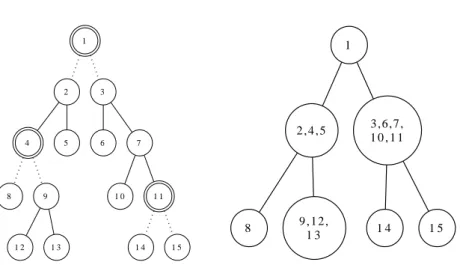
Figure 2.1: Illustration of a segmented tree. On left is view decomposed into its local trees, where double-circle nodes denote hole nodes and dotted edge denote missing edges; on right is view of its global tree.
2.3 Divide and Conquer on Segmented Trees
2.3.1 Segmented Trees
Tree skeletons [Ski96, GCS94, Mat07b] deal with full binary trees. We define full binary trees to formalize tree skeletons as the following grammar:
BinTreeα“Branchpx,BinTreeα,BinTreeαq, BinTreeα“Leafpxq,
where xdenotes a metavariable over values of typeα. We call the value of xa payload value. Branch andLeaf denote the kinds of nodes; we call themnode symbols.
Although BinTreeα is seemingly similar to JListα, both interpretations are different. UnlikeJoin, the interpretation of Branch is generally not associative because rotations are not applicable to every tree. We cannot balance trees of type BinTreeα, preserving their meaning. BinTreeα therefore does not guarantee load balancing of tree skeletons. For example, a tree of typeBinTreeαmay form a linear structure like the cons list. The recursion depth for such a tree will beOpnq, wherenis the number of nodes. To achieverobust load balancing such that it guarantees asymptotic speedup regardless of input trees, we have to consider restructuring of arbitrarily shaped trees.
Like join lists for list skeletons, we use segmented trees1 for tree skeletons. A segmented tree is a tree segmented into its subtrees and its one-hole contexts. Figure 2.1 illustrates a segmented tree. A one-hole context is a subtree that loses the descendant subtrees of one node. This node, i.e., a parent of missing subtrees, is called a hole node. For example, t1uand t2,4,5u on the left of Figure 2.1 are one-hole contexts and 1 and 4 are hole nodes. A hole node is an internal node in the whole tree but pretends to be a leaf node in the one-hole context. Every segment (i.e., subtree or one-hole context) of a segmented tree is a tree and we call it alocal tree. We also call the tree structure of all segments in a segmented treea global tree, where the node of a global tree is a segment. Therefore, the nodes of each segment in Figure 2.1 reduces to a single node in the view of its global tree.
1The same term was not used in [Mat07b] but an equivalent notion was used.
2.4. TREE CONTRACTION OPERATIONS 11 We can define segmented trees as the followingSegTreeα:
SegTreeα“BranchpContextα,SegTreeα,SegTreeαq, SegTreeα“LeafpBinTreeαq,
Contextα“Branch1px,Contextα,BinTreeαq, Contextα“Branch2px,BinTreeα,Contextαq, Contextα“Holepxq.
Here, BinTreeα denotes the subtrees of an original tree, Contextα denotes the one-hole contexts, and Holepxqdenotes the hole nodes. As seen from the grammar above, the root-to-hole path in a one-hole context is the main difference between subtrees and one-hole contexts. Note that the formalization above of segmented trees is inherently similar to ternary trees [Mat07b, MM11b]. By following the grammar above, we describe the segmented tree shown in Figure 2.1 as
Branchpc1,Branchpc2,Leafps1q,Leafps2qq,Branchpc3,Leafps3q,Leafps4qqq, wherec1“Holep1q,
c2“Branch1p2,Holep4q,Leafp3qq,
c3“Branch2p3,Leafp6q,Branch2p7,Leafp10q,Holep11qqq, s1“Leafp8q,
s2“Branchp9,Leafp12q,Leafp13qq, s3“Leafp14q,
s4“Leafp15q.
2.3.2 Properties of Segmented Trees
Segmented trees have two important properties. The first is that the operations of parallel tree contrac- tion [Rei93] guarantee parallel reduction of every segment. The second is that them-bridging technique [Rei93] enables us to partition an arbitrarily shaped tree into segments of almost balanced sizes. The details of tree contraction operations andm-bridging shall be described later.
The segmented trees derived from a tree are contained in an equivalence class modulo appropriate interpretations of tree contraction operations. Tree skeletons can exploit this degree of freedom in structure of segmented trees. If we use segmented trees whose segment sizes are balanced, tree skeletons achieve an excellent load balancing. Note that any tree can be seen as a segmented tree that consists of the single segment. The equivalence class of the segmented trees derived from a given tree therefore contains the given tree.
Along the structure of a segmented tree, the divide-and-conquer computation over a segmented tree is two-tiered; it consists of computation over a local tree and computation over a global tree. A segmented tree is therefore well-suited to distributed memory. By laying an entire segment upon the local memory of a processor, we can perform the entire computation over each local tree in parallel. In this case, the computation over a global tree requires a collective communication on distributed-memory machines.
This communication is efficient because a global tree is much smaller than its original tree.
2.4 Tree Contraction Operations
In this section, we briefly describe tree contraction operations on the basis of Reference [Rei93].
There are two basic operations: RakeandCompress. TheRakeoperation is to contract a leaf and its parent to an internal node. TheCompressoperation is to contract an internal siblingless node and its parent to an internal node. Figure 2.2 illustratesRakeandCompress. The original tree contraction algorithm by Miller and Reif [MR85] usesRakeandCompress.
AlthoughRakeandCompressare intuitive, an intermediate result in a series of these applications to a full binary tree becomes a general (i.e., non-full) binary tree. However, if we perform a pair of
8?9>:=;<
8?9>:=;< 8?9>:=;<
44444444
////
/
Rake +3 8?9>:=;<
8?9>:=;<
44444444
////
/
Compress+3
8?9>:=;<,, ,,,, ,,,, ,,,,
////
/
Figure 2.2: Rakeoperation andCompressoperation.
8?9>:=;<
8?9>:=;< 8?9>:=;<
44444444
////
/
Shuntr
+3
8?9>:=;<,, ,,,, ,,,, ,,,,
////
/
8?9>:=;<
8?9>:=;< 8?9>:=;<
44444444
////
/
Shuntl
+3
8?9>:=;<
////
/
Figure 2.3: Shuntoperations.
applications ofRakeand Compressat once as illustrated in Figure 2.2, the intermediate results from full binary trees remain full binary trees. This pair of applications of Rake and Compressis called the Shunt operation. Specifically, the Shunt operation is to contract the siblings of a leaf node and an internal node, and their parent to an internal node, as illustrated in Figure 2.3. We can consider two symmetrical instances of theShunt operation for binary trees. In this dissertation,Shuntrmeans the Shuntoperation that appliesRaketo a left leaf andShuntlmeans the Shuntoperation that applies Raketo a right leaf. The cost-optimal tree contraction algorithm on EREW PRAM by Abrahamson et al. [ADKP89] uses theShunt operation.
2.5 Definitions of Tree Skeletons
Parallel tree contraction algorithms guarantee asymptotically linear speedup for arbitrarily shaped trees.
Because of this excellent algorithmic property, existing formalizations [Ski96, GCS94, Mat07b, MMHT09]
of tree skeletons are based upon parallel tree contraction algorithms. However, in this dissertation, we do not deal with these algorithms themselves because they are not very useful for implementation. If we use optimal algorithms, the parallel time complexity of the divide-and-conquer computation over a global tree improves from Oppqto Oplgpqbut synchronization/communication steps increase in practice. We therefore adopt sequential manners for computations on global trees. Note that bulk synchronous com- munication steps areOp1qand the amount of communication data isOppqin a collective communication for the computation over a global tree on distributed-memory machines.
We assume that the sizes of the segments of a given segmented tree are sufficiently balanced. This is not a responsibility of tree skeletons. We have to give tree construction operations appropriate in- terpretations for using tree skeletons. The appropriate interpretations here mean that the results of a tree skeleton equal for any segmented tree in the equivalence class. This requirement is represented as algebraic conditions on the parameters of tree skeletons, as in thereduce list skeleton.
We introduce three representative tree skeletonsreduce,uAcc, anddAcc. The sequential definition of
2.5. DEFINITIONS OF TREE SKELETONS 13 reduceis the following bottom-up reduction:
reduce:pβˆαˆβÑβq ˆ pαÑβq ˆBinTreeαÑβ
reducepkB, kL,Branchpx, l, rqq “kBpreducepkB, kL, lq, x,reducepkB, kL, rqq, reducepkB, kL,Leafpxqq “kLpxq.
The parallel definition ofreducetakes, instead of a simple tree of typeBinTreeα, a segmented tree of type SegTreeα. Recall that for the divide and conquer over a segment tree, the appropriate interpretations of tree contraction operations must be given. The parallel definition ofreducetherefore requires additional parameter operators: τ, ϕ, ψl, and ψr. ψl and ψr respectively correspond to Shuntl and Shuntr. To conform the reduce of a segmented tree to that of a simple tree, the parallel definition of reduce necessitates some algebraic conditions among parameter operators. The parallel definition ofreduceis:
reduce:pβˆαˆβ Ñβq ˆ pαÑβq ˆ pαÑγq ˆ pβˆγˆβ Ñβq ˆ pγˆγˆβÑγq ˆ pβˆγˆγÑγq ˆSegTreeαÑβ reducepkB, kL, τ, ϕ, ψl, ψr, tq “redptq,
whereredpBranchpc, l, rqq “ϕpredplq,redCxtpcq,redprqq, redpLeafptqq “reducepkB, kL, tq,
redCxtpBranch1px, l, rqq “ψlpredCxtplq, τpxq,reducepkB, kL, rqq, redCxtpBranch2px, l, rqq “ψrpreducepkB, kL, lq, τpxq,redCxtprqq, redCxtpHolepxqq “τpxq,
{Algebraic conditions}
kBpl, x, rq “ϕpl, τpxq, rq,
ϕpϕpl1, y1, r1q, y, rq “ϕpl1, ψlpy1, y, rq, r1q, ϕpl, y, ϕpl1, y1, r1qq “ϕpl1, ψrpl, y, y1q, r1q.
Although the parallel definition above is seemingly involved, it simply interprets node symbols by using given operators, as in the sequential definition. The definition above formalizesreduceoverSegTreeαbut does not describe its actual computation. The actual computation ofreduceconsists of two phases. The first is the bottom-up reduction of every local tree; the second is the bottom-up reduction of a global tree. In the first phase, we use kB andkL for reducing complete subtrees. As a result, for a one-hole context, the root-to-hole spine remains. We use τ, ψl, and ψr for reducing such spines. We useϕ for reducing a global tree.
uAcc(upward accumulation) is an accumulative version ofreduce, i.e., the following accumulation:
uAcc:pβˆαˆβÑβq ˆ pαÑβq ˆBinTreeαÑBinTreeβ
uAccpkB, kL,Branchpx, l, rqq “BranchpkBprootpl1q, x,rootpl1qq, l1, r1q, wherel1“uAccpkB, kL, lq,
r1“uAccpkB, kL, rq, rootpBranchpx, l, rqq “x, rootpLeafpxqq “x,
uAccpkB, kL,Leafpxqq “LeafpkLpxqq.
uAccconstructs a tree that has the same shaped as a given tree and whose payload values are intermediate values inreduce. The payload value of the root of a resultant tree equals to the result of reduce. The operators given to uAcc and the algebraic conditions on them are the same as those of reduce. The
parallel definition ofuAccis:
uAcc:pβˆαˆβ Ñβq ˆ pαÑβq ˆ pαÑγq ˆ pβˆγˆβ Ñβq ˆ pβˆγˆγÑγq ˆ pγˆγˆβ Ñγq ˆSegTreeαÑSegTreeβ uAccpkB, kL, τ, ϕ, ψl, ψr,Branchpc, l, rqq “Branchpc1, l1, r1q,
wherec1“updPathppsegRootpl1q,segRootpl1qq,uAccCtxpcqq, l1“uAccpkB, kL, τ, ϕ, ψl, ψr, lq,
r1 “uAccpkB, kL, τ, ϕ, ψl, ψr, rq,
uAccCtxpBranch1px, l, rqq “Branch1px2, l2, r2q, wherex2“ψlpctxRootpl2q, τpxq,ctxRootpr2qq,
l2“uAccCtxplq, r2“uAccpkB, kL, rq,
uAccCtxpBranch2px, l, rqq “Branch2px2, l2, r2q, wherex2“ψrpctxRootpl2q, τpxq,ctxRootpr2qq,
l2“uAccpkB, kL, lq, r2“uAccCtxprq, uAccCtxpHolepxqq “Holepτpxqq,
updPathppxl, xrq,Branch1px, l, rqq “Branch1pϕpxl, x, xrq, l, rq, updPathppxl, xrq,Branch2px, l, rqq “Branch2pϕpxl, x, xrq, l, rq, updPathppxl, xrq,Holepxqq “Holepϕpxl, x, xrqq,
segRootpBranchpc, l, rqq “ctxRootpcq, segRootpLeafptqq “rootptq,
ctxRootpBranch1px, l, rqq “x, ctxRootpBranch2px, l, rqq “x, ctxRootpHolepxqq “x,
uAccpkB, kL, τ, ϕ, ψl, ψr,Leafptqq “LeafpuAccpkB, kL, tqq, where {Algebraic conditions}
kBpl, x, rq “ϕpl, τpxq, rq,
ϕpϕpl1, y1, r1q, y, rq “ϕpl1,pψlpy1, y, rq, r1qq, ϕpl, y, ϕpl1, y1, r1qq “ϕpl1,pψrpl, y, y1q, r1qq.
Here, one-hole contexts that uAccCtx yields and updPath consumes are intermediate results defined as the following grammar:
Contextβ,γ“Branch1px,Contextβ,γ,BinTreeβq, Contextβ,γ“Branch2px,BinTreeβ,Contextβ,γq, Contextβ,γ“Holepxq,
where x denotes a metavariable over values of type γ. The definition above merely formalizes uAcc over SegTreeα. The actual computation of uAcc consists of three phases. The first is the bottom-up accumulation of every local tree; the second is the bottom-up accumulation of a global tree; the third is the bottom-up accumulation of all root-to-hole paths of every one-hole context by using the payload values of the missing children of the hole nodes in a resultant tree.
The sequential definition ofdAcc(downward accumulation) is the following top-down accumulation:
dAcc:pβˆαÑβq ˆ pβˆαÑβq ˆβˆBinTreeαÑBinTreeβ
dAccpgl, gr, e,Branchpx, l, rqq “Branchpe,dAccpgl, gr, glpe, xq, lq,dAccpgl, gr, grpe, xq, rqq, dAccpgl, gr, e,Leafpxqq “Leafpeq.
2.5. DEFINITIONS OF TREE SKELETONS 15 The parallel definition of dAcc also requires additional parameter operations: τl, τr, ρ, and ‘. ‘ corresponds toCompressandρcorresponds toRake. It also necessitates algebraic conditions among parameter operators. The parallel definition ofdAccis:
dAcc:pβˆαÑβq ˆ pβˆαÑβq ˆβˆ pαÑγq ˆ pαÑγq ˆ pβˆγÑβq ˆ pγˆγÑγq ˆSegTreeαÑSegTreeβ dAccpgl, gr, e, τl, τr, ρ,‘,Branchpc, l, rqq “Branchpc1, l1, r1q,
wherec1“dAccCtxpe, cq,
l1“dAccpgl, gr, ρpe,redPathpτl, cqq, τl, τr, ρ,‘, lq, r1“dAccpgl, gr, ρpe,redPathpτr, cqq, τl, τr, ρ,‘, rq, redPathpτ,Branch1px, l, rqq “τlpxq ‘redPathpτ, lq, redPathpτ,Branch2px, l, rqq “τrpxq ‘redPathpτ, rq, redPathpτ,Holepxqq “τpxq,
dAccCtxpe,Branch1px, l, rqq “Branch1pe,dAccCtxpglpe, xq, lq,dAccpgl, gr, grpe, xq, rqq, dAccCtxpe,Branch2px, l, rqq “Branch2pe,dAccpgl, gr, glpe, xq, lq,dAccCtxpgrpe, xq, rqq, dAccCtxpe,Holepxqq “Holepeq,
dAccpgl, gr, e, τl, τr, ρ,‘,Leafptqq “LeafpdAccpgl, gr, e, tqq, where {Algebraic conditions}
glpe, xq “ρpe, τlpxqq, grpe, xq “ρpe, τrpxqq, ρpρpe, yq, y1q “ρpe, y‘y1q.
The definition above merely formalizesdAccoverSegTreeα. The actual computation ofdAccconsists of three phases. The first is the reduction of the root-to-hole paths of every one-hole context by using τl, τr, and‘; the second is the top-down accumulation of a global tree by usingρ; the third is the top-down accumulation of every segment by using a giveneor the payload values of the hole nodes in a resultant tree as initial values.
Chapter 3
Interface Between Data Structures and Skeletons
This chapter has a content almost identical to our publication [SM14a].
3.1 Introduction
Since parallel machines are widespread, parallel computing can be ubiquitous. Parallel programming is, however, still an expensive task even for expert programmers. To make parallel programming be cheap and next-door, we require high-level abstractions for parallel computing.
Skeletons [?, RG02] are patterns of parallel computing. Data-parallel skeletons are ones classified by their target data structures, e.g., lists [Ski93], matrices [EHKT07], and trees [Ski96, GCS94]. These computational patterns denote high-level specifications over target data structures. The data-parallel skeletons therefore provide a high-level abstraction for parallel computing over target data structures.
Data-parallel skeleton libraries provide a pair of the implementation of a data structure and that of a set of skeletons over it. This pair is tightly coupled because parallel access to such a data structure relies on its implementation. However, loose coupling between the implementations of data structures and those of the operations over them is important for modularity and flexibility. For example, C++
STL achieves such loose coupling. Most sequence operations defined in<algorithm> operate sequence containers uniformly, regardless of their implementations, e.g., a variable-length array <vector>and a doubly-linked list <list>, where these have different cost models on access. C++ STL enables us to select various implementations of containers that fit use cases. Loose coupling between skeletons and data structures in skeleton libraries will enable us to select implementations of a data structure.
Selection of implementation is actually valuable for tree skeletons. Because tree data are inherently non-uniform, the implementations of tree structures often require taming their non-uniformity for tree skeletons. For example, a full binary tree, whose every internal node has exactly two children, is required for the brevity of the APIs of tree skeletons. To use tree skeletons, we have to transform non-full binary trees into full binary trees by filling missing leaf nodes with dummy nodes. This transformation is obviously undesirable overhead. We can elude this overhead if we can select an implementation of binary trees that pretends to be a full binary tree by returning a common dummy node when missing leaf nodes are demanded.
A similar situation can be found in XML processing. DOM trees derived from XML documents are ranked unbounded-degree trees. In XML processing by using tree skeletons [Ski97, NEM`07], input DOM trees are preprocessed into full binary trees by inserting internal nodes and dummy leaf nodes.
It is valuable to elude this preprocessing by using an implementation of DOM trees that pretends to be full binary trees. In addition, it is known that the bracket structures of XML documents are worth preserving for efficient parallel computing [KME07]. An appropriate implementation of tree structures greatly relies on their input/output formats. A general-purpose yet efficient implementation of trees is extremely difficult.
17
Since we cannot uniquely define an efficient implementation of tree structures for tree skeletons, flexible switching of instances of tree-structure implementation is desirable. However, as in usual im- plementations of data-parallel skeletons, the existing ones of tree skeletons are tightly coupled with tree-structure implementation and do not support such flexible switching.
To resolve this problem, we have designed an interface between tree skeletons and tree-structure implementation on the basis of iterators. Our interface clarifies the requirements of tree-structure im- plementation and supports loose coupling. We have implemented our interface on the basis of C++
templates and implemented tree skeletons [Mat07a] in SkeTo1 by using our interface.
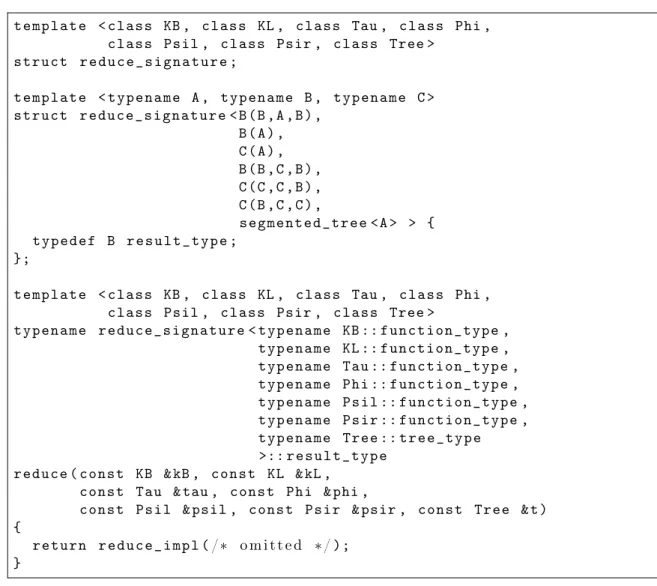
We have used C++ templates extensively for our generic implementation. Enormous unreadable error messages at compile time are a known problem with such template-based implementations [ME10].
Our new implementation of tree skeletons tames error messages by using a type-checking technique.
This chapter presents our design and implementation of tree skeletons as well as describes cases where our interface design works effectively. This chapter also reports the results of preliminary experiments.
The following are our major contributions:
• We have designed an interface between tree skeletons and tree-structure implementation on the basis of iterators (Section 3.3). We describe the benefits of our design for tree skeleton libraries (Section 3.5).
• We have implemented our interface on the basis of C++ templates and implemented array-based tree skeletons [Mat07a] by using our interface (Section 3.4). Our new implementation tames enor- mous error messages at compile time by using a type-checking technique.
• We report the results of preliminary experiments on our new implementation of tree skeletons (Section 3.6). No significant overhead of the use of our interface was observed. The flexibility and efficiency of the implementation derived from our interface design were demonstrated.
3.2 Tree Skeleton Library
In this section, we introduce the SkeTo library. SkeTo were implemented in C++ with MPI2 for distributed-memory machines such as clusters. It provides data-parallel skeletons as generic function templates that take function objects and the distributed implementations of their target data structures.
SkeTo is based on the single-program multiple-data (SPMD) model along MPI. A program that uses SkeTo runs in multiple MPI processes. Each process performs the same computation by default except for the internals of skeletons and distributed data structures. For example, we can use list skeletons in SkeTo as shown Figure 3.1. A notable point is that each variable provides the same view among all processes. All parallel computing is closed in the internals of skeletons and distributed data structures.
This design is not specific to SkeTo but common in data-parallel skeleton libraries.
An experimental version of SkeTo contained an array-based implementation [Mat07a] of tree skeletons.
As mentioned in Section 2.3, segmented trees are well-suited to distributed memory. The distributed implementation of segmented trees is as follows. The entire of each local tree lies in the local memory of a process. Global trees are replicated among all processes because their sizes are reasonably small.
Each node of a global tree contains a segment and the rank of a MPI process to which we assign the segment. A global tree lying in the local memory of each process includes only the segments assigned to the process. That is, the replicated global tree in a process is different in locally lying segments from that in another process. In the rest of this chapter, we intentionally confuse MPI processes with processors in parallel algorithms and do MPI process ranks with processor numbers.
Even though the global tree of a segmented tree is replicated among all processors, computations on global trees require collective communications because of intermediate results for segments that do not locally lie. The root processor gathers scattered intermediate results, performs computations on global trees exclusively, and scatters the results over the other processors. Replicated global trees specify the sources and destinations in message passing.
1http://sketo.ipl-lab.org/
2http://www.mpi-forum.org/
3.3. OUR INTERFACE OF TREES 19 int s k e t o :: m a i n ( int argc , c h a r ** a r g v )
{
// All processes perform the following two lines equally.
int * r a w _ a r r a y = new int [ n ];
i n i t i a l i z e ( r a w _ a r r a y , n );
// Construction of a distributed list of lengthn.
s k e t o :: d i s t _ l i s t < int > dl ( n , r a w _ a r r a y );
// Application of list skeletonmapwith a function objectf.
s k e t o :: d i s t _ l i s t < int > ret = s k e t o :: l i s t _ s k e l e t o n s :: map ( f , dl ) // Gather distributed data ofretto raw_array.
// All processes can observe the elements ofretviaraw_array.
ret . g a t h e r ( r a w _ a r r a y , n );
// Application of list skeletonreducewith+.
// All processes can observe its result viasum.
int sum = s k e t o :: l i s t _ s k e l e t o n s :: r e d u c e ( std :: plus < int >() , 0 , dl );
r e t u r n 0;
}
Figure 3.1: Example use of list skeletons in the SkeTo library.
3.3 Our Interface of Trees
In this section, we describe our interface of trees for tree skeletons. The primary part of our interface is an iterator for trees. The concept of iterators itself is very common; they are extensively used in C++. The iterator is only an abstraction of pointers. The requirements of iterators for tree skeletons are important. We describe our iterators in the following two subsections.
3.3.1 Iterators over a Tree
Tree structures are necessary for computation on trees. However, an iterator that points to a node does not have to return its children. We have only to be able to perform both bottom-up and top- down reductions of trees by using iterators. For example, we can perform both reductions of a tree in its preorder/postorder traversal by using a stack. Actually, preorder/postorder traversal is essential for depth-first search, and depth-first search is a traversal pattern appropriate to both reductions. We therefore base iterators upon preorder/postorder traversal.
We do not have to extract from a node its children, but we have to know whether it is a leaf node or an internal node. Otherwise, we could not reduce a tree by using a stack. A requirement of preorder/postorder iterators is therefore to return node symbols as well as payload values.
Postorder and reverse preorder are more appropriate for bottom-up reduction. Preorder and reverse postorder are more appropriate for top-down reduction. Which of preorder and postorder is more ap- propriate relies on input/output formats. XML, which is a popular serialization format of trees, adopts preorder. We therefore adopt preorder and reverse preorder for iterators over a tree.
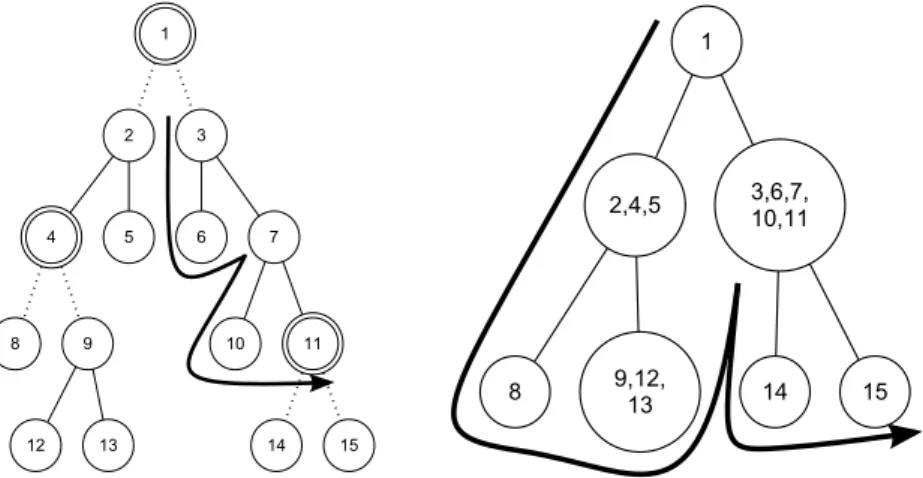
3.3.2 Global Iterators and Local Iterators
A segmented tree is a two-tiered tree; a segment is a local tree and all the segments constitute a global tree. It is therefore natural to define an iterator over a local tree, i.e., alocal iterator and an iterator over a global tree, i.e., aglobal iterator. Figure 3.2 illustrates the traversals of local/global preorder iterators.