CITATION
Toner, B.M., M.A. Marcus, K.J. Edwards, O. Rouxel, and C.R. German. 2012. Measuring the form of iron in hydrothermal plume particles. Oceanography 25(1):209–212, http://dx.doi.org/10.5670/
oceanog.2012.19.
DOI
http://dx.doi.org/10.5670/oceanog.2012.19
COPYRIGHT
This article has been published in Oceanography, Volume 25, Number 1, a quarterly journal of The Oceanography Society. Copyright 2012 by The Oceanography Society. All rights reserved.
USAGE
Permission is granted to copy this article for use in teaching and research. Republication, systematic reproduction, or collective redistribution of any portion of this article by photocopy machine, reposting, or other means is permitted only with the approval of The Oceanography Society. Send all correspondence to: [email protected] or The Oceanography Society, PO Box 1931, Rockville, MD 20849-1931, USA.
O ceanography THE OffICIAl MAGAzINE Of THE OCEANOGRAPHY SOCIETY
DOwNlOADED fROM HTTP://www.TOS.ORG/OCEANOGRAPHY
O c e a n i c S p r e a d i n g c e n t e r p r O c e S S e S |
ridge 2000 p r O g r a M r e S e a r c h
Measuring the Form of iron in
hydrothermal plume particles
B y B r a n d y M . t O n e r , M at t h e w a . M a r c u S , K at r i n a J . e d wa r d S ,
O l i v i e r r O u x e l , a n d c h r i S t O p h e r r . g e r M a n
BacKgrOund
The global mid-ocean ridge (MOR) system is a 60,000 km submarine volcanic mountain range that crosses all of the major ocean basins on Earth.
Along the MOR, subseafloor seawater circulation exchanges heat and elements between the oceanic crust and seawater.
One of the elements released through this venting process is iron. The amount of iron released by hydrothermal venting to the ocean per year (called a flux) is similar in magnitude to that in global riverine runoff (Elderfield and Schultz, 1996). Until recently, measurements and modeling activities to understand the contribution of hydrothermal iron to the ocean budget have been largely neglected. It was thought that hydro- thermal iron was removed completely from seawater by precipitation of iron- bearing minerals within plumes and then deposited at the seafloor close to vent sites. With this assumption in place, the contribution of hydrothermal fluxes to the ocean budget was considered negligible. Recent work, however, ques- tions the validity of that assumption, and leads to what we call the “leaky
vent” hypothesis. Our goal is to measure the forms of iron, known as speciation, present in hydrothermal plume particles to better understand the bioavail- ability, geochemical reactivity, and transport properties of hydrothermal iron in the ocean.
aSSuMptiOnS aSide
During the 1980s and 1990s, the role of hydrothermally derived iron in present- day marine trace element cycling was discovered and described in a small body of literature (Lilley et al., 1995).
Then in 2006, it was hypothesized that up to 50% of deep-ocean dissolved iron occurring in the Pacific Ocean may have come from hydrothermal sources throughout the past 10 million years
(Chu et al., 2006). Since then, the “leaky vent” hypothesis has been supported by reports that chemical mechanisms protect iron from precipitation as minerals (Bennett et al., 2008; Toner et al., 2009) and that physical processes can prevent settling of minerals (Yücel et al., 2011). Recent modeling efforts have addressed hydrothermal iron contributions to the ocean at the plume and ocean-basin scale. At the plume scale, dissolved organic molecules facilitate release of iron to the ocean (Sander and Koschinsky, 2011). At the ocean-basin scale, a hydrothermal iron flux of 20.8 x 10
9g Fe yr
–1to the Southern Ocean is predicted (Tagliabue et al., 2010). World Ocean Circulation Experiment data demonstrate that an
Brandy M. Toner ([email protected]) is Assistant Professor, Department of Soil, Water, and
Climate, University of Minnesota-Twin Cities, St. Paul, MN, USA. Matthew A. Marcus
is Beamline Scientist, Advanced Light Source, Lawrence Berkeley National Laboratory,
Berkeley, CA, USA. Katrina J. Edwards is Professor, Departments of Biological Sciences and
Earth Sciences, University of Southern California, Los Angeles, CA, USA. Olivier Rouxel is
International Chair in Deep Sea Environments–Europole Mer, Institut français de recherche
pour l’exploitation de la mer, Department of Marine Geoscience, Technopole Brest-Iroise,
France. Christopher R. German is Senior Scientist, Geology and Geophysics Department,
Woods Hole Oceanographic Institution, Woods Hole, MA, USA.
East Pacific Rise (EPR) plume is carried south along constant density surfaces, and is brought to the ocean surface by wind-driven upwelling in the Southern Ocean (Lupton, 1998; Winckler et al., 2010). Beyond the Southern Ocean, a more nuanced view of ocean circulation, where eddies play a larger role in over- turning of water masses, is building. It is known that eddies in the surface ocean can bring nutrient-rich water masses up from depth (McGillicuddy et al., 2007), and that mesoscale eddies transmit surface ocean conditions to deep-sea currents at the EPR (Adams et al., 2011).
Starting at the Beginning We must start with the most basic question: does hydrothermal iron stay dissolved or suspended in seawater long enough to affect the upper water column?
In plumes, direct iron speciation in the precipitates has been reported just twice. Campbell (1991) measured iron in plume particles from the TAG vent field on the Mid-Atlantic Ridge using bulk X-ray absorption spectroscopy (XAS), and Toner et al. (2009) reported iron speciation in plume particles from the
EPR using microprobe XAS techniques.
Why have so few measurements of iron speciation been made? High-quality samples are difficult to obtain, and iron speciation in plume particles is difficult to measure. These challenges have slowed our understanding of hydrothermal iron’s speciation, transport, and contribution to the global ocean iron budget. Ongoing sediment-trap deployments and new in situ filtration equipment (Breier et al., 2009) are making it easier to obtain great samples, and improved synchrotron- radiation X-ray microprobe and X-ray microscopy instruments are making measurements of iron speciation acces- sible (Toner et al., 2009; Lam et al., 2011;
Mayhew et al., 2011).
SediMent tr apS and SynchrOtrOnS
We developed X-ray microprobe measurement and data analysis protocols for iron speciation in hydrothermal samples. Particles were captured using sediment traps—250 mL bottles at six-day intervals—deployed on seafloor moorings in the EPR 9°N region (Figure 1, Step 1). Particles were
transferred to a polycarbonate membrane by filtration (Figure 1, Step 2), and used for X-ray microprobe measurements of iron speciation at the Advanced Light Source, Lawrence Berkeley National Laboratory, Berkeley, CA, USA, using beamline 10.3.2 (Marcus et al., 2004).
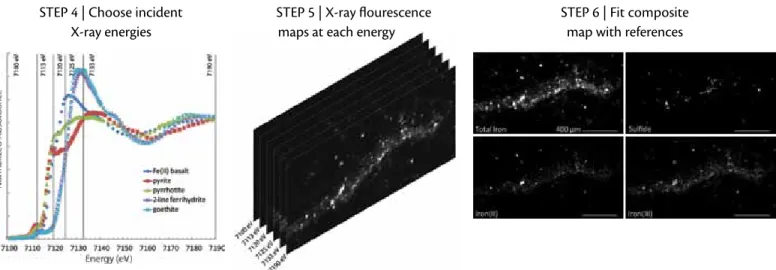
First, X-ray fluorescence was used to map the distribution of elements in the sample (Figure 1, Step 3). Next, chemical mapping was used to collect a series of six X-ray fluorescence maps that home in on iron (Figure 2, Steps 4 and 5). Once these iron maps were compiled, and fit with iron-bearing reference materials, we obtained iron speciation at every pixel within specific regions of the filter (Figure 2, Step 6). We then collected iron point XAS spectra to “ground truth” the chemical map fitting (Figure 2, Step 4).
irOn in pluMe particleS The EPR particles and particle aggregates settling into sediment traps comprise a mixture of chemical forms, and we can measure a variety of iron oxidation states in them (Table 1). Sulfide-associated iron accounts for ~ 10 mol % of the total iron present. Oxidized iron(III) Step 1 | collect particles
in seafloor sediment trap
Step 2 | concentrate particles on filter
Step 3 | Measure distribution of iron (and other elements) with x-ray microprobe
Figure 1. From seafloor to synchrotron. Step 1: hydrothermal particles that settle from the water column are collected using sediment traps moored at the seafloor. Step 2: particles are concentrated on a membrane filter. Step 3: Subsections of the filter are then examined by x-ray microprobe for iron. Sediment trap illustration: Jack Cook, ©Woods Hole Oceanographic Institution
represents 60–70 mol %, and nonsulfide iron(II) the remaining 20–30 mol % iron. The iron sulfide and iron(III) oxyhydroxides observed are consistent with previous predictions and observa- tions for plumes (e.g., Feely et al., 1987).
An iron(II) nonsulfide phase was also reported previously for EPR plume particles using qualitative X-ray micros- copy measurements (Toner et al., 2009).
However, the relatively large fraction of nonsulfide iron(II) reported here was unexpected because iron(II) should form inorganic sulfides or oxyhydroxides.
How can iron(II) “escape” this fate?
Our knowledge of iron chemistry tells us that certain organic molecules can intercept iron(II) before it precipitates.
We also know that particle aggregates composed of minerals and organic matter may host more reducing “micro- environments” than the surrounding bulk water column. Our results suggest that hydrothermal plume particles descending through the water column, or being resuspended from the seafloor, are potentially protected from the oxygen in deep seawater by such “escape”
mechanisms. We further propose that the high organic carbon content of these particle aggregates favors iron interactions with organic matter, and the aggregated particle morphology (± microbial activity) maintains low oxygen micro-environments in an other- wise oxic deep-sea setting.
what iS next?
The research we conducted within the Ridge 2000 Program has allowed us to test the “leaky vent” hypothesis and identify mechanisms by which interac- tion with organic matter could sustain a significant flux of iron to the wider deep ocean. But just demonstrating that these processes can occur does not prove that they are important. What is needed next is a series of programs to test their impact at the ocean basin scale, and we already have plans to do just that. First, recent examination of dissolved iron concentrations in the open Northeast Pacific Ocean have shown that there are anomalously high dissolved iron concentrations right at the depths where our “leaky vent”
hypothesis would predict them (Wu et al., 2011). The next major cruise of the US GEOTRACES program
1will test this hypothesis further by tracing the fate and dispersion of dissolved and particu- late trace elements and isotopes (with
1 geOtraceS is an international Study of Marine Biogeochemical cycles of trace elements and Their isotopes. See http://www.geotraces.org.
table 1. iron speciation in plume particles collected by sediment traps at the east pacific rise
Sample
Iron Sulfide (mol %)
Iron (III) (mol %)
Iron (II) (mol %)
Total Iron (wt %)
Mass Flux (mg m2 d–1) July 25–31, 2006
(r2l1-05) 12 57 28 1.54 24.43
august 24–30, 2006
(r2l1-10) 11 68 19 0.81 4.17
Step 4 | choose incident x-ray energies
Step 6 | Fit composite map with references Step 5 | x-ray flourescence
maps at each energy
Figure 2. iron speciation in hydrothermal plume particles. Step 4: The incident x-ray energies for chemical mapping are chosen to maximize the distinctions among iron species while minimizing the estimated error for calculations of percent iron species present. Step 5: we then collect x-ray fluorescence maps at the energies selected in Step 4. These maps are compiled and fit using reference spectra (Step 6). grayscale maps are presented for “total iron,” “sulfide” iron,
“iron(ii),” and “iron(iii).”
iron prominent among them) across the Southeast Pacific Ocean, intercepting the world’s largest deep-ocean hydrothermal plume (http://www.usgeotraces.org/
html/pacific.html). Second, the new Ocean Observatories Initiative includes, as part of its Regional Scale Node ambi- tions, an opportunity to evaluate fluxes from a single hydrothermal field over a timescale of decades, capturing mineral- ogical and biogeochemical outputs from venting. By extending both the timescale and the length scale of our studies, now that the Ridge 2000 programmatic research has shown us the way forward, we can prepare to answer the question:
what is the impact of hydrothermal venting on the ocean?
acKnOwledgMentS
We thank Diane Adams for inspiration in using sediment trap deployments at the EPR for plume biogeochemistry;
EPR cruise principal investigators Jim Cowen, Karen Von Damm, and Lauren Mullineaux for access to the EPR; the Woods Hole Oceanographic Institution Deep Ocean Exploration Institute, the National Science Foundation Ridge 2000 Program, and the Gordon and Betty Moore Foundation for funding; Steve Manganini,
Maureen Raymo, Sirine Fakra, and Jeffry Sorensen for research support;
and Breea Govenar, Stace Beaulieu, Susan Mills, Tim Shank, and
Dan Fornari for trap deployments and recovery. The Advanced Light Source is supported by the Director, Office of Science, Office of Basic Energy Sciences, of the US Department of Energy under Contract DE-AC02-05CH11231.
reFerenceS
Adams, D.K., D.J. McGillicuddy Jr., L. Zamudio, A.M. Thurnherr, X. Liang, O. Rouxel, C.R. German, and L.S. Mullineaux. 2011.
Surface-generated mesoscale eddies transport deep-sea products from hydrothermal vents.
Science 332:580–583, http://dx.doi.org/10.1126/
science.1201066.
Bennett, S.A., E.P. Achterberg, D.P. Connelly, P.J. Statham, G.R. Fones, and C.R. German.
2008. The distribution and stabilisation of dissolved Fe in deep-sea hydrothermal plumes. Earth and Planetary Science
Letters 270:157–167, http://dx.doi.org/10.1016/
j.epsl.2008.01.048.
Breier, J.A., C.G. Rauch, K. McCartney, B.M. Toner, S.C. Fakra, S.N. White, and C.R. German.
2009. A suspended-particle rosette multi- sampler for discrete biogeochemical sampling in low-particle-density waters. Deep-Sea Research Part I 56:1,579–1,589, http://
dx.doi.org/10.1016/j.dsr.2009.04.005.
Campbell, A.C. 1991. Mineralogy and chemistry of marine particles by synchrotron X-ray spectroscopy, Mossbauer spectroscopy, and plasma-mass spectrometry. Pp. 375–390 in Marine Particles: Analysis and Characterization.
D.C. Hurd and D.W. Spencer, eds, American Geophysical Union, Washington, DC.
Chu, N.C., C.M. Johnson, B.L. Beard,
C.R. German, R.W. Nesbitt, M. Frank, M. Bohn, P.W. Kubik, A. Usui, and I. Graham. 2006.
Evidence for hydrothermal venting in Fe isotope compositions of the deep Pacific Ocean through time. Earth and Planetary Science Letters 245:202–217, http://dx.doi.org/10.1016/
j.epsl.2006.02.043.
Elderfield, H., and A. Schultz. 1996. Mid-ocean ridge hydrothermal fluxes and the chemical composition of the ocean. Annual Review of Earth and Planetary Sciences 24:191–224, http://
dx.doi.org/10.1146/annurev.earth.24.1.191.
Feely, R.A., M. Lewison, G.J. Massoth, G. Rober-Baldo, J.W. Lavelle, R.H. Byrne, K.L. Von Damm, and H.C. Curl. 1987.
Composition and dissolution of black smoker particulates from active vents on the Juan de Fuca Ridge. Journal of Geophysical Research 92:11,347–11,363.
Lam, P.J., D.C. Ohnemus, and M.A. Marcus. 2012.
The speciation of marine particulate iron adja- cent to active and passive continental margins.
Geochimica et Cosmochimica Acta, http://
dx.doi.org/10.1016/j.gca.2011.11.044.
Lilley, M.D., R.A. Feely, and J.H. Trefry. 1995.
Chemical and biochemical transforma- tions in hydrothermal plumes. Pp. 369-391 in Seafloor Hydrothermal Systems: Physical, Chemical, Biological, and Geological Interactions. S.E. Humphris, R.A. Zierenberg, L.S. Mullineaux, and R.E. Thomson, eds,
Geophysical Monograph Series, vol. 91, American Geophysical Union, Washington, DC, http://dx.doi.org/10.1029/GM091p0369.
Lupton, J.E. 1998. Hydrothermal helium plumes in the Pacific Ocean. Journal of Geophysical Research 103:15,853–15,868, http://
dx.doi.org/10.1029/98JC00146.
Marcus, M.A., A. MacDowell, R. Celestre, A. Manceau, T. Miller, H.A. Padmore, and R.E. Sublett. 2004. Beamline 10.3.2 at ALS:
A hard X-ray microprobe for environmental and material sciences. Journal of Synchrotron Radiation 11:239–247.
Mayhew, L.E., S.M. Webb, and A.S. Templeton.
2011. Microscale imaging and identification of Fe oxidation state, speciation, and distribution in complex geological media. Environmental Science & Technology 45:4,468–4,472, http://
dx.doi.org/10.1021/es104292n.
McGillicuddy, D.J. Jr., L.A. Anderson, N.R. Bates, T. Bibby, K.O. Buesseler, C.M. Carlson, C.S. Davis, C. Ewart, P.G. Falkowski, S.A. Goldthwait, and others. 2007. Eddy/wind interactions stimulate extraordinary mid-ocean plankton blooms. Science 316:1,021–1,026, http://dx.doi.org/10.1126/science.1136256.
Sander, S.G., and A. Koschinsky. 2011. Metal flux from hydrothermal vents increased by organic complexation. Nature Geoscience 4:145–150, http://dx.doi.org/10.1038/ngeo1088.
Tagliabue, A., L. Bopp, J.-C. Dutay, A.R. Bowie, F. Chever, P. Jean-Baptiste, E. Bucciarelli, D. Lannuzel, T. Remenyi, G. Sarthou, and others. 2010. Hydrothermal contribu- tion to the oceanic dissolved iron inven- tory. Nature Geoscience 3:252–256, http://
dx.doi.org/10.1038/ngeo818.
Toner, B.M., S.C. Fakra, S.J. Manganini, C.M. Santelli, M.A. Marcus, J.W. Moffett, O. Rouxel, C.R. German, and K.J. Edwards.
2009b. Preservation of iron(II) by carbon- rich matrices in hydrothermal plumes.
Nature Geoscience 2:197–201, http://
dx.doi.org/10.1038/ngeo433.
Winckler, G., R. Newton, P. Schlosser, and T.J. Crone. 2010. Mantle helium reveals Southern Ocean hydrothermal venting.
Geophysical Research Letters 37, L05601, http://
dx.doi.org/10.1029/2009GL042093.
Wu, J., M.L. Wells, and R. Rember. 2011.
Dissolved iron anomaly in the deep tropical- subtropical Pacific: Evidence for long-range transport of hydrothermal iron. Geochimica et Cosmochimica Acta 75:460–468, http://
dx.doi.org/10.1016/j.gca.2010.10.024.
Yücel, M., A. Gartman, C.S. Chan, and G.W. Luther III. 2011. Hydrothermal vents as a kinetically stable source of iron- sulphide-bearing nanoparticles to the ocean. Nature Geoscience 4:367–371, http://
dx.doi.org/10.1038/ngeo1148.