Doctoral Dissertation
A STUDY ON THE GUARANTEE OF RURAL TEACHERS’
TRAINING RIGHTS IN THE MIDWEST AREAS OF CHINA THROUGH A NATIONAL TRAINING PROJECT
Zhang Zhiguo
2020
Table of contents
Table of contents... i
List of tables...iv
List of figures... vi
Introduction... 1
1. The purpose of the study... 1
2. Literature Review...6
3. Research Questions and Research Methodology... 13
4. Organization of the dissertation... 18
Chapter One: Rural Teachers’ Training in the Starting Period of TTMP (2010-2014)...23
1. The generation of TTMP...24
2. Outcome of training time of TTMP from 2010 to 2014...28
3. Analysis of training quality of TTMP from 2010 to 2014...31
4. Conclusion...39
Chapter Two: Rural Teachers’ Training in the Development Period of TTMP (2015 -2018)...47
1. Reform and expansion of TTMP...48
2. Outcome of training time after the reform of TTMP... 53
3. Changes of training quality after the reform of TTMP... 56
4. Conclusion...65
Chapter Three: Western Guarantee on Sub-project of “Sending Trainers to Rural Schools” (Case Study Ⅰ)...71
1. Background... 72
2. Introduction of the case... 74
3. Organization and management of the project...78
4. Training activities and processes of the project...84
5. Interview with receivers... 87
6. Summary and reflection... 91
Chapter Four: Central Guarantee on Sub-project of “Sending Trainers to Rural Schools” (Case Study Ⅱ)... 96
1. Background... 97
2. Introduction of the case... 98
3. Organization and management of the project...102
4. Training schedule and processes of the project...109
5. Interview with receivers... 112
6. Summary and reflection... 119
Chapter Five: Western Guarantee on Sub-project of “Visiting Famous Shcools” (Case Study Ⅲ)... 124
1. Background... 125
2. Introduction of the case... 127
3. Organization and management of the project...129
4. Training curriculum and processes of the project... 137
5. Interview with visitors...143
6. Summary and reflection... 152
Chapter Six: Central Guarantee on Sub-project of “Visiting Famous Schools” (Case Study Ⅳ)...158
1. Background... 159
2. Introduction of the case... 161
3. Organization and management of the project...164
4. Training curriculum and processes of the project... 172
5. Interview with visitors...177
6. Summary and reflection... 182
Conclusion...187
1. Findings and significance...187
2. Issues in the future...191
References... 198
List of tables
Table 1 Total number of full-time teachers in rural primary schools in the
Midwest areas of China in 2013...3
Table 2 Total number of full-time teachers in rural secondary schools in the Midwest areas of China in 2013...3
Table 3 Provinces of the implementation of TTMP... 26
Table 4 Training objects of TTMP form 2010 to 2014...27
Table 5 Statistic of per capita training time of rural teachers in TTMP...30
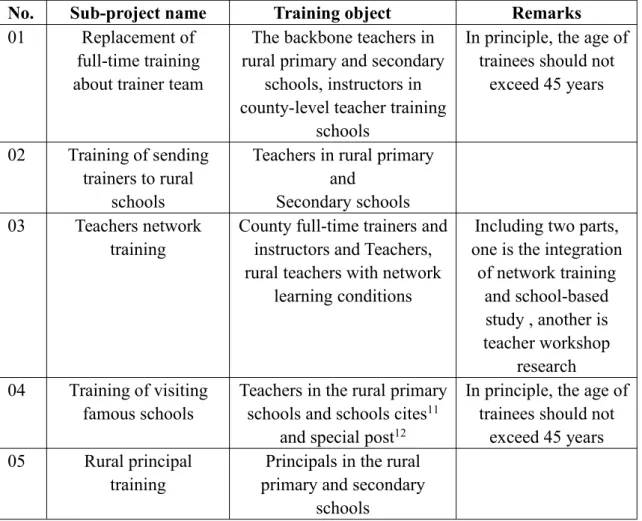
Table 6 Training objects of TTMP after the reform in 2015... 50
Table 7 Changes of training objects of TTMP in 2017... 51
Table 8 Changes of training objects of TTMP in 2018... 52
Table 9 Statistic of per capita training time of rural teachers in TTMP...53
Table 10 Implementation of the project of sending trainers to rural primary and secondary schools in Shaanxi province in 2018...74
Table 11 Professional level of teachers participated in the project in Baxian town's secondary school...79
Table 12 Professional level of teachers participating in heterogeneous activities of the same lessons in Baxian town's secondary school...80
Table 13 Responsibility arrangements of personnel...83
Table 14 Schedule of "sending trainers to rural schools" in Baxian town's secondary school... 84
Table 15 Implementation of the project of sending trainers to rural primary and secondary schools in Henan province in 2018... 97
Table 16 The titles of experts team in the project featuring "sending" in Limin town's primary school...103
Table 17 Statistic of selected trainees of Chinese workshop in Y county...104
Table 18 Responsibility arrangements of personnel...105 Table 19 Schedule of "sending trainers to rural schools" in Limin town's
primary school...109 Table 20 The plan of implementation about the project of visiting famous schools for rural teachers in Shaanxi province in 2018...127 Table 21 Sources of rural teachers participating in the project of visiting famous
schools in the D primary school...128 Table 22 Professional situation of teams of trainers in the D Primary school
...130 Table 23 The division of responsibilities about members of the project...135 Table 24 Curriculum of "immersion" about the project of visiting famous schools for rural teachers in the D primary School in 2018...138 Table 25 The plan of implementation about the project of visiting famous schools in Henan province in 2018... 160 Table 26 Sources of rural teachers participating in the project of visiting famous
schools in S city's normal university...163 Table 27 Professional level of trainers team in college of humanities of S city's normal university...165 Table 28 The division of responsibilities about members of the project...169 Table 29 Curriculum about the project of visiting famous school in college of humanities of S city's normal university in 2018... 173
List of figures
Figure 1 A conceptual framework of the guarantee of teachers' training rights.16
Figure 2 Correlations of sub-projects in TTMP from 2010 to 2014... 32
Figure 3 Source and composition of trainer teams of TTMP...34
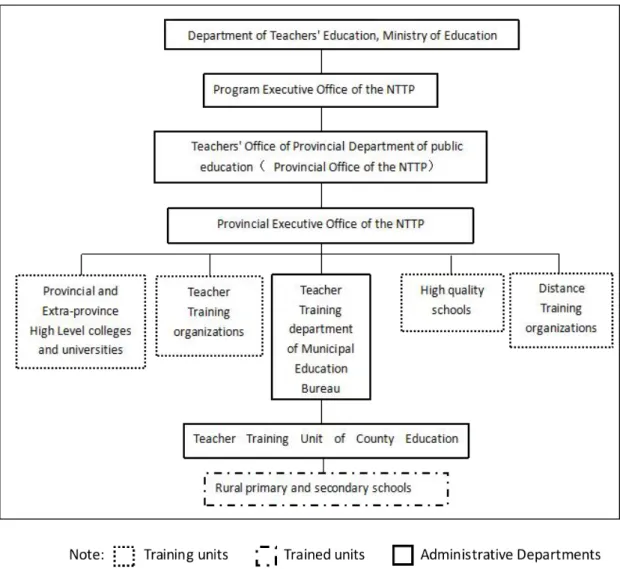
Figure 4 Framework of basic management of TTMP from 2010 to 2014... 37
Figure 5 Correlations of sub-projects in TTMP after the reform... 57
Figure 6 Source and composition of trainer teams after the reform of TTMP...59
Figure 7 Source and composition of trainer teams for the training of visiting famous schools and rural principals' training...60
Figure 8 Framework of basic management after the reform of TTMP... 63
Figure 9 Organizational framework of project in Baxian town's secondary school...81
Figure 10 Management framework of project in Baxian town's secondary school...82
Figure 11 Management framework of project in Limin town's primary school ...105
Figure 12 The structure of the training organization about the project of visiting famous schools in the D primary school... 132
Figure 13 Management structure of the project of visiting famous schools in the D primary School... 134
Figure 14 Structure of training organizations in the project of visiting famous schools in college of humanities of S city's normal university... 166
Figure 15 Management structure of the project of visiting famous schools in college of humanities of S city's normal university... 168
Map of China
Research site 3:
Xi’ an
Research site 1:
P county
Research site 2:
Y county
Research site 4:
S’ city
Introduction
1. The purpose of the study
Since the adoption of Recommendation Concerning the Status of Teachers by UNESCO in 1966, the movement of teacher professionalization has gradually developed into a trend of professional development with teachers as subject. In this process, teachers’ professional development cannot be separated from the guarantee and promotion of the necessary external environments, conditions and systems (Ruan Cheng-wu, 2005, p. 168)1. In 2001, the Chinese government first used the concept of
"teacher education" in The State Council’s Decision on the Reform and Development of Basic Education, which means the beginning of the transition from normal education to Teacher Education ( Zhong Qi-quan & Wang Ya-ling, 2012). With the integration of Pre-service Education and Post-service Training of teachers in this stage, and the professional development of teachers has become the development goal of the new stage. In there, the primary and secondary teachers who accounts for the majority of teachers have become an important part in the process of promoting and achieving the goal of teachers’ professional development. Therefore, training of teachers in compulsory education stage occupies an significant position in this part.
As an essential element ofTeacher Education in compulsory education stage, training is a key link for teachers to improve teaching quality and promote their professional development, which is extreme importance for China’s teacher education when considering the function of training as a symbol of level in teachers’
professional development and the main ways to improve teacher quality. Furthermore, the training is more significance for promoting balanced development of educational and social equality. At the same time, as the main ways to improve teacher quality in China, training is also an important link between urban-rural teachers and different stages of professional development of teachers’ groups. Thus, training plays an important role in teachers’ professional development in China.
However, with the rapid development of China’s economy since the reform and opening up in 1978, the gap between urban-rural areas and different regions in China has gradually widened, which has resulted in relatively backwardness of education in the Midwest rural areas2. And rural teachers, especially, non-backbone teachers3 in compulsory education stage in the above-mentioned areas have a few training opportunities4. Actually, Chen Xiang-ming & Wang Zhi-ming(2013) conducted a large-scale investigation on teacher training from April 2010 to September 2011, with the research group collected 9197 teachers’ questionnaires, 298 trainers’ questionnaires and more than 300 interviews in 11 provinces and cities of China. Their findings proved that there were obvious differences in training opportunities between urban and rural teachers, and the training times that urban school teachers participate in all kinds of training is greater than that of rural school teachers. And the opportunity to participate in the training above prefecture level and city level is also significantly less in rural teachers than in urban teachers5. Thus, it is difficult for rural teachers, especially rural non-backbone teachers to obtain adequate guarantee on their training.
Meanwhile, according to the Report on the Development of Rural Compulsory Education in China (Yu Wei-yue 2013), there are 65.53 million teachers in compulsory education stage in rural areas of China, which accounted for 72.3% of the total number of teachers in compulsory education stage. Among them, there are 48.033 million rural teachers in the central and western rural regions, accounting for 73.3% of the total number of rural teachers in compulsory education stage. The statistical of rural teachers in the primary and secondary schools in the Midwest areas is made as follows:
Table 1 Total number of full-time teachers in rural primary schools in the Midwest areas of China in 2013
Table 2 Total number of full-time teachers in rural secondary schools in the Midwest areas of China in 2013
Source: Educational Statistical Yearbook of China in 2013
Note: Primary and secondary school teachers in rural areas in this table include four areas:
Urban-rural Transitional area, Counties & Towns area, County-towns Transitional area and Rural area.
In the above tables, there are 4.118 million teachers in rural primary schools, accounting for 73.7% of the total number of teachers in primary schools, and 2.435 million teachers in rural junior middle schools, accounting for 70.0% of the total number of teachers in secondary schools. Among them, the proportion of backbone teachers at county level and above county level is 12.0% in rural primary schools. The proportion of non-backbone teachers is 88.0%, with the number of non-backbone teachers is 3.624 million. The proportion of backbone teachers at county level and above county level is 15.1% in rural secondary schools, the rest is 84.9% in non-backbone teachers with the number of 2.067 million. Therefore, non-backbone teachers occupy a large part of the total number of rural teachers, the proportion of non-backbone teachers in rural primary schools and secondary schools in the Midwest
Category Areas
Urban-rural Transitional area
Counties &
Towns area
County-towns Transitional area
Rural area Total
Central 77,327 868,248 220,130 364,789 1,530,494
Western 54,995 864,514 160,784 337,576 1,417,869
Total 132,322 1,732,762 380,914 702,365 2,948,363
Category Areas
Urban-rural Transitional area
Counties &
Towns area
County-towns Transitional area
Rural area Total
Central 51,816 573,139 183,293 750,597 1,558,845
Western 40,469 538,406 129,804 737,094 1,445,773
Total 92,285 1,111,545 313,097 1,487,691 3,004,618
areas should be about 85%, which maybe equal to or lower than that in the whole country. Considering that the proportion of rural teachers, especially rural non-backbone teachers in the Midwest areas, the effect of their training affects not only the achievement of goals of teachers’ professional development, but also the progress of the overall development of teacher education of China. Therefore, the guarantee of the training rights for rural primary and secondary teachers, especially rural non-backbone teachers in the Midwest areas, has become an important and necessary issue.
With the training development from stage of academic compensation into stage of improvement on teachers’ profession(Guo Fei-jun & Yang Qing-xi, 2012), the situation on rural teachers’ training has started to change. The Chinese government promulgated the Training Project for Rural backbone Teacher in the Midwest Areas [Teacher Training Midwest Project (TTMP)] of the National Teacher Training Program(NTTP) in 2010, which covers all teachers in primary and secondary schools in rural areas of central and western provinces to carry out a 10-year training plan.
This means that TTMP is training activity with the longest time, the highest level and the largest scale of rural teachers. Moreover, TTMP as special training activities has covered all rural non-backbone teachers. More importantly, the implementation of TTMP as national policies indicates the development trend of training of rural teachers and non-backbone teachers in China. Meanwhile, it affects the formulation and implementation of training policies for rural teachers and non-backbone teachers in Midwest provinces. Therefore, TTMP is the most appropriate research object of this study.
On the other hand, in Article 7 of the Teacher’ s Law of the People’ s Republic of China in 1993, the right of teachers’ training is clearly stated that
“teachers have the rights to take refresher courses or other forms of training”, which is the rights endowed to teachers as the rights to continuing professional education.
After establishing the right-oriented doctrine on teacher training, this law also stipulates the responsibility of the government as the obligor to provide training funds and system as the guarantee for teachers’ training. But it is different from some
countries such as Japan and Germany which define teachers as civil servants, and other countries such as Britain and the United Stated which define teachers as public employees, China defines teachers as professionals who are engaged in education and teaching activities6. This results in simple contents of rights and the weak operability of the law, which leads to some problems. These problems include the lack of specific provisions on what and how to guarantee the rights of teachers’ training (Wang Dong-ni, 2007).
At present, academic learning of teachers’ training rights, which could be included by the studies with the rights-based perspective(Robinson. B, 2008), mainly conducted around learning right as a bundle of rights composed by free learning, learning condition guarantee and individuality development. Among them, based on free learning as the boundary between the power and learner, learning condition guarantee, centering on education rights, stipulates that the government and social organizations compulsorily create learning conditions to realize the abstract learning right for the realization of the ultimate objective of learning established by individuality development (Chen En-lun, 2003; Wang Wei, 2005). According to the definition of Teachers’ Training Rights that “the rights and interests owned by teachers in their education and teaching activities according to law are the abilities and qualifications to develop their abilities and improve their quality through learning, and to require the obligor of rights to provide conditions”(Wang Dong-ni, 2007, p.7), and legal status of teacher as professionals, teachers’ training rights is not only teachers’ learning right as reception education right to ask the government to create training conditions, but teachers’ professional right to perform the responsibility of education and teaching, which defines that the training rights is compound right with rights and obligations. In other words, teachers must participate in training activities to perform their obligation and ask the government to create training conditions in order to realize their abstract training right for their professional development (Wang Dong-ni, 2007). According to the composition of learning right, the study of Wang (2007) actually clarified that the characteristic of teachers’ training rights was limited free learning, but Training Condition Guarantee, which originates from the learning
condition guarantee,still remain the blank of stage.
Therefore, as the first use of concept, the Training Condition Guarantee is employed to explore this research topic, i.e. the guarantee of teachers’ training rights7. Then based on the above, the purpose of this study is to illuminate the basic situation of the guarantee of rural teachers’ training rights by investigating and analyzing the change of “training condition guarantee” in TTMP and its sub-projects for non-backbone teachers, since the implementation of this national project.
2. Literature Review
2.1. Review of preceding researches on TTMP and its sub-projects
The preceding researches on TTMP of NTTP and its sub-projects for non-backbone teachers, namely, project of distance training before 2015, project of sending trainers to rural schools and project of visiting famous schools after 2015, are shown as follows respectively.
2.1.1. Review of preceding researches on TTMP of NTTP
In the preceding researches on TTMP, firstly, the study noted is that Li Jin-qi (2015) specially investigated the overall implementation of TTMP of NTTP from 2010 to 2015 in his writings through the analysis and evaluation on the systematic design of NTTP. He discussed training model and management measures and gave further advice for the improvement of NTTP. Secondly, focusing on the background and process of implementation of TTMP in the initial stage, Feng Jian-xia & Li Jin-qi (2013) analyzed the restriction and influence on TTMP of NTTP through reflection on rural educational problems which were partly resulted from backward of rural economic and social development at this stage, and partly from the defects of the current educational policy mechanism. They argued that the implementation of TTMP of NTTP should be based on the requirements of rural, rural school and rural teachers, and then give full play to the special advantages of local normal colleges and
universities so as to improve the effectiveness of training model. Zhao Hong-ya (2011) also putted forward some suggestion on the improvement of NTTP, which were aimed to the implementation of objectives, roles and difficulties in the initial stage of NTTP in her study.
On the other hand, there are many studies on the implemented process on specific targets in TTMP. In the view of training institutions, Kuang Hong (2012) discussed the improvement in effectiveness of training through an analysis of training sessions that influenced effectiveness of training in the process of implementation of TTMP. Based on the case-study in Hunan Province of TTMP in 2012, Xu Wei-liang (2013) also discussed the effective implementation of NTTP through the lens of curriculum development of training institutions. Starting from the specific implementation case in TTMP, Lin Zhi-miao et al. (2013) made a survey on the satisfaction of TTMP implemented by Hebei Normal University in 2010, 2011 and 2012, and then introduced and summarized relevant measures and experiences in the implementation of TTMP, and gave suggestions for improvement of TTMP according to the analysis of the implemented process and the training effect. Ma Ru-biao, Li Jin-rong & Hou Lan-ping (2012) summarized that how did a solid and effective measures in the training of TTMP in Chuxiong Teachers College of Yunnan province.
In addition, the implemented process of TTMP were investigated around training objects as follows: Deng Na-na (2012) conducted a survey and analyzed the training for backbone teachers in rural primary and secondary schools in Jiangxi normal university as an example. She investigated the training situation and the effect of NTTP and proposed suggestions for the improvement of NTTP in the future.
According to the training experience of TTMP in Jishou University in 2017, Yang Yang et al. (2017) analyzed the main problems existing in the continuing education for rural teachers in physical subject through investigating the continuing education system and training model in rural secondary school, and then further analyzed the advantages and disadvantages of NTTP. Lastly, they gave the suggestion for the sustainable professional development of rural physical teachers.
2.1.2. Review of preceding researches on sub-projects of TTMP for rural non-backbone teachers
1) Project of distance training
The preceding researches on the project of distance training are mainly focused on the investigation and study on the effect and implementation of this project for specific training objects from 2010 to 2014. Among them, the majority of researches focused on the process and the effect of project implemented in provinces. For example, Jia Wei & Zhang Tian-rong (2013) took the rural teachers in primary and secondary school in Ningxia province as the research object, and investigated and summarized their learning behaviors in distance learning, and then analyzed the factors effected their learning behaviors in distance learning, and then putted forward improving suggestions for this project. Ou Dian-nan & Liao Shi-chang (2011) investigated the effect of this project through the questionnaire for trainees in Hunan province, and found that the lack of the monitoring system in practice affected the training effect. Yu Qian (2014) discussed the implemented situation of this project for rural primary and secondary school teachers in Z County of Hebei Province through investigation on the four aspects of policy itself, targeted groups, subjects of implementation and implementation environment, and then putted forward corresponding countermeasures to solve problems existed in the implementation of this project. Wei Fei & Xiao Li-zhi (2016) made an in-depth analysis on the schemes of learning evaluation & design from five training institutions which undertaken tasks of distance training in X province in 2015, and explained the optimization strategy on the learning evaluation
& design through some practical cases. Li Xiao-fang (2012) took the distance training of rural primary and secondary school teachers in Anqiu City as the main research object, and investigated the problems of distance training on the aspects of thought, management mechanism, training content, training form and environment in network, and then gave improving suggestions for this project. Tao Lei (2013), based on the survey of the project in Chongqing in 2011, putted forward the corresponding improvement path for problems existed in the implementation of this project. Jia Wei
& Huang Lan-fang (2013) took the rural teachers in primary and secondary schools in Ningxia province as the research object, they analyzed the interaction of distance learning and effect of this project according to their investigation and research. Shen Yun (2013) employed the concept of social network to discuss that how to carry out distance training under the environment of social network, according to the experience of distance training in Jilin province of NTTP in 2012. Lu Xiao-li (2014) took the distance training of NTTP in Gansu province as an example, and putted forward specific improvement strategies on the aspects of training management, training organization, training implementation and training evaluation. Wang Wen-hua (2011) summarized the main experience of implementation on distance training of NTTP in Anhui province in 2010, and gave countermeasures and suggestions for the problems in the organization and management, curriculum and resources, guidance and service in this project. Liu Guang-wei (2011) took this project in Gansu province in 2010 as an example, and putted forward improving suggestions for the model of scientific management and assurance mechanism in quality of this project.
On the other hand, there are some researches on the project implemented in universities. Cai Ke (2011) investigated the effect of this project undertaken by Peking university in some central and western provinces in 2010, and summarized the assurance system, which was related to elements such as training content, teaching activities, educational administration and control in quality. Wu Shao-jing & Wang Jing (2014) putted forward improving suggestions for the process of distance training in Central China Normal University. Through the example of NTTP of Peking university, Leng Jing, et al.(2015) studied the model of learning support & service that was based on the characteristics of students and teachers, and gave some suggestions on the effect of the training model.
In addition, Wu Wen-chun & Zhou Yuan (2013) analyzed the obstacles of online learning in distance training and discussed the reasons, and then proposed strategies to improve the effectiveness of online learning in distance training for rural primary and secondary. Duan Jian-bin, et al.(2016) proposed the effective strategies for teacher training through three stages of training support, implementation and
training performance & evaluation, and gave suggestions for improving the effective implementation of distance training in NTTP. Li Feng-lan (2011) took the distance training of rural teachers in compulsory education as an example, analyzed the general practice and existing problems of online teaching, and proposed effective strategies and implemented methods to improve this project.
2) Project of sending trainers to rural schools
In the preceding researches of this project, there are many case studies that focused on the implementation of this project implemented in regions. Firstly, Li Ting-hai et al.(2018) in his works gave systematic summary on the overall implementation of this project in Longjiang county, Heilongjiang province. They summarized from the diagnosis of problems in subjects, teaching in classroom, training of teaching concepts, evaluated criteria and assessment schemes, and then provided some experience for the further improvement of this project. Secondly, Yi Hong-yue (2016) summarized the experience of implementation of the project in Fengxiang county, Baoji city in 2015. Fan Li (2015) discussed the effectiveness and training model of NTTP for rural teachers in primary and secondary schools in counties of Xi’an City.
Yang Chang-you (2016) focused on the project of sending biology trainers to the rural school in Xiushan county of Chongqing city, and then summarized the training activities on four aspects: professional concepts, teacher’s ethics, professional knowledge and professional skills. Li Yong (2018) reviewed the basic situation, thought of training, process of implementation, training effect and problems of the project in Pingjiang county of Hunan province in three years, and further discussed how to promote school-based research. Yao Zi-lin (2019) summarized the effect of this project in Shiyan city of Hubei province. Zhang Jing-xiang et al.(2016) investigated the training requirements of nearly 106 rural primary teachers in subject of science in Yunnan province, and revealed the training needs of science teachers in Yunnan province from the aspects of the basic situation of science curriculum, the setting of experimental courses, the situation adopted by information technology, and the training needs of this project. Xu Sha-sha (2018) analyzed problems existed in the
implementation of this project and putted forward proposals for improvement on the specific measures through the perspective of sender in this project of Henan province.
In addition, the preceding researches on the training process, evaluation, effect and model of this project were included as following : Mu Zhi-ping (2017) reflected on the training process of the project, and argued that it can develop school-based research through relying on local trainer teams and integrating expert’s resources outside the regions with task-driven approach to conduct regular training activities in the rural schools. He thought the above practice should improve the effectiveness of rural teachers’ training. Considering that difficulties and problems in implementation of the project, Han Dong-mei (2018) proposed several training strategies and suggestions for senders in this project in order to improve the effectiveness of the training. Zhang Hao & Ren Shao-jian (2016) discussed how to make full use of modern information technology to effectively carry out the training model in the project under the background of educational informatization. In order to improve rural teachers’ teaching capacity in classroom, Liu Chao et al.(2016) made an investigation of the implementation of the project, and summarized the teaching experience according to grass-roots trainer teams’ practice. Wang Yan-ling et al.(2017) discussed a feasible evaluation system of the project at provincial and county levels, which was based on research of two-year implemented experience and verification of the design & evaluated strategy in this project. Fu Liang (2017) discussed the training model of this project in English subjects of rural secondary school in the aspects of training mode, training effect, reflection and suggestions.
3) Project of visiting famous schools
The preceding researches on the project of visiting famous schools for rural teachers mainly focused on the implementation, evaluation and feedback on the project.
Especially, through the lens of social justice, Cheng Ming-xi (2018) analyzed the project through the lens of training course to reveal problems in design and implementation of the project, and then proposed feasible implemented strategies. He summarized the two-year implemented process of the project in Nanchang normal
college of Jiangxi province, and offered the training model of “three-stages”, namely, visiting county-level famous schools, visiting provincial famous schools and returning to work-spot for practice. Based on the design and implementation of the project for rural chemistry teachers in secondary school in five provinces in 2015, Chen Feng (2017) inspected the process of this project at the provincial implementation level, and analyzed the management problems and effected factors of implementation in the process of NTTP, and then proposed suggestions for improving the effect of NTTP.
Ren Meng & Xie Fei (2017) took 100 trainees as village primary teachers participated in the project in Yunnan province in their study as the research object, and used questionnaire to investigate and analyze their working status and training requirements so as to improve the pertinence and effectiveness of this project. Chen Huan (2017) took the project for special post English teachers in primary schools in Guangxi province as an example, and adopted methods of questionnaire and interview to investigate their professional development from aspects of training methods, effects and training management, and putted forward improving suggestions for training effect. Tang Xiang-ling & Xu Li-ping (2015) discussed training requirements of rural geography teachers in secondary school in the Xinjiang production and construction corps, and putted forward some operable suggestions for strengthening the effectiveness of the project. According to the demand of physics teachers in rural secondary schools for training content, training methods, trainers and other training related elements, Zhu Ying (2017) conducted a questionnaire for 102 teachers, and then analyzed the problems and reasons of needs in their professional development, and putted forward improving suggestions on four aspects: educational administration, organization and management of school, departments of teacher training and rural teachers themselves.
2.2. Review of preceding researches on the guarantee of teachers’ training rights Among a few literature related to the rights-based perspective to study teachers’
training in China, Li Jin-yu (2003) stated that teacher training was based on the perspective of teacher’s obligations for a long time. He argued that the perspective
should be shifted to teachers’ rights of training so as to promote teachers’ professional development. Feng Chen (2012) proposed solutions to some problems existing in the legal protection of teachers’ training rights, such as the lack of legislation, the absence of obligations of the government and schools. Ren Miao (2015) summarized the results of previous researches about guarantee on training funds and training timing for rural teachers in the past, and further explores guarantee on organizational level and teachers’ level through the investigation of guarantee situation in Liaoning province. On the other hand, some scholars from other countries have also involved in relevant research. For example, Shinohara Kiyoaki (1995) has investigated the nature of the teachers’ law of China and studied the guarantee of rights to financial and welfare treatment, but he did not discussed the guarantee of training rights with definition of ‘guarantee’. Robinson. B (2008) evaluated the effectiveness of the rural teachers’ training program in Gansu province of China by the rights-based perspective, and putted forward training strategies and suggestions for developing countries. She also pointed out that there were few studies on the rights to teachers’ training in previous literature.
3. Research Questions and Research Methodology
3.1. Research Questions
Based on the literature review of TTMP, China’s preceding researches mainly focus on the implementation and review of process of this project, the evaluation of training model and training needs (e.g., Zhao Hong-ya, 2011; Ma Yan, 2014; Feng Jian-xia &
Li Jin-qi, 2013; Chen An-ning, 2015; Kong Ying-yi, 2016, etc.). Secondly, there are many case studies on the implementation and effect of distance training as sub-project (e.g., Cai Ke, 2011; Jia Wei & Huang Lan-fang, 2013; Xiao Li-zhi, 2014, etc.). With the specific implementation of the project, the preceding researches on the sub-project of sending trainers to rural schools mainly focus on the effectiveness of the project’s implementation and the relevant experience of training model (e.g., Yi Hong-yue,
2016; Li Hui, 2017; Han Dong-mei, 2018, etc.), while researches on the sub-project of visiting famous schools concern on the design and implementation process of project, and the investigation of training needs and effects of project (e.g., Cheng Ming-xi, 2018; Chen Feng, 2017; Zhang Xian-jin, & Wu Xin-ye, Yan-zhu, 2016, etc.).
Generally, the preceding researches mainly summarized the implemented experience on the effectiveness of training activities. There is no study as to what means the guarantee of training project has been investigated and analyzed with rights-based perspective. Especially, there is no research on the value and significance of training timing and overall effectiveness of sub-projects for training rights, and the investigation and analysis between the whole implementation process of sub-projects and the guarantee and training rights.
On the other hand, based on the literature review of the guarantee of rural teachers’ training rights(e.g., Li Jin-yu, 2003; Ren Miao, 2015; Robinson. B, 2008, etc.), these studies conducted by Chinese scholars and foreign scholars all pointed out general problems, such as the lack of training funds, training opportunities and contradiction in training times between working and studying, the poor practicality of training content, and the single training approaches and methods. And these studies revealed some general legal problems of the guarantee of rural teachers’ training rights, for example, there is a legal shortage of teachers’ continuing education and corresponding relief law. However, there are no studies with obvious definition of
‘guarantee of training rights’ as to what investigates and analyzes of the guarantee for rural teachers’ training rights have been conducted by empirical research. Particularly, there is a lack of study on empirical research based on logical analysis with conceptual framework and theoretical basis.
The above literature reviewed so far indicates that the interrelation between the implementation of TTMP and the guarantee of teachers’ training rights is blank and significant that any study attempting to investigate training rights which neglects actual guarantee with training activities is subject to enormous flaw. Conversely, specifying only the implementation at project activities with training effectiveness will probably underestimate training values on the guarantee of training rights.
Therefore, a systemic investigation and analysis on changes of training condition guaranteeincluded an array of factors of TTMP is needed so that a basic situation can be illuminated on the guarantee of training rights for rural teachers, especially rural non-backbone teachers. Based on the purpose of this study, four research questions are cited as following:
1. What have been the changes on training opportunities and training approaches for rural teachers since the implementation of TTMP?
2. What these changes mean for the guarantee of rural teachers’ training rights?
3. What about the present training opportunities, approaches and methods and contents of sub-projects for rural non-backbone teachers?
4. What does the present sub-projects mean for the further guarantee of the rural non-backbone teachers’ training rights?
3.2. Research Methodology
3.2.1 Conceptual framework
According to the studies of Chen En-lun(2003) and Wang Wei(2005), the realization offree learning(Learning right) depends onlearning condition guarantee to promote individuality development. Among them, with the lens of learning process, learning condition guarantee includes learning opportunities, learning approaches and learning contents. Upper the above, with the lens of learning process, Training Condition Guarantee, which is defined that the government compulsorily creates training conditions to realize the abstract teachers’ training rights, includes three parts: training opportunities, training approaches and training contents. In here, the government creates training opportunities as the premise of guarantee to offer training contents through training approaches for promotion of teacher professional development, with some key factors of each part according to the corresponding each part of project - TTMP - created by the Chinese government. Thus, this study forms a
conceptual framework to investigate and analyze relationship between these parts and the guarantee of training rights, which is as follows in figure 1.
Teacher professional development
Project contents
- Curriculum Training contents
- Process
Project styles
- Trainers Training approaches
- Management - Correlation Project opportunity
- Scope
- Objects Training opportunities
- Timing
Training with limited free learning
Training condition guarantee Study domain TTMP Figure 1 A conceptual framework of the guarantee of teachers’ training rights
Under each part of TTMP some key factors of training condition guarantee are listed. The premise of this study is that factors, collectively called ‘project opportunities’, are most significant in bringing about the basic guarantee in training conditions because, as supported by Wang Dong-ni(2005), these factors determines
fair basis of the guarantee of training rights. These factors include scope, objects and timing(times and hours). As the critical part of training condition guarantee, training approaches are embodied under ‘project styles’ and include correlation of various styles, trainers and management. These factors are most critical in providing sustainable quality guarantee in training conditions because, as supported by Chen Bi-fa(2005), Wu Lun-dun & Ge ji-xue(2016 a、c), Chai Gong-li(2009) and other research, these factors directly influence the utility of the guarantee of training rights.
Then, these factors included in ‘project contents’ such as curriculum, schedule and process are considered as the core guarantee in training condition, which directly affect the result of the guarantee of training rights8. With all these factors included, this conceptualization can be used as the analyzed framework of this study.
3.2.2 Research settings
The investigation for collecting data for this study was collected from related official websites of Ministry of Education of China (MOE) and China National Knowledge Infrastructure (CNKI), these data concluded policy texts and conference records, reports & newspapers, conference records, journal articles form 2010-2018. And the field investigation for collecting data were conducted by four typical cases9 carried out in Shannxi province and Henan province(see map on page vii) from September to December in 201810, taking the total rural population density and the total number of rural teachers as the criteria of case. Meanwhile, the data in these cases was also collected about the sub-project implementation plans regarding project opportunities in two sub-projects of local policy texts of 2018, and local documents and files regarding project styles and project contents in the above-mentioned provinces.
3.2.3 Research instruments and data
The data on which this study is based was collected through four times of fieldwork, each of which lasted for about one month. Some instruments were employed to collect these data including literature of review and interviews with teachers. As research method to transcend the limitation of space and time (e.g.,Wang Li-bing, 2005; Sun
Chuan-yuan, 2010), literature of review was firstly employed. Nine policy documents and thirteen implementation plan texts about this national project in eight years (from 2010 to 2018), and three records of project meetings were obtained through the website of MOE. The research papers of this national project and its three sub-projects studied by researchers were obtained through website of CNKI. The documents, texts, records and research papers comprised the data for Chapter 1 and Chapter 2.
As effective research method to get more deep, specific and authentic information (Sun Chuan-yuan, 2010), semi-structured interview was adopted to evaluate the basic effect of the training condition guarantee included project opportunities, styles and contents. Thirteen teachers as trainees participated in these sub-projects in cases were interviewed which was recorded electronically, during which they were asked about their professional development situation and their perception about their effects on training projects. The interview time for each teacher was about 30 minutes according to the interview outline included interview questions revised and reviewed by researchers and experienced teachers who participated in these sub-projects. Information about training implementation plans, case-school introduction and training organization resources and training schedule were also collected from the school principals and managers in charge of the sub-projects. Then, according to the purpose and case design and case description as analysis strategy of case study research(Robert.K.Yin, 2017)11, information and text-recording of interviews were identified and categorized according to the factors of conceptual framework, and were analyzed and verified each other12. Chapter 4, Chapter 5 and Chapter 6 are mainly based on these information data and interviews.
4. Organization of the dissertation
The dissertation contains six chapters divided into two parts. These fundamental parts are preceded by an introduction and followed by a conclusion. The introduction
delineates the background, objectives and methodology of the study. In the first part of the dissertation (Chapter one through two), through the investigation and analysis of the changes on the related factors of project opportunities and project styles in the first stage of TTMP (2010-2014), Chapter one concludes the mean for the guarantee of rural teachers’ training rights in this period. Then, after the reform of TTMP in 2015, Chapter two reviews the mean for the guarantee of rural teachers’ training rights through the investigation and analysis of the changes in the above-mentioned factors of project opportunities and project styles. The second part of the dissertation(Chapter three through six) is devoted to the illumination of the present guarantee of rural non-backbone teachers’ training rights with the two sub-projects featuring sending and visiting by conducting investigation and using text-recording of interviews.
Specifically, regarding the sub-project of sending trainers to rural schools, chapter three and chapter four investigate the background, organization(included trainers and trainees) and management, and training curriculum or schedule and process, which are based on the case of the project implemented in a typical rural secondary school in P county of Shaanxi province and the case of the project implemented in a typical rural primary school in Y county of Henan province in 2018 respectively. Then, based on the analysis of investigation and interviews for the cases, the guarantee problems on timing, methods and contents are concluded. Another sub-project, namely, visiting famous schools, is studied in the chapter five and chapter six through a detailed investigation, which included the background, organization and management, and training curriculum or schedule and process based on the case of the project implemented in a typical urban primary school in Xi’an city of Shaanxi province and the case of the project implemented in S city’s normal university of Henan province in 2018 respectively. Then these two chapters summarize the guarantee problems on timing, methods and contents of the sub-project through analysis of investigation and interviews. Finally, the conclusion summaries the findings and significance and issues for improvements.
Notes
1. There are many definitions of the concept of “teacher professional development”in China and abroad(e.g., Yang Tian-ping & Shentu Jiang-ping, 2012, p. 17). In the study, teacher professional development as concept means that under the guarantee and promotion of the necessary external environment, education and system, through their own learning and practice activities, teachers as subject constantly realizes the diachronic process of restructuring, renewing, improving and perfecting on themselves professional structure (Ruan Cheng-wu, 2005, p.168).
2. In here, the criteria for the division of rural areas are divided into broad and narrow senses according to administrative areas. Broad sense of rural areas refer to administrative regions in county level (including County level), while narrow sense only refer to administrative regions below county level. This study defines the rural areas in a broad sense as some research(e.g., Ren Miao, 2015), namely, rural areas include counties, autonomous counties and the administrative regions at township, ethnic township.
3. Here, non-backbone teachers refer to teachers in rural primary and secondary schools who do not have the qualifications of backbone teachers at or above the county level. And they mainly include primary school teachers, junior middle school teachers, special post teachers and teaching sites teachers in rural areas.
4.From the perspective of training opportunities, there is no accurate statistics on the number of rural teachers’ training times in the central and western regions. However, from an article published in the Chinese Youth Newspaper on January 30, 2011,"The Midwest Distance Training Project Benefits Hundreds of Thousands of Rural Teachers", we can see that in the past, the training opportunities for rural teachers in the Midwest were less by these words: for a long time, a large number of rural teachers in China have been suffering from the lack of training opportunities. At present, this worrying situation is gradually changing. An action aimed at improving the teaching level of rural primary and secondary school teachers in central and Western of China will benefit more and more teachers and students.
5. Especially, comparing with the situation of urban teachers’ training before 2010 by the study of Chen Xiang-ming & Wang Zhi-ming(2013), rural teachers lacked regular training, which is demonstrated as follows: rural teachers have few training opportunities; The majority of trainees were backbone teachers, it was difficult to
guarantee the training for all the staff; The trainers’ capacity could not meet the training needs; Training organizations and management lack of integration and supervision; The training contents and approaches and methods were divorced from the reality of rural education.
6. Specially, for example, Japan issued ‘Law for Special Regulations Concerning Educational Public Service Personnel’ that established status of teachers as national civil servants. Teachers as public employee have been issued in local law(e.g., Education Act of California) in the United Stated (Li Su-min, 2005). Then, a complete set of specific legal regulation and rules is established, such as legal relief, training funds and norms on guarantee of training rights. Conversely, because legal status of teachers is professionals, China lacks such a set of perfect and specific legal law on training rights except issued ‘Regulations on Continuing Education for Primary and Secondary School Teachers’(Wang Dong-ni, 2007). Thus, there are many problems in the implementation of guarantee of training rights.
7. In China, as the research topic, the guarantee of teachers’ training rights is changing with the diachronic process, for example, the study of Ren Miao(2015) summaries the results of previous researches about guarantee on training funds and training timing for rural teachers in the past. But there is no clear definition on guarantee in these previous literature presently. Thus, it firstly defines the guarantee, i.e., training condition guarantee(see the definition on page 15), based on the concept of teachers’
training rights in this study.
8. Regarding the project contents, the study mainly discussed the compatibility between the content supplied by the government & training organizations and the rural teachers’ needs in professional development because, as supported by Wu Lun-dong & Ge Ji-xue, (2016 c), Ai Xin-qiang, et al., (2010) and other research, whether these contents demonstrated by curriculum, schedule and process meet teachers’ needs directly affect the results of training guarantee.
9. In here, considering policies that giving priority to rural primary school teachers, especially, teacher in villages and townships schools in the sub-project of visiting famous schools, and rural townships schools are main training places in the sub-project of sending trainers to rural schools. Meanwhile, according to the recommends of the deputies of NTTP in two provinces, four provincial typical training models of sub-projects were selected as cases to study in this study.
10. According to the total number of rural teachers( Education Statistical Yearbook of China in 2015) and the population density(Statistical Yearbook of Urban Construction in 2018) which could show a basic educational situation in the Midwest areas, this study selects Henan province and Shaanxi province as research samples in the central and western regions respectively according to the following reasons. 1, In the statistics of population density & number of primary and secondary school teachers in central areas, Henan province ranks first in the central areas included 8 provinces.
Moreover, as the economic, cultural and educational central in central areas, Henan province has an important impact on education in the central areas. Therefore, it is suitable to be taken as the representative sample in this study; 2, In the western areas, although Shannxi province is cited in the 10th place in the total number of primary and secondary school teachers in the western areas included 12 provinces, it ranks first in the western areas of population density. More importantly, as major population aggregation areas and educational & economic center in the western regions of China, Shannxi province has an huge impact on the education in the whole western areas.
Thus, it is suitable to be taken as the other representative sample in this study.
11.As for the question:how you can deduce conclusion from a case study? case study research can be used as analytic generalization rather than statistical generalization, and its purpose is to generalize theories, not to calculate probabilities as use of Sample(see Robert K.Yin, 2017, p.26-27). In a word, the purpose of using case study is not as one sample to search answer for the statistical question but for the generalization.
12. All quotations about records of interviews are marked in the study, such as W-1, which means teacher W’s answer to the first question in the section six of related chapter.
Chapter One: Rural Teachers’ Training in the Starting Period of TTMP (2010-2014)
With China’s normal education entering the stage of Teacher Education in 2001, the training as the important means of professional development for rural teacher becomes significance. On the other hand, China’s economy has made rapid development, which has also caused a gap on education between urban-rural areas and between different regions. Affected by this, rural teachers lack the opportunity to participate in training activities1. Meanwhile, training activities are divorced from the actual situation of rural teachers, and it is difficult to meet the development needs of rural teachers2. Thus, the training of rural teachers is difficult to obtain adequate and better guarantee. Therefore, it is necessary for the government to provide necessary training condition guarantee to realize their training rights. In 2011, MOE issued the training policy, namely, the opinion about further strengthening the training of primary and secondary school teachers, which stated that “create more and better training opportunities for primary and secondary school teachers, especially for rural teachers in central and Western China, and provide high-quality training services”3. Based on this policy, TTMP has been implemented since 2010.
In the preceding researches of TTMP, implemented model and process on specific targets and objects were studied(e.g., Li Jin-qi, 2015; Kuang Hong, 2012;
Deng Na-na, 2012; etc.), but these studies seldom discuss the whole situation on training opportunity as well as training approaches with no or fewer specific studies of non-backbone teachers, though some studies investigated training approaches and content about sub-project involving non-backbone teachers (e.g., Wang Wen-hua, 2011; Lu Xiao-li, 2014, etc.). Then, for rural teachers including backbone teachers and non-backbone teachers, what kind of opportunities and services do they get in this project? What does this mean for the guarantee of their training rights? In a word, how about the guarantee of rural teachers’ training rights with the implementation of
this project from 2010 to 2014. In this regard, this chapter will figure out the guarantee of rural teachers’ training rights through investigation and analysis of TTMP from 2010 to 2014.
In order to answer the above-mentioned questions, this chapter will use implemented plans of TTMP from 2010 to 2014 as main research materials, because these materials, as the guidelines and standards for the implementation of the project, could be better reflect the overall outlook, basic situation and key points of the project, which is also a specific showed form of guarantee. Above all, the implemented background and scope of this national project is showed by the introduction of its generation and development in this period of 2010 - 2014, which is the foundation to show the overall basic guarantee. And then, based on the introduction, the training time, as a specific form of training opportunity that could reflect the basic situation on the guarantee of teacher’ training rights in this project is analyzed by the related outcome and statistic of sub-projects in this period. The next place is the analysis of the training quality through the demonstration on the correlation of the sub-projects, trainer, organization and management of the project4, which are showed images of the high-quality training services that reveal the level of guarantee of teacher’ training rights in this project. Finally, the basic situation of the guarantee of rural teachers’
training rights is concluded by the summary of the characteristic in the end of this chapter according to the discussion of findings in this period.
1. The generation of TTMP
In July 2010, the Chinese government published the Outline of the National Medium and Long Term Education Reform and Development Plan (2010-2020). It proposed to improve the teacher training system, to include the funds for teacher training in the government budget, and to implement a five-year full-staff training plan for teachers.
The promulgation of the Outline is mainly due to Chinese rapid development after the reform and opening up, which give rise to series problems,such as the unreasonable
structure and layout of education, the unbalanced development of urban and rural and regional education, the backward development of education in poverty-stricken areas and ethnic minority areas. And these problems are challenges for the development goal of "developing education and building a strong human resource country" that be proposed by the 17th National Congress of the Communist Party of China (the 17th CPC National Congress) in October 2007. Therefore, as a specific plan to solve the above problems and an important measure to achieve the development goals of the 17th CPC National Congress, in 2010, "focusing on rural teachers, large-scale teacher training should be organized by classifying, stratifying, assigning posts and dividing subjects, so as to improve the overall quality of primary and secondary school teachers in an all-round way", the Ministry of Education and the Ministry of Finance of China launched the National Teacher Training Program for Primary and Secondary School Teachers.
In this program, aiming at the weak situation of teachers' training in rural areas of central and Western of China, the central government has arranged a special fund since 2010 to organize professional training activities for backbone teachers of rural compulsory education in central and western provinces every spring so as to train a group of backbone teachers who should play an exemplary role in implementing curriculum reform, quality education and teacher training to promote the development of compulsory education in rural areas of the Midwest areas, and then achieve the equitable and balanced development of compulsory education5. As a result, the "Training Project of the Rural backbone Teacher in the Midwest areas"[Teacher Training Midwest Project (TTMP)] came into being.
The implementation of the Midwest Project adopted the Project System as "a governance mode "(Qu, 2005, p.114)6, which specifically applies tendering and bidding systems7 to carry out training activities for rural primary and secondary school teachers in central and western areas of China.
The implementation scope of this project covers primary and secondary schools in rural areas of central and Western of China, including the following provinces in the table 3:
Table 3 Provinces of the implementation of TTMP
Areas Provinces Remarks
Central Shanxi, Jilin, Heilongjiang, Anhui, Jiangxi, Henan, Hubei and Hunan
Western Sichuan, Chongqing, Guizhou, Yunnan, Tibet, Shaanxi, Gansu, Ningxia, Qinghai, Xinjiang,
Guangxi and Inner Mongolia
Including Xinjiang Production and Construction Corps Source: The Notice of the Office of the Ministry of Education and the Office of the Ministry of Finance on Organizing the 2010 "National Teacher Training Program" - the Declaration and Publication of Project Tendering Guidelines for TTMP
In this table, rural areas, according to the criteria of the broad-sense divisions of rural areas in China (Zhang Shi-sen, 2013, p.3)8, includes counties, towns, villages and towns, and combined districts.
Furthermore, concerning the reality that teachers, especially backbone teachers, in the Midwest rural areas, have faced difficulties in participating in training activities because of their limited time and quantity (Sun Jian & Chen Yan-hua, 2010;
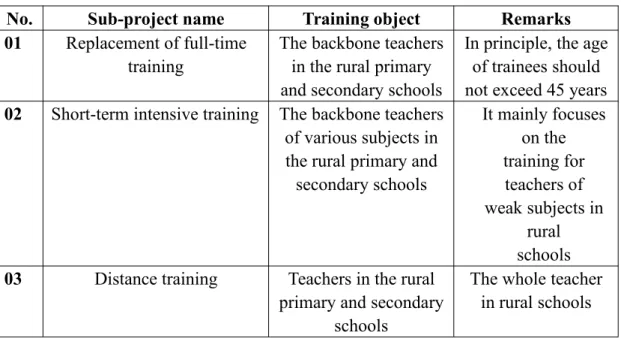
Tang Na & Song Chao, 2012)9, their un-replaced posts (Li Ze-min & Cai Ming-qin, 2012)10, and inconvenience of transportation (Li Chang-juan, 2015)11 etc. Thus, the implementation of TTMP aims to replace rural backbone teachers with supported urban teachers and seniors of normal colleges and universities to participate in long-term centralized training, which firstly formed sub-project of Replacement of Full-time Training by the way of on-the-post internship (Wu & Zhang, 2011)12. Secondly, considering situation of the unreasonable subjects structure, weak bases of teachers in some subjects and lower teaching level in the rural schools of Midwest areas (e.g., Yu Wei, Li Guang-ping, Qin Yu-you, & Li Bai-ling, 2007; Liu Jian-long, 2009)13, substance of the project has been clearly defined as "subjects training of teachers rather than theoretical training, emphasizing full coverage"(Song Yang-gang, 2010, August 21)14. Therefore, the sub-project of short-term intensive training was established for rural backbone teachers of various subjects, to improve teaching level on their subjects. Thirdly, because of the requirements of TTMP for the training of all
rural teachers in the Midwest areas, meanwhile, considering the practical constraints of contradictions between work and study, training funds and limited resource of trainers (Mou Yan-na, 2011)15, the sub-project of distance training was set up for all rural teachers to train in a certain amount of hours of online courses, thus improving the teaching level of the rural schools in the Midwest areas. Specifically, the training targets in the three sub-projects are shown in the table 4:
Table 4 Training objects of TTMP form 2010 to 2014
No. Sub-project name Training object Remarks
01 Replacement of full-time
training The backbone teachers in the rural primary and secondary schools
In principle, the age of trainees should not exceed 45 years 02 Short-term intensive training The backbone teachers
of various subjects in the rural primary and secondary schools
It mainly focuses on the training for
teachers of weak subjects in
rural schools 03 Distance training Teachers in the rural
primary and secondary schools
The whole teacher in rural schools Source: The Circular of the Ministry of Education and the Ministry of Finance on the Implementation of the National Teacher Training Program for Primary and Secondary School Teachers (2010).
Note: In the No.1 and No.2, the proportion of rural teachers came from township level in the total number of teachers participating in training is not less than two-thirds.
In the above table, the training objects of the first sub-project are the backbone teachers who have been engaged in front-line teaching tasks of main subjects for a long time in county-level primary and secondary schools, secondary schools of township and village primary schools. And specific selection of rural backbone teachers is based on the relevant policies issued by various provinces. The second sub-project focuses on the training of backbone teachers in weak subjects such
as music, sports, arts, science, information technology, general technology and comprehensive practical activities, and mental health education in rural schools, and training of some backbone teachers in major subjects such as Chinese, mathematics and English. The third sub-project ,namely distance training, mainly uses modern distance network to do training for all the teachers of primary and secondary schools in rural areas of central and Western provinces.
From the perspective of the scope and content of the project in this period, the Chinese government began to carry out large-scale training activities for rural teachers of primary and secondary school, which means that the guarantee of rural teachers' training rights began to be implemented.
2. Outcome of training time of TTMP from 2010 to 2014
As an important measure to guarantee the training rights of rural teachers, NTTP included the Midwest project firstly achieved the coverage for all rural teachers in the central and Western regions. According to the Ministry of Education’s introduction to the effectiveness of NTTP, by 2014, the central government has invested 11.5 billion RMB in training of primary and secondary school teachers and the number of trainees is more than 11 million person-times (MOE, 2015a)16. In the first training cycle, more than 7 million teachers were trained, of which 96.4% were rural teachers. A round of training for more than 6.4 million rural teachers in the central and Western regions, including border areas, was completed. The whole coverage of rural schools in compulsory education and kindergartens in the central and western regions was basically achieved17.
Secondly, NTTP has also achieved effective coverage of rural teachers.
According to Liu Li-min, Vice Minister of MOE, introduced NTTP: "to implement NTTP as the starting point, classification, stratification and post-division training18 for primary and secondary school teachers to ensure that teachers receive no less than 360 training hours every five years"(Jin Xiao-yan, 2011, April 6)19. In here,
classification of training refers to the implementation of corresponding training with according to the types of teachers’ qualifications in primary and secondary schools stipulated the Regulations on Teachers’ Qualifications. Stratification of training carries out corresponding training with according to the general teachers and backbone teachers assessed by the level of teacher titles. Post-division of training mainly carries out corresponding training with according to teaching, assistant and management positions. It is no doubt that these specific standards of training effectively guarantee the implementation of training of rural teacher in different situations in the Midwest project.
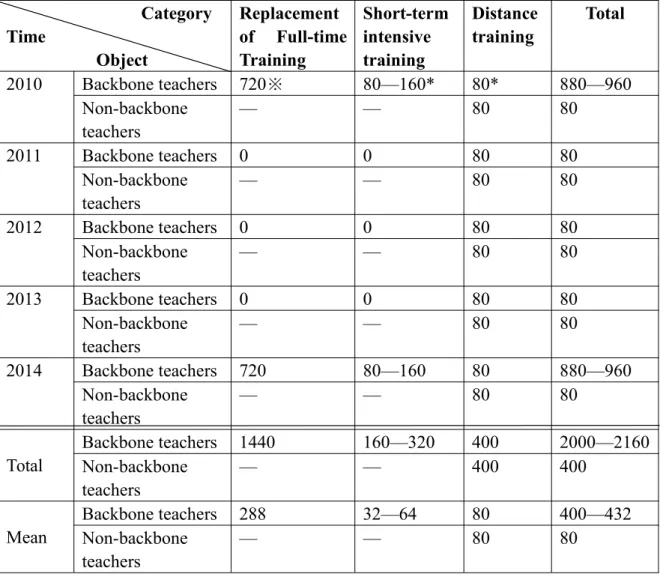
Thirdly, NTTP has also realized the guarantee of individual and group training time for rural teachers. In the course of guaranteeing that teachers receive no less than 360 training hours every five years mentioned by Liu Li-min, according to the specific training time stipulated by different sub-projects in the implementation plan of the Midwest Project from 2010 to 2014, the specific situation of the per capita training time of rural teachers is shown as follows: