JAIST Repository
https://dspace.jaist.ac.jp/
Title
並列データベースシステムにおける更新を考慮したディレクトリ構成に関する研究
Author(s)
金政, 泰彦Citation
Issue Date
1998‑03Type
Thesis or DissertationText version
authorURL
http://hdl.handle.net/10119/1130Rights
Description
Supervisor:横田 治夫, 情報科学研究科, 修士for Parallel Database Systems
Yasuhiko Kanemasa
Scho ol of Information Science,
Japan Advanced Institute of Science and Technology
February 13, 1998
Keywords: ParallelDatabase, Directory Up dating,Parallel Index,ParallelB-tree,
Fat-Btree.
1 Introduction
Inshared-nothingparalleldatabasesystems, retrievalandupdateop erationsare executed
inparalleloneachPE wheredatatheyaccessisstored. Therefore,loadbalancing among
PEs results in improvement of processing performance, and data partitioning strategies
forloadbalancingbecomeveryimportant[1,3]. Therearemanystrategies ofpartitioning
data, such as hash partitioning or range partitioning[2]. However, the hash partitioning
cannot cope with range queries which the range partitioning can, and with clustering
data accesses. On theother hand,the rangepartitioningneeds verylargecost tobalance
loads when a data skew o ccurs as a result of up dating data. In order to solve these
problems, there have been a study using a parallel B-tree for data partitioning[4]. By
using a parallel B-tree, we cannot only solve the weak p oints of both hash and range
partitioning strategies, but also speed up data access. But in the previous study on
parallel B-trees, there are problems of updating the parallel directory. If all PEs have
copies of the whole directory for access distribution, simultaneous update accesses to all
PEs reduce throughput of the system. On the other hand, if the directory is placed in
one PE, centralizedaccesses tothe PE cause a process bottleneck.
Inthisstudy,anewmetho dofstructuringaparalleldirectory,Fat-Btree[6],isadopted.
This studyexamines characteristicsof the Fat-Btree,compares the methodadopting the
Fat-Btree with the ordinary method copying the whole B-tree to all PEs by probability
based performance analyses, and showsthat the Fat-Btree structure is better inrespects
of both throughputandresponse time. This studyalso examinesawayfor implementing
Fat-Btree, and considers about the alternative ways to implement which are caused by
the dierence between Fat-Btreeand ordinaryB-trees.
Copyright c
1998byYasuhiko Kanemasa
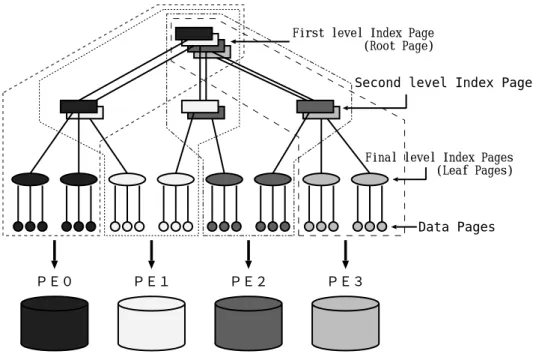
PE2 PE3 PE1
PE0
First level Index Page (Root Page)
Second level Index Pages
Final level Index Pages (Leaf Pages)
Data Pages
Figure1: Fat-Btreestructure
In Fat-Btree structure, leaf pages (nal level index pages) of B-tree are distributed
uniformly toallPEs. Withregardtoindex pages (exceptleaf pages)ofB-tree, thepages
which are recursively above the leaf pages stored in the PE are stored in the same PE.
Hence, in the Fat-Btree structure, the subtree from the root page to the leaf pages is
stored toeach PE (Figure 1).
In Fat-Btreestructure, higher level index pages included in many paths to leafpages
are copiedand distributedtoPEshavingdescendentpages. Thusthe rootpageis copied
to all PEs. However, index pages modied in a directory update are mostly lower level
pages, and those pages are copied to a less PEs. So, the processing cost of directory
update intheFat-Btreemethodis expectedtobelowerthan onefor the methodcopying
the whole B-tree to all PEs. Moreover, since whole path from the root page to a leaf
page is stored inone PE,data retrievalcan be done inparallel oneach PE.It can avoid
concentrating processes ona fewPEs.
3 Probability based Performance Analyses
In order to show usefulness of Fat-Btree, this studycompares the method adopting Fat-
Btree with the ordinary metho d copying the whole B-tree to all PEs[4] (say the whole
B-tree copying method) using probability based performance analyses. In the analyses,
the numb ersof page accesses and communication messagesboth whichare necessary for
one READ or WRITE op eration, are calculated from expected value of the number of
numb ers, the total processing time and response time per one operation are calculated.
Throughput and response time of the system are calculated from them.
The analysis results indicate that the Fat-Btree is mostly better than the whole B-
tree copying method in resp ects of throughput, unless memory caches are not used, the
numb erofPEsisnotlarge,andthedirectoryupdatesarefew. Inparticular,thelargerthe
numb ers of PEs and tuples grow, and the higher the ratio of write operations increases,
on a larger scale the Fat-Btree improve the whole B-tree copying method in respects of
throughput. Ifthe numb erof PEsgrows higher,the wholeB-tree copyingmethodneeds
high cost for simultaneous up date accesses to all PEs, so it reduces system throughput.
On the other hand, the Fat-Btree restrictsthe PEs involvedin the directoryupdating to
a few PEs, so it has few simultaneousup date accesses to many PEs, and it improve the
system'sthroughputlinearlyasthenumb erof PEsgrows. Moreover,theFat-Btreestores
fewerdirectory pages ona PE, therefore itincreases hit ratio of cachememory, and it is
better than the whole B-treecopyingmethod also in respects of response time.
4 Implement of Fat-Btree
In Fat-Btree structure, since some child pagesof aindex page are in otherPEs and have
many copies in many PEs, it is a problem that how to link the parent index page with
the child index page. One of the good solutions for the problem is that, physical page
numb er of a child index page stored in the same PE with parent index page is recorded
into the parent index page, ones of child pages stored in other PEs are recorded into
anotherpages, and the additionalpages are linkedfrom the parentindex page.
AtmakinginitialFat-Btreestructurefromarelation, itisaproblemthathowtomake
the respectivedierentdirectories ineach PE.One of thegoodsolutionsfor the problem
is that, every PE makesthe identical Fat-Btree structure simultaneously from the same
relation, and then eachPE deletesrespective unnecessary pages init.
In Fat-Btree structure, an access path spreads over a few PEs, so the page locking
protocol is animportantissue. In the case of READ, the Fat-Btree structure had b etter
adopt a mo died B-link structure[5]. Then a lock on the parent page can b e released
beforea lock onthe childpage isacquired whenthe queryis takenoverbetween PEs. In
the caseofWRITE,anoptimistic pagelockingproto colusingIX lockssuits toFat-Btree.
In this proto col, an updater traces access path to leaf page using IX locks, and if the
updater updates the directoryas aresult of a writeprocess in the leafpage, the updater
redos itstracing fromthe rootpage using SIX locks.
5 Conclusions
The results of our probability based performance analyses indicate that the larger the
numb ers of PEs and tuples grow, and the higher the ratio of write operations increases,
on a larger scale the Fat-Btree improve the ordinary method copying the whole B-tree
time as well as the throughput. We presented about these analysis results in IEICE
Special InterestGroup of Data Engineering[7].
This study also examined the way to implement Fat-Btree, and considered about
structuresof anindexpage, methodsformakingthe initialFat-Btreestructure, andpage
lockingprotocols. Wewill present ab out these considerationabout implementFat-Btree
in DataEngineering Workshop(DEWS'98).
Futureworks could involve: we need toimplement Fat-Btree indeed, and to domore
detailed performance analyses that take account of waiting time for locking and real
numb er of copy pages.
References
[1] G.Cop eland andW. Alexander andE. Boughter andT Keller, \DataPlacementIn
Bubba", Pro c. of ACMSIGMOD Conf., pp.99{108 (1988).
[2] D.DeWittandJ.Gray,\ParallelDatabaseSystems: TheFutureofHighPerformance
Database Systems", CACM,Vol.35, No. 6,pp.85{98 (1992).
[3] S. Ghandeharizadeh and D. J. DeWitt, \Hybrid-Range Partitioning Strategy: A
New Declustering Strategy for Multiprocessor Database Machines", Proc. of 16th
VLDB Conf., pp.481{492 (1990).
[4] B. Seeger and P. Larson, \Multi-Disk B-trees", Proc. of ACM SIGMOD Conf.,
pp.436{445 (1991).
[5] V. Srinivasan and M. J. Carey, \Performance of B-Tree Concurrency Control Algo-
rithms", Pro c.of ACMSIGMOD Conf., pp.416{425 (1991).
[6] H. Yokota, J. Miyazaki, Y. Tsuchiya, \Parallel Processings in Parallel Active
Database Engine (Parade)", in Japanese, Proc. of Matsue Workshop on Advanced
Database, pp426{433 (1996).
[7] Y.Kanemasa,J.Miyazaki, H.Yokota, \AStructureof Update-conscious Directories
for Parallel Database Systems", in Japanese, Technical Report of IEICE DE97{
77(AI97{44)(1997).