Japan Advanced Institute of Science and Technology
JAIST Repository
https://dspace.jaist.ac.jp/Title A Fault Diagnosis Support System Using Agents
Author(s) Hu, Daiping; Huizhang, Shen; Huanchen, Wang; Qian, Wei
Citation
Issue Date 2005-11
Type Conference Paper
Text version publisher
URL http://hdl.handle.net/10119/3818
Rights ⓒ2005 JAIST Press
Description
The original publication is available at JAIST Press http://www.jaist.ac.jp/library/jaist-press/index.html, IFSR 2005 : Proceedings of the First World Congress of the International
Federation for Systems Research : The New Roles of Systems Sciences For a Knowledge-based Society : Nov. 14-17, 2028, Kobe, Japan, Symposium 3, Session 1 : Intelligent Information Technology and Applications Men and Computing
A Fault Diagnosis Support System Using Agents*
Hu Daiping1, Huizhang Shen1, Huanchen Wang1, Qian Wei21
Antai School of Management, Shanghai Jiaotong University Fahuazhen Road 535, Shanghai, 200053, P. R. China
{dphu, hzshen, hcwang}@sjtu.edu.cn
2
Engineering College, Airforce Engineering University Baiqiao District, Xi’an 710038, P. R. China
[email protected] ABSTRACT
Fault diagnosis within airplane is a complex and time consuming task. Both the efficiency and the effect of fault diagnosis are increasingly important for airplane flying on timetable and flight security. In this paper, we propose a fault diagnosis support system (FDSS) by using agent technology to support ground crew in process of airplane fault diagnosis. This FDSS consists of four kinds of agents: management agent, interface agent, diagnosis agent and data agent. Management agent serves as an agent name server and keeps the all agents’ information, such as name, location, capabilities. Interface agent is the interface of FDSS. Fault diagnosis user and expert have their own interface agent to interact with the FDSS. Diagnosis agent encapsulates a diagnosis method. Data agent gets the required signals for fault diagnosis. All agents have the capabilities of communication and cooperation with each other. We study the FDSS architecture, and discuss the development technology of FDSS.
Keywords: fault diagnosis, support system, agent
1 INTRODUCTION
Airplane has a lot of parts, complex structures and works in a complicated process, so the fault diagnosis within airplane is often a difficult, complex and time consuming task. But the fault diagnosis and reparation within a short time is increasingly important for the airplane flying on timetable and flight security. We should improve the fault diagnosis efficiency and effect. Fault diagnosis study has concentrated on two subjects:
First, on the fault diagnosis methods, such as cause and effect analysis method, fault tree method [1], artificial neural network method [2], case based reasoning method [3], knowledge based inference method, Petri nets method [4, 5] and Bayesian network method [6], etc. Second, on the fault diagnosis system that contributes to the automotive fault diagnosis. Agent and multiagent have been introduced to the fault diagnosis system. Researchers have proposed many agent based fault
diagnosis system emphasized on automotive fault diagnosis in their certain application domains [6, 7, 8, 9, 10].
But within airplane fault diagnosis, complete automotive process is too difficult to realize. The ground crew can use the computer based fault diagnosis methods and their own experiments, and also, they need the help of experts in relative fields. The airplane fault diagnosis is dynamic process. Therefore, in this paper, we propose a concept of fault diagnosis support system (FDSS) which is a computer based support system to help users diagnose faults in airplane. By using FDSS, they can use lots of fault diagnosis methods built in the system, and can get the help from experts online through computer networks. This paper is organized as follows: In section 2 we propose the architecture of FDSS. In section 3 we study the diagnosis agents. In section 4 we discuss the development technology of FDSS and implementation of all kinds of agents. At last we give conclusion and further research work for FDSS.
2 ARCHITECTURE OF FDSS 2.1 Components in FDSS
Components in FDSS include agents, users, experts, database and knowledge base. Agents are the main components. All agents are classified to four kinds: management agent, interface agent, diagnosis agent and data agents.
(1) Management agent
It is responsible for system management. It keeps all the information, such as the names, locations, communication ports of all agents and provides the functions for registring, updating, querying the information of agents in the system. Each agent work for fault diagnosis should register to management agent. Management agent also works as an agent name server. The identify number of each agent is its name. The communication between agents can use agent names and ignore their location.
(2) Interface agent
*Supported by the National Nature Science Foundation of China (No. 70450001) and the Airforce Scientific Research Foundation of PLA (No. BK05026)
It is built for its user to interact with the multiagent based FDSS. Every user has an interface agent. An interface agent has GUI for its user (ground crew) or fault diagnosis expert to access data, query diagnosis method information and use the fault diagnosis method.
(3) Diagnosis agent
It is developed by its master or a fault diagnosis expert. It is the main component of multiagent based FDSS to diagnose airplane fault. Each diagnosis agent encapsulates the algorithms of a fault diagnosis method, which can be invoked by the users and experts using their interface agents.
(4) Data agent
It is designed for the purpose of collecting required voltage or current analogue signals by using suitable circuit and translates them to digital (A/D) signals. It provides data for other agents in the system. Data agent includes hardware circuit and relative instrument. (5) Users
A user is the member of the ground crew who maintains the airplane. He can use the interface agent publish the fault he found in the routine check and utilize the diagnosis methods and get help from experts.
(6) Experts
The experts are sophisticated persons who know airplane fault very well or researchers studied on fault diagnosis. An expert can use interface agent take part in fault diagnosis process and give advices based on his own experiments or methods. He can also invoke the fault methods which are encapsulated by diagnosis agents. (7) Database
It stores data about the airplane, such as all parts types, numbers, location, principle, circuits, working sounds, etc. The ability of multimedia format storage is necessary.
(8) Knowledge database
It keeps common knowledge of the airplane including checking instruction and steps, frequent fault dissolving approaches, etc.
All kinds of agents have GUI interface for his masters to interact with directly.
Data in database, knowledge in knowledge base are called global data and knowledge, can be accessed by agents. Each agent in the FDSS also has itself local knowledge base and database.
2.2 Architecture of FDSS
A multiagent based FDSS is comprised of one management agent, many interface agents, many diagnosis agents, and many data agents. All agents run
their resided computers connected by computer network, such as LAN, Intranet or Internet. They can communicate with each other by using agent communication language to form cooperation in the fault diagnosis process. The architecture of FDSS is demonstrated as figure 1.
FDSS is an opened architecture. It let a new developed agent join the system conveniently by simply registering to the management agent.
Generally, the user works at parking apron or hangar. His interface agent is running in his a notebook computer, with wireless network adaptor (802.11b). In order to be more convenient for him to do work, his interface agent can run in his mobile phone with GPRS.
Data agents must have circuit and instrument connected to airplane. So they should run in the computers such as near the airplane just like the users’ interface agents. Notebook computers or mobile phones are suitable for them.
Management agent resides in a 24 hours a day running computer. And diagnosis agents run in distributed computers at airport or Airline Corporation.
An expert’s interface agent can run in his computer in the office or at home, or even run in his mobile phone.
Figure 1. Architecture of Multiagent based FDSS 2.3 Supporting process of fault diagnosis
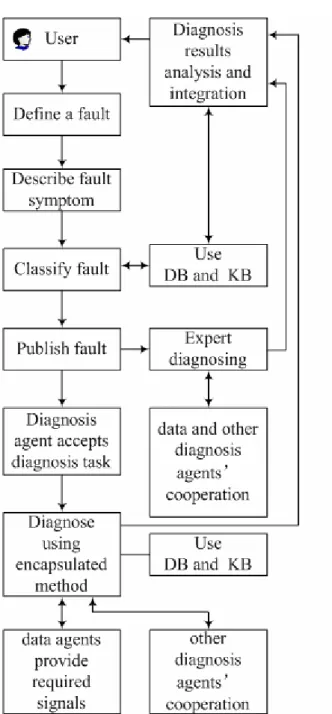
The process of FDSS supporting user for fault diagnosis is showed as figure 2.
Figure 2. Supporting process in fault diagnosis (1) Fault definition and publication.
When a user finds a fault within the airplane, he can use his interface agent running in his notebook computer to define the fault. He should follow the instruction of interface agent to input the description of the fault symptoms and then classify the fault. Knowledge base and database may be useful in fault classification. Then let the interface agent publish the fault.
(2) Diagnosis agents accept diagnosis task
After the fault publication in the system, diagnosis agents
make decision about if they accept the diagnosis task according to their abilities and the fault property. If one of diagnosis agents accepts the task, it will use the encapsulated method to execute fault diagnosing. In its process of fault diagnosis, data agents may be invoked to acquire required data, knowledge base and database may be accessed for getting useful knowledge and data, other diagnosis agents may be asked to do some work in a cooperation way.
(3) Experts accept diagnosis task
Experts can accept diagnosis task published by the interface agent if they are online. Uses can also use the interface agent invite some offline experts to do diagnosis task by sending email or mobile phone short message. When an expert accepts the diagnosis task, he analyzes the fault by his own diagnosis method and experiments. He can also ask data agent for acquiring data, invoke diagnosis agents’ methods and query knowledge base and database.
(4) Diagnosis results analysis and integration
When diagnosis agent and expert get their diagnosis results, they should return results to user’s interface agents. Interface agent with the user’s interaction analyzes and integrates the results and then forms fault dissolving approaches that need the user to follow step by step.
3 DIAGNOSIS AGENTS
So far, a lot of diagnosis methods are available, such as cause and effect analysis method, fault tree method [1], artificial neural network method [2], case based reasoning method [3], knowledge based inference method, Petri nets method [4, 5] and Bayesian network method [6], etc.
Within airplane fault diagnosis, we choose some methods including cause and effect analysis method, artificial neural network method, case based reasoning method and knowledge based inference method. By now, in the multiagent based FDSS, there are four types of diagnosis agents:
(1) Cause and effect analysis (CEA) diagnosis agent CEA agent is according to the working principles of airplane and parts to find the causes of the fault. It takes the fault as the effect and finds the relative causes, and then takes the causes as effects and searches further causes in an iterant way. Each time CEA agent sends the causes to user’s interface agent and needs the user to confirm if make further iteration. Cause and effect knowledge of airplane and parts are stored in its knowledge base, can be maintained by the master of CEA agent using CEA agent GUI interface.
(2) Artificial neural network (ANN) diagnosis agent ANN agent is based on the voltage or current signals
from the airplane measured by data agent using some circuit instruments to classify the fault into a certain type. Before putting into use, the ANN should be trained by utilizing sample data. Knowledge of ANN agent is stored in the network as nodes threshold and weights to other nodes.
Figure 3. 3 layers BPNN for fault diagnosis (3) Case based reasoning (CBR) diagnosis agent
CBR agent has a case base and a reasoning module. Case base is to keep typical faults occurred formerly. A fault case includes precondition, conclusion and solution. Precondition is the characteristics abstracted from fault symptoms, conclusion is the fault identification and solution is the approaches to dissolve the fault. When a new fault occurs, reasoning module abstract fault characteristics and compare with cases in case base to find the most analogous case. And then output the approaches for dissolving the fault. In FDSS, the case base is belong to CBR agent, can only be accessed by CBR agent. If other agents want to search cases, they must communicate with CBR agent. So, case base has a different accessing way from that of common knowledge base and database.
(4) Knowledge based inference (KBI) diagnosis agent KBI agent has a built-in expert system including knowledge base and inferring mechanism. Knowledge base stores facts and if-then rules.
Fact: A is B Rule: If X then Y X, Y is fact
Inferring mechanism uses knowledge to infer certain conclusion. KBI agent use the fault symptoms to abstract condition and get the conclusion of identifying fault.
4 DEVELOPMENT OF FDSS 4.1 structure of agent
Based on the proposal by Shoham [10], we design the general structure of agent in FDSS as figure 4.
Figure 4. General structure of agent in FDSS The agent includes four modules, database and knowledge base.
Interface module is a GUI interface for master to guide or control other modules and access database and knowledge base. Communication module is responsible for communicating with other agents by using agent communication language. We utilize query and manipulation language (KQML). Task execution module is for accomplishing task with encapsulated method. Inferring mechanism can substitute user to guild task execution and communication module working in the absence of master.
Local database keeps the internal status and other necessary data of agents. Local knowledge base stores the facts and inferring rules.
Based on the common structure above, some agents in FDSS may have some modification. The execution module of data agent includes instrument with the circuit connected to airplane. In CBR agent, reasoning module replaces task execution module and inferring mechanism, and database works as a case base storing cases and internal status.
4.2 Implementation of agents
Shoham [10] has proposed that the implementation of agent by methodology of agent oriented programming (AOP) using AOP programming language. But so far, there is not an AOP language as mature as OOP language, such as C++, Java. So we still use OOP language java to develop agents based on the structure proposed above.
We have implemented prototype of multiagent based FDSS. The implemented agents include management agent, interface agent, data agent, CEA agent, ANN agent, CBR agent and KBI agent. Data agent is to acquire signals for ANN agent. Four diagnosis agents are developed for diagnosing fault within engine startup of a specific type airplane.
4 CONCLUSIONS
In this paper, a multiagent based fault diagnosis support system (FDSS) is proposed to support ground crew for fault diagnosis within airplane. It is not a complete automotive fault diagnosis system and includes users and experts. Main components of FDSS are four kinds of agents including management agent, interface agent, diagnosis agent and data agent. All agents accomplish divided task and can cooperate with each other in fault diagnosis process. Efficiency and effect of fault diagnosis can be improved with the multiagent based fault diagnosis support system.
Further research interests focus on developing more fault diagnosis agents for the whole airplane. Implementation of interface agent running in mobile phone is our urgent work.
REFERENCES
[1] W.G. Schneeweiss, Fault tree analysis in case of multiple faults, especially covered and uncovered ones, Microelectronics and reliability, vol. 38, no. 4, pp. 659-663, Apr., 1998
[2] Y.H. Song, Q.X. Xuan, A.T. Johns, Comparison studies of five neural network based fault classifiers
for complex transmission lines, Electric power systems research, vol. 43, no. 2, pp. 125-132, 1997 [3] P.W. Grant, P.M. Harris, L.G. Moseley, Fault
diagnosis for industrial printers using case-based reasoning, Engineering applications of artificial intelligence, vol. 9, no. 2, pp. 163-173, 1996
[4] M.S. Ouali, D. Ait-Kadi, N. Rezg, Fault diagnosis model based on Petri net with fuzzy colors, Computers & industrial engineering, vol. 37, no. 2, pp. 173-176, 1999
[5] L.R. Ray, J.R. Townsend, A. Ramasubramanian, Optimal filtering and Bayesian detection for friction-based diagnostics in machines, ISA Transactions, vol. 40, no. 3, pp. 207-221, 2001 [6] Youping Fan, Yunping Chen, Wansheng Sun, etc.,
System description and petri nets model for reconfiguration of fault diagnosis multi- immune agent, Proc. of 5th world congress on intelligent control and automaion, pp.195-199, Jun. 2004 [7] S. D. J. McArthur, E. M. Davidson, J.A. Hossack
and J. R. McDonald, Automating Power System Fault Diagnosis through Multi-Agent System
[8] Technology, Proceedings of the 37th Hawaii International conference on system sciences, pp.1-8, 2004
[9] Yi Lu Murphey, Jacob A. Crossman, ZhiHang Chen, and John Cardillo, Automotive Fault Diagnosis—Part II:A Distributed Agent Diagnostic System, IEEE Trans. On vehicular technology, vol. 52, no. 4, pp. 1076-1098, 2003
[10] R. Marzi, P. John, Supporting fault diagnosis through a multi-agent-architecture, Mathematics and Computers in Simulation, vol. 60, pp. 217–224, 2002
[11] Y. Shoham, Agent-oriented Programming, Artificial Intelligence, 1993, 60(1): 51-92