著者(英)
Junko Harada
journal or
publication title
Journal of the Open University of Japan
volume
31
page range
27-36
year
2014-03-20
Ⅰ.Introduction
Seniority wages and long-term employment are widely recognised as central elements of the typical Japanese management system, which is sometimes presented in exaggerated form as being based on life-time employment, together with enterprise unionism (see, for example, Hart and Kawasaki, 1999).
Typical-ly, wages increase with age in Japan, but a pure se-niority wage system is very exceptional. Normally, wages are determined by both merit and seniority. It is, therefore, more accurate to say that Japanese em-ployees have upward sloping age-wage profiles, rath-er than a seniority wage system. The wage system has been modified in the past, but upward sloping
age-wage profiles have been maintained up to the present for standard employees. Broad and striking changes, however, appeared in Japanese pay systems in the early 1990s, after the bubble economy burst, and the influence of merit in pay and promotion is be-coming more important in Japanese firms (Benson and Debroux, 1998;Jacoby, 1995;Morishima, 1995). It is often stated that the seniority wage system and long-term employment are positively related to sys-tematic skill formation through on-the-job training and the strength of Japanese firms (e.g. Kumazawa, 1997;Shimada, 1994). In addition, it is also argued that the combination of upward sloping age-wage pro-files and long-term employment provide incentives to workers (e.g. Becker, 1962;Lazear, 1979). Clearly, any pay reform that substantially modifies long-term
The Impact of Japanese Pay Reform in the 1990s
Junko HARADA
1990年代の日本的賃金制度改革の影響
原 田 順 子
1)ABSTRACT
This paper has outlined the background and characteristics of the 1990s pay reforms. Pay reform resulted from the need to decrease labour costs. This necessity was caused by economic depression, demographic conditions and intensified world competition. The main characteristic of pay reform was to decrease seniority/age factors and increase merit factors. However, these changes varied by job track and status. The target of the pay reform was focused on managers both because they were not protected by unions and because managersʼ supply greatly exceeded demand for demographic and economic reasons. Therefore, the pay reform in the 1990s was cosmetic, and not resulted in decisive changes of Japanese pay systems.
要 旨 本論文は1990年代の賃金制度改革の背景と特徴を論述するものである。賃金制度改革は人件費削減の必要性の結果 である。これは経済不況、人口構造の状況、国際競争の高まりから生じた。賃金制度改革の主な特徴は年功的要素を 減らし、成果的要素を増加させることであった。しかし、これらの変化はジョブ・トラックと職位により異なってい た。賃金制度改革は、組合による保護がなく、人口構成上の理由と経済的理由から供給過多になっていた管理職がタ ーゲットになっていた。したがって限定的な面があり、1990年代の賃金制度改革は日本的賃金制度全体からみると決 定的な変化には至らなかった。 1) 放送大学教授(「社会と産業」コース) 放送大学研究年報 第31号(2013)27-35頁
Tanaka, et. al. 2001). I will discuss below the details of the economic depression, demographic conditions and the unionsʼ attitudes towards pay reform.
1.Economic Depression
Japan experienced an economic boom from the mid 1980s until the economic bubble finally burst in 1992. Since then, Japan has suffered severe economic de-pression. According to the Economic Planning Agen-cy, Japan (1999), real GDP declined by minus 0.4% in 1997 for the first time since the 1974 oil shock. Subse-quently, real GDP recovered slightly, but it fell again in 2001 (Cabinet Office, 2002).
The recession is rooted in the failure of macroeco-nomic policy after the sharp appreciation of the Japa-nese currency (the yen) in the mid 1980s. In Septem-ber 1985, the G5 countries (Britain, France, Germany, Japan and the US) intervened in the exchange mar-kets in order to depreciate the US dollar (Plaza Ac-cord). This aimed to help decrease the massive trade deficit of the US. Due to the sudden and dramatic ap-preciation of the Japanese yen, Japanese manufactur-ers had difficulty exporting goods. In addition, in re-sponse to international pressure against Japanʼs trade surplus, the government needed to increase domestic demand. Therefore, low interest rates were set by the Bank of Japan in order to moderate the effect of the sudden appreciation of the yen on manufacturers and to stimulate domestic demand. Although there was an option to increase government spending to expand do-mestic demand, the Japanese government, which was seeking to reduce government debt, relied heavily on its monetary rather than its fiscal policy (Shimada, 1994). As a result, extremely low interest rates con-tinued from the mid 1980s. The bubble economy was created not only by expansionary monetary policy (low interest rates), but also by the newly launched
fi-nancial liberalisation which resulted partly from for-eign pressure for open markets (Blomstrom et. al., 2001). Excess money flow pushed up the prices of stock and land. At the same time, firms were shifting from direct to indirect finance, due to financial liberali-sation. Therefore, banks lost stable borrowers and over-lent to risky customers. The money which was lent at low cost was used for speculation on stock and land, and the economic bubble increased dramatically in size. In 1992, the bubble finally burst, associated with a slow down in the world economy.
Subsequently, world competition was intensified further due to the development of the ex-communist countries. In 1997, the Asian economic crisis and the increase in consumer tax damaged the economic re-covery. As noted above, this prolonged economic de-employment, incentive systems and related internal
firm practices could have critical importance for the wider Japanese system of labour management. Abeg-glen (1958) argued that “the Japanese system is on the whole self-consistent” (Abegglen, 1958, p130). This paper looks at the impact of pay reform for stan-dard employees in the 1990s and shows that it is diffi-cult to discern any fundamental changes to date (see also Lincoln and Nakata, 1997).
Ⅱ. Background to the Pay Reform of the
1990
s
The main aim of the 1990s pay reform was to de-crease seniority/age elements (or inde-crease merit fac-tors), resulting in widening wage dispersion. In par-ticular, performance-based pay (seikashugi chin-gin) is a key concept of the 1990s pay reform. After the bubble economy burst, the Japan Federation of Employersʼ Associations (or Nikkeiren), the leading business association, published a significant book re-garding their pay policy, “Japanese Management in the New Era” (Shinjidan no nihonteki keiei) (1995). This book argued that Japanese pay principles
should be more performance-based (seikashugi) in future. In addition, it stated that long-term employ-ment was unnecessary for all standard employees, and that the seniority promotion system should also be modified. The Japan Federation of Employersʼ As-sociations explained that pay reform aimed to de-crease total labour costs. The policy reflects the fact that traditional pay systems, which make seniority/ age factors significant in pay and promotion systems, have become a burden to Japanese firms in a situation of economic depression, intensified world competition, and an ageing workforce.
According to Shimazu (2002), the cost of labour (employeesʼ income as a share of national income) in Japan was lower than that in the US from 1980 to 1993, but exceeded it between 1994 and 2000. Japa-nese national income decreased due to the economic recession, but labour costs increased because seniori-ty wages automatically increased as the workforce aged. Clearly, relatively high labour costs work nega-tively against Japanese firms in world competition. It is, therefore, natural that Japanese firms recognise the necessity to decrease labour costs in order to maintain their competitiveness. It was also widely predicted that the traditional pay system, with its sub-stantial proportion of seniority or age factors, would further increase labour costs with the inevitable fur-ther ageing of the workforce (for example, Genda, 1999;Koshiro, 2000;Kusuda 1999;Shimazu, 2002;
When the economic depression started in 1992, they were already 45-47 years old and receiving high sala-ries. In addition, it is expected that firms will have to pay out large cash lump-sums when the baby boom-ers retire in the near future. Therefore, it is conceiv-able that the existence of the baby boomers strength-ened the necessity for pay reform.
Moreover, Genda (1999) argued that the problem with baby boomers is not only their huge number, but also their high level of education. In 1965, when the baby boomers were at student age, 294,540 enrolled in higher education institutions (universities, colleges and polytechnics) (Ministry of Education, 2000). This had more than doubled from 131,526 in 1955. The numbers enrolling in higher education have continu-ously increased ever since, but there has never been another period of such rapid change. Furthermore, when the baby boomers finished their higher educa-tion, the Japanese economy was growing rapidly. It was, thus, relatively easy for them to obtain jobs in the managerial track in large enterprises. The Japa-nese labour market subsequently shrunk due to the 1973 Oil Shock, and Genda (1999) argued that many baby boomers remained with the firms to which they were first recruited. He argued that most baby boom-ers became managboom-ers in the 1980s due to seniority promotion systems, resulting in an excess supply of managers. This issue will be discussed later in associ-ation with changes in age-wage profiles.
3.Unions Attitudes
In the private sector, wage bargaining is conducted at individual enterprises, except for a few occupa-tions. Normally, each firm has its own enterprise union, to which all non-managers belong regardless of their job tracks. The unions have been co-operative with management, especially in the last three decades due to the Oil Shock and the subsequent appreciation pression was the worst since the Oil Shock, and also
lasted longer. Clearly, it damaged firmsʼ profits signifi-cantly. In this situation, firms are prone to cutting any stable costs, including labour costs.
2.Demographic Conditions
Firms also needed to conduct pay reform for demo-graphic reasons. The birth rate peaked during 1947-1949, immediately after the Second World War (Min-istry of Health, Labour and Welfare, 2002). Those who were born during this period were termed the “baby boomers”. The second peak occurred during 1971-74, and these are termed the “children of the baby boomers”. These are significantly fewer in num-ber than the original baby boomers. Subsequently, the birth rate significantly and continuously decreased un-til the present day. By contrast, life expectancy in-creased due to improvements in health care and hy-giene. Accordingly, on average, the Japanese pop u-la tion has been dramatically ageing, and the elderly proportion (65 years old or over) increased consider-ably from 4.9% in 1950 to 17.5% in 2002 (Ministry of Public Management, Home Affairs, Posts and Tele-communications, 2002).
The Japanese population structure significantly changed between 1950 and 1999, as illustrated in Fig-ure 1. The young substantially outnumbered the old in 1950, and thus the seniority wage system did not cre-ate problems for firms. The situation, however, com-pletely changed over the next 50 years. The 1999 fig-ure shows the two peaks of the baby boomers and their children, while the population after the children of the baby boomers decreases sharply.
The Japanese population is not only continuously ageing, but also has a peculiar structure, with the two peaks of the baby boomers and their children. It is noteworthy that the baby boomers received under the traditional seniority wage system in the late 1990s.
1950 0 500 1,000 1,500 2,000 2,500 3,000 0 15 31 47 63 79 95 age population (1,000) 1999 0 500 1,000 1,500 2,000 2,500 0 18 36 54 72 90 age population (1,000) Figure 1 Japanese Population by Age in 1950 and 1999
Source:National Institute of Population and Social Security Research (2002) Note:In the 1950 data, Okinawa Prefecture is not included.
nature of enterprise unions, their survival is aligned with the firmsʼ survival in the market. Hence, espe-cially in large firms, enterprise unions remember that their membersʼ working conditions are significantly better than in small and medium sized firms, and thus their first priority has been the protection of employ-ment (Koshiro, 1998). Wage bargaining is not radical in Japan, because there is a mutual understanding be-tween the two sides and, in most cases, management provides the union with confidential information about the profitability of the firm, and productivity per em-ployee, before the annual wage negotiation (Morishi-ma, 1992).
Thus, the major reason for pay reform was econom-ic depression, and intensified world competition made the situation even more serious. In addition, there were two notable domestic factors encouraging the pay reform. Firstly, economic recession happened at a bad moment with an ageing workforce and aged baby boomers worsening the burden of labour costs. Sec-ondly, unions were generally open to co-operation with management on pay reform issues. How did pay reform develop in these conditions?
Ⅲ.The 1990s Pay Reform
The influence of merit in pay and promotion is be-coming more important in Japanese firms (see for ex-ample, Benson and Debroux, 1998;Hart and Kawasa-ki, 1999;Jacoby, 1995;Morishima, 1995;Shibata, H. 2000).
In 1999, the Ministry of Labour, Japan, undertook a survey regarding changes in wage systems in 5,297 firms with 30 standard employees or more, and 93% of firms responded (Nihon keizai shinbun, 2000). Ac-cording to the survey, 53% of firms had altered their wage systems in the last 3 years, and 39.7% intended to modify their wage systems in the next 3 years. 15.8 % of firms had increased the proportion of pay in a salary which is determined by job grade. 15.5% of firms increased the proportion of pay which varies ac-cording to the performance of the firm or individuals within it. This was particularly clear in large firms with 1,000 employees or more, and 38.8% of large firms had increased the proportion of pay which var-ies according to the performance of the firm and/or the individual. In pay reform, there is a clear trend that seniority has decreased in importance while mer-it has increased.
In addition, some innovative firms have implement-ed a radical Annual Salary System (nenpo-sei) (Ari-ga et. al., 2000). For a long period, Japanese employ-ees were unfamiliar with the concept of an annual of the yen (e.g. Koshiro, 1998 and Weathers, 1999).
As a result of stable union-employer relations, unions were not militant, and the rate of wage increase was determined with careful consideration of the firmsʼ competitiveness in the world market;therefore, the rate of wage increases from 1973 to 1998 has been cor-related to the consumer price index, labour demand, exchange rate against the US dollar (the currency of the major trade partner), and the indexes of export and import prices (Koshiro, 1998).
The enterprise unions affiliate to upper-level unions, such as industrial federation and national con-federations. Among the three national confederations, the Japanese Trade Union Confederation (or Rengo) is the leading union confederation. Most major firms, and 64% of unionised workers in Japan, are affiliated to it (Ministry of Health, Labour and Welfare, 2001). It is the third largest organisation in the International Confederation of Free Trade Unions, after the Ameri-can Federation of Labor and Congress of International Organizations in the USA, and the Deutscher Gewerk-schaftsbund in Germany (Japanese Trade Union Con-federation, 2002). The Japan Trade Union Con fed-er a tion and the Japan Fedfed-eration of Employfed-ersʼ As so-ciations are key actors in annual wage bargaining in Japan.
In 1996, the Japanese Trade Union Confederation conducted a survey of over 1,405 unions, including 645 unions of large firms, to which 889 unions, including 456 unions of large firms, responded (Japanese Trade Union Confederation, 1997). The opinion poll investi-gated the increasing importance of job-related wages (or decreasing proportion of person-related wages with seniority or age factors). 46.6% of unions re-sponded that they accepted it, or would accept it with certain conditions. 5.1% said that they were willing to accept the change unconditionally. 30.6% had not de-cided their attitudes towards this change. Only 9.6% of unions answered “we cannot accept it because a negative effect is predicted” (8.2% of responses were not applicable.). Similarly, many unions accepted in-creasing or implementing contingent pay which varies according to the performance of individuals in the short term. 4.8% of unions were willing to accept this, and 31.2% accepted or would accept it with certain conditions. Yet, 11.7% of unions stated “we cannot ac-cept it because a negative effect is predicted”. 43.5% had not decided their attitudes towards this change, and this indicated that the increase in the contingent part in wages was a relatively new issue in pay chang-es.
Therefore, most unions were not opposed to the 1990s pay reform. This is understandable. Due to the
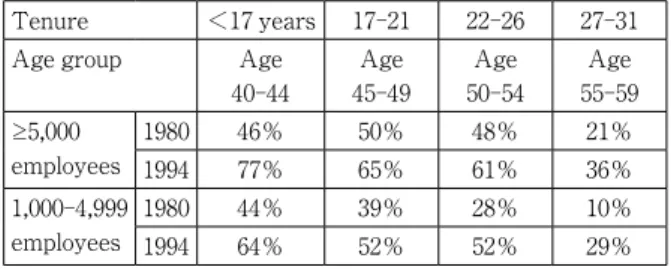
1980 and 1994 (Table 1). This result indicates that long-term employment gradually intensified over the last four decades, as follows.
The proportion of employees who worked for a sin-gle firm after school/university graduation was origi-nally high in firms with 5,000 employees or more and greatly increased between 1980 and 1994. Those aged 55-59 more than doubled from 29% to 65% during the same period in firms with 5,000 employees or more. In 1980, no more than 50% in any age group among high school leavers worked for a single firm. It appears that long-term employment came to be common first among white-collar university graduates in the mana-gerial track, and that it took time for the custom to spread widely to other workers. It is supposed that long-term employment became common also for high school leavers during the 1960s and 1970s. Since the 55-59 years age group in 1980 left high school in the 1940s, they were excluded from the long-term em-ployment custom. Therefore, the younger the employ-ees, the higher the proportions of those who worked for a single firm after their high school graduation, ac-cording to the data of 1994. This gradation shows the way that long-term employment steadily increased in popularity over the last 40 years. By 1994, long-term employment had become a common custom for all standard male workers regardless of job track. Although the study of Chuma (1997) covers the pe-riod up to 1994, length of tenure continued to increase after this (Ministry of Health, Labour and Welfare, Ja-pan, 2002). Thus, long-term employment, which is one of the ʻthree pillarsʼ of the Japanese wage system, has not decreased in the 1990s. On the contrary, it has rather intensified. Firms seem to prefer to modify age-wage profiles, rather than long-term employ-ment, under the constraint of tightened labour costs. This stems from two factors. Firstly, long-term em-ployment and seniority wages are positively related to systematic skills formation through on-the-job train-ing and the strength of Japanese firms (e.g. Kumaza-wa, 1997 and Shimada, 1994). Upward sloping age-salary, since their salary basis was monthly in
gener-al. Nenpo (annual salary) was only known as the pay system for professional baseball players. Therefore, the implementation of an Annual Salary System ap-pears to the Japanese to be extremely merit-oriented. Ariga et. al. (2000) defined the Annual Salary System (nenpo-sei) as follows:(1) oneʼs annual pay is
deter-mined solely by job assignment and performance;(2) pay varies greatly according to the result of personal assessment by supervisors;(3) age-related pay is abandoned. They argued that the Annual Salary Sys-tem can require fundamental changes in pay and per-sonal appraisals, and eliminates the overlapping of pay ranges between job grades.
As a result of these changes, it has been observed that tenure has risen, while age-wage profiles have flattened. For a long time, long-term employment and upward sloping age-wage profiles were regarded as an inseparable combination. This phenomenon, how-ever, indicates that the protection of employment has a higher priority than ʻseniority wageʼ in Japanese firms. We will map out below the changes in tenure and age-wage profiles.
Length of tenure in Japanese firms has risen steadi-ly among all job tracks in all sizes of firms, despite the economic depression (Chuma, 1997). From 1992 to 1999, the average tenure of all employees increased from 10.9 years to 11.8 years (Ministry of Health, La-bour and Welfare, Japan, 2013). Chuma (1997) stud-ied the changes from 1980 to 1994 in so-called ʻperma-nent employmentʼ, namely, the proportion of those who worked for a single firm after school/university graduation. For example, since most people leave high school at age 18, high school leavers with 32 years ten-ure or more at age 50-54 were expected to have worked for the same firm since their high school grad-uation. University graduates were assumed to enter the job market at 22 or 23 years old, because it is com-mon to re-try entrance examinations at the age of 19 and to graduate at the age of 23. The estimations dem-onstrated that the tenure of both groups rose between
Male Standard University Graduates
Tenure <17 years 17-21 22-26 27-31
Age group Age
40-44 Age 45-49 Age 50-54 Age 55-59 5,000 employees 1980 82% 66% 66% 29% 1994 78% 77% 75% 65% 1,000-4,999 employees 1980 73% 63% 50% 13% 1994 71% 72% 63% 54% Source:Chuma (1997)
Table 1 Proportion of Employees Who Work for a Single Firm After Graduation from School/University (Large Firms)
Male Standard High School Leavers
Tenure <17 years 17-21 22-26 27-31
Age group Age
40-44 Age 45-49 Age 50-54 Age 55-59 5,000 employees 1980 46% 50% 48% 21% 1994 77% 65% 61% 36% 1,000-4,999 employees 1980 44% 39% 28% 10% 1994 64% 52% 52% 29% Source:Chuma (1997)
sharp contrast is observed by job track. Wage disper-sion of male standard white-collar university gradu-ates increased only in their late 30s or above;but there were no significant changes among standard male white-collar high school leavers;and it is note-worthy that wage dispersion decreased among stan-dard male blue-collar workers in their late 30s or above from 1980 to 1999. The implementation of an Annual Salary System shows a sharp contrast be-tween managers and non-managers. According to a survey by Roumu Gyousei Kenkyusho (1998) from April 1996 to June 1997 involving 150 major firms in various industries, 20.7% of firms introduced an An-nual Salary System for managers, but only 3.3% of firms implemented the system for all employees. It is likely that this tendency will continue. Table 2 presents the results of an opinion survey conducted by a research institute, Shakai keizai seisansei honbu (1998), concerning future pay policy. The weight of merit is more significant for managers, and the impor-tance of seniority is more significant for non-manag-ers. For example, 38.3% of firms considered that pay should be determined solely by job-ability and result-related pay for managers, but the proportion was only 2.4% for non-managers. In contrast, 14.9% of firms responded that their future pay policy will be mainly seniority pay for non-managers, but this was only 2.9 % for managers. Different attitudes toward pay policy by job status are consistent with the changes in wage dispersion by job track from 1980 to 1990 in which only managersʼ wage dispersion increased. In Table 2, “solely job-ability & result-related pay” is treated as the Annual Salary System (nenpo-sei) using the defi-nition provided by Ariga et. al. (2000). Therefore, an Annual Salary System is, and will be, much more com-mon for managers, than for non-managers.
Why are managers the major target of pay reform? There are two main reasons:(1) protection by unions (Ministry of Labour, Japan, 2000) and (2) the excess supply of managers (Imada and Hirata, 1995;Genda, wage profiles can be temporarily weakened and
recovered in future, but employment cannot. It is, thus, understandable that Japanese firms attempt to protect employment, especially that of core workers (standard male employees). This is also reflected in recent unemployment statistics. Due to the severe economic condition, the unemployment rate consider-ably increased from 2.2% in 1992 to 4.7% in 1999 (Ministry of Internal Affairs and Communications, 2013). It is, however, argued that unemployment was a phenomenon occurring mainly among older men (55-64 year olds) and younger women (25-34 year olds) (Rebick, 2001). Rebick claimed that unemploy-ment of prime-age men was below 2% and that fami-ly well-being was not seriousfami-ly damaged, even though the overall unemployment rate was significantly high-er (4.9% in June 1999).
Secondly, a legal reason should be highlighted. Whilst labour law provides the right of dismissal to employers, it is unlikely that they will win court cases without substantial reasons (Koshiro, 1997). There-fore, when Japanese firms, especially large ones, face economic depression, they tend to avoid large scale layoffs, and attempt to protect the employment of their core workers, who are normally standard male employees, by restricting overtime, laying off part-timers, changing individualsʼ jobs, secondments to subsidiary firms, decreasing/stopping mid-career re-cruitment, temporary suspensions, early retirement plans and having fewer new intakes (Koshiro, 1998). It is noteworthy that the modification of the pay system varies according to job track and status. Be-cause there is a correlation between job status and age, it also depends on age. Changes in wage disper-sion can be a proxy for the implementation of perfor-mance-related pay. According to the Ministry of La-bour, Japan (2000), wage dispersion rose from 1980 to 1999 only among standard male university graduates in their late 30s or over. In contrast, it decreased among those in their 20s. In manufacturing firms, a Table 2 Pay Policy in the Future
Managers(%) Non-managers(%)
Solely seniority pay 2.9 14.9
Seniority = job-ability & result/related pay 2.4 16.0 Seniority < job-ability & result-related pay(1) 15.7 38.6 Seniority << job-ability & result-related pay(2) 39.4 26.6 Solely job-ability & result-related pay 38.3 2.4
Total 100.0 100.0
Source:Shakai keizai seisansei honbu(1998)
Note:(1)Seniority remains, but job-ability & result-related pay is more important. (2) Seniority is minimised, and job-ability & result-related pay is the main element
to 1999 by 5% , but this was not enough. As a result, it took longer to become lower, middle and upper man-agers, and also university graduates who did not be-come managers appeared. It has also been argued that the older the average age of employees in a firm, the later their age on becoming a manager (Ministry of Labour, Japan, 2000). Consequently, the degree of excess supply of those in their 40s and 50s was partic-ularly serious among university graduates (white-col-lar workers on the managerial track).
Ⅳ.Conclusion
This paper has outlined the background and charac-teristics of the 1990s pay reforms. Pay reform result-ed from the neresult-ed to decrease labour costs. This neces-sity was caused by economic depression, demographic conditions and intensified world competition. Pay re-form is a general trend and is particularly significant in large firms. Unions usually show co-operative atti-tudes towards pay reform.
The main characteristic of pay reform is to de-crease seniority/age factors and inde-crease merit fac-tors. The key concept of the 1990s pay reform is the implementation of performance-based pay (seika-shugi chingin), of which the Annual Salary System (nenpo-sei) is one major type. As a result, it is
as-sumed that wage dispersion among employees will be widened by individualsʼ merit payments.
Despite pay reform, tenure increased between 1992 and 1999 (Ministry of Health, Labour and Welfare, Ja-pan, 2002). Chuma (1997) examined the proportion of those who work for a single firm after school/universi-ty graduation, and claimed that long-term employ-ment has gradually intensified over the last 40 years. One of the reasons might be a positive link with skills development, yet it should also be noted that standard employees are legally protected.
This paper considers at the typical Japanese system of wages and promotion, and seeks to examine the im-pact of pay reform on large Japanese firms in the 1990s and its implication on the people involved. It has been argued that upward sloping age-wage profiles and long-term employment are positively related to the strength of Japanese firms (e.g. Becker, 1962;Ku-mazawa, 1997;Lazear, 1979;Shimada, 1994).
However, upward sloping age-wage profiles have been gradually flattening out. But, these changes vary by job track and status. The target of the pay reform was focused on managers both because they are not protected by unions and because managersʼ supply greatly exceeds demand for demographic and eco-nomic reasons.
1999;Okunishi, 1998).
Firstly, managers are the easiest target for altering wages, since they do not belong to unions. As de-scribed above, managers cannot belong to enterprise unions. There are some independent unions for man-agers, but it is a very exceptional case to affiliate to them. Secondly, an excess supply of managers has been caused by an excess supply of university gradu-ates, the great number of baby boomers and the insuf-ficient increases in managerial posts due to slow eco-nomic growth. According to a study by Imada and Hirata (1995) regarding a large Japanese manufactur-ing firm with approximately 35,000 employees, the number of university graduates exceeded that of high school leavers in the firm after 1976. The number of university graduates has dramatically increased in Ja-pan. The proportion of full-time high school students who went to university was 11% in 1965, and this sub-sequently steadily increased to 31% in 1975 and 38% in 1995 (Ministry of Education, Japan, 2000). Thus, it is a common phenomenon in Japan that the relative importance of university graduates fell gradually but continuously. A firm I investigated decreased the rela-tive status of university graduates. The firm changed its pay system because they estimated that qualified high school leavers would be in short supply. Several university graduates have already worked as blue-collar workers in the firm.
Moreover, Okunishi (1998) argued that flattening age-wage profiles are closely related to the propor-tion of workers in their 40s and 50s, because the rapid-ly ageing Japanese population has resulted in an ex-cess labour supply of 40 and 50 year olds, leading to downward pressure on their wages. The existence of baby boomers worsened the situation. The Ministry of Labour, Japan (2000) claimed that the more the work-force of a firm is ageing, the flatter the age-wage pro-files of their employees are. This supports Okunishiʼs argument.
Furthermore, it is a problem when the number of posts does not increase sufficiently. Normally, promo-tion management is based on peer-cohort and job track. In general, all male university graduates are put onto the managerial track together, and are sup-posed to become managers by their 30s. If firms grow, the number of posts increases, but this did not occur during the economic recession of the 1990s.
Rebick (2001) argued that the number of manageri-al posts for older employees became fixed during the 1980s and 1990s, and that this resulted in reduced mo-rale among employees. In contrast, the Ministry of La-bour, Japan (2000) stated that firms in all industries increased the number of managerial posts from 1980
Tokyo, Iwanami shinsho.
Kusuda, K. (1999) ʻWagakuni no jinji chingin seido no sen-go no henkaku to hyouka seido no genjouʼ, in
Koreka-ra no chingin seido no arikata ni kansuru kenkyu-kai(eds.), Kongo no gyouseki seika no hyouka seido no arikata, Chapter 1, Tokyo Zaidan houjin koyou jouhou senta-, pp.9-20.
Lazear, E. P. (1979) ʻWhy is there mandatory retire-ment?ʼ, Journal of Political Economy, vol.87, no.6, December, pp.1261-1284.
Lincoln, J. R. and Nakata, Y. (1997) ʻThe transformation of the Japanese employment system:Nature, depth and originsʼ, Work and Occupations, vol.24, no.1, Febru-ary, pp.33-55.
Ministry of Education (2000) (on line) (cited 17 April 2000) Available from <URL:http://www.monbu. go.jp>.
Ministry of Internal Affairs and Communications (2013) Roudoushoku Chousa, (on line) (cited on 11 Novem-ber) Available from <http://www.stat.go.jp/data/ roudou/longtime/03roudou.htm#hyo_1>.
Ministry of Health, Labour and Welfare (2001) Nihon no
roudou kumiai no genjou 1:Roudou kumiai kiso chousa houkoku, Heisei 13 nen ban, Tokyo, Zai-mushou insatsukyoku.
Ministry of Health, Labour and Welfare (2002) Chingin
kouzou kihon toukei chousa, (on line) (cited on 5 November) Available from <URL:http://wwwdbtk. mhlw.go.jp/toukei/kouhyo/data-rou4/data13/1.xls>. Ministry of Labour, Japan (2000) (CD-ROM) Heisei 12
nen ban:Roudou hakusho, Tokyo.
Ministry of Public Management, Home Affairs, Posts and Telecommunications (2002) Population survey (on line) (cited 17 October 2002) Available from <http:// www.stat.go.jp>.
Morishima, M. (1992) ʻUse of joint consultation commit-tees by large Japanese firmsʼ, British Journal of
In-dustrial relations, vol.30, no.3, pp.405-423.
Morishima, M. (1995) ʻEmbedding HRM in a social con-textʼ, British Journal of Industrial Relations, vol.33, no.4, December, pp.617-640.
National Institute of Population and Social Security Re-search (2002) Nihon no shourai suikei jinkou, To-kyo, Ministry of Health, Labour and Welfare.
Nihon keizai shinbun (2000) ʻKako 3 nen de gyousekikyu
kakudaiʼ, 19 September.
Okunishi, Y. (1998) ʻKigyounai chingin kakusa no genjou to sono youinʼ, Nihon Roudou Kenkyu Zasshi, no.460, October, pp.2-16.
Rebick, M. (2001) ʻJapanese labor markets:Can we ex-pect significant change?ʼ, in Blomstrom, M., Gangnes, B. and La Croix, S. (eds.), Japan’s new economy:
Continuity and change in the twenty-first century, Chapter 5, Oxford, Oxford University Press, pp.120-144.
Roumu Gyousei Kenkyusho (1998) ʻNenpo sei no atarashii tenkaiʼ, Rousei Jihou, no.3360, 24 July, pp.2-13. Shakai keizai seisansei honbu (1998) cited in (CD-ROM)
Ministry of Labour, Japan (2000), Heisei 12 nen
ban:Roudou hakusho, Tokyo.
Shibata, H. (2000) ʻThe transformation of the wage and Therefore, the pay reform in the 1990s was not
re-sulted in decisive changes of Japanese pay systems. (This paper is based on the authorʼs PhD Thesis.)
References
Abegglen, J. C. (1958) The Japanese factory:Aspects of its social organization, Glencoe, Illinois, The Free Press.
Ariga, K., Brunello, G. and Ohkusa, Y. (2000) Internal
La-bor Markets in Japan, Cambridge, Cambridge Uni-versity Press.
Becker, G. S. (1962) ʻInvestment in human capital:A the-oretical analysisʼ, Journal of Political Economy, vol. 70, no. 5, part 2, October, pp.9-49.
Benson, J. and Debroux, P. (1998) ʻHRM in Japanese en-terprises:trends and challengesʼ, in Rowley, C. (eds.),
Human resource management in the Asia Pacific region:Convergence questioned, London, Frank
Cass.
Blomstrom, M., Gangnes, B. and La Croix, S. (2001)
ʻIntro-duction:the Japanese economy:from miracle to stagnationʼ, in Blomstrom, M., Gangnes, B. and La Croix, S. (eds.), Japan’s new economy:Continuity
and change in the twenty-first century, Oxford, Ox-ford University Press .
Cabinet Office (2002) ʻQuarterly estimates of GDPʼ, (on line) (cited on 15 May 2002)Available from <http:// www.esri.cao.go.jp>.
Chuma, H. (1997) ʻKeizai kankyou no henka to chukounen-sou no chokinzokukaʼ, in Chuma, H. and Suruga, T.
(eds.), Koyou kankou no henka to josei roudou, Chapter 2, Tokyo, University of Tokyo Press, pp.47-82.
Economic Planning Agency, Japan (1999) Heisei 11 nen
ban:Keizaihakusho, Okurasho insatsukyoku, To-kyo.
Genda, Y. (1999) ʻHowaito kara- no shogu henka to dankai sedai no eikyouʼ, Shakai kagaku kenkyu, vol.5, no.3, pp.35-54.
Hart, R. A. and Kawasaki, S. (1999) Work and Pay in
Ja-pan, Cambridge, Cambridge University Press. Imada, S. and Hirata, S. (1995) Howaito kara- no shoshin
kozo, Japan Institute of Labour, Tokyo.
Jacoby, S. M. (1995) ʻRecent organizational developments in Japanʼ, British Journal of Industrial Relations, vol.33, no.4, December, pp.645-650.
Japanese Trade Union Confederation (Rengo) (1997)
Rengo seisaku shiryo, no.101, 31 January.
Japanese Trade Union Confederation (2002) 2002-3
Watashitachi no Rengo, Tokyo, Kyoiku bunka kyokai. Koshiro, K, (1997) ʻSanshu no shingiʼ, Nihon roudou
ken-kyu zasshi, no.443, April, pp.2-3.
Koshiro, K. (1998) Sangyo to roshi no kankei, Tokyo, Housou daigaku kyoiku shinkou kai.
Koshiro, K. (2000) A fifty year history of industry and
labor in postwar Japan, Weather, C. (eds.), Tokyo, Japan Institute of Labour.
Tanaka, T., Hori, Y., Suzuki, Y., Imai, A., Tateishi, A. and Yamakita, K. (2001) ʻNihon no roudou keizai jijou 2001ʼ, Nikkeiren repo-to, Tokyo, Nihon keieisha
dan-tai renmei.
Weathers, C. (1999) The 1999 Shunto and the
restruc-turing of Japan’s wage system, Asian Survey, vo.39, no.6, pp.960-985.
(2013年10月30日受理) performance appraisal system in a Japanese firmʼ,
In-ternational Journal of Human Resource Manage-ment, vol.11, no.2, April, pp.294-313.
Shimada, H. (1994) Nihon no koyou:21 seiki he no
saisekkei, Tokyo, Chikuma shinsho.
Shimazu, H. (2002) ʻMisumacchi kaishou ga motarasu koy-ou no kakudaiʼ, Kongetsu no mondaiten, 11 January, Tokyo, Sanwa Research Institute, pp.1-19.