Microflora in the Alimentary Tract of Gray
Mullet IX : Vitamin Requirement for the Growth
of Vibrio and Enterobacter Isolates
著者
KAKIMOTO Daiichi, MOWLAH Aleya H.
journal or
publication title
鹿児島大学水産学部紀要=Memoirs of Faculty of
Fisheries Kagoshima University
volume
29
page range
355-359
別言語のタイトル
ボラ消化管の微生物叢 IX : Vibrioならびに
Enterobacter属菌のビタミン要求
Mem. Fac. Fish., Kagoshima Univ. Vol. 29 pp. 355-359 (1980)
Microflora in the Alimentary Tract of Gray Mullet—IX
Vitamin Requirement for the Growth of Vibrio
and Enterobacter Isolates
Daiichi Kakimoto and Aleya H. Mowlah*
Abstract
Isolates of Vibrio, similar to Vibrio anguillarum and isolates of Enterobacter, similar to Enterobacter
aerogenes isolated from the alimentary tract of Gray mullet (Mugil cephalus) were grown in the
presence or absence of eight vitamins. Omission of vitamins from the medium confirmed that biotin, riboflavin, pantothenic acid, folic acid, pyridoxal and nicotinic acid were not essential for the growth ofthe isolates of Vibrio and Enterobacter. It was found that cobalamin was non essential and inhibited the growth of Enterobacter isolates. Although a little requirement of thiamin for the growth of Vibrio isolates was detected, but it seems to be non essential for the growth of the isolates. No requirement of the other essential growth factors could be detected.
The normal intestinal microflora including bacteria are a source of vitamins
in animal rations to improve feed efficiency and increase the rate of growth of
animal (Hall)1).
Riboflavin is synthesized in varying amounts by many bacteria
(Prydham)2).
The production of B12 by microorganisms has been studied extensively
(Burton and Lochead)3>.
Indigenious bacteria in the gastrointestinal tract influence
profoundly the lives of their hosts by producing or utilizing vitamins and other im
portant nutrients (Gordon)4^.
The purpose of this communication was undertaken
to determine the requirement of vitamins by Vibrio and Enterobacter during the growth
at various temperatures, since, these two bacterial spp. are supposed to be the most
important and useful for the growth of gray mullet.
Materials and Methods
Bacteria, their Growth Conditions and Characterizations:
The methods for enumaration of bacteria, procedures for isolation, compositions of
the media used, incubation temperatures, methods for morphological and biochemical
examinations of the species of bacteria, process of estimation of enzymic activities of
the bacteria and the assessment for the requirement of amino acids by the intestinal
bacteria of gray mullet were the same as described previous papers of this series5)~n).
Culture Media:
Strains of Vibrio isolates and Enterobacter isolates were cultured in ZoBell and
356
Mem. Fac. Fish., Kagoshima Univ. Vol. 29 (1980)
ent broth at 25°C and 30°C respectively on a shaker for 18 hours.
Cells were har
vested, washed and resuspended in 0.9% NaCl.
An aliquot of 0.1 ml of suspension
was inoculated in test tubes containing 10 m/ basal medium12 containing KH2P04:
lgm., Na2HP04: 3 gm., NaCl: 5 gm., CaCl2: 0.1 gm., MgS04-7H20: 0.2 gm.,
MnS04H20: 0.006 gm., FeS04-7H20: 0.015 gm. and vitamin free casamino acid or
amino acids: (except glutamic acid, glycine, lysine and serine because the growth of
the isolates were positive in these amino acids) 0.5 gm. each in distilled water 1
liter (pH adjusted to 7.0).
The tubes were then incubated on a shaker at tempera
tures at 20°C, 25°C, 30°C and 35°C for 72 hours respectively.
Growth of the test
organisms was determined by measuring the absorbance at 470 nm wave length by
spectrophotometer (Hitachi/Model 101).
Vitamin Mixture:
This contained (fig ml'1 final concentration): riboflavian, 0.5; nicotinic acid, 1.0;
thiamine, 1.0; biotin, 0.5; folic acid, 2.5; cobalamin, 1.0; pyridoxal, 1.0; and
pantothenic acid, 0.5; dissolved in water.
The mixture was diluted to half strength
when used in growth media.
Results and Discussion
Growth of Enterobacter and Vibrio isolates in eight vitamins at different temperatures
are shown in Table 1.
It has been shown that all the bacterial strains grew well at
all the tested temperatures in a medium containing tryptic digest of casein and amino
acids.
The nutritional requirements for the growth of these intestinal isolates were
not unusual.
The unique features of the growth of these isolates in the media were
Table 1. Growth of the isolates of Vibrio and Enterobacter at different temperatures. The composition of the medium were sterilized in an autoclave for 20 min at 121°C, except for vitamins which were added after sterilization by filtration.
Vitamin used Temperatures °C Vibrio isolates Enterobacter isolates Basal medium - (0.00) - (0.00) Vitamin free Casamino acids fr (0.98) ft (0.65) Amino acids + (0.76-0.78) + (0.56) Thiamine +f (0.86-0.89) + (0.54-0.57) Riboflavin 20°C -1- (0.71-0.74) -f (0.54-0.55) Pyridoxal + (0.76-0.78) 4- (0.57) Cobalamin + (0.71-0.75) ± (0.49-0.51) Folic acid 4- (0.70) + (0.54-0.56) Nicotinic acid + (0.76) 4- (0.55) Pantothenic acid + (0.71-0.74) + (0.51) Biotin + (0.74-0.76) 4- (0.57)
Kakimoto-Mawlah : Vitamin Requirement of Intestinal Bacteria
Table 1. (Continued)
Temperatures Vibrio Enterobacter
Vitamin used
OQ
. ^ ^
isolatesBasal medium - (0.00) - (0.00) Vitamin free Casamino acids -f|(1.10-1.15) ++ (0.78-0.80) Amino acids + (0.85-0.87) 4- (0.68-0.70) Thiamine fr (0.92-0.95) 4- (0.65-0.68) Riboflavin 25°C + (0.82-0.85) 4- (0.61-0.64) Pyridoxal + (0.85) 4- (0.65) Cobalamin 4- (0.83) ± (0.55-0.57) Folic acid 4- (0.84-0.85) 4- (0.62-0.64) Nicotinic acid 4- (0.81-0.83) 4- (0.65) Pantothenic acid 4- (0.83-0.85) 4- (0.66) Biotin 4- (0.85) 4- (0.67-0.70) Basal medium - (0.00) - (0.00) Vitamin free Casamino acids +1 (0.85-0.87) ++(1.00-1.10) Amino acids 4- (0.65) 4- (0.89-0.92) Thiamine ++ (0.70) 4- (0.89-0.90) Riboflavin 30°C 4- (0.62-0.64) 4- (0.80) Pyridoxal 4- (0.60-0.64) 4- (0.85-0.87) Cobalamin 4- (0.65) ± (0.70-0.71) Folic acid 4- (0.67) + (0.89) Nicotinic acid 4- (0.66) + (0.91) Pantothenic acid 4- (0.64-0.67) 4- (0.87) Biotin -1- (0.61-0.64) 4- (0.87-0.89) Basal medium - (0.00) - (0.00) Vitamin free Casamino acids TT (0.65-0.67) -H- (0.95-0.97)
Amino acids -I- (0.45-0.47) + (0.75-0.79)
Thiamine ++ (0.45-0.48) 4- (0.71-0.74) Riboflavin 35°C + (0.41) 4- (0.76) Pyridoxal 4- (0.43-0.45) 4- (0.73-0.75) Cobalamin 4- (0.47) ± (0.65) Folic acid 4- (0.45) + (0.74-0.78) Nicotinic acid 4- (0.43) 4- (0.73-0.75) Pantothenic acid 4- (0.45-0.46) 4- (0,76) Biotin 4- (0.43) 4- (0.71-0.74)
(—) No growth, (±) weak growth, (4-) good growth, (++) very good growth.
358
Mem. Fac. Fish.j Kagoshima Univ. Vol. 29 (1980)
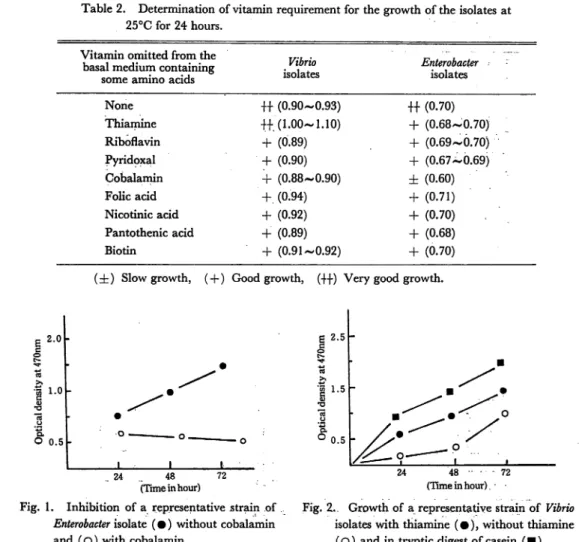
not specifically dependant on the presence or absence of vitamins, (except thiamine
and cobalamin). Each vitamin was omitted in turn from the medium, no specific
change of growth yield was detected, except in thiamine, where the growth yield of
Vibrio isolates was a little higher at all the tested temperatures (Table 2). But when
the thiamine was omitted, the growth of Vibrio isolates continued, although slow
growth occurred after a relatively long lag period (Fig. 1). Addition of thiamine
shortened the lag period and improve the growth, but the growth rate remained
poorer than that ofin control culture where the bacteria had been grown with tryptic
digest ofcasein.
Here thiamine could be supposed to be stimulant and probably non
essential for the growth of Vibrio isolates.
It may be concluded that Vibrio and Enterobacter isolates did not require cobalamin,
since, it grew well without cobalamin. Moreover, growth of the isolates was not
affected by the addition of cobalamin to the culture of Enterobacter isolates.
The
Table 2. Determination of vitamin requirement for the growth of the isolates at
25°C for 24 hours. Vitamin omitted from the
basal medium containing
some amino acids
Vibrio isolates Enterobacter isolates None 4+ (0.90-0.93) +4 (0.70) Thiamine 4+. (1.00-1.10) 4- (0.68-0.70) Riboflavin 4- (0.89) + (0.69-0.70) Pyridoxal 4- (0.90) 4- (0.67-0.69) Cobalamin 4- (0.88-0.90) ± (0.60) Folic acid 4-. (0.94) 4- (0.71) Nicotinic acid 4- (0.92) 4- (0.70) Pantothenic acid 4- (0.89) + (0.68) Biotin 4- (0.91-0.92) 4- (0.70)
(4z) Slow growth, (4-) Good growth, (44) Very good growth.
2.0 1.0 0.5 24 48 (Tune in hour) 72
Fig. 1. Inhibition of a representative strain of .
Enterobacter isolate (•) without cobalamin
and (O) with cobalamin.
2.5 • • 1.5 -• • • • o 0.5
^
_—- 9 1 24 48 • -(Time in hour). 72Fig. 2,. Growth of a representative strain of Vibrio isolates with thiamine (#), without thiamine (O) and in tryptic digest of casein (•).
Kakimoto-Mawlah: Vitamin Requirement of Intestinal Bacteria 359
growth rate of Enterobacter isolates was reduced when cobalamin was added to the
medium, that may inhibits the growth of bacteria in this medium (Fig. 1).
The results ofthe identification of essential and non essential components by studying
the effect of their omission or addition, indicated that there was no specific require
ment for biotin, riboflavin, pantothenic acid, folic acid, pyridoxal, cobalamin and
nicotinic acid for the growth, under this experimental condition. It could be con
cluded that these vitamins are not essential, for their growth.
Thus these strains could not utilize vitamins which could be assumed to be essential
for gray mullet. Phillips et al.13) determined the need of 10 members of the vitamin
B complex for Carp and Trout. Delong14> established the necessity of carp for
pyridoxamine, riboflavin and pantothenic acid.
The inability to utilize these vitamins might be indicating the possibility of pro
ducing them together with other important nutrients in fishes with undeveloped
stomach, like gray mullet.
Thus the result could be concluded that Enterobacter isolates and Vibrio isolates
(studied only on their nutritional point of view) were most important and probably
indispensable for gray mullet, living in fresh and sea water.
Acknowledgements
The authors would like to thank Prof. Takahisa Kimura and Dr. Yoshio Ezura
of Microbiology Laboratory, Faculty of Fisheries, Hokkaido University for their kind
discussion and important suggestions.
References
1) H. H. Hall, J. C. Benjamin, H. M. Briker, R.J. Gill, W. C. Haynes and H. M. Tsuchiya: Bacterial. Prac. (Soc. Am. Bacteriologist), 50, 21 (1950).
2) T. G. Pridham: Econ. Botany b, 185-205 (1952).
3) M. O. Burton and A. G. Lochead: Can. J. Bot. 29, 352 (1951). 4) H. A. Gordon and L. Petri: Bacterial. Rev. 35, 390-429 (1971).
5) A. Hamid, T. Sakata and D. Kakimoto: Mem. Fac. Fish. Kag. Univ. 25(1), 59-60 (1976). 6) A. Hamid, T. Sakata and D. Kakimoto: Bull. Jap. Soc. Scin. Fish. 44(1), 53-57 (1978). 7) A. Hamid, T. Sakata and D. Kakimoto: Mem. Fac. Fish. Kag. Univ. 26, 79-87 (1977). 9) A. Hamid, T. Sakata and D. Kakimoto: Bull. Jap. Soc. Sci. Fish. 45(1), 99-102 (1979). 9) A. H. Mowlah, T. Sakata and D. Kakimoto: Bull. Jap. Soc. Sci. Fish. 45(10), 1313-1317
(1979).
10) A. H. Mowlah and D. Kakimoto: Mem. Fac. Fish. Kag. Univ. 28, 35-40 (1979).
11) A. H. Mowlah and D. Kakimoto: Mem. Fac. Fish. Kag. Univ. 41-45 (1979). 12) P. K. Zachariah and I. Liston: Appl. Microbiol. 26, 437 (1973).
13) A. M. Phillips, Jr. Brockway, D. R., Podoliak and H. A. Balzer: Fish. Res. Bull., 20, State of New York, Conservation Department, Albany,