Doctoral Thesis
Modeling Associations between Student
Affective Factors and EFL Learning Achievement
September 2016
Doctoral Program in Advanced
Information Science and Engineering
Graduate School of Information Science
and Engineering
Ritsumeikan University
Doctoral Thesis reviewed
by Ritsumeikan University
Modeling Associations between Student
Affective Factors and EFL Learning Achievement
(学生の感情要因と EFL 学習到達度との関連のモデル化)
September 2016
2016 年 9 月
Doctoral Program in Advanced Information Science and Engineering
Graduate School of Information Science and Engineering
Ritsumeikan University
立命館大学大学院情報理工学研究科
情報理工学専攻博士課程後期課程
Fitra Abdurrachman BACHTIAR
フィトラアブドゥラフマンバッチャー
Supervisor: Professor KAMEI Katsuari
研究指導教員:亀井且有教授
Abstract
There are three domains in educational objectives, cognitive, affective, and psychomo-tor domains. The affective domain concerns facpsychomo-tors like motivation, attitude, and feelings. Despite its central role in teaching and learning, this domain is the least researched due to the complexities, vagueness, and difficulty to quantify the domain. Modeling affective factors to infer student English achievement has not been empir-ically demonstrated. This dissertation describes methods to model student affective factors and to infer achievement in English as a foreign language based on these factors.
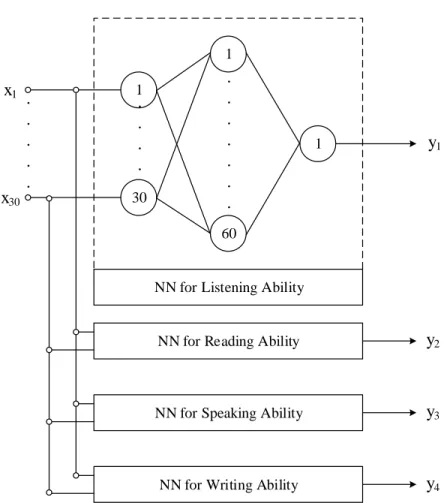
First, questionnaires are developed to collect responses from 154 students related to 30 affective factors in English learning, 10 each for motivation, attitude, and per-sonality. Four neural networks are trained to infer these students’scores on four types of achievement test, listening, reading, speaking, and writing scores. Each neu-ral network consists of 30 inputs, affective factors, and one output, the score. The average mean square errors for the test data in 10-fold cross validation were 0.07, 0.06, 0.05, and 0.06 for listening, reading, speaking, and writing, respectively.
Next, because test score inference using neural networks does not reveal which affective factors influence scores, association analysis is conducted to understand the relationship of affective factors and scores. Four types of transaction are made from the database of affective factors (Mo: Motivation, At: Attitude, Pe: Personality, An:
vi
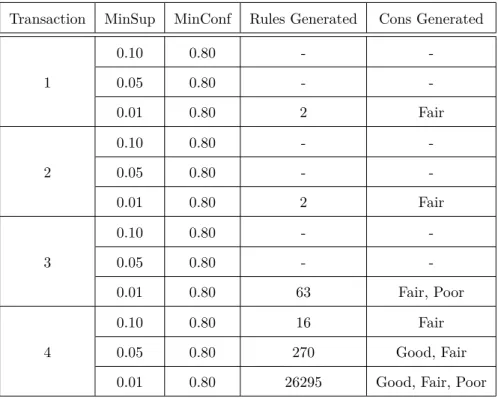
Anxiety, Se: Self-Esteem) with three levels (H: High, M: Moderate, L: Low) and scores (P: Poor, F: Fair, G: Good), each obtained from 188 students: TR1= {Mo, An}, TR2={Mo, At, P e}, TR3={Mo, At, P e, An, Se}, TR4={Mo1−Mo5, At1−At3, P e1−
P e2, An, Se}. The numbers of generated rules were 2, 2, 63, and 26295 for TR1, TR2,
TR3, and TR4, respectively. These association rules elucidate the relation between the affective factors and the scores.
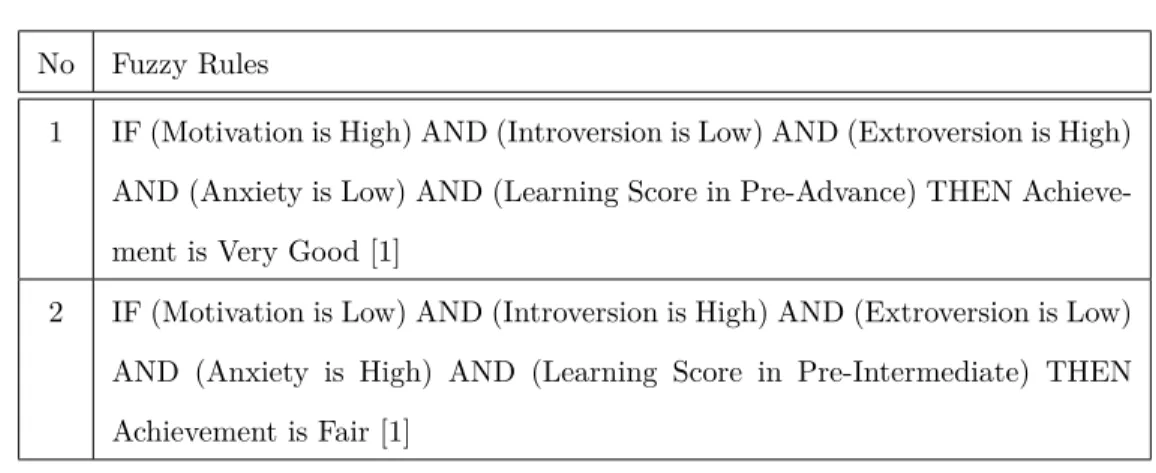
Finally, FIS (Fuzzy Inference System) is proposed to evaluate student achievement using affective factors and cognitive factors, whereas previous studies only considered cognitive factors. The affective factors are “Motivation”, “Introversion”, “Extrover-sion”, and “Anxiety”. The cognitive factor is obtained from scores of tests, quizzes, and/or assignments and has five fuzzy subsets of “Elementary”, “Pre-Intermediate”, “Intermediate”, “Pre-Advanced”, and “Advanced”. The achievement is “Unsatisfac-tory”, “Fair”, “Good”, “Very Good”, and “Excellent”. The proposed system consists of 25 IF-THEN rules, Mamdani’s implication and Center of Gravity defuzzification. When compared to seven English language professors’evaluations of 0 to 100 for 20 students, the error was 5.15 and the correlation was 0.79.
Acknowledgments
First of all, I would like to say Alhamdulillah. It is due to His blessings, mercy, and help that finally I can complete my doctorate study at Ritsumeikan University, Japan.
I would like to express my sincere gratitude and highest appreciation to many people that have helped me during my graduate study. I would like to express my deepest gratitude to my supervisor Professor Katsuari Kamei for his availability in giving support in my study, research directions as well as numerous constructive feedback, and his critical suggestion during his busy schedule. I also would like to thank Professor Eric W. Cooper in guiding my research patiently, providing me with critical and constructive comments, putting aside his valuable time for my numerous consultations, and his support in scientific English writing.
I also indebted to all the professors in the committee of my dissertation for their very useful comments and questions to improve the presentation and clarity of my dissertation. For these matters I would like to thank Professor Ruck Thawonmas and Professor Hiromitsu Shimakawa.
I would like to thank organizations that have provided financial support that enables me to accomplish my doctoral study in Japan. Brawijaya University has provided me with a Settlement Scholarship, Ritsumeikan University have supported me with several scholarships including, Special Encouragement Scholarship, Gakkai
viii
Happyo Grant, and Kokusaiteki Research Fund. Other scholarships are from Japan Student Service Organization (JASSO), ASTER Scholarship, and Mitsubishi Schol-arship.
I would like also to offer my gratitude and appreciation to my family that has endlessly supported me spiritually with their silent prayers.
Finally, the completion of my doctorate study has involved many people. How-ever, I assume full responsibility for inadequacies and inaccuracies remaining in my dissertation.
Contents
Abstract v
Acknowledgments vii
List of Figures xv
List of Tables xvii
1 Introduction 1
1.1 Role of Affective Factors in Education . . . 1
1.2 Affect, Learning, and Educational Data Mining . . . 7
1.3 Research Objectives and Dissertation Outline . . . 10
2 Affective Factors 13 2.1 Definition and Classification of Affect . . . 13
2.2 Interdependence between Affect and Learning . . . 15
2.3 Affect in Language Learning . . . 18
3 Soft Computing and Methods Used 23 3.1 Introduction . . . 23
3.2 Neural Networks . . . 25
3.2.1 Neuron Model . . . 25
3.2.2 Multilayer Neural Network Architecture . . . 27
3.2.3 Backpropagation Algorithm . . . 28
3.3 Fuzzy Logic Theory . . . 31
3.3.1 Fuzzy Sets . . . 32
3.3.2 Membership Function . . . 32
3.3.3 Fuzzy Operators . . . 33
3.3.4 Fuzzy Inference System (FIS) . . . 35
3.4 Association Analysis . . . 38
3.4.1 Association Analysis Terms . . . 39
3.4.2 Apriori Algorithm . . . 42
3.5 Conclusion . . . 44
xii CONTENTS
4 Models of Affective Factors in English Learning using NN 45
4.1 Introduction . . . 45
4.2 Collecting Data of Student Affective Factors . . . 47
4.2.1 Affective Factors Selection . . . 47
4.2.2 Questionnaire Implementation . . . 50
4.3 Data Preprocessing . . . 52
4.4 NN Model to Infer Student Achievement . . . 53
4.4.1 NN Model Construction . . . 54
4.4.2 NN Training and Testing . . . 55
4.5 NN Model to Classify Student . . . 57
4.5.1 NN Model Construction . . . 57
4.5.2 NN Training and Testing . . . 61
4.6 Conclusion . . . 63
5 Student Profiles Based on Affective Models 65 5.1 Introduction . . . 65
5.2 Affective Factor Selection . . . 66
5.3 Association Rules Model . . . 68
5.3.1 Data Pre-processing . . . 68
5.3.2 Student Classification by Association Rules . . . 69
5.3.3 Association Rules Results . . . 70
5.4 Conclusion . . . 81
6 Implementation of Affective Factors in Assessment Using FIS 83 6.1 Introduction . . . 83
6.2 Fuzzy Inference Based on Affective Factors . . . 85
6.2.1 Affective Factors Selection . . . 85
6.2.2 Fuzzy Affective Inference Model . . . 86
6.2.3 Results . . . 89
6.3 Fuzzy Inference Based on Affective-Cognitive Factors . . . 93
6.3.1 Affective and Cognitive Factors . . . 94
6.3.2 Fuzzy Affective-Cognitive Inference Model . . . 94
6.3.3 Result . . . 99 6.4 Conclusion . . . 105 7 Conclusions 107 A Affective Factors 111 B Affective Questionniare 113 C Affective Descriptors 121
CONTENTS xiii
E Fuzzy Rules 131
Bibliography 133
List of Figures
1.1 Educational objectives levels of cognitive affective, and psychomotor
domain . . . 2
1.2 Causal model of teacher immediacy . . . 5
3.1 McCulloch and Pitts’ neuron model . . . 25
3.2 Feed-forward neural network . . . 27
3.3 Simplified backpropagation network . . . 29
3.4 Three layer back propagation . . . 30
3.5 Fuzzy inference structure . . . 36
3.6 A maximum accumulation method . . . 37
4.1 Questionnaire development . . . 48
4.2 Questionnaire construct . . . 49
4.3 Screenshoot of the main page of the website . . . 50
4.4 An example of uploaded questionnaire . . . 51
4.5 Factor analysis process . . . 52
4.6 Study overview . . . 53
4.7 Basic struture of construted NN . . . 54
4.8 Inference model of English abilities by NN . . . 56
4.9 Testing error for each experiment . . . 57
4.10 Basic structure of constructed NN for classification . . . 58
4.11 NN for each ability classification . . . 60
4.12 NN for general ability classification . . . 61
4.13 Testing error of each ability classification . . . 62
5.1 Process of conducting Apriori algorithm . . . 71
6.1 Block diagram of FIS . . . 89
6.2 Surface plot of FIS . . . 90
6.3 Overall process of affective-cognitive inference system . . . 96
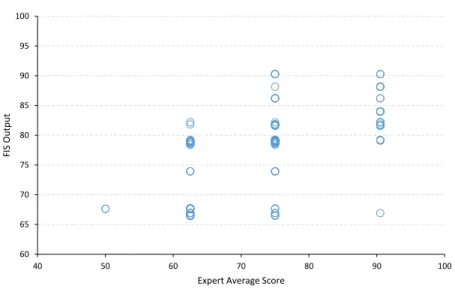
6.4 FIS output and average experts score . . . 102
6.5 Correlation plot of FIS output and experts score . . . 103
List of Tables
3.1 Typical membership functions . . . 33
3.2 An example of market basket transaction . . . 38
3.3 Binary representation of market basket data . . . 39
4.1 Error and variance of English ability inference . . . 56
4.2 Norm Referenced Interpretation table . . . 59
4.3 Error and variance of each English ability classification . . . 62
4.4 Error and variance of general English ability classification . . . 62
5.1 An example of Transaction 1 . . . 69
5.2 An example of Transaction 2 . . . 70
5.3 An example of Transaction 3 . . . 70
5.4 An example of Transaction 4 . . . 70
5.5 Antecedent and consequent rule representation . . . 71
5.6 Association analysis result . . . 72
5.7 Examples of generated rules for poor, fair, good achievement . . . 72
5.8 Rule representation of fair achievement in Transaction 1 . . . 72
5.9 Rule representation of fair achievement in Transaction 2 . . . 73
5.10 Rule representation of fair and poor achievement in Transaction 3 . . 74
5.11 Rule representation of good, fair, and poor achievement in Transaction 4 75 6.1 Examples of fuzzy rules . . . 89
6.2 Relationship between affective factors and student score . . . 91
6.3 Regression analysis result . . . 91
6.4 Descriptive statistics of survey data and generated data . . . 93
6.5 Correlation of survey data and score . . . 93
6.6 Correlation of generated data and score . . . 93
6.7 Affective-Motivation ability criterion . . . 96
6.8 Cognitive ability criteria . . . 97
6.9 Examples of fuzzy rules . . . 98
6.10 Assessment result of affective-cognitive FIS . . . 99
6.11 Correlation of survey data and score . . . 100
6.12 Correlation of generated data and score . . . 100
6.13 Correlation between FIS output and average experts score . . . 102 xvii
xviii LIST OF TABLES
6.14 Correlation between FIS output and all experts score . . . 103
6.15 Correlation between FIS output and expert score . . . 104
6.16 Inter–correlation of expert’s evaluation . . . 104
A.1 Motivation factors . . . 111
A.2 Attitude factors . . . 111
A.3 Personality factors . . . 112
B.1 Integrative motivation questionnaire development-part 1 . . . 113
B.2 Integrative motivation questionnaire development-part 2 . . . 114
B.3 Instrumental motivation questionnaire development . . . 114
B.4 Resultative motivation questionnaire development . . . 115
B.5 Intrinsic motivation questionnaire development . . . 115
B.6 Global motivation questionnaire development . . . 115
B.7 Situational motivation questionnaire development . . . 116
B.8 Task motivation questionnaire development . . . 116
B.9 Attitude to community questionnaire development . . . 116
B.10 Attitude to English questionnaire development . . . 117
B.11 Attitude to learning English questionnaire development . . . 117
B.12 Introversion questionnaire development . . . 117
B.13 Extroversion questionnaire development . . . 118
B.14 Anxiety questionnaire development . . . 118
B.15 Self-esteem questionnaire development . . . 119
B.16 Inhibition questionnaire development . . . 119
C.1 Description of motivation label . . . 121
C.2 Description of attitude label . . . 122
C.3 Description of personality label (introversion, extroversion, anxiety, self-esteem) . . . 122
C.4 Description of personality label (introversion, extroversion) . . . 122
C.5 Description of anxiety label . . . 122
C.6 Description of self-esteem label . . . 123
C.7 Description of integrative motivation label . . . 123
C.8 Description of instrumental motivation label . . . 123
C.9 Description of resultative motivation label . . . 123
C.10 Description of intrinsic motivation label . . . 123
C.11 Description of attitude to community label . . . 124
C.12 Description of attitude to English label . . . 124
C.13 Description of attitude to learning label . . . 124
C.14 Description of introversion label . . . 124
C.15 Description of extroversion label . . . 124
C.16 Description of achievement label . . . 125
LIST OF TABLES xix
D.2 Affective - Motivation criteria . . . 128
D.3 Affective - Introversion criteria . . . 128
D.4 Affective - Extroversion criteria . . . 129
D.5 Affective - Anxiety criteria . . . 129
E.1 Fuzzy rules of student affective-cognitive inference system - part 1 . . 131
Chapter 1
Introduction
1.1
Role of Affective Factors in Education
Affective domain is integral of educational objectives that are concerned primarily with motivation, attitude, and feelings in learning. Despite its central role in teaching and learning processes, affective domain has the least attention compared to other domains in studies. Some of the reasons are that affective factors are complex, vague, difficult to measure, considered as private matters, and may take longer time to evaluate. Affective factors are an integral part of instruction. Also, student learning involves affective processes. Therefore, providing a positive learning environment is preferable in the teaching and learning activities by providing students with many opportunities to take risks, engaging them with learning activities, and maintaining their desirable emotional state to create effective learning.
Bloom taxonomy has been used as the basis for teachers to set learning goals. According to Bloom taxonomy, there are three domains of educational objectives: cognitive domain, the affective domain, and the psychomotoric domain [1]. Each of the domains has a rank from the low level to the high level describing the basic to
2 Chapter 1 Introduction the complex achievable learning potentials of individuals. The cognitive domain is related to student skill and knowledge, such as ability to recognize facts in a particular topic. The affective domain is related to student motivation, attitude, and feelings, for example student motivation toward a course. Meanwhile, the psychomotoric domain is related to learning that involves physical activities, for instance using a tool in a given task. Each of the domain levels is shown in Figure 1.1.
Creating Evaluating Analyzing Applying Understanding Remembering Cognitive Domain Internalizing values Organization Valueing Responding Receiving Affective Domain Organization Adaptation
Complex Overt Response
Mechanism
Guide Resoponse
Set Psychomotor Domain
Perception
Figure 1.1 Educational objectives levels of cognitive affective, and
psy-chomotor domain
Previous studies have suggested that the affective domain is access to learning where the cognitive and psychomotoric domains take precedence [2]. Studies have emphasized the role of affective factors in learning conceptually and empirically. Theoretically, affective factors have been emphasized in learning as the aspect of cognition is subsumed under the affective processes serving as an emotional rudder to guide judgment and action [3]. The evidence from a patient with pre-frontal cortex brain damage shows compromised social behaviors, unawareness to the consequences
1.1 Role of Affective Factors in Education 3
of their actions. In the teaching and learning, affect is seen to be significant as it is integrated with teacher instructional responses and student beliefs and action as well as other interpersonal processes to create classroom context [4, 5]. Further, negative teaching and learning atmosphere could interfere with student mental life and, as a result, students may not absorb the information well in the learning process [6]. In ad-dition, motivating students through the affective domain hierarchy is more successful in certain teaching and learning activities [7]. Empirically, several studies also have indicated the significant role of emotion or affect in education. A study has shown that student may experience positive or negative affect through a dynamic model of interplay of affect and learning processes [8]. A study also reveals that positive affect, i.e. engagement, also has been associated with student performance even though the relationship is weak [9]. Affect also could have different impacts in terms of gender and intelligence on student learning [10].
Affective factors are often overlooked due to several reasons. Teaching and assess-ment in higher education generally focus on cognitive skills rather than the affective domain [7]. A large number of existing materials in teaching and learning are to evaluate student performance and achievement in the cognitive domain, while a few course plans specifically address how students feel about the material, achieve or modify attitudes, or other values in the affective domain [2]. Measuring affective outcomes possesses challenges as outcomes that underlie emotions, feelings, or an extent of acceptance or rejection may be difficult to convey or to measure. Affective outcomes are various, from simple attention to internally complex student characters. Further, affect phenomena are complex, vague, messy, unpredictable, and poorly un-derstood [2, 11–13]. Thus, many teaching and learning plans with affective outcomes are unable to point out how the affective outcomes will be understood or evaluated in practice [2]. Another reason affective factors are often neglected is because it would
4 Chapter 1 Introduction take a longer time to evaluate students within a timescale of any particular teaching and learning activity. Furthermore, topics related to student values, attitude, and behaviors are believed to be private matters [7].
Teachers methods are considered to play a vital role in learning competences. Therefore, delivering appropriate teaching methods and materials to the student also needs to be considered carefully. However, from the teachers’perspective, they teach their students without sufficient knowledge of how the students learn and without the concepts to understand the learning processes in their students [14]. Moreover, most practices in teaching and learning use the cognitive domain exclusively [7]. Also, the assessment is made more excessively based on cognitive perspectives. Teachers assume that teaching and learning based on the cognitive domain is more predictable and controllable than based on the affective domain. In addition, they assume that by considering cognitive outcomes, the affective outcomes also progress. This assump-tion is inappropriate as the evidence suggests that the affective domain develops proper affective learning experiences just as in the cognitive domain [2]. Further-more, according to Pratt and Collins [15], most teachers commonly possess only one, or sometimes two dominant teaching perspectives. These perspectives could be mis-guided when applied in teaching and learning practices as students are diverse in terms of their ability to absorb new information, interest, levels of motivations and so on. Therefore, teachers should be able to accommodate a more balanced approach to meet the diverse need of students.
Teachers should be aware of student emotional cues. These signals such as student excitement, enjoyment, anger, confusion, depression, and many others are signs of what is happening in the student affective progress. The extent to which negative emotions could impact student learning has been known by teachers. Students with negative emotions could not take information in learning efficiently or concentrate
1.1 Role of Affective Factors in Education 5
well [6]. The learning process is less likely to occur if a student feels stressed, sad, or/and anxious [16]. Ignoring these signs are unwise as these emotional cues could guide teachers to effective teaching and learning methods. To bridge the gap between student emotional cues and teaching, teachers should develop their ability to read these negative signals, avoid negative signals that could prevent learning, and be able to give positive signals to the student to facilitate learning. Teacher immediacy could facilitate learning by providing a variety of approaches in teaching and learning [17]. Teacher ability to provide a positive classroom environment could lead to cognitive learning through affective learning indirectly [17] as in the model shown in Figure 1.2. This model implies that improvements in student affective domain could support the student cognitive domain. Positive attitude-based instruction should involve students emotionally and teachers should be able to demonstrate the required behavior that is consistent with the desired attitude and when the instruction is positively reinforced, such instruction could bring the desired changes.
Teacher Immediacy Affective Learning Cognitive Learning
Figure 1.2 Causal model of teacher immediacy
Another aspect in teaching and learning worth considering is student differences. Student differences can be viewed as the differences that are manifested by the in-dividuals and in their learning behavior, and learning processes. Students can be different in their motivation levels, their attitude to perceive teaching and learning, and their intellectual level to response specific instructional practices [18]. Students also are different in terms of their learning behavior. They are different in their general skills, aptitude, and preference to process information, to extract and con-struct meaning from it, and to apply it in new situations. They also have different
6 Chapter 1 Introduction abilities to perform learning tasks and outcomes where different learning tasks and outcomes require different set of skills, aptitudes, and preferences. In the field of lan-guage learning, student differences could be viewed from the cognitive domain and the affective domain. In the cognitive domain, students are different in their learning processes in general, and in their cognitive variation in learning styles and strategies. Meanwhile, student differences in the affective domain are viewed from the student intrinsic factors, which is personality factors within a student that could contribute to the success in language learning.
Instructional activities that provide students with an environment that gives stu-dents an opportunity to express their attitude and responds to student expressions with positive reinforcement could move students toward changed behaviors (Zimbardo and Leippe, 1991; as cited in [2]). Instructional designers should not use students’ af-fective domain only to motivate them to learn. They should also consider an approach to engage students in deeper learning using their affective domain with appropriate pedagogy and evaluation methods [2]. Three approaches are suggested to incorporate affect in teaching and learning: fostering emotions towards the material, encourag-ing students to develop smart academic intuitions, and actively managencourag-ing the social and emotional climate of the classroom [19]. The approaches could be incorporated into teaching and learning activities that address learning outcomes on the various taxonomy levels and move students to a higher level in the context of the affective domain. Therefore, considerations should also be made for assessing outcomes, pro-viding academic credits, and designing formal methods in the affective domain [7].
In summary, the affective domain needs to be considered, as each learning objective domain has the affective domain as a component. Theoretically and empirically affect has been shown to influence student learning. Teachers should be able to promote, incorporate, and apply the affective domain in their teaching and learning practices
1.2 Affect, Learning, and Educational Data Mining 7
as the role of emotion and affect can influence student learning outcomes. Inability to account for these matters is undesired as student learning processes involve affective processes.
1.2
Affect, Learning, and Educational Data
Min-ing
In recent years, a field of research has emerged in the intersecting fields of educa-tion, psychology, and computer science called educational data mining. Educational data mining is a field that analyzes educational data using computational methods of statistical analysis, machine learning, and other algorithms to solve problems in edu-cational areas. Eduedu-cational data mining is mainly concerned with developing methods to explore specific data from educational settings. The methods developed are then used to better understand students, their learning characteristics, and environments that are suitable for learning. Essentially, educational data mining tries to achieve new knowledge from raw student data, evaluating educational systems, improving aspects of quality in education, and the laying foundation for more effective learning processes [20].
Analyzing student data in the field of English learning using affective factors is limited in number. Most research using affective factors is limited where the factors are investigated in isolation [21–26] or the studies merely seek relationships between factors [27–29]. Moreover, the studies are descriptive in methods and some others are qualitative in design [26]. The common methods to analyze the student data are descriptive statistics, correlation, ANOVA, and regression. The data gathering commonly in English learning studies are mostly questionnaire [22–25,27,28,30] while some others using student journals and interviews [21, 29].
8 Chapter 1 Introduction Beyond English learning and affective factors, several various studies using student data has been carried out to enhance teaching and learning and include a broad range of topics. The topics are improving student models, scientific studies into learning and learners, models of student typical learning behaviors [31–33], and assessment of student learning performance. The common approaches to solve student data are clustering, prediction, association analysis, and model discovery.
Previous studies in the field of student performance has been carried out by several researchers, specifically, performance in predicting student graduation outcomes [34, 35], monitoring student performance during their studies [36–38], and prediction of student final grade [39]. However, these studies rarely use affective factors. The common features used in these studies consist of socio-factors, previous knowledge about certain subjects, scores obtained in previous semesters, and logged data accesses in electronic learning systems. Meanwhile, student scores in certain subjects and GPA are generally used to predict student performance.
Previous studies have been performed using student emotion in learning such as engagement, curiosity, frustration, boredom, confusion, and happiness. Facial expressions have been used to link to student comprehension [40] and along with Facial Action Coding System (FACS) to link to student confusion, frustration and boredom [41] where association analysis is used to discover these relationships. Detecting student emotions using learning systems also has been studied. Student emotions were recorded through observations [42], conversational patterns in learning system dialogue [43], and effortful [44] and complex [45] problem solving. Based on obtained information, further analysis such as prediction, occurence probability, and inference analysis were conducted to describe student dynamics in learning processes or as a basis to build emotion-aware learning systems [42].
1.2 Affect, Learning, and Educational Data Mining 9
Studies have been attempted to implement emotions in a learning system using more sophisticated detection of affect by physiological signals such as EEG [46, 47], GSR [48, 49], heart rate [46–48], and skin temperature [50]. Typically, a stimulus to induce user emotions, such as a picture [47], a movie [51], a learning system [49, 50, 52], or learning feedback [46, 48] is used to arouse user affect states. Further processes of these studies involve data pre-processing, hypothesis confirmation, and also prediction of learner emotions. Typically Bayesian Networks and Neural Network are the common used algorithm. Finally, the result of prediction is implemented to adjust the learning system to adjust user learning needs based on the physiological response.
Student learning data also have been used to assess student learning using fuzzy logic systems. Fuzzy logic systems are used to assess student answer scripts by linearly projecting the final score [53], integrating fuzzy membership functions and fuzzy rules [54], using fuzzy inference systems as an enhancement [55], combining it with multi-criteria [56], and automatically generating weighted attributes of assessment such as accuracy rate [54]. Specifically, the combination of fuzzy logic systems and set skill criteria of Criterion Referenced Assessment (CRA) also have been performed as a guide to evaluate student comprehension and knowledge [57]. The application of fuzzy logic could provide objectivity and fairness in the assessment process by minimizing the biases or subjectivity of the evaluator. Further, fuzzy logic could capture the impreciseness of human linguistic terms often used in the assessment process.
These studies have emphasized the importance of affect in teaching and learning. In studies specifically English learning, most of research is limited in terms of the analysis methods and the studies are often isolated in a restricted number of fac-tors. Outside of the English learning studies, various studies have been performed in
10 Chapter 1 Introduction prediction of student performance, prediction of student emotion, implementing emo-tion in learning systems, and assessment processes. However, most of these studies are concerned with cognitive ability. In addition, using sensors to capture students’ performance in real settings may interfere with student learning, and concrete im-plementation is still immature. In terms of the analysis methods, various studies have used multiple linear regression, association rules, decision trees, support vec-tor machines, and neural networks. However, the selection of algorithm also needs to consider the fact that simple algorithms sometimes perform better than complex algorithms. Furthermore, the result of the models should be easier to understand for implementation in real practice. In terms of interpretability, simple algorithms make it easier to describe the relation between independent and dependent factors compared to complex algorithms. The long-term goals of research involving affect are to optimally benefit student learning processes or even to develop learning envi-ronments. To successfully build an affection-based system of learning, basic research about emotions and how these emotions affect student learning outcome is needed as a foundation for further studies. Further, Kort, Riley, and Picard [8] state two problems in building context aware systems: the need of new educational pedagogy, and the system accuracy and responsiveness in any given situation.
1.3
Research Objectives and Dissertation Outline
Affective factors have been shown to play a central role in language learning. How-ever, affective factors are considered complex, vague, and difficult to understand, which makes teaching and learning in affective domain fail to get the benefits, indi-cate, integrate, or evaluate them in practice. The objective of this dissertation is to provide specific methods using soft computing techniques to analyze data collected
1.3 Research Objectives and Dissertation Outline 11
by questionnaires designed to assess affective factors, to model student affective fac-tors, and to provide practically applicable description evaluations that correlate to student achievement in a foreign language study. The methods that are described are expected later to help teachers implement and promote affective factors as one of the components in educational objectives that could be used in the teaching and learning.
The remainder of this dissertation consists of six chapters describing points as follows:
Chapter 2 briefly describes affect and different classifications of affect in general. Interdependence of affect and learning is also explained concisely. Finally, a brief description of affective factors in language learning and the definition of each affective factors used in this study is presented.
Chapter 3 presents some fundamental methods used in this study, including Soft Computing and Association Analysis. Soft computing techniques are computing methods that allow to process complex and ambiguous information using a human-centered approach. Among those methods, Neural Networks and Fuzzy Set Theory are used in this study. Another method, Association Rules methods to find interesting rules in the data, is also explained in this chapter.
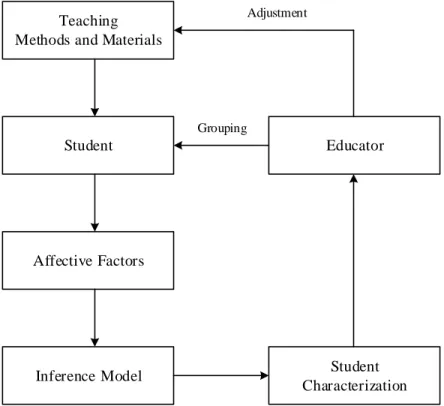
Chapter 4 describes modeling student affective factors. Differences of teacher and student perspectives in teaching and learning may result in ineffective learning. Student identification of affective factors could be a guide to design effective teach-ing and learnteach-ing. In this research, several affective factors are used to infer student achievement and to group students based on the same characteristics. Neural Net-works models are constructed to infer and to group students based on their affective factors.
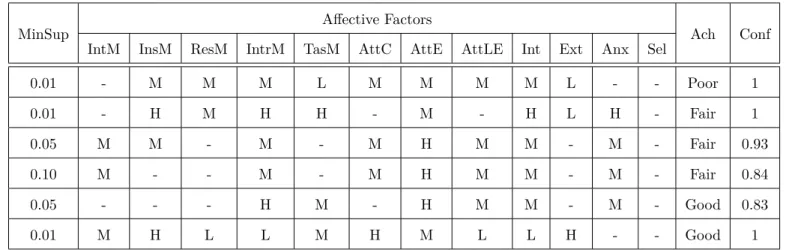
12 Chapter 1 Introduction Chapter 5 describes a method of student profiling based on student affective fac-tors. Affective factors are often neglected factors in teaching and learning, while teaching and learning is more successful when motivating students through affec-tive domain hierarchies is exerted. Recognizing student affecaffec-tive factors associated with their achievement may lead to better understand student affectionately. In this research, association analysis is conducted to link between student affective factors and achievement. Student affective factors are mapped to their achievement using Association Rules, thus providing general to specific student profiles categorized by achievement levels.
Chapter 6 describes a method to integrate student affective factors in the student evaluation. Quantification of affective ability for evaluation is not straightforward as cognitive ability, while evaluation is one of the important steps to give feedback of students’ performance. In this study, Fuzzy Sets and Criterion Referenced Assess-ment (CRA) are used to quantify the impreciseness of teachers in indicating student affective abilities and to guide teachers in assessing students’ performence.
Chapter 7 summarizes the dissertation by reviewing the current studies and a discussion on further research topics, as well as some ideas for future research.
Chapter 2
Affective Factors
2.1
Definition and Classification of Affect
There is no precise consensus on the definition of emotion, due to the complexities of emotional processes, limited depth in literature dealing with emotion, and different conceptualizations of emotion [58–60]. Literature review on emotion shows that there are inconsistencies in terms of approaches of emotion, whether it is behavioral or physiological, its precision, and the scope that defines emotion [61, 62]. Moreover, there is no widely preferred definition of emotion even though there is a lot of existing literature on the psychobiology of affect [63].
According to a psychology dictionary, emotion is considered as “any short-term evaluative, affective, intentional, psychological state, including happiness, sadness, disgust, and other inner feelings” [64]. In other definitions, emotion may also include, subjective experiences, and characteristic behaviors. According to Smith, Sarason, and Sarason, [65] emotion is a state where feelings and sentiments are experienced by an individual. Meanwhile, Baron, Bryne, and Kantowitz [66] define emotion as a state of subjective feelings that involves physiological arousal and is accompanied by
14 Chapter 2 Affective Factors characteristic behaviors. Emotion is also defined as a complex affective experience involving diffused physiological changes and can be expressed plainly in characteristic behaviors [67]. Another definition of emotion states that emotion has two dimensions: qualitative and quantitative. The qualitative dimension of emotion has valences of pleasant and unpleasant states, while quantitative emotion has a direction of in-tensity. The unpleasant and pleasant emotional states act as negative and positive incentives, respectively, while the intensity will act as a motivation to approach or to avoid [68]. Based on previous studies of emotion definition, Plutchik [62] has sum-marized that emotion is generally aroused by external provocations or stimuli. In addition, emotional expression is directed to particular stimulus in the environment, not necessarily activated by a physiological state, and induced after an object is seen or not seen. Meanwhile, emotion is defined as a complex set of interaction of sub-jective and obsub-jective factors and is mediated by neural systems which can stimulate affective experiences, generate cognitive processes, activate physiological adjustments, and lead to behavior that is expressive, goal directed, and adaptive [59].
Reeve [69] gives a multidimensional definition of emotion as short-lived, having elements of feelings, arousal, purpose, and expressive phenomena that could help the subject to adjust to challenges and opportunities during important events. An argument by Griffiths [70] differentiates basic emotions and complex emotions. Basic emotions have behavioral consequences that are observable through facial expressions that happen for short periods of time. Basic emotion has reciprocal interactions with complex cognitive processes. Complex emotion occurs in response to complex properties of the stimulus situation, thus needing more sophisticated appraisal by adding together the basic emotion. Complex emotion also tends to last much longer than basic emotion as a psychological processes. Some complex emotions are involved in long-term actions. Recently, Izard [71] offers a distinction between first-order
2.2 Interdependence between Affect and Learning 15
emotion or basic emotion and complex emotion. He has identified basic emotions as emotions that require only minimal cognitive processes of perceiving and imaging in order to generate a quick and involuntary action and it often occurs without self-awareness in early development. These emotions are identified as interest, enjoyment, sadness, anger, disgust, fear, and possibly contempt. Complex emotions can be a simple or complex combination of emotions, blended with cognitive and self-regulation elements allowing interpretation and continuous interaction with the surrounding context.
2.2
Interdependence between Affect and Learning
Several studies of modern biology reveal that humans are social creatures that need interactions with others as a fundamentally emotional creature. These however often fail to be considered properly in the field of education, where cognitive skills taught in schools include rational thinking, reasoning, decision making, and other related processes are influenced by affect. A note from Hilgard (1963 as cited in [12], p. 142), who is well known for his study of human learning and cognition, has stated the cognitive theories of learning will not be complete if the role of affect is not acknowledged.
Recent advances in the field of neuroscience of emotions have highlighted the con-nection between cognition and emotional function that could guide understanding of learning in the school context. For example, a conceptual framework proposed by Immordino-Yang and Damasio [3] argues for a link between reasoning, decision mak-ing, and emotion. Their conceptual framework is based on evidence from patients with brain damage. The incidence in a patient who suffered from brain damage in the ventromedial prefrontal cortex, located in the frontal lobe, demonstrated
compro-16 Chapter 2 Affective Factors mised behaviors that could not be explained from their cognitive mechanism. The patients with brain damage were insensitive to the consequences of their actions and unable to learn from their mistakes. Further examinations indicate that the patient had no problem with knowledge, knowledge access, or logical reasoning. The patient’s logic and knowledge existed but failed to use past emotional knowledge to lead rea-soning process. The problem lay in the patient’s area of emotion. Effective learning will not take place if there is insufficiency in the access to emotional, social and moral feedback from other people as source of knowledge. It has been believed that learning processes, language and reasoning are high-order processes that influence individual behaviors. However, the important roles of emotions in impacting behaviors and thinking processes are oftentimes not in a person’s attention. Roles of emotions in these two areas tend to be out of sight. Based on their framework, Immordino-Yang and Damasio [3] put the aspects of cognition that are mostly implemented in the education, such as, learning, attention, memory, and social functioning, are under the process of emotion.
There are six notions of factors affecting teaching and learning process in any behavioral setting for learning, which are learner characteristics, teacher character-istics, learner and teacher behavior, group charactercharacter-istics, physical characteristics of the behavioral setting, and outside forces [72]. The term “behavior” indicates the range of cognitive, affective, and psychomotor activities engaged in by teachers and students. These concepts imply that there are complex interrelationships that influ-ence classroom learning, especially the important influinflu-ence of affective factors. The term “affective factors” refers to personal-social-emotional behavior of teacher and student interaction in the learning context. Meyer and Turner [4] also emphasize influence affect in learning, stating that emotions are integrated in teachers, instruc-tional responses, and student belief and action, and they become an integral part of
2.2 Interdependence between Affect and Learning 17
the interpersonal processes creating classroom context. The interaction of teachers and students could also enhance learning through teacher immediacy. Involvement of teachers in providing a positive classroom for teaching and learning through af-fective hierarchies, such as positive attitude instruction, could lead to more effective cognitive learning [17].
The role of emotion in learning activities can also be considered essential when emotion is significant not only in social relationships but also in the development of maintaining student identity [73]. Both past emotion experienced and present mem-ories experienced consciously or subconsciously impact the maintenance of student self-esteem and identity. Recognizing the significant role of emotion in shaping learn-ing will give benefits in both shaplearn-ing learnlearn-ing theories and pedagogical practice [73]. Salzberger-Wittenberg [74] argues that learning arises in a situation which involves uncertainty, hope, and fear. Based on his model, he suggests there is a relationship between teachers, peers, and parents who are involved in eliciting emotions of pride or shame, accompanied with confidence or fear. All of these aspects are the foundation or source of decision making towards learning, whether the student is immediately aware or not.
Emotions act as a cognitive guide and assist adults in making reasoning in daily life [6]. For instance, emotions guide students to empathize with a sad friend or ask a question to a teacher in a classroom. Emotions are also critical by permeating perspec-tives and assisting to make meaning of physical and social environments [6, 75–77]. Emotions could also influence learning through enriching experiences by directing learning perspectives. Furthermore, in adult learning, emotions are seen as an im-portant facet as they could inhibit or motivate learning [76]. Emotions also not only create purpose and shape the context of learning experience by serving as motiva-tion to pursue desire [69, 78], but also play an important role in the construcmotiva-tion of
18 Chapter 2 Affective Factors meaning and knowledge in the learning process [76].
In brief, it can be stated that cognition and emotions are related. Emotions as affective factors that influence aspects of cognition such as learning, attention, memory, decision making, motivation, and social functioning as the factors considered most important in education. Learning which is focused merely on logical reasoning and factual knowledge will not be optimally fruitful. There is a need to consider emotions as having an important role in learning. Students need to take them into consideration in learning and educational matters. When educators fail to appreciate the importance of students’ emotions, they fail to appreciate the critical force in student learning. Learning as a reflection of cognitive mechanisms will optimally occur when emotions as affective factors are sufficiently addressed and managed optimally in the educational process.
2.3
Affect in Language Learning
According to Arnold [79], affect is defined as “aspects of emotions, feelings, moods or attitudes which condition behaviors”. Affect is an integral part of individual needs and reactions, which include motivation, attitudes, anxiety, and other factors [12,80]. In the language classroom context, affect can come up in the relational aspects that develop between the participants in the classroom in the form of interaction between students, students and teachers, or possibly between learners and the target language and culture. Stern [81] states that “the affective component contributes at least as much and often more to language learning than the cognitive skills”. The section that follows deals with selected affective factors under investigation in the present study. These factors are motivation, attitude, personality, anxiety, and self-esteem.
2.3 Affect in Language Learning 19 Motivation. Most researchers and educators would agree that motivation is
one of the key factors influencing the rate of success in second language learning [12, 80, 82–88]. Gardner [83] defines motivation to learn a second language as “the extent to which the individual works or strives to learn the language because of a desire to do so and the satisfaction experienced in this activity”. According to Keller (1983, p.389 as cited in [27]), motivation is “the choices people as to what experiences or goals they will approach or avoid, and the degree of effort they exert in that respect”. A higher level of motivation will determine student success in learning [12, 89]. If a student has a motive or reason to learn, then she/he sustains herself/himself to engage, make an effort, and to show a willingness to achieve the learning goal.
Integrative Motivation. As cited by Gardner [83] (1985), the concept of integrative-instrumental motivation was initiated by Gardner and Lambert (1972) who later demonstrated empirically that student success in learning was dependent on the affective reactions toward the target of linguistic groups [90]. This means that some learners may want to learn a second language because they are interested in the people and culture [13] (see Gardner, [91] 1983:203 for the definition).
Instrumental Motivation. On the other hand, Ellis [13] describes instrumental
motivation as learner efforts to study a second language for some functional benefits. For instance, a learner that is instrumentally motivated will learn a language as a means to pass an exam, to get a job, or to get a place in university (see Gardner, [91] 1983 for the definition).
Resultative Motivation. Another type of motivation that results from
suc-cess in language learning is referred to as resultative motivation [13]. Harter and Connel (1984 as cited in [92]) state that improved learning of the student will have an additional effect on sustaining intrinsic motivation and in turn creates a positive synergistic effect. Learners who experience success in learning might become more
20 Chapter 2 Affective Factors motivated in learning. In some cases, they might become less motivated to learn.
Intrinsic Motivation. Intrinsic motivation is termed as a stimulus originating
from inside of the learner. If the learner finds the learning tasks they are asked to do are intrinsically interesting, it is called intrinsically motivated [13]. According to this view, learners are able to maintain their curiosity and the extent to which they feel individually involved in the learning activities.
Global - Situational Motivation. Global motivation consists of general
ori-entation to the goal of learning second language, while situational motivation is a motivation that varies according to the situation in which learning takes place.
Task Motivation. According to the specific task characteristics, a student’s task
behavior is driven by a combination of generalized and situation specific motives [22]. A learner will be motivated in general because of the overall interest toward the subject matters in a specific way, and in a situation specific. This emotion comes up because of the challenging nature of the task presented [85]. Tasks in learning have significance in sharpening learners’ interest in learning. The recognition of the significance of tasks is in line with teacher’s perceptions, in that the quality of the activities and the way these activities are administered in the language classes have a massive impact on student attitude toward learning [93].
Attitude. By nature, language learning has psychological and social aspects.
Thus, the learning of a language is influenced by not only mental competences or language skills, but also student motivation, attitudes, and perceptions towards the target language [90, 94] (see [95, 96] for the definition). There are three aspects of attitude, namely behavioral, emotional, and cognitive aspects [30]. The behavioral aspect deals with the way a person feels and acts in a particular situation. Success-ful learning enhances the learners’ability to establish a connection with the native speaker and try to adopt different aspects of behaviors that characterize the
mem-2.3 Affect in Language Learning 21
ber of the target language community. Kara [24] states that a positive attitude will guide students to exhibit more positive behaviors towards the study by engaging in the course and striving to learn more. The emotional aspect is related with learning; that is, learning is an emotional process and the process is affected by different emo-tional factors [97]. Students’ inner feelings and emotions influence their perspectives and attitude towards the target language [21] and the learning of the language. The attitude in learning can help learners to express whether they like or dislike the ob-jects or surrounding situations. The cognitive aspect is related with student beliefs of the knowledge that they receive and understand the process of language learning. Kara [24] states that beliefs have an obvious influence on student behavior and con-sequently on student performance. Students possess positive beliefs about language learning and have a shift to a more positive attitude while negative beliefs may lead to student anxiety in class, low cognitive achievement, and negative attitudes [98].
Personality. Introversion and extroversion are used to describe two classes of
personality. A student might have one of these traits, introversion or extroversion, to some degree, but not in the same level [26]. Introversion is depicted as quiet, private, reserved personalities [99]. On the other hand, extroversion is represented as outgoing, amiable, gregarious, talkative personalities [26, 99]. Unlike introverts, extroverts are more sociable, have more friends, and look outside themselves for relief [26]. An extrovert likely finds an easier way to make contact with other second language learners, and such a personality thus will receive more input and practice with the second language.
Anxiety. Research has confirmed existence of language anxiety and its effect on
student proficiency [100] (see [101] for the definition). According to Dulay [102], low anxiety and outgoing personality are associated with successful learners of a second language. Studies by MacIntyre and Gardner [103] demonstrate that anxiety can
22 Chapter 2 Affective Factors interrupt production and acquisition in three places: at the input, processing, and output of the learning phase.
Self-Esteem. Studies have shown that self-esteem can considerably influence the
student language learning process. Brown [12] states that the cognitive and affective activities cannot be successful without some degree of self-esteem, self-confidence, and self-knowledge. See [104], Coopersmith, 1976 as cited in [12].
Inhibition. Inhibition is hypothesized as discouraging of taking risks which are
necessary for rapid progress in a second language learning. Those who have weaker self-esteem maintain walls of inhibition to protect what is self-perceived to be a weak or fragile ego. They may also lack of self-confidence in a situation or task.
Chapter 3
Soft Computing and Methods Used
3.1
Introduction
This chapter describes the theoretical aspect of the methods used in this study. The methods used include soft computing and association analyses. In principle, soft computing techniques include Neural Network, Support Vector Machine, and Fuzzy Logic. The soft computing component techniques included in this study are Neural Networks and Fuzzy Set Theory. The other method used is association analysis, specifically Association Rules. These techniques are used in the proposed model to link student affective factors with their achievement in learning.
Soft computing is an emerging collection of computation techniques in computer science that allows imprecision, uncertainty, and approximation [105]. Soft comput-ing is different compared to hard computcomput-ing. Soft computcomput-ing allows imprecision while hard computing requires a precise stated analytical model. Many real world problems exist in the area of non-ideal environment. This condition is suitable for soft com-puting that allows uncertainty, unlike hard comcom-puting where many analytical models are valid for ideal cases. The aim of soft computing is to exploit the tolerance of
24 Chapter 3 Soft Computing and Methods Used impreciseness, uncertainty, and partial truth to achieve robustness, tractability, and total low cost [105]. Association analysis is an unsupervised learning algorithm that has emerged as a popular tool in data mining techniques. The aim of association analysis is to find a joint value of a variable that appears most frequently in the data base [106].
The Neural Network (NN) is an adaptive statistical model of which structure mimics the analogy of the brain structure. NN has the ability to generalize reason-able output based on the given input on a complex problem. Applications of NN are quite effective in solving classification and prediction for non-linear problems. Com-mon problems for classification and predictions include pattern recognition, feature extraction, and image matching. One of the drawbacks of NN is the interpretation of the given output.
Fuzzy logic is a method that offers a solution to the impreciseness of measuring human natural language. Fuzzy logic is based on Fuzzy Set Theory introduced by Zadeh [107]. This theory provides a formal methodology for representing, manipu-lating, and implementing human heuristic knowledge [57]. Fuzzy logic provides the opportunity to model phenomena under conditions of imprecisely defined problems, as represented in natural language.
Association analysis is a method to discover interesting relationships among data. The relationship of among data can be represented in the form of association rules, where the rules are sets of frequent items that appear in the data set. Association rules are one of the most commonly used techniques in data mining [20] and have the ability to deal with large data set.
3.2 Neural Networks 25
3.2 Neural Networks
In the following sections, a concise introduction of Neural Network will be presented. The following sub sections cover topics on neuron model, multilayer neural network, and backpropagation algorithm.
3.2.1
Neuron Model
McCulloch and Pitts’ [108] model is the most widely used neuron model called Arti-ficial Neural Network (ANN) or simply Neural Network among many neuron models proposed. As the name resembles, NN is built from the simple unit of cell structures or neurons that are composed of units to establish network and cooperate together to perform a desired function. The unit communicates by sending signals to each other over a large number of connections and connected by a set weight of connections. The simple model of NN is shown in Figure 3.1.
a u θ x1 w1 w2 wn x2 xn
Figure 3.1 McCulloch and Pitts’ neuron model
The structure of a single neuron transforms the given input into an output re-sponse. Each of neurons consists of two parts, summation of the given input and weight, and activation function as shown in Figure 3.2. The input of the neuron is denoted xi(1 ≤ i ≤ j) and the weight of each given input is wi(1 ≤ i ≤ j) called
26 Chapter 3 Soft Computing and Methods Used synapse weight. Each of the corresponding inputs will be multiplied by corresponding weights as expressed in Equation 3.1.
u =
n
∑
i=1
wixi+ θ0 (3.1)
The θ value is called a bias that is used to model the threshold. There are two steps to process the output of a neuron. The first step is the weighted sum of the inputs is computed which is called neuron activation denoted by a. The second step is the neuron activation that is transformed into a response by using activation function denoted by f (u) as shown in Equation 3.2. The activation function calculates the weighted sum of the inputs to produce an output.
a = f (u) (3.2)
There are many types of activation function, such as linear (Equation 3.3), hy-perbolic tangent (Equation 3.4), and sigmoid function (Equation 3.5). Each of the activation functions serves different applicability and function to different modeling problems.
f (x) = x (3.3)
f (x) = tanh(x) (3.4)
f (x) = 1
(1 + e−x) (3.5)
Basically NN is composed of three essential elements: the activation function, the architecture, and the learning algorithm [109].
3.2 Neural Networks 27
3.2.2
Multilayer Neural Network Architecture
A multilayer neural network model is a feed-forward layered structure of neurons that in each of the layers consists of one or more neurons as proposed by McCulloch and Pitts [108]. The feed-forward neural network is the most common neural network architecture being used in studies.
θ
. . . . fk-1 fk Input Hidden Outputx
1x
ix
nθ
k-1θ
ky
kw
iw
jFigure 3.2 Feed-forward neural network
A typical structure of feed-forward neural network can be seen in Figure 3.2. The neural network structure shown in Figure 3.2 is a feed-forward neural network that has one layer input unit, one layer of hidden unit, and one layer of output unit. The number of hidden units between input and output unit could have more than one layer. Each neuron is connected with the successive layers in the network. The information flows in one direction; the outputs of one layer act as an input to the next layer. The output of a multilayer neural network is calculated in Equation 3.6 and 3.7.
28 Chapter 3 Soft Computing and Methods Used ukj = n∑k−1 i=1 wijkxki−1 (3.6) xkj = f (ukj) (3.7)
Where nk represents the the number of neurons in the kth layer (k = 2, 3, ..., m),
and wk
ij represents the weight between ith neuron (i = 1, 2, 3, ..., nk−1) in the (k−1)th
layer and the jth neuron (j = 1, 2, ..., nk) in the kth layer. ukj and xkj represent the
combined input inside the jth neuron in the kth layer, and the output from the jth neuron to the kth layer, respectively.
3.2.3
Backpropagation Algorithm
NN is categorized as a supervised algorithm where the network is provided with inputs and the desired output. The desired output acts as a teacher to the input to adjust the weight of the input. In the training process, the network gradually adjusts the connection weights in each neuron based on the error produced between the desired output and actual output known as back-propagation algorithm [109].
Delta Rule
Delta rule is a gradient descent learning rule that is generally used in the back propagation algorithm. The correction of of weight coefficient can be calculated using learning error formula as shown in Equations 3.8 and Equation 3.9, respectively:
∆wi = α( ˆyi− yi)f′(xi) (3.8)
3.2 Neural Networks 29
where ∆wi is the correction associated to the ith input, α is learning rate, ˆyj is the
desired output, yj is the actual output of neuron, f′(xi) is the derivative of activation
function, xi is the ith input, and wi(t + 1) is the value of weight after adjustment.
Backpropagation Algorithm
The back propagation algorithm involves two steps, namely the forward step and the backward step. During the forward step, the input parameters are distributed through the network layer to the output layer. The error is calculated from the difference between the desired output ˆyi and the actual output yi produced by the
network in response to input xi. In the backward step, the error ei is distributed
through the network in the backward direction. During this backward propagation, the weights are adjusted to minimize the error ei. Basically, the algorithm tries to
minimize the mean square error function. It learns from the error yielded by the network. An illustration of simplified back propagation is shown in Figure 3.3.
θ θ θ Adaptive System Training Algorithm Cost Output Error Desired Input Change parameters
Figure 3.3 Simplified backpropagation network
Suppose a network is given, as shown in Figure 3.4. The index i refers to neurons in input layer, j refers to neurons in hidden layer, and k refers to the neurons in the output layer. The inputs signals (x1, x2, ..., xn) are propagated from the input layer
30 Chapter 3 Soft Computing and Methods Used
θ
θ
θ
. . . . i j kx
1x
ix
ny
ky
ky
k Input Hidden Output input errorFigure 3.4 Three layer back propagation
denotes the weight that connects neuron i in the input layer with neuron j in the hidden layer, while wjk denotes the weights that connect neuron j in the hidden layer
with neuron k in the output layer. The error of neuron ek in the output layer can be
calculated by Equation 3.10:
ek = ˆyk− yk (3.10)
where ˆyk is the desired output and yk is the actual ouput produced by the network.
The weight is updated using the delta rule using Equation 3.11 as follows:
wjk = wjk + ∆wjk
wij = wij + ∆wij
(3.11)
The weight correction ∆wjk in the output layer is calculated using Equation 3.12.
3.3 Fuzzy Logic Theory 31
where α is the learning rate, xi is the input, and δk is the error gradient of neuron
k in the output layer. The error gradient is determined by the error at the neuron
output as shown in Equation 3.13:
δk =
δyk
δXk
× ek (3.13)
where Xk is the net weighted input to the neuron k. In the hidden layer, the weight
correction ∆wij is calculated by using Equation 3.14:
∆wij = α× xi× δi (3.14)
where δj is the error gradient at neuron j in the hidden layer. The error gradient is
determined by the error at the neuron output as shown in Equation 3.15:
δ = δyj δXj × l ∑ k=1 δkwij (3.15)
where Xj is the net weighted input to the neuron j.
3.3
Fuzzy Logic Theory
Fuzzy logic is a technique that intended to include the impreciseness of measuring human inaccurate natural language. The term of fuzzy logic is based on proposal of Fuzzy Set Theory introduced by Zadeh [107]. Fuzzy Set Theory provides a formal method to represent, manipulate, and implement human heuristic knowledge. In the next sections, a brief concept of fuzzy logic theory will be introduced covering fuzzy sets, membership function, fuzzy operators, and also fuzzy inference system.
32 Chapter 3 Soft Computing and Methods Used
3.3.1
Fuzzy Sets
Fuzzy sets are an extension of mathematical principles of classical sets where the ele-ment membership is determined by degrees of membership function [107]. In contrast, classical sets, where an element is evaluated according to binary condition, belong to a set or not, or often called crisp set.
Suppose A be the classical sets of objects in the universe of discourse of X. An element that belongs to set A of X is viewed as a characteristic function XA such as
XA: X → {0, 1} where: XA(x) = 1 iff x∈ A 0 iff x /∈ A (3.16)
However, if an uncertainty is allowed whether an element belongs to a set using a membership function where the value is [0, 1], then the set is called a fuzzy set. Let
A be a fuzzy set of a universe of discourse X having a membership function µA(x).
The value of the membership function is defined as:
µA: X → [0, 1] (3.17)
where µA(x) is the membership value of x in set A.
3.3.2
Membership Function
Fuzzy sets give possibilities to models of real world that allow impreciseness symbol-ized using a membership function. Membership functions can be represented using a graphical form or mathematical form. In the graphical form, the membership func-tion is represented in two dimensional graphs where x axis represents the universe of discourse and y axis represents the membership of function. Table 3.1 shows the
3.3 Fuzzy Logic Theory 33
membership functions that are typically used in practice.
Table 3.1 Typical membership functions
Types of MF Graphical Mathematical
Triangular MF θ θ θ µa(x) a1 m b x 0.2 0.4 0.6 0.8 1 θ θ θ µA(x) = 0, x ≤ a x−a m−a, a ≤ x ≤ m b−x b−m, m ≤ x ≤ b 0, x ≤ b θ θ θ θ θ θ Trapezoidal MF θ θ θ µa(x) a b d x 0.2 0.4 0.6 0.8 1 c θ θ θ θ θ θ µA(x) = 0, (x < a)or(x > d) x−a b−a, a ≤ x ≤ b 1, b ≤ x ≤ c d−x d−c, c ≤ x ≤ d θ θ θ Gaussian MF θ θ θ µa(x) x 0.2 0.4 0.6 0.8 1 m θ θ θ θ θ θ θ θ θ µA(x) = e− (x−m)2 2k2
3.3.3
Fuzzy Operators
In fuzzy sets, some basic mathematical sets operations also apply. The operations include these: union, intersection, and complement [105]. Other operations often used in the fuzzy sets are t-norms and t-conorms.