
se
Learning
about
Conic
Sections
with
Geometric
Algebra
and
Cinderella
University
of
Fukui,
Department
of
Mechanical
Engineering
Eckhard
$\mathrm{M}.\mathrm{S}$.
Hitzer
Abstract
Over time an astonishing and sometimes confusing variety of descriptions of
conicsections has beendeveloped. Thisarticle will givea briefoverview over some
interesting descriptions, showing formulations in the three geometric algebras of
Euclidean spaces, projective spaces, and the conformal model ofEuclidean space.
Systematic illustrations with Cinderella created Javaapplets are included. I think
a combined geometric algebra
&
illustration approach can motivate students toexplorative learning.
1
Introduction
Conic sections
are
the familiar plane objects of points, $\mathrm{x}$-shaped pairs of lines, circles,ellipses, parabolasand hyperbolas. These
curves
havean enormous
practical significance.They describe rotation trajectories, the orbits of planets, the trajectories of comets and
soccer
balls, commercial satellites, the ideal form of well focused antennas (nowadayspopularfor satellite$\mathrm{T}\mathrm{V}$),etc. They
are so
important that everystudent in the engineeringsciences has to study them
as
part of his first year curriculum.In this article
we
first briefly touch upon the history of geometric algebra [1], to motivate the description of conic sections with geometric algebras. The descriptions in the geometric algebras of twO-dimensioal and three-dimensional Euclidean space ofsection 2
are
mainly taken from [2], The presentation of each description consists of the relevant formulas accompanied byan
illustrative set of figures. The figureswere
created with the interactive geometry software Cinderella[3]. Cinderella allows purely interactive construction and animations with export functionstoJava applets [4, 5, 6] and postscript format graphics.One of the finest descriptions ofconic sections
was
given by B. Pascal.Grassmann
later givesa
general formula for it in terms of Grassmann algebra. We translate this into both projective[9] and conforma1[10, 11, 12] geometric algebra. Fora
subset ofconic sections, the conformal model [10, 11, 12, 13, 14] providesan even more
elegant “linear” description.eo
1.1
A
new branch of mathematics
In 1844, just about 200 years after Pascal discovered his theorem, the German mathe-matics school teacher HermannGrassmann (1809-1877) invented his“Extension Theory” [15], which he republished in 1862[8]. He
saw
his “new branch ofmathematics” indeed to ”... form the keystone of the entire structure ofmathematics.”[8]Also the popular
German
mathematicianAlbrecht Beutelspacher considers the exten-sion theory to comprisea
number of“theoretical milestones” and “gems.” Amongst the latter he counts:Without usingcoordinates, he could represent the equation of
a
conic sectionthrough five points $(A, B, C, D, E)$ in general position in
a
plane.Later we will state Grassmann’s representation of conic sections in precise formal
terms. But before doing that
we
shall follow up the historical development of thisnew
“keystone of mathematics.”
1.2
Geometric
algebra
In 1878,
one
year after Grassmann’s death, William K. Clifford (1845-1879) published his “Applications of Grassmann’s extensive algebra.” [17], in which he successfully uni-fied Grassmann’s extensive algebra[8, 15, 18] with Hamilton’s quaternion [19] description of rotations. Thiswas
the birth of (Clifford) Geometric $Algebra^{1}$, (which needs to bethoroughly distinguished from algebraicgeometry.)
During the last 50 years
or
so
geometric algebrahas becomequite popularas a
ratheruniversaltoolfor mathematicsandits applications[20], including engineering.$[21, 22]$ But
the development of applications
seems
not finished yet. Projective geometry is bynow
well integratedin geometricalgebra.[9] Especially forapplicationsincomputer vision and robotics it proves very versatile to adopt a higher dimensional geometric algebra model, thesocalledconformal
geometric algebra.[10, 11, 12, 13, 14]1.3
Conformal model
of Euclidean
space
The conformal modelof Euclidean space simply interprets the point oforigin andspatial
infinity
as
two extralinear dimensions ofspace, whose vectors have the peculiar propertythat they square to zero.[10] This
can
beseen
as borrowing from the description of the propagationof light inspace andtime. Light propagates at the invariantvacuum
speedoflight and is therefore relativistic. The propagation of light in four-dimensional space-time
alsohappens alongvectorswhich square to
zero.
Fora
point lightsource, allthese vectorsform together the light
cone.
Defining
an
even
higher dimensional “light con\"e, the socalled horosphere inour
five dimensional space oforigin, 3-space and infinity,we
get the socalled conformal model of Euclidean space. In this conformal model, every pointon
the horosphere is in one-tO-Onecorrespondence with every point in Euclidean space. Thisidea
can
be implemented witha
host of geometric and computational benefits forareas
like: computer vision, computer1Cliffordwrote: ”Thechiefclassificationofgeometricalgebras is intothoseof odd andevendimensions
91
graphics, robotics, etc.[ll, 21, 22] The idea of the horosphere is not at all new, it
was
already defined by $\mathrm{F}.\mathrm{A}$. Wachter (1792-1817),an
assistant of Gauss.[23]Based on the conformal model, a number ofcomputer programs have been developed
for various applications, using object oriented programming languages, such
as
$\mathrm{C}++$ andJava.[ll, 12, 24, 25] The description of points, pairs of points, lines, planes, circles and
spheres is ofgreat elegance, just using one, two, three
or
four points. (In thecase
of linesandplanesone of these points will beat infinity.) But
a
yetunsolved questionis, whetherwe can findin the conformal modelasimilarly elegant description for conicsections, only
using the five general points $A$,$B$,$C$,$D$,$E$ (comp. Fig. 8) which Grassmann used.
The answer will be worked out in this paper. We will find, that in the conformal
model, the implementation of Grassmann’s formula for the conic sections given by five
general points in the plane is indeed possible. But so far the resulting description will continue to be “quadratic” in each point and not “linear”. This is in contrast to the “linear” descriptions ofe.g. circles (and lines) in the conformalmodel.
2
Euclidean
description
of
plane
conic sections
2.1
Cone
and plane
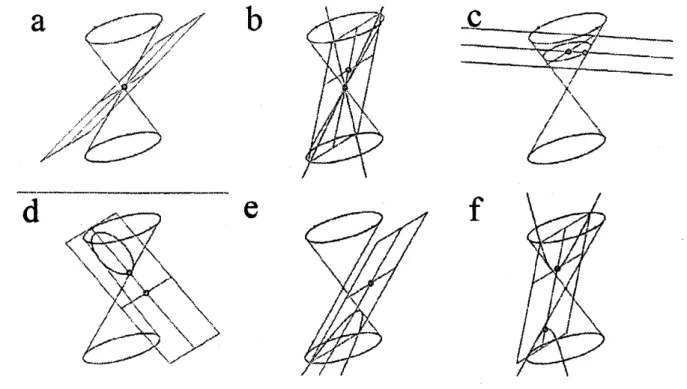
Plane conic sections
are
simply thecurves
of intersection of acone
and a plane. Thiscan
be beautifullyvisualized with colorful, interactive Cinderella[3] created Java applets.Suitable exported applets allow to freely manipulate the position and orientation of the
plane inspace (comp. Fig. 1)$.[4,5,6]$ Cinderella’sSpherical view (acentral ball projection
to the surface of
a
ball) allowseven
to visualize what happens at infinity. In this view it isseen
that parabolas close at infinity, but hyperbolas remain divergent.2.2
The
semi-latus
rectum
formula
A wellknown formula for the unified analytic description ofellipses, parabolas and
hyper-bolas is the semi-latus rectum $fo$ rmula. The radial distance $|\mathrm{r}|$ of
a
pointon
a
coniccurve
from a focus point in the direction of$\hat{\mathrm{r}}$ $-/$ $|\mathrm{r}|$ is given by$| \mathrm{r}|=\frac{l}{1+c*\hat{\mathrm{r}}}$, (1)
where the semi-latus rectum is defined
as
the length ofthe excentricity vector(perpen-dicular to the directrix, attached to the focus), times the length of the distance of the focus from the directrix
$l=|\epsilon$ $||\mathrm{d}|$ (2)
The asterisk product in eq. (1)
means
the scalar product of vectors. Dependingon
the scalar magnitude of the excentricitywe
obtain for$\mathrm{o}$ $|\epsilon|<1$
an
ellipse, $\mathrm{o}$ $|\epsilon$ $|=1$a
parabola,82
a
$\sim$$.’.’.\nearrow$
$\mathrm{b}$
$\iota_{1}$
$\overline{\backslash }\backslash ^{j}.\backslash \cdot\vee,.\nearrow’..\cdot.’$
..,
$\cdot$$\mathrm{s}$
$.P’. \cdot...\cdot ^{’}\nearrow,\int_{j}$
$\nearrow,\cdot.\backslash _{\backslash _{\backslash }}\nearrow$
1
$J^{\cdot}.I_{\acute{}}\cdot..\cdot$,
$\mathrm{f}$
Figure 1: Conic (inter)sections: a) Point, b) pair ofintersecting straight lines, c) circle,
d) ellipse, e) parabola, f) hyperbola.
Thesemi-latus rectumformula
can
againbe colorfully visualized witha
Cinderellacreated applet (compare Fig. 2)$.[4,5,6]$ It is possible to interactively change the directrix, thefocal
distance, the excentricity, and vary the radial direction by movinga
pointon
the directrix. The semi-latus rectum $l$ appearsas
the distance between the focus,and the intersection point of the conic section with
a
line parallel to the directrix through the focus. This happens precisely when the scalarproduct in eq. (1) vanishes, i.e. when $\hat{\mathrm{r}}$ isparallel to the directrix.
2.3
Polar
angle description
of
ellipse
The polarangle parameter description
of
an
ellipse is perhaps the mostcommon
descrip-tion of the ellipsestudied alreadyin highschool. Usually two mutuallyorthogonal vectors,
the semi-major axis vector
a
and the semi-minor axis vector $\mathrm{b}$ witha
$*\mathrm{b}=0\Leftrightarrow$a
1$\mathrm{b}$ (3)are
linearly combined with trigonometric coefficients to give the distance ofa
pointon
the ellipse in the directionspecified by the polarangle ?
$\mathrm{r}=$
a
$\cos\varphi+$$\mathrm{b}$$\sin\varphi$.
(4)Cinderella created Java applets$[4, 6]$ both allow to
see
an animation with thepolar angle$\varphi$
as
animation parameter, andan
interactive version where thetwo.
semi-axis, and the83
$\mathrm{b}$ $\mathrm{c}$ $|\mathrm{i}$ , $——\cdot--.----..\cdot\cdot-\cdot-\cdot-.\cdot---$ . $:.\cdot.\acute{\mathit{1}}’..\cdot.-$:.
. $J$ $’,\cdot.$..
$\cdot$ -$.\cdot..\cdot.:\cdot\backslash .\cdot$ ., $|$Figure 2: Semi-latus rectum formula: a) Ellipse, b) parabola, c) hyperbola.
c)
Figure 3: Polar angle parameter description
an
ellipse: a) polar angle in first quadrant,94
a)
,-...b)
c)
. $\wedge$ $\cdot$ -$\cdot$—–
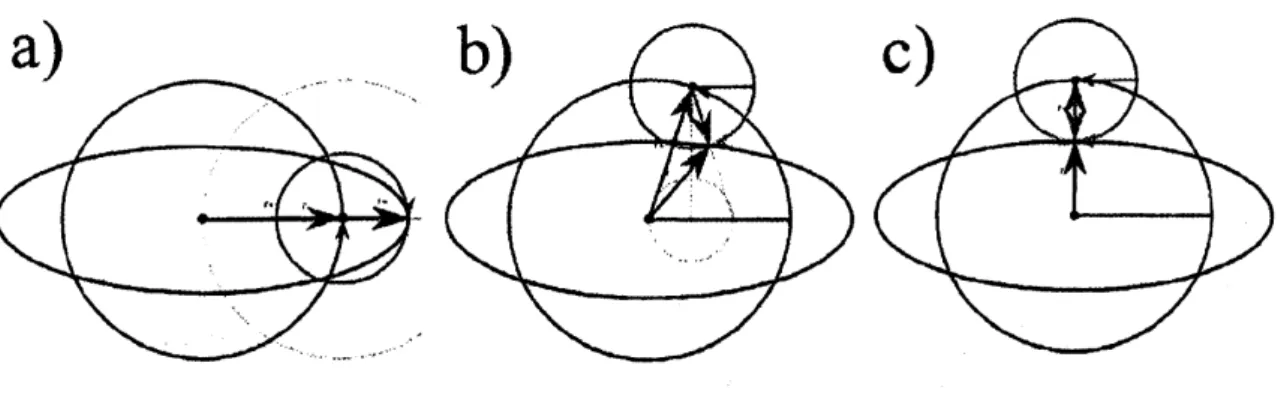
$\sim$ . $..\cdot.-\cdot’\backslash$ - – . .$J$Figure4: Coplanar circular description of ellipse: a) $1=0$, b) $0<\varphi<\pi/2$, c) $\varphi=\pi/2$
.
2.4
Coplanar
circle
description
of
ellipse
The description of
an
ellipse bymeans
ofa
linear combination oftwo circular motions inone
plane (coplanar) is very instructive. Especially engineering students learn in this wayan easy-tO-apply method for generatingelliptical motions from circular motions:
$\mathrm{r}=\mathrm{r}_{+}+\mathrm{r}_{-}$, (5)
with the first circular motion in the unit bivector \’i-plane ofthe geometric algebra of the embedding vector space
$\mathrm{r}_{+}=\mathrm{r}_{+0}\exp(\mathrm{i}\varphi)$ (6)
and thesecond circular motion with opposite
sense
ofrotation in thesame
i-plane$\mathrm{r}_{-}=\mathrm{r}_{-0}\exp(-\mathrm{i}\varphi)$
.
(7)That forfixed$\mathrm{r}_{+0}$ and $\mathrm{r}_{-0}$ the trajectory of$\mathrm{r}$describes indeed
an
ellipsecan
beintuitivelyillustrated with Cinderellacreated applets$[4, 6]$, both interactively (with free interactive
choices of$\mathrm{r}_{+0}$, $\mathrm{r}_{-0}$ and $\varphi$) and animated (compare Fig. 4).
2.5
Non-coplanar
circle
description of ellipse
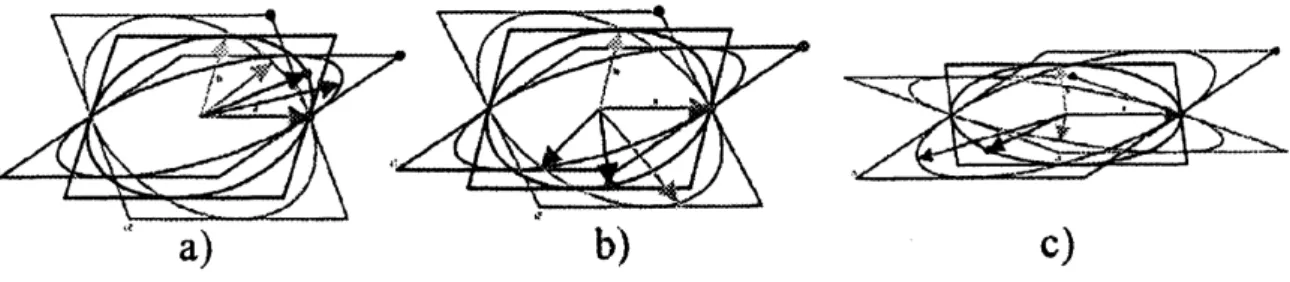
It isfurtherpossibletodescribe
an
ellipseas
a
linear combination oftwocircularmotions intwoplanesofdifferent orientation (non-coplanar). The two circular motions
are
supposedto have equal amplitude, frequency and phase. The twocircle planes
are
characterized in the geometric algebra of Euclidean threespace bytheirrespective unit bivectors $\mathrm{i}_{1}$ and $\mathrm{i}_{2}$.That the planes
are
not coplanar means, that the intersection (or meet) will bea
linear one-dimensional subspace represented by the vectora
$=\alpha \mathrm{i}_{1}\vee \mathrm{i}_{2}=at$ $\mathrm{i}_{1}\llcorner(i\mathrm{i}_{1})$, (8)where the symbol ” $\llcorner$” represents the right contraction [26] and $i$ the grade three
pseu-doscalarof the geometric algebra ofthree-dimensional Euclidean space. The real scalar$\alpha$
85
Figure 5: Non-coplanarcircle description ofellipse: a) $0<$ $\varphi$ $<\pi/2$, b) $3\pi/2$ $<p$ $<2\pi,$ c) changed orientation ofplanes.
the intersection of the two planes indicates rightly, that it will
serve as
the semi-major axis vector of the ellipse to be generated. The semi-minor axis vector will be$\mathrm{b}=\frac{1}{2}\mathrm{a}(\mathrm{i}_{1}+\mathrm{i}_{2})$
.
(9)The formula for the ellipse to be generated is
$\mathrm{r}=\frac{1}{2}\mathrm{a}\{\exp(10)+\exp(\mathrm{i}_{2}\varphi)\}$, $0\leq\varphi<2\pi.$ (10)
The ellipse generated according to (10)
can
be illustrated by interactiveor
animatedCinderella created applets.$[4, 6]$ The intereactiveconstruction allows to change the length
of
a
and theindividual orientations of the planes. The dependence of the semi-minor axis(9) on the two plane bivectors $\mathrm{i}_{1}$ and $\mathrm{i}_{2}$ is thus well visualized (compare Fig. 5).
2.6
Conic
sections
as
second
order
curves
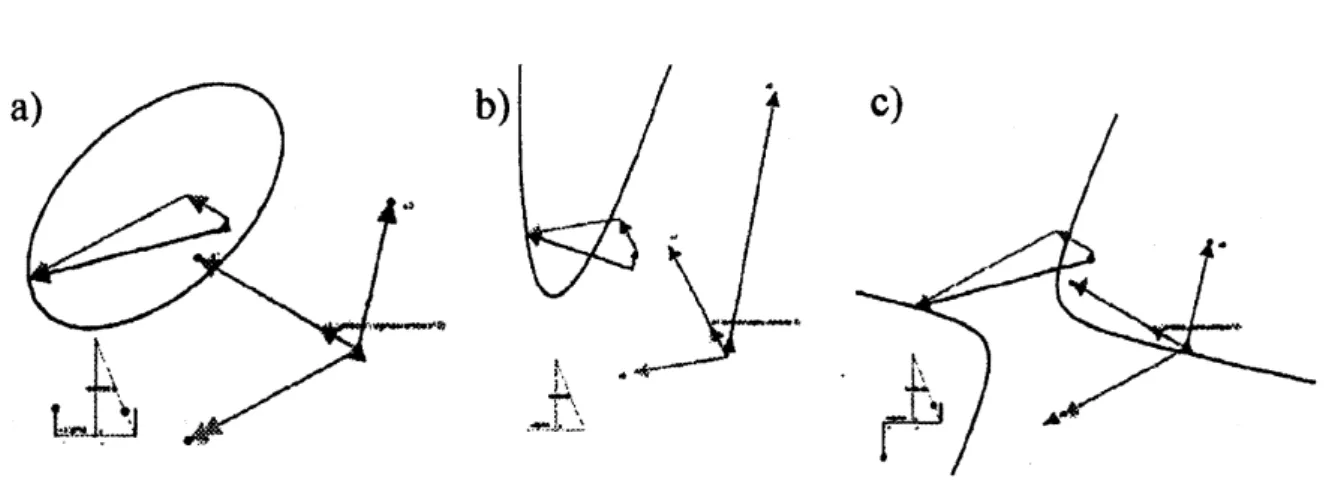
Cinderella’s Locus mode is very suitable for visualizing the fact that conic sections
are
equivalent to second ordercurves
according to the formula$\mathrm{r}(\lambda)=\frac{\mathrm{a}_{0}+\mathrm{a}_{1}\lambda+\mathrm{a}_{2}\lambda^{2}}{\alpha+\lambda^{2}}$, (11)
with the vectors $\mathrm{a}_{0}$,$\mathrm{a}_{1}$,$\mathrm{a}_{2}$
.
The values of the real scalar $\alpha$ decide wether the resultingquadratic
curve
is for0 $\alpha>0$ an ellipse,
$\circ$ $\alpha=0$
a
parabolaor
0 $\alpha<0$
a
hyperbola.The real scalar A parametrizes the
curves.
InteractiveCinderella
created applets$[4, 6]$allow to freely vary the vectors $\mathrm{a}\mathrm{o}$,
$\mathrm{a}_{1}$,$\mathrm{a}_{2}$ andthe scalars $\alpha$and A. One kind of animation
allows to show how the
curves
a
swept out by the vector $\mathrm{r}$ of$\mathrm{e}\mathrm{q}\mathrm{u}$
.
(11) with Aas
theee
a) b) $\dot{}.\backslash \backslash$ $\cdot$ – $\sim.\cdot...\backslash$ -$\cdot\cdot$ $.\lrcorner$ $.\sim\ldots\backslash$Figure 6: Conic sections
are
second ordercurves:
a) $\alpha>0$ ellipse, b) $\alpha=0$ parabola,c) $\alpha<0$ hyperbola. Apart from the complete curves, the graphs show the
vec-tors $\mathrm{a}_{0}$,$\mathrm{a}_{1}$,$\mathrm{a}_{2}$ and $\mathrm{a}$.linear combination of the three vectors with scalar coefficients
$\neg_{\alpha+\lambda}1\mathrm{g}$,$\neg_{\alpha+\lambda\alpha+\lambda}\lambda\lambda^{2}\mathrm{a}_{1,\neg}\mathrm{a}_{2}$ for
a
certain value of A.3
Projective
description of plane
conic
sections
3,1
Pascal’s mystic
hexagon
Blaise Pascal (1623-1662, Fig. 7) researched the foundations ofhydrodynamics, stating that the pressure isthe
same
atallpointsina
fluid. Thisis the basis for hydraulic lifts. [27] But Pascal is also famous for his works in mathematics, both in theory and application.He developed and sold e.g.
a
calculator machine. In his religious writings he famouslystated[28] :
If God does not exist,
one
will lose nothing by believing in him, while if he does exist,one
will lose everything by not believing.Our
present pointofinterest is Pascal’s workon
conic sections.At
theage
of16
he found what isnow
called “Pascal’s mystic hexagon”or
less glamorous “Pascal’s theorem”:If
a
hexagon (ABCDEX) isinscribed ina
conic section, then the threepoints($S_{1}$,$S_{2}$ and $\mathrm{S}_{3}$) where opposite side (lines) meet
are
collinear.[7]The theorem is illustrated[7, 4, 6] in Fig. 8. The theorem is equally true for all plane
conic sections previously mentioned.
Formally speakingPascal’s theorem belongs to the field of“higher geometry,”
“geom-etry ofposition,” “descriptive geometry,”
or
in modern terms to “projective geometry.”The six basic axioms of projective geometry
are
easy tounderstand[29]:$\mathrm{o}$ If$A$ and $B$
are
distinct pointson a
plane, there is at leastone
line containing both$A$ and $B$
.
$\mathrm{o}$ If$A$and $B$
are
distinctpointson a
plane, there is notmore
thanone
line containing97
Figure 7: Blaise Pascal (1623-1662)[28]
38
Point $=$ Intersection oflines
$s_{1}$ $S_{2}$ $S_{3}$ $XA$ and $CD^{-}$ AB and DE $BC$ and $EX$
Table 1: Construction of$S_{1}$, $S_{2}$, and $S_{3}$
$\circ$ Any two lines in
a
plane have at leastone
point of the plane (which may be thepoint at infinity) in
common.
$\mathrm{o}$ There is at least
one
lineon
a
plane.$\mathrm{o}$ Every line contains at least three points oftheplane. $\mathrm{o}$ All the points of the plane do not belong to the
same
line.3.2
Conic
sections
from
five points
Pascal’s construction of Fig. 8
can
be interpretedin twoimportant ways,an
analytic anda
constructive way. The analytic interpretationwas
given in the introduction.The constructive interpretation
means
using the theorem for the construction ofa
conic section from five general points
on a
plane. Assume five points $A$,$B$,$C$,$D$,$E$ tobe given. Construct the four lines AB,$BC$,$CD$, DE and the point of intersection $S_{2}$
of the lines AB and DE. Next draw any line $g$ through the point $S_{2}$ and construct the
intersection points $S_{1}$ and$S_{3}$ ofthe line$\mathrm{g}$with $CD$ and $BC$, respectively. After thatdraw
the lines $S_{1}A$ and $S_{3}$E. According to Pascal’s theorem the point $X$ of intersection of the
lines$SiA$ and$S_{3}E$isalso
a
pointon
theconic section. By conducting this construction forevery angle ofthe line $g$ through the point 52, $X$ will sweep out the whole conic section.
This
can
be interactively realized witha
Cinderellacreated applet.A consequence is, that any point $X$ in the plane will be part of the conic section iff
it
can
be reached by changing the angle of line $g$ through point $S_{2}$. Therefore to decidewhether a point $X$ is
on
the conic sectionor
not,we
only need to check, whether Si, $S_{2}$,and $S_{3}$
are
collinear (on$g$)
or
not. The positions of$S_{1}$, and $S_{3}$ in this examination willcritically depend
on
the position of $X$ (compare Table 1).3.3
Grassmann’s formula
Grassmann used precisely this method for obtaining his“equation of
a
conicsection that goes through the five points $A$,$B$,$C$,$D$,$E$,no
three of which lieon
thesame
straightline”[8].
For this purpose he stated: “By planimetric multiplication I
mean
relative multipli-cation in the planeas
a
domain of third order, ...”[8] This hint to the planeas a
domain of third order is very important, because it shows that Grassmann actually expands theplane projectively by adding
an
extradimension, commonly interpretedas
the origin.Grassmann further obtains the expression AB of
a
line from the outer product ofos
expression ABcomes
tomean
both the product of two projective points $A$ and $B$ thatresults in
an
algebraic representation of a line and thecommon
symbolic representationAB ofa line through two points $A$ and $B$.
Let us go into further geometric and algebraic details. The three-dimensional basis of
the projective space of
a
planeis given interms of three orthonormal vectors $\{\mathrm{e}_{1}, \mathrm{e}_{2}, \mathrm{e}_{0}\}$.
The first two vectors span the familiar non-projective Euclidean plane. The third vector
$\mathrm{e}_{0}$, is the additional third dimension for liftingthe origin to $\mathrm{e}_{0}$. We represent a point in
the Euclidean plane by
a
linear combination of$\mathrm{e}_{1}$ and $\mathrm{e}_{2}$:a
$=a_{1}\mathrm{e}_{1}+a_{2}\mathrm{e}_{2}$, (12)where $a_{1}$ and $a_{2}$
are
simply the twO-dimensionalCartesian
coordinates. The projectiverepresentation[13] ofthe point $A$ is obtained by adding $\mathrm{e}_{0}$
$A=$
a
$+$$\mathrm{e}_{0}$.
(13)Projective points
are
homogeneous, i.e. $\lambda A$ represents thesame
point. The Euclideanequivalent ofa projective point $A$ is obtained by
$\mathrm{a}=\frac{A-A*\mathrm{e}_{0}\mathrm{e}_{0}}{A*\mathrm{e}_{0}}$, (14)
I now deliberately introduce the product symbol ”$\Lambda$” for the exterior product in order to
ease
he distinction of thesymbolic representation ofa
lineAB and Grassmann’salgebraicrepresentation A$\Lambda B$. The exterior product is antisymmetric:
$A\wedge B=(\mathrm{a}+\mathrm{e}_{0})\wedge(\mathrm{b}+\mathrm{e}_{0})=$
a
$\Lambda \mathrm{b}+(\mathrm{a}-\mathrm{b})\Lambda \mathrm{e}_{0}$.
(15)a
$\Lambda \mathrm{b}$ is the moment bivector ofa
line and $(\mathrm{b}-\mathrm{a})$ is its direction vector. The twoentities suffice to construct the line.[ll] Grassmann’s planimetric product oftwolines AB andDE
can
be realizedin thegeometric algebra of the projective three-dimension$\mathrm{a}1$ spacespanned by $\{\mathrm{e}_{1}, \mathrm{e}_{2}, \mathrm{e}_{0}\}$ by
$S_{2}=(A\Lambda B)\llcorner$[I3$(D\Lambda E)$], (16)
where the symbol ” $\llcorner$” represents the right contraction[26] and $I_{3}=\mathrm{e}_{1}\Lambda \mathrm{e}_{2}\Lambda \mathrm{e}_{0}=\mathrm{i}\mathrm{e}_{0}$
is the volume 3-vector of the projective space ( $\mathrm{i}=\mathrm{e}_{1}\Lambda \mathrm{e}_{2}$ is the unit bivector of the
Euclidean plane spanned by$\mathrm{e}_{1}$ and$\mathrm{e}_{2}$)
.
$[I_{3}(D\Lambda E)]$ results inthedual complementvectorperpendicular to theprojective linebivector DAE. Finallythe right contraction with the line bivector $A$$\Lambda B$ results in the element $S_{2}$ in the line A$\Lambda B$, which isperpendicular to
[I3 ($D\Lambda E$)] in$A\wedge B$, andtherefore also contained in$D\Lambda E$. Inserting (13) andsimplifying
the expressions algebraically, weget for the intersection
$S_{2}=\lambda_{2}\mathrm{s}_{2}+\lambda_{2}\mathrm{e}_{0}=$ (a -b)$[\mathrm{i}(\mathrm{d}\wedge \mathrm{e})]-(\mathrm{d}-\mathrm{e})[\mathrm{i}(\mathrm{a}\Lambda \mathrm{b})]+\mathrm{i}[(\mathrm{d}-\mathrm{e})\Lambda(\mathrm{a}-\mathrm{b})]\mathrm{e}_{0}$ (17)
In projective geometry points
are
identical up to scalar factors. We therefore divide by100
to get according to eq. (14) the plane Euclidean vector
$\mathrm{s}_{2}=\frac{1}{\lambda_{2}}\{(\mathrm{a}-\mathrm{b})[\mathrm{i}(\mathrm{d}\wedge \mathrm{e})]-(\mathrm{d}-\mathrm{e})[\mathrm{i}(\mathrm{a}\wedge \mathrm{b})]\}$ (19)
Inserting coordinates (13)
we
explicitly get$\mathrm{s}_{2}=\frac{1}{\lambda_{2}}\{(d_{1}e_{2}-d_{2}e_{1})(\mathrm{a}-\mathrm{b})-(a_{1}b_{2}-a_{2}b_{1})(\mathrm{d}-\mathrm{e})\}$ (20)
In the very
same
way Grassmann calculates $S_{1}$ and $S_{3}$ by planimetric productsas
$S_{1}=(X\Lambda A)\mathrm{L}$[I3$(C$$\Lambda D)$], $S_{\theta}=(B\Lambda C)\mathrm{L}$[I3(D$\wedge X)$], (21)
So
we can
finallyexpress the collinearity of Si, $S_{2}$ and $S_{3}$ by$S_{1}\Lambda S_{2}\wedge S_{3}=0,$ (22)
i.e.
$\{(X\wedge 4)\llcorner[I_{3}(C\Lambda D)]\}\Lambda$
{
$(A\wedge B)\llcorner$[I3$(D\Lambda E)]$}
$\Lambda${
$(B\Lambda C)\llcorner$[I3$(E\wedge X)]$}
$=0.$ (23)ThisisGrassmann’s formula for the conic sections throughfivegeneralpoints $(A,$$B$,$C$,$D$, $E)$ in
a
planeexpressed inthe geometric algebra of the projective space$\{\mathrm{e}_{1}, \mathrm{e}_{2}, \mathrm{e}_{0}\}$.
Everypoint $X$, that fulfills equation (23) will be onthe conic section. The equation is quadratic
in $X$ and in all ofthefivepoints$A$,$B$,$C$,$D$,$E$
.
Withthe helpoftheanticommutator”$\mathrm{x}$”$B_{1} \mathrm{x}B_{2}=\frac{1}{2}$($B_{1}B_{2}-$ B2BX) (24)
we
can
rewrite (23)as
$\{[(X\wedge 4)\mathrm{x}(C\wedge D)]\mathrm{x}[(A\wedge B)\mathrm{x}(D\Lambda E)]\}\Lambda\{I_{\theta}[(B\wedge C)\mathrm{x}(E\wedge X)]\}=0.$ (25)
4
Conformal
geometric
algebra description of
plane
conic
sections
4,1
Grassmann’s formula for the conformal model
The
five-dimensional
conformal model [10, 11, 12, 13, 14] adds to the three-dimensional Euclidean space twodimensions:one
for representing the origin andone
for representing infinity. This is done by introducing two null-vectors, which square tozero
andare
perpendicular to thevectors ofEuclidean space:
$\{\overline{\mathrm{n}}, \mathrm{e}_{1}, \mathrm{e}_{2}, \mathrm{e}_{3}, \mathrm{n}\}$, (20)
where$\overline{\mathrm{n}}$and
$\mathrm{n}$representtheorigin andinfinity, respectively. Theconformalrepresentation
of
a
point $A$ is obtained by adding two contributions101
with $a^{2}=$
aa.
A straight Euclidean line AB in the conformal model is given bythe outerproduct of wo points
on
the line with infinity forming the trivector$A$$\Lambda B\Lambda \mathrm{n}=$ a$\Lambda \mathrm{b}\wedge \mathrm{n}+(\mathrm{b}-\mathrm{a})N=\mathrm{m}_{\mathrm{l}}\mathrm{n}+\mathrm{d}_{1}N$, (28)
where the unit bivector$N=\mathrm{n}\Lambda\overline{\mathrm{n}}$represents the additionaltwo dimensional (Minkowski)
space. A point $X$ is
on
the line AB iff$X\Lambda$A$\Lambda B\Lambda \mathrm{n}=0.$ (29)
Similarly the line DE is given by the trivector
$D\Lambda E\wedge \mathrm{n}=\mathrm{d}\Lambda \mathrm{e}\Lambda \mathrm{n}+(\mathrm{e}-\mathrm{d})N=\mathrm{m}_{2}\mathrm{n}+\mathrm{d}_{2}N$, (30)
where $\mathrm{m}_{1}$ and $\mathrm{m}_{2}$
are
the Euclidean moment bivectors of the lines AB and DE, and thevectors $\mathrm{d}_{1}$ and $\mathrm{d}_{2}$ aretheir directionvectors, respectively. Theintersection$S_{2}^{c}$oftwo lines
AB and DE is obtained in
a
fashion very similar to (16)$S_{2}^{c}\wedge \mathrm{n}=(A\wedge B\wedge \mathrm{n})\llcorner[I_{4}(D\Lambda E\wedge \mathrm{n})]$ , $S_{2}^{c2}=0,$ (31)
where $I_{4}=$ iN, with \’ibeing the bivector that represents the plane shared by $A$,$B$,$D$ and $E$
.
We
now
performa
detailed calculation of the rightside ofthe first equation of(31) inorder to show that the specialform ofthe bivector on the left side is indeed justified. (A
reader less familiar with geometric algebra may skip this calculation.)
$(A\wedge B\Lambda \mathrm{n})\mathrm{L}[I_{4}(D\wedge E\Lambda \mathrm{n})]=$ $(30)$ $+\mathrm{d}_{1}N)\mathrm{i}N(\mathrm{m}_{2}\mathrm{n}+\mathrm{d}_{2}N)\rangle_{2}$
$=\langle \mathrm{m}_{1}\mathrm{n}\mathrm{i}N\mathrm{m}_{2}\mathrm{n}+\mathrm{m}_{1}\mathrm{n}\mathrm{i}N\mathrm{d}_{2}N+$
dlNiNm2n
$+\mathrm{d}_{1}N\mathrm{i}N\mathrm{d}_{2}N\rangle_{2}$$=\langle \mathrm{i}\mathrm{m}_{\mathrm{l}}\mathrm{n}7\mathrm{V}\mathrm{n}\mathrm{m}_{2}+\mathrm{i}\mathrm{m}_{1}\mathrm{n}\mathrm{d}_{2}N+\mathrm{d}\mathrm{i}\mathrm{i}\mathrm{m}2\mathrm{n}+\mathrm{d}_{1}\mathrm{i}\mathrm{d}_{2}N\rangle_{2}$
$=\langle 0-$ imid2n$+$im2din$+\mathrm{i}\mathrm{d}_{1}\mathrm{d}_{2}\overline{\mathrm{n}}\wedge \mathrm{n}\rangle_{2}$ $=\langle--\mathrm{i}\mathrm{r}\mathrm{o}_{1}\mathrm{d}_{2}+\mathrm{i}\mathrm{m}2\mathrm{d}\mathrm{i}\mathrm{n}\langle \mathrm{i}\mathrm{d}_{1}\mathrm{d}_{2}\rangle_{0}\mathrm{i})_{1}$ $\wedge$n.
$\lambda_{2}\mathrm{s}_{2}$ -A2 (32) (33) (34) (35) (36)
Angularbrackets with
an
integer grade index ( $\rangle_{k}$,$k\geq 0$ referto theoperationofgrade $k$selection. The equality in (32) is
a
simple applicationof the definition of the contraction ofa
vector $\mathrm{I}\mathrm{A}(\mathrm{D}\Lambda E\Lambda \mathrm{n})$ ($=$ the dual of the trivector $(D\Lambda E\Lambda \mathrm{n})$) from the rightontoa
trivector to the left.[26] The equality between lines (33) and (34)uses
the following identities: $\mathrm{m}_{1}\mathrm{n}\mathrm{i}=$ imin, $\mathrm{m}_{2}\mathrm{n}=\mathrm{n}\mathrm{m}_{2}$, $N\mathrm{i}=\mathrm{i}N=I_{4}$, and $NN=1.$ The equalitybetween the lines (34) and (35)
uses
the following identities: $\mathrm{n}N=$ n,nn
$=0,$ andhence $\mathrm{n}N\mathrm{n}=0.$ It further
uses
$\mathrm{n}\mathrm{d}_{2}=-\mathrm{d}_{2}\mathrm{n}$, $\mathrm{d}_{1}\mathrm{i}=-\mathrm{i}\mathrm{d}\mathrm{i}$, $\mathrm{d}_{1}\mathrm{m}_{2}=-\mathrm{m}_{2}\mathrm{d}_{1}$, and that$N=\mathrm{n}\Lambda \mathrm{i}$ $=-$ $\mathrm{i}$$\Lambda \mathrm{n}$ is already a bivector. It remains to be observed that in line (36)
the entities $\mathrm{i}\mathrm{m}_{1}$, $\mathrm{i}\mathrm{m}_{2}$ and $\langle \mathrm{i}\mathrm{d}_{1}\mathrm{d}_{2}\rangle_{0}=-\lambda_{2}$
are
all scalars, whereas$\mathrm{d}\mathrm{i}$,
$\mathrm{d}_{2}$ and $\mathrm{i}$
are
allvectors.
The explicit calculation of (31) yields therefore
102
with the
same
Euclidean vector $\mathrm{s}_{2}$as
in equations (19) and (20). Note that $\mathrm{n}\wedge \mathrm{n}=0,$but the term $(s_{2}^{2}/2)\mathrm{n}$isinserted to fulfill $S_{2}^{c2}=0,$ the secondpart of(31). Similar to (31)
weobtain
$S_{1}^{c}\wedge \mathrm{n}=(X\wedge A \Lambda \mathrm{n})$ $\llcorner[I_{4}(C\wedge D\wedge \mathrm{n})]$, $S_{1}^{c2}=0,$ (38)
and
$S_{3}^{c}\Lambda \mathrm{n}=(B\Lambda C\Lambda \mathrm{n})\mathrm{L}[\mathrm{h}\{\mathrm{E}\wedge X\wedge \mathrm{n})]$, $S_{3}^{c2}=0.$ (39)
Using the three
conformal
points of intersection $S_{1}^{c}$, $S_{2}^{c}$ and $S_{3}^{c}$we
can
finally give theequation for the
conic
sections through five general pointson
a
plane in the conformal modelas
$S_{1}^{c}\Lambda S_{2}^{c}\Lambda S_{3}^{c}\Lambda \mathrm{n}=0.$ (40)
Thisis the conformal equivalent of Grassmann’s formulaforconicsections, which in turn has been
seen
to be basedon
Pascal’s theorem. Every conformal point$X=x+\mathrm{j}x^{2}$ $\mathrm{i}+\mathrm{n}$that fulfills (40) is
on
the plane conic section through $A$,$B$,$C$,$D$,$E$.
By construction,equation (40) is again quadratic in $X$ and in all of the five points $A$,$B$,$C$,$D$,$E$
.
4.2
Cirlces
This quadratic property of(40) is in contrast to the simpler representation ofcircles[ll]
by three conformal points $A_{1}$, $A_{2}$ and
A3
$A_{1}\Lambda A_{2}\Lambda 4_{3}$
.
(41)According to (28) straight lines
are
simplycircles through infinity $\mathrm{n}$.
All points$\mathrm{X}$on
thecircle through $A_{1}$, $A_{2}$ and
A3
are simply obtained from$X\wedge A_{1}\wedge A_{2}\wedge A_{3}=0.$ (42)
This equation is linear in $\mathrm{X}$ and in the three general defining points
$A_{1}$, $A_{2}$ and
A3.
Theexplicit form of(41) becomes
$\frac{1}{2}(a_{1}^{2}\mathrm{a}_{2}\Lambda \mathrm{a}_{3}+a_{2}^{2}\mathrm{a}_{3}\Lambda \mathrm{a}_{1}+a_{3}^{2}\mathrm{a}_{1}\Lambda \mathrm{a}_{2})\mathrm{n}$
$+(\mathrm{a}_{3} \Lambda \mathrm{a}_{1}+\mathrm{a}_{2}\wedge \mathrm{a}_{3}+\mathrm{a}_{1}\Lambda \mathrm{a}_{2})\mathrm{n}-$ (43)
$+ \frac{1}{2}([a_{2}^{2}-a_{3}^{2}]\mathrm{a}_{1}+[a_{3}^{2}- a_{1}^{2}]\mathrm{a}_{2}+[a_{1}^{2}-a_{2}^{2}]\mathrm{a}_{3})N$
.
The expected first term $\mathrm{a}_{1}\Lambda \mathrm{a}_{2}\wedge \mathrm{a}_{3}$ will be zero, because
we
assume a
circle in twoEuclidean
dimensions2
and not three, i.e. the origin $\mathrm{i}$ will always be in the circleplane.Separatingoff the circle center vector $\mathrm{c}$ and the radius $r(x_{1}^{2}=x_{2}^{2}=x_{3}^{2}=1)$
$\mathrm{a}_{1}=\mathrm{c}+r\mathrm{x}_{1}$, $\mathrm{a}_{2}=\mathrm{c}+r\mathrm{x}_{2}$
,
a3 $=\mathrm{c}+r\mathrm{x}_{3}$, (44)we
finally get for (43)$\mathrm{c}(\mathrm{c}\wedge I_{c})\mathrm{n}+\frac{1}{2}(r^{2}-c^{2})I_{\mathrm{c}}\mathrm{n}+I_{\mathrm{c}}\overline{\mathrm{n}}-\mathrm{c}I_{\mathrm{c}}N$, (45)
$2\mathrm{A}$more general
103
where
we
set the bivector of the circleplain to$I_{c}=(\mathrm{a}_{3}-\mathrm{a}_{2})\Lambda(\mathrm{a}_{1}-\mathrm{a}_{2})$. (46)
Because
we
assume, thatwe
are
just dealing with the plane two dimensionalcase
the circle center $\mathrm{c}$ must also be in the $I_{c}$-plane (i.e. $c\Lambda I_{c}=0$) and hence$A_{1}\wedge A_{2}\wedge A3$ $=$ [$\frac{1}{2}(r^{2}-c^{2})\mathrm{n}+\overline{\mathrm{n}}-$cN]Ic. (47)
We therefore
see
how (41) includescomponentbycomponentthecircleplane$I_{e}$, thecenter$\mathrm{c}$ and the radius $r$. Equation (42) is
a
condition for all points $X$on
the circle (41). Byinserting $X= \mathrm{x}+\frac{1}{2}x^{2}\mathrm{n}+\overline{\mathrm{n}}$ into (42) we get after
some
algebra$(\mathrm{x}-\mathrm{c})^{2}=r^{2}$
.
(48)Acknowledgements
Theheavens declare thegloryofGod; the skiesproclaimthe work of his hands. Day afterdaytheypour forth speech; nightafter night theydisplay knowledge. There is
no
speechor
language where their voice is not heard. Their voicegoes
out into all the earth, their words to the ends of the world.[30]I thank my dear wife and my dear sons,
as
well as H. Ishi, R. Nagaoka and J. Browne. Soli Deo Gloria.References
[1] P. Lounesto, Clifford Algebras and Spinors, CUP, Cambridge, 2001.
homepage mirror: $<$http://www.hut.fi/ $\mathrm{p}\mathrm{p}\mathrm{u}\mathrm{s}\mathrm{k}\mathrm{a}/\mathrm{m}\mathrm{i}\mathrm{r}\mathrm{r}\mathrm{o}\mathrm{r}/\mathrm{L}\mathrm{o}\mathrm{u}\mathrm{n}\mathrm{e}\mathrm{s}\mathrm{t}\mathrm{o}/>$
[2] D. Hestenes, New Foundations for Classical Mechanics (2nd ed.), Kluwer,
1999.
[3] Cinderellawebsite $<$http://www.cinderella.de/en/home/index.html$>$,
Cinderella Japan website $<$http://www.cinderella.de/en/home/index.html$>$
[4] E. Hitzer, $<$http:$//\mathrm{s}\mathrm{i}\mathrm{n}\mathrm{a}\mathrm{i}$.mech.fukui-u.ac.j$\mathrm{p}/\mathrm{g}\mathrm{c}\mathrm{j}/\mathrm{s}\mathrm{o}\mathrm{f}\mathrm{t}\mathrm{w}\mathrm{a}\mathrm{r}\mathrm{e}/\mathrm{G}\mathrm{A}\mathrm{c}\mathrm{i}\mathrm{n}\mathrm{d}\mathrm{y}/\mathrm{G}\mathrm{A}\mathrm{c}\mathrm{i}\mathrm{n}\mathrm{d}\mathrm{y}$ .htm$>$
$[5]$ E. Hitzer, UAJ LA2 support website
http:$//\mathrm{s}\mathrm{i}\mathrm{n}\mathrm{a}\mathrm{i}$.mech.fukui-u.$\mathrm{a}\mathrm{c}.\mathrm{j}\mathrm{p}/\mathrm{g}\mathrm{a}\mathrm{l}\mathrm{a}2/\mathrm{i}\mathrm{n}\mathrm{d}\mathrm{e}\mathrm{x}$.html
[6] E. Hitzer, Presentation at Innovative Teaching
of
Mathematics with GeometricAl-gebra 2003, Nov. 20-22, Kyoto University, Japan.
http: //sinai.mech.fukui-u.ac.jp[ITM2003/
presentations/Hitzer’
pagel.html [7] World website, $\mathrm{h}\mathrm{t}\mathrm{t}\mathrm{p}://\mathrm{m}\mathrm{a}\mathrm{t}\mathrm{h}\mathrm{w}\mathrm{o}\mathrm{r}\mathrm{l}\mathrm{d}.\mathrm{w}\mathrm{o}\mathrm{l}\mathrm{f}\mathrm{r}\mathrm{a}\mathrm{m}.\mathrm{c}\mathrm{o}\mathrm{m}/\mathrm{P}\mathrm{a}\mathrm{s}\mathrm{c}\mathrm{a}\mathrm{l}\mathrm{s}\mathrm{T}\mathrm{h}\mathrm{e}\mathrm{o}\mathrm{r}\mathrm{e}\mathrm{m}.\mathrm{h}\mathrm{t}\mathrm{m}\mathrm{l}$[8] H. Grassmann, Extension Theory, $\mathrm{t}\mathrm{r}$
.
by L. Kannenberg, AMS, Hist, ofMath., 2000.104
[10] D. Hestenes, H. Li, A. Rockwood in G. Sommer (ed.) Geometric Computing with
Cliff. Alg., Springer, 2001.
[11] E. Hitzer, KamiWaAi- Interactive $3\mathrm{D}$ Sketching with Java based
on
Cl$(4,1)$Confor-mal Model of Euclidean Space, Adv. in Ap. Clif. Alg. 13(1) pp. 11-45 (2003).
http://sinai.mech.fukui-u.$\mathrm{a}\mathrm{c}.\mathrm{j}\mathrm{p}/\mathrm{g}\mathrm{c}\mathrm{j}/$publications/KWAdoc/KWAdcibs.html
[12] E. Hitzer, Homogeneous Model of Euclidean Space in theCl$(4,1)$ Algebra of
{origin,
3-space,
infinity}
and Java ImpL, lect. at ICIAM Clif. Minisymp., Sydney 2003. [13] C. Doran, A. Lasenby, J. Lasenby Conformal Geometry, Euclidean Space andGeO-metric Algebra, in J. Winkler (ed.), Uncertainty in Geom. Comp., Kluwer, 2002.
[14] L. Dorst, Interactively Exploring the Conformal Model, Lecture at Inn. Teach,
of
Math, with Geometric Algebra 2003, Nov. 20-22, Kyoto University, Japan.
[15] H. Grassmann, A
new
branch ofMath., $\mathrm{t}\mathrm{r}$.
by L. Kannenberg, Open Court, 1995.[16] A. Beutelspacher in G. Schubring (ed.), $\mathrm{H}.\mathrm{G}$. Grassmann, Kluwer, Dordrecht,
1996.
[17] W. K. Clifford. Appl. of Grassmann’s extensive algebra.
Am. J.
Math., 1:350,1878.
[18] J. Browne, $<$http://www.ses.swin.edu.au/homes/browne$/\mathrm{i}\mathrm{n}\mathrm{d}\mathrm{e}\mathrm{x}.\mathrm{h}\mathrm{t}\mathrm{m}>$[19] W. R. HamiltonOn
a
newSpeciesofImag. Quant, connected$\mathrm{w}$.
a
th.ofQuaternions,Proc. ofRoy. Irish Acad., Nov. 13, 1843, 2, 424-434.
[20] D. Hestenes, G. Sobczyk, Clifford Algebra to Geometric Calculus, Kluwer, 1992.
[21] C. Doran, L. Dorst and J. Lasenby $\mathrm{e}\mathrm{d}\mathrm{s}.$, Appl. Geom. Alg. in Comp. Science and
Engineering, AGACSE 2001, Birkhauser, 2002.
[22] E. Hitzer, Geometric Calculus-Engineering Mathematics for the21stCentury, Mem.
Fac. Eng. Fukui Univ. 50(1), 2002.
[23]
G.
Sobczyk,Clifford Geometric
Algebras in Multilinear Algebraand Non-Euclidean Geometries, Lecture at Comp. Noncom. Algebra and AppL, July 6-19, 2003,$\mathrm{h}\mathrm{t}\mathrm{t}\mathrm{p}://\mathrm{w}\mathrm{w}\mathrm{w}$.prometheus-inc.$\mathrm{c}\mathrm{o}\mathrm{m}/\mathrm{a}s\mathrm{i}/\mathrm{a}\mathrm{l}\mathrm{g}\mathrm{e}\mathrm{b}\mathrm{r}\mathrm{a}2003/\mathrm{a}\mathrm{b}\mathrm{s}\mathrm{t}\mathrm{r}\mathrm{a}\mathrm{c}\mathrm{t}\mathrm{s}/\mathrm{s}\mathrm{o}\mathrm{b}\mathrm{c}\mathrm{z}\mathrm{y}\mathrm{k}$.pdf
[24] L. Dorst, GAViewer website $<\mathrm{h}\mathrm{t}\mathrm{t}\mathrm{p}://\mathrm{w}\mathrm{w}\mathrm{w}.\mathrm{s}\mathrm{c}\mathrm{i}\mathrm{e}\mathrm{n}\mathrm{c}\mathrm{e}.\mathrm{u}\mathrm{v}\mathrm{a}.\mathrm{n}\mathrm{l}/\mathrm{g}\mathrm{a}/\mathrm{v}\mathrm{i}\mathrm{e}\mathrm{w}\mathrm{e}\mathrm{r}/>$
[25] C. Perwass, CLUCalc website, $<$http:[/www.perwass.de/cbup$\oint$clu.html>
[26] L. Dorst, The Inner Products ofGeometric Algebra,
in
L. Dorst et. al. $(\mathrm{e}\mathrm{d}\mathrm{s}.)$,Appli-cations ofGeometric Algebrain Comp. Sc. and Eng., Birkhaeuser, Basel, 2002.
[27] Science World website: Pascal biography entry,
http:[$/\mathrm{s}\mathrm{c}\mathrm{i}\mathrm{e}\mathrm{n}\mathrm{c}\mathrm{e}\mathrm{w}\mathrm{o}\mathrm{r}\mathrm{l}\mathrm{d}$.wolfram.$\mathrm{c}\mathrm{o}\mathrm{m}/\mathrm{b}\mathrm{i}\mathrm{o}\mathrm{g}\mathrm{r}\mathrm{a}\mathrm{p}\mathrm{h}\mathrm{y}/\mathrm{P}\mathrm{a}\mathrm{s}\mathrm{c}\mathrm{a}\mathrm{l}$.html
[28] $\mathrm{h}\mathrm{t}\mathrm{t}\mathrm{p}://\mathrm{w}\mathrm{w}\mathrm{w}$
-groups.
$\mathrm{d}\mathrm{c}\mathrm{s}.\mathrm{s}\mathrm{t}$-and.$\mathrm{a}\mathrm{c}.\mathrm{u}\mathrm{k}/\mathrm{h}\mathrm{i}\mathrm{s}\mathrm{t}\mathrm{o}\mathrm{r}\mathrm{y}/\mathrm{M}\mathrm{a}\mathrm{t}\mathrm{h}\mathrm{e}\mathrm{m}\mathrm{a}\mathrm{t}\mathrm{i}\mathrm{c}\mathrm{i}\mathrm{a}\mathrm{n}\mathrm{s}/\mathrm{P}\mathrm{a}\mathrm{s}\mathrm{c}\mathrm{a}\mathrm{l}$.html
[29] O. Veblen, J. Young, Projective Geometry, 2 vols. Boston, MA: Ginn,

![Figure 7: Blaise Pascal (1623-1662)[28]](https://thumb-ap.123doks.com/thumbv2/123deta/6017514.1064860/9.892.104.749.189.929/figure-blaise-pascal.webp)
