The Relativity of Language on Human Thought
Ronald Crosby
Abstract
Psychologists and linguists have debated the correlation between language and thought for over a hun-dred years. From a human’s beginnings as a baby until adulthood, the processing of language and its role in cognition is controversial. However, the effect of thought perception upon multi-lingual subjects has been beneficial in approving the Whorfian hypothesis. This research project sought out to evaluate the effects of language usage on thought perception in multi-lingual participants. Thought was evaluated through questions gauging the individual’s ability and ease to undertake everyday tasks in a language, such as sports, politics and culture. The −option Likert scale questionnaire was utilized. The results were evaluated by statistical deviation and t-test. The result is that communicability between native and second languages is statistically significant(P-value< . ). With future projects and a larger participant group, hopefully this significance will be repeated.
Key Words
Language, Thought, the Whorfian Hypothesis, Multilingual, and Personality
The Relativity of Language on Human Thought
Views on the relation between personality/thought and language have persisted for over a hundred years, with theories from Ludwig Wittgenstein, Benjamin Lee Whorf, Jean Piaget, and many others within the Psy-chological field. There have been many studies performed, with its conclusions discussed in many journals and classrooms. These studies include investigations into child language development, personality effects upon language utilization and even how language translation affects the thought process of individuals. How-ever, relations between personality/thought and language still remain inconclusive and circumstantial, making the realization of this answer as inexplicable as before.
Thought is the process of thinking, or utilization of the mind to formulate a judgment or opinion. Past the view of John Locke’s ‘tabula rasa,’ or blank slate of infants who learn only from sensory stimuli, thought today is seen as an the expression of infants as they utilize their minds to understand their environment (Knezek ). As stated by Locke: ‘[L]anguage is the conduit through which people share their thoughts and intentions and thereby acquire the knowledge, customs, and values of those around them’; it ‘allows know-how to be shared at low cost’(Proudfoot ).
As noted by Ludwig Wittgenstein, limitation in one’s language also results in a similar limitation in how one related to the world. Benjamin Lee Whorf noted that through language, humans interact with their real-ity. Language is now seen as a determiner of cognitive and social interaction between an individual and the world. Certainly, research into language relatively delves into how language influences thought(identity), and how the individual thinks about language(ideology)(Seargeant ). Human language diversifies
mans from other animals, with language used to: induce action in others, for self-memorization, teaching knowledge to others, and to discuss language to others. Therefore, language is created by the interaction be-tween human cognition and physical attributes(larynx, tongue, teeth),forming a factor that aids humans in a way that a human cannot do without language. Languages vary in how objects are addressed; such as in Korean objects that are combined are noted if they do so limply or securely. Contrarily, in English it is noted whether the two objects are within or separate from each other(Cromie ).
In one study, five-month old babies were shown cylindrical objects that were placed within each other. They would stare at it till they were bored. Then, they were shown objects that fitted tightly or loosely to-gether. The babies were intrigued by the objects as the previous ones, unlike another group of college students who did not notice. This was due to the babies noticing objects and their motions. It was concluded that ba-bies view objects as the Koreans do, but that upon growing older with the instillation of language, thought distinction is lost. This loss of thought distinction, after the first year of life, makes learning a language harder for adults(Cromie ).
Indeed, within neuroscience the correlation between thought and language as active functions of the brain against the environment is still challenging to the researcher(Keestra ). It has been theorized that even conversational lexical choice is dependent on memory derived from the conversational partner (Brown-Schmidt ). Indeed, one study has demonstrated how the partner is able to affect entrained and new terms. Another study noted that the employment of prosody in language processing via memory units is less effec-tive than the ‘specialized’ role, which emphasizes on pitch and the grouping of decisions(Carlson ).
As stated by Lera Boroditsky, Assistant Professor of Cognitive Psychology at Stanford University, lan-guages around the world use different genders, tenses and structures to describe reality, thus formulating the way one thinks(“Language and Thought”, ). When artists represent death, time or liberty as either mas-culine or feminine, they will more often than not choose according to how this word is depicted within their own language. For death, it would be ascribed as a woman in Russia, but become a man in German. In Span-ish, instead of saying an English phrase like, “I forgot my dog,” it would become, “the dog forgot itself”(Kotte ). Therefore, those who know several languages must learn how to distinguish when talking in various languages as, when noted above, what is appropriate in one language is not so in another(Cromie ).
According to Benjamin Lee Whorf, the developer of the Whorfian hypothesis: )language determines thinking, )language influences perception, and )language influences memory only. With the first hy-pothesis, which was elaborated upon by Hunt and Agnoli(Eysenck ), it can also be assumed, and more likely rationalized, that variation in environmental climate affects human thought. In strong debate were the effects of language on color memory, as Whorf’s hypothesis concludes that color varies between languages, whereas Heider(Eysenck )disputed, reasoning it should be universal. When researched by Robertson et al(Eysenck ),using English and Berinmo speakers, who were studied under categorical perception, the third facet of the Whorfian hypothesis was proven correct. In Hoffman et al(Eysenck ),the use of bilingual English-Chinese speakers, it was noted that the language used for thinking influenced the perception of others. This was consistent with Whorf’s first hypothesis(Eysenck ).
In another study, language and thought were directly analyzed as to the perception of English versus Japanese speakers. In this study the instrumentation utilized were the object-substance rating, word extension and quantity judgment. The result was that the knowledge of mass-count grammar had marginal effect on the
elucidation of nouns recognizable between English and Japanese. Mandarin-English bilinguals were also tested, with the bilinguals noted to have extended novel words in a way similar to those who spoke only Eng-lish(Barner ).
Personality is the process by which an individual’s beliefs and attitudes are projected upon how that in-dividual feels, acts and thinks towards its inward and outward environment and its relationship with others (‘Stedman’s’, ). Therefore, thought is a facet of personality, but personality entails more than mere thought. Personality is a deeper and more constant gauge of an individual than thought. It has been noted that consistent traits influence personality, whereas others believe that social interaction formulates the behaviour of personality. Research into personality has often utilized the traits of extraversion and neuroticism. Within the language of speech, extraverts are noted to talk at a louder pitch with greater fluidity but also greater limited-wordage verbosity than their introverted counterparts. Extraverts have also been noted to use fewer emotionally connoted negative words, with more abstraction, compliments, and implicit language within speakers of native or other languages. Speakers with high scores in neuroticism tended to use more negative words, with greater concreteness and repetition when speaking about relations(Gill ).
In one study done in the United States, bilingual English/Spanish Hispanic women evaluated an event differently based on the language of interpretation, known as frame shifting. The study involved participants watching televisions adverts, with the first instance in either Spanish or English, then again in the other lan-guage in six months time. Participants noted that Spanish-speaking females seemed to be more vociferous and independent than their English counterparts(“Switching Language,” ).
In another study, participants from the United States and Mexico filled out questionnaires based on per-sonality traits of neuroticism, extraversion, conscientiousness, openness and agreeableness. This question-naire was completed in English and Spanish a variable three times. The English questionquestion-naires typically had slightly lower scores on neuroticism and higher scores on conscientiousness, agreeableness and extraversion. Thus, bilingual speakers become more extraverted when speaking one language over another, but do not dras-tically change their personalities(Jarrett ). These results seem to conflict with that of the previous study, in that the perceived extraversion of the language groups varied. The previous group perceived Spanish speakers to be more extraverted and dominant, whereas the latter group perceived English to be so. However, this may be due to the differences in the measured forms in the two studies; as study one dealt with visual/audi-tory stimuli that lacked a necessity for interaction and study two was only visual stimuli that required the in-teraction of reading and internal reflection.
This research was conducted to review how being multi-lingual affects the thought processes and person-ality of an individual. Though there have been studies completed to relate thought perception and personperson-ality of multi-lingual individuals, this study evaluated the effects of language on daily life thought processes and attributed personality. Hypothesis for this research is that language has a relevant influence on thought and personality.
The purpose of this study was to evaluate the existing perception of daily life(such as hobbies, sports, politics and culture)on multi-lingual individuals. The methods and results of this study are noted below.
METHODS Participants
Thirty subjects were randomly selected, regardless of sex, creed, disability, occupation, socio-economic status, age or sexual orientation. All subjects were multi-lingual and maintained insight(therefore were not delirious, suffering from alcohol intoxication, dementia or bipolar disorder manic phase). No incentives or rewards were offered for participation, only emphasis on the role of importance that this study would provide to the worldwide scientific community. Privacy was maintained by not allowing any names to be assigned to the research scale forms. On the forms only data and participant number was noted. Each subject was as-signed a number at the time of participation. Informed consent, which included the purpose of the study, was given to the subject before completing the questionnaire, to which the participant signed that the consent was understood and approved. Participants were told that if at any time they not fully satisfied with the procedure that they could stop the questionnaire with no discrimination held against them. The only probable harm that this study may have had upon the participants was the time incurred in partaking in the study. The possible benefits of the study are that the subjects can self-reflect on the effect of celebrity’s in the lives of ordinary people, thus helping with those who may suffer psychologically, emotionally or economically from the effort.
Apparatus
Utilized for this study was the Likert scale, developed by Rensis Likert. The reliability and validity of this scale is debatable by many, however, there is no conclusive evidence as of yet to deem it to be unsuitable. It has been noted that neither sample size nor item correlation will disturb the measurability of the scale. Yet, except for the three-option Likert, when there is a decrease in the number of options, the reliability also de-creases. With an increase in the number of options there are also noted better psychometric properties (“Re-liability and Validity”, ). However, there was also the dilemma of impairment upon respondents to ac-curately discriminate in their responses. Therefore, the optimal number of options for the Likert is between four and seven. In this study five options were utilized, allowing the respondent to choose neutrality. The questions provided for the scale were open-ended questions in order to not give the respondent the ability to agree or disagree, thus an important facet in the formulation of a Likert item(Markusic ).
The scale was printed on an A sheet of paper, with seven questions administered. With each question, the five options were provided below, ascending in number from very comfortable to very uncomfortable. On the form only the questions and participant number were noted. The participants were provided pens to fill out the questionnaires.
Design
The dependent variable for this study were the questions, whereas the independent variables were the options of strongly comfortable to strongly uncomfortable and strongly agree to strongly disagree. The inde-pendent variables factors were repeated. There were no groups, only evaluation by the responses given to the questions asked.
Procedure
An individual was approached in order to participate in the study. The participant was told of the proce-dure and given the informed consent papers so that they could review for themselves. If the participant agreed, they were asked to sign the informed consent. If they did not agree, then they were allowed to
con-tinue with their tasks, but were allowed to keep the informed consent in case they changed their mind. The agreeing participant was then given the questionnaire to complete. The questionnaire was administered by myself, and was filled in by the participants by themselves, without any outside influences. Upon completion of the questionnaire, the participant was thanked and allowed to leave without any influences. The partici-pants needed to fill out the questionnaire only once, therefore was no need for follow up.
RESULTS
From the seven questions asked of the Likert scale questionnaire, each of the sub-questions answers were quantified. This quantification was handled by multiplication of the answer value to the number of responses to that answer. This numerical score was used to formulate the mean, statistical average and be implemented into the standard t-test.
In question one, participants were asked about their communicability in English, Japanese or any other, unspecified languages. The results showed that most were above the level of novice in English, though the other two categories had an array of answers. All of the participants were able to communicate in English, whereas % were able to communicate in Japanese, and % in another unspecified language. For English speakers, the mean= . , SD= . , V= . , whereas it was . / . / . and . / . / . for Japanese and Other, respectively. The mean was calibrated by a Beginner equalling a numeric value of , ascending to Native with a numerical value of .
In question two, participants were asked on how communication in their second language affected their personality. Participants dominantly agreed that their personality did change, constituting %. Along with the % who strongly agreed, this meant that % of participants qualified language to distorting their per-sonality. All thirty participants answered this question, with a rating average of . . In this case, the numeri-cal value of was assigned to strongly agree, with the numerical value of towards strongly disagree. SD = . , V= . .
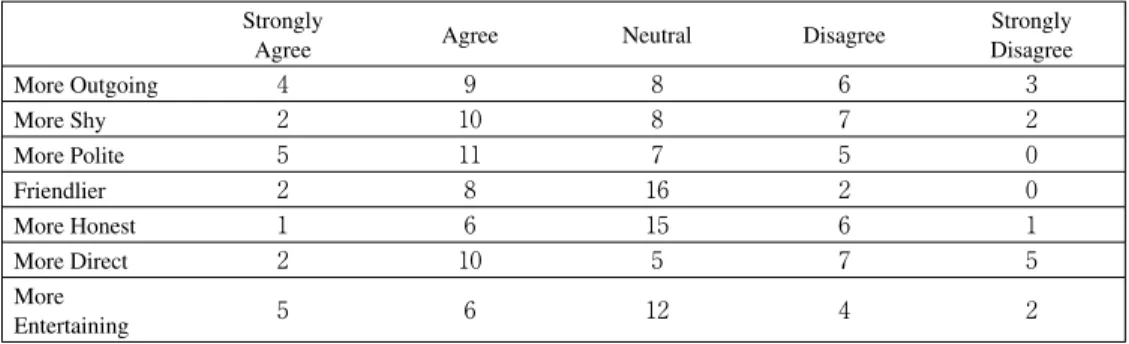
In question three, participants related to the ability to communicate certain emotions whilst communicat-ing in a second language. These emotions included: shyness, politeness, honesty, and sociability. Domi-nantly, the group tended to agree on being more outgoing, shy, polite and direct. There was also a dominant tendency to answer neutrally on being more honest, friendly and entertaining. All thirty participants answered this question. The greatest difference in those who answered with the majority and those with the minority was with the attribute of being friendlier( -neutral, -strongly disagree), SD= . , V= . . The small-est disparity was with the attribute of being more outgoing( -agree, -strongly disagree),SD= . , V= . . The means were as follows: more outgoing − . , more shy − . , more polite − . , more friendly− . , more honest − . , more direct − . , and more entertaining − . .
Question four asked participants to describe their personalities in their native languages using four out of eleven adjectives. The adjectives asked were: friendly, shy, outgoing, funny, intelligent, silly, boring, witty, lengthy, popular, and positive. The participants more often chose friendly( %)and less frequently chose boring( %). All thirty participants answered this question.
In question five, participants were again asked to describe their personalities in their second languages using four out of eleven adjectives. The adjectives were the same used in question four. It is interesting to note that again participants more often chose their personalities as being friendly( %). However, the less
frequently chosen personality characteristic changed to witty, though its frequency was the same( %). Questions and were compared with a t-test, the results of which were: P-value= . , Mean differ-ence=− . , Confidence Interval = . to . , t= . , SD= . , df= .
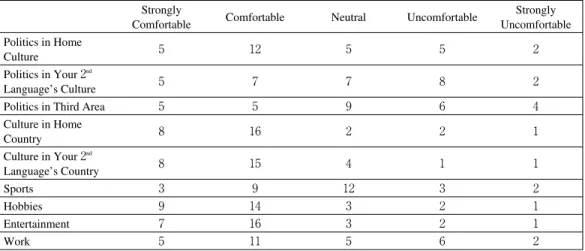
In question six, participants were asked on how well they feel that they communicate on various topics with others in their native language. The topics were: sports, entertainment, hobbies, politics in home culture, politics in second language’s culture, politics in third area, work, culture in home country and culture in sec-ond language’s country. All thirty respsec-ondents answered this question. Most respsec-ondents were very comfort-able in the communication of these topics, except politics in home culture, which was mostly slated as com-fortable. The greatest difference in those who answered with the majority and those with the minority was with the communicability of hobbies( -very comfortable, -very uncomfortable, -uncomfortable)and cul-ture in one’s home country( -very comfortable, -very uncomfortable). The smallest disparity was with the communicability of politics in a third area( -very comfortable, -very uncomfortable). The means were as follows: sports− . , entertainment − . , hobbies − . , politics in home culture − . , politics in second language’s culture− . , politics in third area − . , work − . , culture in home country − . , and culture in second language’s country − . .
In question seven, participants were asked on how well they feel that they communicate on various top-ics with others in their second language. The toptop-ics were the same as for question six. Only of the thirty participants answered this question. Most respondents were comfortable in the communication of these top-ics, except politics in a third area(neutral),sports(neutral)and politics in your second language’s culture (uncomfortable). The greatest difference in those who answered with the majority and those with the minor-ity was with the communicabilminor-ity of entertainment( -comfortable, -very uncomfortable)and culture in one’s home country( -very comfortable, -very uncomfortable). The smallest disparity was with the com-municability of politics in a third area( -neutral, -very uncomfortable). The means were as follows: sports − . , entertainment − . , hobbies − . , politics in home culture − . , politics in second language’s culture− . , politics in third area − . , work − . , culture in home country − . , and culture in second language’s country− . .
Responses from Questions and were analysed via a t test. The results were: P-value= . , Question Mean= . , Question Mean= . , Question SD= . , Question SD= . , N= , Mean difference= . , Confidence Interval= . to . , t= . , SD= . , df= .
DISCUSSION
Based on the results provided, the difference between communicability from native and second language speakers is statistically significant(P value< . ). Therefore, based on the results between native and sec-ond language communicability, the ability to communicate via language(the process of thinking to allow elaboration through speech)is statistically relevant between language groups. This correlates with the multi-lingual study on Chinese/English speakers, as noted previously in the literature review that language used for thinking influences the perception of others(Eysenck ).
This correlates with Benjamin Lee Whorf’s first hypothesis, that language determines thinking. As noted between the two language groups, the thinking of individuals varied based upon the language in which he or
she was corresponding. This proves the first Whorfian hypothesis to be correct. Therefore, based on the as-sumption that thought is a facet of personality, the language should have given the individual a new personal-ity as well, with the descriptive adjectives that they depicted for themselves in questions four and five.
The results for the descriptive adjectives are not statistically significant, though both groups determined friendly as the dominant adjective. The lack of statistical significance for this question seems illogical from the previous statement. However, noting previous studies, perhaps it was the questions themselves that re-sulted in this poor result. Other studies did not use descriptive adjectives as this one, but more prominently utilized known personality scales, perception of other speakers, or the word habits naturally used by the speaker. Also, the words tested on the participants(friendly, shy, outgoing, funny, intelligent, silly, boring, witty, lengthy, popular, and positive)may have been too vague for the participant to effectively gauge in re-flection of his or her personality. Likewise, as some of these English words do not translate well into other languages, the respondents may have had different interpretations of a certain word. It is also important to note that participates and came from various cultures, yet culture itself was not taken into consideration.
For the first question, which asked respondents to reveal the languages they knew, it was noted that all of the participants were able to communicate in English, whereas % were able to communicate in Japanese, and % in another unspecified language. Therefore there were some participants who could communicate in three or more languages(at least %). However, the small group of subjects limits the broad applicabil-ity of this research.
CONCLUSION
The idea that people act, and even think, differently depending on the language they speak has been de-bated for years. This paper set out to prove that language has a significant influence on thought and personal-ity by assessing existing views of daily life on multi-lingual people. The results of the research show this to be true, agreeing with Benjamin Lee Whorf’s hypothesis.
As the number of participates was rather low, hopefully this study can be redone to apply to a larger group, and expand on the effects participants’ cultures have on their personality and language, as well as the instrumentation via descriptive adjectives to be re-evaluated to change to a more notable personality score, such as extraversion, agreeableness, neuroticism, conscientiousness and openness.
REFERENCES
.Lozano, Luis M.; Garcia-Cueto, Eduardo; Muniz, Jose.( )“Effect of the Number of Response Categories on the Reli-ability and Validity of Rating Scales.” Methodology: European Journal of Research Methods for the Behavioral and Social
Sciences. Vol.( ), ― .
.Boroditsky, Lera.( )“Language and Thought.” in Philosophy Talk, Stanford University. October . .Barner, D, Inagaki, S, & Li, P.( ).Language, Thought, and Real Nouns. Cognition, , ― .
.Brown-Schmidt, S.( ).“Partner-Specific Interpretation of Maintained Referential Precedents During Interactive Dia-log”. Journal of Memory and Language, , ― .
.Carlson, K.( ).“How Prosody Constrains Comprehension: A Limited Effect of Prosodic Packaging.” Lingua, ,
― .
.Cromie, W.( ).“Which Comes First, Language or Thought?” in Harvard Gazette, Retrieved June , , Web site: http://www.news.harvard.edu/gazette/ / . / -think.html
.Eysenck, M.( ).“Psychology: An International Perspective”. London: Psychology Press.
.Gill, A.( ).“Personality and Language: An Overview of Recent Findings”. in Alaister Gill. Retrieved July , , Web site: http://www.cogsci.ed.ac.uk/~agill/PersLang.html.
.Keestra, M, & Cowley, S.( ).“Foundationalism and Neuroscience; Silence and Language.” Language Sciences, ,
― .
.Knezek, M.( ). “Nature vs. Nurture: The Miracle of Language.” in Duke University Retrieved June , , Web site: http://www.duke.edu/~pk /language/psych.htm.
.Kottke, J.( ).“Language Shapes Thought”. in Kotte.org. Retrieved June , , Web site: http://kottke.org/ / / language-shapes-thought.
.Jarrett, C.( ). “Change Your Personality, Learn a New Language.” in BPS Research Digest Web site: http://bps-research-digest.blogspot.com/ / /change-your-personality-learn-new.html.
.Markusic, M.( ).“What is the Likert Scale?” in BrightHub Retrieved June , , Web site: http://www.brighthub. com/education/special/articles/ .aspx.
.Proudfoot, D.( ). “Meaning and Mind: Wittgenstein’s Relevance for the ‘Does Language Shape Thought?’” New Ideas
in Psychology, , ― .
.Pugh, M.( ).“Stedman’s Medical Dictionary.” Baltimore: Lippincott Williams & Wilkins.
.Seargeant, P.( ). “Language Ideology, Language Theory, and the Regulation of Linguistic Behaviour”. Language
English Japanese Other Beginner Lower Intermediate Conversational Fluent Native APPENDIX
TABLE : COMMUNICABILITY IN STATED LANGUAGE
Strongly Agree Agree Neutral Disagree Strongly Disagree In nd
Language Com-munication Personal-ity Varies From Na-tive Language
APPENDIX
TABLE : ABILITY TO COMMUNICATE WELL IN SECOND LANGUAGE
Strongly
Agree Agree Neutral Disagree
Strongly Disagree More Outgoing More Shy More Polite Friendlier More Honest More Direct More Entertaining APPENDIX
TABLE : COMFORTABILITY IN COMMUNICATION OF SECOND LANGUAGE
Responses Friendly Shy Outgoing Funny Intelligent Silly Boring Witty Lengthy Popular Positive APPENDIX
Responses Friendly Shy Outgoing Funny Intelligent Silly Boring Witty Lengthy Popular Positive APPENDIX
TABLE : PERSONALITY IN SECOND LANGUAGE
Strongly
Comfortable Comfortable Neutral Uncomfortable
Strongly Uncomfortable Politics in Home Culture Politics in Your nd Language’s Culture Politics in Third Area Culture in Home Country Culture in Your nd Language’s Country Sports Hobbies Entertainment Work APPENDIX
TABLE : COMFORTABILITY IN COMMUNICATION OF HOME LANGUAGE
Strongly
Comfortable Comfortable Neutral Uncomfortable
Strongly Uncomfortable Politics in Home Culture Politics in Your nd Language’s Culture Politics in Third Area Culture in Home Country Culture in Your nd Language’s Country Sports Hobbies Entertainment Work APPENDIX
APPENDIX SURVEY QUESTIONS
.How would you rate your ability to communicate in the following languages? English, Japanese, Other
.How strongly would you agree or disagree with the following statement?
“When communicating in my ndlanguage, I feel my personality is different from when I communicate in my native lan-guage.”
.How strongly would you agree or disagree with the following statements?
“When communicating in my ndlanguage, I feel I am: more outgoing, more shy, more polite, friendlier, more honest, more direct, more entertaining.”
.Which of the following adjectives would you use to describe your personality when communicating in your native language? Friendly, shy, outgoing, funny, intelligent, silly, boring, witty, lengthy, popular, positive
.Which of the following adjectives would you use to describe your personality when communicating in your second lan-guage? Friendly, shy, outgoing, funny, intelligent, silly, boring, witty, lengthy, popular, positive
.When communicating in your native language, how comfortable do you feel discussing the following topics? politics in your home culture, politics in your ndlanguage’s culture, politics in a third area, culture in your home country, culture in your
ndlanguage’s country, sports, hobbies, entertainment, work.
.When communicating in your second language, how comfortable do you feel discussing the following topics? politics in your home culture, politics in your ndlanguage’s culture, politics in a third area, culture in your home country, culture in your ndlanguage’s country, sports, hobbies, entertainment, work.