Growth, Environment, and Politics:The Case of
China
著者
Kwan S. Kim, Renping Hao, Andrew Champeau
雑誌名
アジア文化研究所研究年報
号
47
ページ
84(149)-105(128)
発行年
2012
The Case of China
Kwan S. Kim
Renping Hao
Andrew Champeau
* 要 旨 改革・開放以来,中国は高い高度経済成長を達成した一方,大気汚染,水汚染や生態環境悪化な ど深刻な環境悪化という代価も払った。中国政府は1990年代後半から,「経済成長」優先の考え方 から,「経済成長と環境保護」との両立へと発展戦略を転換し始めた。とくに2003年に胡錦涛政権 になってから,「循環型経済」(2004年),「節約型社会」(2005年),「科学的発展観」(2007年)など, 環境やエネルギーの制約を受けるなかで中国経済が持続的な成長を維持するための国家戦略が次々 打ち出された。環境法規の整備,環境政策の体系化および行政管理の強化と同時に,環境管理の手 段も従来の政府行政管理から,市場メカニズムを利用した経済的手段,法的,技術的手段も活用し, 徐々に多様化になってきた。SO2,COD などの指標の変化をみると,中国では2006年頃から環境汚 染が改善されるようになりつつあり,環境改善への取組みが一定な成果を収めたと言える。しかし 環境汚染は中国には依然として深刻であり,これを抜本的に解決するためには,中国政府がさらに 踏み込んだ政策や制度を構築することが必要であろう。 AbstractThe controversial relationship between economic growth and the environment in China has gained worldwide attention in the context of the global warming and ecological disasters that herald a changing global climate. China is seen widely in the international community as a nation that prizes only economic growth at any cost, oblivious to the devastating growth-induced pollution. This assertion is too simplistic to unerringly hone in on the real issues of China.
Ultimately, the environmental degradation infl icted by the pollution-intensive technology employed by Chinese industries will make China’s robust economic growth more diffi cult. The post-Mao ZeDong government showed some concern for the environment and placed fairly comprehensive environmental protection laws in place. Faced with the growing, plaguing problems of acid rain, a dwindling clean water supply, desertifi cation, deforestation, and substandard air quality, the Beijing government, only recently beginning in the late 1990s, began seriously to look beyond the past era of sustained high growth. The question thus remains: Will China under the current authoritarian regime be able to continue with its robust growth and to resolve the problems of egregious pollution?
This paper starts with an overview of China’s development policy and its consequences from the recent past historical perspective. We then look into statistical evidence for the relationship between economic
growth and environmental degradation in China. In explaining changes in the environment, we examine how large the explanatory power that government policy has and analyze its policy-related consequences for the Chinese people. Finally, the paper concludes by proposing policy actions required for thorough environment protection in domestic and international communities.
1. Profi le of the Economy
The Chinese economy’s unprecedented growth has garnered considerable international scrutiny. The past four decades saw China’s gradual transformation from an inward-oriented economy to an outward-oriented one. The unprecedented growth has raised the average living standards of average Chinese citizens, drastically reducing the poverty rates. It has also, however, created unprecedented damages to its environment. This precarious predicament between economic progress and environmental preservation continues to persist today. The problem has been amplifi ed by China’s past development.
(1)Post-Mao Development
China’s multifaceted growth represents the culmination of nearly four decades of evolving economic policy. Following the Communist victory in the Chinese Civil War, Mao Zedong assumed supreme authority in China. From 1949 to 1977, the dogmatic vision of Maoism prevented the Chinese economy from exhibiting any real progress. Mao’s dedication to continuous revolution led to the Cultural Revolution and other forms of social upheaval. In addition, an ideological rivalry with the Soviet Union led to extremely limited international aid for a nation already openly embracing isolationism. The economy was unable to gather any momentum and China was mired in poverty.
Upon Mao’s death, Deng Xiaoping assumed control of Chinese government and ushered in an era of economic reform. Emphasizing pragmatism in economic policy, Deng gradually liberalized the economy, opening the door to foreign trade and investment. With help from the newly-formed, state-guided business elite class in the nation of what is referred to as “Red Capitalist”, China continued on the arduous path of resource- and energy-intensive industrialization. Subsequent leaders Jiang Zemin and Hu Jintao furthered China’s national goal for robust economic growth, leading to the creation of the burgeoning economy known today.
(2)The Current Economy
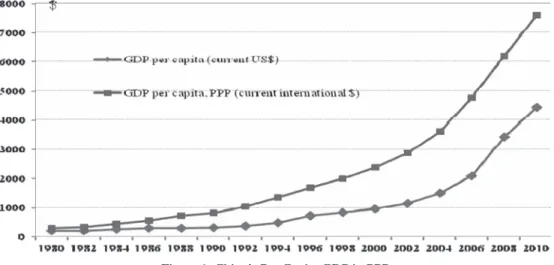
China’s skyrocketing GDP currently ranks as the world’s second largest at $8 trillion in PPP. The average annual growth rates over the past 15 years hovered around 12% in contrast to those of the United States which stayed at 2.5% (Figure 1). The robust economic growth has astonishingly lifted 500 million Chinese out of poverty in the country with the world’s largest population of over 1.3 billion. China extended its infl uence far beyond regional Asian economies to Latin America and Africa. It is well to note, however, that despite China’s accomplishment in massive wealth accumulation, income inequality has been rising since 1997 (Figure 2).
In addition to the problem of growing in the context of a global economic recession, Chinese leaders are worried about social stability and unrest. They have decided to backtrack and focus less on foreign ventures and more on domestic markets. In accordance, the Chinese People’s National Congress (PNC) offi cially proclaimed the 12th Five-Year Plan, calling for domestic stimulus packages aimed at raising the grass-roots
underway as well. The plan also called for banking reforms to ensure fi nancial security in the face of uncertain global fi nancial future.
(3)Energy Needs
A distinctive feature behind China’s dazzling success is that its industries embody the main force of growth and rely on use of cheap energy resources, in particular unfettered use of low-quality coal. China turned to various methods of producing energy. Coal burning power plants continue, however, to account for about 80% of all energy resources in China (Figure 3). With industrial growth rates far surpassing GDP
Figure 1. China’s Per Capita GDP in PPP Source: The World Bank WDI Database.
Figure 2. Income Inequality in China Source: China Statistics Yearbook 2010.
Figure 3. Composition of Energy Use in China Source: China Statistics Yearbook 2010.
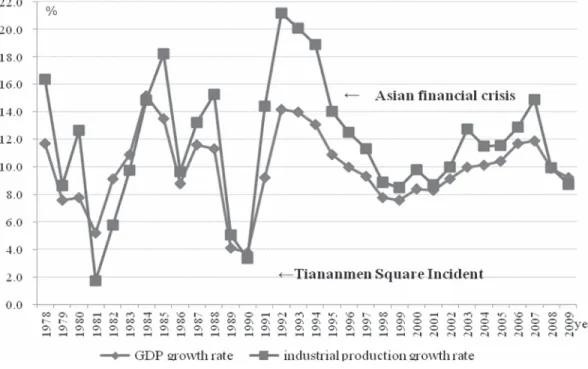
Figure 4. Chinese GDP and Industrial Output Growth Rates Source: China Statistics Yearbook 2010.
growth, the regional and federal coalmines have persistently been exploited to meet industrial needs as the cheapest source of energy resources (Figure 4). Coal burning is among the most environmentally harmful means of generating energy.
China’s toxic environment and accompanying international pressure have begun to prompt the country to turn to “greener” energy sources. The government has been heavily investing in hydropower and air power for several years now. The recent completion of the Three Gorges Dam illustrates China’s interest in hydropower. Nuclear power research has similarly received governmental funding in an effort to curb reliance on coal power. Although China is now among the world’s largest producers of solar cells, a majority of these are exported and solar power has yet to see real signifi cant use in China. China is also among the world’s top 10 consumers of natural gas. Much of this fuel, however, is imported and therefore places a stronger fi nancial liability of consumers. Its future use is therefore still in question.
Despite these efforts for alternative energy generation, the sheer need for energy is so large that a majority of power still must come from coal-based power plants. China has additional diffi culties in meeting growing energy demands for housing and transportation. Economic growth has always been heavily export-based, despite a recent national emphasis on providing for domestic consumers(2). Thousands of manufacturing
plants for exports also require power. Despite these government efforts to switch to sustainable energy sources, ballooning new consumer demands for power are making the change more diffi cult and protracted. The most controversial byproduct of China’s need for energy will be the environmental degradation over the foreseeable future.
Most Chinese industrial processes that involve large-scale production of energy give rise to copious amounts of pollution. China’s use of coal accounts for 33% of the global coal supply. China has also begun importing mineral resources, and its oil consumption has been steadily rising (Figure 5). The fossil-fuel using plants are extremely harmful to the environment, releasing toxic fumes into the air that create other environmental problems like acid rain. Some efforts to embrace sustainable energy production have also destroyed priceless ecosystems. The Three Gorges Dam project fl ooded much of the original Yangtze River
Figure 5. Energy Use (Kilograms of Oil Equivalent Per Capita) Source: The World Bank WDI Database.
valley. While newer, more sustainable methods of energy production are constantly being formulated, the burgeoning economy’s insatiable need for energy is destroying the environment. The government has long recognized energy-production’s destructive impact on the environment and made ineffective, limited attempts to institute reform measures as early as in the late 1970s.
2. Strategy and Development (1)Policy Dilemma
The post-revolution Chinese government has shown a half-hearted concern for the environment by occasionally enacting proactive legislation to curb pollution, always without compromising economic growth. The fi rst Chinese National Conference on Environmental Protection occurred in Beijing in August 1973. This conference was only able to agree on basic sustainability principles, such as recycling, and to agree to the idea that public participation would be necessary for holistic environmental protection(3)
. As China’s economic climb became accompanied by a steadily rising need for cheap, pollution-intensive energy resources, greater efforts were made by occasional new environmental legislation. The 1978 effort culminated with the Law of Environmental Protection was more remarkable. This legislation created a strict, streamlined process that all new building projects were required to follow. Each new construction site was to undergo an inspection by offi cials of the System of Environmental Impact Assessment (SEIA). Subsequent reports must be submitted for formal government approval.
A whole decade later, China moved further ahead with the 1989 Environmental Protection Law. The law had four main goals: coordinating environmental protection, preventing pollution, promoting polluter responsibility, and strengthening environmental management. It also required the creation of regulatory agencies and the rigorous observance of national and local standards for environmental quality and protection. These regulatory agencies included the Discharge Permit System (DPS), Deadline Requirements for Pollution Control, and the Environmental Impact Assessments (EIAs)(4)
. The DPS requires all companies to register with their local Environmental Protection Boards (EPBs). These EPBs are responsible for issuing permits to enterprises concerning waste discharge standards. Fines or closure face any violator of environmental statues.
Towards the end of March 1998, the National Environmental Protection Agency (NEPA) was upgraded to the level of an official ministry. It then became known as the State Environmental Protection Administration (SEPA). SEPA was one of the highest-ranking governing bodies in China with regards to the development and management of environmental protection legislation. For the decade SEPA was active, however, industrial pollution continued and showed no signs of curbing. In March 2008, the Ministry of Environmental Protection of the People’s Republic of China (MEP) was created to replace SEPA. The MEP sets environmental quality standards and fi nes violators, while also attempting to monitor the development of sustainable technology like nuclear power. MEP, alongside its many underling organizations represent the central government’s branch dedicated to preventing environmental degradation.
Each of these regulatory agencies has regional branches that monitor the activities of local enterprises. Although legislation was written by the highest level of Chinese governance, it was and remains the responsibility of regional agency offi ces to actually enforce the environmental regulations. Subsequent measures to prevent the release of emissions and pollution sought a centralized enforcement mechanism with moderate success.
(2)Policy and Implementation
As mentioned previously, the Chinese government has recognized the gravity of environmental damage and begun penning further ecological protection legislation. China’s economic progress continued to come at the expense of its environmental health to the present. Legislators continued to pen a number of laws stipulating new measures for environmental protection. Environmental protection legislation and economic policies have since been engaged in a tense, dynamic relationship that governs the shape of China’s future.
The well-articulated, comprehensive environmental legislation for China has been in place over the past several decades. Why then has China failed in environmental protection? Has the government been unable or unwilling to chart a new environmental course that could go hand-in-hand with economic growth?
Environmental Policy
China’s environmental laws and regulations currently in place clearly refl ect the central government’s good intentions for environmental protection. However, these efforts extend only as far as the central government wishes. A latecomer to the developing world, China has argued that the main responsibility of emission reduction and environmental protection falls primarily on developed nations with greater technological abilities. This argument refl ects the popular developing-country perspective that before any attempt to acquire and use advanced, clean technologies, the emerging economy must fi rst progress through a period of pollution-intensive but cost-effective industrialization. Offi cial government policy in the era of China’s breakneck growth conforms to this growth at all costs perspective(5).
In the late 1990s, China began experiencing a series of environmental disasters along with rising social unrest. In response, Hu Jintao’s government started to launch more environmental protection measures as far as central authority could reach. The government devised a variety of methods to improve effi ciency in implementing environmental laws. While encouraging enterprises to proactively lower emissions, the government has simultaneously resorted to a punitive fi scal policy for the fi rms producing excessive emissions. For instance, the government taxes the use of coal with high sulfur content at a higher rate. The progressive tax system is to encourage enterprises to use more sustainable energy resources. Enterprises equipped with treatment facilities for emissions and waste products are offered tax breaks and subsidies. Offi cial attempts have also been made to establish a system of emissions trading but it still remains at an experimental stage.
The provisions of the 11th Five-Year Plan stipulate the responsibility of the government to promote the
use of sustainable energy resources, such as hydropower, solar power, wind power, natural gas, biomass fuel and methane. Stipulated goals under the plan include the addition of approximately 3,000 megawatts of hydropower each year(6). Wind power is also being explored. Most wind farms are to be located along the
coasts and in the northern and western regions. These farms can produce energy that will be used in local villages and will later be integrated into grid-type power structures.
Solar energy production has remained on a relatively small-scale, powering individual homes and other small enterprises. China is the world’s largest producer of solar energy cells, but the majority of them are exported. Solar energy remains a growing enterprise across China. Although it currently represents a sizeable export and tiny portion of domestic energy production, its use and study is gradually climbing. The largest form of sustainable energy will likely remain hydropower. The completion of the 18.2-gigawatt-producing Three Gorges Dam will yield signifi cant amounts of electricity, but at the great costs of fl ooding and pollution resulting from dam construction. Despite these advances made in sustainable energy development, it is well
to note that the coal sector continues to account for the largest percentage of energy resources and consequent pollution in China.
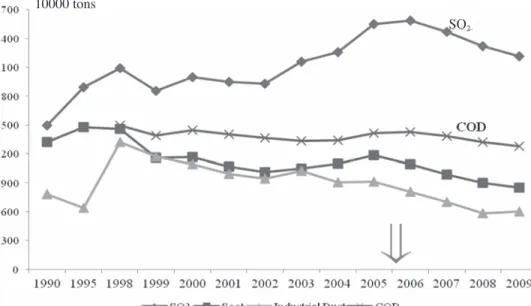
President Hu justifi ed the commissioning of massive projects such as Three Gorges Dam by proclaiming a new era of sustainable development known as “Green GDPism”. This proclamation is considered a turning point in China’s offi cial policy on environmental protection. The statistical evidence does reveal that the total volume of chemical gases such as Sulfur Dioxide (SO2) and other noxious discharges released into the
atmosphere decreases beginning in 2005-2006 at which point the release of these pollutants peaked (Figure 6). SO2 is among the most harmful pollutants and unfortunately one of the most common emissions from coal
combustion plants. The burning of coal releases this harmful chemical in gas form, where it bonds with atmospheric gasses like nitrogen (N2) and oxygen (O2) to produce the gas form of acid rain. It will eventually
return to earth as precipitation and massively destabilize agricultural and industrial infrastructures. In China’s southeastern provinces, this acid rain has reached an unprecedentedly low power of hydrogen, or pH, which is a measure of acidity. Lower pH values correspond to more acidic compounds.
The annual discharge of water pollutants measured via Chemical Oxygen Demand (COD) tests is also shown to begin to fall from 2006 onward (Figure 6)(7). COD tests detect organic pollutants in surface water
using a Carbon Dioxide (CO2) treatment. This method is heavily used to assess the quality of China’s
dwindling water supply. In major rivers, this test is yielding alarming results that label many major sources of drinking water unfi t for consumption. An example demonstrating COD test’s role in China’s environmental policy is closely related to solar power. The production of solar cells releases pollutant Silicon Tetrachloride (SiCl4) into the environment. This chemical, with a melting point of -68°C and a boiling point of 57°C, takes
a liquid form at most ambient temperatures. Although SiCl4 is a treatable pollutant, large treatment costs force
most solar cell production enterprises to dump the pollutant untreated. SiCl4 is therefore discharged into
China’s rivers untreated, where it is eventually detected using COD testing.
There is also no evidence of any decline in the country’s emission of the greenhouse gas, Carbon
SO2
10000 tons
Figure 6. Turning Point During the “Green” Period (Which the Arrow Indicates) Source: China Statistics Yearbook 2010.
Dioxide (CO2). Greenhouse gas is widely acknowledged as the main culprit for global warming. China has
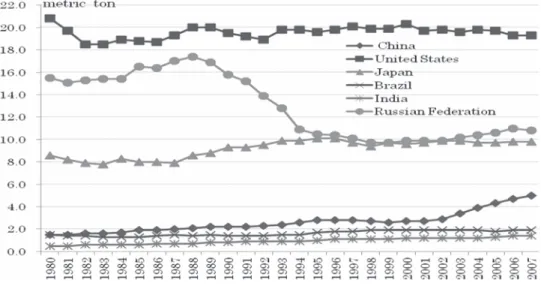
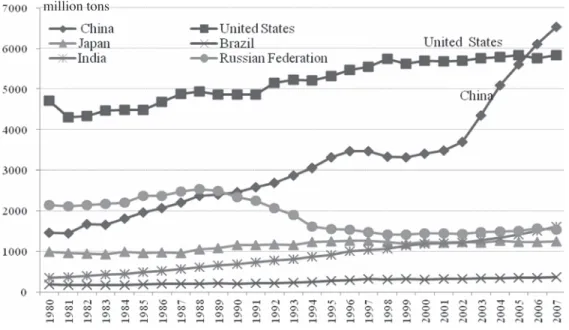
now surpassed the United States in greenhouse gas emission on a rising trend (Figure 7). The increasing affordability of cars is largely responsible for this trend. Most Chinese cars are well below international standards in terms of emission release. If the Chinese economy is able to gradually shift to a nonresource-intensive, clean technology- based development path, the emissions of these pollutants could subside in future. The government’s latest efforts to raise air and water quality, although somewhat limited, must not be overlooked for this turn-around.
Amongst the most pollutant heavy provinces, there have been signifi cant signs of emission lowering. The pollutant-heavy Shandong province lowered SO2 emissions from 2 million tons in 2005 to 1.5 million
tons in 2010. It remains premature to tell whether these observed improvements will be sustainable over a long-term period. Also, the overall level of emissions has yet to show signifi cant signs of lowering.
Implementation Challenges
Hu’s governmental efforts to resuscitate the environment have, however, been facing insurmountable obstacles. First, one needs to understand China’s political structure, culture and institutions that may well undermine the efforts by central authority in Beijing. Although Chinese environmental protection legislation is relatively thorough, it has been very poorly implemented. There are huge obstacles in implementing the offi cial policy. The current mechanisms in place to enforce environmental protection are highly inadequate and ineffective for resolving continuing tensions among the central government, local authorizes, polluters and pollution victims (Wang, 2007).
The major obstacle to policy implementation is the country’s multifaceted corruption system. Corruption in China is a result of both greed and the central government’s lack of clarity and uniformity. Because the central government has cited both economic growth and environmental protection in legislation, enterprises
million tons
Figure 7. Comparison of Carbon Dioxide Emissions Source: The World Bank WDI Database
and government power plants are faced with altering methods of production while simultaneously continuing to increase output(8)
. Such a transition is clearly diffi cult and should be implemented in an iterative fashion rather than all at once. However, since legislation stipulates strict requirements for both fi nancial growth and emission reduction, local authorities are forced to partially enforce national laws citing quotas in both fi elds. Since meeting or exceeding economic growth goals rewards offi cials a considerable fi nancial bonus, most of them choose to meet growth goals rather than to begin instituting cleaner, more effi cient technologies
In the context of widely spread corruption, the hierarchical system of Chinese governance contributes to the rampant violations of environmental protection law by local governments. Chinese public administration refl ects a “pressurized system,” in which the highest authority develops policy that is left to lower levels of governance to implement. This system is responsible for many of the environmental law enforcement issues in China, including pervasive corruption. Because Chinese offi cials are not elected by citizens and are only promoted by higher authorities, local governments feel obligated to listen to the complaints of constituents. There is no actual mechanism of accountability. The grass-roots citizens, particularly rural dwellers, are the ones most hurt by pollutions and the most vocal for policy changes. Since the citizens have no voices or infl uences on the promotional mechanism of public offi cials, local governments rarely heed regional demands and strictly abide by those of the central government.
The pressurized system also creates an unhealthy atmosphere amongst local authorities. Because promotion of local offi cials can come from a higher authority, regional governments and their employees compete with one another to report on their own progress. This leads to a systematic defraud and corruption described earlier. Because catering to central government objections embodies the local offi cials’ only hope for promotion, they also frequently take on tasks or objectives beyond their immediate capability. The promotion mechanism completely devoid of public voice fosters inter-regional governmental competition, not a cooperation, which make many overarching objectives unobtainable. In a recent effort to address this problem, the central government has started to set long- term objectives, but has then divided them into individual responsibilities sent out to regional offi cials(9)
.
Owners and operators of coal-burning plants and other enterprises alike also receive fi nancial bonuses for meeting or exceeding power output quotas. Therefore, before government offi cials arrive to inspect emission output, plant workers frequently decrease power output in order to meet pollution standards. With decreased power output comes decreased emissions release. After inspectors depart the plant satisfi ed, owners will return settings for maximum power output and the corresponding level of pollution that typically violates the law. In other instances, inspectors receive money from the central government for operating effi cient sectors and conduct bogus inspections. Inspectors frequently receive bribes from polluting manufacturers to allow their businesses to continue. No reward is offered for curbing emissions. Bribery between inspectors and plant owners is very common. These power plants are also vital to rural township economies. If they were to close due to either excessive pollution or insuffi cient energy production, workers would be without pay or employment. Therefore, plant workers, plant owners, inspectors, and regional overseers alike all fi nd it advantageous to allow excessive pollution.
Within power plants, the equipment and processes necessary to fi lter and capture pollutants are also costly. Factory owners allow pollution to continue to keep costs of production low. In some cases, such as Township and Village Coalmines (TVCM), bribes are distributed to allow power plants and other facilities to simply be granted operational approval. Chinese coalmines are owned by either the central or state government. In the early days of the People’s Republic of China, TVCM supplied coal to the rural areas for
power generation. When environmental protection was launched, most TVCM sites were deemed both unsafe and excessively polluting. The central government set cleanliness standards that few TVCMs could meet. However, many of those unable to satisfy the government’s emissions standards continue to operate illegally to this day. Because they embody a signifi cant source of income and employment, few regions can afford to lose TVCMs, so local offi cials ignore them. The coal from TVCMs is of very poor quality, generating pollution exceeding the government-approved level(10). China’s GDP per unit of energy consumed has
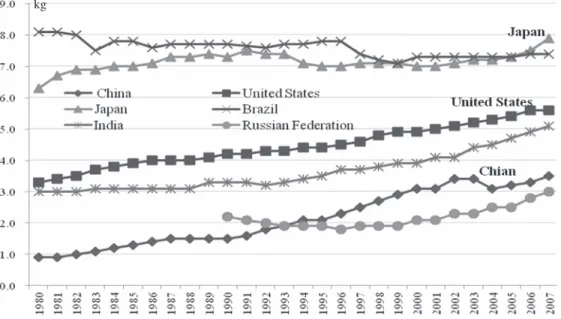
remained substantially low compared to other nations in part due to poor quality coal (Figure 8). Local administrators and workers fi nd it mutually benefi cial to dodge environmental protection legislation and to increase power output, employment, and income.
Although China is currently undergoing a massive influx of advanced, cleaner technologies, manufacturing and processing raw materials continue to account for a large share of its GDP. The evidence shows a statistical relationship between the size of GDP and the amount of pollution at the provincial level in China. With the exception of the Guangdong province, the province nearest Hong Kong that boasts some of China’s most advanced technology and trade policies, China’s most productive provinces are also the most polluting. The Jiangsu province boasted an annual GDP of 41 million Yuan in 2010, second only to Guangdong. Unfortunately, in 2010 COD tests had abnormally high pollution results in Jiangsu as well. The Shandong province has a similar situation. Despite its outstanding output of 39 million Yuan in 2010, it was also responsible for 1.5 million tons of SO2 released into the atmosphere, the highest in all of China. Pollution
data for each province is presented in Table1.
It appears that in spite of China’s burgeoning supply of advanced technologies and its gradual devolution from labor and energy intensive industries, the country can not signifi cantly cut down its overall pollution emissions. The Guangdong province boasted 46 million Yuan in output GDP in 2010, it also typically maintains air quality fi ve times above U. S. safety limits. Guangdong boasts the highest GDP per province in all of China. Clearly, a large portion of China’s GDP is tied to pollution-intensive industries. Chinese leaders
kg
Figure 8. Comparison of GDP Per Unit of Energy Use Source: The World Bank WDI Database
face the challenge of maintaining an impressive annual output while simultaneously strengthening industries less harmful to the environment.
3. Policy Consequences
Inattentive and poorly executed government policies result in the release of pollution, degrading the country’s habitat in a multifaceted manifestation. The major air pollutants are SO2, nitrogen oxides, and soot.
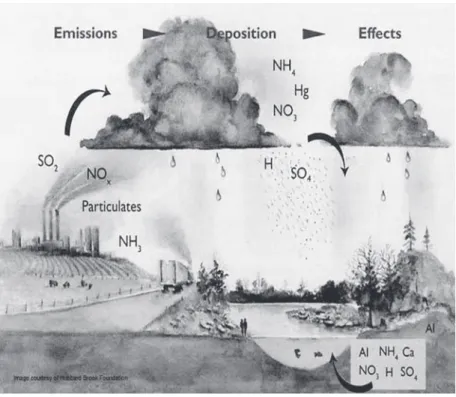
All primarily result from coal combustion in power plants and individual homes along with the burning of fossil fuels (Figure 9). Their polarity, or charge distribution, makes many of them relatively unstable and as a consequence, volatile. They, therefore, react easily with water and oxygen in the atmosphere to form mild
Table 1. Sulfur Dioxide emission by province for years 2002-2010
(10000tons) Region 2002 2003 2004 2005 2006 2007 2008 2009 2010 National Total 1927 2158 2255 2549 2589 2468 2321 2214 2185 Beijing 19 18 19 19 18 15 12 12 12 Tianjin 24 26 23 27 26 24 24 24 24 Hebei 128 142 143 150 155 149 135 125 123 Shanxi 120 136 142 152 148 139 131 127 125 Inner Mongolia 73 129 118 146 156 146 143 140 139 Liaoning 79 82 83 120 126 123 113 105 102 Jilin 27 27 29 38 41 40 38 36 36 Heilongjiang 29 36 37 51 52 52 51 49 49 Shanghai 45 45 47 51 51 50 45 38 36 Jiangsu 112 124 124 137 130 122 113 107 105 Zhejiang 62 73 81 86 86 80 74 70 68 Anhui 40 45 49 57 58 57 56 54 53 Fujian 19 30 33 46 47 45 43 42 41 Jiangxi 29 44 52 61 63 62 58 56 56 Shandong 169 184 182 200 196 182 169 159 154 Henan 94 104 126 163 162 156 145 136 134 Hubei 54 61 69 72 76 71 67 64 63 Hunan 74 85 87 92 93 90 84 81 80 Guangdong 97 108 115 129 127 120 114 107 105 Guangxi 68 87 94 102 99 97 92 89 90 Hainan 2 2 2 2 2 3 2 2 3 Chongqing 70 77 80 84 86 83 78 75 72 Sichuan 112 121 126 130 128 118 115 114 113 Guizhou 133 132 132 136 147 138 124 118 115 Yunnan 36 45 48 52 55 53 50 50 50 Tibet 0 0 0 0 0 0 0 0 0 Shaanxi 64 77 82 92 98 93 89 80 78 Gansu 43 49 48 56 55 52 50 50 55 Qinghai 3 6 7 12 13 13 13 14 14 Ningxia 22 29 29 34 38 37 35 31 31 Xinjiang 30 33 48 52 55 58 59 59 59
solutions of sulfuric and nitric acid. Winds spread these new compounds before they return to land as acid rain, which falls on over 30% of China’s surface area(11). This process as a whole is dubbed “The Acid Rain
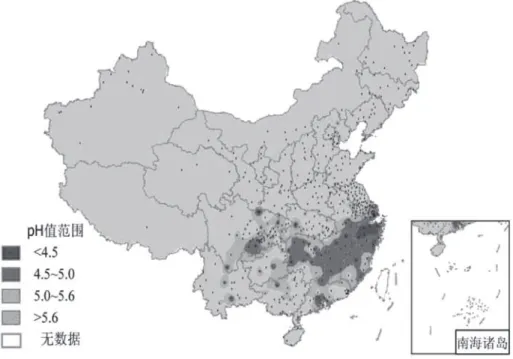
Cycle.” (Figures 9) Thirty three percent of agricultural land in China is subject to acid rain, contaminating crops. This acid rain has a power of hydrogen slightly less than 4.5 in certain areas, which is a very acidic level (Figures 10).
China is currently home to 16 of the world’s most polluted cities, and only 1% of 560 million urban dwellers breathe air that meets the European Union’s standards. About 66% of Chinese cities fail to meet air quality standards set by the national government. These egregious conditions create a plethora of respiratory diseases, culminating in an estimated 75,155,000 asthma attacks and 400,000 premature deaths. Incidences of diarrheal diseases, cancer, tumors, leukemia, and stunted growth have all risen over the past 30 years. The pollution-caused incidence of cancer is 19% in urban areas and 23% for rural dwellers since 2005. The World Health Organization (WHO) estimates 380,000 deaths per year in China are caused by indoor air pollution usually caused by domestic coal combustion. Diseases including chronic bronchitis, chronic obstructive pulmonary disease, tuberculosis, cataracts, childhood mortality, childhood asthma, upper aero-digestive tract carcinomas, decreased birth weight, nasal polyposis, respiratory problems and decreased lung function are all caused by poor air quality across China(12). The US Environmental Protection Agency estimates 25% of Los
Angeles air pollution fl oats across the Pacifi c Ocean from China.
China’s water pollution is also a devastating byproduct of acid rain. Some 70% of China’s two major rivers, the Yangtze and Huang He, have been contaminated, resulting in the local extinction of many species. This has a crippling effect on rural dwellers, 75% of whom have no access to drinking water. In a survey of 44 cities, 42 had “serious” groundwater problems. 75% of city water is unfi t for drinking and 30% of river
water is unsuitable for fi shing. Water categorized as being of the lowest quality now represents 25% of the Chinese water supply(13). Rural dwellers who require drinking water, food, and income via fi shing from rivers
are hit hardest. The WHO estimates 95,600 deaths per year occur due to the ingestion of contaminated water. Two-thirds of the Chinese rural population is without piped drinking water, and in these regions incidences of diarrheal diseases are much higher. Without providing rural citizens with access to piped, treated, and potable drinking water, water-carried diseases with continue to thrive in less-developed regions.
This devastating water pollution is also a result of illegal waste disposal practices. A majority of power plants dispose of all waste without any treatment(14)
. Many coal-burning power plants dispose of waste by simply dumping into rivers or lakes. Droughts are also common because water is siphoned from rivers to irrigate distant agricultural projects that are destroyed by acid rain. Deforestation has also increased the fl ow of bud down the rivers, further polluting waters.3 This bud combines with pollution from power plants to form massive concentrations of algae that contaminant river drinking water. Multiple sewage treatment plants have been erected solely to fi lter these giant fl oating clusters of algae.
China’s climate has also begun to change for the worst. Temperatures have risen by 0.5°-0.8° Celsius annually. Precipitation has decreased at an average rate of 2.9 MM/10a (millimeters per 10 annum) since the 1950s. This decrease has proven severest in the northern regions where the rate of the decline has reached an alarming 20-40 MM/10a. This sharp drop in precipitation has further depleted China’s rivers that are the source of siphoned irrigation waters(15). Droughts have struck much of the country, particularly during the
summer months. The sea level along China’s eastern border has risen an average of 2.5 MM/A (millimeters per annum), which surpasses the global average(16)
.
China’s massive population is also becoming a source of environmental degradation. In 2007, China surpassed the United States as the world’s largest producer of greenhouse gases(17). These gasses, such as
Figure 10. Acid Rain Distribution by Region and Acidity in 2009 Source: China environmental status report 2009.
carbon dioxide, result from the burning of fossil fuels and any form of combustion and are responsible for global warming. As China grows wealthier and more citizens are able to afford cars, carbon dioxide emissions will continue to rise steadily(18). China now is the largest emitter of CO
2 in the world (Figure 7). Current
estimates place the number of private cars in China over 30 million, with projections reaching 110-160 million cars by 2020. China also currently has 50% of the world’s motorcycles. Chinese cars do not meet the European Union’s oldest emissions standards. Greenhouse gasses are hastening desertifi cation across the Gobi Desert, which has steadily increased by 1900 square miles a year(19). Over 25% of China’s land area is a
now desert, affecting over 400 million citizen in the Northwestern provinces.
WHO estimates that the ‘environment’ conservatively accounted for 2.35 million deaths per year in China and accounted for 22% of the total disease burden in 2009. Due to diffi culties gathering data in rural regions, these fi gures are widely regarded as underestimates. These statistics also neglect social or cultural interactions with the environment, only including physical, chemical, and biological factors that are readily modifi able. Generally speaking, rural dwellers are much more egregiously-effected than urban dwellers. Without access to piped water, they are forced to consume water of even lower quality than are those who call cities home. They are also forced to use coal for basic indoor power needs which increases exposure to chemicals released upon coal combustion like SO2. It is alarmingly clear that, without swift government
action that allows for the strict enforcement of environmental protection legislation, innocent Chinese civilians, particularly rural dwellers, will continue to die in massive numbers(20).
4. Policy Actions Required (1)Domestic Actions
In China, the pollution has now reached an egregiously excessive point. A recent estimate indicates that between 8% and 12% of its GDP is lost annually due to pollution(21). Thus, to reduce further aggravation, it
seems imperative that the Chinese government urgently usher in expansive reforms for environmental protection, particularly in implementation methods and procedure. First of all, it is important to note that in order for centralized plans to come to fruition, the full force of the central authority in the case of China must be allowed to be exerted into actions by local authorities. The central leadership should be capable of managing all branches of the administration properly and of forcing regional and local governments to cooperate with the PNC. Because the legislation required for environmental protection is already in place, upon effective implementation the severity of the degradation should decline in a gradual atrophy.
The large question facing the Beijing government is how to articulate a new development strategy consistent and effi cient in resource use and meeting the dual goals of economic growth and environmental protection. Excessive and uncoordinated output targeting by the central authority for growth and environment simultaneously leaves local offi cials with little room or time for actions. Inspectors and overseers face a choice: they can either dodge anti-pollution legislation and be rewarded for the production of energy, or alternatively, they can reduce both output and emission level and be reprimanded by the central authority for not meeting energy production quotas. The two goals cause confusion amongst all those charged with their manufacturing their fruition and, considering one ultimatum involves a fi nancial bonus, all those involved choose to pollute and be rewarded.
By setting a locally achievable growth target considered compatible with local environmental requirements, the PNC could set feasible benchmarks for economic development and emission reduction. The central government must also come up with more realistic and transparent guidelines and regulations to deal
with the case of bribery, corruption and other forms of irregularities(22)
. In this context, the PNC needs to rely on market-friendly interventions as much as is possible. It could begin administering fi nancial penalties for violations of the emission standards while providing fi nancial compensation for compliance. In China today, when these punishments are allotted, they lack the severity necessary to send a message. The collection of penalty fees average only 30% of those actually owed for legislative violations(23)
. Regional governors, inspection officials, and plant employees have deliberately disobeyed regulations, suffered a minor punishment, and received a reward for complying with the growth target. In this context, financial compensation or subsidy in return for emission reductions and green technology adoption should be considered.
China’s few agencies charged with protecting the environment need better training for staff, reorganization and improved inter-agency coordination. Many inspectors are without suffi cient education to properly enforce the laws. China’s efforts to decentralize power and decision-making have backfi red as a result of poor performance of inspectors. Most importantly, these inspectors must be clear of any confl icts of interest with other agencies or producing fi rms of energy. Essentially, they must be uniform in purpose and conviction. Their sole purpose should be to reduce emissions, and their pay should be on the central government’s payroll. Their specifi c missions must also be explicitly stated and distinguished from one another, because they typically have overlapping purposes and missions to accomplish. The Environment Supervision Bureau established in 2002 is the fi rst centralized agency held accountable for implementing environmental regulations.
In order to universally rid local governments of corruption, the central government may consider adopting a policy of effi ciency wages. By paying plant inspectors, regional judiciaries, and local government offi cials higher wages, they may develop a greater incentive to follow all aspects of central government legislation. Higher wages would cause inspectors to enhance plant inspections once their fi nancial need for bribery is unnecessary due to greater earnings. Prior to the implementation of an effi ciency wages policy, however, the central government would fi rst need to recognize and rectify the contradictions between simultaneous quotas for economic growth and emission reduction. By proclaiming brief, sporadic periods of intensifi ed green manufacturing and power generation, the central government could temporarily remove the yoke of power generation and instruct inspectors to revamp plant inspection. The inspectors, under a higher wage system, would more willingly conduct stricter inspections with renewed incentives to enforce the law, subsequently resulting in the reduction of emissions release.
As an ultimate resolution to the problem, a new form of government that listens to its citizens must gradually emerge. Citizens’ opinions should be polled periodically to assess the status and progress of government policy. Ideally to further incorporate public opinion, public elections should be implemented on local levels. This practice could be augmented in the future to allow for the public to voice its opinion on a larger scale. The pressure system currently in use binds regional offi cials between local demands from commoners and formal directives from the central government. Local governments more attentive to the needs of their constituents could potentially receive more support from citizenry and therefore alleviate themselves of local pressures. The central government could also expand its current programs of dividing overarching goals into minor responsibilities for individual provinces. Creating more feasible objectives could be the fi rst step towards the creation of more trustworthy local governments.
The Chinese court system is also in need of reorganization. Judges suffer from an alarming lack of education as well. Most are former soldiers who have been demobilized and never given formal instruction in
the legal system. Some lack education beyond secondary school. The problem is so pervasive that when expert witnesses are called, judges are typically unable to understand their testimony or its signifi cance. Regional judges are also civil servants on the payroll of local governments, calling their bias into question. Because local governments frequently receive fi nancial bonuses from profi t-oriented fi rms, the judges tend to rule in favor of enterprises charged with pollution rather than the plaintiffs. Most of the cases that reach court tend to remain in dispute for over 10 years, which strongly discourages citizens from bringing a dispute to the court. When protracted trials do reach a decision, the courts may not follow up to enforce the decision. Frequently, the defendants fail to compensate plaintiffs for years. By removing the local judiciary branch from the local government’s payroll system, the plaintiffs would be granted much better chance for a fair trial(24)
. The central government could also set a modifi ed pricing system in order to encourage the use of sustainable energy resources. For instance, the energy derived from coal-fi red power plants must be quoted at a higher price in relation to that of sustainable resources. All types of fuel should also be taxed according to the level of environmental degradation they could potentially cause. Leaded petrol should be subject to higher tax rates and potentially be phased out when conditions permit. Chinese cars should also be required to pass rigorous emissions tests and until then be priced higher to compensate for their pollution. Sustainable forms of transportation should be endorsed, rather than discouraged, by the government. The development of a tax rebate system for the purchase of environmentally-effi cient cars, and perhaps new technologies, could increase domestic incentives to purchase green cars and technologies as a whole. Many cities have policies banning the use of bicycles, but these should be quickly and safely reversed. Road pricing that refl ects the environmental cost of excessive car use should also be instituted. While intercity highways have begun charging tolls, the revenue generated does not nearly compensate for the massive CO2 emissions(25). China
should reconsider expressing economic progress in Green GDP. By subtracting from the nominal GDP the costs of environmental damage and natural resources depletion, it could refl ect the real fi nancial effects of the degradation that has gone unnoticed.
The central government could also encourage citizens to share responsibilities protecting their own environment. The PNC tends to control NGOs, preventing them from engaging in grass-roots activities promoting environment protection. Chinese citizens should also be allowed to enjoy more legal and judicial freedom. They are left with little chance of winning a court case. Most of them are not even aware of a citizens’ rights to prosecute a violating enterprise. Citizens should be encouraged to seek reparations from polluting enterprises. Education on environmental protection would prove benefi cial for inspectors, citizens, power plant workers, plant owners, and judges. Many entrepreneurs do not pollute intentionally but are simply oblivious of basic conservation principles. Rural dwellers without education dump sewage and waste products into rivers and lakes, causing a host of environmental disasters (Figure 11). While many domestic problems hinder government efforts to protect the environment, the international arena refl ects more room for improvement.
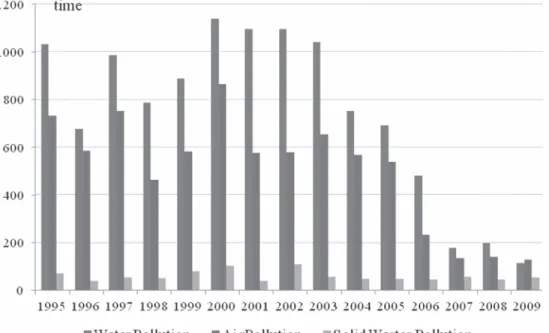
It should also be noted, however, that legislative actions have not completely failed, as it is clear in Figure 10 that environmental accidents have gradually decreased over time. In the year 2000, 2411 environmental accidents plagued China. In 2010, there were only 410 reported environmental accidents. However while this seems impressive, it should be noted, as seen in Table2, the environmental accident and pollution data from several provinces have gone unreported for some reason. Shanghai, according to this data, suffered 161 environmental accidents in 2010, the most of any region. 71 of these were related to air pollution, which can be explained by the city’s massive population, the largest of any city in China, and
subsequent pollution-heavy car use. The 26 instances of water pollution can also be explained when Shanghai’s heavy industries are taken under consideration.
(2)Global Actions
China’s failure with its own environmental problems has aggravated other nations’ environment and will continue to do so unless China can turn the situation around. Acid rain and air pollution in particular have expanded gradually throughout the Chinese countryside and will soon bring devastating consequences to other nations(Figures 9). China, while prioritizing to mend its own fence, should thus make whatever efforts are possible to cooperate with the international community. Hu Jintao already assured of China’s efforts to reduce emissions of pollutants. At the same time, he reminded the already-industrialized West of responsibilities to share the primary burden of global environmental protection. Clearly, China’s insolvency with regards to its environmental problems will have devastating effects on the global economy. The West should cooperate with China in a building capacity, sharing information on environmental management and by sharing access to green technology.
China and Japan already agreed to work together on issues related to global warming under the U. N. Framework Convention on Climate Change(26)
. Both nations will make an effort to promote the post-Kyoto Protocol agreement. China and the United States, as the two largest consumers of energy in the world, have an ongoing dialogue on energy policy annually since June 2005. China, as a heavy investor in the Association of Southeast Asian Nations’ (ASEAN) business ventures, has shown an interest for a joint agreement on energy and pollution issues(27)
.
Figure 11. Environmental Accidents in China Source: China Statistics Yearbook 2010.
5. Concluding Remark
China’s robust growth over the past four decades gave rise to disastrous consequences on the country’s environmental conditions, putting its people much at risk in health and quality of life. The Chinese government’s preoccupation with growth and its systemic failure in environment protection have led to ecological problems of every kind. Critics of the Chinese model even suspect that China may have already reached a point of no return where environmentally sustainable development becomes irreversible. Moreover, it must be noted that China’s recent policies have largely been aimed at reducing local pollution, and certainly
Table 2. Environmental Accidents in China by province in 2010.
Region
Number of
Environmental Water Air Ocean SolidWastes
Noise and
Vibration Others Accidents(time) Pollution Pollution Pollution Pollution Pollution
National Total 420 135 157 3 35 1 89 Beijing 30 1 11 13 5 Tianjin Hebei 7 2 3 2 Shanxi 9 2 2 5 Inner Mongolia 5 4 1 Liaoning 10 1 6 1 1 1 Jilin 3 3 Heilongjiang Shanghai 161 26 71 9 55 Jiangsu 7 2 2 3 Zhejiang 35 19 10 1 5 Anhui 30 10 8 5 7 Fujian 4 2 1 1 Jiangxi 9 5 1 1 2 Shandong Henan 18 8 8 1 1 Hubei 27 15 10 1 1 Hunan 1 1 Guangdong 2 2 Guangxi 4 3 1 Hainan Chongqing 23 16 7 Sichuan 1 1 Guizhou 5 2 2 1 Yunnan Tibet Shaanxi 9 7 2 Gansu 10 3 6 1 Qinghai 1 1 Ningxia 3 3 Xinjiang 6 6
not at curbing greenhouse gas emissions for the benefi t of the world.
While most open, relatively-democratic societies progress through periods of large-scale resource consumption and pollution, their free economies develop and advance to eventually emerge with environmentally-effi cient technology. China, on the other hand, is not bound by free market forces with regards to its technological development, which could strongly infl uence how long the current generation of pollution-intensive technology remains in use. The fate of China’s industrial future therefore rests entirely in the hands of the central government and its desire to reform. Through economic and political reformation and liberalization, the Chinese government can hope to continue economic growth without simultaneously suffering crippling pollution.
In response to the mounting domestic protests, social unrest, and international pressures, the Chinese government only recently became more seriously concerned with protecting the environment. Many barriers exist that prevent the government from adequately addressing the issues on environment and growth simultaneously. These include global uncertainty, rigidity and ineffi ciency in governance, bureaucratic corruptions and rent-seeking activities, technical challenges, and economic realities. Without much bolder and improved policy implementation in place and in the absence of effective global cooperation, it does not appear the government’s current efforts will be enough to assure a sustainable development in the foreseeable future.
Endnotes
*The authors are, respectively, professor of economics at Kellogg Institute for International Studies, University of Notre Dame, USA, guest researcher of Institute of Asian Cultures at Toyo University; professor of economics at Toyo University, Japan; and research fellow at Kellogg Institute of International Studies, University of Notre Dame, USA.
⑴ Koleski, Katherine (June 24, 2011). “Backgrounder: China’s 12th Five-Year Plan.” U. S.-China Economic & Security Review. p.4.
⑵ Koleski, op. cit. p.6.
⑶ MacBean, Alasdair (2007), “China’s Environment: Problems and Policies.” The World Economy. Oxford University Press: p.298.
⑷ MacBean, Alasdair (2007), op. cit. p.299.
⑸ Jin, Bei (2009). “The Relationship between Resource and Environmental Regulation and Industrial Competitiveness.” China Economist. 2009. p.39.
⑹ Chow, George C. (2007), “China’s Energy and Environmental Problems and Policies.” Econometric Research Program. p.11.
⑺ The amount of oxygen required when chemical oxidants are used to oxidize organic pollutants in water. A higher value refl ects more serious pollution by organic pollutants.
⑻ MacBean, Alasdair (2007), op. cit. p.293.
⑼ Ke, Ma. “Driving Force Transmission Mechanism in Chiense Local Government Performance Management Innovation: Deadlock and Reconstruction.” 5-11. Web.
⑽ Reyes, Esteli (2007). “Challenges for Effective Policy Implementation toward a Sustainable Coal Sector in China.” Vancouver, B. C.: Esteli Reyes, 2007. p.15.
⑾ Chow, George C. (2007), op. cit. p.3.
Project (2007): 2-3. Print.
⒀ Matsuno, Hiroshi (2009). “China’s Environmental Policy: Its Effectiveness and Suggested Approaches for Japanese Companies.” NRI Papers. Nomura Research Institute. p.7.
⒁ Wang, Canfa. (2007), “Chinese Environmental Law Enforcement: Current Defi ciencies and Suggested Reforms.” Beijing, China. p.170.
⒂ Mendelsohn, Robert, Ariel Dinar, Jikun Huang, Scott Rozelle, and Lijuan Zhang (2008). “Can China Continue Feeding Itself?” Policy Research Working Paper. World Bank, p.9-10.
⒃ Kim, Yoon Jung, and Dongchao Li (2008),. “Chinese Policies on Climate Change and Environment Protection,” Xiaojie Xu & James A. Baker, ed., The Global Energy Market: Comprehensive Strategies to Meet Geopolitical and
Financial Risks. Institute for Public Policy, Rice University, p.3.
⒄ Chow, George C (2007), op. cit. p.5. ⒅ MacBean, Alasdair (2007), op. cit. p.304. ⒆ MacBean, Alasdair (2007), op. cit. p.297.
⒇ “Environment and Health in the People’s Republic of China.” United Nations in China’ (2009): 12-13. Print. Economy, Elizabeth C (2007), “The Great Leap Backward?”, Foreign Affairs, 86(5), 46.
Bei, Jin (2009), op. cit. p.43.
MacBean, Alasdair (2007), op. cit. p.301. Wang, Canfa. (2007), op. cit. p.174. MacBean, Alasdair (2007), op. cit. p.304.
Kim, Yoon Jung, and Dongchao Li. (2008), op. cit. p.25.
Yoshida, Takashi. (2010) “Environmental Pollution Control: Advantage or Disadvantage for Latecomer’s Economies in East Asia?” PRI Discussion Paper Series. Hiroyuki Taguchi. A ed. Vol.10. Tokyo, Japan: Research Department Policy Institute, MOF. 15-16. Ser.2. p.10.
References
Bei, Jin. “The Relationship between Resource and Environmental Regulation and Industrial Competitiveness” China
Economist. 2009.
Chow, Gregory C. “China’s Energy and Environmental Problems and Policies.” CEPS Working Paper 152, Princeton University. 2007.
Foster, Kenneth W. “Administration Campaigns and Environmental Governance in Contemporary China.” In Guo Li:
China Environmental Science & Sustainability (CESS), UBC-Research Group. 2008.
H. Shi & L. Zhang, “Environmental Governance of China’s Rapid Industrialization,” Environmental Politics, 2006. Hosgood, III, H. Dean. “Environmental Health and Indorr Air Pollution in China.” China Environmental Health
Project (2007): 2-3. Print.
J. Turner and L. Zhi: “Building a green civil society in China,” www.worldwatch.org/node/4000.2008.
Javier Santioso, “Angel or devil?: Chinese impact on Latin America.”. 2005 Conference proceedings, Amsterdam, May 23-24th
, 2005.
K. O’Brien & L. Li: Rightful Resistance in Rural China, Cambridge Press, 2006.
Ke, Ma. “Driving Force Transmission Mechanism in Chinese Local Government Performance Management Innovation: Deadlock and Reconstruction.” 5-11. Web.
Kim, Yoon Jung, and Dongchao Li. “Chinese Policies on Climate Change and Environment Protection.” in Xiaojie Xu & J. A. Baker, The Global Energy Market: Comprehensive Strategies to Meet Geopolitical and Financial Risks,
Institute for Public Policy, Rice University Press, 2008.
Koleski, Katherine. “Backgrounder: China’s 12th Five-Year Plan.” In Joseph Casey. U. S.-China Economic & Security Review Commission report, 2011.
MacBean, Alasdair. “China’s Environment: Problems and Policies.” The World Economy. Oxford University, 2007. Matsuno, Hiroshi. “China’s Environmental Policy: Its Effectiveness and Suggested Approaches for Japanese
Companies.” NRI Papers. Nomura Research Institute, Tokyo, 2009.
Mendelsohn, R., A. Dinar, J. Huang, S. Rozelle, and L. Zhang: “Can China Continue Feeding Itself?” Policy Research
Working Paper (4470). World Bank, 2008.
Reyes, Esteli. “Challenges for Effective Policy Implementation toward a Sustainable Coal Sector in China.” Vancouver, B. C.: Esteli Reyes, 2007.
T. Friedman, Hot, Flat, and Crowded, (NY: Picador, 2006).
T. Panayotou, “Economic Growth and the Environment”, CID Working Paper 56. Harvard, 2000.
Wang, Canfa. Chinese Environmental Law Enforcement: Current Defi ciencies and Suggested Reforms, Vol.8(2), Beijing; 2007.
Taguchi, H. & Y. Takashi: “Environment Pollution Control: Advantage or Disadvantage for Latecomer’s Economies in East Asia?- GMM Estimation on Environmental Kuznets Curve”, Policy Research Institute, Tokyo, 2010.
United Nations. “Environment and Health in the People’s Republic of China.” United Nations in China, 2009: 12-13. Print.