
JAIST Repository: Theoretical Study of Physical and Chemical Properties of Pt Clusters Adsorbed on Single Wall Carbon Nanotubes
5
0
0
全文
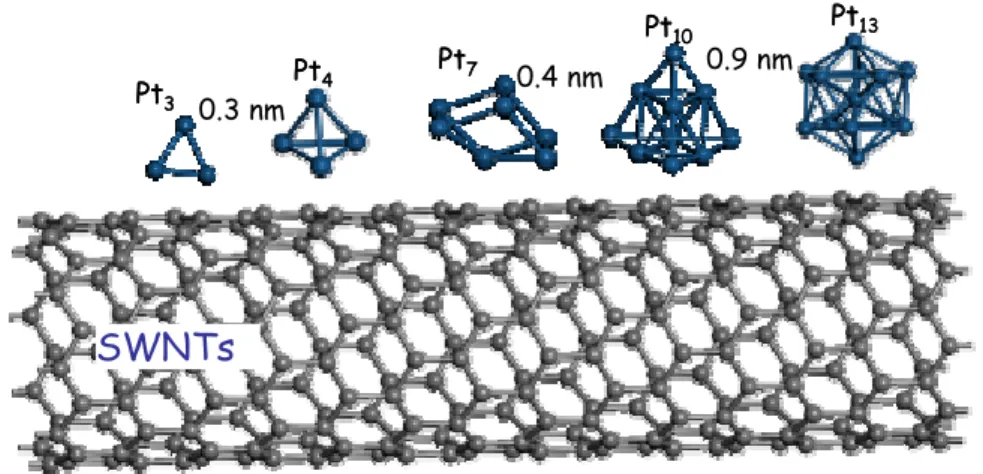
(2) 1. Theoretical Study of Physical and Chemical Properties of Pt Clusters Adsorbed on Single Wall Carbon Nanotubes Fujiwara Lab. 0640203. Nguyen Thanh Cuong. Introduction Platinum metal is widely used in environmentally and economically important processes, such as conversion of harmful gases into less harmful ones, hydrogenation and electrode-reactions of fuel cells, because of its high catalytic activity. It is, however, a precious metal, quite expensive, and limited supply. Therefore, reduction of the consumption of platinum metal is one of the most important issues. By using small clusters, the significant reduction of the consumption is expected. Recently, highly dispersed and size-controlled small Pt clusters (less than 1 nm) made from the dispersed single Pt atoms were achieved by using carbon nanotube (CNT) supports. A miniaturization of materials usually results not only in the enhancement of relative surface area but also in the change of the property itself. Metal nanoclusters usually exhibit the unique catalytic properties that differ from those of extended flat surface or bulk materials. The properties of metal nanoclusters can be governed by several factors such as geometric factors (atomic arrangement, number of coordination), electronic factors (charge states, density of states), and support effects or dynamics structures. These parameters, however, are not always clearly distinct, since a change in the surroundings of a surface atom has a simultaneous influence on its electronic structure. Therefore, characterization and precise control of the properties of Pt clusters are among the outstanding challenges in the research fields of both physics and chemistry, and can lead to atom-by-atom design, tuning and control of chemical activity of Pt clusters. The main purposes of our research are using first-principles density functional theory (DFT) simulation, which is presently established as a standard tool for large system with a reliable compromise between accuracy and efficiency: -. To explore the physical properties (geometry and electronic structure) of small Ptn (n = 3, 4, 7, 10, 13) nanoclusters adsorbed on single wall carbon nanotubes (SWNTs) support.. -. To investigate the chemical reactivity of Ptn (n = 3, 4, 7, 10, 13) clusters adsorbed on single wall carbon nanotubes (SWNTs) support, for reactions in fuel cell particularly.. Computational Methodology Physical and chemical properties of Ptn (n = 3, 4, 7, 10, 13) nanoclusters adsorbed on single wall carbon nanotubes (SWNTs) support have been investigated by density functional theory-based simulations in DMol3 code and OpenMX code. All calculations are carried out under the periodic boundary conditions. The PBE exchange-correlation functional is used to treatment the electron-electron interactions. Double numerical with polarization orbitals basis sets, and normconversing pseudo-potentials are used. The initial structures of Ptn (n = 3, 4, 7, 10, 13) clusters are chosen from stable structures in gas phase. Then, adsorptions of single Pt atom and the Pt clusters on SWNTs support are performed, as shown in Fig. 1, to clarify the their geometric structures. Electronic structures of Ptn (n = 3, 4, 7, 10, 13) clusters on SWNTs support are investigated based on the density of states and charge distribution analyses. The chemical reactivity of Ptn (n = 3, 4, 7, 10, 13) clusters on SWNTs support are explored through the adsorption of O2, CO, OH species, which are primary reactions in hydrogen fuel cell or direct methanol fuel cell (DMFC)..
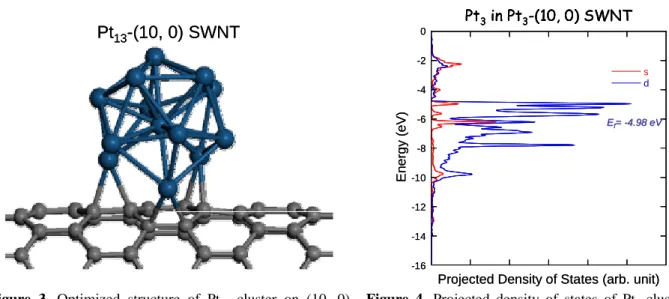
(3) 2. Pt3. 0.3 nm. Pt4. Pt7. Pt10 0.4 nm. 0.9 nm. Pt13. SWNTs. Figure 1. Simulation models of Ptn (n = 3, 4, 7, 10, 13) nanoclusters on SWNTs support Moreover, the oxidation reaction of CO and OH, a rate-limiting step in DMFC is also investigated. The effects of geometry, electronic structure, and dynamic structure on the chemical reactivity of Pt clusters on SWNT are discussed.. Results and Discussion 1. Morphology of Ptn (n = 3, 4, 7, 10, 13) clusters on SWNTs support Figure 2 shows the optimized structures, electronic structure of single Pt atom on the (10, 0) SWNT support. The results show that the interaction between Pt and C is a weak covalent nature with hybridization between d-states of Pt and p-states of C. Pt adatoms can easily diffuse on the surface of SWNT and tend to form a cluster, than to disperse on the SWNT surface. Small Ptn (n = 3, 4, 7, 10, 13) clusters on single wall carbon nanotubes (SWNTs) support are preferred 3 dimensional structures, as shown in Fig. 3. The stability of Pt clusters strongly depends on the curvature and symmetry of the SWNTs surface. In addition, the Pt clusters adsorbed on SWNTs support exhibit several energetically accessible structural configurations with rather low energy barriers that Pt clusters fluctuate rapidly among the configurations, results a high degree of structural fluxionality. 2. Electronic structures of Ptn (n = 3, 4, 7, 10, 13) clusters on SWNT support Figure 4 shows the projected density of states of Pt3 cluster in the Pt3-(10, 0) SWNT. Due to a strong mixing between d-states of Pt clusters and p-states of carbon nanotube, electronic structures of Ptn clusters on SWNTs are. Pt-(10, 0) SWNT. Density of States. dPt-pC Hybridization. 1. Energy (eV). 0. EF. -1 -2 -3 -4 -5 -6. Figure 2. Optimized structure, electronic structures of single Pt atom on the (10, 0) SWNT support.
(4) 3. Pt13-(10, 0) SWNT. Pt3 in Pt3-(10, 0) SWNT. 0 -2. s d. Energy (eV). -4 -6. Ef= -4.98 eV. -8 -10 -12 -14 -16. Projected Density of States (arb. unit). Figure 3. Optimized structure of Pt13 cluster on (10, 0) SWNT support. Figure 4. Projected density of states of Pt3 cluster in Pt3-(10, 0) SWNT. characterized by broadening in a wide range of d-states of Pt clusters, and become bulk-like density of states, at relatively small cluster size. Electron density is accumulated at Pt-C bonds, and a small amount of charge transfer from Pt clusters to SWNT support occurs, in an agreement with experimental measurements. Geometry and electronic structures of Pt clusters on SWNTs support are strongly interrelated. 3. Chemical reactivity of Ptn (n = 3, 4, 7, 10, 13) clusters on SWNT support Mechanisms of the most important chemical reactions at anode and cathode electrodes of fuel cell are investigated. The results demonstrate that adsorption process of O2 and CO is strongly depends on ‘local structure’ and cluster size of Pt clusters on SWNT. Oxygen molecule preferably adsorbs on the Pt-Pt bridge site that suggests the mechanism of oxygen reduction reaction is preferred the 4-electron direct pathway. The ‘Bronsted-Evans-Polanyi’ relation, a linear relation between adsorption energy and activation energy of the dissociation adsorption of O2 and CO oxidation reactions on the Pt clusters adsorbed on SWNT support, is observed. These results suggest that adsorption energies of O2 and CO can be used as descriptors for screening and designing better catalysts in O2 activation process, and CO oxidation process.. Conclusions We have studies the physical and chemical properties of small Ptn (n = 3, 4, 7, 10, 13) clusters on single wall carbon nanotubes (SWNTs) support. The results are summarized as follows: -. Interaction between Pt and C is a weak covalent nature with hybridizations between d-states of Pt and pstates of C.. -. Small Pt clusters on SWNTs support are preferred 3 dimensional structures. The stability of Pt clusters strongly depends on the curvature of the SWNTs. Small Pt clusters adsorbed on SWNTs support exhibit a high degree of structural fluxionality.. -. Small Pt clusters on SWNTs support exhibit high reactivity with O2, CO, OH species. Adsorption energies of O2 and CO can be used as descriptors for screening and designing better catalysts.. The results of this research provide insight into understanding behaviors of Pt clusters on SWNTs support at atomic-scale. These findings also give useful properties of hybrid materials: small transition metal clusters on carbon nanotube support. This research can potentially open a new aspect to atom-by atom design and control the properties of small Pt clusters..
(5) 4. Contents of the dissertation 1. Introduction 2. Metal nanoclusters fundamentals and platinum nanoclusters 3. Ab-initio simulation methods in materials science 4. Structures of Pt clusters adsorbed on single wall carbon nanotubes 5. Electronic structures of Pt clusters adsorbed on single wall carbon nanotubes 6. Chemical reactivity of Pt clusters adsorbed on single wall carbon nanotubes 7. Conclusions 8. Bibliography 9. Publication list 10. Abstract of Subtheme. 1 4 22 37 56 66 83 85 88 89. List of publications [1]. Nguyen Thanh Cuong, Dam Hieu Chi, Yong-Tae Kim, and Tadaoki Mitani, “Structural and electronic properties of Ptn (n = 3, 7, 13) clusters on metallic single wall carbon nanotube”, Phys. Status Solidi B 243, 3472–3475 (2006).. [2]. Dam Hieu Chi, Nguyen Thanh Cuong, Nguyen Anh Tuan, Yong-Tae Kim, Ho Tu Bao, Tadaoki Mitani, Taisuke Ozaki, Hidemi Nagao, “Electronic structures of Pt clusters adsorbed on (5, 5) single wall carbon nanotube”, Chem. Phys. Lett. 432, 213-217 (2006).. [3]. Nguyen Thanh Cuong, Akihiko Fujiwara, Tadaoki Mitani, Dam Hieu Chi, “Effects of carbon supports on Pt nano-cluster catalyst”, Comput. Mater. Sci. 44, 163–166 (2008).. [4]. Hieu Chi Dam, Nguyen Thanh Cuong, Ayumu Sugiyama, Taisuke Ozaki, Akihiko Fujiwara, Tadaoki Mitani, Susumu Okada, “Substrate-mediated interactions of Pt atoms adsorbed on single wall carbon nanotubes: Density functional calculations”, Phys. Rev. B 79, 115426 (2009).. [5]. Nguyen Thanh Cuong, Ayumu Sugiyama, Akihiko Fujiwara, Tadaoki Mitani, Dam Hieu Chi, “Density functional study of Pt4 clusters adsorbed on a carbon nanotube support”, Phys. Rev. B 79, 235417 (2009)..
(6)
図
関連したドキュメント
A two-dimensional viscous dusty flow induced by normal oscillation of a wavy wall for moderately large Reynolds number is studied on the basis of boundary layer theory in the case
Many of the proper- ties of the Coxeter groups extend to zircons: in particular, we prove that zircons are Eulerian posets, that open intervals in zircons are isomorphic to spheres,
Indeed, if we use the indicated decoration for this knot, it is straightforward if tedious to verify that there is a unique essential state in dimension 0, and it has filtration
In Section 3, we show that the clique- width is unbounded in any superfactorial class of graphs, and in Section 4, we prove that the clique-width is bounded in any hereditary
In this paper, under some conditions, we show that the so- lution of a semidiscrete form of a nonlocal parabolic problem quenches in a finite time and estimate its semidiscrete
Wall theorems give local lower bounds for the p-measure of the boundary of a domain in the euclidean n -space.. We improve earlier results by replacing the euclidean metric by the
COVERING PROPERTIES OF MEROMORPHIC FUNCTIONS 581 In this section we consider Euclidean triangles ∆ with sides a, b, c and angles α, β, γ opposite to these sides.. Then (57) implies
Zonal flow formations in two-dimensional turbulence on a rotating sphere (Part 1) Alex Mahalov (Arizona State University). Stochastic Three-Dimensional Navier-Stokes Equations +
