ウ ェ ブ ス タ ー の ホ ー ン 方 程 式 に お け る 摂 動 論 に よ る 高 精 度 計 算 手 法
濱野 慶太*1,坂 本 昇一*2,富 谷 光 良*3
Highly Accurate Perturbative Method for Webster's Horn Equation
Keita HAMANO * 1, Shoichi SAKAMOTO * 2 Mitsuyoshi TOMIYA * 3
ABSTRACT : Applying mathematical and quantum mechanical techniques, this study develops numerical
solutions to Webster's horn equation, which describes the sound inside brass instruments in acoustics. The
wavenumbers and wave functions of the modes in the system are evaluated by perturbation theory, assuming
a solvable system with relatively small perturbations. An obvious solvable example is a straight pipe, whose
wavenumbers can be perturbed by varying the radius of the horn. Maintaining the second-order corrections,
the method generated astonishingly accurate results for varying horn shapes. Moreover, in tests of various
pipe shapes, the perturbation method required far fewer computational resources than the finite element
method. Two analytically solvable shapes and two non-solvable models (one of them is a periodic shape
described by a trigonometric function) are analyzed. The results imply the applicability of the method to
highly non-solvable systems.
Keywords : Webster's Horn Equation, Perturbation Theory, Brass Instruments, High Accuracy Solutions
(Received June 8, 2018)
1 INTRODUCTION
Lately, sophisticated tools designed for solving nonlinear problems have been successfully applied to studies of wind instruments. In particular, these tools can analyze the resonance phenomena and predict the sound propagation and reflection inside finite spaces such as pipes)) A typical application reveals the dynamic function of the register hole on the clarinet, which comprises a two-delay system.2)
However, the sound making methods and resonance mechanisms of musical instruments have not been sufficiently unravelled.1) 3) Even simply structured instruments such as recorders remain incompletely understood. Therefore, investigating these mechanisms is essential for the research and development of wind instruments. One promising approach toward a precise and manageable design method for specific
*1:理 工 学 研 究 科 物 質 生 命 理 工 学 専 攻 修 士 学 生 *2:物 質 生 命 理 工 学 専 攻 助 教
*3:物 質 生 命 理 工 学 専 攻 教 授(tomiya@st .seikei.ac.jp)
instruments is the technique in quantum mechanics, which naturally describes wave dynamics. The expected close relationship between acoustics and quantum mechanics should exactly fulfil our intention.4>
As a representative brass instrument, a trumpet can be divided into three parts: a lead pipe, a piston unit and a horn (also called a bell).1)'3) The lead pipe amplifies the sound, the pistons control the pitch and the horn acts as a speaker. Additionally, the horn is easily manufactured in various sizes and shapes, and from a variety of materials. Indeed, the horn is merely the aperture of the instrument, and its tone is easily supplemented by distinguishing characteristics.
The normal modes and frequencies of the horn can be altered by adjusting the horn structure. Understanding the relationship between the modes and structure of a horn is crucial in instrument manufacture. The pressure changes inside the horn are well approximated by Webster's horn equation,5)'6) which is generally solved by numerical methods; analytical solutions can be obtained only in some special cases. However, the balance of the musical instrument can be disrupted by
numerical errors, which are unavoidable
in numerical analyses.
In this work, we approach the acoustics in a horn from a
quantum mechanics perspective. The perturbation method,
which derives the solutions of Schrodinger
equation with small
perturbations,7) can evaluate the modes of brass
instruments.8>'9)
For various horn shapes, the approximate
solutions computed by perturbation theory are far more
accurate than those of ordinary numerical methods such as the
finite element method (FEM)Iom
0 and the eigenfunction
expansion method.6'12)'13)
Although quantum physics underlies the modern science of
the twentieth century, the perturbation method was originally
developed
to explain the motions of planets in the solar system,
and stars in galaxies, and similar problems in classical
astrophysics.14>
The Webster's equation, which describes
the sound in a pipe
with varying radius,10>
can be mathematically likened to a
perturbed Schrodinger equation.8)'9)
Thus, perturbation theory
can be applied to the acoustics of brass instruments.
Perturbation
theory divides the system into a non-perturbative
and a perturbative
part. The former part usually admits an exact
solution, whereas the latter is expressed
as an asymptotic series
expansion with respect to the perturbation term, assuming a
sufficiently
small perturbation
strength. This formulation
gives
an approximate solution to systems with no exact analytical
solutions.
Our system treats the horn structure as a straight pipe
(exactly solvable) with some deformations (perturbations),
which model the deformation of the stationary states. The
method returns precise results for the rotation volumes (one
revolution around the x-axis) of four horn structures,
proportional to e x , 1/x, 3+ cos x , and ln(x) (x>0). Ordinary
numerical methods such as FEM usually perform best in the
lower frequency region, because the lattice constant must be
smaller than the wavelength. In contrast, the perturbative
method usually achieves better results in the higher frequency
region than FEM.
2 WEBSTER'S EQUATION AND SCHRODINGER
EQUATION
Sound is the physical phenomenon manifesting from the propagation of pressure changes through a medium such as air. If the wavelength is sufficiently larger than the horn diameter, the propagation becomes essentially one-dimensional and is
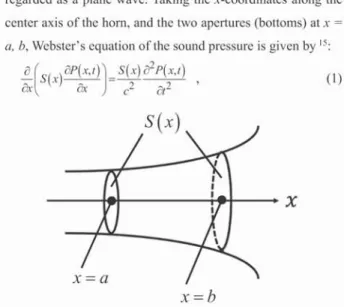
regarded as a plane wave. Taking the x-coordinates along the center axis of the horn, and the two apertures (bottoms) at x = a, b, Webster's equation of the sound pressure is given by 15:
a's(x)aP(,r)`s(~
~
)a~(~,t)
(1)
ax,S(x) .
1
x x=a i. x=bFIG. 1. Outline of the pipe to be used in Webster's equation
where P(x,t) is taken here as the acoustic or excess pressure, which is the pressure difference from the static one, S(x) represents the varying cross-sectional area of the horn part (FIG.1), c is the speed of sound, and t is time.
The Schrodinger equation for an exactly solvable system with Hamiltonian H0 is given by
H0VI0
,n = E0,nyI0,n ,(2)
where Vnis an eigenstate of the solvable system with eigen-energy E0,n• The Schrodinger equation with a small perturbation H1 then becomes
Hyin
= (H0 + H1) vin = Eyi .
(3)
The term H1 can be any suitable term, such as a potential energy, an interaction term or a perturbative part.
Quantum mechanics is a powerful tool for handling systems that satisfy the perturbation equation (3). Perturbation theory derives the energy spectra and wavefunctions of perturbative systems from those of the solvable system, adding correction terms generated by expanding the perturbation. Traditional quantum mechanics7 gives the second-order energy correction as
2
(1VO,kVil1VO,n)((4)
En
=EOn+(VO
,nVHlVO,n)—~4
knEO,n –EO,k and the first-order correction of the wave function asYin= iVOn+1VO,k
1(1VO,kVii
i'O,n)
.(5)
knEO,n —EO,k
Later, we will apply the one-dimensional Schrodinger equation
with a potential V (x)
2 – h a 2+ V (x)Yin = Enyin ,(6) 2m axwhere h is the Planck constant and m is the mass of the particle that follows Eq. (6). Comparing Eqs. (3) and (6), we find the general relations
h2 a2 H
o=---H1=V, H=H0+V.(7) 2
m ax2
Therefore, we expand the perturbation with respect to V.
3 PERTURBATION THEORY FOR WEBSTER'S
EQUATION8'9
To clarify the resemblance between the Webster's and Schrodinger equations, we try a change of variables in Webster's equation (1) as follows:
'Fn (x,t) = Pn (x,t) jS(x)(8)
r (x) = vIS
(x) ,(9)
where r is clearly proportional to the radius of its cross-section at x. The time dependence of P is separated by the factor eiwt
Pn (x ,t) = Pn (x)eiwt(10)
Here 0) is the angular frequency and
k = (11)
is the wavenumber of the wave. The equation (1) then transforms into
–d2 yin
2+r„y'_kn2yin(12) dxr
where
the
eigen-
"wavefunction":
iin (x) is also introduced
as
gin (x,t) _ vin
(x)eiwt(13)
Putting En=k,72 and h = 2m =1 , we obtain Schrodinger equation for one dimensional scattering (6), where k2
n expresses the energy of the particle and the potential energy
V (x) becomes r"/r . Note that n labels the
eigen-wavenumber kn and the eigen-energy En in a finite region, i.e., within the space of the brass instrument. The Hamiltonian of the system becomes
d2 r„ H =H0+V=–
2+—(14) dxr
Thus, the potential
energy term r"/r plays a perturbative
role.
Different from Schrodinger equation, we do not normalize
yin
(x) , because
the
term yin
(x)IIS(x) represents
the
sound
pressure at x. Therefore, the normalization would remove some important information.
Perturbation theory is applicable when the contribution of the perturbation H1 = V = r is relatively small. To obtain the difference between k0,n2 of the straight pipe and kn2 with a second-order perturbation V, we modify Eqs. (4) and (5)
as 2 Y
~)_~1---
z 21Y" —1 , (15) k n = k0+YnYiO,nYY~O,nrk22Yn mnk0,n— k0,m r" Y1O,m rY1O,n16 Y/n =1110,n +2 2 7nYO,n() mn kO,n -kO,mwhere the symbols in (15) and (16) are respectively defined as r"b r"
(1ff
0,n ,m)
' VO,n
—vto,mdx(17)
a and bYn=~1VO,n2dx•(18)
a The factor yn is introduced for acoustical applications. In
quantum mechanics, the wavefunctions yin must be
normalized
as yn =1 , because yin (x)2 dx represents
the
probability that a corresponding particle exists in the range
[x, x+dx] . Therefore,
integrating
all probabilities
of a particle
existing in that region, we obtain
Jb
a2(l ,(19)
implying that the particle is somewhere inside the whole range
[a, b] .
As a non-perturbative system, we solve Webster's equation in a straight pipe. The non-perturbative system should be solvable and admit a series of analytical and exact solutions
vn(x)
A straight-pipe
system is obtained
by neglecting
the potential
energy term r"/r . The solution of the non-perturbed
Eq. (12)
is
1VO
,n
(x)
= An
cos
(kpnx)
+
Bn
sin
(kpnx)
.
(20)
The boundary condition quantizes the wavenumber k. The general solution for the straight pipe, obtained by summing the
kn , is the following Fourier decomposition, as expected:
1'o(x)=L1'O
,n(x)
n(21)
= L{An
cos(ko
nx)+Bn
sin(ko
,nx)}
n As the horn is open-ended at both sides, u must be 0 at both ends x = a and x = b . Thus, the boundary conditions are
tan
(ko,na) = tan (ko,nb)
= - An
1B
;
equivalently,
sin
{k
(b - a)}
= 0 . Thus,
the
wavenumbers
are
quantized
as
n7cnic() k 0'n22 b -a L
Under this boundary condition, Eq. (21) becomes
11/o
=I Bn
{sin
(ko
nx)-tan(ko
n)cos(ko
nx)} (23)
n
Eq.
(22)
also
offers
the
eigen-frequency
fo,n = cko n /271"
= en/2(b - a) of the sound wave in the straight
pipe. (al Solvable system R I , 0 aL
~ x
Strai2ht (h) R Perturbativej{r(x)
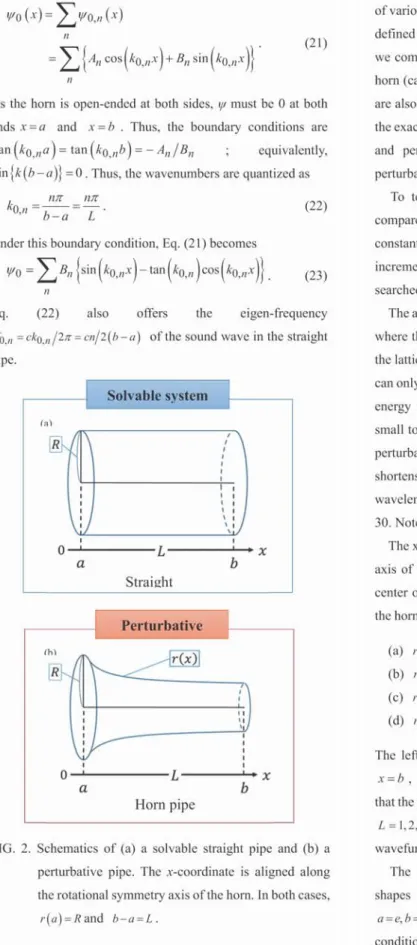
I I I /I I VI 0 J a L '.x b Horn pipeFIG. 2. Schematics of (a) a solvable straight pipe and (b) a perturbative pipe. The x-coordinate is aligned along
the rotational symmetry axis of the horn. In both cases,
r(a)=Rand b-a=L.
4 NUMERICAL CALCULATION MODELS
The shape of a horn pipe can be modeled by various functions. In this paper, we apply perturbation theory to horns
of various shapes. Each shape is determined by rotating a body defined by the function r(x) around the x-axis. For each shape, we compare the solutions of the straight pipe and the varying horn (calculated by perturbation theory)(FIG.2). The solutions are also compared with those of typical numerical methods. If the exact solution is obtainable, comparisons between the exact and perturbative solutions will validate or invalidate the perturbation method.
To test the accuracy and efficiency of our method, we compare our results with those of FEM10,11. The lattice constant is set to AK = 0.001 . The energy E = k2 is incremented by AE = A(k2) = 0.0002 , and the eigenstates are searched.
The accuracy of FEM usually deteriorates at higher energies, where the wavelength becomes comparable to or smaller than the lattice constant Ax . Therefore, computational approaches can only roughly approximate the physical phenomena in high-energy regions. The lattice constant must be set sufficiently small to prevent this degradation. The wavelength of the
non-perturbative system A0,
n= 27z/ko,12
= 2L/n
reduces as L
shortens and/or n increases. In our work, the shortest
wavelength
is 4 ,30 = 2 x 1/30 = 0.06667...
» Ox for L= 1 and n =
30. Note that 20,30 is more than sixty times larger than Ax .
The x-coordinate
of Webster's equation must align along the
axis of rotational symmetry of the pipe (namely, through the
center of the pipe). In the perturbative systems, the shapes of
the horn pipe are given by the following functions
(see FIG. 3):
(a) r (x) = e-x
(b) r (x) =1/x(24)
(c) r(x)=3+cosx
(d) r(x)=lnx
.
The left and right ends of the pipe are located at x = a and x = b , respectively. The pipe length is L=b-a . To ensure that the pipe shape changes gradually along its length, we select L = 1, 2,... ,10 , and determine the wavenumbers k and wavefunctions'n for n= 1, 2,... , 30 .
The end positions are set to a= 0, b= L for potential shapes (a) and (c), a= 1, b = L + 1 for shape (b) and a = e, b = e+L for shape (d). When a=0 , the boundary conditions reduce to the simple forms An = 0 and
tan
(k120
b) = 0 , and
the
result
becomes
Eq.
(22).
This section focuses on V n rather thanPn = vn l j ,
because the effect of varying the radius is much easier to distinguish in ln than in pressure. Different from their usual
definitions, both "energy" and "potential" have units of m-2 and are so named only by mathematical analogy between the Webster's and the Schrodinger equations.
r (x)
=L
„'
0b
r (x) = e-x (a)
'.L0 Ibr(x)=
rr(x)=3+cosx
A. Potential (a): r(x) = ex
In this case r"/r =1 is a constant
"potential",
and Webster's
equation
becomes
d2d'n(k
n2
_ l)vn.(25)
dx2The spectrum is essentially that of the straight-pipe potential
r(x) = 0 (FIG. 4), but with kn2 , in the right-hand
side
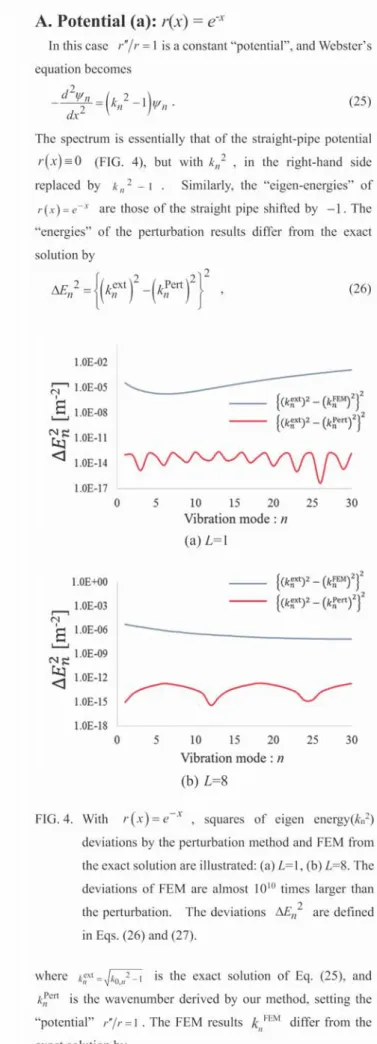
replaced by k 2 - 1 . Similarly, the "eigen-energies" of r (x) = e-x are those of the straight pipe shifted by -1. The "energies" of the perturbation results differ from the exact
solution by 2
AEn2
= (knxt)2(kPert)2(26)
r(x)
I.
L_,..1
elb
xr(x)=1nx
Schematics of the pipe shapes investigated in
perturbation
study: (a) r(x) = e-x , (b) r(x) =1/x ,
r(x)=3+ cos
x, (d)r(x)=1nx.
the (c) 1.0E-02 r^1.0E-052b{(knxt)2
_ (k~`EM)2)
`J 1.0E-08j(knxt)2
_(knert)212
.~ 1.0E-11I)
<I 1.0E-17 0 5 10 15 20 25 30 Vibration mode : n (a) L=11.0E+00---
{(knxt)2
_ (knEM)212
1.0E-03{(knxt)2
_ (knert)2)2
NIE 1
.0E-06
CV1.0E-0941.0E-12
1.0E-15
1.0E-18
0
5
10
15
20
25
30
Vibration
mode : n
(b) L=8
FIG. 4. With r (x) = e
, squares of eigen energy(kn2)
deviations
by the perturbation
method
and FEM from
the exact
solution
are illustrated:
(a) L=1, (b) L=8. The
deviations
of FEM are almost 101°
times larger than
the perturbation. The deviations
AEn2 are defined
in Eqs. (26) and (27).
where knXt
= jkOn2
_ 1 is the exact solution
of Eq. (25), and
kPert
is the wavenumber
derived
by our method,
setting
the
"potential" r"/r =1 . The FEM results k
nFEM
differ from the
exact solution
by
FIG.3.
AEn2_(knxt
)2
—(kkEM)22(27)
where kn
EM is the wavenumber
obtained by FEM.
The calculation which can be estimated in this case, because the exact solution is obtainable. The deviation result AEn2 of the perturbation method is strikingly superior (by 10 orders of magnitude) to the FEM result. The deviations from the exact squared "energies" approach the precision limit of the computational program (FIG. 4). Of course, the wavefunctions are identical to those in a straight pipe.
B. Potential (b): r(x)=1/x
In this case, r"/r= 2/x2 is a monotonically
decreasing
function ofx. This case is also exceptional, because its equation
_d22n
+ 2 yin = kn2~n
.
(28)dxx
can be solved analytically. The solutions are linear
combinations of the Bessel function
2 ~sinx
J3 (x) _—cos
x and the Neumann
function
2Tcxx
/
N3 (x)=J _3 (x)=—?sin
x+cosx
2271"x \x •
n (x) = AnJ3
22(knx)+BnN1
(knx) .(29)
The boundary
condition yin (a) = yrn (b) = 0 then becomes
Nz(kna)N3(knb)
A
n
J
2(kna)J2(knb)B(30)
and k is properly determined8). In terms of kn, the boundary condition is written as
tan{kn
(b—a)}
=kn
(a+b)
2(31) k nab—1
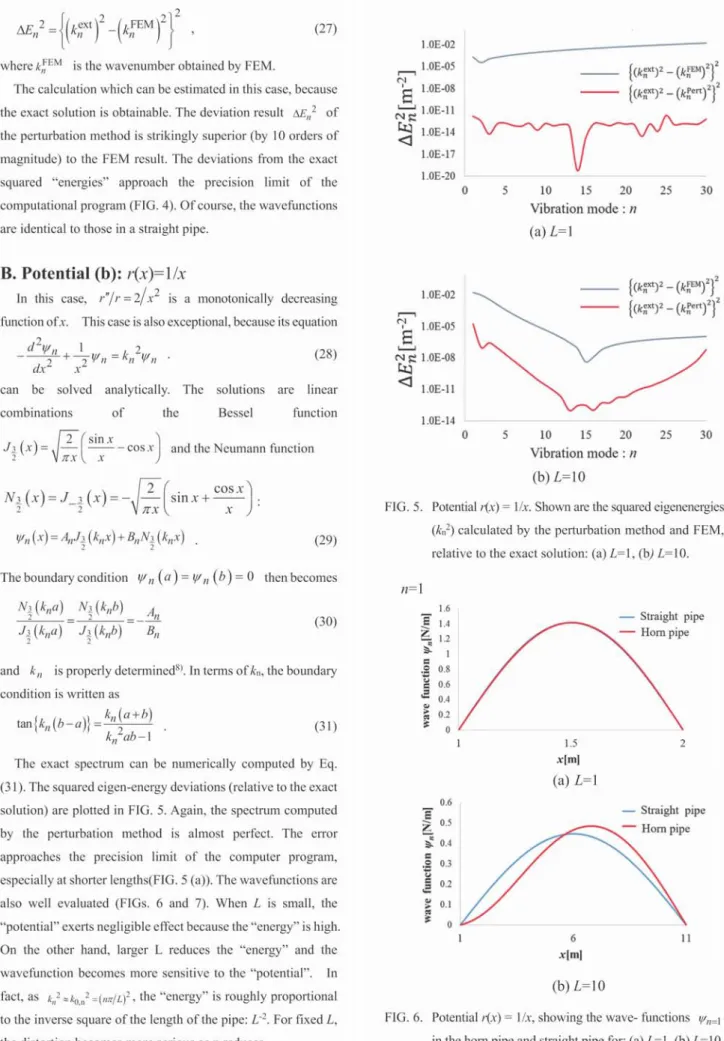
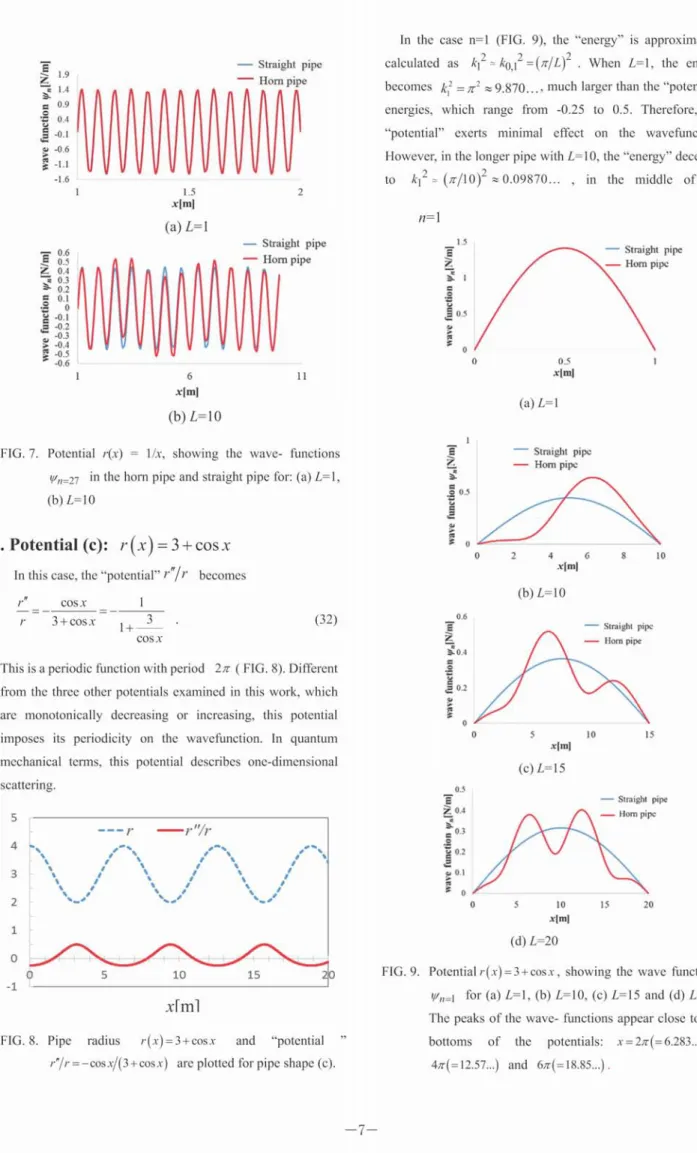
The exact spectrum can be numerically computed by Eq. (31). The squared eigen-energy deviations (relative to the exact solution) are plotted in FIG. 5. Again, the spectrum computed by the perturbation method is almost perfect. The error approaches the precision limit of the computer program, especially at shorter lengths(FIG. 5 (a)). The wavefunctions are also well evaluated (FIGs. 6 and 7). When L is small, the "potential" exerts negligible effect because the "energy" is high. On the other hand, larger L reduces the "energy" and the wavefunction becomes more sensitive to the "potential". In fact, as kn2 ,k00,2=(nr/L)2,the "energy" is roughly proportional to the inverse square of the length of the pipe: L-2. For fixed L, the distortion becomes more serious as n reduces.
u N g W 1.0E-02 1.0E-05 1.0E-08 1.0E-11 1.0E-14 1.0E-17 1.0E-20 1.0E-02 1.0E-05 N g 1.0E-08 W <I 1.0E-11 1.0E-14 0 0 ll(kRxt)2 —(llknEM)21z --- j(knxt)2_(knert)2J12 5 10 15 Vibration mode (a) L=1 20 :n 25 30
(04xt)2
—
(k
{(knext)2_(k
)2}2
)2}2
FIG. 5. Potential r(x) = 1/x. Shown are the squared eigenenergies (k„2) calculat relative to the n=1 1.6 1.4— Straight pipe 1.2— Horn pipe ~'1 O 0.8
co0.6
w
0.4
ct0.2
0
11.52
x[m]
(a) L=1
0.6 — Straight pipeZ0.5—
Horn
pipe
b. 0.4
O 0.3
•
0.2
>0.1
0
1611
x[m]
(b) L=10
FIG. 6. Potentialr(x) = 1/x, showing the wave- functionsy'n=1
in the horn pipe and straight
pipe for: (a) L=1, (b) L=10.
5
10
15
20
25
30
Vibration mode : n
(b) L=10
1/x. Shown are the squared
eigenenergies
f xl by the perturbation method and FEM,--- ~1 .9 1.4 •0.9 0 * -= 0.4 -0.1 cD -0.6 -1.1 -1.6 — Straight pipe — Horn pipe
11.52
x[m]
(a) L=1
— Straight pipeo.s—Horn
pipe
• •z0.4,
• Y 0 , ft 4 $$•
0.3 0.2 O 0.1 4 ,,0• 4, -0 .1w -0.2
C'-0.50O~OO~~O•
0.4 ,0
•
3 -0.6
1611
x[m]
(b) L=10
FIG. 7. Potential r(x) = 1/x, showing the wave- functions
yrn_27
in the horn pipe and straight
pipe for: (a) L=1,
(b) L=10
. Potential
(c): r (x) = 3 + cos x
In this case, the "potential"
r"/r becomes
rn COSx 1
r3 + cos x1 + 3(32)
cos x
This is a periodic function with period 27r (FIG. 8). Different from the three other potentials examined in this work, which are monotonically decreasing or increasing, this potential imposes its periodicity on the wavefunction. In quantum mechanical terms, this potential describes one-dimensional
scattering. 5 4 • 3 2 1 0 0 -1 ---r Y"/r FIG. 8. 0
xi ml
Pipe radius
r (x) = 3 + cos x
and "potential
r"/r = —
cos x/(3 + cos x) are plotted for pipe shape (c).
In the case n=1 (FIG. 9), the "energy" is approximately
calculated
as k12 k0,12
=(ir/L)2 . When L=1, the energy
becomes kt2 =R-2, 9.870..., much larger than the "potential" energies, which range from -0.25 to 0.5. Therefore, the "potential" exerts minimal effect on the wavefunction
. However, in the longer pipe with L=10, the "energy" deceases
to k12 (410)2 0.09870... , in the middle of the
n=1 1.5 — Straight pipe — Hom pipe
a 0.5
V 7 0.51 x[mJ (a) L=1 — Straight pipe — Horn pipe10:
0_Aar
2 4 6 8 10 x[mI (b) L=10 0.6 £— Straight pipe - Horn pipe g.0.4 V I 0.2 0 0510 15 x[mI (c) L=15 0.5 — Straight pipe z 0.4-Hom pipecg
0.2
frv'
i, 0.1
0
0
510
15
20
x[mI
(d) L=20
FIG. 9. Potential r (x) = 3+ cos x , showing the wave functions
Vn=1 for (a) L=1, (b) L=10, (c) L=15 and (d) L=20.
The peaks of the wave- functions appear close to the
bottoms of the potentials: x = 27-c(=
6.283...) ,
47r(=12.57...)
and 67r(=18.85...)
.
-7-"potential" energy range (32). Consequently,
the wavefunction
is enhanced near the bottom of the "potential" r"/r , and
diminished around the peaks. In quantum mechanical terms,
the wavefunction
defines the probability that a particle will be
found at a specific point in the system. The peaks indicate
regions of low probability of finding a particle. Particles are
most likely to exist in the bottoms of the "potentials".
In FIG. 9, the waves in longer horns exhibit multiple peaks
imposed by the periodic "potential". All wavenumbers are
n =1 , denoting ground states or first modes. The pressure
P(x,t) can be enumerated from the wavefunction
(x ,t)
by Eq. (8). The pressures exhibit a single peak (FIG. 10), which
typifies the first mode in a finite region.
0.20.6
EE 0.1
ytA 0 FIG. 10. FIG. -Pressure wave function 0.5 0.4 0.3 0.2 0.1\ 0
0510
15
x]m]
Pressure P(x) and wavefunction
>/rn
(x)
potential r"/r = —
cos
x/(3 + cos
x) with n
L=15.
The pressure
has just a single
peak, all
is quite distorted.
n=27
_-Straight
pipe
-Hom
pipe
E1.5 . .
.
.
.
.
. .
lc 0.5
0 u 0 a -0.5 Rd >-1 -1.5 E 0.5 y 0 + -0.5 E z 0 Ux) in the
n=1 and
although
it
0 0.5 x[m] (a) L=1-Straight pipe -Horn pipe
0510
x(m]
(b) L=10
11. Potential r (x) = 3 + cos x , showing the wavefunctions
Y
n=27 for: (a) L = 1 and (b) L = 10. In case (b), the
wavefunction
is slightly affected by the "potential".
In the higher mode n=27 (FIG. 11), k272
r-z,k0272
=(27ir/L)2
exceeds the "potential". For example, if L=1, thenk272 k0,272
=(272r)2
7200 , outrageously larger than the
"potential" . In this case, the wavefunction is barely influenced by the "potential" (FIG. 11). Even in the longest horn examined in our work (L=10), k272 72 is considerably larger than the "potential" . To observe this apparently unusual wave distortion, we require an unrealistically long horn (e.g., L=100).
D. Potential (d): r(x) = ln(x)
The "potential"
r"/r = —1/(x21n
x) becomes
very small
and negative
in the range
[e, e+L] (r"/r = —0.1353...
at
x = e ), and gradually
approaches
the x-axis.
Initially,
we
simply
multiply
the representative
potential
(a) by —1/1n
x •
Of course, the shape changes drastically toward small x, but this region is discarded. In the valid range, this potential varies much more slowly than the other potentials. As already explained, the energy is also much higher than the potential, so the wavefunction resembles that of the straight pipe over the whole parameter range tested in this study (FIGs. 12 and 13). Nevertheless, the wavefunction slightly distorts in longer systems. n=1 1s -Straight pipe -Horn pipe u
a0.5
0 2.63.13.6 xIm] (a) L=1 FIG. z 0.5 0.25 0 2.6 — Straight pipe — Horn pipe 12. Potential 'Vn=1 for _ exerts negligible effect in both length cases.7.2
11.8
xImJ
(b) L=10
functions
potential"
—8—n=27 E 1.5 z
~ 1
G 0.5 0 e 0 '-, •-0 .5 eta -1 -1 .5 E 0.5 z 0 a ^0 ca 2.6-Straight pipe -Horn pipe
3.13.6 x[m]
(a) L=1
-Straight pipe -Horn pipe
-0.5
2.65.2
7.8
10.4
x[ml
(b) L=10
FIG. 13. With r (x) =1n x , graphs of wave function Vn_27
are illustrated in the cases : (a) L=1, (b) L=10. The
effect of the "potential" is really limited.
5 SUNNARY AND DISCUSSIONS
This paper applies perturbation theory to Webster's equation (1), and derives second-order perturbation expression for horns of various shapes. Successful application of the theory to Webster's equation was confirmed in comparisons with the exact solutions. The wave number kr, and the sound pressure
Pn = p',z
/ J
were correctly enumerated.
Moreover,
this
method was applicable to pipes that markedly deviated from the straight pipe (the simplest solvable shape). Moreover, this method was viable for variously shaped brass instruments.
The calculation can be performed at much higher precision, and with remarkably less numerical computation, than FEM. On a paralleled workstation of several CPUs constructed in our laboratory, the FEM required 20-30 minutes' runtime for each given set of L and n. On the other hand, our method enumerates the cross integrations (16) almost instantaneously.
The longer the instrument, the larger the effect of the perturbation, because the wavefunction in the horn becomes more distorted. However, the perturbation method is much
more resilient to shapes that deviate from straight pipes than initially expected.
We believe that the exponential horn is the preferred design for brass instruments, because of its nearly flat frequency characteristics 1. However, real musical instruments have more delicate structures, for reasons that are not fully understood. When played, the instruments must deliver high-quality sound that changes continuously. Therefore, their dynamical properties must be studied. In subsequent investigations, we will investigate the time dependent characteristics of the horn shapes in a theoretical framework.
The time-dependent acoustical wave equation differs from the quantum Schrodinger equation. The former involves a quadratic time differential, whereas the latter has a first-order time differential. This mathematical difference complicates the analysis, and likely requires a new mathematical approach.4),16)
References and 1. 2. 3. 4. 5. 6. 7. 8. Links
Eric J. Heller. Why You Hear What You Hear: An Experiential Approach to Sound, Music, and Psychoacoustics. Princeton University Press, Princeton, (2012).
Kin'ya Takahashi, Kana Goya, and Saya Goya, "Mode Selection Rules for Two-Delay Systems: Dynamical Explanation for the Function of the Register Hole on the Clarinet", J. Phys. Soc. Jpn. 83, 124003 (2014).
Arthur H. Benade, Fundamentals of Musical Acoustics, Dover Publications, 391-411 (1990).
Mitsuyoshi Tomiya, Yosuke Sasaki and Shoichi Sakamoto, "Numerical Analysis of Dynamical Scar in Sound
Propagation", Proceedings of the 12th Western Pacific Acoustics Conference 2015, P9000179,
http://wespac2015singapore.com/eproceedings/html/P90 00179.xml (2015).
David T. Blackstock, Fundamentals of Physical Acoustics, A Wiley-Interscience publication, 251-254 (2000). P. A. Martin, "On Webster's Horn Equation and Some Generalizations", J. Acoust. Soc. Am. 116, 1381-1388, (2004).
Walter Greiner, Quantum Mechanics: An Introduction 4th Edition, Springer-Verlag, Berlin, Heidelberg, New York, 273-277(2001).
R. Jorge, arXiv: 1311.4238v1, physics.flu-dyn., (2013).
9. 10. 11. 12. 13. 14. 15. 16.
A.H.Benade and E. V. Jansson, "On Plane and Spherical Waves in Horns with Nonuniform I. Flare, "Theory of
Radiation, Resonance Frequencies, and Mode
Conversion", Acustica 31(2), 79-98, (1974).
Ichiro Kawakami, Masamitsu Aizawa, Katsumi Harada and Hiroyuki Saito, "Finite Element Method for Nonlinear Wave Propagation", J. Phys. Soc. Jpn. 54,
544-554 (1985).
Antoine Lefebvre and Gary P. Scavone, "Characterization of Woodwind Instrument Toneholes with The Finite Element Method", J. Acoust. Soc. Am. 131(4), 3153-3163
(2012).
Roger Waxler, "A Vertical Eigenfunction Expansion for The Propagation of Sound in A Downward-refracting Atmosphere", J. Acoust. Soc. Am. 112(8), 2541-2552
(2002).
Yusuke Naka, Assad A. Oberai and Barbara G. Shinn-Cunningham, "Acoustic Eigenvalues of Rectangular Rooms with Arbitrary Wall Impedances Using The Interval Newton/generalized Bisection Method", J. Acoust. Soc. Am. 118(6), 3662-3671 (2005).
Roger R. Bate, Fundamentals of Astrophysics, Dover Publications, 385-427 (1971).
A. G. Webster, "Acoustical Impedance, and The Theory of Horns and of The Phonograph," Proc. Natl. Acad. Sci. U.S.A. 5, 275-282 (1919).
Keita Hamano, Shoichi Sakamoto and Mitsuyoshi Tomiya, "High Accuracy Solution and Shape Universality of
Webster's Equation in High Frequency Region by Perturbation Theory", Proceedings of the 12th Western Pacific Acoustics Conference 2015, P9000185, http://wespac2015singapore.com/eproceedings/htm 1/ P9000185.xml (2015).