© 2007 Thomson South-Western
Consider your typical day:
あなたの普通の一日を考える
• You wake up to an alarm clock made in Korea. 韓国製の目覚し時計で起きる
• You pour yourself orange juice made from Florida oranges and coffee from beans grown in Brazil.
フロリダ産のオレンジとブラジル産のコーヒーを飲む
• You put on some clothes made of cotton grown in Georgia and sewn in factories in Thailand.
ジォージア産の綿でタイで縫製された服を着る
• You watch the morning news broadcast from New York on your TV made in Japan.
日本製のテレビでニューヨークから届いたニュースを見る
• You drive to class in a car made of parts manufactured in a half-dozen different countries.
いろんな国で生産した部品を組み立てだ車で学校に行く。 以上はあなたの1日生活の2時間にしかたっていないが...。
© 2007 Thomson South-Western
Interdependence and the Gains from Trade 自給自足と貿易による利益
Remember, economics is the study of how
societies produce and distribute goods in an
attempt to satisfy the wants and needs of their
members.
経済学は人々の欲望を満足させるため、どのよ
うに物の生産、分配をする学問である。
© 2007 Thomson South-Western
Interdependence and the Gains from Trade
自給自足と貿易による利益
• How do we satisfy our wants and needs in a global economy?
• グローバル化の経済の中ではどのように我々の欲 望と需要に満足させるか。
– We can be economically self-sufficient. – 我々が自給自足の経済になるか。
– We can specialize and trade with others, leading to economic interdependence.
– もしくは生産を特化(専業化)にして他の国と貿易 をして相互依存の経済になるか。
© 2007 Thomson South-Western
Interdependence and the Gains from Trade
自給自足と貿易による利益
• Individuals and nations rely on specialized production and exchange as a way to address problems caused by scarcity. 個人および国は特化した生産に依存し、他の人と他の国と交
易をして自国経済の希少性問題を解決する。 • But this gives rise to two questions:
しがし、こうしたら二つの問題が引き起こす。
– Why is interdependence the norm? なぜ相互依存必要なのか。
– What determines production and trade? 何かで生産と貿易を決めるか。
© 2007 Thomson South-Western
Interdependence and the Gains from Trade
自給自足と貿易による利益
• Why is interdependence the norm?
– Interdependence occurs because people are better off when they specialize and trade with others.
人々は生活を向上するため生産を特化し外国と貿 易をするので経済の相互依存が発生する。
• What determines the pattern of production and trade? – Patterns of production and trade are based upon
differences in opportunity costs.
© 2007 Thomson South-Western
Imagine an economic system with only two goods, potatoes and meat and only two people, a potato farmer and a cattle rancher
ある経済ではポテトと肉の二つの商品しかなく、生産者は農夫と 牛飼しかいない。
What should each person produce?
• Why should these people trade? • 二人は何を生産すべきか。
• また、何を貿易すべきか。
A PARABLE FOR THE MODERN
ECONOMY 現代経済の寓話
© 2007 Thomson South-Western
Production Possibilities 生産可能性
• Suppose the farmer and rancher decide not to engage in trade: 農夫と牛飼は交易しないと仮定し、
• Each consumes only what he or she can produce alone. 各自は自分で生産した物をしか消費できない。
• The production possibilities frontier is also the consumption possibilities frontier.
生産可能性フロンティアは消費フロンティアと等しく • Without trade, economic gains are diminished.
© 2007 Thomson South-Western
Figure 1 The Production Possibilities Frontier
生産可能性フロンティア Potatoes (ounces) ポテト 4 16 8 32 A 0 Meat (ounces) 肉
(a) The Farmer ’s Production Possibilities Frontier
If there is no trade, the farmer chooses this production and consumption.
© 2007 Thomson South-Western
Figure 1 The Production Possibilities Curve
生産可能性フロンティア曲線
Copyright©2003 Southwestern/Thomson Learning
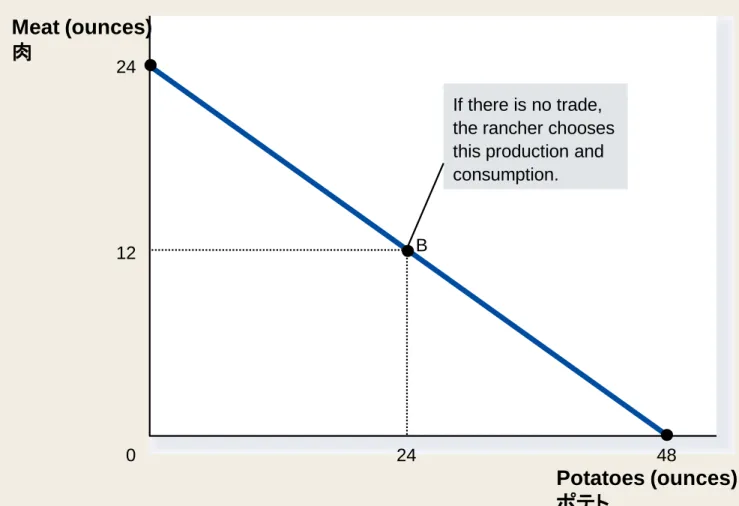
Potatoes (ounces) ポテト 12 24 B 0 Meat (ounces) 肉
(b) The Rancher ’s Production Possibilities Frontier
48 24
If there is no trade, the rancher chooses this production and consumption.
© 2007 Thomson South-Western
Production and Consumption Without Trade
© 2007 Thomson South-Western
The farmer should produce
potatoes.The rancher should produce
meat.
Specialization and Trade
生産の特化と交易
• Suppose instead the farmer and the rancher
decide to specialize and trade…
農夫と牛飼は生産の特化、貿易をしたいと仮
定したら
• Both would be better off if they specialize in producing the product they are more suited to produce, and then trade with each other.
各自に自分の得意の生産に特化し、お互いに交 易を行う場合は、両方とも生活が向上させる。
© 2007 Thomson South-Western
Figure 2 How Trade Expands the Set of Consumption
Opportunities 貿易はどのように消費の機会を拡大するか
Copyright©2003 Southwestern/Thomson Learning
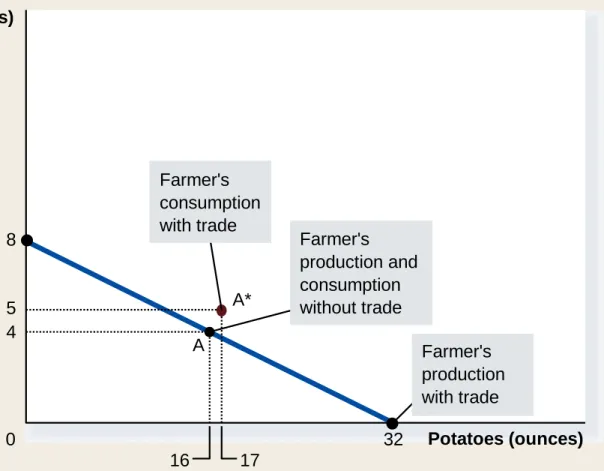
Potatoes (ounces) 4 16 5 17 8 32 A A* 0 Meat (ounces)
(a) The Farmers Production and Consumption 農夫の場合は’
Farmer's production and consumption without trade Farmer's consumption with trade Farmer's production with trade
© 2007 Thomson South-Western
Figure 2 How Trade Expands the Set of Consumption
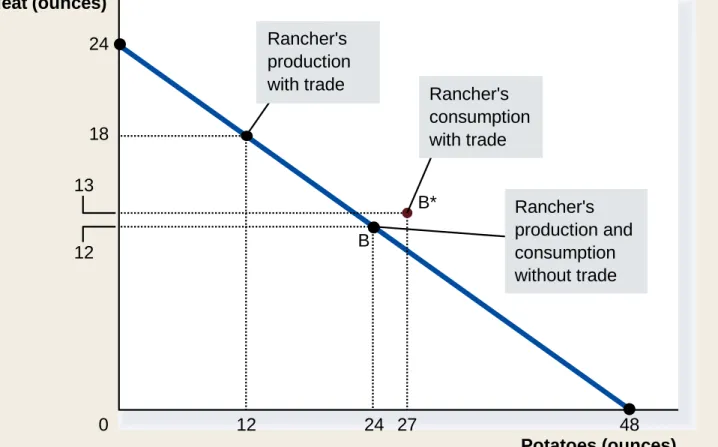
Opportunities 貿易はどのように消費の機会を拡大するか Copyright © 2004 South-Western Potatoes (ounces) 12 24 13 27 B 0 Meat (ounces) (b) The Rancher ’
s Production and Consumption
牛飼の場合は 48 24 12 18 B* Rancher's consumption with trade Rancher's production with trade Rancher's production and consumption without trade
© 2007 Thomson South-Western
COMPARATIVE ADVANTAGE
比較優位
• Differences in the costs of production
determine the following:
生産費用の差は以下のことを決める
– Who should produce what? 誰が何を生産すべきか
– How much should be traded for each product? どのくらい製品を交易すべきか。
© 2007 Thomson South-Western
COMPARATIVE ADVANTAGE
比較優位
• Two ways to measure differences in costs of production:
生産費用の差の測り方法は二つある。
– The number of hours required to produce a unit of output (for example, one pound of potatoes).
1単位当たり製品を生産するために必要な時間。 – The opportunity cost of sacrificing one good for
another.
1つの製品を生産するためにやめた別の製品の 機会費用。
© 2007 Thomson South-Western
Absolute Advantage 絶対利益
• The comparison among producers of a good according to their productivity.
生産者らは生産性に基づいて比較する
• Describes the productivity of one person, firm, or nation compared to that of another.
1人の個人、一つの会社、一つの国とほかの人、会社、国 の生産性を比較する
• The producer that requires a smaller quantity of inputs to produce a good is said to have an absolute advantage in producing that good.
あるモノの生産過程において、少ない量の投入をした場合 は、「絶対優位」という。
© 2007 Thomson South-Western
The Rancher has an absolute advantage in
the production of both meat and potatoes.
Absolute Advantage 絶対優位
• The Rancher needs only 10 minutes to produce an ounce of potatoes, whereas the Farmer needs 15 minutes.
例えば、1オンスのポテトを生産すると、牛飼は10 分間かかるが、農夫は15分間かかる。
• The Rancher needs only 20 minutes to produce an ounce of meat, whereas the Farmer needs 60 minutes.
また、オンスの肉を生産と、牛飼は20分間、農夫は 60分間かかる。
© 2007 Thomson South-Western
Opportunity Cost and Comparative
Advantage 比較費用と比較優位
• Compares producers of a good according to their opportunity cost, that is, what must be given up to obtain some item
1つのモノの生産者を比較するというのはその製品の機会費 用、つまりほかのモノを放棄することに基づく。
• The producer who has the smaller opportunity cost of producing a good is said to have a comparative advantage in producing
that good.
比較的機会費用の少ない生産者は「比較優位」をもつという。 Who has the comparative advantage in the production of each good?
しかし、誰が製品の生産に比較優位をもつか。
© 2007 Thomson South-Western
Comparative Advantage and Trade
比較優位と貿易
• Potato costs…ポテトの費用
• The Rancher’s opportunity cost of an ounce of potatoes is ½ an ounce of meat. 牛飼は1オンスのポテトを生産する機会 費用が½オンスの肉である。
• The Farmer’s opportunity cost of an ounce of potatoes is ¼ an ounce of meat. 農夫は1オンスのポテトを生産する機会 費用は¼オンスの肉である。
• Meat costs…肉の費用は
• The Rancher’s opportunity cost of an ounce of meat is 2
ounces of potatoes.牛飼は1ポンドの肉を生産する機会費用 が2オンスのポテトである。
• The Farmer’s opportunity cost of an ounce of meat is 4
ounces of potatoes... 農夫の1オンス肉の機会費用は4オ ンスのポテトである。
© 2007 Thomson South-Western
Comparative Advantage and Trade
比較優位と貿易
…so, the Rancher has a comparative advantage in the production of meat but the Farmer has a
comparative advantage in the production of potatoes.
そして、
牛飼は肉の生産に、 農夫はポテトの生産に
© 2007 Thomson South-Western
Comparative Advantage and Trade
比較優位と貿易
• Comparative advantage and differences in opportunity costs are the basis for specialized production and trade.
比較優位と機会費用の差は特化した生産と貿易の 元である。
• Whenever potential trading parties have differences in opportunity costs, they can each benefit from trade.
潜在的な交易のパトナーは機会費用に差があった らお互いに貿易を通して利益が得られる。
© 2007 Thomson South-Western
© 2007 Thomson South-Western
Comparative Advantage and Trade
比較優位と貿易
• Benefits of Trade
貿易の利益
• Trade can benefit everyone in a society because it allows people to specialize in activities in which they have a comparative advantage.
• 社会において各個人は優位のある分野に特化して いるので交易は皆に利益を与える。
© 2007 Thomson South-Western
The Legacy of Adam Smith and David Ricardo
アダム・スミスとデービット・リカードの遺産 • Adam Smith アダム・スミス
• In his 1776 book An Inquiry into the Nature and Causes of the Wealth of
Nations, Adam Smith performed a detailed analysis of trade and
economic interdependence, which economists still adhere to today.
• 1776年、アダム・スミスは貿易と経済の相互依存性を分析している本、 『国富論』を出版した。有名な例は時計づくり、農夫と牛飼の寓話であ る。この本に書かれた理論は今でも有効である。スミスは主に自由経 済、自由貿易、小さい政府などの市場原理主義を出張している。
• David Ricardo デービット・リカード
• In his 1816 book Principles of Political Economy and Taxation, David Ricardo developed the principle of comparative advantage as we know it today. 1816年、デービット・リカードは比較優位を中心とした経済と貿 易理論の本『政治経済学および課税の原理』を出版した。有名な例は 自由貿易と保護貿易の政策論争である。
© 2007 Thomson South-Western
APPLICATIONS OF COMPARATIVE ADVANTAGE
比較優位理論の応用
• ロビンソン・クルーソはココナッツを友たちのフライテーさ んに魚を交易すべきか。
• Should Tiger Woods Mow His Own Lawn? • タイガーウッズは庭の芝刈りをすべきか。 • 日本は食料の自給率を向上すべきか。
?
?
?
© 2007 Thomson South-Western
APPLICATIONS OF COMPARATIVE ADVANTAGE
比較優位理論の応用
Should the United States trade with other countries? アメリカはほかの国と貿易をすべきか。
補足:(1)NAFTA設立の裏側 (2)レオンティフの謎;
• Each country has many citizens with different interests.
International trade can make some individuals worse off, even as it makes the country as a whole better off.
• どの国でも多様な利益を持つ国民がいる。自給自足はその 国にとって良いかもしれないが、国民の生活は悪化させる。
補足:鎖国時代の日本、1980年以前の中国、今の北朝鮮
– Imports—goods produced abroad and sold domestically
Summary
© 2007 Thomson South-Western
• Each person consumes goods and services produced by many other people both in our country and around the world.
人々は自国、あるいは他の国の人々が生産したモノ とサービスを消費している。
• Interdependence and trade are desirable because they allow everyone to enjoy a greater quantity and variety of goods and services.
相互依存と交易が求められるのは貿易は国民に大 量・多様なモノとサービスを提供できるはずだ。
Summary
© 2007 Thomson South-Western
• There are two ways to compare the ability of
two people producing a good.
• 1つの製品を生産する2人の能力を比較する
方法は二つある。
– The person who can produce a good with a smaller quantity of inputs has an absolute advantage.
絶対優位:少ない投入でモノづくりをすること。
– The person with a smaller opportunity cost has a comparative advantage.
Summary
© 2007 Thomson South-Western
• The gains from trade are based on comparative advantage, not absolute advantage.
しかし、貿易の利益は絶対優位ではなく、比較優位に基づく。
• Trade makes everyone better off because it allows people to specialize in those activities in which they have a comparative advantage.
• 貿易は誰にも利益を与える理由は人々を比較優位を持つ生 産活動に特化しているのだ。
質問:国際貿易は誰にも利益を与えるのか。
• The principle of comparative advantage applies to countries as well as people.
比較優位の理論は国の経済分析にはもちろん、人々にも 適用できる。
Summary
© 2007 Thomson South-Western 31補足:要素賦存の理論
生産要素賦存の理論(ヘクシャー=オリ‐ン・モデル) 1 生産要素の賦存 ①物的基準:資本-労働比率 ②価格基準: (労働)賃金-(資本)利子比率 2 生産要素の集約度 ①労働集約 ②資本集約 3 生産要素の賦存による国際貿易のパターン ①生産要素の賦存による国際分業 例:農業・水産業、インドネシア:天然ガス、熱帯の気候によ るゴム業。日本:資本・技術集約。 • 生産要素の賦存による国際貿易(日本とタイ:機械・電 気製品と農水産物)Summary
© 2007 Thomson South-Western 32補足:レオンティフの謎
•
普通の貿易パターン
•
アメリカ貿易の謎(労働集約製品
の輸出が中心する、およびその解
説)
•
中国の謎
Summary
© 2007 Thomson South-Western
補足:貿易政策:自由貿易 -
余剰分析Summary
© 2007 Thomson South-Western補足:貿易政策:自由貿易
34 自由貿易の 場合は、消 費者余剰が 増える一方、 生産者の利 益が減少し ていく。Summary
© 2007 Thomson South-Western補足:貿易政策:保護貿易
35 生産者の利 益を守るた め、保護貿 易政策を とってしま う。 しかし、両 国とも保護 貿易の政策 をとる場合 は、不利益 になる。Summary
© 2007 Thomson South-Western 36補足:貿易政策 -管理貿易
• 国際貿易は経済成長のエンジン
• 由貿易と保護貿易の是非
• 管理貿易論とは
• 輸出志向の政策
• 輸入代替
• 輸出代替
• 輸出志向
Summary
© 2007 Thomson South-Western
37
補足:製品のライフサイクル理論
製品の生命循環理論
Vernon: Product life-cycle theory
Maturing product Ⅱ 成長期 Standardized production Ⅲ 成熟期 New product Ⅰ 開発期 Oversea Transfer Ⅳ 海外移転期