Tech Bull Fac Agr Kagawa Univ, Vol 45, No 1, 31-40, 1993
GROWTH INHIBITION OF OBLIGATELY
OLIGOTROPHIC SOIL BACTERIA
BY CARBOHYDRATES, AMINO ACIDS AND VITAMINS
Masayuki SATO, Yusuke UENO, Yutaka SAWAMURA, Kazuko KAJIKAWA, Yoshio KIMURA, Kazuhira YOKOYAMA and Ken IZUMORI
Obligately oligotrophic bacteria, 50 organisms, were isolated from soil The sensi- tivity of them to D-glucose concentrations was classified in four types A, B, C and D An oligotroph, K-27, classified in type A grew well a t no addition of D-glucose to basal medium and was sensitive even to 0 01% D-glucose, and its growth was inhibited by various mono-carbohydrates a t 0 1% Oligotrophs classified in type C were presumed to be osmosensitive, and one of them, Y-28, was sensitive specifically to unnatural sugars, L-galactose and D-psicose The addition of amino acids mixture or a single addition of amino acid and vitamin in a basal medium inhibited the growth of some oligotrophs From these results it was discussed that there were different inhibition mechanisms by D-glucose concentrations, carbohydrates, amino acids and vitamins in these oligotrophs
Key words; oligotrophs, soil bacteria, growth inhibition, glucose sensitivity, un- natural sugars
Introduction
In a subcommittee meeting of the Japanese Society of Microbial Ecology, 1980, oligotrophs were defined as heterotrophic microorganisms which grew in a medium containing 1 mg organic carbon per liter") Oligotrophs have been isolated widely from soil, marine and other oligotrophic water environments Moreover, oligotrophs unable to grow on nutrient rich media such as NB medium(2) containing 1 % yeast extract, 1 % meat extract and 0 5% NaCl or L T medium") containing 0 5 % trypticase were conveniently defined as obligate oligotrophs (1) Hattori and Hattori reported that the growth of soil DNB bacteria which were unable to grow on NB medium and might include oligotrophs was inhibited by inorganic salts, some amino acids, vitamins and organic acidJ3) Inhibitory effects of amino acids and organic acids on the growth of a few marine oligotrophs have been studied(4 5, But little has been known concerning organic substrates which inhibited the growth of obligately oligotrophic soil bacte- ria in nutrient rich media Especially there was no report on inhibitory effects of carbo- hydrates We presumed that important characters of obligate oligotrophs were their specific sensitivity to certain organic nutrients as well as their capability of utilizing very dilute nutrients
Then in the present study we randomly isolated many obligately oligotrophic bacteria from soil and examined for their growth inhibition by various organic substrates such a s D-glucose, other mono-carbohydrates including unnatural sugars, amino acids and vitamins a t variable concentrations And the results in this study will be expected to be a start of further investiga- tions in the growth inhibition mechanisms of obligate oligotrophs
Tech Bull Fac Agr Kagawa Univ, Vol 45, No 1, 1993
In this report a term, "obligately oligotrophic bacteria" is often abbreviated t o "obligate oligotrophs" or "oligotrophs "
Materials and Methods
Organisms. Fifty organisms isolated from soil were mainly used in this study In some cases, Escherzchza colz I F 0 3544 and Baczllus subtzlzs I F 0 13719 were used as standards of eutrophic bacteria
Media and cultivation. Nutrient broth (NB) medium contained 10 g each of polypeptone and meat extract and 5 g of NaCl in one liter of deionized water and was adjusted t o pH 7 0 Diluted nutrient broth (DNB) contained the same composition but a t the strength of 1/102 or 1/
l o 4 Organic carbon content in NB/104 medium was calculated to be less than 1 ppm on the basis of analysis data(6' of polypeptone and meat extract Agar noble was used t o solidify the medium for plate and stab cultures a t 1 5% and 0 4 %, respectively Diluted nutrient broth (NB/102) medium was used a s a basal medium for the growth experiments supplemented with mono-carbohydrates to ensure bacterial growth in control (not supplemented) cultures, where- as a synthetic medium was chosen for the evaluation of inhibitory effect of amino acids, vitamins and nucleic acid bases to control the content of these nutrients Table I shows the composition of the synthetic medium, which is a modification of the basal medium used by Ishida et 0 1 ' ~ ) Deionized and distilled water was used for preparation of the media Carbo- hydrates, amino acids, vitamins and nucleic acid bases were sterilized with filter and neutral- ized before filtration when necessary
In the growth experiments the seed cultures were grown in NB/102 medium for 4--7 days a t 27 "C Each 10 and 100 pl of the seeds was inoculated in 5 and 50 ml of the main culture
Table I Composition of Synthetic Medium
D-Glucose 100 mg Na2HP04"12Hz0 200 mg
KHzPO4 20 mg MgS04 7Hz0 5 mg
(NH4)zSOd 100 mg
Trace salt elements mixture"' 0 1 m l Amino acids m i x t ~ r e ' ~ ' 1 Om1
Vitamins m i ~ t u r e ' ~ ' 1 Om1
Purine and pyrimidine bases m i ~ t u r e ' ~ ' 1 Om1
Deionized and distilled water 1,000ml p H 7 0 (1) The mixture contains NaCl 500 mg, KC1 380 mg, CaCIZ-2H,O 900 mg, MgS04.7Hz0 100 mg, KzHPO, 100 mg, MnClZ-4Hz0 40 mg, ZnC1, 40 mg, CuC12.2H20 l mg, CoClZ-6H20 0 5 mg, FeC13.6H,0 2 mg and In-HzS04 1 ml per liter
(2) T h e mixture contains each 1000 mg of 17 amino acids, 100 mg of cystine and 400 mg of tyrosine per liter
(3) T h e m i x t u r e contains thiamine hydrochloride 96 p g , nicotineamide 2 7mg, riboflavin 9 mg, pyridoxine hydrochloride 2 mg, pantothenic acid 2 2 mg, biotin 6 pg, p-aminobenzoic acid 1 7 mg, inositol 20 mg and cyanocobalamin 30 8 mg per liter
(4) T h e mixture contains each 100 mg of adenine, guanine, xanthine, uracil, thymine and 4-amino-2-hydroxy-pyrimidine per liter
M SAIO et a1 : Growth Inhibition of Obligate Oligotrophs
media, respectively, and incubated statically for 10-15 days a t 27 "C
Isolation and screening. Soil samples were obtained from farms, banks and gardens in Kagawa, Okayama and Tokusima prefectures The soil samples, each 0 5 g, were shaken in 10 ml of sterilized water and filtered with Toyo filter paper No 2 After suitable dilution, each 0 2 ml of the filtrates was spreaded onto plates of NB/102 and incubated a t 27 "C Bacterial colonies developing after 5 days incubation up to 12 days were isolated into the NB/102 stab culture media and incubated at 27 "C The isolates grown in the stab cultures were inoculated in NB, NB/102 and NB/104 media in double or triplicate The organisms which could grow in NB/102 and NB/104 but not in NB a t least up to 7 days were selected as obligate oligotrophs All isolates were confirmed to be bacteria by microscopic observations
Assay methods. The degree of cell growth was measured by the increase in absorbancy a t 600 nm of the culture fluid with light length of 5 cm Viable cell numbers were measured by colony count method on NB/102 plate Reducing sugar content in culture fluid was determined as D-glucose by the Nelson-Somogyi method")
Chemicals. D-Tagatose and D-psicose were synthesized from galactitol by microbial transformation reactions (9'10) Other carbohydrates were purchased from Sigma Chemical
Company Agar noble and yeast extract were purchased from Difco Laboratories All other chemicals were obtained from Wako Pure Chemical Industry, Japan and were reagent grade
Results
Isolation of obligate oligotrophs.
Four hundreds and seven colonies were isolated from 32 soil samples Fifty isolates of them were selected as obligately oligotrophic bacteria because these organisms showed increase of viable cell number a t 10-100 times during 10-20 days in NB/104 but no turbidity in NB Their taxonomic properties have not been tested yet
Effect of D-glucose concentration on growth of obligate oligotrophs.
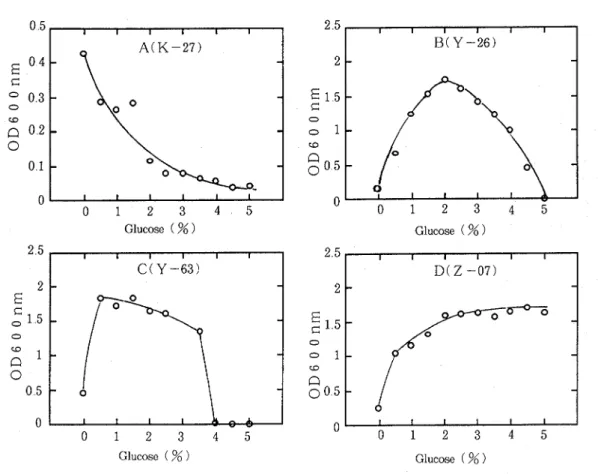
The fifty oligotrophs were grown in NB/102 medium containing 0-5% D-glucose for 10 days The patterns of growth dependence of the organisms on D-glucose concentration were classified in the four types, A, B, C and D The typical four patterns are shown in Fig 1 Two organisms, K-27 and T-17, classified in type A showed the maximum growth without D -glucose and their growth decreased with increase of D-glucose concentration The 13 organ- isms classified in type B showed the maximum growth a t 1-3 % D-glucose In 21 organisms classified in type C, their growth decreased markedly a t 1-5 % D-glucose The growth of 10 organisms classified in type D did not decrease with D-glucose concentration up to 5 % The growth of the remaining four organisms was stimulated by the addition of D-glucose but the relationship between the growth degree and the D-glucose concentrations was not clear
Growth inhibition of K-27 and V-50 by D-glucose.
Inhibitory effect of lower D-glucose concentrations on the growth of K-27 was tested and shown in Fig 2 The growth was maximum a t no addition of D-glucose and inhibited even by the addition of 0 01 % D-glucose Since the reducing sugar content in the basal medium (NB/
lo2) was estimated to be about 10 mg/l as D-glucose, at least ten times higher concentration of D-glucose (or reducing sugar) affected its growth The residual sugar amount in the every culture fluid after the incubation for 18 days little decreased except for in the 0 01 % D-glucose
Tech Bull Fac Agr Kagawa Univ, Vol 45, No 1, 1993
Glucose ( % ) Glucose ( % )
Glucose ( % Glucose ( % )
Fig 1 Growth Dependence of Obligate Oligotrophs on D-Glucose Concentration The organisms were grown in NB/1OZ containing D-glucose a t various concentrations for 10 days
0 3 0 6 0 5 E 0 2 C 0 E C 0 4 0 0 3
;
0 1 wo
a
0 2 0 0 1 0 0Fig 2 Growth Inhibition of K-27 by D-Glu- O 0 0 0 5 0 1 0 1 5 0 2 0 2 5 cose D-Glucose was added in NB/ o-Glucose and sucrose (M) loz a t concentrations of zero(O), 0 Fig 3 Effect of D-Glucose and Sucrose ol(.), 0 02
(o),
0 05(+), 0 1 ( 0 ) , 0 Concentrations on the Growth of V 5 ( W , 1 O(A) and 2 O W % -50 The organism was grown in NB/lOZ containing D - ~ ~ u c o s ~ ( O ) or sucrose(.) for 10 daysM SAIO et a1 : Growth Inhibition of Obligate Oligotrophs
culture where the concentration of reducing sugar declined to about 80 % of the initial As shown in Fig 3, the organism, V-50, classified in type C showed the maximum growth a t the addition of 0 056 M (1 %) D-glucose and the remarkable decrease of growth a t the addition of more than 0 11 M (2 %) The growth was strongly inhibited also by the addition of a similar molar concentration of sucrose
Effect of mono-carbohydrates on growth of obligate oligotrophs.
Eleven oligotrophs were chosen from each type of D-glucose sensitivity and grown in NB/ l o 2 supplemented with 0 1 % a single mono-carbohydrate for 10 days The similar growth experiments were also carried out on E colz The degree of cell growth is shown in Table I1 Many organisms grew well in media containing D-glucose, D-mannose, D-galactose, L
-arabinose, D-xylose and D-fructose. Polyoles a little stimulated the growth of some oligotrophs All carbohydrates tested merely stimulated the growth of K-27 and in many cases various carbohydrates including some unnatural sugars inhibited its growth The other oligotroph, T-17, classified in type A also showed a similar wide spectrum of carbohydrate sensitivity And for the growth of V-50, only D-glucose of carbohydrates tested was a better substrate than the others at 0 1
%
L-Galactose, an unnatural sugar, stimulated the growth of some oligotrophs, but the other unnatural sugars were not good substrates for the growth ofTable I1 Effect of Mono-Carbohydrates on the Growth of Obligate Oligotrophs Carbohydrates Relative growth*' of oligotrophs and E colz
(0 1%) K27 K25 V 2 7 V50 Y26 Y 2 8 Y 3 1 Y 6 3 Y66 Y96 2 0 7 E colz
None 100 100 100 100 100 100 100 100 100 100 100 100 D-Glucose 28 150 120 190 300 300 400 340 120 230 510 200 D-Galactose 20 170 150 100 260 340 490 350 220 300 490 380 L - Galactose* 2 190 160 110 270 1 3 370 240 140 250 380 120 D-Mannose 2 110 140 110 240 420 390 220 130 260 670 220 D-Arabznose 110 340 110 110 110 130 110 90 120 120 120 210 L-Arabinose 130 110 170 100 280 350 440 360 160 370 620 220 D-Xylose 110 170 170 120 390 400 410 200 100 240 530 220 D-Ribose 96 80 150 110 100 120 100 100 180 120 130 250 D- L.pose 7 170 140 100 140 140 160 95 150 120 150 130 D-Sorbitol 47 120 110 98 110 120 110 100 210 100 120 290 D-Mannitol 5 1 100 110 110 110 110 100 100 110 100 120 220 Galactitol 16 140 110 110 110 110 100 100 66 100 120 130 D-Ar abitol 1 23 130 98 110 120 110 110 170 100 120 97 L - Arabztol 8 120 120 110 110 120 110 85 100 110 130 130 Xylztol 54 120 130 110 100 120 110 110 76 110 110 100 Ribitol 79 160 120 99 110 100 410 110 57 99 120 120 D-Fr uctose 25 130 120 100 190 230 340 150 230 150 550 190 D-Sorbose 1 100 110 100 100 120 100 100 73 110 120 120 L -Sorbose 27 130 110 100 96 110 100 100 80 100 100 70 D- Tagatose 92 150 110 100 100 120 100 100 92 110 130 110 L - Tagatose 76 150 110 100 110 110 100 10 79 110 120 110 D - Pszcose 1 110 130 110 110 3 110 180 81 110 140 120
* T h e carbohydrates italicized are unnatural or rare sugars
** The organisms were grown in NB/102 media supplemented with 0 1% a single mono- carbohydrate for 10 days
Tech Bull Fac Agr Kagawa Univ, Vol 45, No 1, 1993
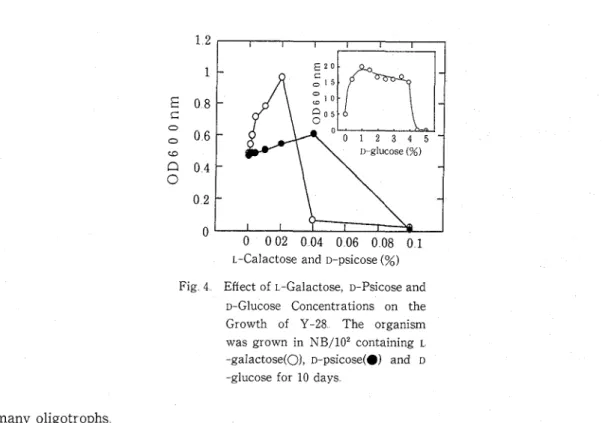
Fig 4 Effect of L-Galactose, D-Psicose and D-Glucose Concentrations on the Growth of Y-28 The organism was grown in NB/102 containing L -galactose(O), D-psicose(0) and D
-glucose for 10 days many oligotr ophs
Bacterial strain, Y-28, classified in type C is an interesting organism a t the viewpoint of response to mono-carbohydrates This isolate grew well in the presence of D-glucose, D -galactose, D-mannose, L-arabinose, D-xylose and D-fructose while it was markedly sensitive to specific unnatural sugars, L-galactose and D-psicose A similar was true for the strain Y-63 whose growth was specifically inhibited by L-tagatose Response of these organisms to unnatural sugars somewhat differs from that of K-27 whose spectrum of sensitivity to mono -carbohydrates was not specific Effect of concentrations of these unnatural sugars and D
-glucose on the growth of Y-28 is shown in Fig 4 The growth was strongly inhibited by the addition of 0 04 % L-galactose or 0 1 % D-psicose Based on a molar concentration, these unnatural sugars were 45 to 113 times more inhibitory to the growth of Y-28 than D-glucose
Effect of amino acids mixture on growth of obligate oligotrophs.
Fifty obligate oligotrophs were grown for 10 days in the synthetic medium supplemented with an amino acids mixture which contained each 100 mg/l (100 times stronger than the control) of 17 amino acids, 50 mg/l (125 times stronger) of tyrosine and 10 mg/l (100 times stronger) of cystine But cysteine was not contained in the mixture because it inhibited the growth of various bacteria strains including oligotr ophs and eutr ophs as described subsequent- ly E colz and B subtzlzs were also grown in the same medium for comparison By the
supplement of amino acids mixture, the growth was stimulated remarkably (more than 200 %
as compared with the control without the supplement) for 16 oligotrophs and E coh, moderate-
ly (120-200 %) for 19 oligotrophs and B subtzlzs On the other hand, the growth was inhibited
strongly (less than 50 %) by the supplement for 11 oligotrophs and moderately (50-80 %) for 2 oligotrophs In the residual two the relative growth was 80-120 % of the control
Growth inhibition of obligate oligotrophs by a single amino acid.
M S A ~ O et a1 : Growth Inhibition of Obligate Oligotrophs 37
Q E z p , m g?h?ze--m d h s h h a :
$ & < +rf
d & C 3
- 2
$ & z ? G G $ g $ 2
Amino acid
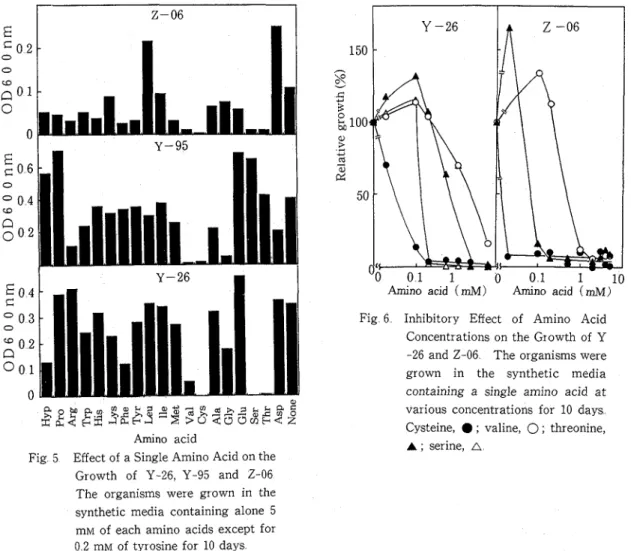
Fig 5 Effect of a Single Amino Acid on the
Amino acid (mM) Amino acid (mM) Fig 6 Inhibitory Effect of Amino Acid
Concentrations on the Growth of Y -26 and 2-06 The organisms were grown in the synthetic media containing a single amino acid at various concentrations for 10 days Cysteine, ; valine, 0 ; threonine, A ; serine, A
Growth of Y-26, Y-95 and Z-06 The organisms were grown in the synthetic media containing alone 5
mM of each amino acids except for 0 2 mM of tyrosine for 10 days
amino acids mixture were examined for their sensitivity to a single amino acid The synthetic medium was used to be supplemented with 5 mM of a single amino acid except for 0 2 mM of tyrosine Figure 5 shows the effect of a single amino acid on the growth of Y-26, Y-95 and 2 -06 The oligotrophs, Y-26 and Y-95 were specially sensitive to only 4 or 5 amino acids while 2-06 was sensitive to more amino acids Cysteine and valine inhibited strongly the growth of three organisms Serine and threonine were inhibitory for Y-26 and 2-06, glycine and arginine for Y-95 and 2-06 The growth of two eutrophs, E colz and B subtilzs was inhibited only by
cysteine
Figure 6 shows the inhibitory effect of concentrations of some amino acids on the growth of Y-26 and 2-06 Both oligotrophs were most sensitive to cysteine and their growth was inhibited by 0 02 mM of cysteine Serine of 0 2 mM and threonine of 0 1 mM inhibited strongly the growth of Y-26 and 2-06, respectively The growth inhibition by valine was observed a t concentrations of more than 1 0 mM
Effects of vitamins, purine and pyrimidine bases on growth of obligate oligotrophs. No growth inhibition of oligotrophs, E colz and B subtilzs was observed by the supplement
of nine vitamins mixture or nucleic acid bases mixture a t 100 times of the concentration in Table I Three organisms, K-27, K-013 and K-034 were examined for the growth inhibition
Tech Bull Fac Agr Kagawa Univ, Vol 45, No 1, 1993
Table 111 Effect of Vitamins on the Growth of K-27, K-013 and K-034 Concentr a t ~ o n Relative growth* of oligotr ophs Vitamins (mg/l) K-27 K-013 K-034 None 0 100 100 Thiamine hydrochloride 0 0096 140 110 Nicotineam~de 0 27 120 53 Riboflavin 0 9 180 140 26 Pyridoxine hydrochloride 0 2 220 2 59 Pantoteinic acid 0 22 70 130 28 Biotin 0 0006 290 140 70 p-Aminobenzoic acid 0 17 60 110 41 Inositol 2 0 20 130 27 Cyanocobalamin 3 0 30 140 93 All vitamins 6 7702 4800 120 130
" The oligotrophs were grown in the synthetic m e d ~ a supplemented with a single vitamin for 10 days
by a single supplement of nine vitamins The growth of K-27 was most stimulated by the supplement of vitamins mixture and the growth of the latters was least stimulated Table I11 shows the effect of a single vitamin on the growth of three organisms Nicotineamide, riboflavin, pyridoxine hydrochloride, pantoteinic acid, p-aminobenzoic acid, inositol and cyanocobalamin showed the inhibitory effect on the growth
Discussion
It has been generally thought that D-glucose is a good carbon source for the growth of most microorganisms Ohta and ~ a t t o r i ' ' ' discussed that D-glucose was one of the most important carbon source for DNB bacteria But the growth of a considerable number of obligately oligotrophic bacteria isolated in this study was inhibited by D-glucose of a certain concentration as shown in Fig 1 Among them, organisms classified in type C may be osmosensitive to a certain concentration of sugars rather than sensitive to D-glucose itself, since the strong growth inhibition in V-50 belonging to type C appeared a t a similar molar concentration of D
-glucose and sucrose (Fig 3)
The inhibition mechanisms in K-27 classified in type A are presumed to be different from those in oligotrophs in type C It is interest what mechanisms of the strong growth inhibition by D-glucose are in K-27 cells, whose growth was inhibited even by 0 01% D-glucose (Fig 2) The growth inhibition by D-glucose has been rarely reported in bacteria except for in anaerobes such a s Clostmdzum (12s13) and ~ a c t e r o z d e s ~ ~ The strain K-27 was more sensitive (100 times or more) to the concentration of D-glucose than the anaerobes and showed very wide spectrum of growth inhibition by mono-carbohydrates (Table 11) We now attempt to elucidate the inhibi- tion mechanisms by D-glucose in K-27
The effect of unnatural sugars on growth of microorganisms has been little tested because these sugars are available with difficulty, especially D-tagatose and D-psicose are so As we expected, many unnatural sugars were little effective to enhance the growth of many oligotrophs tested (Table 11) Besides K-27 which was sensitive to various unnatural sugars,
M SATO et a1 : Growth Inhibition of Obligate Oligotrophs 39
0 04% L-galactose and 0 1% D-psicose specifically inhibited the growth of Y-28 (Fig 4) which belonged to type C concerning to sensitivity to D-glucose Therefore, it is suggested that the inhibition mechanism by unnatural sugars is different from that by D-glucose in Y-28 cells In contrast, L -galactose, unlike other unnatur a1 sugars, stimulated the growth of some oligotrophs (Table 11) No report has been found on the metabolism of L-galactose by microorganisms We expect that these results in oligotrophs will be compared with those in many eutrophs other than E colz
One of the reasons for which obligate oligotrophs cannot grow in NB medium is expected to be in the growth inhibition by high concentrations of certain amino acids contained in the medium Hattori and ~ a t t o r i ( ~ ) s h o w e d that some amino acids of 10 mM inhibited the growth of soil DNB bacteria Akagi et Martin and ~ a c l e o d ' ~ ) reported that the growth of marine oligotrophs was inhibited by alanine or phenylalanine of 1000 mg carbon per liter We showed that the growth of the obligate oligortophs isolated in this study was inhibited by a single addition of some amino acids a t lower concentrations than those described above (Fig 6) Thus growth inhibition of bacteria by amino acids a t similar concentrations to our study was observed in Escherzchza colz (15316), Thzobaczllus neapolztanus (In and Agmenellum quadru-
plicatumu8) When cysteine was oxidized by ~xygen''~) or heated a t pH 6@'), it was reported that the antibacterial compounds were formed from cysteine In this study it was not examined whether such compounds were formed
It is a well known phenomenon that growth of some bacteria is inhibited by unbalanced concentrations of certain natural L-amino acids(2U Thus growth inhibition is often recovered by other amino acids, for example, in E c01z'~~) and A quadruplzcaturnu8' And in DNB bacteria it was reported that their serine-sensitivity was recovered by coexisting with threonine or a mixture of leucine and ~ a l i n e ' ~ ) In our obligate oligotrophs thus recovery by other amino acids has not been observed yet The growth of three oligotrophs tested was strongly inhibited not only by a single amino acid a t very low concentrations but by amino acids mixture (Fig 6) Therefore, it is suggested that growth inhibition of some oligotrophs results from balanced amino acids through unknown mechanisms as well as from unbalanced composition of amino acids In contrast, excess vitamins when these were supplemented solely showed an inhibition similar to the effect by unbalanced composition (Table 111)
Unfortunately, the relationship between sensitivity to the organic compounds tested and a physiological importance of such sensitivity was not clear But we suggested that there were different types in the growth inhibition of obligately oligotrophic soil bacteria by D-glucose concentrations, other mono-carbohydrates, amino acids and vitamins In further studies the characteristic inhibition mechanisms will be investigated in certain oligotrophs
Oligotrophs were reported not only to be predominant in oligotrophic conditions such a s in open ocean"), in periphyton a t an oligotrophic r i ~ e r ( ' ~ ) a n d in NB/104 mediumQ5) but to coexist widely in general soil and even in fertile soilUU together with eutrophs Thus specific growth inhibition by certain organic nutrients is expected to be a strategy for survival which obligate oligotrophs obtained during the process of evolution
Acknowledgment
40 Tech Bull F a c Agr Kagawa Univ, Vol 45, No 1, 1993
Tohoku U n i v e r s i t y f o r h i s valuable discussions and e n c o u r a g e m e n t
References
(1) ISHIDA, Y , and KADOTA, H : M Z C Y O ~ Ecol, 7,
123-130 (1981)
(2) OHTA, H , and HATTORI T : Sot1 Scz Plant Nutr , 26, 99-107 (1980)
(3) HATTORI, R , and HATTORI, T : J Gen Appl Mz- crobzol, 26, 1-14 (1980)
(4) AKAGI, Y , SIMIDU, U , and TAGA, N : Can J
Mzcrobzol , 26, 800-806 (1980)
(5) MARTIN, P , and MACLEOD, R : Appl Envzron M Z C Y O ~ Z O ~ , 47, 1017-1022 (1984)
(6) Kyowa Hakko Tokyo Institute: Biseibutu Jik- ken Manual pp 266-267 Kodansya Scientific, Tokyo, (1986)
(7) ISHIDA, Y , IMAI, I , MIYAGAKI, T , and KADOTA, H : Mzcrob Ecol, 8, 23-32 (1982)
(8) NELSON, N : J Bzol Chem 153, 375-380 (1944)
(9) IZUMORI, K , MIYOSHI, T , TOKUDA, S , a n d YAMABE, K : Appl Envzron Mzcrobzol, 46, 1055
-1057 (1984)
(10) IZUMORI, K , YAMAKITA M , TSUMURA, T , and KOBAYASHI, H : J Fement Bzoeng, 70, 26-29
(1990)
(10 OHTA, H , and HATTORI, 'T : Sozl Bzol Bzochem ,
15, 1-8(1983)
(12) IMAIZUMI, M , and NISHIDA, S : Igaku to Sezbut- sugaku, 70, 41-45(1965)
(13) SCHRODER, D J , and B u s r ~ , F F : J Mzlk Food Technol, 37, 4-lO(1974)
(14) RUSSELL, J B : Appl Envzron Mzcrobzol, 58,
2040-2045(1992)
(15) COSLOY, S D , and MCFALL, E : J Bactenol, 103,
840-841, (1970)
(16) LEAVITT, R I , and UMBARGER, H E : J Bacter- 201, 83, 624-630(1962)
(17) JOHNSON, C L , and VISHNIAC, W : J Bacterzol,
104, 1145-1150(1970)
(18) INGRAM L 0 , and JENSEN, R A : Arch Mz- krobzol, 91, 221-233(1973)
(19) NYBERG, G K , GRANBERG, G P D , and CARLS. S O N , J : Appl Envzron Mzcrobzol, 38, 29
-34(1979)
(20) JONSSON, S , and RAA, J Food Scz , 45, 1641 -1644, 1648(1980)
(20 SHIVE, W , and SKINNER, C G : Metabolic In- hibitors In R M Hochster and J H Quastel (eds), vol 1 p 26 Academic Press, New York, (1963)
(22) RASKO, I , and ALFOLDI. L : EUY J Bzochem, 21,
424-427(1971)
(23) ISHIDA Y , EGUCHI, M , and K A D ~ ~ A , H : Mar Ecol Prog Ser, 30, 197-203(1986)
(24) MORIKAWA, K : Jpn J Lzmnol, 48, 67-70(1987)
(25) SUWA, Y , and H A T T O R I , T : Sozl SCZ Plant Nutr , 33, 235-244(1987)